THE PATRIOTS
I enjoyed (and appreciated) your Summer 2026 issue’s timely cover story about the enduring connections between northerners and southerners in the 1860s and the American Revolution [“The Patriots,” Vol. 16, No. 2]. I found each of the essays of interest, but two especially: Allen C. Guelzo’s on “The Last Men”—I had no idea that such an effort to track down surviving Revolutionary War vets had occurred during the Civil War—and Anne Sarah Rubin’s on “Southern Yankee Doodles.” It didn’t surprise me that Confederates looked to the Founding Fathers as a motivating force, but rather that they did so, as Rubin outlines, in so many different ways.
Patrick Anderson
Via email
* * *
Thanks to all of the historians who contributed essays to your Summer issue’s coverage of “The Patriots.” I’m primarily a Civil War enthusiast, and this was a good way of getting me to think more about the lasting significance of the country’s founding. It strikes me that Civil War-era Americans invoked the Revolution as much as we do today—and probably even more so. It is an informative article. Thanks again for it.
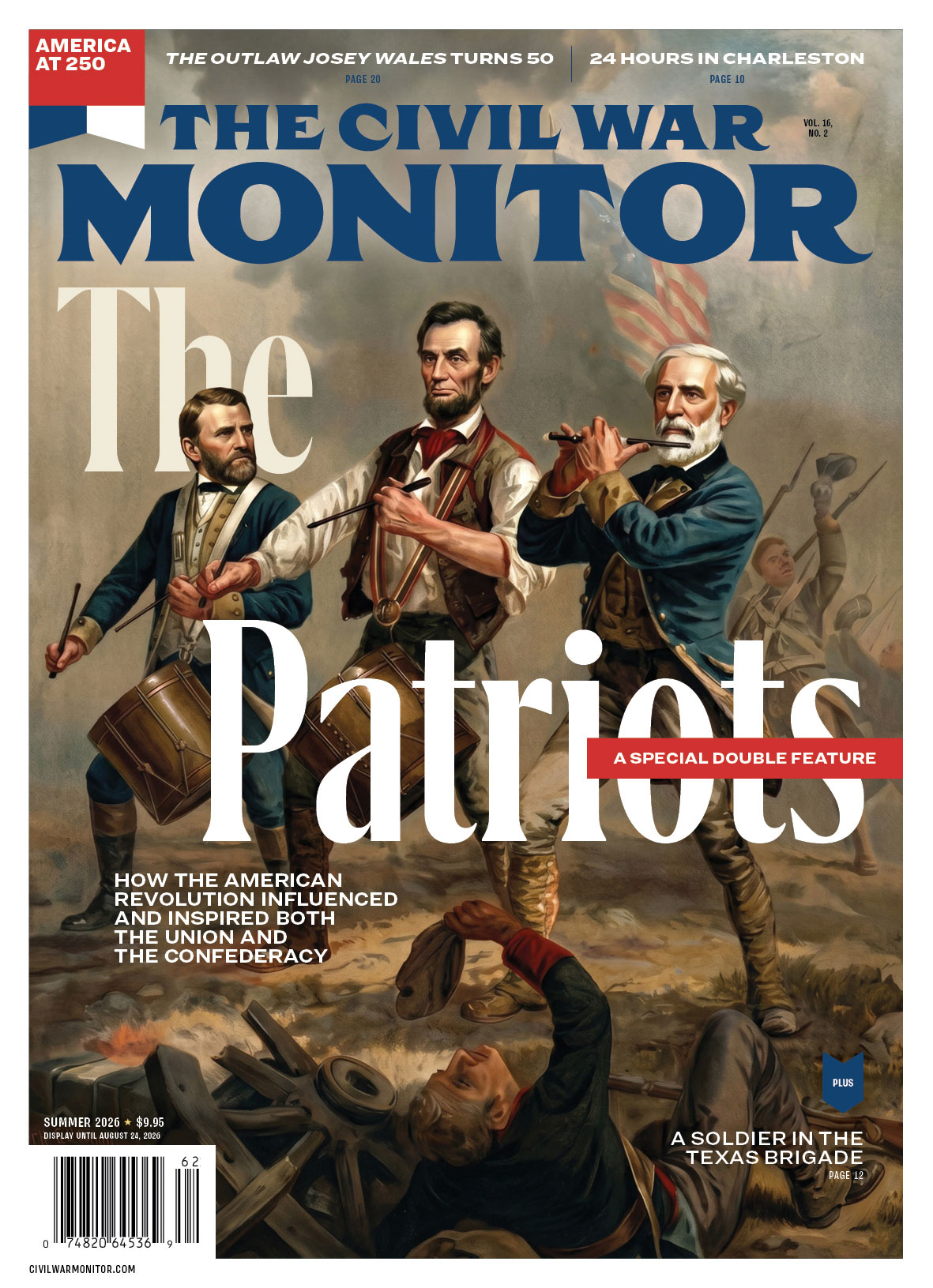
I also enjoyed the issue’s striking cover image, which made me chuckle. It might be my favorite in recent memory.
S.A. Schmidt
Via email
* * *
The cover of the most recent issue of The Civil War Monitor is both disturbing and disappointing. Abraham Lincoln and Ulysses S. Grant marching alongside Robert E. Lee … under the banner “The Patriots”? Lee was not a patriot to the United States of America—during the Civil War, he was not even an American citizen! Placing Lee on the same footing (literally on the cover) as Lincoln and Grant is insulting—and would have generated a violent pushback from Americans if published in the immediate aftermath of the Civil War. Imagine if a cover of a journal today chose JFK, John McCain, and Ho Chi Min similarly touted as American “Patriots”—I wonder how our Vietnam veterans and their families would react?
Gary Christie
Via email
Ed. Thanks for your feedback, Gary. By putting Lee alongside Grant and Lincoln under the heading “The Patriots,” our goal wasn’t to suggest they were equally invested in preserving the United States. Rather, it was a way of noting visually that each of them believed he was fulfilling his patriotic duty based on his interpretation of the Founding Fathers’ actions. As we noted on the cover, this issue looks at “how the American Revolution influenced and inspired both the Union and the Confederacy.” We hope you found our coverage illuminating.
* * *
Your Summer issue brings a fresh view of the Civil War I haven’t seen before, especially Allen Guelzo’s essay about how the last few people who fought in the Revolutionary War in their youth viewed the Civil War as old men.
I know Mr. Lincoln never tired of reminding southerners that George Washington was a staunch Unionist and that Thomas Jefferson was the original abolitionist, when he persuaded Virginia’s Legislature to cede the Northwest Territory (then counties of Virginia) to the national government of the United States upon the condition that “There shall be neither slavery nor involuntary servitude in the said territory….” It’s hard for me to imagine the southern founders of 1776–1787 getting on board the secession bandwagon in 1860–1861.
Another thing I wonder about is how the oldest survivors among the youngest men who fought in the Civil War—those born from 1845 to 1848—viewed the 20th-century world. A few thousand Civil War veterans lived until the 1940s. When young, they fought with muzzle-loaders; as old men, they were familiar with the rockets and atomic bombs of WWII. How did they manage to process all of that progress in their minds?
Alan Sewell
Via email
* * *
As a Civil War Monitor subscriber since day one, I would like to relay praises and kudos for your Summer 2026 issue. It’s arguably the best you ever produced. Above all, a big “huzzah” for the five essays on “The Patriots” that superbly juxtapose 1776 with 1861. Also the various departments and the article on Gettysburg relic hunters [“Relic-Hunters, Sightseers, and Ghouls,” Vol. 16, No. 2].
Ron Block
Via email
KUDOS
I really enjoy the Monitor and find it so informative as to the people and events of the U.S. Civil War. I thank you and the entire staff for all of your hard work and dedication to keep our history alive.
Elizabeth Courtney
Chief of Staff, CA/NV Daughters of Union Veterans
San Dimas, California
COLD WAR REBS
Matthew Christopher Hulbert’s article “Confederates in the Cold War West” [“Observatory,” Vol. 16, No. 1] makes no mention of two significant movies of the Cold War period. Major Dundee (1965) depicts Confederate prisoners of war recruited by the Union army to fight Indians, reminiscent of the actual “galvanized Yankees” who in reality were recruited for that purpose during the war. The movie even has the Union/Confederate force skirmishing with the French in Mexico and a rebel seizing a U.S. flag that the French briefly grabbed, a topical reference to the tensions the U.S. was having with Charles de Gaulle’s nationalist foreign policy at the time. The Undefeated (1969) has Confederates crossing into Mexico to fight for Maximilian (reminiscent of the actual experience of Jo Shelby and his remaining troops in the summer of 1865) and meeting Union veterans, who aid the rebel exiles in fighting bandits, and who even ransom the rebels with horses when the Mexicans turn on the southerners. The movie ends with Confederate and Union veterans riding back into the U.S. together, a nod toward modern-day Americans reconciling differences to resist common enemies and learning to live together.
Andrew O. Lutes
Erlanger, Kentucky
A REQUEST
While I read every issue of the Monitor cover to cover, I’m especially fond of the book section. I wonder if I may make a request for future coverage: Could you ask Civil War historians what their absolute all-time favorite book about the conflict is? That might make for very interesting reading—as well as offering some good ideas for new books to look into.
Thanks in advance for your consideration. And keep up the great work with the Monitor!
Teresa Kennedy
Via email
Ed. Teresa, thanks for the suggestion and the kind words. In fact, we recently started asking that question—at least a twist on it—in our book section’s author/historian Q&A (which you can find in this issue on page 62): “What’s your favorite Civil War book no one else has heard of?”
Here’s hoping our Books & Authors section continues to alert you to new titles to investigate. Happy reading!
MEASURING THE COST OF WAR
I enjoy the Monitor greatly and the stories you publish about individual participants in the conflict, like Harlan Paige [“The Survivor,” Vol. 16, No. 1], are fascinating.
However, I can’t help thinking about the tremendous disruptions the war inflicted on the country. I wonder if there’s updated data that might form the basis for an article on the actual loss of life caused by the conflict. For example, how many men and boys age 15–40 were in the northern and southern regions of the country at the start of the war, and how many of them were killed or died of disease during it?
While I am fascinated by battles and leaders (indeed, I have walked the same path of Pickett’s Charge at Gettysburg), the nagging emotion as I read these fascinating stories and learn about the lives of those who served is for death and disease and loss.
Leslie R. Butler
Wilmington, Delaware