Civil War chaplain holds service at camp.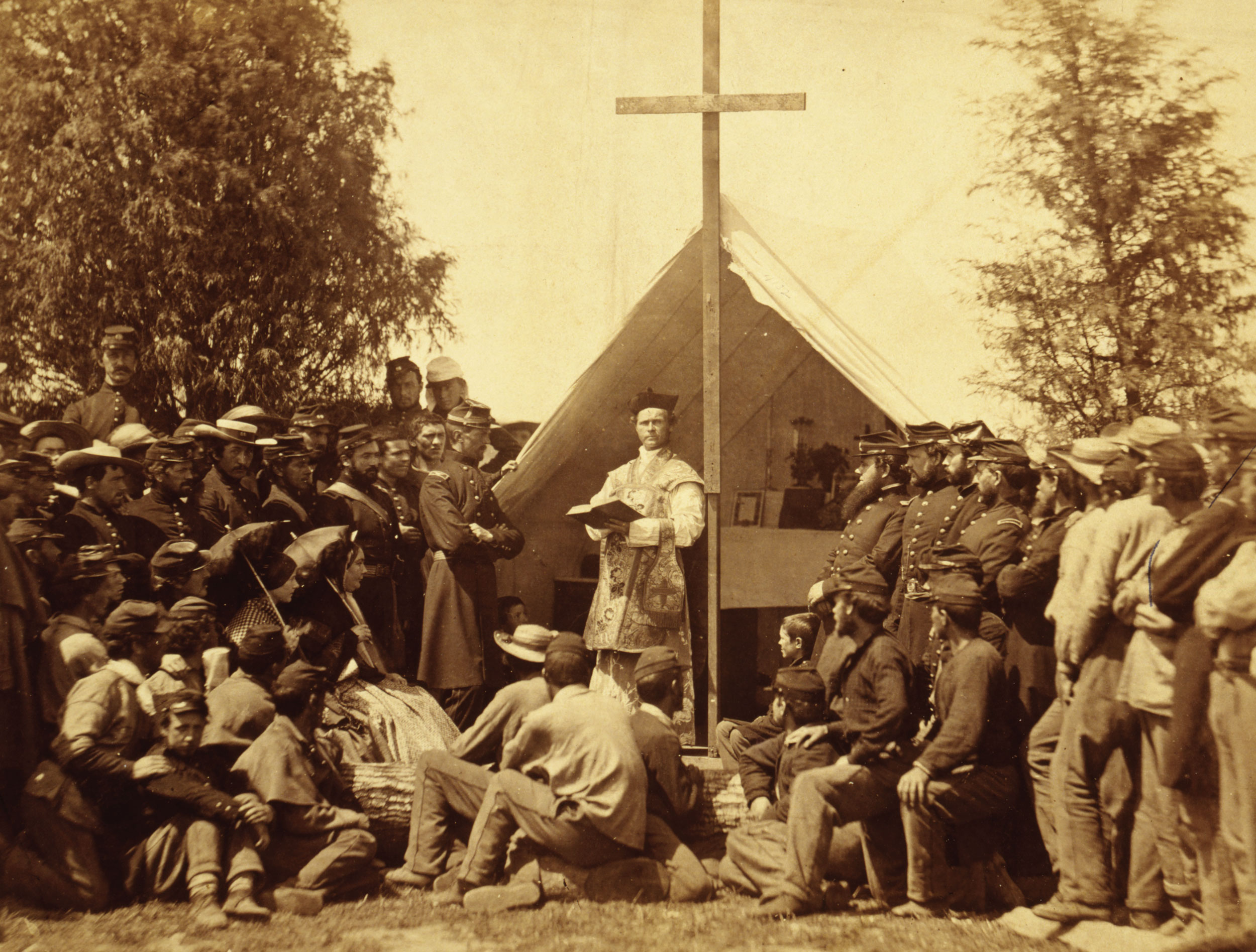 Library of Congress
“From the very first, I desired to go to the war. I felt that no man has any right to look about him for an excuse to stay home. If blessed with good health, his first duty is to his country; for, without his country’s benignant laws and institutions, he is worth just nothing.” So wrote Boston resident George Hepworth of his decision to go to war in November 1862. In his statement of patriotism and duty, Hepworth expressed sentiments similar to those held by many of the estimated 2.75 million men who joined the Union and Confederate armies during the Civil War.
Yet unlike those other volunteers, Hepworth joined the army not as a soldier, but as a military chaplain. Representing a variety of faiths and serving in a number of posts—in hospitals and prisons, on ships, and, most commonly, with army regiments—chaplains provided spiritual comfort and moral guidance to their comrades. Among their duties, they held regular worship services, prayer meetings, and Bible classes; helped care for the sick and wounded (including administering last rites and conducting burials); and often shared in the hardships, and dangers, of military life. By war’s end, nearly 4,000 men on both sides of the conflict had served as chaplains. Here we highlight statistics about Union chaplains, about which much more is known than their Confederate counterparts.
Civil War Chaplains by the Numbers
13: Average length of service, in months, of Union chaplains
569: Number of regimental chaplains who served for six months or shorter
112: Number of regimental chaplains who served for three years or longer
38: Average age of Union chaplains at time of enlistment
19: Age of the youngest Union chaplain, George F. Pentecost of the 8th Kentucky Cavalry, at time of enlistment
76: Age of the oldest Union chaplain, John Pierpont of the 22nd Massachusetts Infantry, at time of enlistment
2,398: Number of Union army and navy chaplains commissioned during the war
15: Number of Union chaplains killed or mortally wounded in action
101: Number of Union chaplains known to have died of disease
17: Number of African-American Union chaplains
$100: Union chaplains’ monthly salary
111: Number of Union chaplains who served as enlisted men before or after being commissioned as chaplains
4: Number of Union chaplains awarded the Medal of Honor
Denominational breakdown of Union chaplains:
38%: Methodist
17%: Presbyterian
12%: Baptist
10%: Episcopalian
9%: Congregationalist
4%: Unitarian/Universalist
3%: Roman Catholic
2%: Lutheran
All other denominations: 1 percent or fewer of each
Sources
John W. Brinsfield, William C. Davis, Benedict Maryniak, and James I. Robertson Jr., eds., Faith in the Fight: Civil War Chaplains (2003); Benedict R. Maryniak and John Wesley Brinsfield Jr., eds., The Spirit Divided: Memoirs of Civil War Chaplains, The Union (2007); John P. Deeben, “Faith on the Firing Line: Army Chaplains in the Civil War” Prologue vol. 48, no. 1 (Spring 2016).
Related topics: religion