Satterlee General Hospital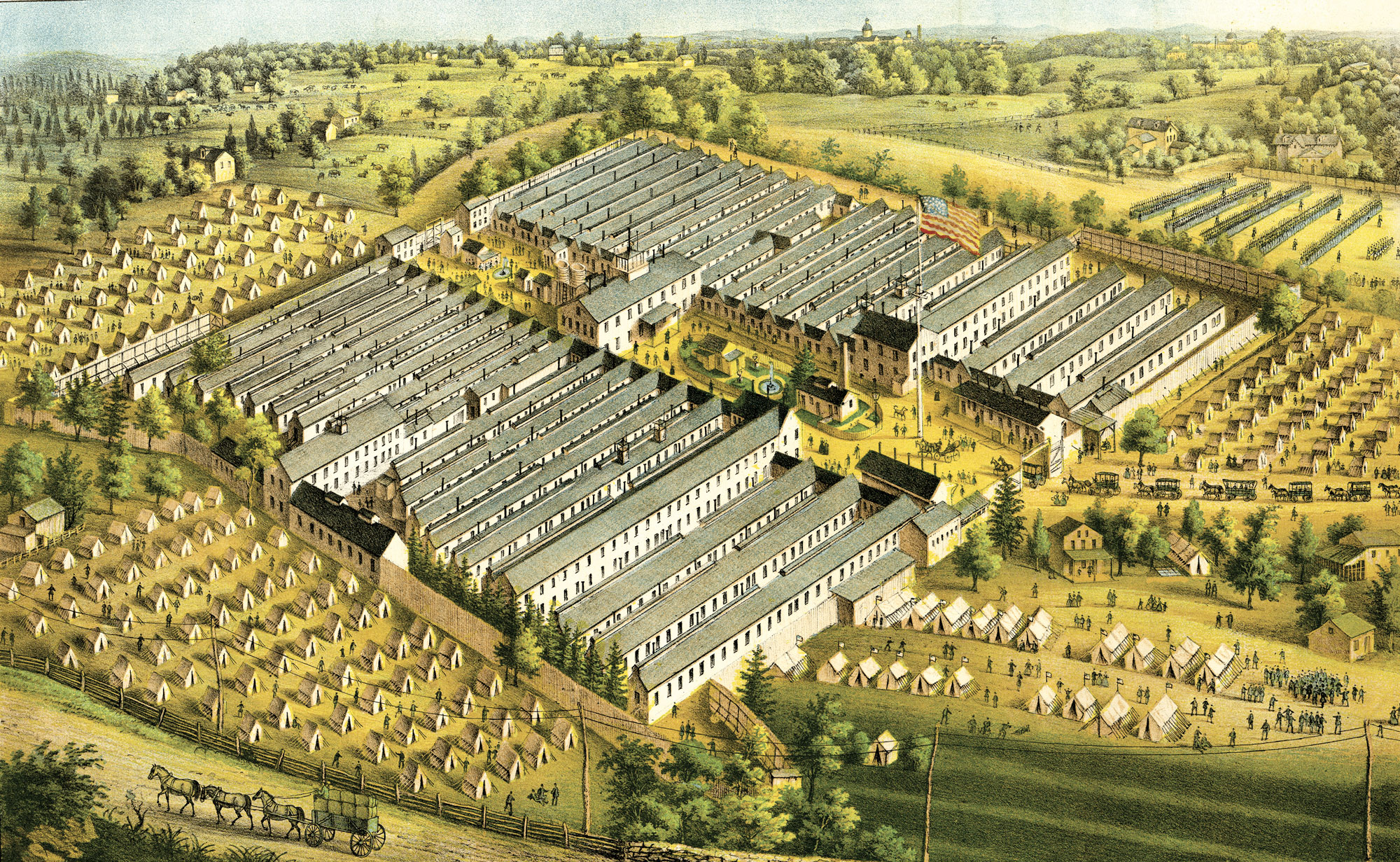 Image courtesy of the Countway Library of Medicine.
“I was learning to love the place—to love its kind people, and even its very scenery…. Days, months and perhaps years may roll on before I am permitted to see my second home again.” So wrote a grateful Union soldier in 1863 about Philadelphia’s Satterlee General Hospital, where he had recently been a patient. Opened in June 1862 as Western Philadelphia Hospital, it was renamed the following year after the army’s chief medical purveyor, Richard S. Satterlee, and became the Union’s largest military hospital. Designed in the “pavilion” style, with its multiple wards linked to two long central corridors and supplemented by tents, the hospital occupied roughly 16 acres of high ground, which, according to one of its staff, contributed to it possessing “all that could be desired as to pure air, and other natural helps to the procurement of round health.”
During its nearly three years of operation (the hospital closed in August 1865), Satterlee buzzed with activity, its well equipped and trained doctors, nurses, and other workers catering to the needs of a rotating array of sick and wounded Union soldiers. Their efforts proved remarkably successful, resulting in a patient mortality rate of approximately two percent. Here we highlight a number of figures about Satterlee and its operations.
Satterlee General Hospital by the Numbers
2: Number of corridors (each 775 feet long)
34: Number of hospital wards (each 167 feet long by 24 feet wide) in October 1863
150: Number of hospital tents on the grounds
4,500: Patient capacity of the overall hospital (including tents)
5,847: Number of patients admitted from October 8, 1862, to October 8, 1863
110: Number of patient deaths during this period
4,062: Greatest number of patients admitted in any month during this period (July 1863)
25: Greatest number of patient deaths in any month during this period (August 1863)
40: Number of physicians who worked at the hospital during the war
91: Number of nuns (Sisters of Charity) who volunteered as nurses at the hospital during its existence
2: Number of hours the hospital band performed every afternoon, weather permitting, from the observatory
3: Miles distant the band might be heard in favorable winds
14: Height, in feet, of the fence that surrounded the hospital
25: Number of sentries posted in and around the hospital
177: Number of men comprising the hospital guard
Food Consumed at Satterlee, September 1862 – September 1863
803,418: Pounds of bread
540,519: Pounds of beef and mutton
41,052: Pounds of pork
37,420: Pounds of chicken
95,250: Pounds of fish
490,388: Pounds of potatoes
283,120: Pounds of mixed vegetables
23,635: Pounds of coffee
4,425: Pounds of tea
74,325: Pounds of sugar
334,222: Quarts of milk
27,272: Dozens of eggs
Sources
Rev. Nathaniel West, History of the Satterlee U.S.A. Gen. Hospital (1863); Margaret Humphreys, Marrow of Tragedy: The Health Crisis of the American Civil War (2013); Charles Magnus (lithographer), “Satterlee U.S.A. General Hospital, West Philadelphia” (1864).
Related topics: medical care