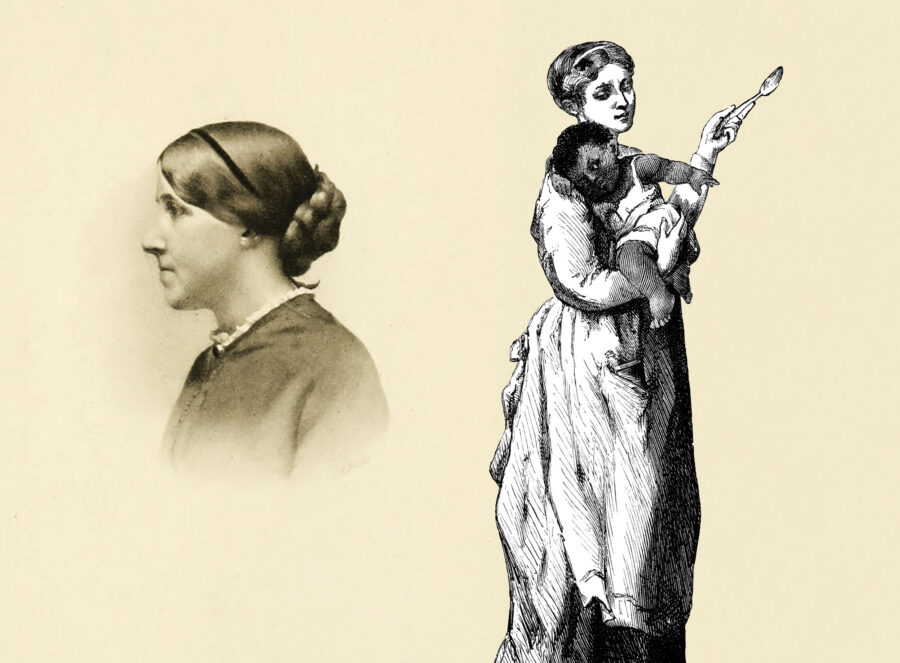
 Louisa May Alcott: Her Life, Letters, and Journals(1889), right: Hospital Sketches (1885)
“If I was only a boy, I’d march off tomorrow.” —Louisa May Alcott (pictured above left in 1862). Above right: Alcott is depicted as a nurse in an illustration from a postwar edition of her book Hospital Sketches.
On November 29, 1862, Louisa May Alcott turned 30 and could satisfy the age requirement for volunteer nurses for the Union army. She lost little time in taking the plunge.
An ardent abolitionist, Alcott had cast about for ways to help the Union cause since the Civil War had begun. She was one of 300 women in Concord, Massachusetts, who answered a call from Dorothea Dix, the army’s superintendent of nurses, and sewed 500 shirts in two days for Union soldiers. She also joined the women in scraping and collecting lint to be used to make wound dressings. But Alcott didn’t want to stay home sewing shirts and collecting lint. She wanted to go to war like the boys and men in Concord who had joined up and left with their regiments; heading south to serve as an army nurse looked like the next best thing. A few days after her birthday, she wrote to her grandmother Anna: “I am getting ready to go to Washington as an army nurse in one of the Hospitals & expect to have a hard winter if I do but I like it & want to help if I can…. If I was only a boy, I’d march off tomorrow.”1
Alcott would discover that being an army nurse could be as dangerous as being a soldier. More soldiers in the war died of disease than wounds, and those who cared for them in the unhealthy conditions prevalent in many army hospitals were susceptible to the same diseases and questionable medical practices. Alcott was a nurse for only a few weeks, and was fortunate to survive the experience, but it would leave her sickly for the rest of her life and lead to her early death at 55.
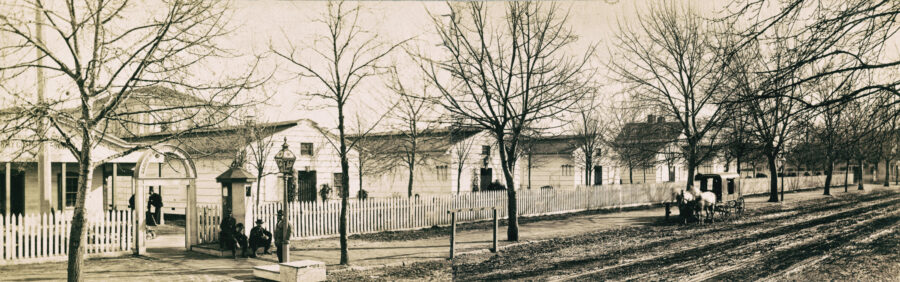 Library of Congress
In late 1862, soon after she turned 30, Louisa May Alcott looked for a job as a nurse in a U.S. Army hospital. An acquaintance who was the head of nursing at Washington’s new Armory Square Hospital (shown here) appointed her for an open spot, but not before it was filled.
Alcott, who had had stories published in the 1850s and in The Atlantic Monthly beginning in 1860, recognized that experiences like serving as an army nurse would make her a better writer. “First live, then write,” she said.2 Little Women and her other famous works lay in the future, but to her, writing was a job, a way to make money to help support her impoverished parents and three sisters. As the war approached, she was working on a series of gothic thrillers, some under the pen name “A.M. Barnard,” for magazines like the Saturday Evening Gazette and The Monitor. Most recently, Alcott sent a potboiler called “Pauline’s Passion and Punishment” under her pseudonym to Frank Leslie’s Illustrated Newspaper in an effort to win a much-needed $100 prize.
Ironically, notwithstanding her desire to get as close to soldiering as possible, her best contribution to the cause would be her writings about nursing. There were many nursing memoirs written, but few by an author of Alcott’s reputation and ability.3 In Hospital Sketches, she created perhaps the war’s most entertaining and revealing first-person account of Civil War hospitals and female nurses.
By early in the war, the army’s dreams of rigorous training for nurses had given way to finding women who were willing and able to do the work. Alcott was in many ways an excellent candidate. In addition to her age, she was healthy, of good character, educated, and “matronly,” qualities required or favored by recruiters. She was also unmarried (and never did marry) and available on a moment’s notice to leave town. (She was living in Concord with her parents, Bronson Alcott and Abigail May, at Orchard House, next door to the home Nathaniel and Sophia Hawthorne later would call Wayside.) She had experienced taking care of sick people. Friend and fellow writer Ednah Cheney wrote that Alcott “had always been the nurse in the family and had by nature, the magnetic power which encourages and helps the feeble and suffering.”4
 Library of Congress
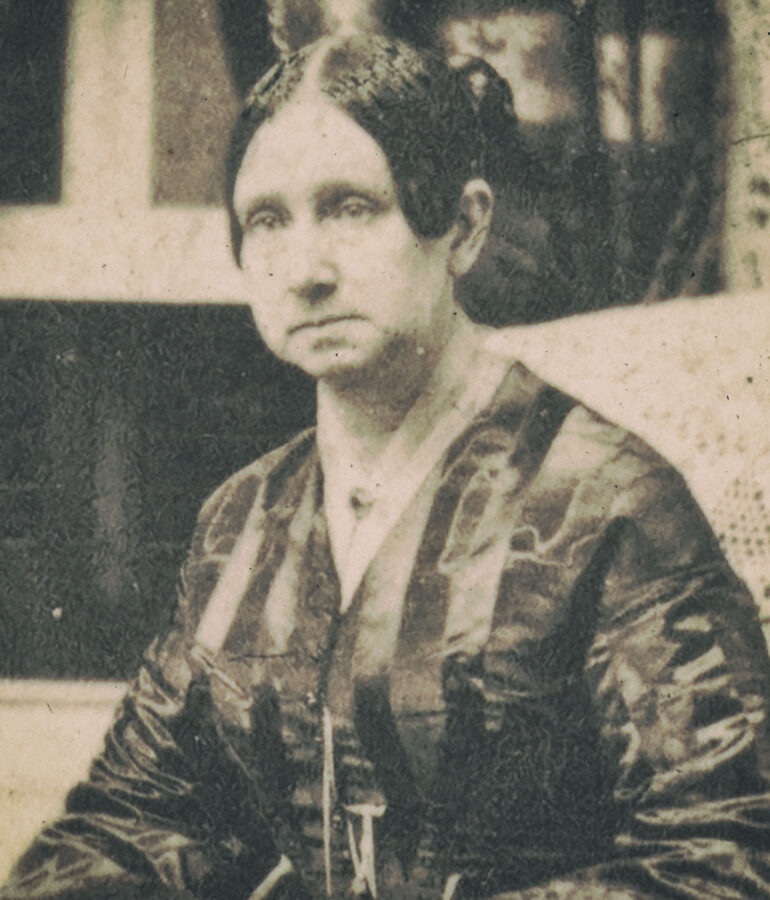
Dorothea Dix
Nursing appointments required references, and Alcott obtained a powerful one. She had made the acquaintance of Bostonian Hannah Stevenson, like her a reformer and abolitionist, who was now head of the nursing staff at the new 1,000-bed Armory Square Hospital in Washington, D.C., where many nurses from Massachusetts worked. The Armory had a vacancy, and Stevenson’s recommendation secured Alcott’s appointment, but not before the vacancy was filled. Accordingly, on December 11, 1862, Alcott received an appointment instead to the Union Hotel Hospital, located in neighboring Georgetown, where Hannah Ropes, 53, also a staunch abolitionist from Massachusetts, was the nursing matron. Unlike the Armory, which was designed and built as a hospital near the Washington armory, the Union, as the name suggests, was a converted hotel. In Hospital Sketches, Alcott dubbed it the “Hurly-burly House.” Though it was an inferior assignment, she accepted without hesitation.
The day she received her appointment, Alcott spent the afternoon packing for Washington and storing the rest of her belongings in two boxes, suggesting to her family that they make a bonfire of them if she never returned. After a tearful farewell, she walked a few blocks to the Concord depot escorted by her neighbor Julian Hawthorne, and her youngest sister, May, and took the train to Boston, where she spent the night at a cousin’s.
The next day she would take a 5 p.m. train from Boston to New London, Connecticut, then board a boat that night for Jersey City, New Jersey, where she would take a train to Washington.
Her first concern was to obtain the free pass available for volunteer nurses. After meeting with Stevenson for some final instructions, she next visited the president of the railroad—in a room full of men at Boston’s Worcester depot—in regards to the pass. He referred her to, of all people, the governor.
High-level public officials were not as inaccessible then as today. Earlier that year, Alcott’s neighbor Ralph Waldo Emerson had visited Washington, where he was introduced almost as a matter of course to President Abraham Lincoln, whom he found to be “a frank, sincere, well-meaning man.” When Bronson Alcott came to Washington to fetch Louisa home in 1863, he sat near Lincoln in the Senate Chamber and regretted being too busy to meet him.5 So his daughter did not hesitate to cross Boston Common to the office of Governor John Albion Andrew in the domed Massachusetts State House in pursuit of her pass. On the way, she wondered whether she ought to address him as “your honor,” but decided simply to call him “sir.”
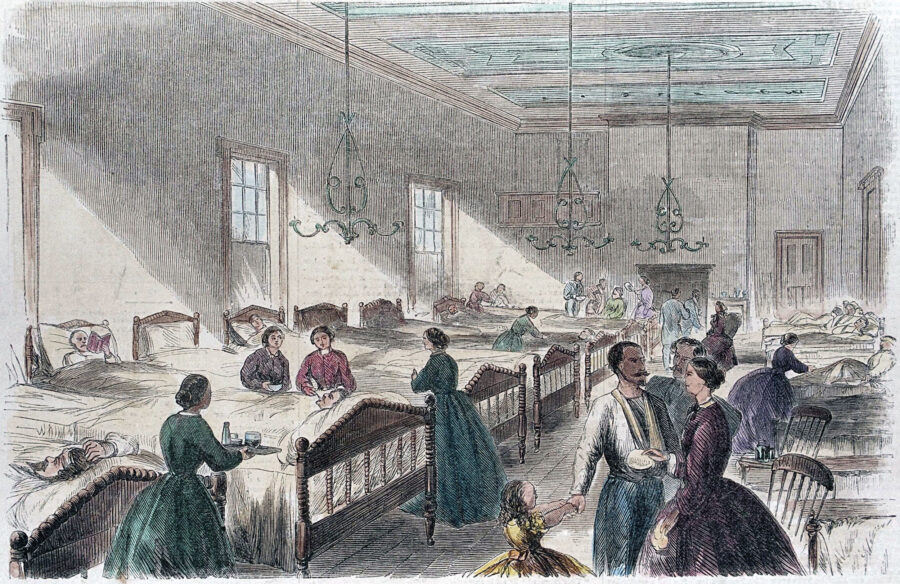 The Commons—Flickr
After missing out on a position at Armory Square Hospital, Alcott secured a nursing position at the Union Hotel Hospital in Georgetown (depicted above in a wartime illustration), which she later referred to as “Hurly-Burly House.”
She needn’t have worried. After bumbling around the State House, Alcott was told the governor was not there and whom she needed to see, and after a lengthy back-and-forth through the streets of Boston, she was finally able to procure her pass. She dined with her sister Anna and brother-in-law, John, who then escorted her to the train station for her free ride to New London. Meanwhile, far away to the south, the Army of the Potomac was preparing an attack the next morning on Confederate positions overlooking a town in Virginia called Fredericksburg. The resulting battle would have a big impact—including on Alcott’s nursing work.
When the train from Jersey City reached Washington, D.C., the next evening, she transferred to a carriage for a short tour of the city on the way to Georgetown. She saw the U.S. Capitol, the dome of which was still under construction (and which she found unimpressive), the White House lit up in the winter evening, and Pennsylvania Avenue. Crossing Rock Creek and entering Georgetown, her carriage reached the Union Hotel Hospital. Soldiers guarded the door, and Alcott was greeted inside by Ropes. She was introduced to two roommates and went to sleep in a narrow metal bed.
When hostilities began in 1861, both sides were completely unprepared to care for the massive number of casualties the war would produce. Hurly-burly House reflected this. The former hotel offered no large wards but only a nest of small rooms linked by narrow hallways and staircases. With small and inadequate windows, it was poorly ventilated, with rotting woodwork and insufficient and defective washing and lavatory facilities. Alcott wrote in her journal that the air was bad enough to “breed a pestilence,” and she routinely opened windows in the morning to let fresh air into the ward, however briefly.6 When she visited the Armory Hospital several weeks later, she was astounded at the difference, and praised the Armory’s neatness, comfort, and convenience.
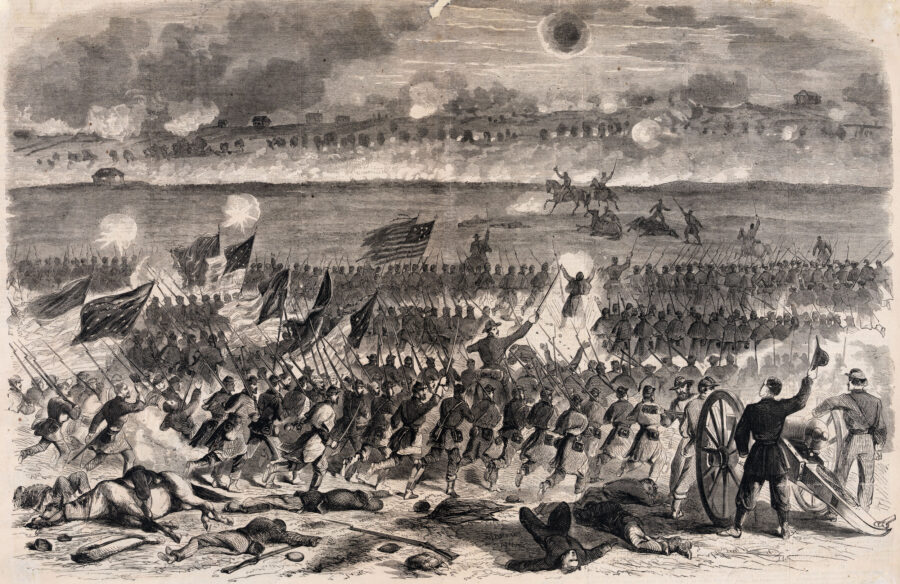 Library of Congress
After only a few days on the job, Alcott was thrust into helping care for an influx of soldiers wounded at the Battle of Fredericksburg (depicted above in a sketch by Alfred R. Waud), men she described as “ragged, gaunt and pale, mud to the knees, with bloody bandages untouched since put on days before.”
Ropes had looked forward to Alcott’s arrival. She viewed her as “the prospect of a really good nurse, a gentlewomen who can do more than merely keep the patients from falling out of bed, as some seem to consider the whole duty of a nurse.”7 On her first day, Ropes gave Alcott charge of Ward I, containing 40 beds and 20 patients. The nurse previously in charge had departed after being accused of theft.
Most of the patients were sick, not wounded, and suffered from a collection of diseases, including pneumonia, diphtheria, typhoid fever, rheumatism, and liver complaints. As the day dawned, one of the men died, and Alcott spent much of the rest of the day sitting between a soldier shot through the lungs and another with pneumonia. Like all patients at the Union, they were enlisted men, officers afforded the privilege of better accommodations. As she cared for them, she found the soldiers to be generally docile, respectful, and affectionate. “You are real motherly, ma’am,” said a patient with pneumonia when she covered him with her mother’s little back shawl.8 She also received an introduction that day to the hospital and staff, and followed the chief surgeon, Dr. George W. Stipp, through the wards as he examined patients. Ropes gave her instructions in how to change beds, empty bed pans, and wash patients.
Alcott spent her first two days caring for patients. It was still dark when she arose at 6 a.m. and dressed by gaslight. After opening windows in her ward and enduring the soldiers’ grumbling and shivers, she went to breakfast, a meal generally consisting of fried beef, salt, butter, bread, and “washy” coffee. She rarely enjoyed the breakfast conversation. Then back to her ward, and after providing breakfast and cutting up food for patients unable to do so, she dressed wounds, sewed bandages, washed patients, distributed pillows, blankets, sponges, and books, and gave directions to staff while the doctors conducted exams.
At noon, dinner, the main meal, arrived to an enthusiastic reception: soup, meat, potatoes, and bread. Patients then spent the afternoon reading, napping, and dictating letters to the nurses. Supper was at 5 p.m., followed by newspaper reading, conversation, the last round of doctor visits, and the final doses of medicine. When 9 p.m. arrived, a bell was wrung, the day nurses departed, and the lights were turned down.
Alcott was fortunate to have two full days to acclimate herself to nursing and hospital life, for things at the Union Hotel Hospital were about to change dramatically. The major fighting at Fredericksburg had ended on the day she arrived in Georgetown; the Army of the Potomac suffered nearly 13,000 casualties in the battle, including approximately 9,600 wounded. On December 16, nurses awoke to the news that the first of the wounded destined for the Union Hotel Hospital had arrived. Now, Alcott was told, she would see what hospital life was really like and that she would scarcely have a moment to sit down before midnight. The Union Hotel was about to earn the appellation “Hurly-burly House.”
In her typical nursing-as-soldiering style (which mimicked how the hospital staff spoke to each other), Alcott reported that, on entering the wards that morning, the first thing she met “was a regiment of the vilest odors that ever assaulted the human nose, and took it by storm.”9 She was able to tolerate the stench only by sprinkling herself with lavender water, and after walking through rooms and hallways and up and down stairs, she finally entered the main hall, where the wounded were being brought in. Some were armless and legless and carried on stretchers or in the arms of companions or hospital staff; others staggered in with the aid of a crutch or two; one was pronounced dead on arrival. They all had to be registered and checked in. Louisa observed that, “round the great stove was gathered the dreariest group I ever saw—ragged, gaunt and pale, mud to the knees, with bloody bandages untouched since put on days before; many bundled up in blankets, coats being lost or useless; and all wearing that disheartened look which proclaimed defeat, more plainly than any telegram of the Burnside blunder.”10
In Alcott’s ward, beds were made up for the men. The first task was to take off their socks, coats, and shorts, wash their bodies, and give them clean clothes, a process that frequently revealed unnoted wounds. Alcott took her washbowl and bar of soap and went to work, which proved an excellent opportunity to get to know the new patients. An “Irishman” blessed her for the honor of being washed by a lady. She brought a mirror to another man so he could look at the wound on his cheek, and when he bemoaned the prominent scar it would leave, Alcott assured him that any girl of sense would find it admirable. A sergeant lying in bed with a leg missing and a shattered right arm (which Louisa thought he was likely to lose) was nonetheless in good spirits and told Alcott how much better it was to lie in a bed than be jostled about on the ambulance ride from Fredericksburg. A soldier from Michigan with his arm blown off at the shoulder and two bullets still lodged in him bemoaned the presence nearby of a Confederate soldier. When Alcott went to attend to the Rebel, she was offended when he said he would take care of himself.
After the washing was done, the food arrived—big trays of bread, meat, soup, and coffee—and the nurses became, as Alcott put it, waiters dispensing bountiful “rations.” A man from New Hampshire with a massive leg wound needed help sitting up. While she fed him, he told her of being wounded by a shell burst in the streets of Fredericksburg and then offered her some jewelry he had stored in a little bundle under his pillow. She accepted a pair of earrings, no doubt out of courtesy, and then moved on to the next bed, where a soldier who hadn’t touched his food asked for a glass of water. She went to fetch the water, but the pails were being refilled. She hurried back with a mug of water, only to find that the soldier had died.
After dinner, the doctors removed bullets and dressed and irrigated wounds, giving Alcott instructions in the process. Ether would not be available until amputations were performed the next day, but Alcott was greatly impressed by the men’s fortitude shown as they endured their pain while being attended. With the dressings in order, she and the other nurses collected the soldiers’ valuables—watches, pocketbooks, locket photos and the like—packed them up, labeled the packages, and sent them to storage for safekeeping. They then talked with the men, read to them, and took down the letters they dictated until the supper bell rang. As she had been led to expect, Alcott ended up caring for the newcomers until 11 p.m., when she was finally able to retire.
Casualties from Fredericksburg continued to arrive, the more serious cases coming later, and soon there were over 300 patients in a hospital intended to hold 225. Wounded were routinely sent to other hospitals. Ropes noted in a December 21 letter, “On Monday we packed off 38 men to other hospitals, and Tuesday received 71. After getting them nicely cared for, the ‘order’ came for us to send 40, the least wounded, further north.”11
Alcott’s shift was soon changed to “night watching.” In Hospital Sketches, she describes this as a promotion, and she liked the new schedule because she was able to go for a run in the morning after work, trotting through the streets of Georgetown and Washington, watching the long processions of army wagons and ambulances come and go. (Alcott had long been a runner.) On January 4, 1863, she wrote in her journal that, given the bad air, bad food, and the work she was doing, the running was necessary to keep her healthy.
On her new schedule, Alcott slept in the afternoon after her morning run and, beginning at 9 p.m., worked in her ward until dawn. The ward now consisted of three rooms, which she called the “duty,” “pleasure,” and “pathetic” rooms, respectively, based on the patients she had (with Ropes’ concurrence) assigned to them and the predominant activities she performed there. The duty room required the wound dressing tray, the pleasure room was given over to gossip, games, and books, and the pathetic room was often the place for lullabies, consolations, and an occasional shroud. Each room had an attendant, and the ward’s night watchman kept the fires going and the wounds irrigated, as needed. She found the work gratifying; the wounded men appreciated her attentions, and smiled when she appeared. In keeping with her fervent belief in the importance of fresh air, her main complaint was that the upper sashes of the windows had been nailed shut, and it was too cold in the winter to open the lower sashes, which were right over patients’ beds, for any length of time.
In Hospital Sketches, which was published in 1863 and later, with additions, in 1869, Alcott describes a particularly difficult night on the ward. Sometime after 11 p.m., she was in the pathetic room trying to soothe a patient whose wound had unhinged his mind more than his body, resulting in a bewildered tirade of screams, laments, and secretive whispers. The night watchman was absent and the room attendant was asleep. A one-legged patient then hopped down the aisle, stopped, balanced on his leg, and launched into a discourse on various aspects of the war. She approached him carefully, but grew afraid the man would hurt himself, and was about to close the pathetic room door and run for help when a fellow patient plopped the one-legged man onto his own bed and instructed him to stay there. As Louisa retraced her steps, she heard a sob from a bed in the corner where a 12-year-old drummer boy had awoken from dreaming that his deceased soldier friend had rejoined the living. Alcott tried to comfort him, but the delirious soldier started shouting again and the one-legged man moved to get out of bed. Only the arrival of the night watchman and the assistance of another patient eventually put a stop to the commotion.
There is no reason to believe the encounters Alcott describes are not truthful, and if they did happen at the same time, as recounted in Hospital Sketches, it was an eventful evening. But the most significant event of the night, as recorded in the book, came later: the death of the patient she refers to simply as “John.” (His full name, John Suhre, appears in her journal, but elsewhere in it he is “John Sulie.”12) During the retreat through Fredericksburg, John was shot in the back; the bullet pierced a lung, broke a rib, and according to “Dr. P,” caused much other damage. Though not mentioned in Hospital Sketches, he may also have had two additional wounds.13 John was slightly ashamed to have been wounded in the back; Alcott was just happy he couldn’t see the wound.
In her narrative, John was handsome, courageous, earnest, and self-effacing. She called him the “prince of patients” and became his admirer and special caretaker.14 To Alcott’s disgust, Dr. P did not have the heart to inform John that he was not expected to live and asked her to tell him, which she eventually did. Her account of the care she provided, his appreciation for her efforts, his fortitude in the face of suffering and death, and his dying is the most powerful and moving episode in Hospital Sketches, and doubtless one of the finest things Louisa May Alcott ever wrote.
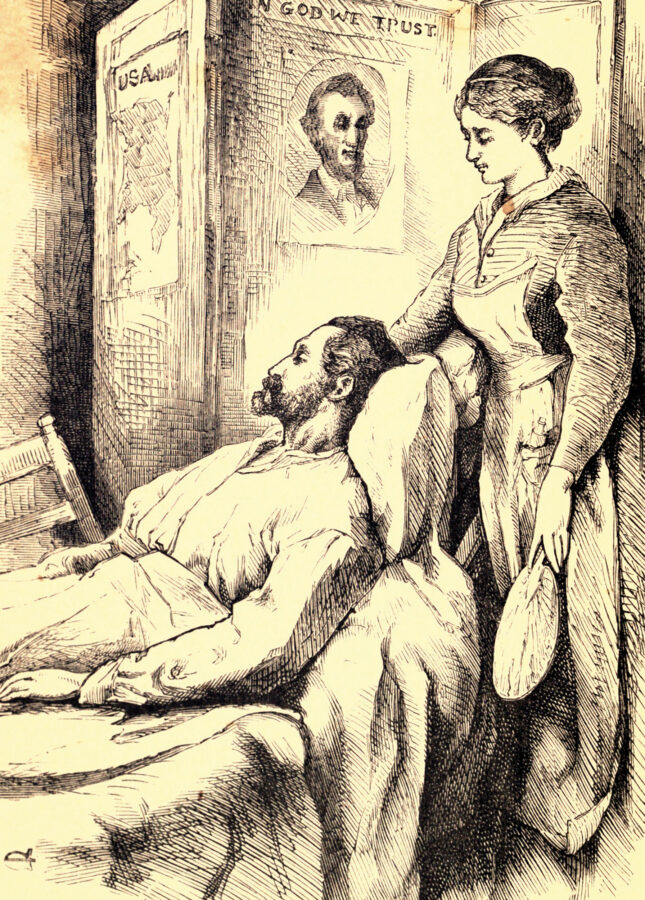 Hospital Sketches (1885)
Among the more moving episodes in Hospital Sketches, Alcott’s account of her time as a nurse, was her interaction with a patient named John, who had been seriously wounded at Fredericksburg. Above: Alcott tends to John in an illustration from an 1885 edition of Hospital Sketches.
Alcott’s nursing work ended in an illness contracted at the hospital. It began with a cough, but she developed other symptoms, including a head “that felt like a cannon ball,” and on January 11, 1863, she was relieved of duty and confined to quarters.15 Her room was hardly a good place to recover, apart from its proximity to the medical staff. Several panes in the room’s two windows were broken, the openings covered with sheets to reduce the winter drafts, and the ill-equipped fireplace was too small to accommodate the large logs provided. Food she stored in the room was consumed by rats. Her appetite, already challenged by the terrible food, was challenged further by illness, and her fellow nurses took to feeding her themselves. The diagnosis was typhoid pneumonia.
At first, Alcott spent much of this sick time sewing. She was grateful for the staff’s attention and decided that one of the best ways to learn nursing at a hospital was to be a patient there yourself, “for only then can one wholly realize what the men suffer and sigh for; how acts of kindness touch and win; how much or little we are to those about us; and for the first time really see that in coming there we have taken our lives in our hands, and may have to pay dearly for a brief experience.”16
Pay dearly she would, for both the illness and the treatment. Like many soldiers in the wards with typhus and other ailments, Alcott was treated with a drug called calomel, a mercury compound popular at the time and available in little blue pills. The drug acts as purgative, and doctors favored it as a method (rather like bloodletting) of forcing the patient’s body (supposedly) to release harmful substances. Though some physicians already opposed its use, it would take many years for the medical establishment to recognize that calomel did more harm than good.
Notwithstanding the purging, Alcott’s condition worsened, and the nurses urged her to return to Concord. At first, characteristically, she refused, and she was judged too weak to travel in any case. But on the morning of January 16, 1863, she stared in astonishment as her father walked into her room. Ropes, who was also suffering from typhoid pneumonia, had telegraphed him about the seriousness of his daughter’s condition. Just days later Ropes succumbed to the disease. On that day, the physicians and Alcott decided it was time for her to go home.
It was not a journey Alcott could have looked forward to. As she recorded in her journal, she “had a strange excited journey of a day & night, half asleep, half wandering, just conscious that I was going home, & when I got to Boston of being taken out of the car with people looking at me as if I was a sight. I dare say I was all … crazy & weak.”17 She arrived home the next day, positive that the roof had been removed from Orchard House, and spent another week and a half in delirium (three weeks total) before recovering her senses.18 Of that period, she remembered nothing apart from some of the strange fancies that had haunted her, and when she recovered a bit and looked in the mirror, she “found a queer, thin, big-eyed face” that she didn’t recognize at all.19 Her first efforts to walk were unsuccessful, and for a time she continued to suffer to some extent from strange fantasies that she recounted to her mother and sister in a sincere and sober voice, as though true.
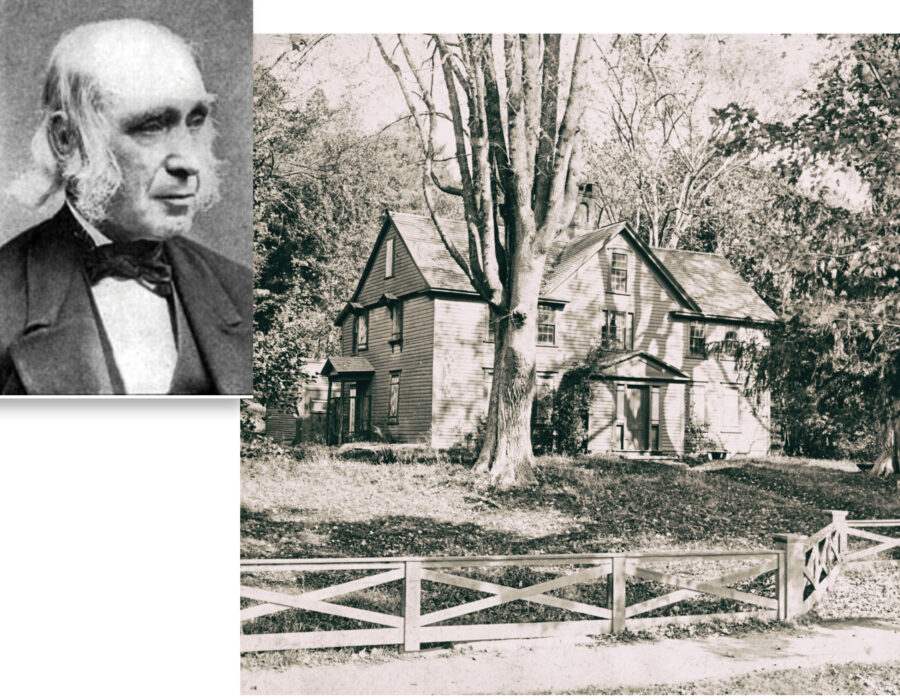 Library of Congress; Wikimedia Commons (Alcott)
Not long after falling seriously ill with typhoid pneumonia, Alcott was whisked away home by her father, Bronson, and eventually recovered. Above left: Bronson Alcott. Above right: Orchard House, the Alcotts’ home in Concord, Massachusetts.
By April, Alcott was feeling better—especially after she received the $100 prize for “Pauline’s Passion and Punishment.” She had now been both nurse and patient and was ready to write about it. She had sent home numerous letters from Georgetown about her experience as a nurse which had made the rounds in Concord to family and friends, including Frank Sanborn, a member of abolitionist John Brown’s “Secret Six” group of financers and editor of the anti-slavery paper The Boston Commonwealth. Alcott gave Sanborn permission to publish her letters in the Commonwealth under the pen name “Tribulation Periwinkle.” Though the Dickensian pen name suggests suffering and distress, it gives no clue to the gender of the author (a good percentage of Civil War nurses were male). For a writer who dreamed of being a soldier instead of a nurse, this may have been deliberate, though “Trib” is clearly a female nurse in the text.
The “Sketches” appeared as a series of four articles in May and June 1863 and were a great hit, not only in the Commonwealth, but also when reprinted in many other newspapers in the North. Book offers from several publishers followed. Roberts Brothers won her approval for publication, but not without some editing and supplementing by the author, including the addition of the first two chapters. Alcott received her copies of Hospital Sketches in late August 1863, a testament to the speed of publishing at the time.
Alcott’s use of literary license increased as she turned her letters into articles and the articles into a book. In the articles, she not only renamed the Union Hotel, but changed or abbreviated most other proper names in the text. Although Alcott’s name appeared on the title page of Hospital Sketches, the text continued to employ the made-up names used in the Commonwealth articles. The first-person narrator was still Tribulation Periwinkle, Hannah Ropes is simply referred to as “my matron,” and Hannah Stevenson (to whom the book is dedicated) is dubbed in the text “my General.”
The reason for the renaming is given in a motto appearing on the book’s title page: “Which naming no names, no offense could be took.” The page attributes this quotation to Sairy Gamp, an incompetent nurse in the novel Martin Chuzzlewit who (though Alcott was unlikely to know this) was herself based on an incompetent nurse whom Dickens had heard about. Alcott compares Tribulation to “Sairy” on two occasions in the text. As the motto suggests, changing the names of the people in her tale gave Alcott license to alter the facts to make a better story to which no one could take “offense.” She had no desire to advertise that the hospital was the Union Hotel, which (among other things) would make it easier to identify the people she wrote about. “To such as wish to know where these scenes took place, I must respectfully decline to answer; for Hurly-burly House has ceased to exist as a hospital; so let it rest, with all its sins upon its head,—perhaps I should say chimney top.”20 On the other hand, she had only praise for Armory Hospital and felt no need to change its name. Similarly, she preferred that no one know that the “John” she described with so much feeling and admiration was John Suhre, and she made it hard even for his family members to identify him, describing him as a 30-year-old blacksmith from Virginia, when he was a 21-year-old Pennsylvanian serving in the 133rd Pennsylvania Infantry. (Suhre’s identity has only recently come to light.) Further, in Alcott’s telling, he would be the perfect age to marry a 30-year-old spinster like Miss Periwinkle.
Alcott’s literary license has played havoc with her biographers. Consider her father’s visit to Hurly-burly House. Hospital Sketches implies that she woke up on January 16 to see her father sitting next to her, which biographers have accepted as fact, whereas it is clear from her journal that she was awake when he walked into her room.21 Similarly, biographers have accepted the account in Hospital Sketches of Bronson Alcott greeting Louisa by saying, “Come home,” to which she immediately acquiesces, whereas in her journal she is angry because she knew that his presence meant she would have to leave, which she does not admit agreeing to until January 21, the day Ropes died.22 Bronson Alcott verifies this in a letter of his own: “I decided to bring her away as soon as I saw her, though she thought it ignominious to depart her post, and persisted at first in staying longer.”23 Thus, Hospital Sketches not only renames its characters to avoid giving offence; it protects the author (for example, by portraying her as a dutiful daughter) and generally changes the facts to make a better story, one the author would in many ways have preferred. Ropes called for Alcott the night John died, but Nurse Periwinkle is holding his hand as he dies, just as the sky brightens with the dawn.24
Alcott’s literary license does not detract from the historical accuracy of Hospital Sketches because her changes are largely immaterial from a historical standpoint. Her aim was not to contribute to the historical record of the Union Hotel Hospital or even of her short time there as a nurse. She sought to convey the courage, suffering, and tragedy of both soldiers and staff and the difficult conditions in which they lived and worked.
What the book cannot tell us is that, like many veterans, Alcott was never the same again. She would enjoy periods of relative health, but she was sick on and off for the rest of her life. This is often blamed on the mercury in the calomel, a judgment that Louisa shared, especially after she received the opinion of an English physician she consulted on a trip to Europe. At this point, it is impossible to be certain what afflicted her. Based on a 2007 review of available information by physicians Norbert Hirschhorn and Ian A. Greaves, the best guess may be an autoimmune disease, systemic lupus erythematosus. There is evidence that mercury can impair the immune system and produce autoimmune effects like lupus.25
However, Alcott felt lucky to survive and (like her hero John Suhre) had no regrets about her abbreviated service. “I narrowly escaped with my life after a fever which left me an invalid for the rest of my days. But I never have regretted that brief yet costly experience … for all that is best & bravest in the hearts of men and women comes out in times like those, & the courage, loyalty, fortitude and self-sacrifice I saw & learned to love & admire in both Northern & Southern soldiers can never be forgotten…. [A]s one who gave her dearest possession, health, to serve the good cause I may perhaps deserve a humble place among the women who did what they could.”26 Louisa May Alcott had become the veteran she hoped to be.
Jeff Wieand, a Massachusetts attorney, is president of the Concord Art Association and former member of the Concord Select Board.
Notes
1. The Selected Letters of Louisa May Alcott, ed. by Joel Myerson, Daniel Shealy, and Madeleine B. Stern (Boston, 1987), 80 (hereafter abbreviated LLMA).
2. See, for example, Daneen Wardrop, Civil War Nurse Narratives (Iowa City, 2015).
3. Louisa May Alcott, Hospital Sketches (1863; reprint, Cambridge, 1960), 7 (hereafter abbreviated HS).
4. Louisa May Alcott, Her Life, Letters, and Journals, ed. by Ednah D. Cheney (Boston, 1916), 137.
5. The Journals and Miscellaneous Notebooks of Ralph Waldo Emerson, 16 vols, ed. by William H. Gilman, Ralph H. Orth, et al. (Cambridge, 1960–1982), 15:187.
6. The Journals of Louisa May Alcott, ed. by Joel Myerson, Daniel Shealy, and Madeleine B. Stern (Boston, 1989), 113–114 (hereafter JLMA).
7. Civil War Nurse: The Diary and Letters of Hannah Ropes, ed. by John R. Brumgardt (Knoxville, 1993), 112.
8. JLMA, 111.
9. HS, 29.
10. Ibid., 30.
11. Ropes, Civil War Nurse, 114.
12. “Finding Private Suhre: On the Trail of Louisa May Alcott’s ‘Prince of Patients,’” The New England Quarterly 88 (2015): 104–125.
13. Ropes, Civil War Nurse, 117.
14. Ibid., 117–119.
15. HS, 75.
16. Ibid.
17. JLMA, 116.
18. Bronson Alcott says Louisa regained her senses on “February 4, 5, 6.” The Journals of Bronson Alcott, ed. by Odell Shepard (Boston, 1938), 354.
19. HS, 117.
20. Ibid., 90.
21. Martha Saxton, Louisa May, A Modern Biography (Boston, 1977), 247; Madeleine B. Stern, Louisa May Alcott (Boston, 1996), 126.
22. John Matteson, Eden’s Outcasts (New York, 2007), 282; John Matteson, A Place Worse Than Hell (New York, 2021), 318; Belle Moses, Louisa May Alcott (New York, 1909), 148.
23. The Letters of A. Bronson Alcott, ed. by Richard L. Herrnstadt (Ames, IA, 1969), 333.
24. Ropes, Civil War Nurse, 118.
25. Norbert Hirschhorn and Ian Greaves, “Louisa May Alcott: Her Mysterious Illness,” Perspectives in Biology and Medicine 50 (2007): 254; Harriet Reisen, Louisa May Alcott (New York, 2009), 333–336.
26. LLMA, 339.
Related topics: medical care, women