 Library of Congress
Commodore John Randolph Tucker, postwar.
“Aye aye!”
As they marched from Richmond and Petersburg in early April 1865, the grizzled foot soldiers of General Robert E. Lee’s Army of Northern Virginia were no doubt puzzled by the navy jargon heard in the ranks.
With them on the grim retreat were the few hundred sailors and marines of the Confederate Naval Battalion, who soon would fight their first—and last—land battle along the weedy banks of a sluggish stream, ironically named Sailor’s Creek, where they would earn a reputation as men “who didn’t know how to surrender.”1
For 10 long months, the Army of Northern Virginia had been mired in the mud and filth of the labyrinthine trenches that stretched around Petersburg, staving off repeated attempts by the U.S. Army to take the strategically significant town and cut the vital railroad lines that ran through it to supply both Lee’s troops and the nearby Confederate capital in Richmond. On April 1, a U.S. force of infantry and cavalry, led by Major General Philip H. Sheridan, broke the lengthy stalemate, winning a decisive victory against part of Lee’s army at Five Forks and exposing the South Side Railroad, by then the Confederates’ last remaining supply line, to capture.
 Library of Congress
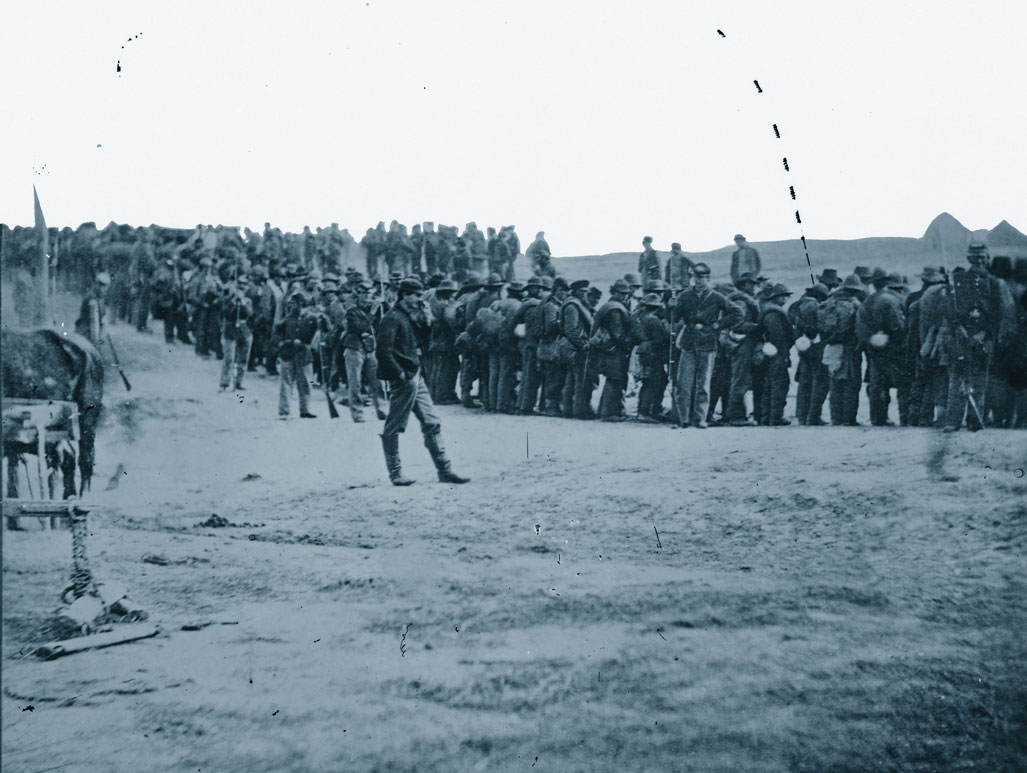
The decisive Union victory at Five Forks left Lee with little choice but to withdraw his army from the defenses around Petersburg. Above: Rebel soldiers taken prisoner at Five Forks are guarded by U.S. troops.
The following morning, as Lieutenant General Ulysses S. Grant launched an all-out offensive against the newly fragmented and vulnerable Confederate lines, Lee, realizing he and his army were no longer in a position to defend the capital from the advancing enemy, sent a dispatch to Confederate president Jefferson Davis suggesting Richmond be evacuated immediately. With little choice, Davis concurred. At the same time, Lee planned for his army’s withdrawal, in hopes that he might regroup his forces to fight another day. To this end, he ordered the various elements of his army to march to Amelia Court House, 40 miles to the west, where he planned to reunite with the troops of Lieutenant General Richard S. Ewell’s Richmond Defense Corps, whom he ordered there from their positions defending the capital. From Amelia, Lee intended to strike southwest toward North Carolina so as to connect with the army of General Joseph E. Johnston, who had been trying with little success to blunt the unrelenting northward advance of Major General William T. Sherman’s veteran blue-clad army. If Lee could successfully link his men with Johnston’s, their combined forces, he hoped, might be in a position to defeat Sherman’s and then Grant’s armies. It was a long shot at best, but Lee had few, if any, options remaining.
Among the troops streaming westward with Lee was Commodore John Randolph Tucker’s Naval Battalion, comprising roughly 300 sailors and 200 marines. For most of the war, Tucker, a 53-year-old Mexican War veteran who in 1861 had ended his 35-year career in the U.S. Navy to side with his native Virginia, had led his “tars” in combat against enemy ships on the high seas, first on board the steamer CSS Patrick Henry and then the ironclad CSS Chicora. Most recently assigned to the Confederate naval force stationed at Charleston, South Carolina, where they battled the vessels that enforced the U.S. coastal blockade, Tucker and his men found themselves land-bound after the city fell to U.S. forces in February. By train and foot, they made their way north to Drewry’s Bluff, the Confederate stronghold near Richmond on the James River, where they joined other Confederate sailors who also lacked a command. With the evacuation of Richmond and Petersburg, Tucker and his men packed up again and marched to join Lee’s army.
The March to Sailor’s Creek
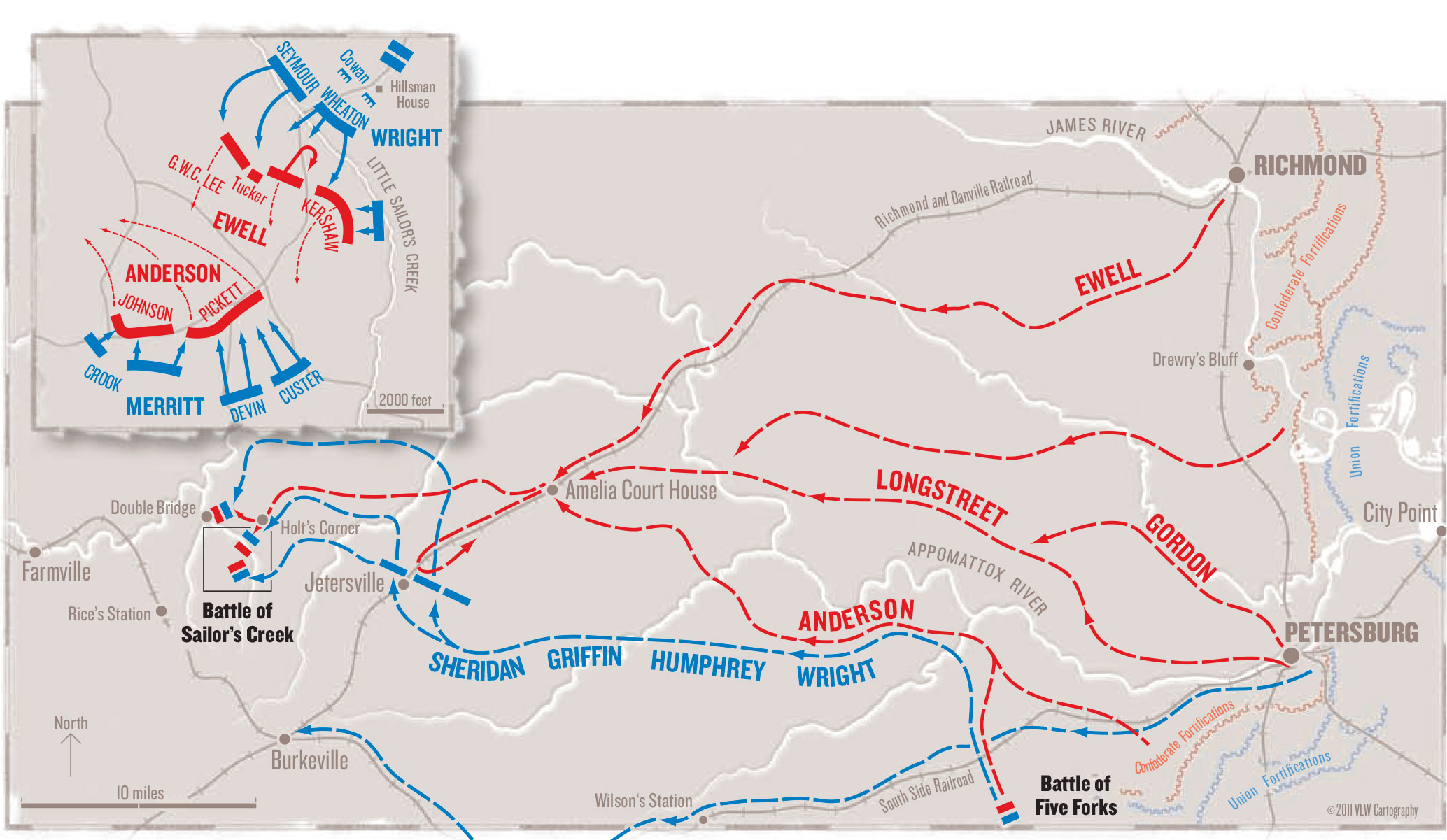
In the wake of the evacuation of Petersburg and Richmond, Lee ordered his forces west, in hopes that they might eventually link up with General Joseph E. Johnston’s Rebels in North Carolina and live to fight another day. After a brief stop on April 5 at Amelia Court House, where the men (including Tucker’s Naval Battalion) of Richard Ewell’s corps joined the retreating Confederate column, Lee’s force continued its westward race, only to be caught the following day by pursuing Union troops. At 2 p.m. on April 6, the Battle of Sailor’s Creek commenced.
The Naval Battalion reached Amelia Court House during the morning of Wednesday, April 5, and linked with the army’s Second Corps, commanded by Lieutenant General Richard Ewell and composed of the divisions of Major Generals George Washington Custis Lee, who was Robert E. Lee’s oldest son, and Joseph B. Kershaw, a stalwart South Carolinian. Assigned to Custis Lee’s division, Tucker’s men found themselves among mostly bottom-of-the-barrel reserve troops and heavy artillerists who, like them, were now forced to fight as foot soldiers.
Still, while many of the men in Custis Lee’s command were marked by a general lack of infantry experience, Tucker and his lads stood out, their nautical dress and mannerisms making them an immediate target of amusement and often derision for many of their fellow Rebs. “I remember, in all the discomfort and wretchedness of the retreat, we had been no little amused by the Naval Battalion,” related Major Robert Stiles. “The soldiers called them the ‘Aye, Ayes,’ because they responded ‘aye, aye’ to every order, sometimes repeating the order itself and adding, ‘Aye, aye, it is, sir!”
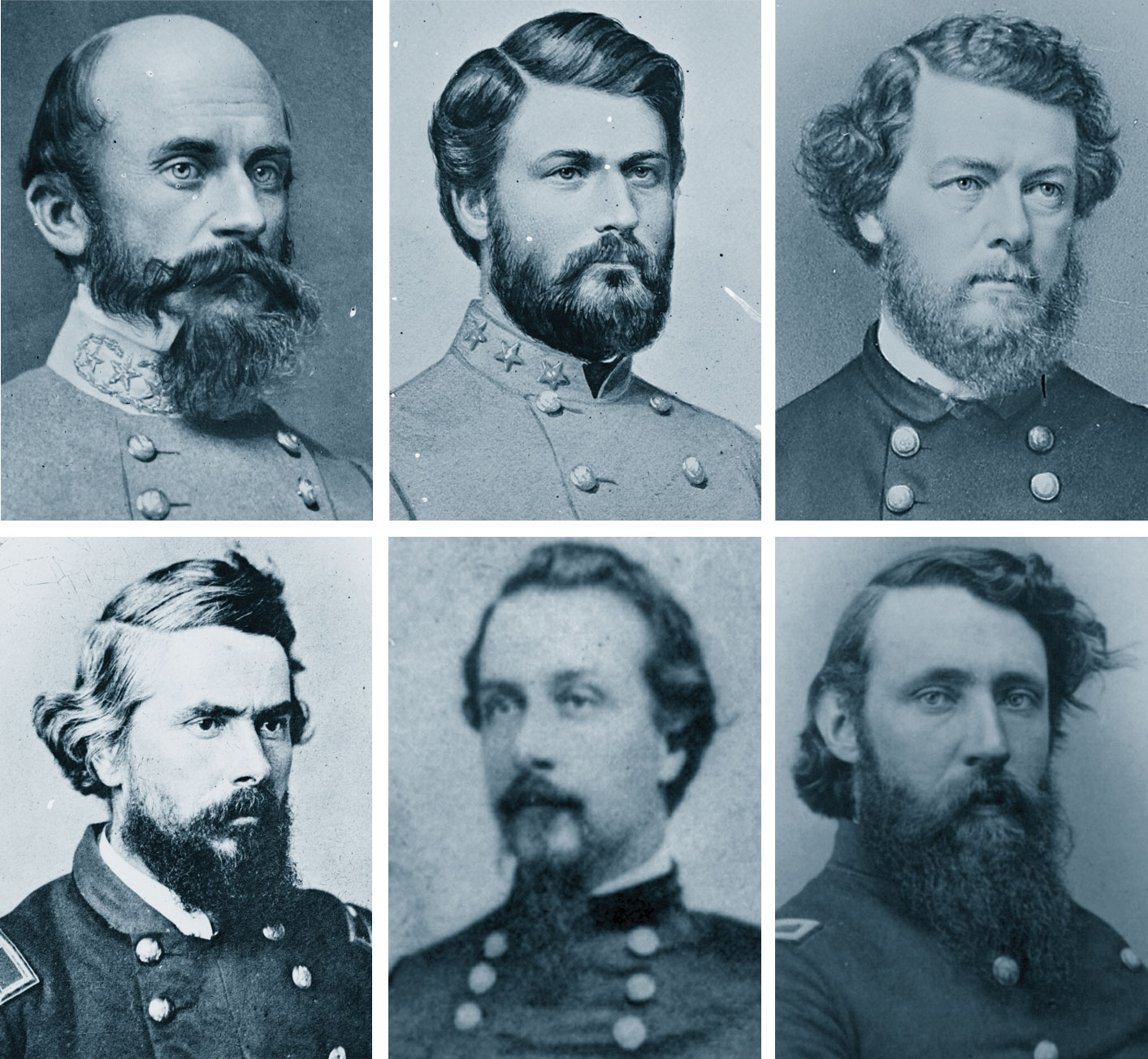 Library of Congress (6)
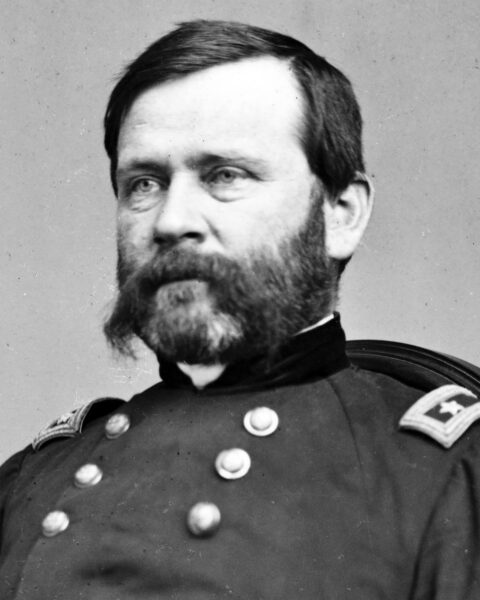
Richard Ewell Custis Lee Horatio Wright Truman Seymour Frank Wheaton J.W. Keifer
Other Confederates, however, seemed much less amused by their new comrades. “I remember the Naval Battalion particularly,” recalled Lieutenant Colonel W.W. Blackford, a Virginia cavalryman and engineer. “The sailors did well enough on the march, but there were the fat old captains and commodores, who had never marched anywhere but on a quarter-deck before in their lives, limping along, puffing and blowing and cursing everything black and blue.”2
Tucker’s command was in Amelia only a few hours before Lee ordered the army westward about 1 p.m. There was no time to linger. An expected ration train had not arrived, forage wagons had turned up little food in the surrounding countryside, and, most importantly, U.S. troops—Major General George G. Meade’s Army of the Potomac, led by its II, V, and VI Corps, along with Sheridan’s cavalry—were in active pursuit, Grant’s forces having two days earlier occupied Richmond and Petersburg in the wake of the Rebel exodus. Unknown to Lee at the time, elements of the U.S. Army, namely the V Corps and Sheridan’s troopers, had raced ahead of him to Jetersville, where they intended to block his path. Upon learning this, Lee, not wanting to risk a major fight, bypassed the town and marched his men through the night, past the village of Amelia Springs and the crossroads at Deatonville before reaching bottom lands cut by Little Sailor’s Creek and Big Sailor’s Creek, both tributaries of the Appomattox River that, while normally only a few feet wide, had been swelled by spring rains and turned into muddy quagmires. It was a taxing excursion for already exhausted men, “the most cruel marching order of the war,” thought one Confederate officer.3
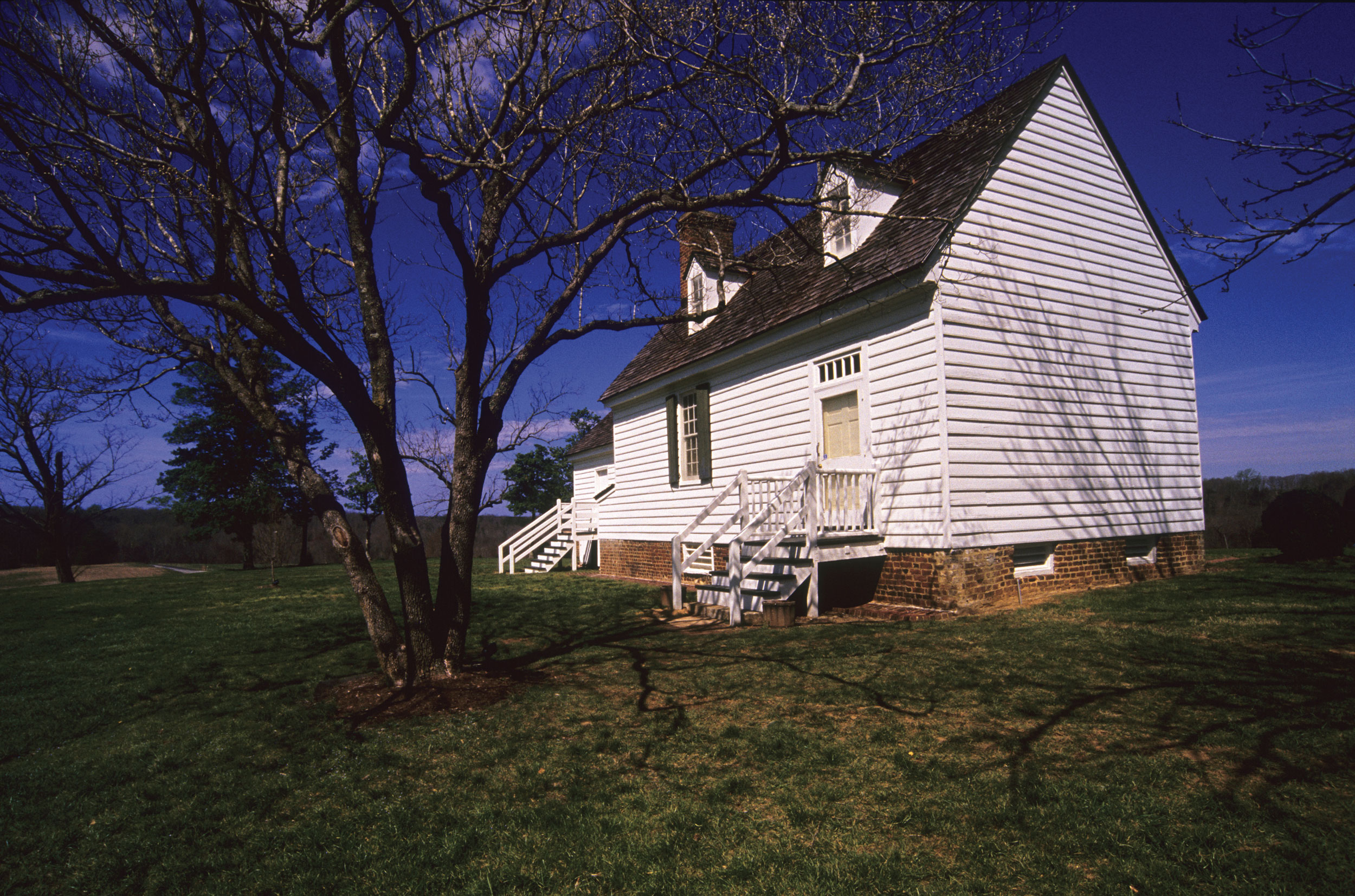 Courtesy Chris Heisey
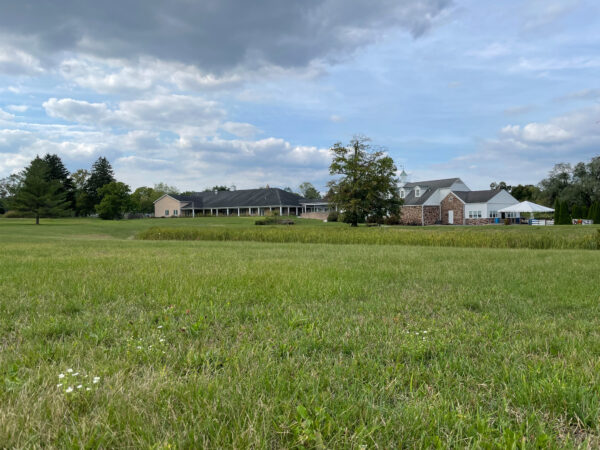
The guns of Captain Andrew Cowan’s artillery brigade, positioned near the James Moses Hillsman house (pictured above), pounded Ewell’s exposed Confederates with a deadly fire from a distance of about 800 yards.
Sunrise on Thursday, April 6, found the Rebel army still on the move west. The men of Lee’s First Corps, commanded by Lieutenant General James Longstreet, were in the lead, followed by those of Lieutenant General Richard H. Anderson’s Fourth Corps. Ewell’s divisions were next, trailed by the several hundred vehicles of Lee’s wagon train. Bringing up the rear was Major General John B. Gordon’s Second Corps. By late morning, Longstreet, who was accompanied on the march by Lee, had crossed both Sailor’s Creeks to reach Rice’s Station on the South Side Railroad. Learning that enemy troops might be in the vicinity, Longstreet began to dig in.
What Longstreet and Lee did not know was that the army’s remaining three corps were in trouble on the roads about four miles behind them. A division of U.S. cavalry had pounced on Anderson’s men near Holt’s Corner crossroads, forcing the Confederate commander into a stop-and-go fight that served to further slow the already ponderous Rebel retreat. Indeed, the column had slowed so much as to open a two-mile gap between it and Longstreet’s position, and before long additional U.S. horsemen, primarily those of Brigadier General George Custer’s division, raced to fill the breach, while the pursuing U.S. infantry steadily gained on the column from behind.
Anderson’s divisions managed to cross Little Sailor’s Creek via the Rice’s Station Road, but by about 2 p.m. they could go no farther, three Yankee cavalry divisions now blocking the way. With the march stalled, Ewell diverted the wagon train that trailed his corps onto an alternate route. At Holt’s Corner, the train wheeled north onto the Jamestown Road, a farm lane that ran generally parallel to the Rice’s Station Road. Gordon’s Rebels, fighting an escalating rearguard action against the Army of the Potomac’s VI Corps, commanded by Major General Horatio G. Wright, broke off from the column and followed the wagons, though he had received no orders to do so.
After reaching Holt’s Corner, Wright chose not to follow Gordon and the wagons on the Jamestown Road, but rather continued after Ewell’s command on the Rice’s Station Road. Before long, Wright’s men found themselves within sight of Kershaw’s division, whose soldiers formed the rear of Ewell’s portion of the column and had been expecting to see Gordon’s troops coming up behind them. Faced with this new and unexpected threat, Ewell quickly deployed a rearguard, posting a brigade of infantry and a regiment of dismounted cavalrymen near the James Moses Hillsman farm. The bulk of his corps continued on Rice’s Station Road across Little Sailor’s Creek—a matter of a few hundred yards—but quickly found the route ahead clogged with Anderson’s troops, who had begun to dig in along the road to stave off an expected U.S. cavalry attack from the south.
Unable to move forward, Ewell arranged his corps in a defensive position along a tree-lined ridge about 300 yards south of the creek, generally facing toward the northeast, where the lead regiments of Wright’s corps, consisting of the regiments of Brigadier General Truman Seymour’s Third Division, could be seen readying for an assault. Custis Lee’s troops occupied the left of the hastily assembled Rebel line, Kershaw’s men the right, and the sailors and marines of the Naval Battalion the center. As they awaited the enemy advance, Tucker’s men got on their bellies, making due with whatever protection the natural contours of the open ground upon which they lay offered.
Seymour’s troops swatted aside the Rebel rearguard with little difficulty, but Wright decided to wait for his First Division, commanded by Brevet Major General Frank Wheaton, to reach the battlefield before launching an all-out assault on Ewell’s line. While Wheaton’s men hustled toward the action, five batteries of Wright’s artillery brigade, led by Captain Andrew Cowan, rumbled into position near the Hillsman house and unlimbered. From a distance of about 800 yards, Cowan opened fire on the Rebel positions about 5:15 p.m. With Ewell having no guns to respond, his men, lying in the open, could do little but hug the ground while deafening enemy rounds tore flesh and earth in their midst. “From our commanding position,” noted a U.S. officer at the scene, “batteries were brought up to bear on this exposed position of their line, which was cut up terribly by our plunging fire of shell and case-shot.” Shortly after the barrage began, Wheaton’s brigades (save one assigned to guard a wagon train) arrived on the field and were ordered into line to the left of Seymour’s men. Now with approximately 7,000 troops on the scene, Wright was ready to attack.4
At about 6 p.m., the blue line surged forward with a shout, dashing across open fields on both sides of the road down into the creek valley. Upon reaching the stream they slowed, incoming fire from Confederate skirmishers and the mucky terrain causing them to lose momentum. Struggling out of the mud and water, Wright’s men reformed their ranks and, covered by renewed fire by Cowan’s artillery, continued up the sloping ground toward the waiting enemy.
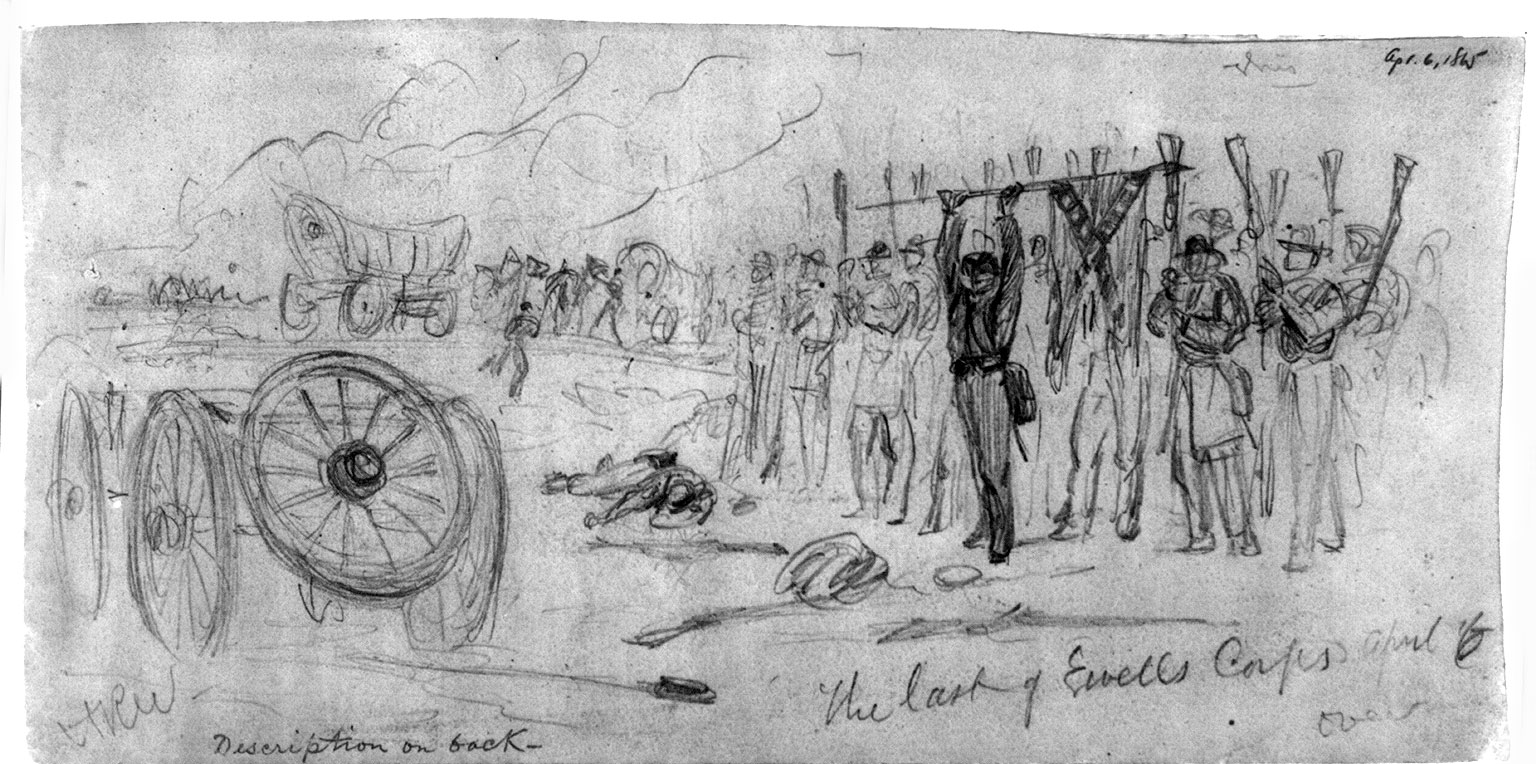 Library of Congress
Alfred R. Waud titled his pencil sketch of surrendering Confederate troops at Sailor’s Creek “The Last of Ewell’s Corps.”
Suddenly, the Confederate line flamed with a devastating volley. Wheaton’s men, at the time closer to Ewell’s position than Seymour’s, were hardest hit by this awful fire, which sent two of his regiments staggering back toward the creek. Sensing an opportunity, the eager yet inexperienced artillerists-turned-infantrymen of Colonel Stapleton Crutchfield’s brigade, whose men occupied a spot in Ewell’s line to Tucker’s immediate right, broke ranks without orders and charged after the fleeing enemy regiments. The impromptu counterattack met with initial success amid hand-to-hand fighting along the creek bank, but soon stalled under canister fire from Cowan’s gunners. In minutes, Crutchfield was dead, shot in the head, and the headstrong survivors of his command scampered back to their positions on the ridge.
As Ewell’s men held on, the fight was going worse for the Rebels in other quarters. At about the same time Wright had launched his attack against Ewell, three Union cavalry divisions, some 10,000 troopers in all, descended upon Anderson’s position in what one U.S. officer called “probably the grandest cavalry charge of the war.” While the fighting was fierce for a few minutes, Anderson’s Rebels, posted behind hastily erected defenses of logs, fence rails, rocks and dirt, stood little chance. Most of his men soon broke, many unable to escape the oncoming horsemen, who rounded up scores of prisoners.5
With Anderson’s corps splintered, Ewell’s divisions, already heavily engaged with Wright’s troops, found themselves sandwiched by the enemy. Pressed hard by U.S. infantry to his front and cavalry from behind, Kershaw ordered his division to pull back and attempt to cut its way out. It was too late; U.S. forces seemed now to be everywhere in swarms. Before long, Kershaw and most of his men laid down their arms. Soon too did Custis Lee and Ewell, who surrendered as he watched his corps disintegrate around him.
On the Jamestown Road, Gordon’s Rebels had fared no better as they battled Union Major General Andrew Humphreys’ II Corps along the ridges and swamps near the James Lockett farm. Dozens of wagons in the train that had preceded his men on the road had bogged down in the creek’s bottomland, forcing Gordon to make a stand. His soldiers fought stoutly, repelling one attack, but were overpowered by superior numbers and routed about 6 p.m.
Despite the confusion that surrounded them, the Naval Battalion held firm. Tucker had remained unruffled in his first land battle, calmly shouting orders as if he were walking a warship’s quarterdeck, his tars responding with their distinctive “Aye, aye, sir!” When at one point early during the fight a Confederate officer rode up and offered Tucker assistance, the commodore quickly declined. “Young man,” he reportedly told the infantryman, “I understand how to talk to my people.” After Crutchfield’s counterattack, which had temporarily blunted the U.S. assault in his sector, Tucker had moved the Naval Battalion into a nearby thicket, where they remained in relative protection as enemy forces overwhelmed Ewell’s line, surging past them on both flanks.6
As night descended on the field, word reached Brigadier General J. Warren Keifer, who commanded a brigade in Seymour’s division, that a nest of Rebels appeared to be in the thicket. Informed that these men had temporarily ceased firing, but had not laid down their arms, Keifer decided to ride forward and investigate for himself. Entering the trees, the general almost immediately stumbled into Tucker’s battle line. Keifer maintained his composure enough to try to bluff his way out of the situation. He shouted, “Forward,” and some of the southerners complied, passing the order down the ranks. In the shadowy light, they mistook him for a Rebel officer.
Given this respite, Keifer decided to make a break for it, wheeling his horse for a scamper to safety. The underbrush prevented him from a clean getaway, however, and by the time he had pulled clear the Confederates had realized he was a U.S. officer. When some of the Rebs raised muskets to kill him, Tucker and one of his officers, a Marine captain named John Simms, used their swords to strike their men’s gun barrels, diverting their aim. His life spared, Keifer galloped to the safety of U.S. lines. Before long, the general was en route back to the Confederate position, this time under a flag of truce.
Keifer met with Tucker, informing him it was futile for him and his men to fight on. The commodore, while aware that the Confederate brigades on either side of him were no longer in action, and having been informed that Ewell himself had surrendered (something a Rebel seaman noted Tucker “refused to believe”), would not budge. “I can’t surrender,” he told Keifer. With that, Keifer rode off, and Tucker instructed his tars to prepare to continue the contest.7
The battle soon resumed, marked by what was some of the most intense combat of the day. A mix of VI Corps commands, including Keifer’s troops, charged into the thicket, where Tucker’s men and some of Crutchfield’s remaining artillerists fought them hand-to-hand. The ferocity of it all startled even the most seasoned of veterans. “I was next to those Marines and saw them fight,” noted a Georgia infantryman. “They clubbed muskets, fired pistols into each other’s faces and used bayonets savagely.” Major Robert Stiles, of Crutchfield’s brigade, recalled that the “battle degenerated into a butchery and a confused melee of brutal personal conflicts. I saw numbers of men kill each other with bayonets and the butts of muskets and even bite each other’s throats and ears and noses, rolling on the ground like wild beasts.”8
In the midst of the chaos, a Rebel navy lieutenant brought Tucker a message confirming Ewell’s capitulation. Based on this information and Keifer’s recent entreaty, the commodore “followed the example of the infantry” and ordered his men to cease firing. He would later tell a fellow officer that he had “supposed everything was going well” before his command was overwhelmed. Tucker’s performance, and that of his Naval Battalion, did not go overlooked. “He had continued the fighting fifteen minutes after they [the bulk of Ewell’s men] had lowered their arms, and the naval colors were the last to be laid down,” an admiring Rebel wrote of Tucker and the tars. “The bravery of the sailors was observed along the Federal lines, and when they did surrender the enemy cheered them long and vigorously.”9
Members of the U.S. forces did indeed take note of Tucker and his men. Some were stunned to see their new prisoners donning naval uniforms. “Good heavens!” exclaimed one incredulous bluecoat. “Have you gunboats up here too?” But most praised the Rebel seamen as worthy opponents. “The Confederate Marine Battalion fought with peculiar obstinacy,” wrote General Seymour in his official report on the battle, while General Wheaton remarked in his how “[a] brigade of Southern marines stubbornly continued the fight” before being “compelled … to speedily recognize our victory” in the face of overwhelming odds. No less impressed was General Keifer, who wrote his wife shortly after the battle to tell her of his close call, noting how Tucker had “knocked up the muzzles of the guns nearest to me and saved my life.” He also had kind words for the Naval Battalion, who he thought “fought better and longer than any other troops upon the field.”10
Amazingly, Robert E. Lee had spent most of the day unaware of what was transpiring at Sailor’s Creek. The battle was nearly over by the time he and one of Longstreet’s divisions approached the field to investigate. The sight of hundreds of Confederate survivors streaming toward them along the road shocked Lee. “My God!” he is said to have remarked. “Has the army dissolved?”11
Indeed, the defeat at Sailor’s Creek essentially sounded the death knell for the Army of Northern Virginia. Eight Confederate generals had been captured and over 7,000 troops lost, most of them taken prisoner, representing approximately one-third of the Rebel force that had marched out of Amelia Court House the previous day. By contrast, U.S. forces emerged from the fight relatively unscathed, suffering losses amounting to less than 1,200 men. Grant continued his dogged pursuit of Lee’s army, which he soon caught up to at Appomattox Court House. On April 9, three days after the fight at Sailor’s Creek, Lee, recognizing the futility of further bloodshed, signed terms of surrender.
after the war, Commodore Tucker relocated to South America, securing an appointment as rear admiral in the Peruvian navy and fighting with the combined fleet of that country and Chile in their war with Spain. He also surveyed the upper reaches of the Amazon River before returning to the U.S. He died in his native Virginia in 1883 at age 71.
Warren Keifer was elected to the House of Representatives as a Republican from Ohio, and served as Speaker of the House from 1881 to 1883. In 1898, he again took up arms for his country, accepting an appointment as brigadier general of volunteers during the Spanish-American War. When he learned that his old adversary was suffering from ill health, Keifer returned the sword that Tucker had surrendered to him at Sailor’s Creek, where years earlier a small band of Rebel seamen, a hundred miles from the sea, had, in the general’s words, “fought with most extraordinary courage.”12
Derek Smith is the author of three books on the Civil War. His fourth, In the Lion’s Mouth: Hood’s Tragic Retreat from Nashville, 1864, is set for release this fall by Stackpole Books.
Notes
1. J. Thomas Scharf, History of the Confederate States Navy From Its Organization to the Surrender of Its Last Vessel (Avenel, NJ, 1996), 749.
2. W. W. Blackford, War Years With Jeb Stuart (New York, 1945), 283; Robert Stiles, Four Years Under Marse Robert (New York, 1904), 329; Ralph W. Donnelly, The Confederate States Marine Corps: The Rebel Leathernecks (Shippensburg, Pa., 1989), 58-62.
3. Nancy Scott Anderson and Dwight Anderson, The Generals: Ulysses S. Grant And Robert E. Lee (New York, 1987), 434.
4. United States War Department, The War of the Rebellion: A Compilation of the Official Records 129 vols. (Washington, 1880-1901), Series I, Volume 46, Part 1, pp. 651-652 (hereinafter OR).
5. Ibid., 1151.
6. Stiles, Four Years, 329.
7. Scharf, History of the Confederate States Navy, 749.
8. Burke Davis, To Appomattox: Nine April Days, 1865 (New York, 1959), 255; Derek Smith, Lee’s Last Stand: Sailor’s Creek, Virginia, 1865 (Shippensburg, Pa., 2002), 157-163; Stiles, Four Years, 333-334.
9. Scharf, History of the Confederate States Navy, 749; John C. Stiles, “Confederate States Navy at Sailor’s Creek, Va.,” Confederate Veteran, vol. 28, no. 7 (July 1920): 252.
10. Burleigh Cushing Rodick, Appomattox: The Last Campaign (New York, 1965), 62; OR, Series I, Volume 46, Part 1, 914, 947; Noah Andre Trudeau, Out of the Storm: The End of the Civil War, April-June 1865 (Baton Rouge, 1994), 112; OR, Series I, Volume 46, Part 1, 998; Donnelly, 61-62.
11. James Longstreet, From Manassas To Appomattox: Memoirs of the Civil War in America (Philadelphia, 1896), 614-615; Richard Harwell, Lee: An Abridgement in One Volume of the Four-volume R. E. Lee by Douglas Southall Freeman (New York, 1961), 476.
12. Scharf, History of the Confederate States Navy, 196.