 Library of Congress
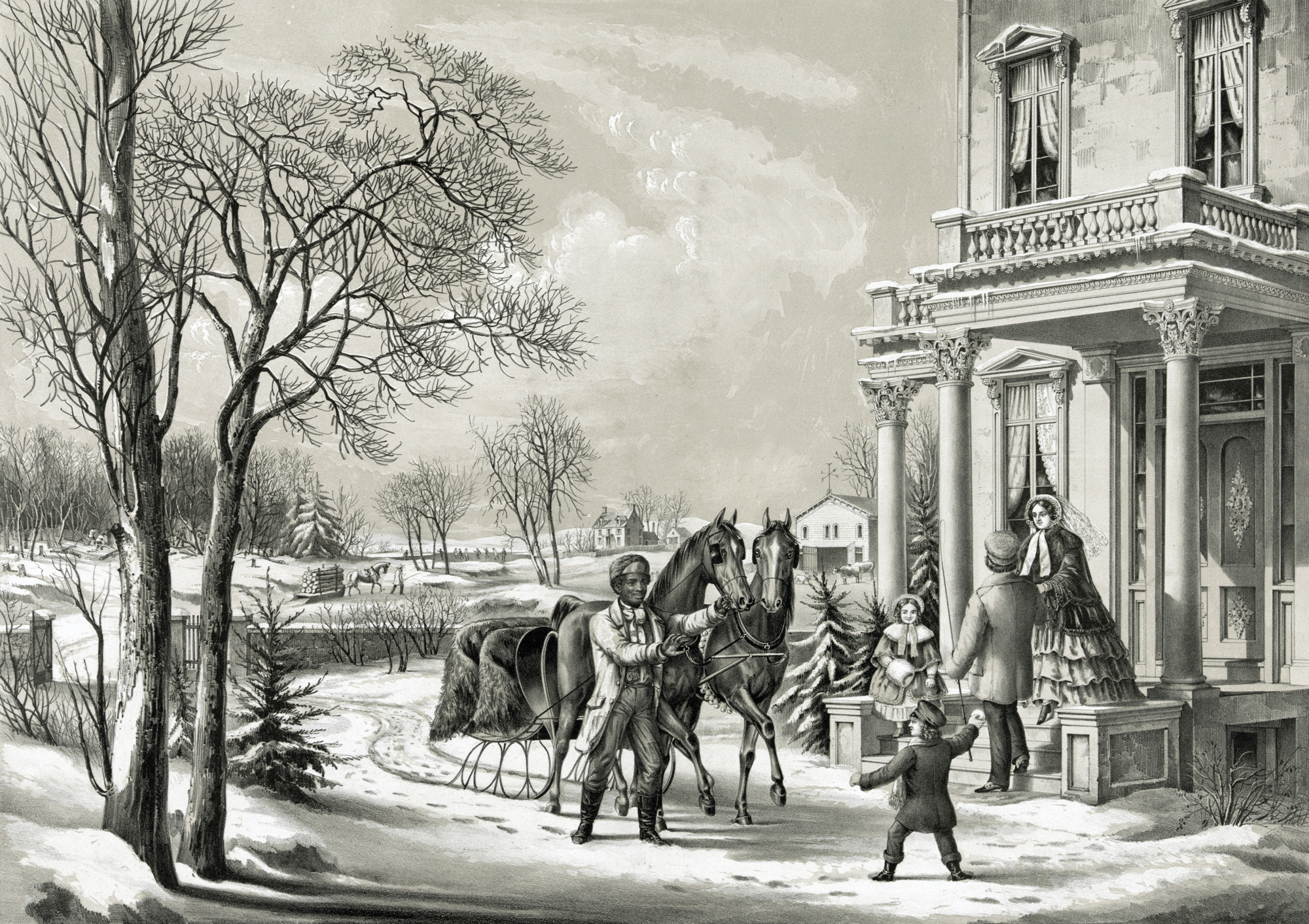
American Country Life, a lithograph by Fanny Palmer, depicts an idyllic winter scene in the years before the Civil War.
On December 25, 1935, “a tattered old man,” nearing his 92nd year of life, rocked in a chair beside a roaring fire. His mind turned to the ghosts of the past and his comrades in “the great beyond.” “70 long years have rolled away since that mighty struggle ended,” the Confederate veteran recalled, “yet fond memory carries me back to these old days of long ago when we were young soldiers fighting the battles for our own native southland[,] the land we loved so well.”1
Exactly 73 years before, on December 25, 1862, William A. Day was recuperating from the Battle of Fredericksburg and he and the similarly lucky boys of the 49th North Carolina Infantry were gathered for Christmastime “amusement.” The snow had melted, but a chill remained in the air. Sheltered under canvas tents near large fires, the soldiers passed time gambling for watches. “A man would put up his watch with a set price on it and every man who wanted to take a chance paid in his dollar. When the price was made up they threw the dice out of a tin cup, and the one who threw the highest number of spots got the watch.”2
Two years later, on Christmas Day in 1864, the 49th was stationed in the trenches outside of Petersburg, Virginia. A steady hail of bullets typically poured into the Confederate lines, but on “that day it was peace on earth [and] good will to men, no firing on that part of our line, no dead men carried to Blandford Cemetery.” Yet all was not merry; food was scarce and men were hungry. With each having only a “small piece of cornbread,” “a slice of bacon,” “a spoonful of raw peas,” and the occasional sample of coffee, the Rebel soldiers were cold and “hungry all the time.” By 1935 he was far removed from a soldier’s hardscrabble life and his boyhood adventures, but Day, even in old age, “cannot forget them” or the days spent campaigning under Robert E. Lee in Virginia. “At peace with the world,” Day waited to join his departed comrades in arms until Death’s “roll is called for me.”3
 Library of Congress
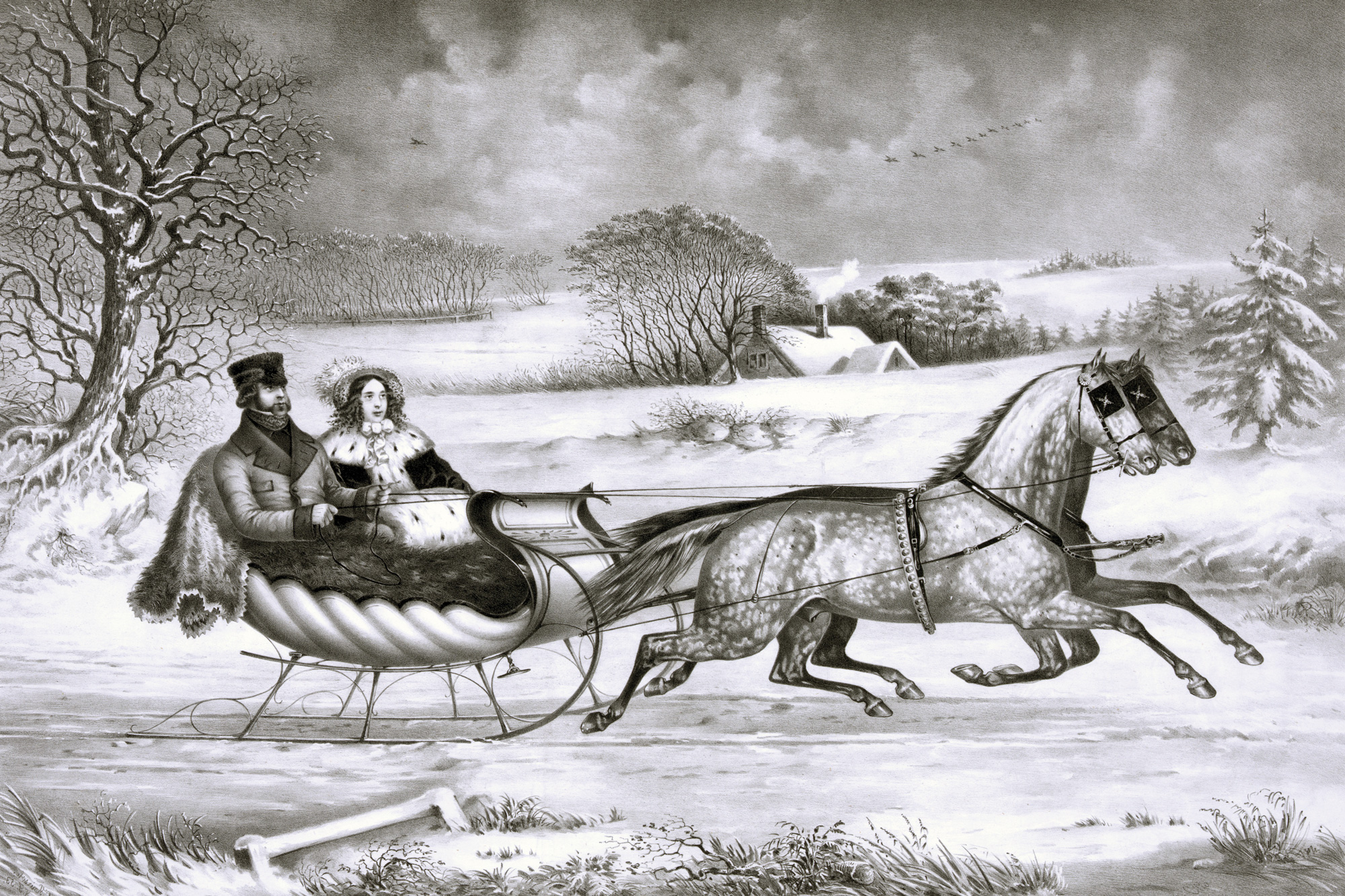
Unlike the prewar Currier and Ives scenes that idealized winter and the holiday season (such as 1853’s The Road, Winter, shown above), Christmas was more endured than celebrated in Confederate army camps during the Civil War.
Christmas, associated as it was, and still is, with friends, family, and fraternity, inspired many such sentimentalized, and even fictionalized, recollections among gray-haired veterans in the winter of life. Looking back years later, South Carolinian Samuel Wilson remembered Christmas week at Pooshee Plantation as a “cherished rendezvous of fun, frolic and freedom” filled with “profuse, generous and unstinted liberality and entertainment.” Men and women, young and old, engaged in practical jokes and danced the season away. Nostalgia blunted and all but erased the brutality of slavery and transformed planters into benevolent father figures and the enslaved into innocent, happy children.4 “Recalling the good old days” in “Ole Virginny,” one southerner ruminated on “the genuine pork sausage, the sweet potato pies & … the home made wine and fruit cake and custard” that graced their family table in 1864. The “old time hymns,” too, were sweeter, simpler back then.5 Aging Confederate veterans remembered the wartime Christmases not as a time of depravity and debauchery, but as a time when Christmas lights glowed brighter, food tasted better, and loved ones’ faces radiated more joyfully. They found Christmas in the 20th century different, and not in a good way. Stepping outside on Christmas Day 1925, a 70-year old veteran “strained his ear, to catch the sound of a ‘pop cracker.’ Not a report did he hear. He realized then the boys were to celebrate without fireworks.” “Humph!” he declared disapprovingly; in his younger days, during the war, boys celebrated Christmas with a bang.6
Wartime reality, however, was a far cry from veterans’ rose-hued memories or idyllic Currier and Ives scenes of pristine snow, warm firesides, and happy gatherings. A soldier’s life—a life of blood-stained grass, damp tents, and bullet-riddled corpses—looked far different. Christmases were endured more than celebrated, and any merriment was had far from home, alongside other male soldiers, in filthy, sin-laden army encampments. For those out fighting and dying for the Confederacy, gourmet meats and sweet treats were substituted with stale bread and homemade whiskey. Religious reverence and soulful contemplation were replaced by sinful pleasures and drunken carousing. Time spent with wives and sweethearts, mothers and fathers, and sons and daughters was supplanted by feelings of pervasive homesickness and deep heartache. Indeed, the Civil War fundamentally changed the meaning of Christmas for Confederate soldiers and white southern families alike. Before the war, Christmas could be a day celebrated or a day largely forgotten. But in war’s wake, Christmas became a holiday for the nation, one celebrated and revered in households across the South.
In 1859, Christmas Day fell on the Sabbath. Julius Walker Wright jotted in his diary: “Sun. 25th Christmas Day: For the first time in many years Christmas falls on Sunday a thing [to] which [we] ought at least pay notice well, coming as the anniversary of our Lord does on the Sabbath.”7 Wright, like many of his contemporaries in antebellum America, attended worship on Christmas morning to mark the day “when Jesus was born in Bethlehem.”8 “As a matter of course all was quiet and peaceful throughout the entire day” in Wilmington, North Carolina. Wright, in particular, considered the “music in Church as very good.”9 The pews of the Episcopal church in Edgefield County, South Carolina, too, were filled on Christmas morning. “The congregation was larger than usual,” maintained local planter Whitfield Brooks in his journal, “the church handsomely ornamented, the signing very good and the sermon the most excellent.”10
Religion was, no doubt, part of antebellum Christmas celebrations in the South—but only a part. For many planters, the day revolved around lavish balls, sweet treats, and gifted gewgaws. Children, “merry at the bestowals of Santa Clause,” peeked inside their stockings on Christmas morning.11 Young men and unmarried women sought solace in each other’s company. And people of all ages spent the day “in refined sociability by the fireside, — inviting friends & relatives to meet & pass … with minds entirely free from care & interchanging feelings of good will with all around them.”12 Some adults found it more difficult to be mirthful; unlike children “we find it now by no means as easy [of a] task to drive dull cares away and chase the butterfly or gather daisies as we roam through ‘life’s broad field of battle.’”13 Even then, however, older folks reflected on their own youthful days of carefree innocence. For in one’s children or grandchildren “we … have seen reflected back upon our own lang-syne enjoyment of Christmas.” By “remembering the past,” a South Carolina planter could “respect and even enjoy the present.”14
In other households, Christmas Day looked like any other. Indeed, the holiday was an inconsistently commemorated affair in the prewar South; some celebrated while others did not. On South Carolina’s St. Helena Island in 1845, Thomas B. Chaplin’s Christmas at Tombee Plantation was “Dull. Dull. Dull.” The only excitement was a visit from two friends, one of whom was “pretty well corned.” The passage of time did not improve his holidays and, with the exception of a small party, Christmas 1848 was almost equally uneventful. “So far,” he complained, “Merry Christmas is rather on the other extreme.” Instead, it was a day just like any other. “Once upon a time,” he mused, “Christmas was to me a very jolly time, fun & frolic for a week, but times and disposition have both greatly changed.” On December 25, 1850, the white children of Tombee lit fireworks and enjoyed themselves while Chaplin sat “mopping at home all day, [with] no pleasure.”15
 Harper's Weekly
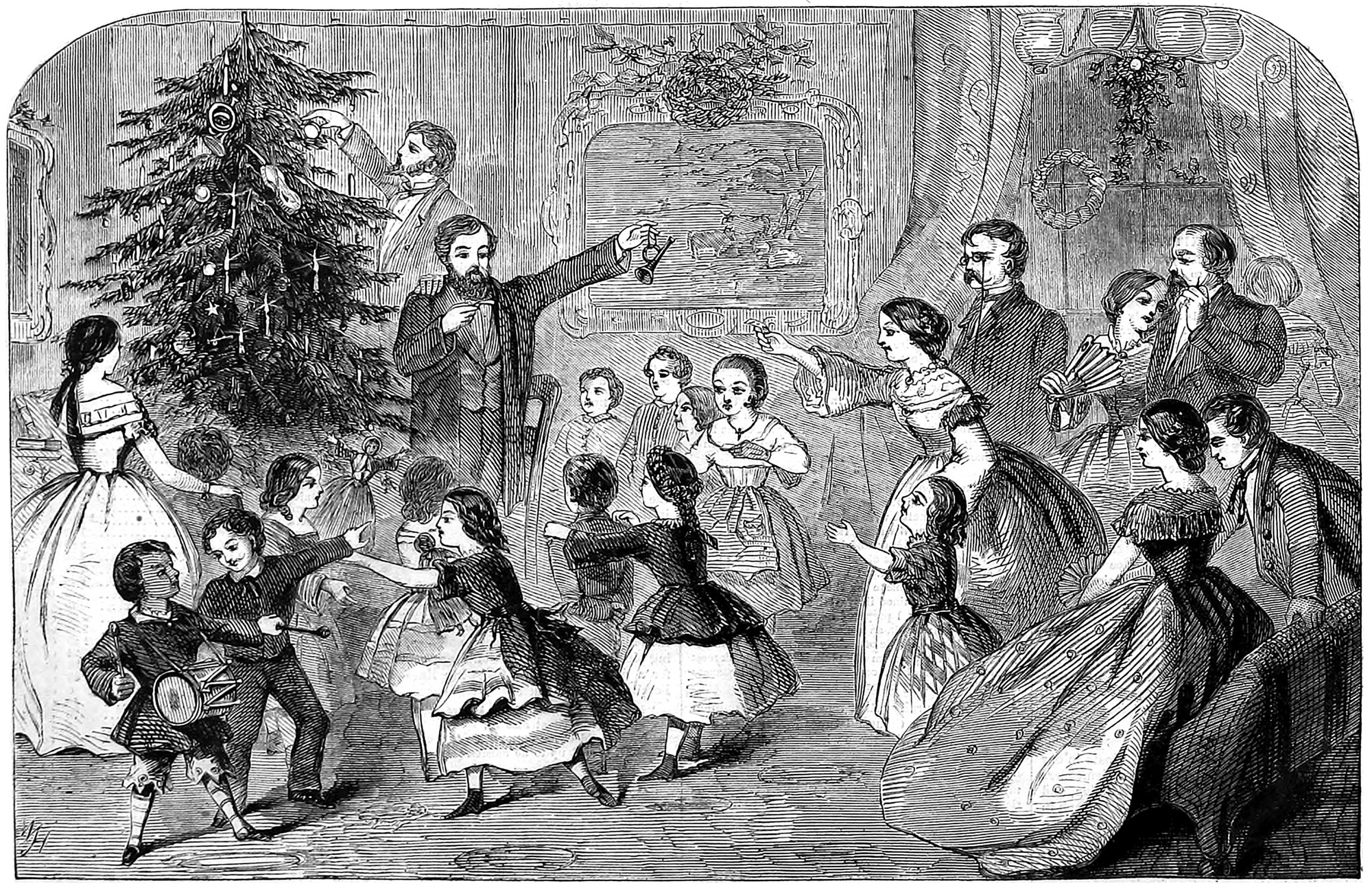
While Christmas was an exciting and joyous time in many antebellum southern households (similar to the scenes depicted in these Harper’s Weekly sketches), in others it was inconsistently celebrated, if marked at all.
While Christmas was an exciting and joyous time in many antebellum southern households (similar to the scenes depicted in these Harper’s Weekly sketches), in others it was inconsistently celebrated, if marked at all.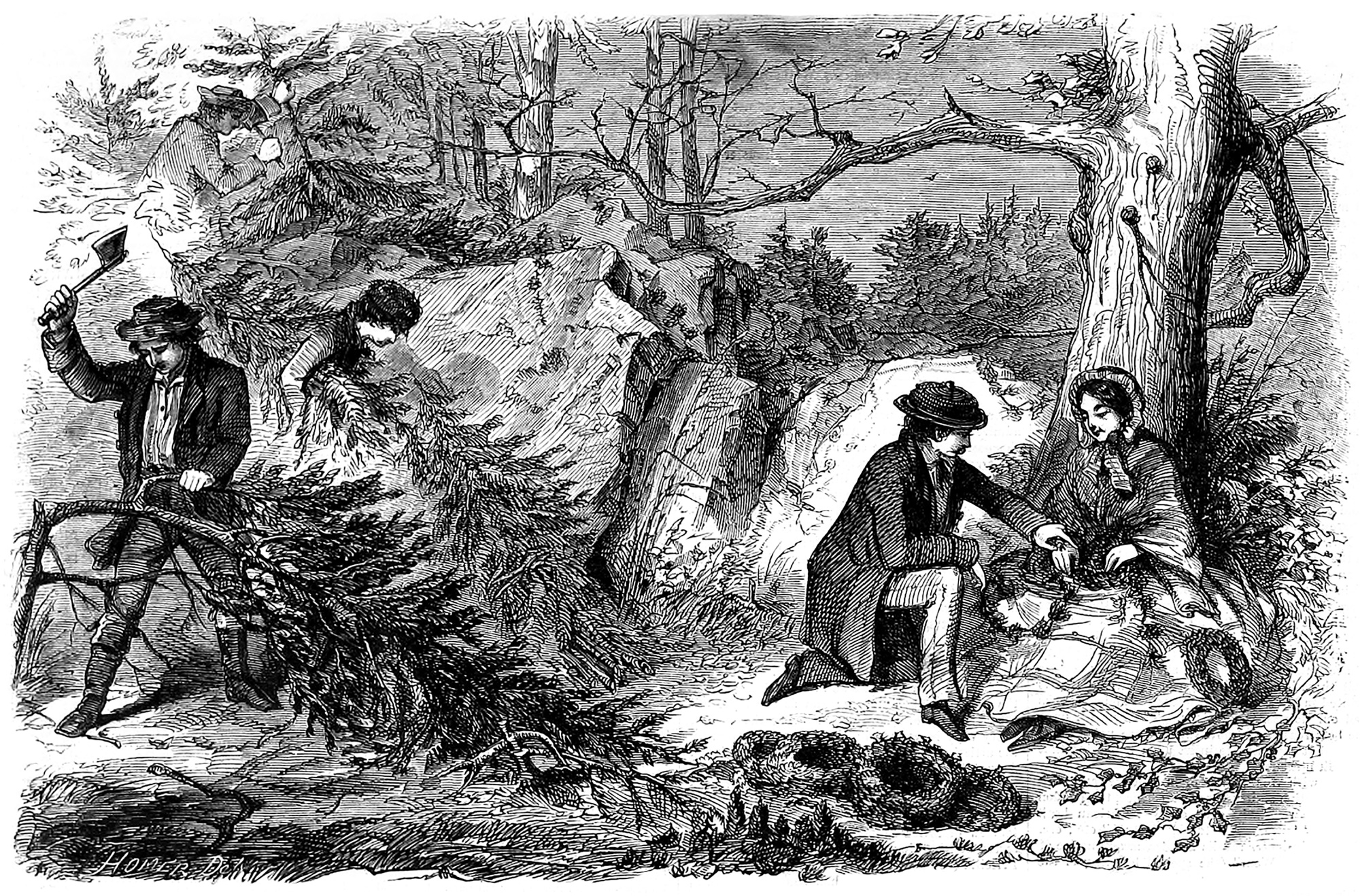 Harper's Weekly
Chaplin was not the only one having lackluster holiday celebrations before the war. In fact, his experiences were typical. Across the state in Edgefield County, Whitfield Brooks reveled in the mundane. Having “heard of but little [Christmas] merry making among the young or old,” he pronounced it an exceptionally “cheering” and “pleasant day.”16 Tennessean Randal W. McGavock, meanwhile, passed Christmas Day 1857 “quietly in my office.” “Christmas in my early life was a joyous day,” he recalled, “but now it is very dull.”17 In Spring Dale, Mississippi, Christmas 1851 passed without any amusement at all for Dr. Elijah Millington Walker. “In a few more years,” he believed, “it will be almost entirely forgotten in the backwoods.”18 Would Christmas be forgotten? No. In fact, the Civil War transformed the day into something more meaningful and emotionally poignant for individuals and something more uniformly celebrated and valued across the nation.
Even the quietest, dullest, most unremarkable holidays, however, assumed a new meaning for Confederate soldiers adjusting to life among strangers and acquiescing to war’s inherent unfairness. Christmas 1861 found Calvin Leach encamped with the 1st North Carolina Infantry. The day had left him in an unusually reflective and thoughtful mood. The preceding year had been filled with new, terrifying experiences, and, he wrote in his diary, “little did I think this day 12 months ago that I would now be in the [army] in Va.” “And where,” he wondered, “will I be 12 months from today; probable, my flesh will be return[ed] to its mother dust.” His Christmas prophecy was only partially wrong. He survived the next 12 months, but he did not survive the war. A shell fragment severed his arm and leg, killing him, on June 30, 1864.19
The past has its burdens, to be sure, but it also has its blessings. And Confederate soldiers carried the bittersweet memories of Christmases past into the army and onto the battlefield. “The recurrence of this Holy day” invoked “many memories of the past” for Nathaniel Dawson, a soldier in the 4th Alabama Infantry. From Virginia, he dreamed of “the many hours of childhood, when church and home were dressed in evergreen, when the Christmas tree was hung with gifts, and Santa Clause made his annual rounds, and ‘all went merry as a marriage bell.’” Nearly a year before he had fallen in love with a young woman, Elodie Todd; eight months before she had confessed her reciprocal love to him; and in four more months they were to be married. Dawson wanted nothing more than to be at home, with her by his side, “at Christmas, the festal season, where age is rejuvenated and lives again in the merry carols of youth.” For Dawson, life did end up being, if not always “merry as a marriage bell,” at least long and happy. He married Elodie. And he did get to go home.20
“Nearly everyone” in the 16th Mississippi Infantry was “searching for liquor” on Christmas Eve 1862. “Prices ranged from fifty to one hundred dollars; quality from bad to worse.” But the men didn’t care, and many paid the asking price. A few days before they had paid another, figurative price at the Battle of Fredericksburg. Guns rang out along the Rappahannock River on December 11, 1862. The boys in gray fell into line as the boys in blue attempted to cross the river and storm Marye’s Heights. Five inches of snow covered the ground as Confederate soldiers lay in line of battle, under steady shelling. “We come very near freezing to death,” a Mississippian recalled. The cold didn’t have a chance to kill Confederate Corporal Richard L. Breeden—a minie ball did that work. Overall, Confederate losses were “trifling”; instead, as James Johnson Kirkpatrick attested, “the valley is strewed with blue corpses.” The battle ended 10 days before Christmas. Private Jefferson J. Wilson had never seen “dead men lay thicker on the ground.” The men of the 16th wanted to forget. They needed to forget. And so the “incessant roar of musketry,” “the busting and whizzing of shell,” and the “buzzing sound of grape and canister that plowed into the ranks of the contending armies” faded into memory, as much as such things can fade. Back at camp, boozing, they were “glad to enjoy once more undisturbed slumbers and that immunity from death and danger which can only be appreciated after a long time’s imminent experience.”21
There were other reasons for drinking, too. Some soldiers were bored and drank to pass the time. Others simply enjoyed the taste. While not all soldiers were tight or even tippling, Confederates, as a whole, drank to a troubling degree during the Christmas season, especially in the early years of the war when liquor flowed freely into camp. Soldiers from the 4th Alabama Infantry turned out en masse to celebrate their first Christmas in the army. After an ample round of eggnog on Christmas Eve, the boys refilled their cups, drinking and singing until sunrise on Christmas morn. “Bad whiskey is abundant and pleasure is sought and sorrow drowned in large potations,” an Alabamian soldier concluded. “I fear we have too much drinking.”22 One soldier started drinking on Christmas Day and then kept on drinking well into January. Corporal Samuel H. Bell did not blame his friend for the nearly three-week-long bender since “he has nothing to do only to drink licker.”23
And there was little to do but drink on Christmas Day. There was no Santa Claus to deliver gifts, no hearty feast to devour, no pretty girls to dance with. Near Fredericksburg, Virginia, with “nothing to drink nor no young ladies to talk too,” North Carolinian Bartlett Yancey Malone had “but little fun” on Christmas Day 1861.24 In sharp contrast to the lavish spreads of his Christmases past, Private John W. Joyce of the 21st North Carolina Infantry had only a little coffee and sugar for breakfast on December 25, 1864.25 By sheer necessity, holiday rituals had to be modified for the times or forsaken altogether. Peacetime’s hunting excursions and firework displays gave way to wartime’s drunken antics and shooting matches. On Christmas Eve 1861, the members of the 2nd Tennessee Cavalry had “plenty of whisky in camp,” which they “were cutting up at such a terrible rate.” The inebriates grabbed their guns, pointed it skyward, and pulled the trigger. Officers eventually halted the raucous celebrations, but not before it had become “vivid in the memory of quite a number of the boys who were present on this special occasion.” “Though, perhaps, I had better not say too much,” a participant recalled, “I shall not accuse any of the boys of being drunk, but I hope that they will excuse me for saying that some of them had either smelled or tasted of something that made them appear a little ‘funny.’”26
 Library of Congress
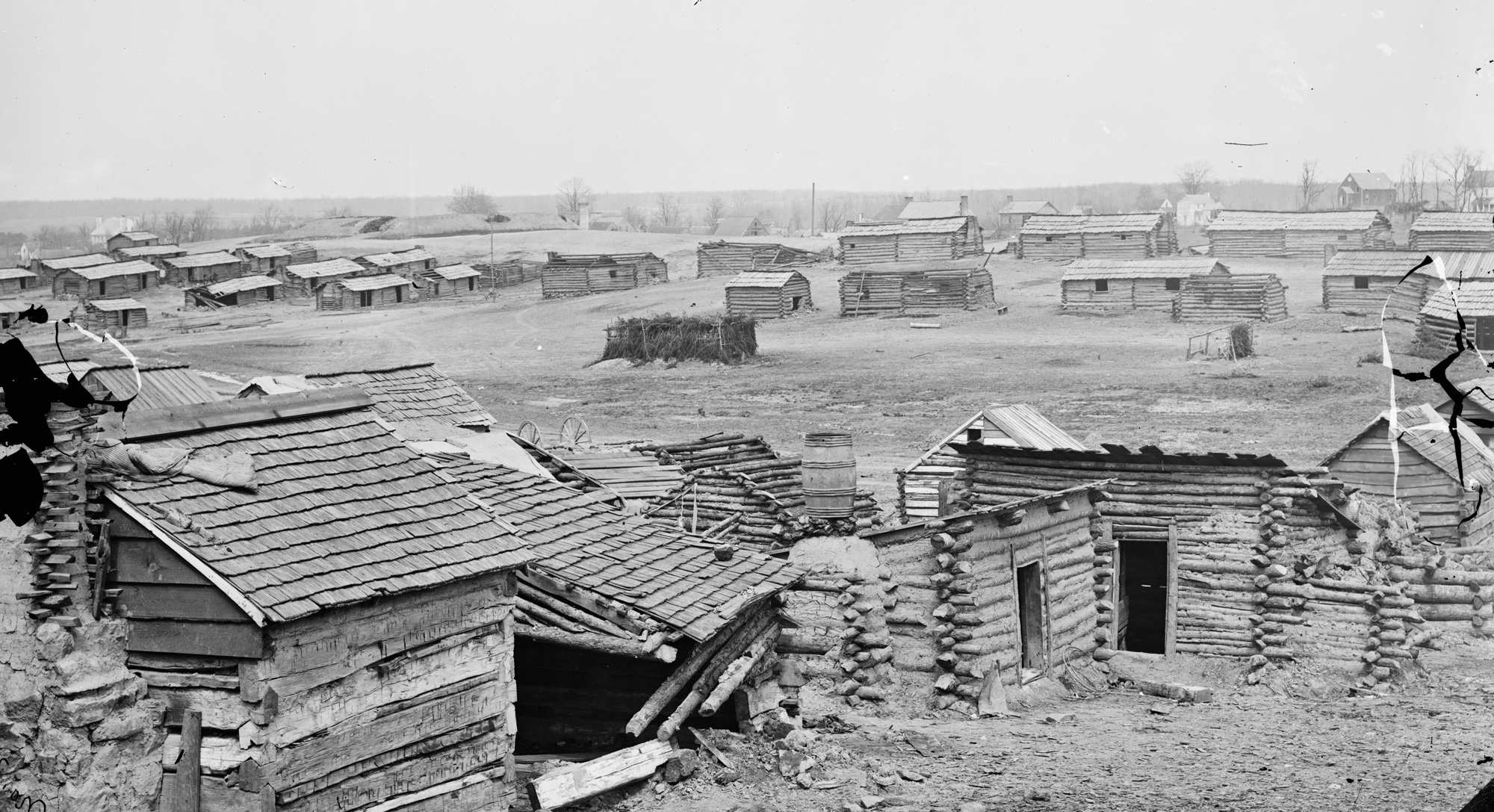
A mix of boredom, homesickness, and access to liquor often turned Christmas celebrations in the Confederate army into occasions for heavy drinking. Above: Abandoned Rebel winter quarters in Manassas, Virginia, as they appeared in 1862.
The officers of the 55th North Carolina Infantry “had what they would call a lively time” on Christmas Day 1862. Private Joseph J. Hoyle, however, called it “a drunken time.” He did not approve of such “worldly Christmas” celebrations.27 James W. Lineberger, too, preferred to put his trust in God. On the “holy day,” he wanted to be, not in the army, but with his wife, Elizabeth C. Lineberger, at church in Gaston County, North Carolina. “I havent herd but one sermon since I left,” he complained, “and I dont believe that I will hear any while.” The brigade either lacked a chaplain or lacked a diligent chaplain who preached. Lineberger also missed his wife. When he left home in March 1862, Lineberger had promised her that he would be home by Christmas. But, as he explained by way of apology in his Christmas Day letter, “times is no better & I cant ask for a furlow.”28 The war made his temporary absence a permanent one. Sometime in the spring or summer of 1864, Elizabeth received a brief letter: “I am sorry to communicate to you the intelligence of the death of your husband. I did not learn when he died. Ambrose Costner Esq. came up on the train this morning and was told by an officer also on the train that Wellington was dead. These are all the facts I was able to learn.”29 Her husband had been mortally wounded at the Battle of Drewry’s Bluff on May 13, 1864. James and Elizabeth Lineberger would never have another holiday together on this earth.
For some Confederate soldiers, alcohol was their only tie to a past life. Christmas Day 1864 passed quietly for the members of the 13th Battalion North Carolina Light Artillery, and to mark the almost unmarkable occasion, James Evans took a nip of eggnog. It was “the only thing to remind me of gone by Days.”30 Samuel A. Barney, a Georgian in Cobb’s Legion, experienced a similar sensation. Longing for his wife and their son, he begged for a “small box of good things”—one that included brandy or whiskey. He would miss the annual hog killing, and a package from home, while an imperfect solution, would remind him of better days. When December came, Barney, having been unable to purchase a turkey or improve his mess, had only the eggnog and whiskey mailed by his father. The liquor was “so different from my usual days feasting that I was reminded very forcibly of Christmas.”31
 The Illustrated London News
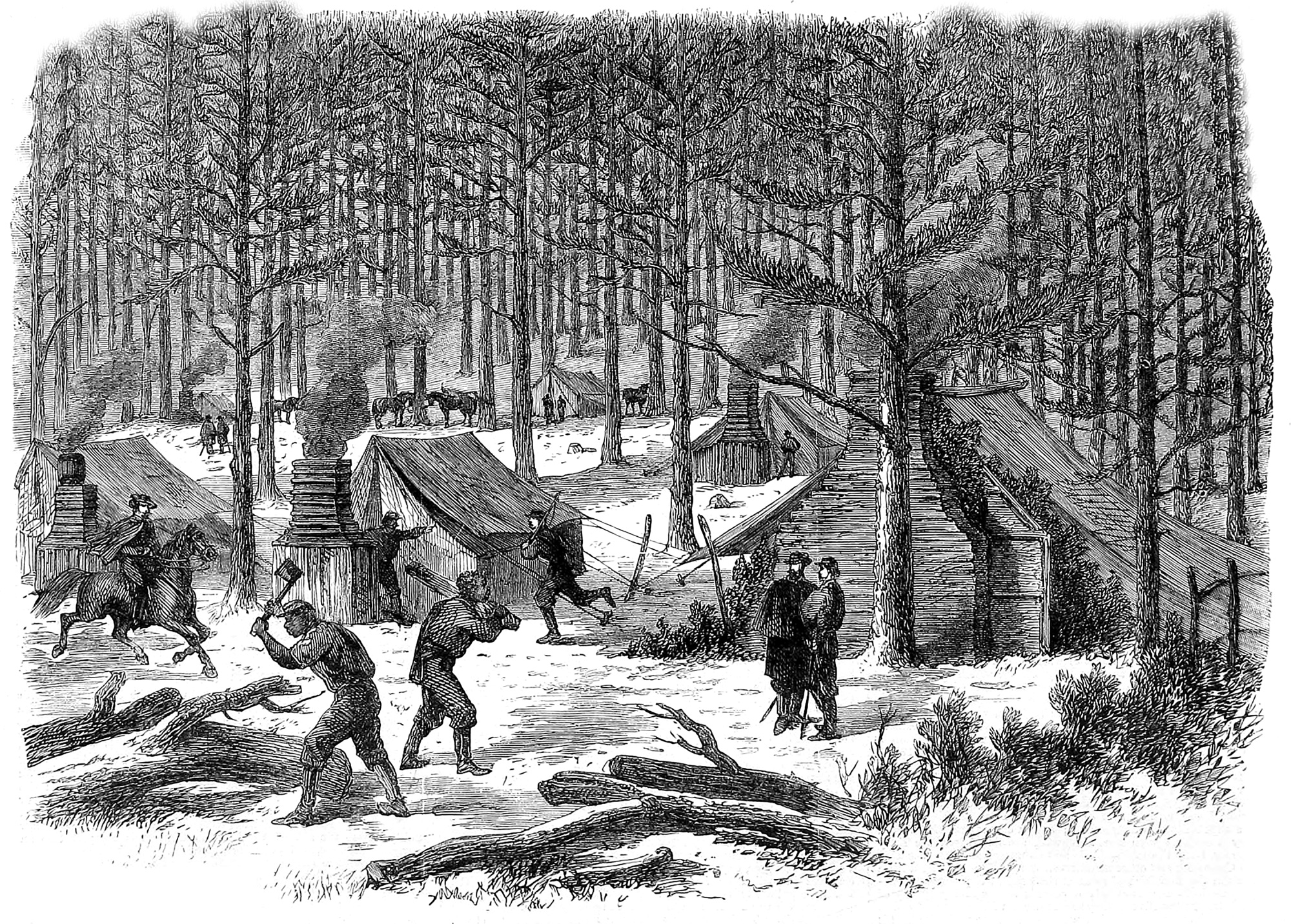
Confederate cavalry commander J.E.B. Stuart’s winter camp along the Rapidan River in 1864.
Indeed, Confederate soldiers made the best of the holiday. At Camp Carondelet in Virginia, Louisiana soldiers anticipated a “very dull Christmas.” The army’s all-male space, however, gave men a license to be licentious, and Rueben Allen Pierson and his fellow Louisianans took full advantage. His messmates procured “enough of the precious fluids to knock up a little nogg on Christmas night,” and the following morning company officers distributed more eggnog to the entirety of the camp. “You can easily imagine that we had a very merry time while the effects of ‘King alcohol’ lasted—a general jabber was kept up for more than an hour.” It reminded Pierson “of a drove of puddle ducks about light of a fine spring morning.”32 During the first Christmas season of the war, the boys and officers of the 12th Texas Cavalry gathered together “impatiently awaiting to slake their thirst at the ‘sparkling bowl.’”33 After dinner, the officers raised their glass to toast the Confederacy, eliciting patriotic cheers from the boys in gray.
To fill the void left by absentee wives and sweethearts, soldiers reveled with other soldiers. The 3rd South Carolina Infantry began their Christmas celebrations early. Just after tattoo on December 20, 1861, Tally Simpson and his five messmates gathered for a little fun. Cracking three dozen eggs, they beat the yokes in a communal tin bucket and, after dividing the whites among several plates, divvied it out to the eager onlookers. “You had better believe there was a rattling of plates and spoons and knives” as the men prepared the concoction. “The ‘nog’ completed, the china cups were set around on the bed, and if there were not enough of them, the vacancies were filled with tin cups. Not having spoons enough for all, we safely and with out a great deal of trouble, deposited it in accordance with the late army style.” Despite all the drinking, “none of us rose this morning with the ‘big head,’ the result of tipsiness.” Alcohol, while problematic for military discipline and general order, also brought men together in a moment of friendship. And while Simpson was “very anxious” to be at home with family on Christmas Day, his messmates, nonetheless, “had a very jolly time” of it in camp.34
Homesick Confederate soldiers, their wives, and their mothers dreamed of a better, brighter future spent with their loved ones. For Henry Orr, a private in the 12th Texas Cavalry, December 25, 1861, “was celebrated differently from those of former times, being far out on the tented field.” The ghosts of Christmas past, present, and future weighed heavily on Orr, who “could not help but revert to the Christmases of bygone times … review the past with some degree of consolation and indulge a prospective view of the future when our enemies shall withdraw from our land the implements of war laid away to rust, and the beacon lights of liberty rekindled again over our once happy county.”35
With her husband serving in the 54th Georgia Infantry, Christmas 1862 was a sad and lonely one for Mattie Ely Bethune, a young wife and the mother of two small children. But she was optimistic for her own and the Confederacy’s future. Looking not to the past nor to the haunted present, she hoped that “we may yet be spared to spend many Christmases together and then we can look back to the one we spend separate, not with pleasure but of one looking from the sunshine of noonday to the darkness of midnight.” Across the state in Beaulieu, Georgia, Mattie’s husband, Marcus Bethune, “had some Christmas even in camp.” Having overindulged, the Confederates toppled a sutler’s tent and unleashed general mischief across the camp. The guards, meanwhile, were also “slightly tight” and, rather than alleviating the problem, simply hollered for the corporal and added to the confusion. In 1863, the couple again spent Christmas apart. “In truth,” Bethune admitted to his wife, “I was a little ‘homesick’…. I do most sincerely hope & trust that era another Christmas rolls around we will be together.”36 Yet a reunion did not occur until after the Confederacy’s surrender, in 1865.
Confederate soldiers assumed an almost religious, worshipful air when their Christmastime thoughts turned to the lives, and the women, they had left behind. With his marriage delayed by “this unfortunate war,”
Nathaniel Dawson nonetheless thought of his sweetheart, Elodie Todd, on Christmas Day 1861. “Tho far away,” Dawson assured her, “I am hovering near you in spirit, and imagine that I hear your merry laughs winging on the ear, and have wished you many a happy returns of the season.”37 He was not alone in his desire. Three days before Christmas, Jesse Harrison told his mother “how happy would I be … if I could come and spend Christmass with you all.”38 On Christmas Eve 1864, William P. Mangum’s mind wandered far from his campsite in Macon, Georgia, to his family farm in Jackson County, Georgia. It was the “desire of the burdensom hart” to “bea at home and spend this Christmas” with his wife, Louisiana C. Mangum. “Nothig,” he assured his mother, “wold render me so happy as to be with you at this time even to spend a fiew days.”39
To a Confederate soldier, Christmas was, at its very heart, all about absent family, friends, and lovers. Jessie Kirkland of the 16th Mississippi Infantry missed home. “Loneliness, particularly at night,” overwhelmed him, and infrequent letters did little to fill the void. On December 25, 1861, he concluded his letter, “Goodbye. I kiss you adieu. Kiss the babies a Merry Christmas.”40 One after another, such homesick refrains filled soldiers’ Christmas letters. Addressing his sister in 1863, John W. Rogers hoped “those few lines” would “find you and the baby and all the rest of the family well … [and] I would like to see you all the best in the world yesterday was Christmas or they tell me it was though it did not seam much like Christmas to me.”41 “Though many miles apart,” Hugh Ponton thought of his wife, Francis. Anticipating a dry holiday, he asked her to “get … [herself] a dram for christmas” and then “drink one for me.”42 Another Confederate soldier had a “wish [that] the last yankee was dead” so he could be home for Christmas to enjoy the good company of family and friends.43
As a Confederate soldier’s wife, Mattie Ely Bethune’s soul was sad on Christmas Eve 1862. “I cannot be gay,” she wrote her husband, “for too deep a gloom is already hovering like a dark pall around my heart…. My love tomorrow is my birthday and a sad one it will be…. I feel more like my funeral was going to be preached.” She had expected her husband home on furlough for Christmas, but, now, she didn’t know his whereabouts and his Christmas presents sat unused and unworn in Barnesville, Georgia. “Yes darling,” she wrote, “there are your socks and gloves, I expected you could get them when you came to see me—but now your hands and feet are now probably suffering with cold.”44 Other southern women struggled, too. With two sons away in the army, Caroline Mauldin tried her best, but “times are too hard for many presents.” Visiting the Episcopal church in Greenville, South Carolina, she noticed the tree’s trimmings, but her focus was not on religion. It was on her boys. How did her sons spend Christmas? Twelve-year-old Sam feared that his elder brothers “had to dine with the Yankees.” Caroline’s Christmas wish was simple: “if I could have you and Willie home we would have Joyful times, but we will remember last Christmas and hope for the future.”45 The future was, in fact, brighter for Caroline. Both sons survived the war.
“How shall we grace this hallowed day?” asked Henry Timrod, often called the poet laureate of the Confederacy, on December 25, 1866. Reading the poem in the morning newspaper, the white residents of Charleston, South Carolina, contemplated the meaning of Christmas for a defeated people living in a defeated nation. “Shall happy bells, from yonder ancient spires, / send their glad greetings to each Christmas fire / Round which the children play?” No. Shall the day be celebrated “With feast, and song, and dance, and antique sports, / And shout of happy children in the courts, / And tales of ghost and fay?” Again, no. The times were too somber for such merrymaking. “How could we bear the mirth,” the poem continued, “While some loved reveler of a year ago / Keeps his mute Christmas now beneath the snow, / In cold Virginia earth?”46 In total, an estimated 750,000 northern and southern men had died during the war.47 In these households, Christmas would never, could never, be the same. Some of them had, to be sure, brought the pain of war upon themselves. They had fought not for a noble cause but to enslave others. They had been active, willing participants in their own and their nation’s demise. But, even in the wake of their destruction, there was a modicum of joy in Christmas.
The Charleston Daily News described Christmas as a day when families, “separated as many of these are during the rest of the year … all make an effort to meet together round the Christmas hearth. The hallowed feelings of domestic love and attachment, and pleasing remembrance of the past, and the joyous anticipation of the future, all cluster round these family-gatherings.”48 After four years of killing and separation, many white southerners did just that in 1866. A “really beautiful” Christmas tree, adorned with “a number of English walnuts, painted different colors suspended from the tree by bright colored ribbons, all filled with sugar plums” graced the Trenholm home in Newberry, South Carolina. Visiting their neighbors, F.A. Trenholm had “a very handsome supper,” with “plenty … of everything that was nice.” They “wound up” the evening with eggnog. It was a “pleasant” Christmas season, Trenholm concluded, filled with weddings “in spite of hard times & want of money.”49 No longer was the midwinter anniversary of Christ’s birth a “dull” or inconsistently celebrated affair in the South.
By 1866, Christmas had become what we know it as today—a sentimental holiday, to be spent at home among loved ones, filled with nostalgic reminiscences. Only five years after the war’s conclusion, Congress declared Christmas a federal holiday, formally endorsing a household custom that had already become meaningful to Americans North and South. It had taken the Civil War—and all its death, debauchery, and despair—to bring about the full meaning of “merry Christmas.”
Tracy L. Barnett is a doctoral student at the University of Georgia and the Graduate Mellon Fellow in the Digital Humanities. Her primary research interest is the cultural history of the mid-19th-century South and she is fascinated by male behavior—especially the bad and unsavory varieties.
Notes
1. W.A. Day Book of Recollections and Miscellany, page 253-254, #3732, Southern Historical Collection, The Wilson Library, University of North Carolina at Chapel Hill (hereafter cited as SHC).
2. Ibid., 248.
3. Ibid., 251, 253.
4. Samuel Wilson Ravenel, “Christmas at Pooshee Plantation, Berkeley County, S.C.,” Charles Stevens Dwight Papers, South Caroliniana Library, University of South Carolina (hereafter cited as USC).
5. December 25, 1925, unknown author, in the Confederate Reminiscences, #1400-z, SCH.
6. Ibid.
7. December 25, 1859, Julius W. Wright Diary, in the Murdock and Wright Family Papers (hereafter MWFP) #532, SHC.
8. King James Bible, Matthew 2:1.
9. December 25, 1859, Julius W. Wright Diary, MWFP #532, SHC.
10. James O. Farmer Jr., ed., An Edgefield Planter and His World (Mercer, GA, 2019), 92.
11. December 25, 1859, Julius W. Wright Diary, MWFP #532, SHC.
12. December 25, 1852, Everard Green Diary, in the Everard Green Papers #41, SHC.
13. December 25, 1859, Julius W. Wright Diary, MWFP #532, SHC.
14. December 28, 1859, Theodore Samuel Marion DuBose to Mrs. E. Marion Porcher, Theodore Samuel Marion DuBose Papers, 1859-1860, USC.
15. Theodore Rosengarten, Tombee: Portrait of a Cotton Planter with the Journal of Thomas B. Chaplain (New York, 1986), 385, 448, 515.
16. Farmer, An Edgefield Planter and His World, 196.
17. Herschel Gower, ed., Pen and Sword: The Life and Journals of Randal W. McGavock (Nashville, 1960), 448.
18. Lynette Boney Wrenn, A Bachelor’s Life in Antebellum Mississippi: The Diary of Dr. Elijah Millington Walker, 1849–1852 (Knoxville, 2004), 179.
19. December 25, 1861, June 29, 1864, Calvin Leach Diary, in the Calvin Leach Diary and Letters #1875-z, SHC.
20. Stephen Berry and Angela Esco Elder, eds., Practical Strangers: The Courtship Correspondence of Nathaniel Dawson and Elodie Todd, Sister of Mary Todd Lincoln (Athens, GA, 2017), 275, 278.
21. Robert E. Evans, ed., The 16th Mississippi Infantry: Civil War Letters and Reminiscences (Jackson, 2002), 126, 128–132.
22. Berry and Elder, Practical Strangers, 279.
23. January 14, 1862, Samuel H. Bell to Mary E. Bell, Private Voices: The Corpus of American Civil War Letters: (hereafter cited as Private Voices).
24. William Whatley Pierson Jr., ed., The Diary of Bartlett Yancey Malone (Chapel Hill, 1919), 27.
25. December 25, 1864, John W. Joyce to Francis A. Joyce, Private Voices.
26. Richard Ramsey Hancock, Hancock’s Diary, or, A History of the Second Tennessee Confederate Cavalry: with Sketches of First and Seventh Battalions (Nashville, 1887), 297.
27. Jeffrey M. Girvan, ed., “Deliver Us from This Cruel War:” The Civil War Letters of Lieutenant Joseph J. Hoyle, 55th North Carolina Infantry (Jefferson, NC., 2010), 89.
28. December 25, 1862, James W. Lineberger to Elizabeth C. Lineberger, Private Voices.
29. Undated Letter, I.R. Peterson to Elizabeth C. Lineberger, Private Voices.
30. January 1, 1864, James Evans Jr. to James Evans Sr., in the James Evans Papers #248, SHC.
31. Nat S. Turner, ed., A Southern Soldier’s Letters Home: The Civil War Letters of Samuel A. Burney, Cobb’s Georgia Legion, Army of Northern Virginia (Macon, GA, 2002), 54–55, 87.
32. Thomas W. Cutrer and T. Michael Parrish, eds., Brothers in Gray: The Civil War Letters of the Pierson Family (Baton Rouge, 1997), 71–72.
33. John Q. Anderson, ed., Campaigning with Parsons’ Texas Cavalry Brigade, CSA: The War Journals and Letters of the Four Orr Brothers (Waco, TX, 1967), 19.
34. Guy R. Everson and Edward H. Simpson Jr., eds., “Far, Far from Home:” The Wartime Letters of Dick and Tally Simpson Third South Carolina Volunteers (New York, 1994), 101–102, 104.
35. Anderson, Campaigning with Parsons’ Texas Cavalry Brigade, 18–19.
36. Linda S. McCardle, ed., A Just and Holy Cause?: The Civil War Letters of Marcus Bethune and Martha Frances Ely 1862–1865 (Macon, GA, 2016), 38–39, 73.
37. Berry and Elder, Practical Strangers, 279.
38. December 22, 1863, Jesse Harrison to Eliza Harrison, Private Voices.
39. December 24, 1864, William P. Mangum to Louisiana C. Mangum and Eliza Mangum, Private Voices.
40. Evans, The 16th Mississippi Infantry, 50–51.
41. December 26, 1863, John W. Rogers to Rhoda Poe, Private Voices.
42. December 13, 1861, Hugh Ponton to Francis Ponton, Private Voices.
43. December 4, 1861, H.T. Reeder to William T. Martin, Private Voices.
44. McCardle, A Just and Holy Cause, 35–36.
45. December 26, 1861, Caroline Mauldin to Belton Oscar Mauldin, USC.
46. Henry Timrod, “Christmas,” The Charleston Daily News, December 25, 1866.
47. J. David Hacker, “A Census-Based Count of the Civil War Dead,” Civil War History 57, no. 4 (2011): 311.
48. The Charleston Daily News, December 25, 1866.
49. January 11, 1866, F.A. Trenholm to Mrs. MacKenzie, MacKenzie Family Papers, USC.