 Wikimedia Commons
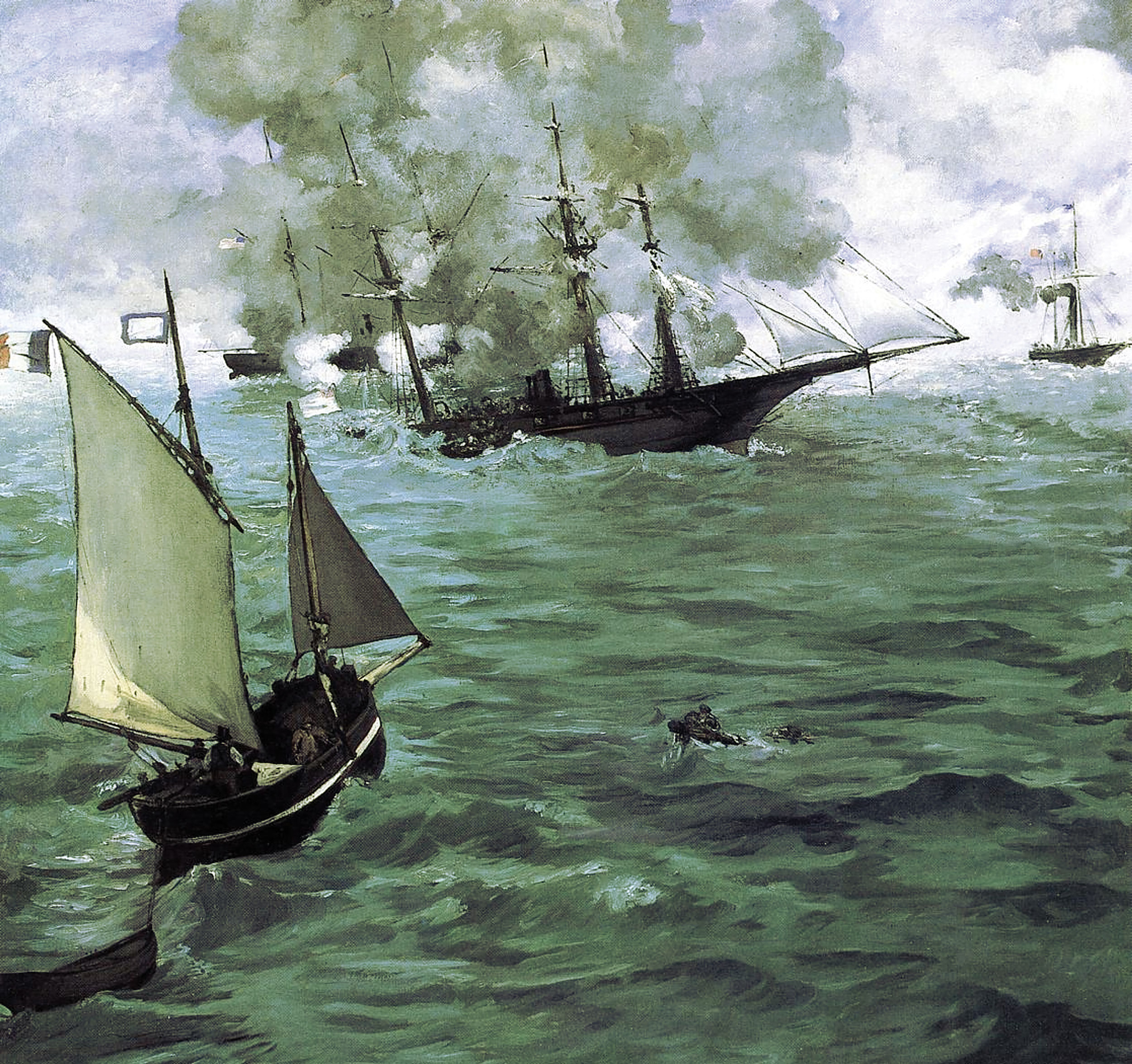
The Battle of the Kearsarge and the Alabama by Edouard Manet depicts the sinking of the Confederate raider CSS Alabama during the Battle of Cherbourg in 1864.
Lieutenant James D. Bulloch would rather have commanded a cruiser for the Confederate States Navy, but Richmond decided his service to the new nation best lay in arranging for the construction of such craft in friendly foreign shipyards. In 1861 he sailed for England as an agent for the Confederate navy, established himself in Liverpool, and from his lodgings at 10 Rumford Place orchestrated the construction of the two most famous seagoing vessels ever to fly the Confederate flag.
Bulloch, an uncle of Theodore Roosevelt, was a native of Savannah, Georgia. He had served in the U.S. Navy for 14 years, and had captained merchant vessels for another eight after that, so he appreciated the attributes of speed and firepower. He incorporated both qualities in the ships he ordered from Merseyside contractors. For the first pair of cruisers, he approached the Laird brothers, whose yards lay at Birkenhead, just across the river from Liverpool.
Deftly skirting the prohibitions in Britain’s Foreign Enlistment Act, which forbade the construction of warships for belligerent nations, Bulloch gave the Lairds every opportunity for plausible deniability. He shipped no arms or ammunition at Birkenhead, saving that for international waters or ports under less particular dominion. Yet the Lairds knew Bulloch’s origins and surely suspected the ultimate plans for the craft he ordered—especially when he asked to have tracks laid in the decks for pivot guns.1
Bulloch’s first vessel put to sea late in March 1862 as the Oreto, but after taking its armament aboard in the harbor of an isolated key, it would gain fame as the CSS Florida.2 The second of Bulloch’s greyhounds left the graving dock at Birkenhead as the Enrica, but the American consul at Liverpool already knew that it, too, was bound for Confederate service, and he came within an ace of having the vessel impounded by British authorities. Bulloch announced that the ship would make a trial run down the Mersey, and to sustain the ruse he ferried out a party of ladies and gentlemen to enjoy the day, including the Laird brothers and their daughters.
The ship cast off from the Canning Street docks on the morning of July 29, 1862, and spent several hours running back and forth before Bulloch announced that the ship would have to stay out all night. He and the civilians transferred to a tug and returned to town, while the captain he had hired slipped the Enrica into an obscure bay on the Welsh island of Anglesey. The next morning Bulloch gathered a few dozen additional men to augment the crew, boarded them all on a tug, and steamed out to the ship’s hiding place. He gave the Enrica’s captain orders for the Azores, shipped the recruits, and returned to Liverpool while the unarmed vessel left the Irish Sea for the Atlantic under sail and steam.3
Like the Florida, the Enrica was bark-rigged, with the foremast and mainmast square-rigged and the mizzenmast sloop-rigged. With all sail set, the engines churning, and a clean copper bottom, it made nearly 14 knots. Ten days after leaving Anglesey the ship dropped anchor in Praia Bay, on Terceira Island. There it lay until August 18, when the tender Agrippina arrived with two big pivot guns and a handful of 32-pounder carronades. The transfer of weapons began the next day, and on August 20 another chartered vessel arrived with Captain Raphael Semmes—a Maryland native who had quit the U.S. Navy after more than three decades of service. The crew spent the next few days mounting the Enrica’s guns, loading the shot lockers, and filling the bunkers with coal from the Agrippina.
By noon on Sunday, August 24, the decks had been washed and the guns polished, and the Enrica started from Praia Bay, stopping five miles out in international waters. There the captain’s clerk read the orders that put the ship in Confederate service under a new name—Alabama—in honor of Captain Semmes’ adopted state. New versions of the Confederate flag were not available in Europe, so the Stars and Bars ran up the mainmast and Semmes climbed atop a gun carriage to entice as many of the crewmen as he could to sign new articles for adventure, generous pay, and the promise of prize money. More than 80 seamen gave their names to the paymaster, receiving dark blue sailors togs indistinguishable from the winter uniforms of the U.S. Navy. With a full complement of officers, many of whom also wore dark blue, Semmes had enough hands to at least begin operations.4
 U.S. Naval History and Heritage Command
Captain Raphael Semmes (center) stands on the deck of CSS Alabama with the ship’s executive officer, First Lieutenant John M. Kell, in August 1863—a year after the raider had put to sea.
Four days later, the Alabama started its first chase as Semmes caught sight of a brig early on the morning of August 29, midway between the Azores and the Portuguese mainland. He kept up with it all day under sail alone; Confederate and Union warships alike conserved as much coal as possible, because most European nations allowed belligerent vessels to refuel within their territories only once every three months. Just as the sun sank, Semmes fired a blank gun from a distance of six miles while his quartermaster raised the Spanish flag, but the brig did not so much as reef a topsail. With darkness looming, Semmes decided to break off the chase, turning his ship back toward the Azores.
During the next week Semmes stopped a Portuguese brig and a French bark, but no legitimate prize passed within range of his spyglass until sunrise of September 5. The Alabama had just passed south of Pico Island when the lookout sighted the double masts of a brig, and the cruiser turned in pursuit. The smaller ship proved much faster, but it had hardly pulled out of sight when another sail appeared. This one lay dead in the water, with the carcass of a sperm whale tied to its side, and when the approaching Alabama raised the British Union Jack the whaler ran up the U.S. flag. She was the Ocmulgee, of Edgartown, on Martha’s Vineyard. Semmes sent Lieutenant Richard Armstrong over in a boat to ask the whaling captain to come aboard. He submitted in apparent confusion, but the Massachusetts Yankee soon understood the nature of his plight—when the British ensign came fluttering down and the Confederate flag went up in its place.5
Taking the Ocmulgee’s crew aboard the Alabama, Semmes put a detail on the prize to strip it of any food, rigging, or supplies his cruiser might need. Lest he alert any other whalers that might lie within sight of the flames, he waited until daylight on September 6 to put the ship to the torch. Permeated with oil as it was, the ship burned bright and fast, consuming what First Lieutenant John MacIntosh Kell estimated as $50,000 in craft and cargo.
The following day, Semmes had no sooner put his prisoners in their own whaleboats to go ashore on Flores Island than a schooner came in view, headed for the harbor. The Alabama leaped to catch it outside Portuguese waters, but the little ship ignored a lee shot and a shot across her bow before heaving to when a third round nearly severed the mainmast. This was Starlight, bound home to Boston with news that the Enrica had slipped away from Liverpool to prey on American shipping. The next day Semmes ran down the Ocean Rover, another whaler more than three years out from Massachusetts, which had 1,100 barrels of oil in the hold; the crew knew little of John Brown, Abraham Lincoln, secession, or the war that destroyed the fruits of their 40 months’ labor.
Lingering in the Azores until mid-September, Semmes picked up several more whaling vessels, and when he left the Portuguese archipelago he headed west, into the shipping lanes from New York and New England. That allowed him to gather in a few more unsuspecting whalers that had left New Bedford, Massachusetts, as recently as three weeks before, giving him newspapers fresh enough to help plan his hunting. The nearer he came to the North American continent, the more recent were the newspapers he took from his prizes. In the Grand Banks he read encouraging reports of the Confederate victory at Manassas, and of Robert E. Lee’s invasion of Maryland, but by the second week of October he found a New York Herald only a week old that dispelled the early rumors of Rebel triumph at Antietam.6
 Florida Keys Public Libraries
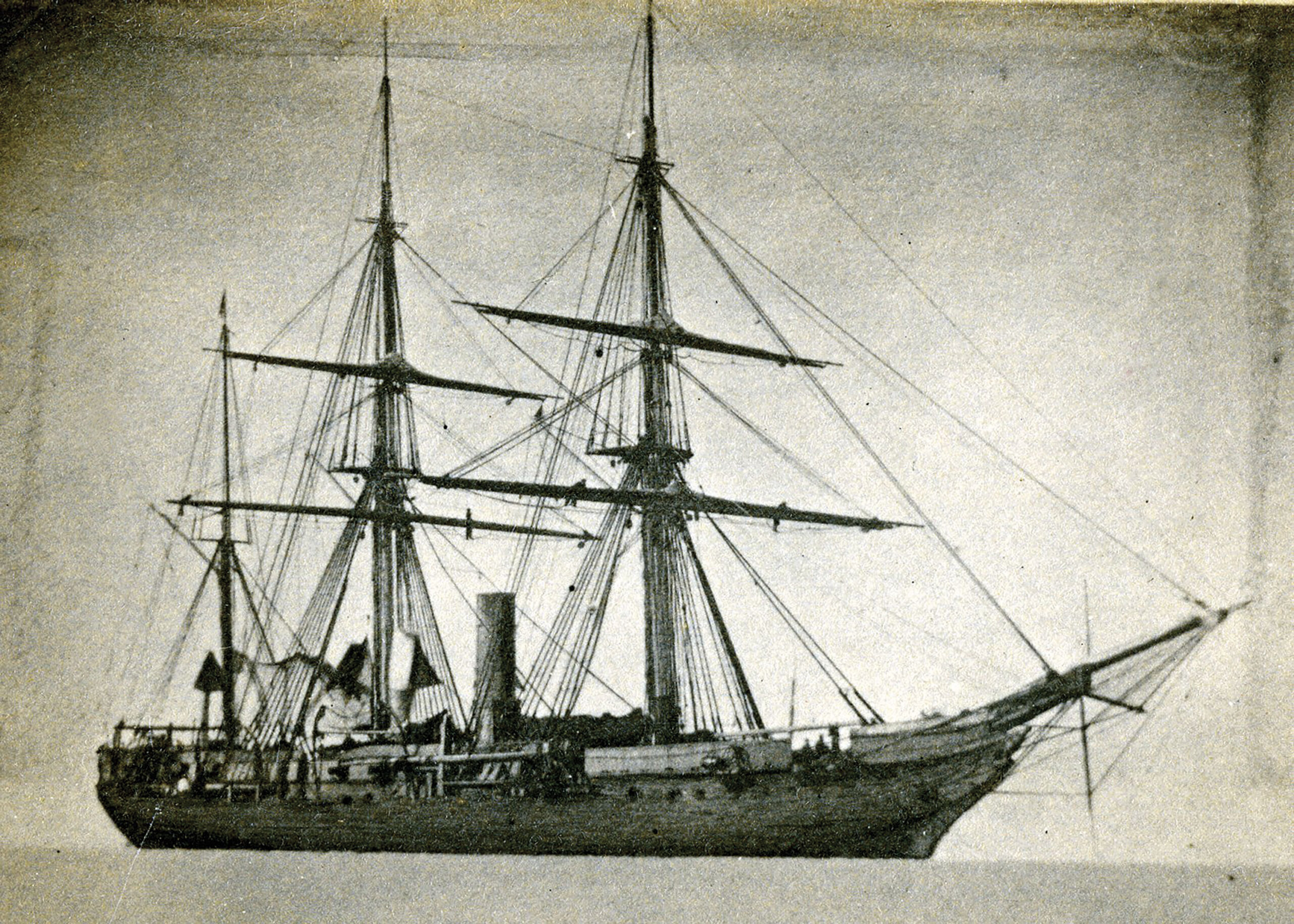
In November 1862, Semmes and the Alabama were able to escape a confrontation with the heavily armed U.S. Navy ship San Jacinto, whose captain, William Ronckendorff, had tried to block the Confederate vessel before it left port in Fort Royal Harbor, on Martinique.
A hurricane struck the Alabama off Cape Breton Island on October 16, nearly sending it to the bottom and driving it far off course. When Semmes made his way back to the New England trade route he learned, through the newspapers found on the next prizes, that New York was aware of his approach and of his captures in the Grand Banks. He had hoped to make a perfunctory strike at New York, if only to embarrass Union authorities and terrify northern shippers, but with coal running low he veered south to meet the Agrippina, which he expected to find waiting in the Lesser Antilles.7
The Alabama dropped anchor in Fort Royal Harbor, on Martinique, the morning of November 18, 1862. There lay the Agrippina, whose captain had blabbed so indiscreetly in barrooms ashore that the now-famous Alabama was looked for by one and all. Word of its impending arrival had leaked to northern merchantmen, who alerted the U.S. Navy, and within 24 hours the USS San Jacinto steamed into view offshore, with 11 guns the size of the Alabama’s biggest pivot. Semmes, who had already sent the Agrippina off to another rendezvous, thought better of fighting so formidable an antagonist and prepared to slip away that night.
The San Jacinto’s commander, William Ronckendorff, conspired with a Maine captain whose Bangor brig was unloading cargo in the port, giving him some rockets and asking him to signal if the Confederate ship should get under way. About 8 o’clock that night three rockets went up, but clouds had darkened the sky and a light rain was falling. The harbor was so wide, too, that watchmen on the San Jacinto could see nothing of their prey, and within an hour and a half Semmes was safely on his way to La Blanquilla Island to replenish his coal from the Agrippina.
La Blanquilla amounted to a mere spit of sand off the coast of Venezuela, which claimed the island. A Provincetown whaling schooner lolled at anchor in the island’s little harbor. When the Yankee captain came out to greet the stranger, the Alabama’s deck officer identified his craft as a United States warship, and the blue uniforms aboard the cruiser aided the masquerade. The Yankee even piloted the Alabama in to a safe anchorage, whereupon the Stars and Stripes came down the mainmast and the Stars and Bars went up. Because of the Venezuelan claim to the island, Semmes declined to take the schooner as a prize, but he detained it there until his coal bunkers were full again. He arranged for his next meeting with the Agrippina to take on coal, released the flustered Provincetown captain with his whaler, and struck for the corridor between Panama and New York, where steamers carried regular shipments of gold from California.8
Sailing unmolested to the Windward Passage between Haiti and Cuba, the Alabama met several big steamers, but all of them loomed out of darkness too dense for a chase. The captain of a Baltimore schooner that Semmes took below Guantanamo Bay reported that the California steamers had changed their route from the Windward Passage. Semmes doubted him, and on December 7 he overhauled the biggest vessel his ship would ever capture. The Ariel belonged to Cornelius Vanderbilt, who had made a fortune on the California gold trade, and it had more than 700 souls aboard, including 140 U.S. Marines. The major in charge of the Marines gathered his men for a fight, but when the Alabama’s guns took down part of the Ariel’s foremast, he assented to the naval officer who counseled surrender. The Marines all signed paroles while the prize crew stripped them of their muskets and took $10,000 in greenbacks from the purser’s safe.
The Ariel had sailed from New York carrying no gold, but Semmes kept all his prisoners on the ship while he waited for another steamer that might have bullion aboard. None appeared, so after a few days Semmes ransomed the Ariel and let it go, rather than loiter where enemy gunboats might come looking for him.9
 VLW Cartography
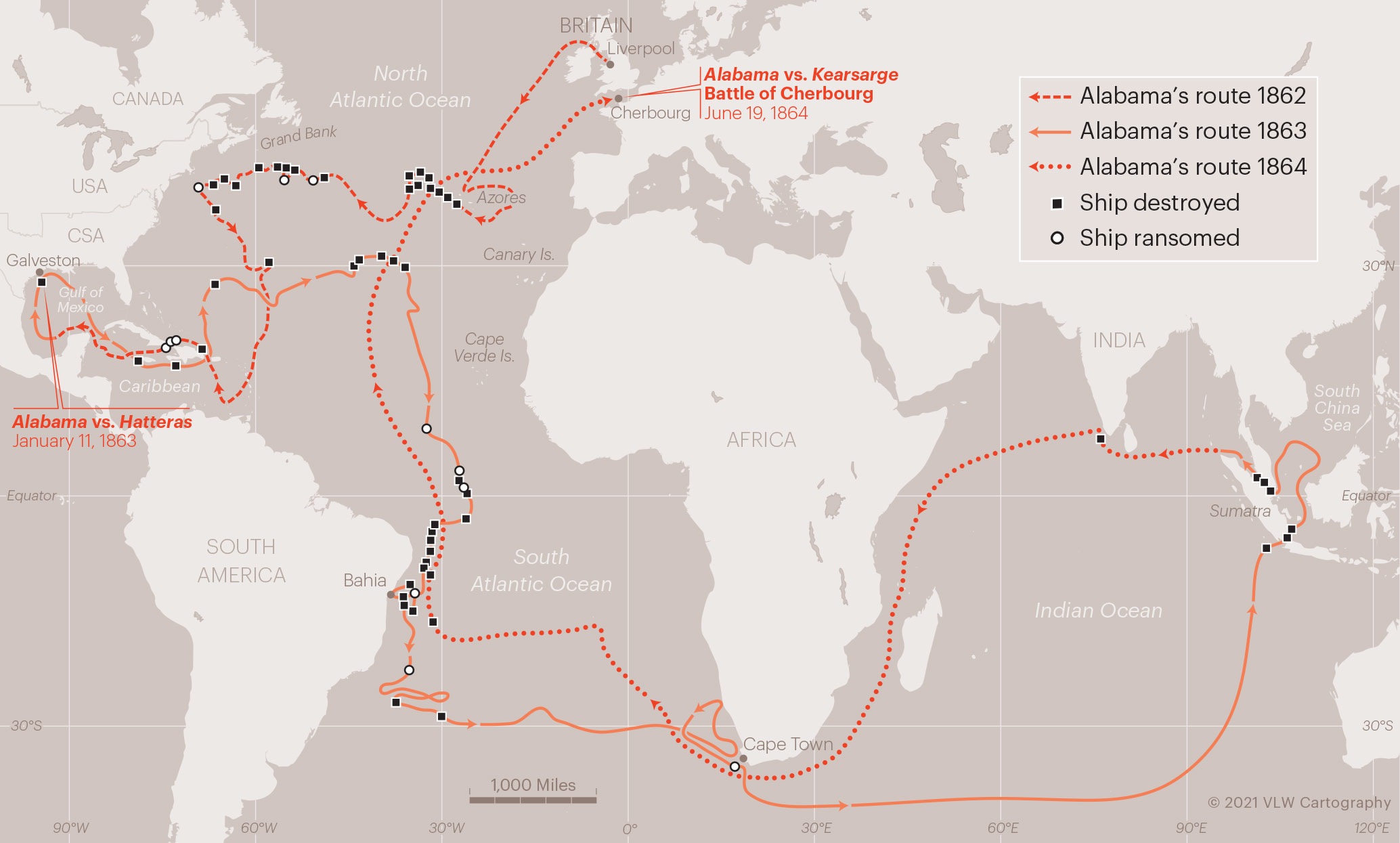
Built in secrecy by British shipbuilders near Liverpool, England, and launched in mid-1862, the Enrica was soon designated as a commerce raider for the Confederate States of America and commissioned as CSS Alabama. Led by Captain Raphael Semmes, the Alabama spent the next two years in search of prizes on the high seas, plotting a circuitous route that led it as far as the South China Sea. By the time the Alabama met its demise at the Battle of Cherbourg in 1864, it had destroyed or ransomed more than 60 vessels.
Learning from newspapers on the Ariel that United States forces probably planned to descend on Galveston, Texas, Semmes decided to lie low in the Caribbean and the Gulf of Mexico so he could venture near Galveston after the first of the year. Just before Christmas he skirted the Yucatan Peninsula and met the Agrippina again in the Arcas Keys, a hundred miles off Campeche. There they remained for two weeks, coaling and caulking the weather-worn raider. Not until January 5, 1863, did Semmes order the Alabama to weigh anchor. As his ship prowled northward he rang the crew to quarters for gunnery practice, allowing his officers to spread the news that he was looking for a fight.
Off Galveston lay a half-dozen Union warships ranging from the 24-gun screw steamer Brooklyn to the converted sidewheel ferry Hatteras, which carried four 32-pounder smoothbores and two smaller rifles. Altogether, the Union vessels mounted 51 guns against the Alabama’s nine. In addition to his original battery of six 32-pounders and two pivot guns—a 100-pounder and a 68-pounder Blakely rifle—Semmes had salvaged a little 12-pounder from the Ariel.
At midafternoon on January 11, the Alabama sailed into view as lookouts in the crow’s nests of the Federal fleet scanned the horizon, and three of those sailors alerted their deck officers to the sighting. When the cruiser spun coyly about as if to run, one of the Union ships started after it. A signal from the flagship Brooklyn notified Lieutenant Commander Homer Blake of the Hatteras to investigate, and he took up the chase at 3:30. He was a half-hour building up a full head of steam, while Semmes ordered his sails shortened to avoid discouraging his unwitting victim. He lowered his own propeller, however, and whenever Hatteras drew too close, the Alabama would surge ahead to a safe distance.
As daylight waned Semmes allowed the enemy to come nearer, but he wanted to leave its sister ships as far behind as possible. Finally, at about 6 p.m., the Alabama hove to and Commander Blake found the chase waiting for him to come alongside. As he did, one of his officers asked through the megaphone who the stranger was.
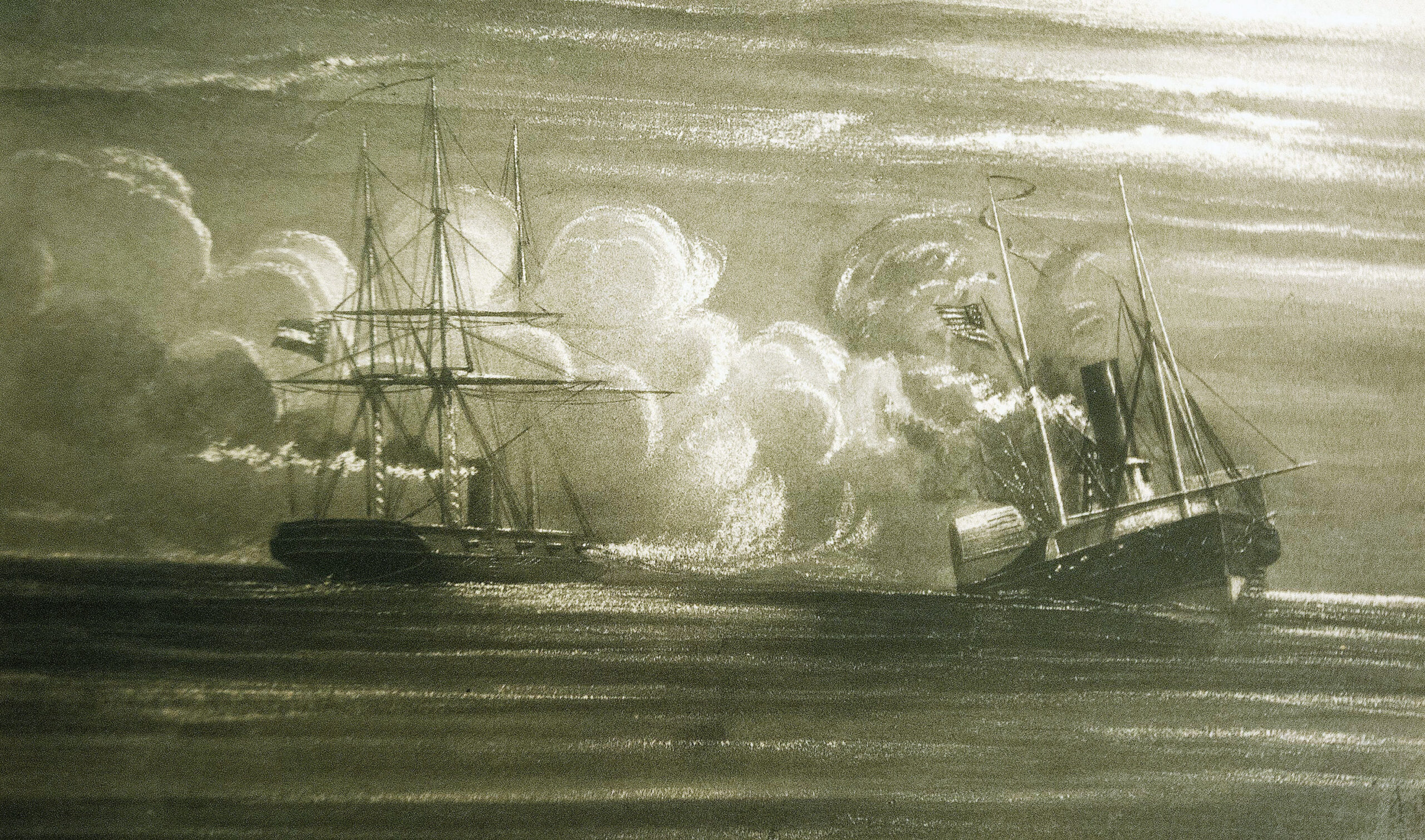
“Her Majesty’s Steamer Petrel,” came the reply, but Blake lowered a boat to board her anyway. The deck officer on the Alabama asked the name of the Union ship. The first answer carried indistinctly, but after a second query Lieutenant Kell caught the words “United States steamer,” at which he grabbed the megaphone himself and bellowed “We are the Confederate steamer Alabama.” With his last syllable, the Alabama let fly with a broadside at a distance of a hundred yards. With his hull already riddled, Blake returned a weak fire and tried to sidle over within boarding distance. At closer range men on both ships fired at each other with small arms. Barely a dozen rounds struck the Alabama, none of them doing much damage, but within minutes the hold of the Hatteras was on fire from a shell that burst amidships, and another had set fire to a room beside the sick bay. A third shell had penetrated the boiler of the Hatteras, killing two firemen when escaping steam filled the engine room.
 National Museum of the U.S. Navy
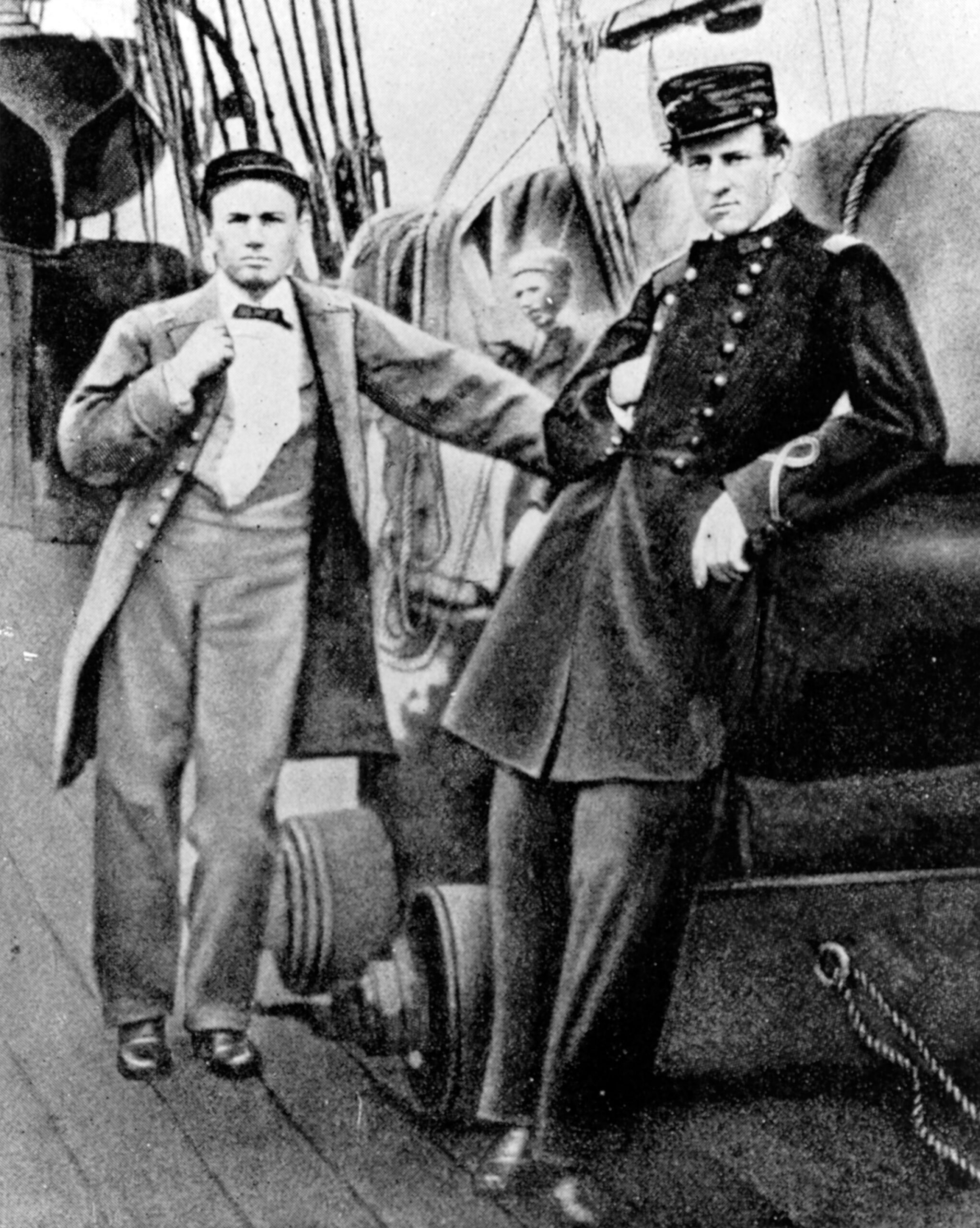
CSS Alabama engages the U.S. gunboat Hatteras off Galveston, Texas, on January 11, 1863. The fight was over within 15 minutes, the badly damaged Hatteras settling in shallow water and most of its crew taken prisoner. Seven months later, Alabama would stop at Cape Town, where it would spend the better part of two months, and some of its crew (including Lieutenant Arthur Sinclair IV and Lieutenant Richard F. Armstrong) had their photos taken on deck.
It was all over within a quarter of an hour. When Commander Blake fired a pair of lee guns to announce his surrender, boats rattled down the davits from the Alabama to rescue survivors. The Hatteras settled in shallow water, its pennant still flapping above the surface, while 118 of its officers and men, including five wounded, gathered on the deck of the raider. Another six had survived in the boat that had been lowered from the Hatteras, but they slipped away in the darkness and managed to row themselves back to shore. Only two men had suffered any injury at all on the Alabama, and neither had to be relieved from duty.10
Weaving his way back through the Yucatan Channel, Semmes eluded a thin screen of Union warships and entered the harbor at Kingston, Jamaica, on the night of January 20. The next morning Lieutenant Kell paroled all the prisoners before sending them ashore to seek help at the American consulate. Some of the Alabama’s crew followed on liberty, and Paymaster Clarence Yonge went with them.
Yonge, a clerk from Savannah, had proven unreliable and discontented. For nine days he had shared his cabin with one of the Hatteras officers, and the association had done nothing for Yonge’s flagging support for the Confederate cause. Ashore in Kingston he went drinking with the paroled Federal officers, staying overnight with them, and Kell finally had him returned to Alabama by force, putting him in arrest during the captain’s absence. Yonge tried to resign, but when Semmes came back he summarily dismissed him and put him off the ship without a penny. Yonge turned to his enemies, sailing back to England to sell his story to the U.S. consul in Liverpool, with whom he may have been in correspondence all along. His testimony seriously impaired Confederate relations with both the crown and with British shipbuilders, and marked the beginning of the end of European sympathies for the Confederate commerce raiders.11
 U.S. Naval History and Heritage Command
Lieutenant Arthur Sinclair IV (left) and Lieutenant Richard F. Armstrong
From Jamaica the Alabama sailed around Santo Domingo and back into the middle of the Atlantic, picking up a handful of prizes on the way. Semmes found much better hunting when he turned the helm to the south, making a dozen captures in just seven weeks. On May 11 he ran into Bahia, Brazil, looking for the Agrippina, but his tender failed to show up, and he never saw it again.
What Semmes did find in Bahia, two days after he dropped anchor there, was the CSS Georgia, which had fitted out as a commerce raider barely a month before. It was the only encounter between Confederate cruisers during the war, and they remained in port together for more than a week before Semmes went back to business. For six weeks the Alabama patrolled up and down the Brazilian coast, finding but few legitimate prizes to burn or bond, but Semmes transformed one of them—the bark Conrad—into a satellite cruiser that he christened the Tuscaloosa. Manned by 15 of the Alabama’s officers and sailors, and armed with a pair of light cannon and an assortment of small arms from the Ariel, the Tuscaloosa set off on an undistinguished six-month career, making only one capture before colonial authorities impounded it at Cape Town.12
Semmes himself started for Cape Town, but when the supply of bread was found to be spoiled he set out for Rio de Janeiro to resupply. On July 1, as the Alabama made for Rio, the lookout spotted a ship that showed the American flag, and a boarding party found the prize loaded with enough bread to last as far as the Cape of Good Hope. Once the provisions had been transferred, the Alabama proceeded across the largely deserted South Atlantic.
Crossing to the southern tip of Africa took most of a month. It was not until July 29 that the Alabama slipped into Saldanha Bay, up the coast from Cape Town. Saldanha was an isolated spot with no local amenities, but some of the men Semmes put ashore nevertheless came back drunk and rowdy, including his reliable old chief boatswain’s mate. Several officers went hunting, and while clambering out of the boat one of the assistant engineers fatally shot himself. Once the body had been buried on shore, the Alabama weighed anchor for Cape Town.
The cruiser had earned a worldwide reputation by August 1863, and it lay in or near Cape Town all that month and most of the next. Photographers came aboard to immortalize Semmes, Kell, and some of the other officers, and visitors in broadcloth and crinoline strode the famous deck. Not until midnight of September 24 did Semmes put to sea, sailing into a gale on a report that the massive USS Vanderbilt was headed his way.13
Cruising due east through the Indian Ocean, the Alabama spotted no game for more than six weeks, until catching the bark Amanda on November 6, near the Sunda Strait between Java and Sumatra. Two other sails fell to the raider in the strait, after which Semmes rounded the western cape of Borneo and sailed for Pulo Condore in the Con Son Islands, 70 miles off the Mekong Delta. There Semmes brought his ship close in to shore, allowing the receding tide to leave it heeled over in the shallows, so crewmen could scrape her fouled bottom. With friendly ports growing fewer every month, crucial maintenance required ingenuity.
A few days before Christmas the Alabama eased into the harbor at Singapore, where nearly a score of American vessels lay hiding from her. Two of them fled as the raider took on coal, hoping for a head start. Semmes had been losing more deserters at every settled port, and at least 10 of Alabama’s crew slipped over the side during the two days in Singapore, including another of the four Savannah pilots whom he had brought aboard as quartermasters. One had deserted at Bahia, and another had gone aboard the Tuscaloosa, leaving only one of those southerners among a crew that now consisted overwhelmingly of British subjects.14
 The Photographic History of the Civil War (1911)
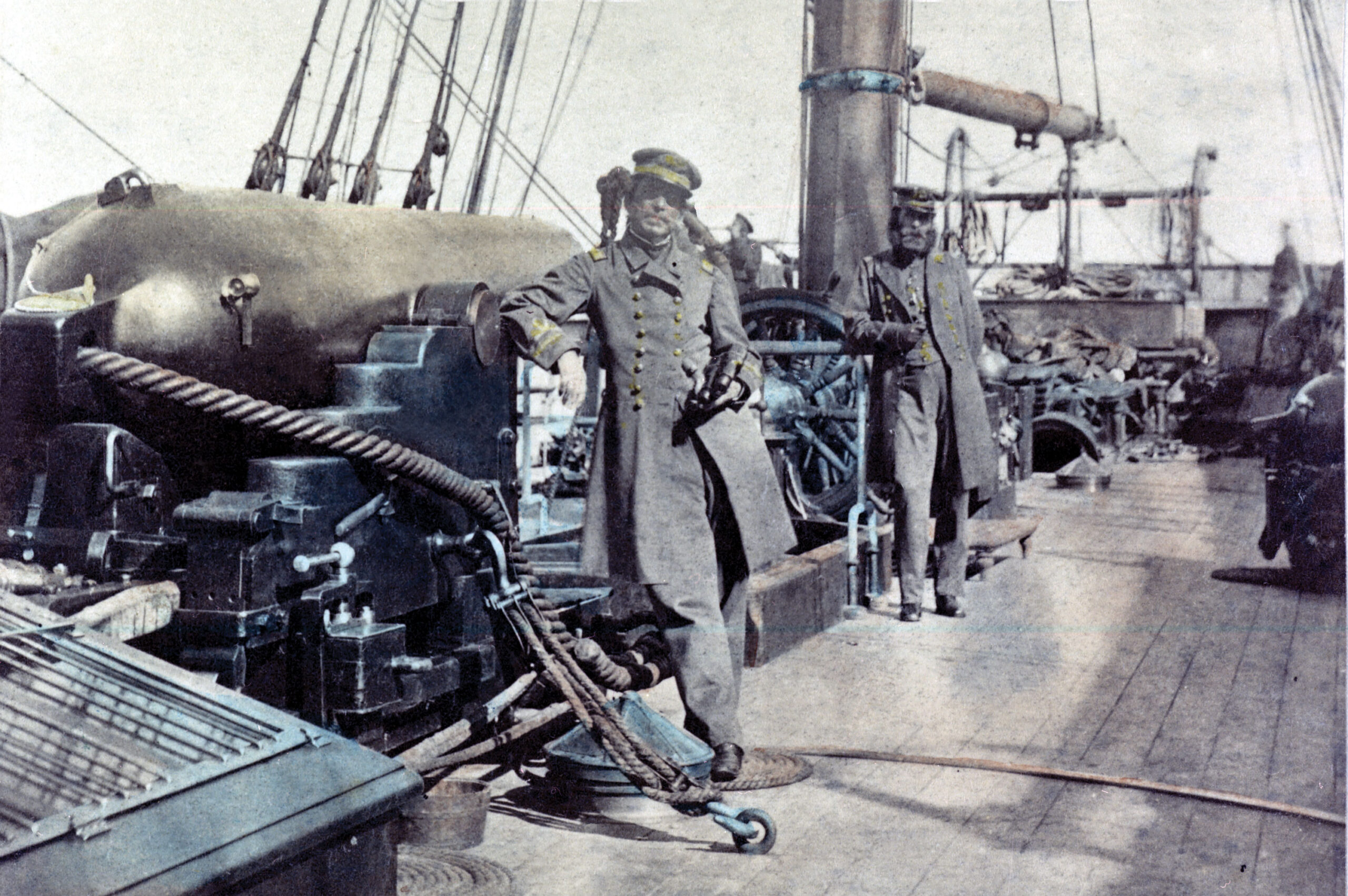
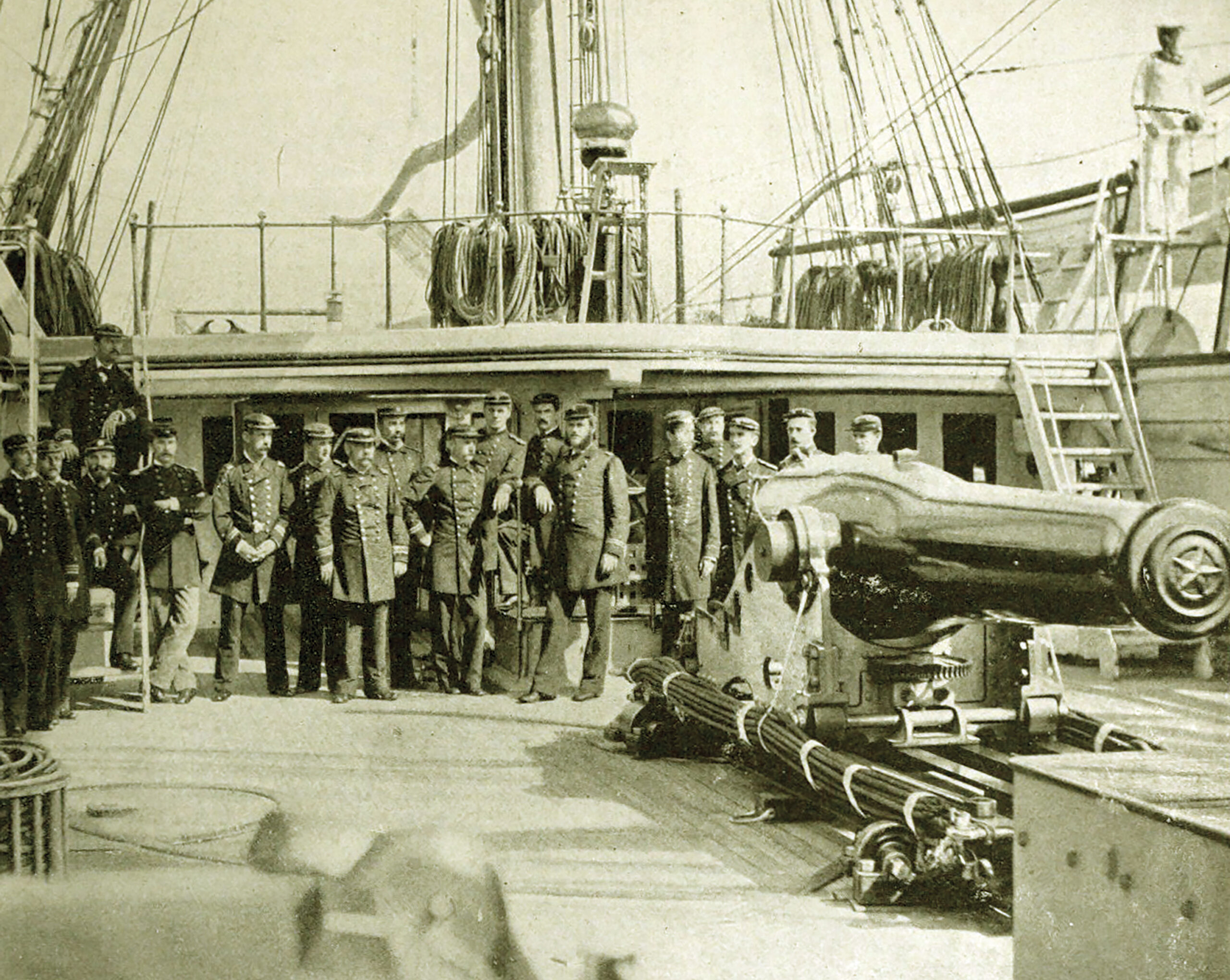
In June 1864, the U.S. warship Kearsarge caught up with the Alabama off the port of Cherbourg, France, where the Rebel raider was to have undergone repairs. On the 19th, the two ships circled at a distance and then engaged, firing over 500 shots between them. The Alabama got the worst of it and sank about an hour after the battle started. Above: Kearsarge officers stand next to one of the vessel’s 11-inch pivot guns.
Leaving Singapore on Christmas Eve, Semmes slipped up the Malay Peninsula by the Strait of Malacca, snagging three prizes that included one of those that had fled from him in Singapore. From there he skirted the Bay of Bengal and the Arabian Sea, taking his first prize of 1864 at the southern tip of India on January 14. On his way back to Cape Town he kept close to the east coast of Africa. As the ship crossed the Tropic of Capricorn the weather turned abruptly cold, while water cascaded belowdecks through crevices that a steaming tropical sun had opened between the oak deck planks.15
Semmes sighted Cape Town on March 11. He had to wait another 12 days to sail into the harbor for coal, for Singapore had been a British port and so was Cape Town, and the 90-day refueling restrictions of the Foreign Enlistment Act did not expire until March 23. Still, Semmes dared not put in to wait, lest he begin losing men. A lack of pay, long periods without liberty, and a seemingly endless cruise had made the Alabama’s crew restive over the past few months, and discipline had relaxed considerably. Prisoners taken in the East Indies had reported that enlisted men ignored or even struck their superiors, and that Semmes, Kell, and all the duty officers had taken to wearing their revolvers and cutlasses on deck.
Once in the harbor, Semmes found that official Britain had grown cool to Confederate cruisers. Cape Town officials had detained the Tuscaloosa there on complaints from the United States ambassador in London, and Semmes wrote a formal protest while his ship took on coal. Her Majesty’s ministers had already decided to return the ship to Semmes, as it happened, but their reply had not made it to Cape Town before the Alabama departed on March 25.16
The effectiveness of Confederate commerce raiding, and especially that of the Alabama, became evident as that cruiser continued on its northwesterly course. So many northern ship owners had sold their vessels to foreign owners, and so few potential customers dared send their cargo under American colors, that only two sightings proved to be fair game all the way across the South Atlantic—both of them off the coast of Brazil, late in April. They were the last two merchantmen Semmes ever ordered burned, but first he called for some gunnery practice on one of them, which illustrated how unpracticed his gun crews were and how stale the ship’s ammunition was.17
Six weary weeks later the Alabama entered the English Channel with its mizzenmast altered to square rig, to disguise the illustrious bark as a full-rigged ship. At 10 o’clock on the morning of June 11, Cape de la Hague came into view on the French side of the channel, at the tip of Normandy’s Cotentin Peninsula. The Alabama’s boilers and copper tubing wheezed and whistled with corrosion, and the copper plating was peeling from the bottom, despite the impromptu scraping at Pulo Condore six months before. Ship and crew alike needed to rest and refit, so Semmes brought the Alabama to off the breakwater outside Cherbourg.18
The raider had lain at anchor in Cherbourg only 24 hours before the news reached Captain John Winslow, of the USS Kearsarge. The Kearsarge was tied up at Flushing, in the Netherlands, where it had undergone some structural repairs, and Winslow steamed away immediately. His ship was a good match for the Alabama in terms of size and firepower, but it had enjoyed much better maintenance. The crew consisted largely of New England sailors, farm boys, and mechanics, augmented by similar volunteers from the Mid-Atlantic states and a variety of European recruits. They could be downright unruly, and several of them had just been released from a Flushing jail, but they did not suffer the deep-seated dissatisfaction of their counterparts on the Alabama.19
Semmes applied for permission to put his ship in the government drydock at Cherbourg, to clean and repair the hull and overhaul his engines. So controversial had Confederate commerce raiders become that the admiral in charge dared not grant that permission himself, and he forwarded the request to Paris. Semmes in turn learned that the Kearsarge was on its way, and he had to decide quickly whether to run for it with his disabled raider or wait for imperial permission. If he waited, the Alabama would probably be trapped in the harbor whether or not he won permission to make his repairs, for a Yankee flotilla would surely gather to box him in. By the time the Kearsarge appeared off Cherbourg, on June 14, Semmes had apparently concluded that the best he could do for the Confederacy (and perhaps incidentally for his own reputation) was to make a fight of it.20
At dawn of Sunday, June 19, engineers lighted fires in the Alabama’s boilers, and steam was up within two hours. Anticipating that the battle would come that day, Parisian tourists from a new weekend excursion train sought vantage points. The breakwater blocked the view from Cherbourg, so most of the spectators gravitated to the ancient chapel of St. Germain, at Querqueville, four miles west of town.
At 9 a.m. the Alabama hauled up its anchor. Half an hour later the propeller started churning, and at 9:45 the ship lurched toward the opening in the breakwater. A French ironclad, the Couronne, escorted the cruiser through the breakwater, clinging alongside as far as the three-mile limit to prevent any violation of French neutrality. A British yacht, the Deerhound, followed in their wake to witness the fight, carrying John Lancaster and his curious family.
The Kearsarge came racing in from the channel, pulling up six or seven miles from shore. With sand spread on the decks to offer better traction if blood soaked them, the gun crews all stood to their stations and waited. Similar preparations busied the men on the Alabama, where crewmen dragged heavy ordnance across the deck to present six muzzles on the starboard side, and at about 11 a.m. the Alabama threw the first broadside from three-quarters of a mile away. The whole volley sailed high, merely snapping a few lines in the upper rigging of the Kearsarge. Racing to reload, the Confederate gunners fired a second and then a third time, doing little more harm.
One broadside came from the Kearsarge at a thousand yards, and then the two ships started circling at that distance, each firing from its starboard battery. Seven times they pirouetted around each other in a clockwise, elliptical pattern, drifting west and slightly south. The Alabama’s big rifled pivot gun sank a shell into the sternpost of the Kearsarge, and had it exploded it would have decided the battle by leaving the Federal sloop rudderless. One shell did explode as it passed the aft pivot on the Kearsarge, severely wounding three men.
Those lucky shots were the best that came from the Alabama, which took the worst of the contest from gunners with better training and more reliable ammunition. Winslow had hung spare chains over the sides of the Kearsarge to protect his engines, disguising them with a veneer of boards, and those chains deflected rounds that might have penetrated the hull. One shell from the Kearsarge killed or wounded the entire crew of the Alabama’s aft pivot, and others went through the hull at the waterline. When it became clear that his ship was sinking, Semmes tried to run back into French waters, striking for Querqueville Point. Finally a white flag fluttered up, and the one sound boat left on the Alabama started for the Kearsarge to ask for aid. The Kearsarge had lost all but two of its boats, though, so Winslow sent the Rebel boat back for its comrades and asked the captain of the Deerhound to save whomever he could. A French pilot boat also sprang to the rescue. The Alabama went down by the stern about an hour after the first broadside.
To Winslow’s consternation, the Deerhound turned for the English coast after picking up Semmes, Kell, and 39 of the crew. Semmes asked to be dropped at Mr. Lancaster’s home port of Southampton, and late that evening he and Lieutenant Kell took rooms at the Oriental Hotel on Canute Road.21
 The Photographic History of the Civil War (1911)
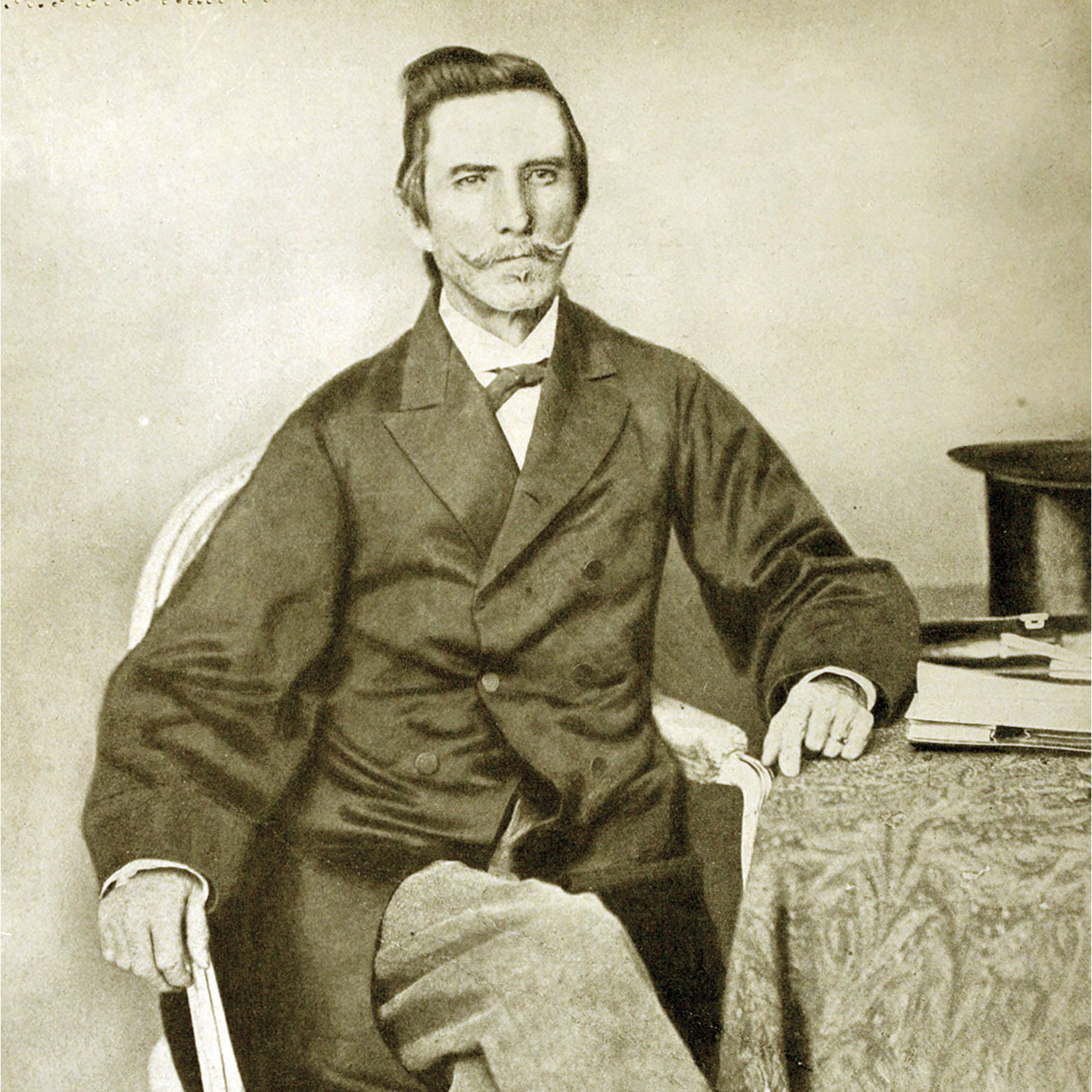
Raphael Semmes, shortly after the Battle of Cherbourg.
Twenty-seven of the raider’s crew were killed in the fight or drowned. Ten officers and men made it ashore in the pilot boat. The Kearsarge put in at Cherbourg with 67 survivors from the Alabama and the bodies of three more who had died from their wounds. The wounded from both ships were taken to the Marine Hospital on Rue de l’Abbaye, which looked out on the scene of the fight. With no room to house his prisoners, Winslow paroled the rest of the Alabama’s enlisted men and turned them loose, allowing four officers to lodge ashore on their promise to return when called.
Of the three men wounded on the Kearsarge, only Ordinary Seaman William Gowin, of Michigan, died from his injuries. He and two of the Alabama’s dead—New Brunswick native George Appleby and James King, a Briton who had shipped in Singapore on Christmas Eve—were buried together in a tiny lot of the Cimetière Ancien, on a hillside overlooking Cherbourg. Apparently either the U.S. Navy or the Kearsarge crew paid for the lot, and 16 months later a navy surgeon who had died of fever filled the remaining gravesite.22
Semmes and Kell made their way back to the Confederacy for further service, but the Kearsarge took their fellow officers back to Boston that autumn, arriving amid the excitement of the presidential election. The enlisted crew of the Kearsarge disbanded upon their return, but the prisoners went into Fort Warren for the rest of the war.23
Cherbourg photographer François Rondin later claimed that he had caught the naval battle on camera from the chapel on the Querqueville hillside. His distance from the scene and the movement of the ships would seem to have precluded any results beyond an indistinguishable blur, but at the end of June he told sailors on the Kearsarge that he had the picture for sale. One of the Marines on the ship thought some of the crew bought them, but no such print has ever surfaced.24 No photograph of the ship survives, even at anchor, except for those taken on the deck at Cape Town, and the lack of such an image only enhances the air of spectral mystery that the Alabama still evokes.
William Marvel is the author of many books about the Civil War, including The Alabama and the Kearsarge: The Sailor’s Civil War (UNC Press, 1996), and most recently Radical Sacrifice: The Rise and Ruin of Fitz John Porter (UNC Press, 2021).
Notes
1. James D. Bulloch, Secret Service of the Confederate States in Europe (New York, 1964), 1:53-63, 68; Official Records of the Union and Confederate Navies (hereafter ORN), Series 2, 2:184, 381–384.
2. ORN, Series 2, 1:252.
3. “Messrs. Laird Brothers and the ‘Alabama,’” Gladstone Papers, Additional Collection 44610, folios 45–48, British Library; Bulloch, Secret Service, 1:238–242; Liverpool Evening Mercury, July 31, 1862; Kenneth Bourne and D. Cameron Watt, eds., British Documents on Foreign Affairs: Reports and Papers from the Foreign Office Confidential Print, 49 vols. (University Publications of America, no date), 6:152–153.
4. ORN, Series 1, 1:771–778, 783-86; Bourne and Watt, British Documents, 6:153; Raphael Semmes journal, Alabama Department of Archives and History (hereafter ADAH), August 21–24, 1862; The Case of Great Britain as Laid Before the Tribunal of Arbitration at Geneva, 3 vols. (Washington, 1872), 3: 414, 416–418, 426, 475–476; Charles G. Summersell, The Journal of George Townley Fullam, Boarding Officer of the Confederate Sea Raider Alabama (University, AL, 1973), 6, 10–11, 29.
5. Semmes journal, ADAH, August 25-September 6, 1862; ORN, Series 1, 1:786–787 and 3:677; Case of Great Britain, 3:425, 451.
6. Semmes journal, ADAH, September 7-October 13, 1862; ORN, Series 1, 1:787–795; Case of Great Britain, 3:429-31, 447–449; Summersell, Fullam Journal, 29, 33–34; The New York Times, October 17, 1862.
7. ORN, Series 1, 1:796–797; Summersell, Fullam Journal, 38; Semmes journal, ADAH, October 16-23, 1862.
8. Semmes journal, ADAH, November 16-26, 1862; ORN, Series 1, 1:804–806; Summersell, Fullam Journal, 50–57.
9. Summersell, Fullam Journal, 57–68; ORN, Series 1, 1:807–810.
10. ORN, Series 1, 1:813–817, 2:720–722; Semmes journal, ADAH, December 23, 1862-January 11, 1863; Summersell, Fullam Journal, 68–77; Clarence R. Yonge to “Esteemed Friend,” January 20, 1863, Thomas Dudley Papers, Huntington Library; sketch of Alabama’s damage, “Subject File of the Confederate Navy” (M-1091), National Archives, Reel 7.
11. Summersell, Fullam Journal, 81–82; Semmes journal, ADAH, January 11-25, 1863; Yonge to Thomas Dudley, various dates in 1863 and 1864, Dudley Papers, Huntington Library; London Times, June 24, 1863; English News (London), September 21, 1863.
12. Semmes journal, ADAH, January 29-June 21, 1863; Summersell, Fullam Journal, 87–122; ORN, Series 1, 2:724–752.
13. Semmes journal, ADAH, June 24-September 24, 1863; ORN, Series 1, 2:752–767; Summersell, Fullam Journal, 124–146; Cape Mercantile Advertiser (Cape Town), August 8 and 15, 1863; Diary of E.B. Rose, South African Library, August 5, 1863; South African Advertiser and Mail (Cape Town), August 12 and 19, 1863; Cape Argus (Cape Town), August 18 and September 3, 1863.
14. ORN, Series 1, 2:560–561, 767-92; Semmes journal, ADAH, September 25-December 24, 1863; Summersell, Fullam Journal, 147–164; Henri Galos, “L’Expédition de Cochinchine,” Revue des Deux Mondes (May 1864), 180; Lieutenant de vaisseau Lepotier, Les Corsaires de Sud et le Pavillon Etoilé (Paris, 1936), 146; Singapore Free Press and Advertiser, December 10, 17, and 24, 1863.
15. Semmes journal, ADAH, December 24, 1863-March 4, 1864; ORN, Series 1, 2:792–804; Summersell, Fullam Journal, 166–178; Overland Singapore Free Press and Advertiser, December 31, 1863, January 7 and 8, 1864; Cochin (India) Chronicle, January 23, 1864; The Bengal Hurkaru (Calcutta), February 4, 1864; Times of India (Bombay), February 4, 1864.
16. Semmes journal, ADAH, March 4–25, 1864; ORN, Series 1, 2:562, 804–806; Summersell, Fullam Journal, 178–179; Cape Argus, March 15, 21, and 22, 1864; London Times, February 12 and 15, 1864.
17. Semmes journal, ADAH, April 3–28, 1864; Summersell, Fullam Journal, 182–185.
18. Semmes journal, ADAH, June 4-11, 1864; Summersell, Fullam Journal, 188–190; Phare de la Manche, June 14, 1864.
19. Charles Poole and William Wainwright journals, Mystic Seaport Museum, June 12, 1864; muster rolls of USS Kearsarge, 1862–1864, U.S. Navy Records, Record Group 24, National Archives.
20. Semmes journal, ADAH, June 11-16, 1864.
21. William L. Dayton Jr., to William L. Dayton Sr., June 22, 1864, Princeton University; Paul Ingouf, Coulez l’Alabama!, Un Épisode de la Guerre de Sécession en Cotentin (Cherbourg, 1976), 58–59; Waldo G. Leland, “The Kearsarge and Alabama: French Official Report, 1864,” American Historical Review (October 1917): 120–122; Phare de la Manche (Cherbourg), June 20, 1864; USS Kearsarge log, Record Group 24, National Archives, June 19, 1864; Charles Poole and William Wainwright journals, Mystic Seaport Museum, June 19, 1864; Martin Hoyt to “Dear Uncle,” June 19, 1864, Portsmouth (NH) Historical Society; ORN, Series 1, 3:79–81, 649-51; London Times, June 23, 1864; Willmer & Smith’s European Times (Liverpool), June 27, 1864; Hampshire Independent (Southampton), June 25, 1864; The Mercury (Liverpool), June 25, 1864.
22. ORN, Series 1, 3:71–72, 78–80; Actes de Décès, Archives Municipales de Cherbourg, Entries 562–564.
23. Boston Transcript, November 8 and 10, 1864.
24. William Wainwright journal, Mystic Seaport Museum, June 30, 1864; Austin Quinby journal, Peabody Essex Museum, June 30, 1864. Norman C. Delaney characterized Rondin’s battle photo as a hoax in “Monsieur Rondin’s Fake Photo: A Scam that Failed,” Military Images, Vol. 19, no. 4 (January-February, 1998): 30–32.
Related topics: naval warfare