 Library of Congress
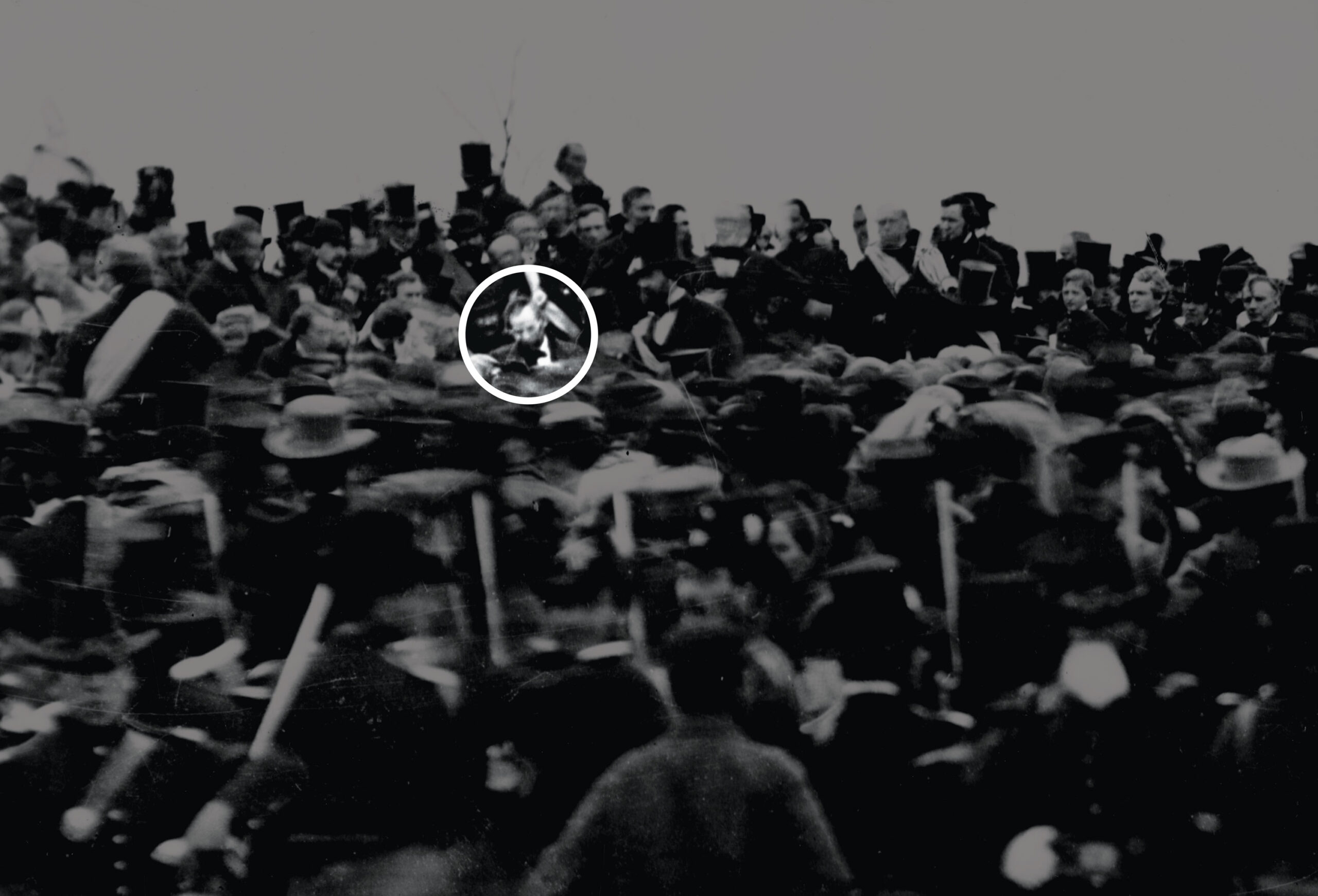
Dignitaries and onlookers gather around the speakers platform during the dedication ceremony of the Soldiers’ National Cemetery in Gettysburg, Pennsylvania, on November 19, 1863. President Abraham Lincoln can be seen in the highlighted circle.
On November 19, 1863, President Abraham Lincoln delivered a solemn benediction at the dedication of the national cemetery at Gettysburg, Pennsylvania.
From a rostrum in the town where, just four months previously, two of the largest armies ever assembled on the American continent had waged a fierce battle, Lincoln used just 272 words to assess the battle’s cost and the war’s greater meaning. Since that long-ago day, seven presidents have delivered addresses at Gettysburg. Each of them celebrated the legacy of Lincoln’s remarks—though Lincoln himself realized they made little impression on his countrymen. Lincoln could not have known that by the time his successors faced the prospect of speaking at Gettysburg, he had become an act impossible to follow.
Rutherford B. Hayes, the 19th president, Theodore Roosevelt (the 26th), Woodrow Wilson (28th), Calvin Coolidge (30th), Herbert Hoover (31st), Franklin D. Roosevelt (32nd) twice, and Dwight D. Eisenhower (34th) all accepted an invitation to add their voices to the Gettysburg chorus. And in the battle’s centenary year, it was a vice president, Lyndon Baines Johnson, who delivered a memorably powerful address. Each of these men spoke at Gettysburg with a goal in mind. Most used the Civil War, and especially the pivotal engagement at Gettysburg, to make meaning of both the sacrifice and the progress brought about by the conflict. Taken as a group, the speeches are a microcosm of a century of Civil War memory, most of them touching on diverse memorial traditions while retaining a particular resonance, just as the first Gettysburg Address still does today.
 Library of Congress
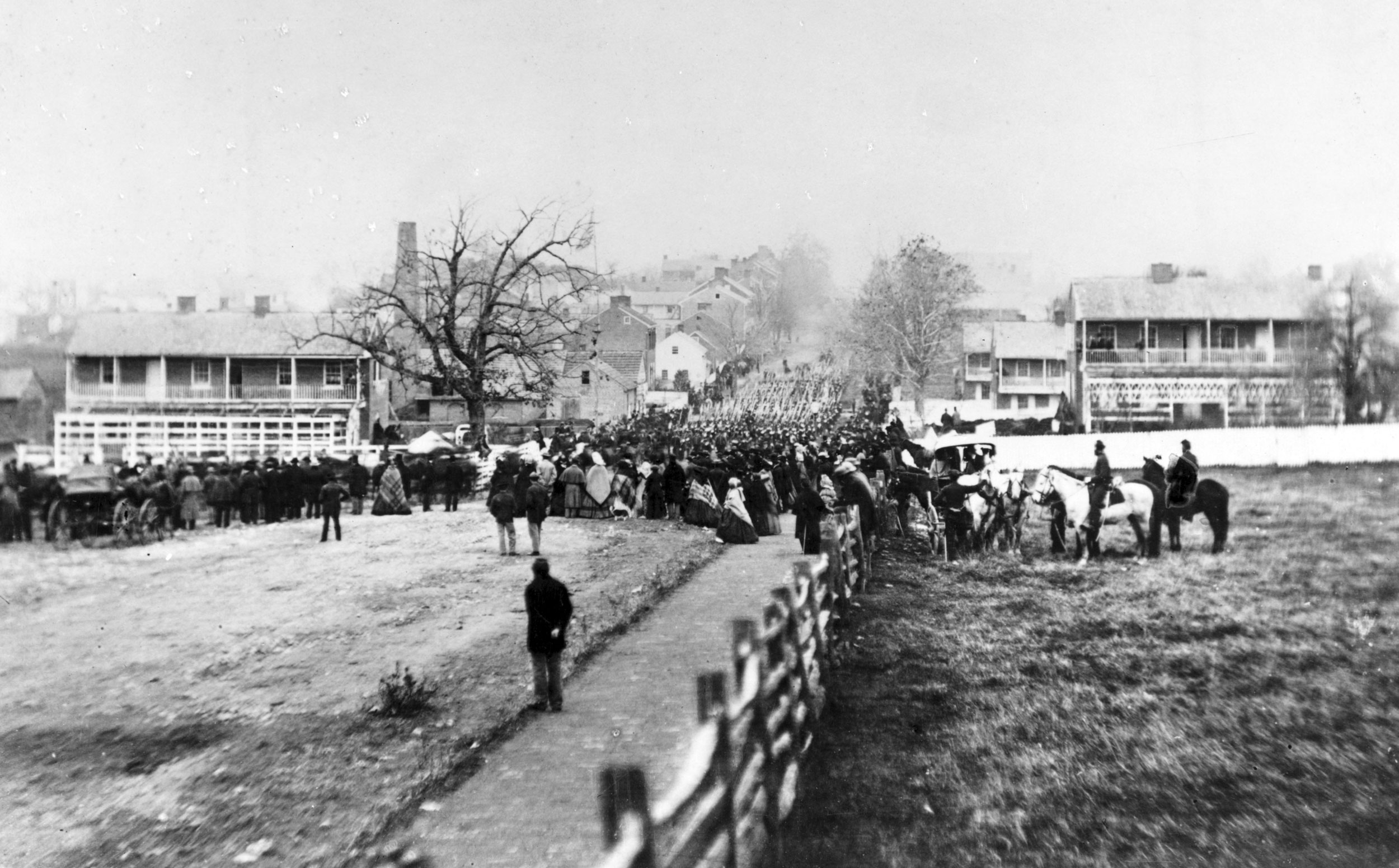
Soldiers and civilians crowd the streets of Gettysburg as a military procession makes its way to Cemetery Hill, where President Lincoln would deliver his address.
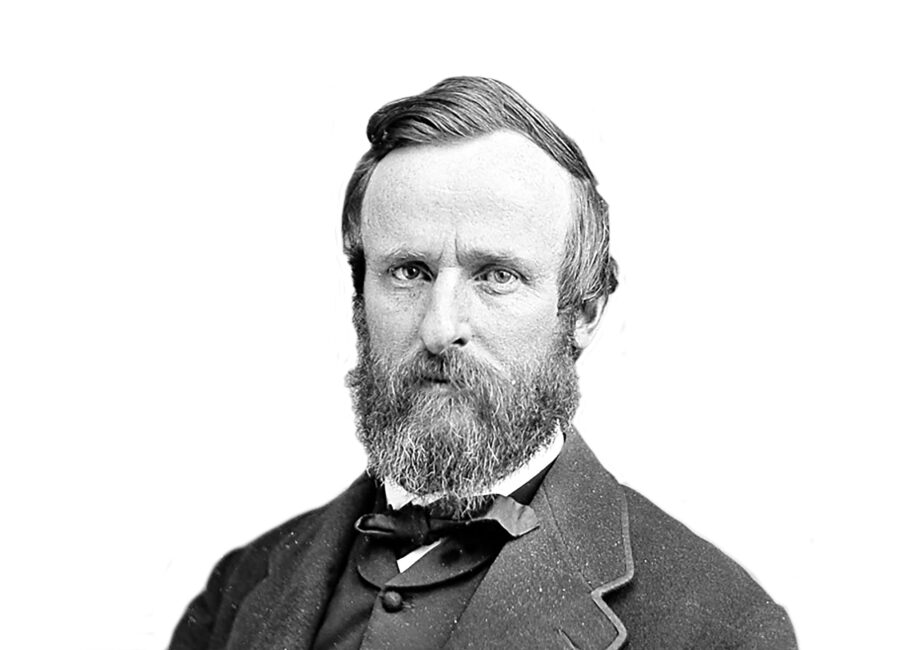
It was 1878 before an address at Gettysburg followed Lincoln’s, and it was to be the only one given by a Civil War veteran. In the wake of the shelling of Fort Sumter, Rutherford B. Hayes had joined an Ohio volunteer company at age 39. He was appointed a major in the 23rd Ohio Infantry, a regiment that also included a private named William McKinley. Hayes saw his first significant action in September 1862 at the Battle of South Mountain, in Maryland, where he was wounded leading a charge against an entrenched Confederate position. Recovery and reenlistment occupied Hayes until he helped lead Union troops sent to check Confederate raider John Hunt Morgan’s foray into West Virginia and Ohio in July 1863, just when the armies at Gettysburg were making history.
Hayes served capably in the war’s closing stages. With the Army of the Shenandoah he participated in the battles of Fisher’s Hill and Cedar Creek. His fellow Ohioan Ulysses S. Grant wrote of Hayes that “[h]is conduct on the field was marked by conspicuous gallantry as well as the display of qualities of a higher order than that of mere personal daring.”1 Hayes ended the war as a brevet major general of volunteers.
 National Archives
Rutherford B. Hayes
Looking back from 1878, President Hayes proclaimed that the fight at Gettysburg represented one of the most decisive moments of the war. He went so far as to assert that Gettysburg was the “battle which did more than any other to determine the result of the great civil war in the United States.” His assessment of the battle was generous; most modern historians argue that Gettysburg was not a decisive turning point in the war. Army of the Potomac commander George G. Meade’s failure to capitalize on his victory—allowing Robert E. Lee and the Army of Northern Virginia to retreat without harassment—struck even contemporaries as one of the great missed opportunities of the conflict, which ground on for almost two more years. Hayes spoke even fewer words than Lincoln, exactly 250, the final 43 of which were a direct quote from Lincoln’s address.2
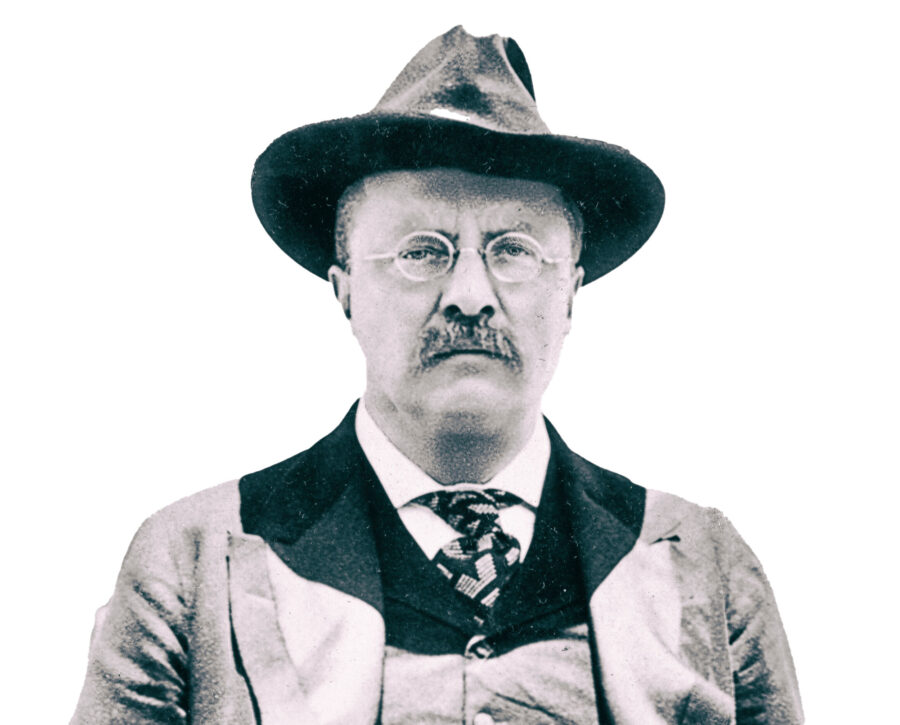
Nearly a quarter-century passed between Hayes’ brief speech and a much longer one delivered by Theodore Roosevelt on Memorial Day 1904. Roosevelt had a unique connection to the war and to the man who first spoke so eloquently of Gettysburg’s meaning. Roosevelt was a 6-year-old boy when he witnessed the funeral procession for the slain president pass outside his grandfather’s Union Square mansion in New York City. Roosevelt’s youth was defined by the titanic struggle between the Union and the Confederacy—and he claimed relatives in both armies. A Republican like Lincoln, Roosevelt often proclaimed his reverence for the first man from their party to hold the presidential office. When asked why he chose to display a portrait of the 16th president in the Oval Office, Roosevelt said, “I look up to that picture, and I do as I believe Lincoln would have done.”3
At Gettysburg, Roosevelt delivered a speech that demonstrated his authority not only as a world leader but also as a historian. By the time of his address, he had published what remains one of the best histories of naval operations in the War of 1812, as well as several works on the history of frontier settlement. Roosevelt could also speak with experience about military combat, given his role in volunteering to lead a regiment in the Spanish-American War, preceded by service as the assistant secretary of the navy (an office his cousin Franklin would later fill). He was an ardent champion of expanding America’s influence in the world and of preserving the nation’s great cultural and natural sites for the enjoyment and education of future generations.
 Library of Congress
Theodore Roosevelt
The ideology of Union, above all else, defined Roosevelt’s speech. It celebrated the Union victory and the preservation of the democratic republic in the face of the greatest threat to its survival. This memory of the war, commonly held among the generation who fought and by their children, eroded significantly over the course of the 20th century. Where most Civil War-era Americans would have celebrated the preservation of the Union as the conflict’s primary outcome, subsequent generations split along partisan lines in either adopting the Lost Cause mythology (in which the Confederate cause was portrayed as just, heroic, and not centered on slavery) or emphasizing emancipation in their speeches and writings about the war. Roosevelt understood the outcome of the conflict in terms that would have been instantly recognizable to the men who fought for the United States at Gettysburg. “The crisis which they faced,” he proposed to his audience, “was to determine whether or not this people was fit for self-government, and therefore fit for liberty.” The Civil War, he went on, “meant the triumph of both liberty and order, the triumph of orderly liberty, the bestowal of civil rights upon the freed slaves, and at the same time the stern insistence on the supremacy of the national law throughout the length and breadth of the land.” The end of slavery mattered to Roosevelt, but the preservation of the Union was paramount.
Though he believed the end of slavery had been a critical outcome of the war, Roosevelt spent more time on the topic of reconciliation than on emancipation. This is not surprising in the era of Jim Crow segregation—and in a generation that overlooked the contributions of black Americans to the national narrative of progress. In his memoir of the Spanish-American War, for example, Roosevelt paid little attention to the role that black troopers in the 9th and 10th Cavalry Regiments had played in the assaults on Kettle and San Juan hills. He later wrote that “Negro troops were shirkers in their duties and would only go as far as they were led by white officers.” Reconciliation was a much easier narrative to promote in the context of his era. Looking back on the nearly five decades since the conflict, Roosevelt insisted: “All are at one now, the sons of those who wore the blue and the sons of those who wore the gray, and all can unite in paying respect to the memory of those who fell, each of them giving his life for his duty as he saw it.”4
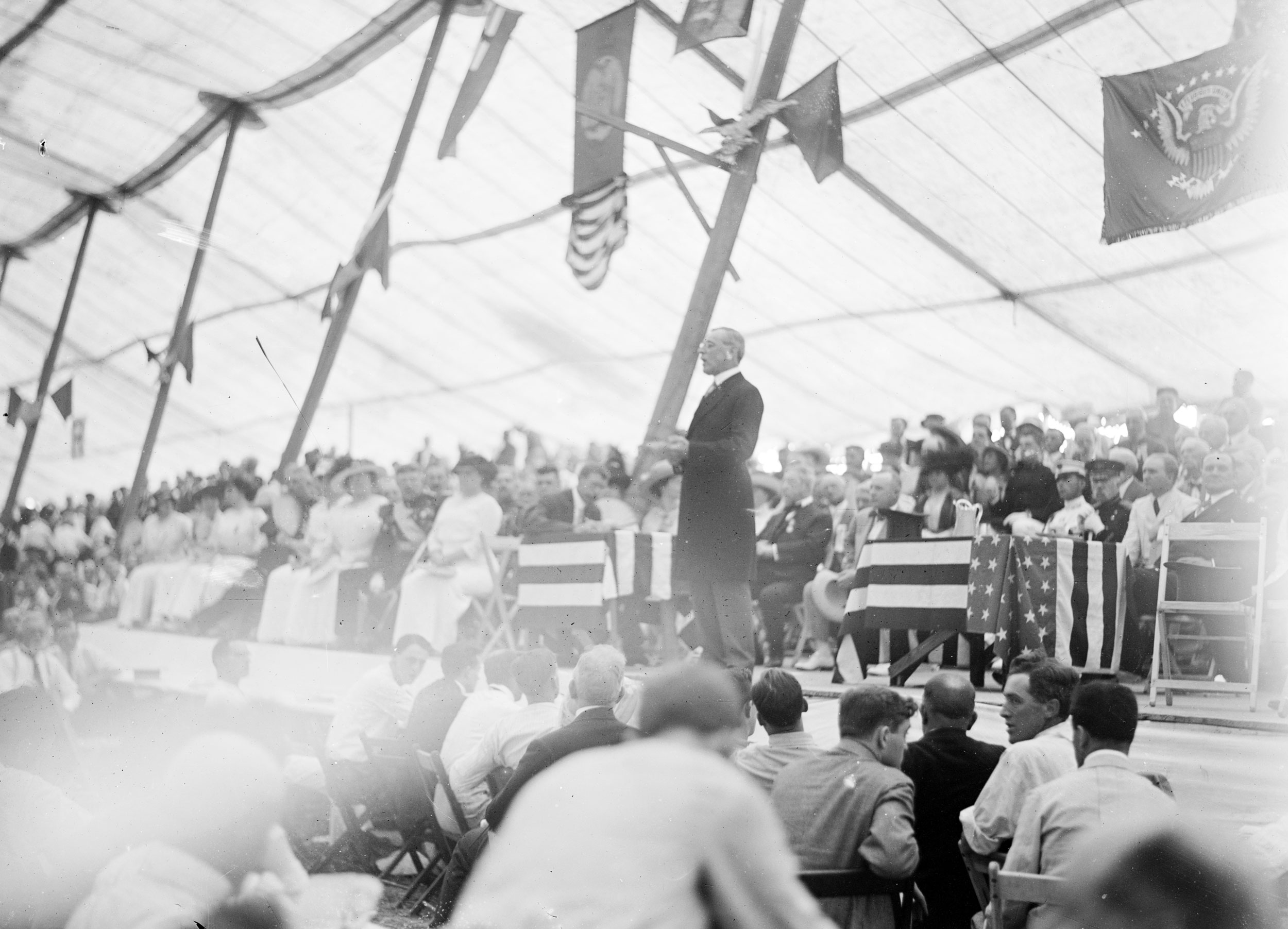
If Roosevelt celebrated reunion and the soldiers of both North and South, the next president to speak at Gettysburg seemed, at times, to have forgotten who fought in the war at all. Woodrow Wilson was so reluctant to choose a side that he spent much of his 1913 address referring vaguely to the soldiers who fought at Gettysburg without ever commending or decrying one cause or the other. Fifty years after Lincoln’s moving tribute, Wilson, a man born and raised in the South and a believer in the Lost Cause mythology—but also a student of history and government with a law degree and a doctorate—showed little interest in interpreting the battle’s meaning or resonance, opening his speech saying, “Friends and Fellow Citizens: I need not tell you what the Battle of Gettysburg meant.”
 Library of Congress
Woodrow Wilson speaks at the 1913 ceremony marking the Battle of Gettysburg’s 50th anniversary. Unlike past and future presidents to deliver remarks at the historic Pennsylvania town, Wilson referred only vaguely to the soldiers who fought there without commending or decrying either side.
For a historian, Wilson’s speech was remarkably present-minded and expressed his love of peace. The president spoke of the economic and political benefits that a five-decade period of relative peace had bestowed upon the American republic: “How wholesome and healing the peace has been!… We are debtors to those fifty crowded years,” he told the audience in Adams County, “they have made us heirs to a mighty heritage.” He concluded with: “Lift your eyes to the great tracts of life yet to be conquered in the interest of righteous peace, of that prosperity which lies in a people’s hearts and outlasts all wars and errors of men.”
But to honor that heritage and preserve the peace would be much more difficult than the years of civil war. Wilson seemed to claim that the task facing him as the leader of the United States in a time of peace was more difficult than the challenge that had confronted Abraham Lincoln when he took the oath of office in 1861. “We have harder things to do than were done in the heroic days of war,” Wilson asserted, “because harder to see clearly, requiring more vision, more calm balance of judgment, a more candid searching of the very springs of right.” In short, tasks that required a president of Wilson’s ability. In just over 1,200 words, Wilson made the Battle of Gettysburg and the Civil War’s legacy all about himself.5
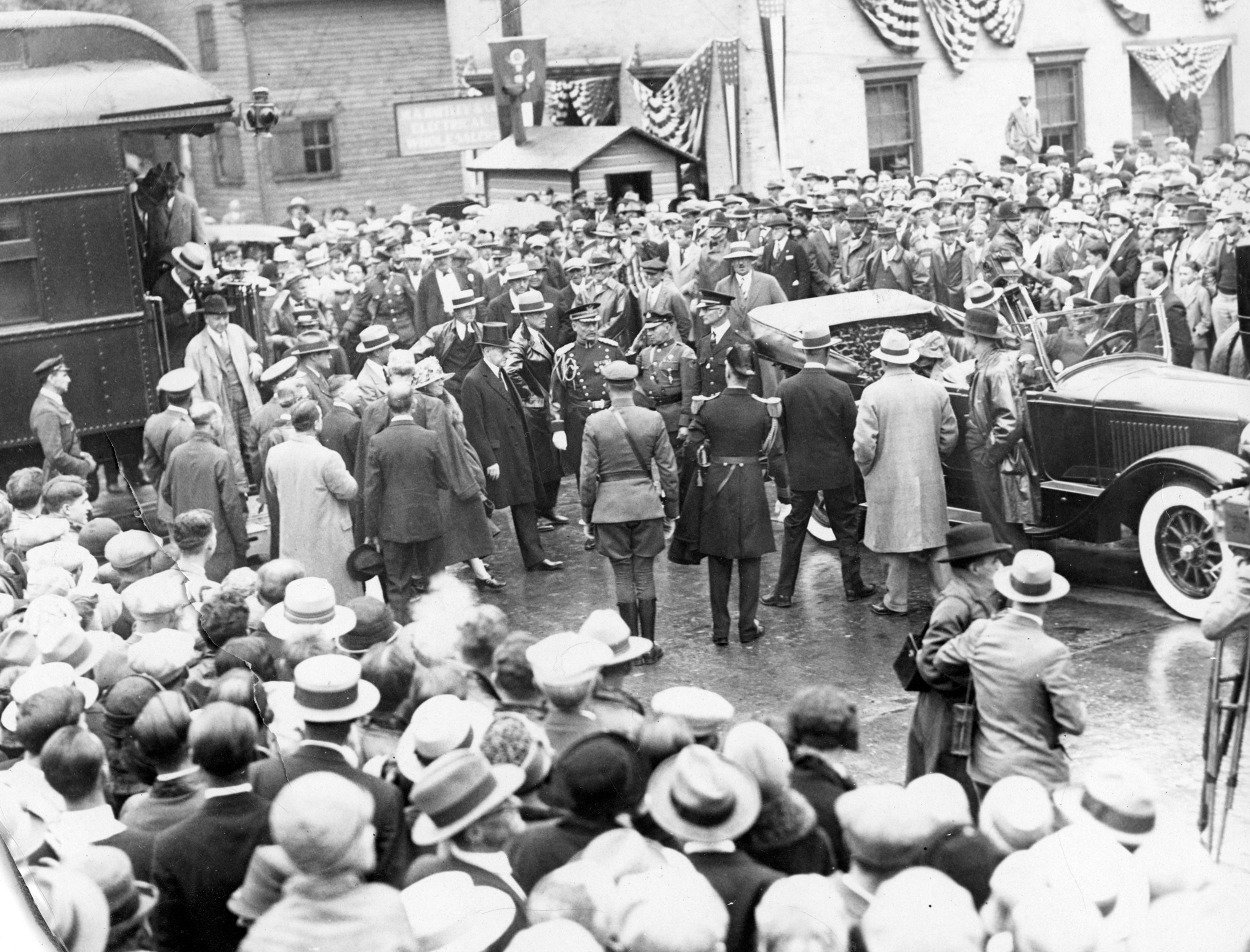
The 15 years that passed between the appearances in Gettysburg of Woodrow Wilson and Calvin Coolidge saw the collapse of Wilson’s dreams of peace spreading over the globe, after a war that many believed would never be surpassed in its magnitude or violence. World War I figured heavily in Coolidge’s 1928 address on Decoration Day at Gettysburg. The more-than-3,000-word oration by the man nicknamed “Silent Cal” remains the longest presidential speech delivered there. A son of Vermont who was steeped in Massachusetts politics, Coolidge was every bit the Yankee to Wilson’s semi-reconstructed Rebel.
Coolidge opened by quoting from “Bivouac of the Dead,” the Theodore O’Hara poem that appears in part on plaques in almost every national cemetery today. Gazing back on the nation’s history, Coolidge said that Gettysburg compared in importance to the battles of the Plains of Abraham, Saratoga, and Yorktown. Coolidge, like Rutherford Hayes, viewed Gettysburg as the place where the war reached its “crest”—the high-water mark of the conflict. He made this observation in the context of explaining to his audience that by the time of his speech, the federal government had paid between $6 billion and $7 billion in pensions to Union veterans. It was a cost, Coolidge said, that showed those veterans that their nation intended to care, as Lincoln had put it, “for him who shall have borne the battle.”
But it was a cost that Coolidge was reluctant to increase through wars in his own time. He focused much of his speech on a plea for peace around the world, meanwhile asserting the primacy of the United States in maintaining and securing that tranquil global order, especially among the great powers of Europe. The legacy of the Civil War, in Coolidge’s view, was showing that the American people were once committed to maintaining the Union in the face of a grave threat to liberty and democracy. They should, Coolidge believed, show now that same commitment to expanding peace abroad and ensuring—by treaty and example—that war would not define the history of their own century. “The government of the people, by the people, for the people, which Lincoln described in his immortal address,” Coolidge concluded, “is a government of peace, not of war, and our dead will not have died in vain if, inspired by their sacrifice, we endeavour by every means within our power to prevent the shedding of human blood in the attempted settlement of international controversies.”6
 Adams County Historical Society at Gettysburg
 Calvin Coolidge arrives in Gettysburg on Decoration Day in 1928. His more than 3,000-word oration remains the longest presidential speech delivered there.
Two years later, President Herbert Hoover stepped back from the economic and political crises facing his administration to pay a Memorial Day tribute to the few remaining veterans of the Civil War. Hoover proved an astute student of history with a sharp eye for irony. Where Lincoln expected that the world “would little note nor long remember” the words he spoke at Gettysburg, Hoover proclaimed “no monument has been or can be erected here so noble and enduring as that simple address which has become a part of this place.” Unlike Wilson, Hoover recognized that the Civil War was the greatest challenge the nation had ever faced, and while he was keenly aware of the problems confronting his own administration, he believed “no President has been so beset, though no time in our history has been so dark, though never have strong men been so affected with doubts” as were Americans from 1861–1865.
Like Theodore Roosevelt, Hoover spoke primarily of Union as he searched to explain the war’s resonance in 1930 for a nation careering headlong into the greatest financial crisis in its history. “In the weaving of our destiny,” he said (to Americans far beyond Gettysburg thanks to national radio networks), “the pattern may change, yet the woof and warp of our weaving must be those inspired ideals of unity, of ordered liberty, of equality of opportunity, of popular government, and of peace to which this Nation was dedicated.” Hoover hoped to make the meaning of Union relevant to his own era, calling on the nation’s citizenry to unite despite the calamity that beset them, to become not merely a physical union of states, as he put it, but rather a spiritual union in which Americans worked for the good of the entire nation and found, in that effort, individual fulfillment. Hoover’s idealism was deeply grounded in an appreciation for the meaning of Union, a meaning that has been eroded by the passage of time and, in the present, can feel almost entirely lost.7
Theodore’s cousin Franklin Delano Roosevelt spoke twice at Gettysburg in his four presidential terms. The first speech, in 1934, was decidedly reconciliationist. Roosevelt began by speaking not about Lincoln, but about George Washington, who, he reminded his audience, in 1796 had offered his farewell address to the nation from Philadelphia, a city not far from Adams County. Roosevelt believed that if the Civil War generation had heeded Washington’s warning against the pernicious nature of political factions, “we should have had no family quarrel, no battle of Gettysburg, no Appomattox.” He hoped his own generation would not make the same mistakes.
 Adams County Historical Society at Gettysburg
 Franklin Delano Roosevelt spoke twice at Gettysburg, first in 1934 and again on July 3, 1938, the battle’s 75th anniversary. Above: President Roosevelt waves to onlookers during his 1938 visit.
Roosevelt proposed that Americans in 1934 were fortunate to live in a world knitted together by communication networks and growing transportation routes. He speculated that if there had been similar ease in traveling across the United States in the 1850s, the North and South would not have grown apart and war could have been averted. In this way, Roosevelt’s speech celebrated the notion of reunion—it was industry and advancement that had managed to repair the damage the war had done, to bind up the nation’s wounds just as railroads and highways figuratively and physically stitched the nation back together. And Roosevelt, ever cognizant of the populism that had helped propel him to the presidency, did not limit his remarks on reunion to the old divisions between North and South. “We are all brothers now,” he said, “brothers in a new understanding; the grain farmers of the West and in the fertile fields of Pennsylvania do not set themselves up for preference if we seek at the same time to help the cotton farmers of the South; nor do the tobacco growers complain of discrimination if, at the same time, we help the cattle men of the plains and mountains.” Reconciliation, he believed, had triumphed from sea to shining sea and sounded “the doom of sectionalism.”8
For his second Gettysburg address, Roosevelt spoke at the dedication of the Eternal Light Peace Memorial on July 3, 1938—the battle’s 75th anniversary. Over 250,000 people attended, with an estimated 100,000 more unable to make it because of overcrowded highways. FDR focused this time on Lincoln, saying that he had no intention of comparing himself—or any other leader—to that president. He did, however, note that the fundamental challenge facing America in 1938 was little changed from the one that had faced the nation three-quarters of a century earlier: the maintenance of the federal Union. It was, in fact, the challenge posed by Benjamin Franklin, who, when pressed at the conclusion of the Constitutional Convention about the form of government the nation was to have, replied: “A republic, if you can keep it.” It was the challenge of keeping it that had faced Lincoln, and Roosevelt encouraged his audience to commit itself for posterity to preserving “a people’s government for the people’s good.”
In this second speech, which emphasized Lincoln’s desire to achieve peace in his own time, Roosevelt proved himself an astute scholar of Lincoln and the meaning of the Civil War. As Lincoln had done, Roosevelt placed the emphasis for continued action in maintaining and securing liberty and justice for all Americans on “the people.” Lincoln had spoken resoundingly in 1863 of a government “of the people, by the people, and for the people.” And had his high and clear voice been recorded that November, listeners would have known that Lincoln’s emphasis was not on the prepositions, but on “the people.” In crafting his own speech, Franklin Roosevelt made no mistake about where the emphasis ought to remain. Many a reading of Lincoln’s immortal words has foundered due to misplaced emphasis, but Roosevelt’s clear understanding is a reminder of the central lesson of Lincoln’s speech, the lesson Roosevelt intended to impart to his own generation: Regardless of partisanship and sectionalism, despite conflict and clash, the country could only survive if there were people willing to sacrifice for its preservation.9
Roosevelt’s emphasis on the unity of the people lent his remarks a heavily reconciliationist tone. He did not mention emancipation, slavery, or black Americans—not in his own time or in reference to the Civil War. He did not differentiate between the two sides, eliding the service of Union and Confederate veterans in the spirit of the memorial he was there to dedicate. The monument’s flickering flame signified peace and striving for the future, not the sectional animosities that had driven millions of men in the Union and Confederacy to battle and die for their distinct causes.
In 1954, when the next president spoke at Gettysburg, the audience was a group of Dwight D. Eisenhower’s fellow Republicans. The man who had been supreme commander of the Allied Expeditionary Forces in Europe a decade before, and achieved the five-star rank of general of the Army, certainly understood the meaning of sacrifice. His orders had sent tens of thousands of American G.I.s onto the beaches of Normandy and onward to the Ardennes to try to finish World War II.
 Adams County Historical Society at Gettysburg
 In 1954 in Gettysburg, Dwight Eisenhower spoke not about the Civil War, but rather aimed his remarks at boosting Pennsylvania Republicans in legislative and governor’s races. Above: Eisenhower delivers remarks at the 100th anniversary of the Gettysburg Address in November 1863.
But the university president and NATO commander-become-U.S. president said nothing about the Civil War when he spoke that October day. (Or, at least not about the American Civil War; instead, Eisenhower did offer a brief and positive reflection on Oliver Cromwell, the Roundhead leader of the English Civil War.) His purpose was not to pay any kind of tribute to the fight or to the memory of the war—it was to stump for Pennsylvania Republicans in legislative and governor’s races. Additionally, as he said more than once, he was there to visit the farm behind Little Round Top, where one day he and his wife, Mamie, were to spend their post-presidential retirement and “raise a few cows of our own.”
Eisenhower’s embrace of politics set him apart from previous West Point graduates in the upper echelons of army command. In deference to the Founders, who imagined that a large standing army posed a threat to the stability of the republic, America’s professional soldiers mostly assumed the guise of political neutrality. They were a force pledged to serve any administration regardless of political affiliation. But, in times of war, the republic could not rely on professional soldiers alone. This has always meant that when the ranks swelled with citizen volunteers, the American armed forces became volatile political entities. And, often, they have the power to convert their neutral officers into viable political candidates—see, for example, Zachary Taylor, Ulysses S. Grant, James Garfield, and Eisenhower himself. And so, while Eisenhower may not have spoken to the Civil War in his Gettysburg address, his postwar career exemplified a tradition in American political and military history by which great army officers were elevated to political office.10
 Adams County Historical Society at Gettysburg
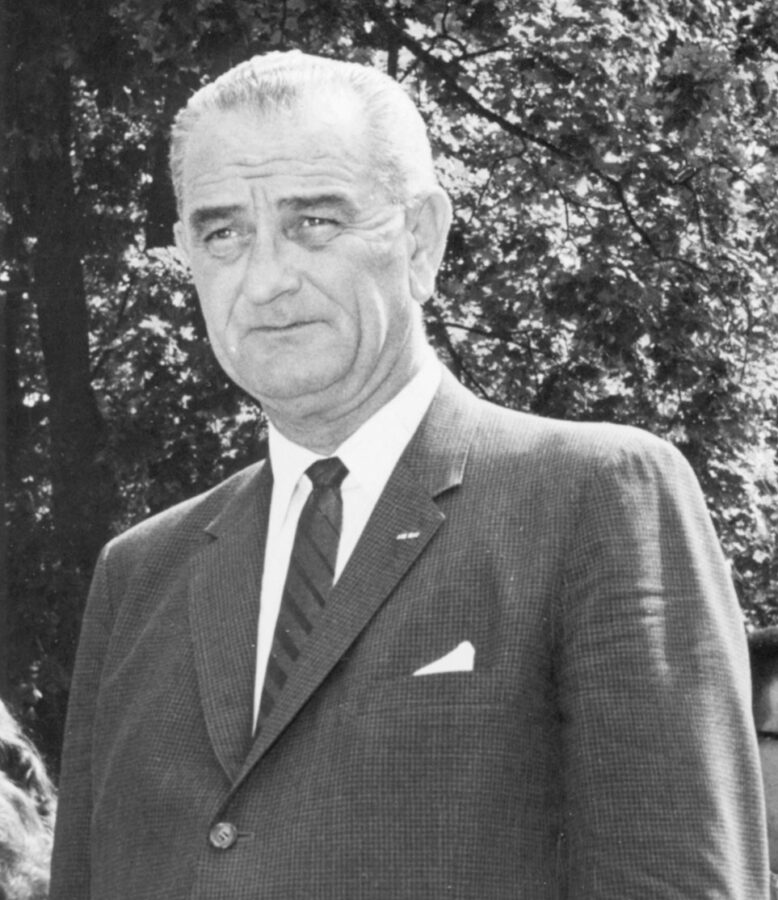
 Lyndon Baines Johnson
It was the Civil War Centennial when Vice President Lyndon Baines Johnson spoke at Gettysburg on May 30, 1963, while President John F. Kennedy attended Memorial Day exercises at Arlington Cemetery (where he would be laid to rest less than six months later). Johnson was there to speak about civil rights—the jewel in the Kennedy administration’s domestic policy crown. In many ways, Johnson’s speech offered a fitting conclusion to the arc of presidential addresses delivered at Gettysburg. Where the earliest orators had focused on Union and sacrifice and later speakers had focused on reconciliation between the Union and Lost Cause mythology and the need for peace at home and abroad, Johnson, the Texan upon whom the Kennedy campaign had relied to deliver the South to Democrats—and Kennedy to the White House—spoke about emancipation.
Johnson’s speech was just over 700 words, on the shorter end of Gettysburg addresses. But in rhetoric characteristic of the idealism of the early 1960s, it contained a powerful message. Johnson said, “One hundred years ago, the slave was freed,” and continued, saying, “One hundred years later, the Negro remains in bondage to the color of his skin.” He lamented the fact that most white Americans seemed content to ask African Americans to continue to wait for the rights and freedoms promised by the Emancipation Proclamation and the protections of the 13th, 14th, and 15th Amendments to be fully granted to them. It did a disservice, Johnson said, to the memories and the sacrifice of the men buried in the national cemetery at Gettysburg to delay freedom for black Americans any longer. He continued: “The Negro says, ‘Now.’ Others say, ‘Never.’ The voice of responsible Americans—the voice of those who died here and the great man who spoke here—their voices say, ‘Together.’ There is no other way.”
For Johnson, the meaning of the Civil War hinged upon whether all Americans had equal access to the freedoms granted under the law. As he stood in the cemetery, not far from where John Bell Hood’s Texans had struggled to reach the Round Tops on the scorching afternoon of July 2, 1863, Johnson paid no attention to the Lost Cause. He shed light instead on the lost opportunities of the intervening century—when the law codified prejudice rather than granting justice. “Until justice is blind to color, until education is unaware of race, until opportunity is unconcerned with the color of men’s skins,” he concluded, “emancipation will be a proclamation but not a fact. To the extent that the proclamation of emancipation is not fulfilled in fact, to that extent we shall have fallen short of assuring freedom to the free.”
In its meaning and its message, Johnson’s speech remains perhaps the most resonant to modern Americans. In almost all popular culture relating to the Civil War created since the centennial, emancipation has eclipsed all other memorial exhortations—the Lost Cause, Union, even reconciliation. And Johnson’s speech may have echoed longer than any other presidential utterance at Gettysburg because it was delivered by a southerner whose grandfather had served in Company B of the 26th Texas Cavalry, such that LBJ was descended from men who had fought a war to establish a slaveholding republic and against the idea that any black citizens should ever have the same rights and freedoms as their white counterparts. Johnson was a living example that the prejudices of the past need not be carried into the present, and he urged his listeners to adopt the same perspective.11
The fact that no president has ventured to Gettysburg since 1954—and no vice president since 1963—is worth noting. The entirety of the war’s sesquicentennial fell in the two terms of the first black man elected to the office. President Barack Obama attended no events related to the conflict’s 150th anniversary—save for a ceremony in the U.S. Capitol celebrating the passage of the 13th Amendment. The man whose presidency was the realization of what Lyndon Johnson hoped the country could achieve by finally fulfilling the promise of emancipation did not seem to share the conflict’s importance to 21st-century Americans.
Gettysburg—and certainly Lincoln’s speech—is not forgotten, but perhaps its symbolic value has waned for refreshing our collective memory of the nation’s bloody crucible. Several generations have passed since Lyndon Johnson’s Gettysburg speech, or since a president last called attention to the lessons of July 1–3, and November 19, 1863. The century that passed between Lincoln and LBJ saw America rise to the status of global superpower, fight two world wars, advance industry and science and art and diplomacy. Between 1863 and 1963, American presidents used Gettysburg to remember the sacrifice required to keep the nation from being sundered by secession—to preserve the Union and to bring an end to slavery. And above all to advocate on Gettysburg’s battlefield for peace and reconciliation in the face of disagreements that threatened to divide us—though the threat each generation faced was its own to overcome. 
Cecily N. Zander is a postdoctoral fellow at the Center for Presidential History at Southern Methodist University. She received her PhD in American History from Penn State in 2021. Her research and teaching interests include the Civil War era, American military history, memory, and popular culture.
Notes
1 Ulysses S. Grant, Personal Memoirs of U.S. Grant, 2 vols (New York, 1886), 2:340.
2 Rutherford B. Hayes, “Memorial Day,” delivered May 30, 1878.
3 Theodore Roosevelt quoted in Merrill D. Peterson, Lincoln in American Memory (New York, 1995), 164.
4 Theodore Roosevelt, “Remarks in Gettysburg, Pennsylvania,” delivered May 30, 1904.
5 Woodrow Wilson, “Address at Gettysburg,” delivered July 14, 1913.
6 Calvin Coolidge, “Address at Gettysburg Battlefield,” delivered May 30, 1928.
7 Herbert Hoover, “Memorial Day Address at Gettysburg Battlefield,” delivered May 30, 1930.
8 Franklin Delano Roosevelt, “Address at Gettysburg,” delivered May 30, 1934.
9 Franklin Delano Roosevelt, “Address at the Dedication of the Memorial on the Gettysburg Battlefield, Gettysburg, Pennsylvania,” delivered July 3, 1938.
10 Dwight D. Eisnhower, “Remarks in Gettysburg to a Group of Republican Candidates,” delivered October 23, 1954.
11 Lyndon B. Johnson, “Remarks at Gettysburg on Civil Rights,” delivered May 30, 1963.