Sherman’s March Library of Congress
When James Austin Connelly, an Illinois soldier in William Tecumseh Sherman’s marching army, arrived at the banks of Ebenezer Creek, a broad bayou off the Savannah River, in Georgia, he believed he was seeing a slow-moving massacre. It was December 9, 1864, almost two years after the Emancipation Proclamation had freed the slaves. Scores of African-American refugees—some men but mostly women and children—who had been following the army for some time were being turned off the road and told to wait while the army crossed to the creek’s other side.Except they weren’t being held back, they were being blocked.
Orders had apparently come down from Brevet Major General Jefferson C. Davis, head of Sherman’s XIV Army Corps, to pull up the temporary pontoon bridge before any of the freed slaves could cross. Connelly, the soldier from Illinois, knew this would end with Joseph Wheeler’s Confederate cavalry either capturing or killing those people stranded on the opposite bank.
Jefferson Davis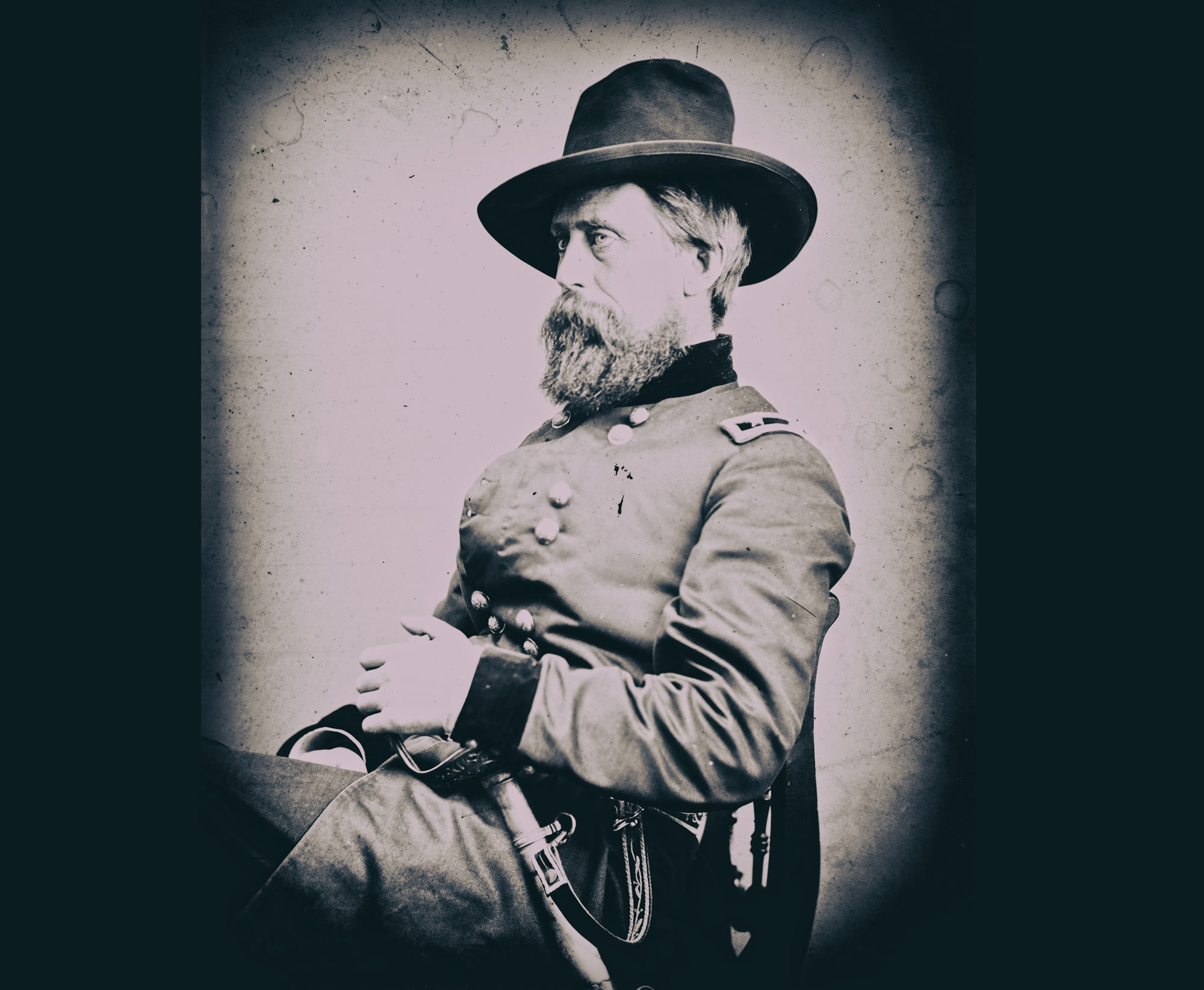 Library of Congress
Connelly went into a rage. Standing along the bank, with armed men marching in the background and the dark, brackish water of Ebenezer Creek moving off to the side, he cursed at Davis’ underlings, vowed to expose them all, and later wrote that he was prepared to lose rank or even shoot Davis if the general tried to retaliate.
But once the army was safely across the river, the bridge went up, and Connelly’s fears were realized. Wheeler’s cavalry arrived on the road, sparking chaos: pistol shots rang out, screams and shouts howled across the creek, the former slaves plunged down the bank, and bodies and bullets crashed into the water. Soldiers watching from the safety of the opposite bank threw felled trees into the water to help pull people across, but it was too late. Many of those who went into the water never came out and countless others never made it into the water. Those who fell into Confederate hands were said to have been captured or killed.
 Library of Congress
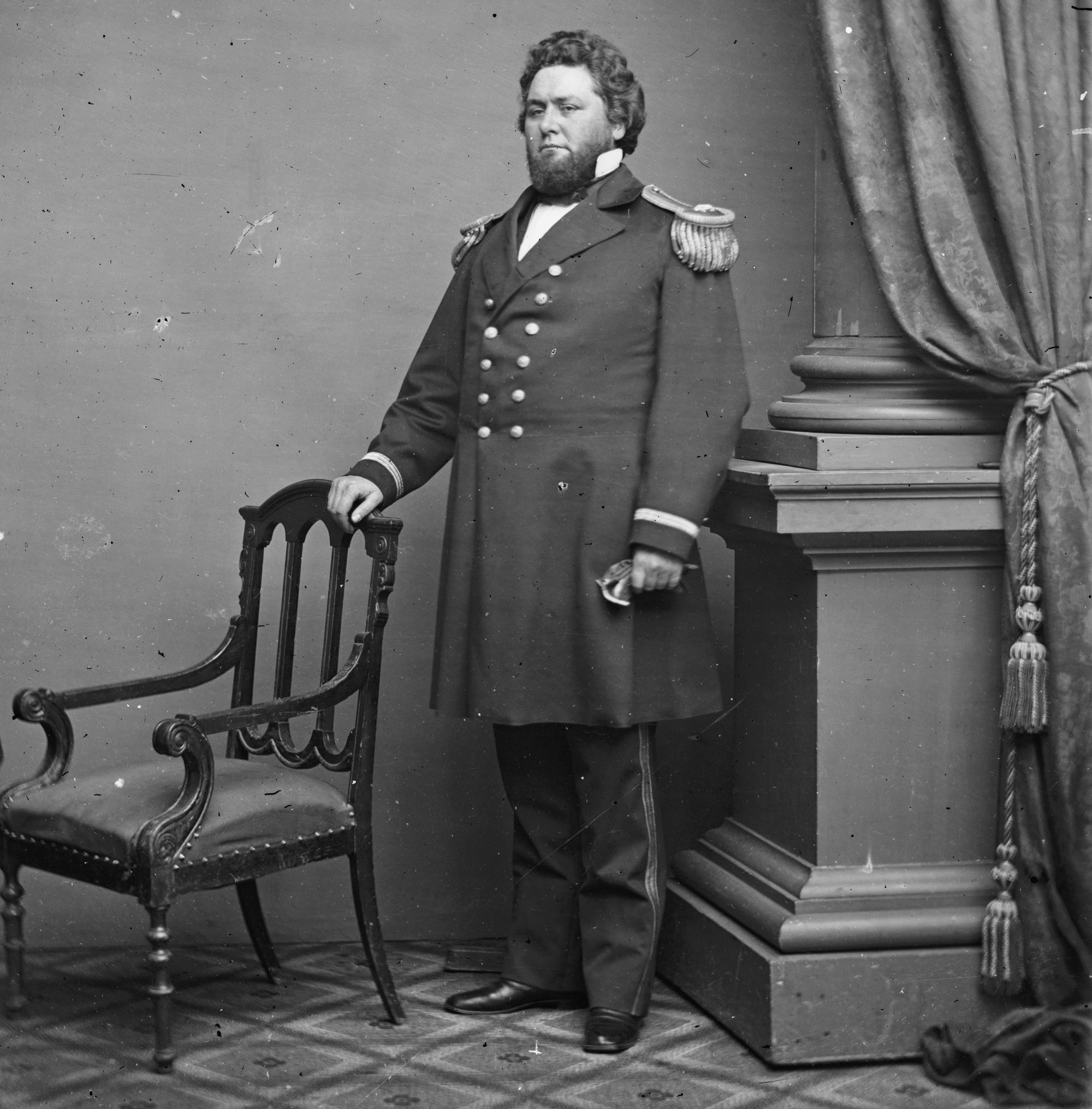
Union general William “Bull” Nelson in a wartime photo.
Despite eyewitness accounts from several Union soldiers who reported what they saw, exactly what happened at Ebenezer Creek still remains unsettled. There’s never been an official body count: Some accounts suggest hundreds of the freed slaves may have fallen into Wheeler’s hands; others say only a few were captured and returned to slavery. Some accounts say Wheeler’s men killed the refugees on the spot; others say they didn’t kill anyone. Some say only a few of the African Americans got across the water; others say most of them made it across one way or another. There are even conflicting reports as to whether the army simply pulled up the bridge, or did it pull up the bridge and then burn it for good measure?
Even given these outstanding questions, there’s never been any doubt that what happened at Ebenezer Creek was one of the Civil War’s most dreadful moments—a sinister betrayal-turned-tragedy. There’s also been little doubt as to who was responsible. Most if not all the soldiers there, like Connelly, recognized the incident as the personal handiwork of one Jefferson C. Davis, a man of credentialed notoriety and the otherwise undisputed villain of Sherman’s March to the Sea.
Davis was someone to whom infamy came easily. For starters, Jefferson Columbus Davis of Indiana shared his first and last name with Jefferson Finis Davis of Mississippi, the president and commander in chief of the Confederacy.
 Harper’s Weekly
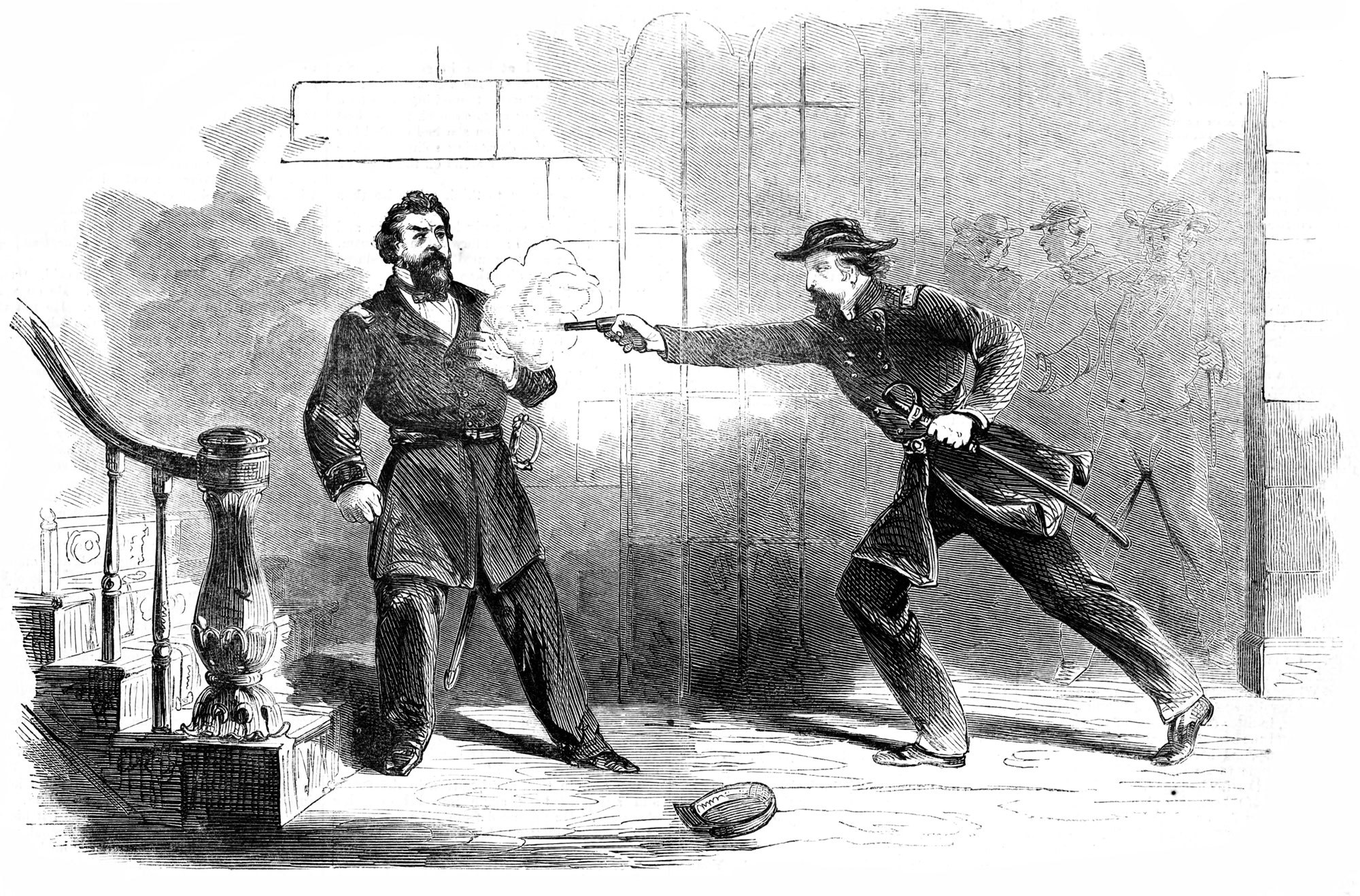
By the time of the incident at Ebenezer Creek, Jefferson C. Davis was already notorious for killing fellow Union general William “Bull” Nelson in a Louisville hotel in 1862. Above: A Harper’s Weekly illustration depicts “the assassination of General Nelson by General Jefferson C. Davis.
He also had a temper that tended to get him in trouble—and in one instance, should have gotten him hanged. That happened in Louisville, Kentucky, in 1862. Davis, who was from Clarke County, just on the Indiana side of the Ohio River, reported there after a brief, army-approved home convalescence. Two days later, Major General William “Bull” Nelson, a 300-pound hulk of a man and commander of the city, angrily dismissed Davis, citing incompetence and a lack of trust.
Incensed over what he perceived as a personal and professional affront, Davis left for Cincinnati, only to return less than a week later and demand an apology. “Go away, you damned puppy,” is what Nelson is reported to have said as he scoffed at Davis. In response, Davis pulled a resignation letter from his pocket, crinkled it up, and flipped it at Nelson’s face—an offense Nelson responded to by backslapping Davis across the cheek.1
Davis took off and stalked the city in search of a gun. When he finally found a small pistol, borrowed from a friend, he walked back to the Galt House Hotel, marched through the lobby to Nelson’s office, and shot him in the chest. Nelson had the strength to hobble up a flight of stairs before falling dead, a bullet hole in his heart.
Eyewitnesses confirmed that Davis never ran or looked flustered. He stood next to the general’s body as the authorities arrived to take him away. He admitted everything, declaring that it was Nelson who had instigated the whole affair by denying Davis the respect his rank deserved.
It just so happened that Davis’ murder of Nelson coincided with the Confederate invasion of Kentucky, and his friend, Major General Horatio G. Wright, argued that the Union army couldn’t spare any fighting men. Davis didn’t so much as see a trial, nor was there a court martial. He simply began reworking his way up the chain of command, though his time in Louisville never left him: Everyone knew that behind that fierce beard and those sad, sunken eyes was a stone-cold killer.
Davis was one of Sherman’s trusted lieutenants. Though he hadn’t been at either Shiloh or Vicksburg and was a relative newcomer to Sherman’s army, he had commanded men at Stones River, Chickamauga, and he proved especially capable in the summerlong fight for Atlanta. By late 1864, he was one of several officers expected to fill the void left by the death of Major General James B. McPherson, a rising young commander and close friend of Sherman’s killed at the Battle of Atlanta.
Along the famous March to the Sea, Davis covered Sherman’s most leftward flank. He had about 15,000 men, mostly Midwesterners, under his command, and he followed an important, if winding, route. He moved first out of Atlanta to Milledgeville, made a slight feint to the east in the direction of Augusta, and then angled his way farther south while all but hugging the Savannah River, which meant that his path encountered an almost endless array of swampy ground and rivers and streams.
Davis knew this was no ordinary campaign. In plunging deep into Georgia’s gullet, Sherman had basically cut his army off from any base of supplies. Sherman’s men had to feed themselves by foraging off the farms of central Georgia. This was partly a strategic choice—to crush the Confederacy by waging a relentless material war on an already debilitated southern homefront. But it also meant that any error or false movement might result in the army stalling out before Savannah and facing a hungry winter stranded in enemy territory.
The March was different in another striking respect. Starting from as far back as Sherman’s initial push out of Atlanta, incredible numbers of enslaved people fled their plantations and ran to meet the advancing army. They came in groups as large as a hundred or more; sometimes whole neighborhoods walked away from their enslavers and lined the roads, waiting to see the army. Henry Hitchcock, one of Sherman’s adjutant generals, who kept a remarkable diary of the March, recalled a time near the town of Shady Dale when a group of 250 African Americans marched off their plantations and “joined the Yankees in high glee!” “So it was everywhere,” he wrote later, believing it was the start of a greater phenomenon.2
But enslaved people had been running to Union armies ever since the Emancipation Proclamation effectively made the armies a liberation force. Where the armies were, slaves were free. The phenomenon was that those freed people were now following an army; by the time Sherman’s left wing rolled into Milledgeville, the midpoint of his campaign, hundreds, if not thousands, of former slaves marched at the rear of his columns, forming what one soldier described as a large cloud at the end of a thunderstorm.3
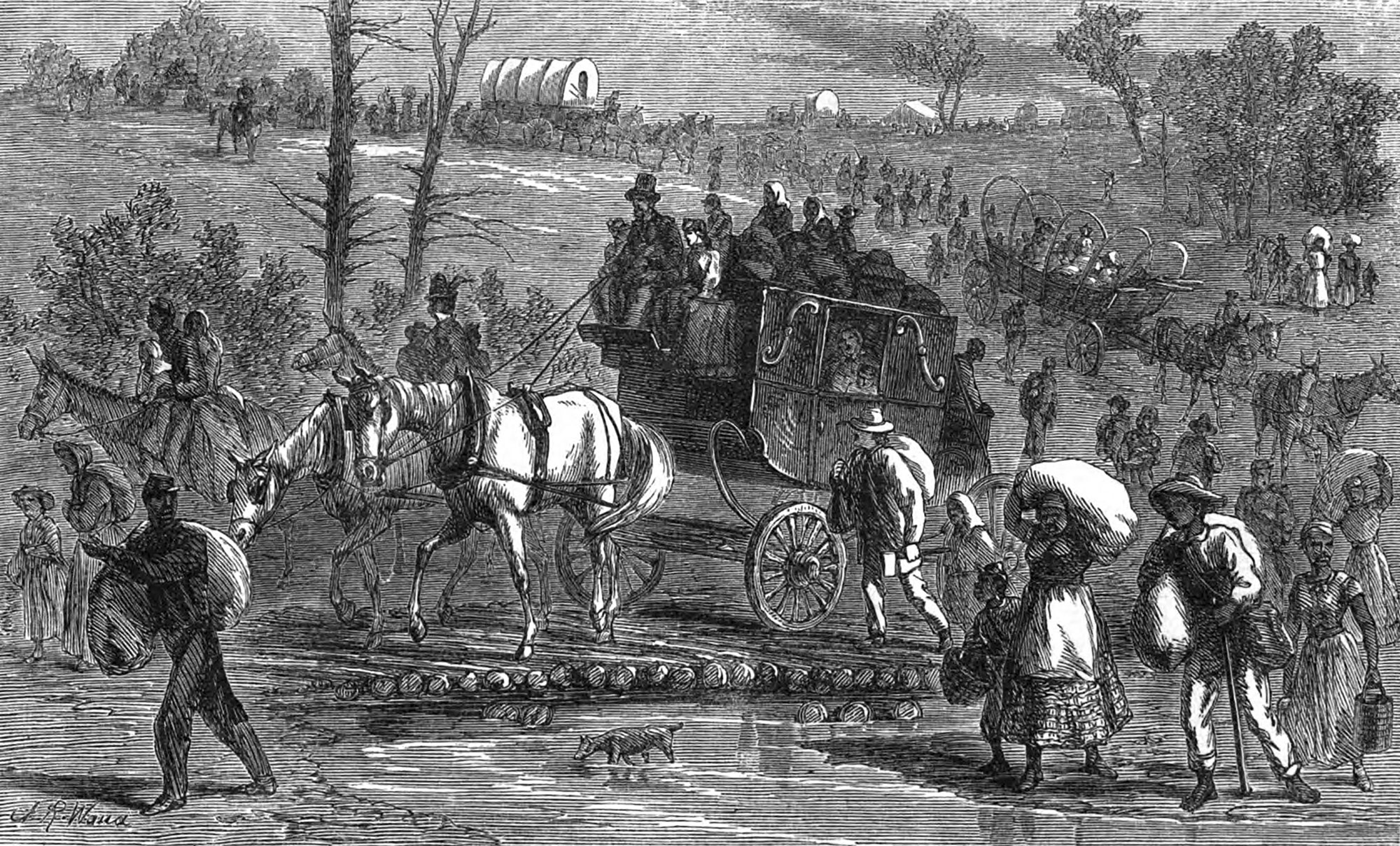
Though most of Sherman’s soldiers never recognized it as such, this was a concerted movement. Many of the freed people marched on foot. Others rode on horseback. Some rode atop wagons or carts loaded down with suitcases and sacks of corn or ham. In some cases, they were families; in other cases, men, women, and children marched hoping to reconnect with loved ones and reconstitute families separated under slavery. Moreover, while many of these refugees approached the soldiers with a degree of skepticism, others embraced them and pressed into camp night after night—in effect, laying a special claim to the March and their place in it.
 The Story of the Great March (1865)
Thousands of African-American refugees followed Sherman’s advancing army on its March to the Sea (as depicted above in an illustration from 1865) in hopes of securing their freedom. As one Union soldier put it, the train of refugees appeared something like a large cloud at the end of a thunderstorm.
In some ways, this attachment to the army became a force behind the entire campaign. Freed people scouted for the army, cooked for the army, and often ferried soldiers away from danger. Some would direct Sherman’s foragers to hidden plantation treasures, and an astounding number of freed men became laborers for the army, impressed as pioneers or road-builders, which meant they quite literally paved the army’s way to Savannah. All the rest, disproportionately women and children, brought up the rear, a kind of ever-present force in their own right.
Between Milledgeville and Savannah, hundreds more joined the swelling caravan, with one soldier calculating that as many as 10,000 freed people followed the army into Savannah—not counting, he said specifically, the numbers that turned back along the way. Major General Henry Slocum, head of Sherman’s left wing, believed as many as 14,000 freed people joined his wing in Savannah, and Sherman himself thought the total number was even higher. He would later write that as many as 20,000 freed people marched with his army to Savannah—a number that nearly matches the population of Savannah itself, the largest city of prewar Georgia.
By the time Davis’ XIV corps arrived at Ebenezer Creek—the day before Sherman would arrive at the outskirts of Savannah—there were probably a large number of freed people following close behind. Davis had disdained them from the start. Not only was he an “infernal copperhead,” to quote Connelly, meaning a northern Democrat of anti-abolitionist sympathies, he saw the freed slaves as only potential impediments. In his mind, all they would do is clog the roads, eat too much of the day’s forage, and slow down his columns.4
We know this about Davis because of all Sherman’s generals, he was the only one known to have complained of these black army followers in writing and to have issued orders meant to check their advance. For example, near Eatonton in the early days of the March, he reported: “Useless negroes are being accumulated to an extent which would be suicide to a column which must be constantly stripped for battle and prepared for the utmost celerity of movement.” He followed that up by warning his men that the March wouldn’t remain unobstructed for long and that “every additional mouth consumes food.”5
Not long thereafter Davis made his first official move. Orders came down from the general’s staff barring these refugees (women specifically) from riding along with the army in army wagons, and Davis then prohibited all but a small number of them—those serving as valets or personal servants to soldiers—from riding horses or mules. The message, which he couched in the language of military resources and preparedness: offer no implicit invitations and remove anything that might make following the army easier.
On the winding roads south of Milledgeville, the army rose each morning to a changing landscape. The breadbasket of central Georgia—a region of rolling hills and rich, fertile soil—gave way to flat, sandy terrain lined with rivers and cypress swamps. Here, on the edge of the Georgia Lowcountry, a low-lying region running in from the coast, the fields were leaner, the roads more rutted, and the day’s march was often entombed in a dense thicket of towering pines.
The army’s general approach to the freed refugees had also begun to change. Previously, it had been one of ambivalence: Officers had orders to only let those who could be of military use—i.e., working-age men—follow along, but enforcement had waned. So long as the refugees kept to the rear and mostly out of sight, Sherman’s soldiers generally ignored them and didn’t bother turning anyone away.
That changed, however, in the second half of the March as the crowd grew larger and the landscape became less hospitable. Suddenly, there was a renewed urgency to turn freed people away—and not just new arrivals, but everyone, even those who had been with the army for weeks. Some reports suggest this was a retrenchment ordered by Sherman; others suggest it came from an army-wide sense of unease over the refugees and the potential problems they posed.
Davis took it as an invitation to try to rid his army of the refugees by any means necessary. His first attempt came alongside a body of water known as Buckhead Creek. Just as he would do again days later to more disastrous results along the banks of Ebenezer Creek, Davis ordered the bridges up before the refugees could cross: Cries of alarm went up with the bridges, people poured into the river. Then bedlam broke out as someone spotted what looked like Confederate cavalry charging up from the rear—a false alarm that sent even more refugees plunging into the river. They tried frantically to swim across; soldiers on the opposite bank lobbed sticks into the water to help pull them through the current. In the end, the river proved passable and most of the refugees managed to make it to the other side.
John Hight, an army chaplain marching in a Wisconsin regiment, described the scene at Buckhead Creek as “disgraceful to American history”—and not necessarily because of what happened, but because of Davis’ willful intent. As Hight would later write, everyone, including Davis, knew that to leave the refugees stranded on the opposite bank was to leave them to the whims of the Confederate cavalry, which Hight believed was as good as a death sentence. Not only had Wheeler’s men been spotted traveling close behind, they’d made it perfectly clear that freed slaves would be treated as runaways and punished as such. And yet, the bridges still went up.6
Davis did it again at Ebenezer Creek. And he may have done the same thing in the intervening days, at a crossing of a river known as Rocky Comfort Creek. By this time, Hight writes, the people following the army had grown so distrustful of the soldiers that many began finding their own routes around bodies of water.
How many times did this happen? The answer isn’t clear. What’s clear is that the tragedy at Ebenezer Creek was hardly a single incident. Rather, it was planned, premeditated, and a result of Davis’ close-fisted attitude toward the freed people following his lines; many of his men didn’t mince words when it came to assigning blame. “Let the ‘Iron Pen’ of history write the comment on this action of a Union general,” wrote one man; another, an Indiana medic named James Comfort Patten, used a biblical reference in writing: “If I had the power I would have him [hanged] as high as Haman.” Patten went on to say that a general disgust with Davis had so spread through the soldiery that he believed Davis should watch his back, or a not-so-stray bullet just might hit him from behind. (Counting Connelly’s threat, this is the second soldier to imagine Davis being shot by his own men.)7
Despite the tragedy at Ebenezer Creek, Davis wasn’t done. No more than a day later, Davis’ columns came to the banks of Lochner Creek (sometimes spelled Lockner Creek), where again Davis ordered up the bridges. Countless numbers of freed people—all of them probably still numb from the waters of Ebenezer Creek—were left with no choice but to wade into the water and swim for the safety of the opposite bank.
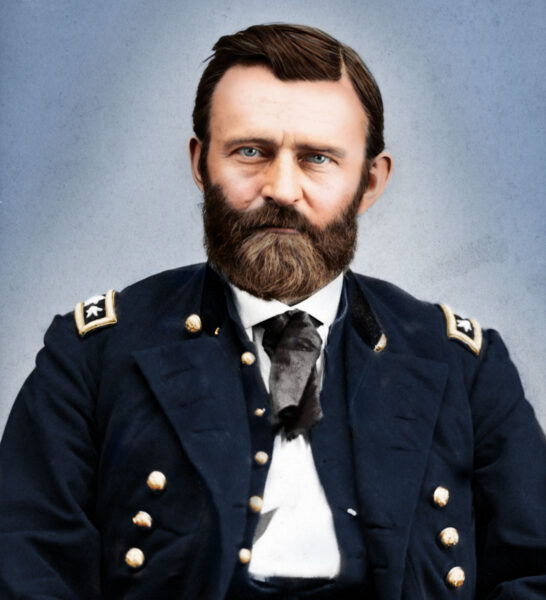
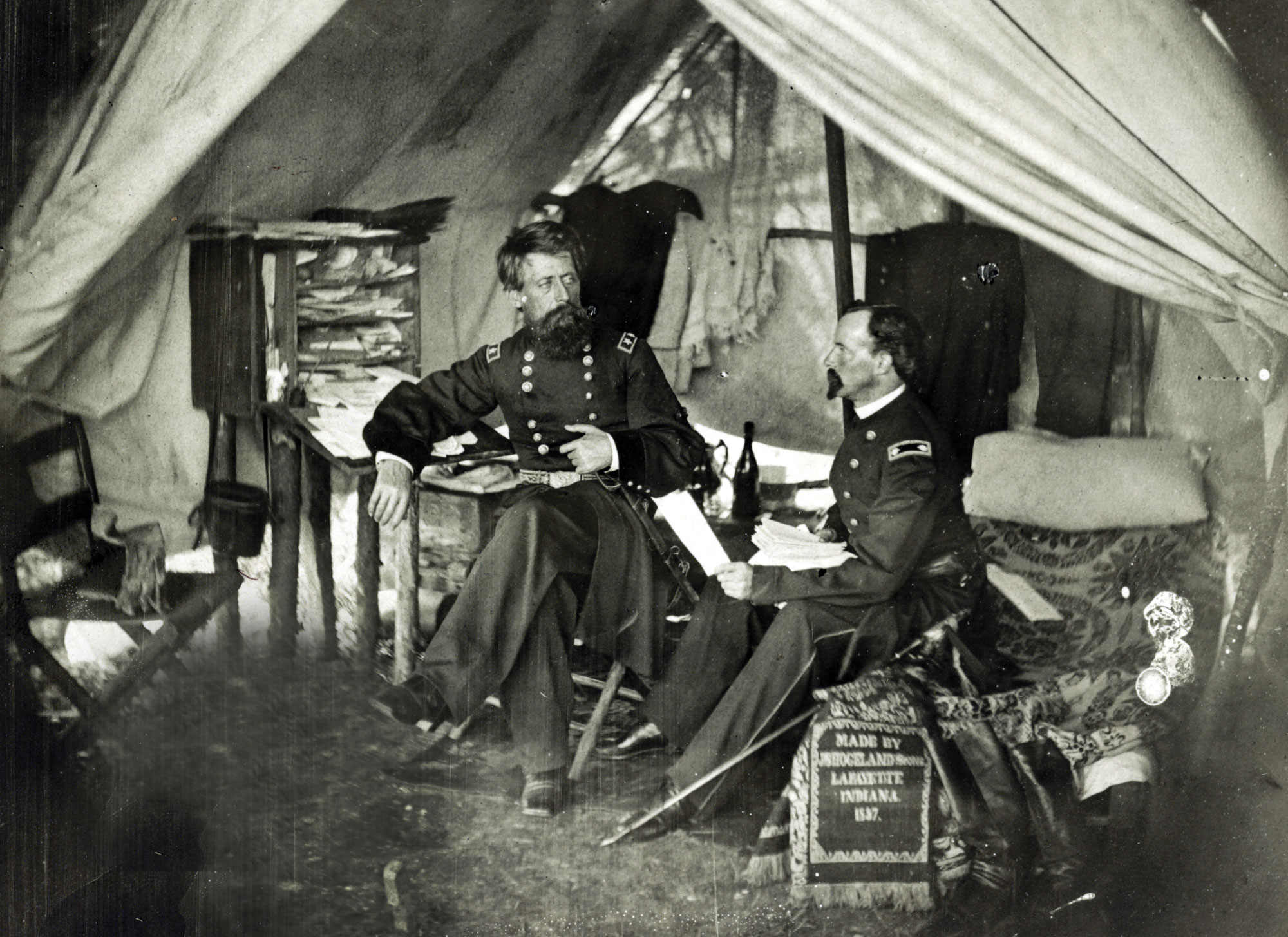 Library of Congress
Throughout the March to the Sea, Jefferson C. Davis (pictured here at left in a wartime photo) repeatedly acted to prevent refugees from following the army. “Useless negroes are being accumulated to an extent which would be suicide to a column which must be constantly stripped for battle and prepared for the utmost celerity of movement,” he reported near the outset of the campaign.
Ebenezer Creek was a turning point in the month-and-a-half-long march through Georgia. On the one hand, Ebenezer Creek was where many of Sherman’s soldiers began to truly see the refugees and recognize what the March meant to them: “And what is it all for? Freedom. They are periling their lives for freedom, and it seems to me that any people who run such risks are entitled to freedom,” wrote an Illinois private who saw it all unfold and witnessed the aftermath as broken families huddled together, trying to warm themselves with whatever they could find.8
On the other hand, Ebenezer Creek was a point of no return for the refugees. The damage couldn’t be undone: Families had been shattered, loved ones lost, and the survivors all wore the trauma of the crossing in their clothes. Moreover, in a literal sense, there was no going back. To turn back was to walk headlong into Wheeler’s cavalry. It was Savannah or bust.
Ebenezer Creek was also a turning point in a broader sense because word of it eventually got out. Though the story was never fully told, news of the tragedy became central to a larger narrative suggesting that Sherman and his men had turned their backs on the freed people—and that had the army pursued emancipation to the fullest extent possible, it could have liberated tens of thousands more slaves and basically ended the war by the time Sherman arrived in Savannah.
This competing narrative didn’t come close to eclipsing the image of Sherman and his army as conquering heroes, but in certain circles in Washington, D.C., and elsewhere, it did take some of the shine off the March and what it had accomplished. The big fear, politically speaking, was that news of some betrayal involving bridges and a creek would anger black leaders and threaten to stall the army’s recruitment of black troops. In that vein, the War Department launched a tepid and largely symbolic inquiry into what went on along the March to the Sea.
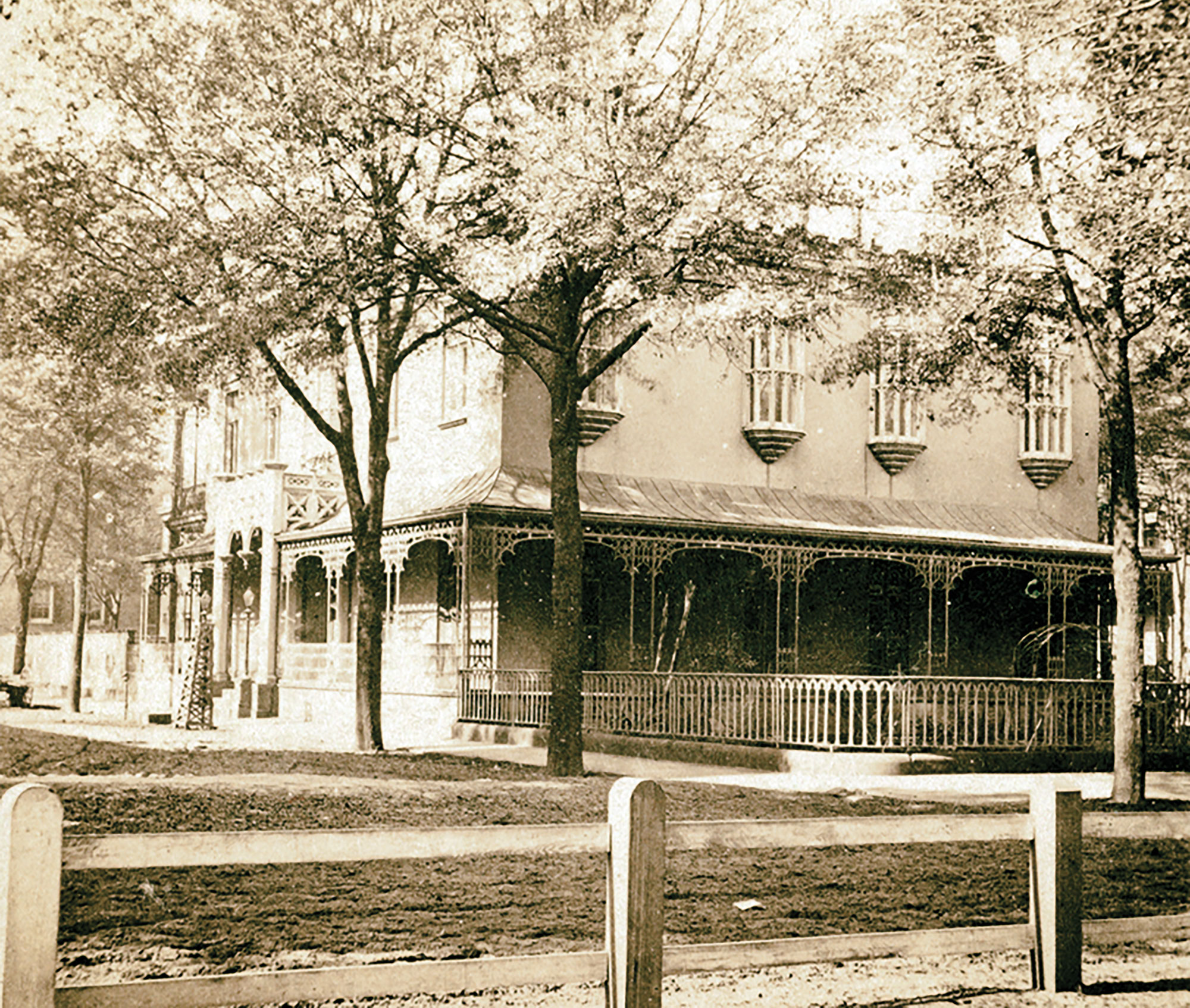 Library of Congress
The Green Mansion in Savannah, where on January 12, 1865, William T. Sherman and Edwin Stanton met with 20 local African-American religious leaders to discuss the future of the city’s newest refugees.
Everything came to a head on January 12, 1865, in what became a famous meeting. Three weeks after the city’s surrender, Sherman, Secretary of War Edwin Stanton, and 20 of Savannah’s African-American religious leaders held a “colloquy” at Sherman’s headquarters, the beautiful Green Mansion off Madison Square. It revolved crucially around how best to handle the many thousands of refugees now in Savannah, and as the meeting unfolded, Garrison Frazier, a former slave and the chosen spokesperson for the black pastorate in attendance, outlined a broad vision of freedom predicated on black landownership and independence. His answer to the problem was to give freed people land and the right to work it for themselves, an answer that he said came directly from the refugees, many of whom he had spoken to in the course of his ministry.
After Frazier handled all of Stanton’s probing questions in a clear, focused fashion, Stanton dismissed Sherman so that he could speak with Frazier and the pastors in private.
Stanton wanted to know how the men felt about Sherman, with the obvious subtext being Ebenezer Creek and the army’s conduct around the refugees. While Stanton pried a door open, Frazier—who may or may not have fully known about the incident—slammed it shut. He responded that he and the other pastors had the utmost faith in Sherman and believed him both a gentleman and a friend, which satisfied Stanton.
There was still the sense that Sherman needed to do something to settle the refugee situation more permanently and assuage any critics. Thus, four days after the meeting, he issued Special Field Orders No. 15, which set aside nearly 400,000 acres of land from Charleston, South Carolina, to Jacksonville, Florida, exclusively for black homesteading. The land was to be broken into 40-acre plots, and he issued a separate order days later suggesting the government would provide some of the tools needed to till the land, thus the likely origin of the phrase “forty acres and a mule.” This was the most drastic escalation of Reconstruction policy to date and a sign of just how radical Reconstruction could become.
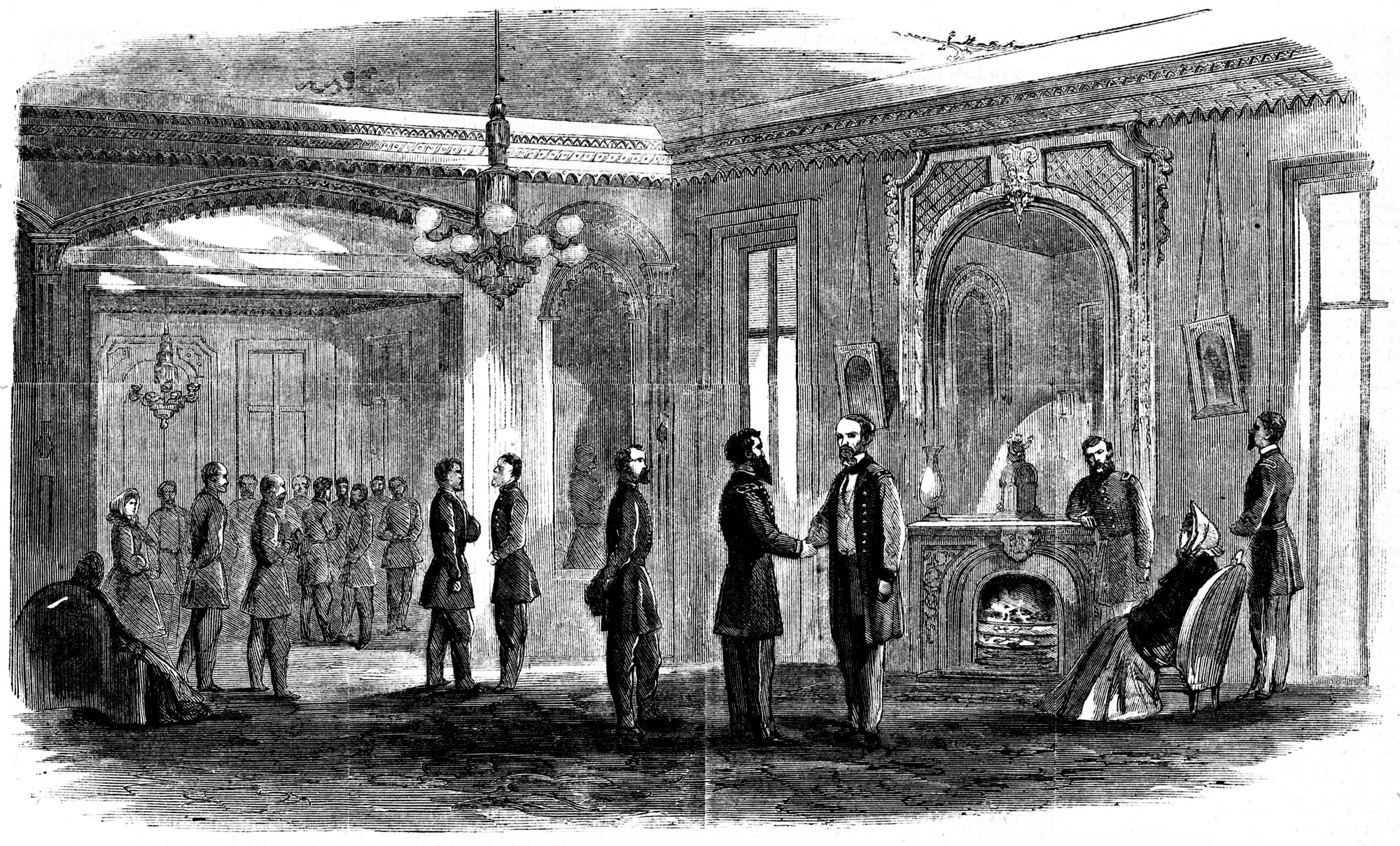 Harper's Weekly
William T. Sherman (shown above hosting a New Year’s Day reception weeks earlier at the mansion)
If the Special Field Orders represented a small token of redress, responsibility was much harder to come by. On that score, Davis again got off scot-free. Sherman was the man making headlines and the man in charge, which meant that the most pressing questions concerned his orders, his actions, and his army’s general posture toward the refugees, not Ebenezer Creek or Sherman’s Jefferson Davis.
Sherman always stood by his men. In particular, Sherman wrote to Henry Halleck, chief of staff of the armies, calling the reports that he turned refugees back so that Wheeler’s men could kill them “a-cock-and bull-story.” He admitted that Davis had turned refugees back at Ebenezer Creek, but he went on to imply that the story had been misconstrued: Davis had simply prohibited the refugees from following him. That the refugees didn’t listen was no one’s fault but their own. Moreover, Sherman told Halleck that when Davis pulled up the bridge, he didn’t mean to harm anyone; he just wanted his bridge back (a story that doesn’t hold up against those reports that Davis’ men burned the bridge upon pulling it up). Sherman also told Halleck that he had it on good authority from both Davis and Henry Slocum, Davis’ superior, that Wheeler’s men didn’t kill any of the refugees, another claim that conflicts with a number of eyewitness reports.9
The military establishment in the person of Slocum offered what became the standard line of defense of Davis and Sherman’s army when he wrote: “On several occasions on the march from Atlanta we had been compelled to drive thousands of colored people back, not from lack of sympathy with them, but simply as a matter of safety to our army.” In other words, it was a necessity—even when it caused what Hitchcock, Sherman’s adjutant, euphemistically described as “incidental consequences.”10
Not everyone agreed. Many of the rank and file troops who marched with Davis stood by their initial statements. Davis pulling up the bridges was often referred to as a kind of dirty trick, and when Chaplain Hight heard that perhaps not as many people had been captured at Ebenezer Creek as originally thought (and possibly sent back into slavery), he still wrote: “Such would have been the fate of all had the will of Jeff Davis had anything to do with it.” Hight hadn’t seen the calamity of Ebenezer Creek first hand, but he had been at Buckhead Creek, had heard the cries, and marched among Davis’ men. He knew a villain when he saw one.11
for an army unwilling to turn on one of its own, the argument for military necessity provided an easy out. After the war, Sherman tried to get Davis promoted, recommending him for the rank of full major general. But perhaps because Davis’ killing of Nelson still loomed large, perhaps because he was known to be unpopular with his men, perhaps because he couldn’t outrun his actions on the March, Congress left his preferment in inaction purgatory.
The waning years of Davis’ career featured one dalliance with disrepute after another. In the late 1860s, he forcibly deported Russian settlers while heading up the Alaska territory; a few years later, he fought native peoples in the bloody Modoc War (1872–1873) and apparently without authority tried to execute Modoc chieftains; and lastly he led his men as glorified strikebreakers in the Great Railroad Strike of 1877.
In 1879 Jefferson C. Davis died at 51, having never risen above the rank of a brevetted major general. The rank he held at Ebenezer Creek.
Bennett Parten is a Ph.D. candidate in American History at Yale University. He’s currently at work on a history of Sherman’s March and American emancipation. His writing has appeared in The Los Angeles Review of Books, The Washington Post, History Today, and the History News Network.
Notes
1. See John Cheairs Hughes Jr. and Gordon D. Whitney, Jefferson Davis in Blue: The Life of Sherman’s Relentless Warrior (Baton Rouge, 2002), 112.
2. M.A. DeWolfe Howe, ed., Marching with Sherman: Passages from the Letters and Campaign Diaries of Henry Hitchcock, Major and Assistant Adjutant of Volunteers, November 1864–1865 (Lincoln, NE, 1995), 78.
3. J.R. Kinnear, History Eighty-Sixth Regiment Illinois Volunteer Infantry (Chicago, 1866), 81.
4. Paul Angle, ed., Three Years in the Army of the Cumberland: The Letters and Diary of James A. Connelly (Bloomington, 1996), 356–357.
5. United States War Department, The War of the Rebellion: A Compilation of the Official Records 129 vols. (Washington, 1880–1901), Ser. 1, Vol. 44, 502.
6. John J. Hight, History of the Fifty-Eighth Regiment of the Indiana Volunteer Infantry (Princeton, 1895), 426–427.
7. Ninety-Second Illinois Volunteer Infantry (Freeport, IL, 1875), 200; Robert G. Athearn, ed., “An Indiana Doctor Marches with Sherman: The Diary of James Comfort Patten,” Magazine of History, Vol. 49, No. 4. (December 1953): 419–420.
8. Ninety-Second Illinois Volunteer Infantry, 197.
9. William T. Sherman Letter to Henry Halleck, January, 12, 1865 in Simpson, Berlin, eds., Sherman’s Civil War: Selected Correspondence of William Tecumseh Sherman, 1860–1865 (Chapel Hill, 1999), 795–796.
10. Quoted in Hughes, Gilbert, Jeff Davis in Blue, 312; Ibid.
11. Hight, Fifty-Eighth Regiment Indiana Volunteers, 467.