 Library of Congress
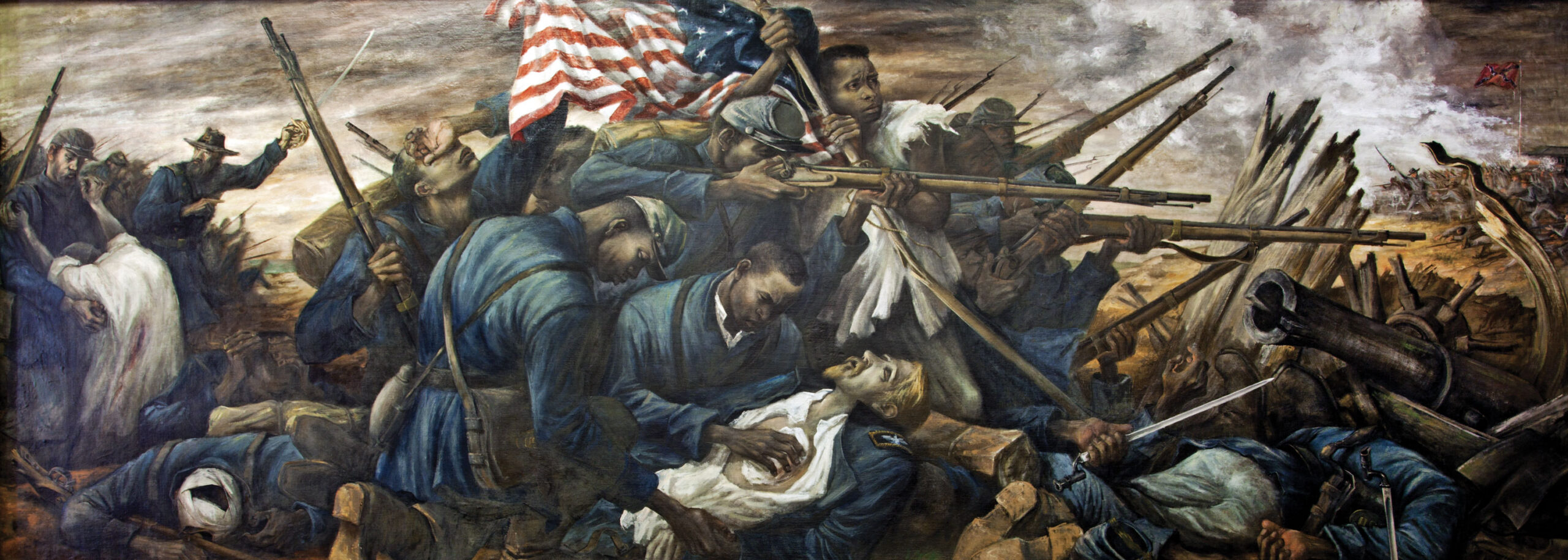
The men of the 54th Massachusetts Infantry attack Fort Wagner on Morris Island, South Carolina, in July 1863, in “The Death of Colonel Shaw at Fort Wagner,” a mural by Carlos Lopez completed in 1943 for the Recorder of Deeds Building in Washington, D.C.
In our current political environment it is common for pundits and social media blowhards to remark that we are more divided than ever. Of course, scholars of American history, and particularly of the Civil War era, know better. Some of the biggest contributors to our tribal political culture represent the partisan press. The gulf between how different media report on the same events can make it difficult to discern the reality from the camouflage. Yet while it is tempting to view the divide between reported fact and opinion as greater than ever, a partisan press has been an element in the nation’s political culture for most of our history. Civil War-era newspapers made no secret of their leanings, as openly proclaimed party politics shaded their interpretations of events. A particularly interesting example is how northern newspapers reported on the July 18, 1863, attack on Fort Wagner in South Carolina.
Today it is often argued that the efforts of the famous 54th Massachusetts Infantry in the Wagner attack helped northerners not only accept African Americans as soldiers but also their recruitment to Army service. And further, that the regiment’s valiant but doomed effort also helped turn northern opinion in favor of emancipation as a tool for saving the Union. Yet a look at the contemporary newspaper coverage shows that the 54th’s performance in the battle came to be bitterly debated. This was largely the result of Abraham Lincoln’s insistence that the Confederacy give equal treatment to the regiment’s soldiers taken prisoner, which raised questions in the press about racial equality and African-American citizenship.
 USAMHI
While today it is believed the battlefield performance of the 54th Massachusetts Infantry at Fort Wagner (shown here in a photo from 1865) helped convince most northerners of the merits of black soldiers and emancipation, a look at contemporary newspaper coverage tells a more complicated story.
In 1857, the Supreme Court had ruled that all people of African descent could not be citizens. Thus, when freed blacks or escaped slaves wanted to enlist in the U.S. Army at the start of the Civil War, the government refused them. Many whites believed that because blacks were noncitizens, the nation was not theirs to defend—and, too, that blacks could not be good soldiers because they did not possess “manly” qualities. Because African-American men did not possess citizenship rights allowing them to be autonomous patriarchs—the era’s image of self-reliant protectors and shepherds of their dependents—whites perceived black men as lacking in manhood.
But by the summer of 1862 a faltering military situation led many white northerners to decide it was necessary for blacks to aid the Union effort in some form. Congress authorized the president to enlist the runaway slaves of Rebels in any military service “for which they may be found competent.” Most people viewed this as endorsing the use of African Americans as laborers only. Lest anyone think such service elevated blacks to the status of “men” deserving citizenship, their compensation confirmed otherwise. Black soldiers were paid $3 less per month than white soldiers, with another $3 deducted for clothing.
While the Emancipation Proclamation, which went into effect the following January, specifically encouraged black enlistment, many still felt African Americans’ military service should be limited to garrison and fatigue duty. Democrats in particular objected to African-American soldiers, insisting they would increase southern hostility, making a negotiated peace impossible; that their fighting alongside white troops would demoralize whites and slow enlistments; and that creating black troops would be the first step toward racial equality. While many Radical Republicans did hope for that, more conservative Republicans generally downplayed the possibility of such an outcome.
As the first regiment of African-American troops recruited in the northern states (in the early months of 1863), the 54th Massachusetts stepped immediately into this socio-political divide, drawing much newspaper coverage. “The regiment attracts considerable attention,” noted one of its first recruits, Private James Gooding, writing for his hometown New Bedford Mercury, “if judged by the number of visitors we have” in camp. Comprised mostly of northern free blacks, the volunteers signed up not only to fight against slavery, but also to justify their right to full citizenship by displaying the manly qualities of their race. Their ardor was revealed from the start, as a Republican Vermont newspaper reported: “There is among [the regiment] a pride in their organization; they are strong, active men having confidence in themselves and their officers.” The Boston Daily Advertiser noted that all “visitors have been surprised to find a remarkably fine body of men, and have come away from the camp … with strong confidence that [the regiment] will do well.” Governor John Andrew, himself an abolitionist, weighed in, remarking that even in its “brief history of camp life” the 54th was already accomplishing its most important goal: demonstrating “the manly character … of the colored citizens” enlisted in the regiment.1
 Library of Congress
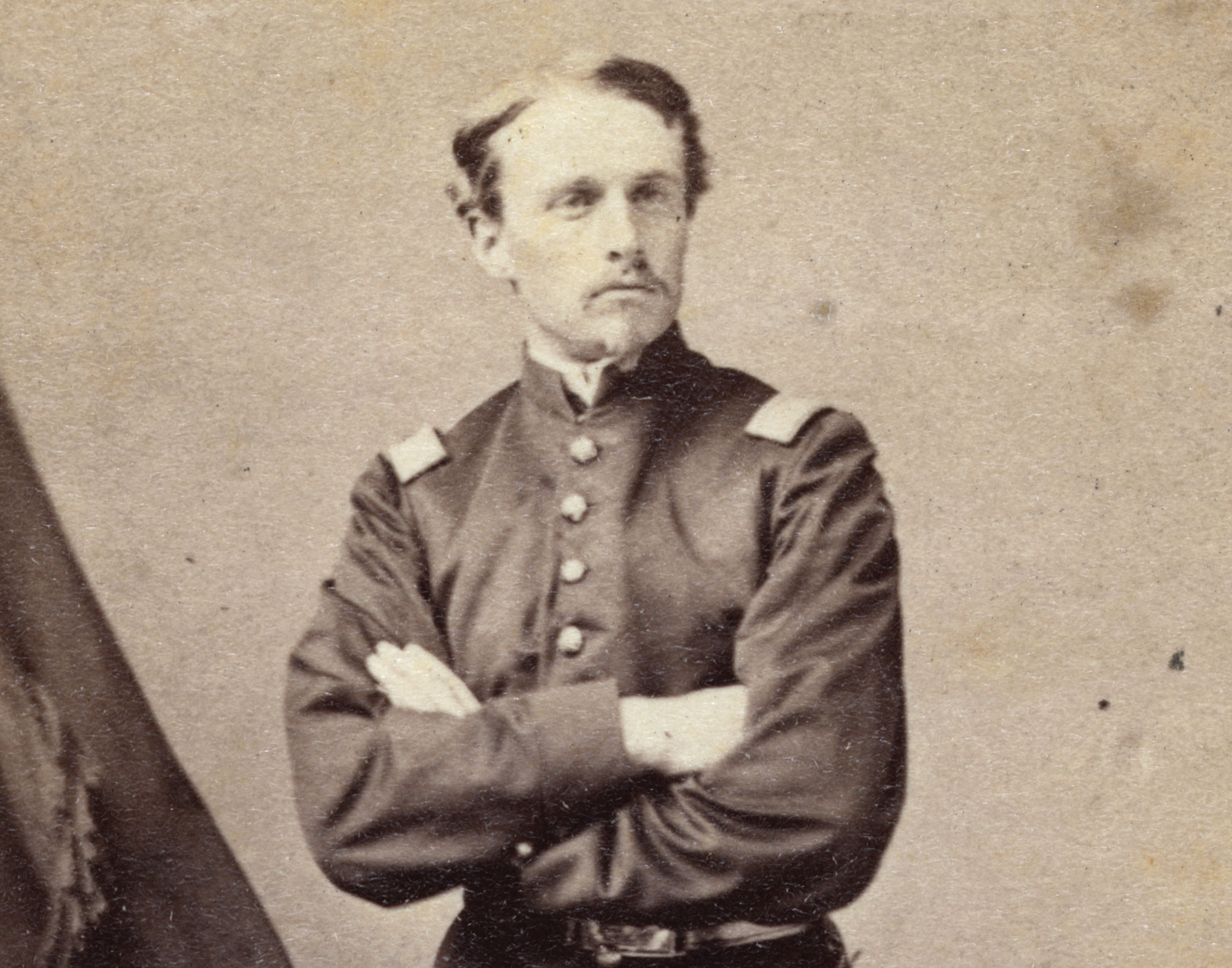
Robert Gould Shaw (shown here in a photo from 1861), the son of prominent Boston abolitionists who had been appointed colonel of the 54th Massachusetts, believed that if his black troops played a significant part in the taking of Charleston, it might help secure emancipation and perhaps even citizenship for African Americans.
At the same time, the Democratic press mocked the men of the 54th Massachusetts. The Boston Pilot odiously opined, “Negroes on the march will be smelled 10 miles distant.” The Boston Courier fabricated a recruitment speech given in a “cellar.” Using minstrel dialect, the paper suggested the regiment’s existence challenged white northern manhood and promoted black citizenship. “White folks is all skeered,” a fictional black recruiter proclaimed, “and now dey calls on us to save de nation. Bredren is we ekal to do it?” Meanwhile, the New York World expressed outrage at a Republican editorial hoping the 54th would not see combat until they had enough weapons training. The paper criticized the “negrophilists of Massachusetts” for loving “the negro with a love passing the love of woman.”2
After several months of recruiting and training, the 54th Massachusetts was assigned at the end of May to the Department of the South (which included coastal South Carolina and Georgia), pairing it with another black regiment, the 2nd South Carolina. Composed of freed slaves, the less-well-trained regiment was led by Colonel James Montgomery, who had been one of abolitionist John Brown’s cohorts in Kansas. On June 9, the regiments went on a supply raid into the small town of Darien, Georgia. Finding it practically deserted, Montgomery ordered the soldiers to take all useful supplies and then burn the town. Dutifully, the soldiers set Darien ablaze.
That bothered Robert Gould Shaw, the 25-year-old son of prominent Boston abolitionists who had been appointed the colonel of the 54th. He worried the action would be used to denigrate black troops. Southern newspapers quickly reported the “atrocity” committed by “Yankee vandals,” exaggerating the details. As Shaw feared, northern papers picked up the story, with even Republican papers like the New-York Tribune issuing a mild rebuke. The Democratic press was harsher. The New York Journal of Commerce, for example, reported that “from one end of the country to the other” there were protests “against the monstrous vindictiveness” unleashed by the black troops in Georgia. The paper decried leading a regiment “into a peaceful village, whence all the men have gone,” letting loose “the work of robbery and fire.” Because only women had remained to resist, the paper depicted the 54th’s actions as unmanly.3
Over the next few weeks, Shaw hoped for a way to counteract the bad press. Prospects presented themselves in July when the military sent the regiment to augment U.S. forces gathering for operations against Charleston, South Carolina, assigning them to James Island, one of the small islands ringing the city. After they performed well there in a skirmish, Union commanders praised the men of the 54th. “The best disciplined white troops could have fought no better,” Brigadier General Alfred H. Terry told the New-York Tribune.
 Library of Congress
Brigadier General George C. Strong
On July 18, Brigadier General George C. Strong summoned Shaw to Morris Island. Because of its performance on James Island, the 54th would be included in a large-scale assault that evening. Taking Charleston required capturing Fort Sumter, which meant negating the sandy forts on the islands ringing the harbor. Most essential was Fort Wagner on Morris Island. Naval artillery had pummeled the Confederate stronghold for a week, but infantry would have to attack. Strong asked if the 54th could lead the assault. Answering with an affirmative, Shaw believed that if his regiment played a prominent role in Charleston’s capture, it might help accomplish all they were fighting for: emancipation, manhood, and citizenship.
That evening, Private Gooding wrote, “We were marched up past our batteries, amid the cheers of the officers and soldiers.” Shaw stopped for a moment to speak to Edward L. Pierce, a friend who wrote for the New-York Tribune, had access to Union headquarters, and thus had a perfect viewing spot of Fort Wagner from a nearby knoll. Shaw then took his position at the head of his troops.
General Strong rode up and reportedly shouted to the 54th, “Is there a man here who thinks himself unable to sleep in that fort to-night?” The men shouted “No!” After Strong rode away, Shaw gave a last exhortation to his soldiers, summing up their higher objective: “I want you to prove yourself men.”4
It was a full three days before news of the 54th’s fate appeared in newspapers. Southern sheets were the first to report, with the Richmond Enquirer succinctly and accurately writing on July 21: “The bombardment of battery Wagner … was terrific…. At dark the enemy numbering 10 regiments made a determined assault on our works. After a desperate struggle … they were repulsed with heavy loss. We captured over 200 prisoners, including some black troops.”5
This was all the public knew about the battle until six days after the attack, when the Charleston Mercury offered an account based on reports from Rebel officers that was reprinted in northern papers. Another three days passed before northern newspapers finally had detailed accounts from their reporters. Over the next few days, these papers provided the bloody details, criticized the assault’s planning—and praised the African-American troops.6
 West Virginia and Regional History Center, WVU
While the Union attack on Fort Wagner failed, initial press coverage of the 54th Massachusetts was generally positive, replete with tales of heroism on the part of its African-American soldiers. One oft-repeated story was how Sergeant William Carney (pictured here) bravely carried the regiment’s colors forward under heavy fire—and planted them on the fort’s parapet.
Having watched the fighting from his vantage point, Pierce (Shaw’s friend at the New-York Tribune) provided an exceptional account that Republican, Democratic, and African-American newspapers widely reprinted. Noting the “terrible shower of shot and shell” greeting the troops after Shaw led them forward, Pierce had seen the men advance “along the narrow beach for more than half a mile before [reaching] the fort, exposed every step to … fire in front from the heavy guns and … the massed musketry of Fort Wagner, and still more terrible enfilading fire from Fort Sumter.”7
Despite the “murderous reception” of artillery and small-arms fire, Pierce detailed how the regiment continued through abatis as Wagner’s Rebel defenders hit them with “grape and canister … hand grenades, and … almost every other murderous implement of modern warfare.” Still, the Times observed in another report, “The gallant negroes … plunged on” and into a ditch “containing 4 feet of water,” gaining the fort’s parapet. Accounts vary, but Shaw went down in a hail of Confederate gunfire while rallying his men forward.8
Pierce saw the Rebels become furious at the sight of black troops “and neglect all else for a moment in attacking the negroes.” The fight became a savage hand-to-hand struggle in the dark, illuminated by musket flashes and artillery bursts. Northern reporters praised the 54th for standing firm. Pierce believed the men proved their manliness when “fighting in that deadly breach till almost every officer had fallen and three hundred of its men lay dead.”9
The New York Herald wrote, “The Fifty-fourth fought very bravely. They had numerous invitations to become prisoners … but they declined … for the terrors of bondage … were worse than those of death…. Individual instances of heroism in the contest were numerous.” Sergeant William Carney, for example, managed to grab the 54th’s colors, and, as The New York Times reported, “he stood nobly on the glacis with his flag, endeavoring to rally the men.” He then planted the flag, the African-American Christian Recorder wrote, “right where [General Strong] told them to plant it.” When supporting regiments arrived, Union forces maintained a position in the fort for close to an hour, but it was futile. By the time the men heard the retreat, nearly every commissioned officer in the 54th had been shot.10
Along with the violent details, papers praised Shaw, but that did not exceed what was heaped upon the black soldiers. The Boston Herald, for example, noted that despite being “the object of the most severe attack of the day,” the men “behaved exceedingly well.” In an editorial reprinted in papers across the country, The New York Times praised “the gallant negroes” and their “gallant Col. Shaw,” and related Carney’s heroics. Perhaps the most notable and widely seen editorial was the New York Herald’s. Their reporter admitted he had been a critic of black troops, but changed his mind. “I must do this regiment the credit of fighting bravely and well.” Even if they were “darkeys,” he maintained, “the Massachusetts negro regiment is evidently made of good stuff.”11
Pierce’s praise was the most generous. “Let it be remembered,” he wrote, “that this colored regiment … was put at the head of a storming column” in the “utmost test of courage and of soldierly qualities.” Yet they “gave the most splendid and most terrible proof of [their] heroism; fighting in a deadly breach until almost every officer had fallen and 300 of [their] men dead.” A blurb appearing in numerous papers subtly hinted the men had proved themselves equal to white soldiers. “They fought heroically and only retreated when the rest [of the white troops] did.” Northern papers even passed around a “gleaning” from the Savannah Republican that begrudgingly acknowledged the 54th had fought well. “Willing to do justice to a brave foe,” the Rebel paper noted, “it may be added that a more daring assault has not been made on either side since the commencement of the war.”12
Despite their dramatic success in a doomed assault, the men of the 54th Massachusetts received a crushing blow just two weeks later, learning the government intended to pay them only $10 a month. When they were recruited, they were told they would receive the same pay as white soldiers, $13 a month. The government’s stated reason for paying them less was that African-American regiments had enlisted under the 1862 Militia Act, which authorized the service of black laborers at $10 a month. But the men of the 54th were not laborers; they were soldiers striving for equal treatment and citizenship. Taking less pay would acknowledge inferior status. Their heroism at Fort Wagner had garnered lofty praise, yet the nation seemed still intent on denying their manhood. The men refused the lesser pay.
The dispute lingered for months, as family members and supporters deluged the government with letters begging for equal pay. Except for the black press, however, the issue received little attention from northern newspapers.
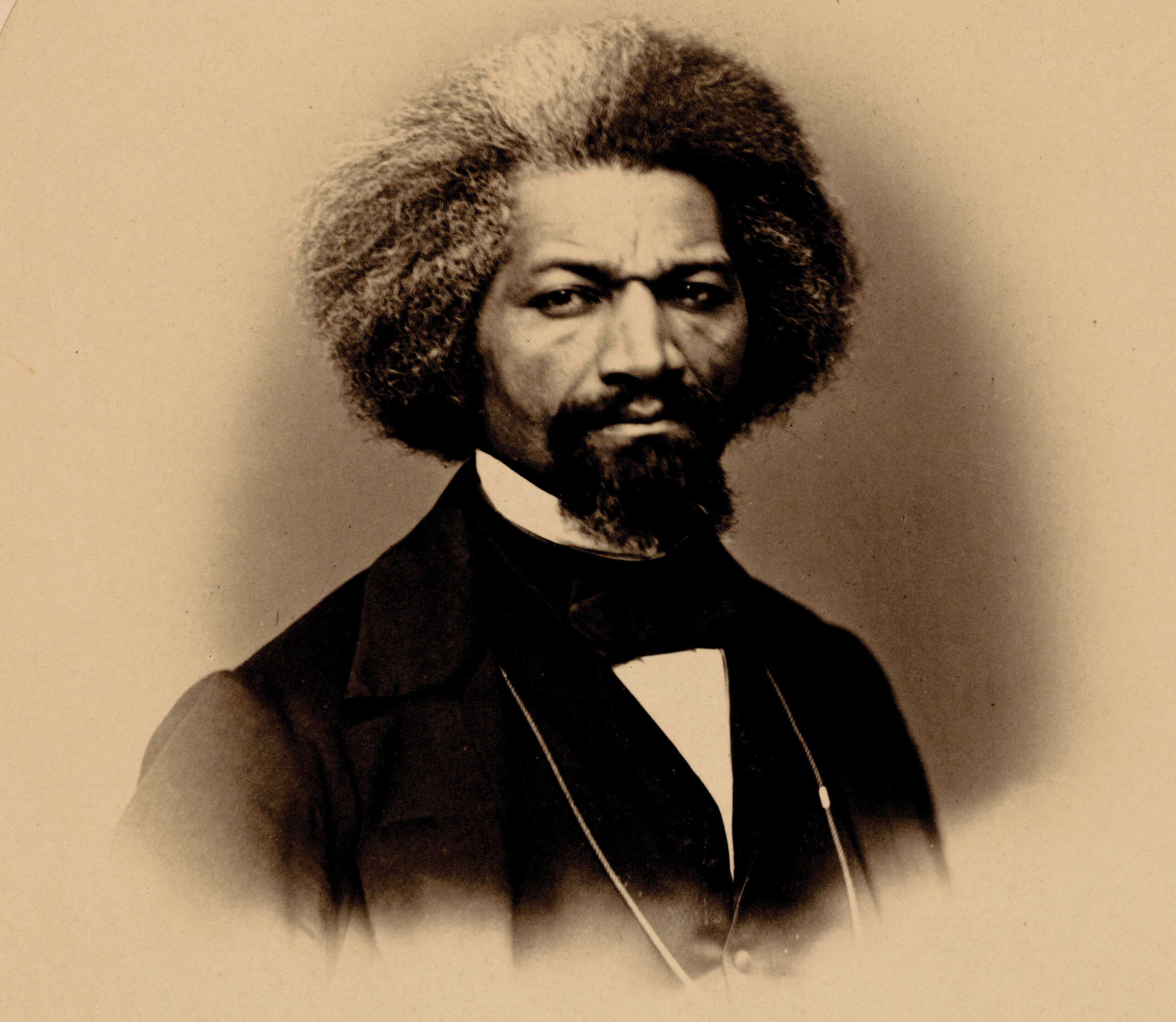
To push the issue, in early August Frederick Douglass made his first trip to Washington to talk to Abraham Lincoln and Secretary of War Edwin Stanton. In this legendary meeting between the famed runaway slave and the president, Douglass—who had two sons in the 54th—raised the pay issue. He argued he could no longer assert that the government gave equal treatment to black soldiers, thereby hindering his efforts to persuade African Americans to enlist. Douglass later claimed that Lincoln was sympathetic but had explained the pay disparity was necessary at the moment to get whites to accept black troops.13
If the president was correct, it helps explain why the Democratic press did not initially refute reports of the 54th’s soldierly qualities, as the pay difference indicated the government did not embrace black equality. Lincoln’s sentiments perhaps explain why most Republican papers also remained silently uncritical of the policy.
 Library of Congress
Frederick Douglass
Nevertheless, the underpaid (and now unpaid) 54th Massachusetts stayed in the news because of prisoner-of-war issues. At the end of July, the New-York Tribune reported on a meeting between Union and Confederate officers to discuss burial of the Fort Wagner dead and prisoner exchanges. The Rebels assured the Union men that they had attended to the burials, but expressed “much indignation,” the Tribune reported, because “Negro troops [had been] in the front on the night of the assault.” The Rebels claimed the white prisoners would be “well treated.” And while admitting “the Fifty-fourth Massachusetts fought well, [they] say all the prisoners captured from that regiment will be sold into slavery.”14
Southern papers unapologetically confirmed this news. The Charleston Mercury reported the Rebel military turned their prisoners of war over to state authorities to determine their fate. The Confederate government had long claimed they would enslave black POWs and now seemed ready to fulfill the threat. “We cannot, of course,” the Mercury opined, “pit ourselves against Negroes; we cannot ignore and belie our own social organization.” In response to such reports, the New York Herald insisted, “Serious complications are likely to arise from the barbarous treatment by the rebels of Negro soldiers who fall into their hands.” If the Confederates start “selling at auction all Negro soldiers captured … retaliation is inevitable.”15
That prediction proved accurate. Just three days after papers first reported that the Rebels had refused to exchange their prisoners from the 54th, Lincoln responded with an Order of Retaliation. “It is the duty of every government,” the president stated, “to give protection to its citizens, of whatever class, color, or condition, and especially to those who are duly organized as soldiers in the public service.” He ordered that for every black POW sold into slavery, a white POW held by the Union would be sentenced to hard labor.16
Days later, a widely reprinted Republican editorial on Lincoln’s order appeared in northern papers, noting the problem was not just with the POWs from the 54th: “The colored troops, of whom we have many thousands in the service, have, hitherto, apparently been treated as outside the protection of the government.” The editor praised Lincoln’s action: “This order … puts [the black troops] in this respect, just where they should be, on an equality with the other troops in the service.”17
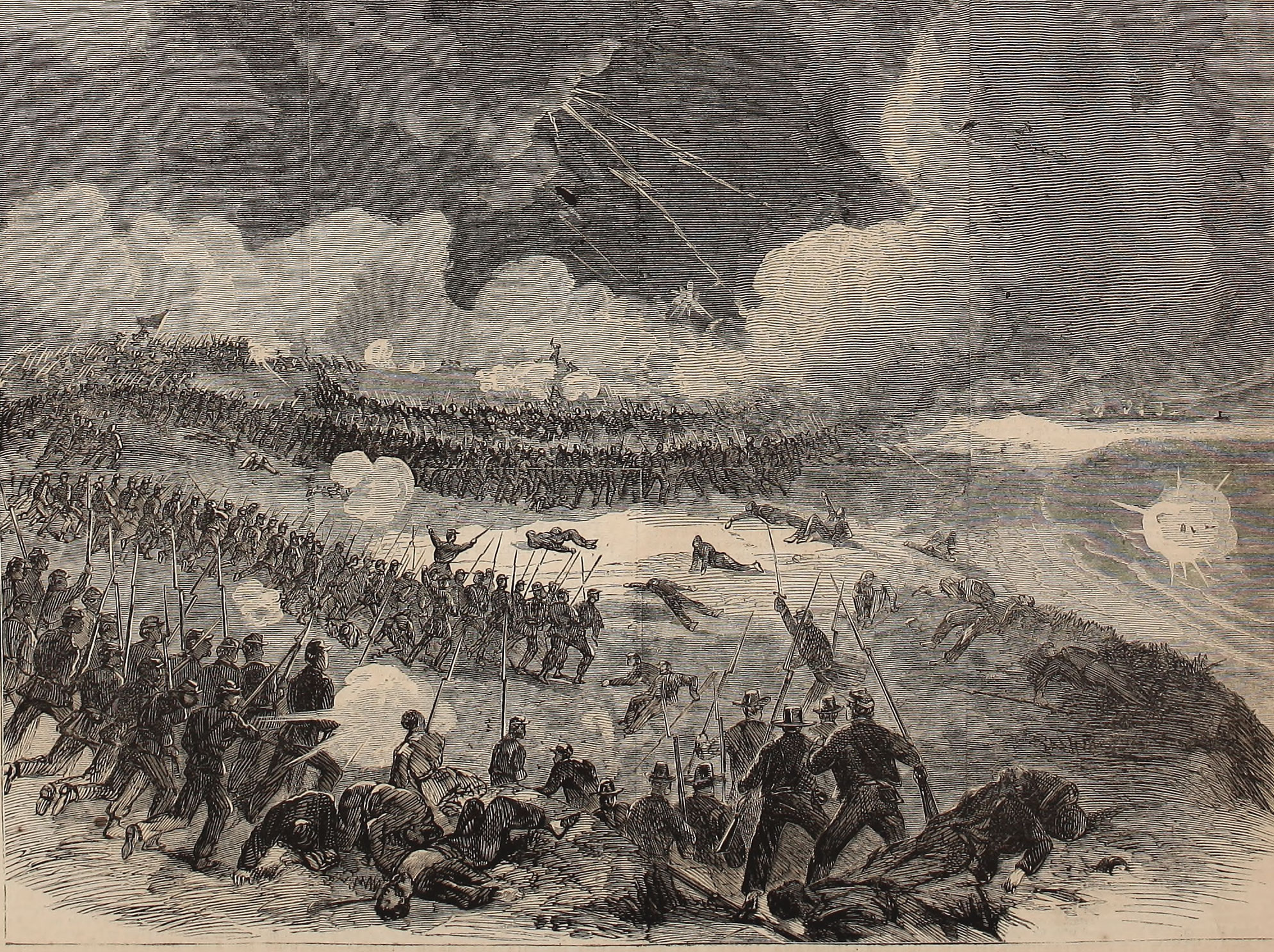
Meanwhile, the popular Harper’s Weekly amplified these calls for equal treatment of black soldiers. Praise of the 54th filled newspapers at the same time as did reports that the infamous New York City Draft Riots had included brutal attacks on African Americans. Noting that sad irony, Harper’s pointed out that black soldiers had been heralded for their performance at battles such as Port Hudson in Louisiana, yet especially noted that at Fort Wagner “the colored regiment from Massachusetts … was placed in the front, and sacrificed itself to make way for the white troops that followed.” The editors pointed out that even the New York Herald, “prejudiced as they admit they had been about the employment of negro troops,” were “forced to admit that they never saw better fighting done than was done by the colored regiments at Charleston” and elsewhere.18
Thus, less than two weeks after the country learned of the 54th Massachusetts’ praiseworthy conduct in the Wagner attack, high-profile demands were coming for African-American soldiers to be treated on par with their white comrades, if not in pay, at least in regard to prisoner exchanges. Was this not a prelude to calls for black citizenship, just as the men of the regiment hoped to achieve? Northern Democrats quickly saw it that way and so began questioning the performance of the 54th Massachusetts.
 Harper’s Weekly
Controversy over the handling of the African-American soldiers taken prisoner at Fort Wagner—and the Lincoln administration’s response—helped fuel coverage of the 54th Massachusetts in the northern press for weeks after the battle. Above: The August 6, 1862, edition of the popular newspaper Harper’s Weekly—in which the editors called for the equal treatment of black soldiers—included this illustration of the Wagner attack.
On July 28 (10 days after the battle), the Washington Evening Star was one of the first northern papers to report, “Stories are flying around … that but for the frightened Fifty-Fourth Massachusetts (negro) regiment we would have carried the Fort [Wagner].” Before Lincoln’s retaliation order and the Harper’s story, however, the only papers providing negative assessments of the regiment were mostly southern. After Lincoln’s order and the Harper’s story, however, northern Democratic papers picked up the dubious southern reports. Additionally, as the Milwaukee News bemoaned under the headline “More Negro Equality,” Democrats insisted Lincoln’s retaliation order declared “in substance that Negroes are the equals of white men.” In a similar vein, an Ohio paper criticized the New-York Tribune and other papers that had printed Pierce’s reports praising the 54th, charging that he characterized black soldiers as superior to whites. “Having found that the Negroes, after being drilled as soldiers, do not drop their arms and skedaddle, or lie down on their backs and cry for mercy,” Republican papers “are now asserting that they are the best soldiers in the Army.” Further, the Democratic paper criticized Republicans for ignoring the white regiments involved in the Wagner and Port Hudson attacks, while “the Negroes are exalted as demi-gods” with “superhuman bravery.”19
Even as days passed, a widely shared editorial by the Democratic press cast doubt on the 54th’s performance. It contained a statement purporting to be from “a [Union] officer in the Army before Charleston” who insisted, “The stories about the [54th’s] splendid fighting are ‘all in my eye.’” During the Wagner assault, “they ran away as fast as they could, and came near demoralizing the whole attacking force.” Soon, “over a thousand of them came straggling down to the south end of the island, and before morning there were at the hospital and dock over three hundred of them not hurt in the least.”20
The Chicago Times leveled the most vicious attack in another widely circulated editorial. The paper had warned the president “that the employment of Negro soldiers would cause the war to assume features of atrocity,” which the possible enslavement of black POWs and Lincoln’s retaliation order had now unleashed. “It were folly to suppose that the rebels can recognize negroes as soldiers … [affording] them the same rights which they afford to” white men. Thus, the president’s “pompous order” would “not save the unfortunate darkeys.” It went on to say, “A negro is not equal to a white soldier, and Mr. Lincoln cannot change the law of nature so that the negro will become so.” The editors criticized his “flippant language” and “virtual assertion … that every worthless darkey is as good in every respect as … a noble [white] soldier.” Insisting white troops would loathe their commander in chief for equalizing them with black men, the editors felt Lincoln should quickly “disband his regiment of ‘shades’” and employ blacks for manual labor only.21
The Republican press responded quickly, the Chicago Tribune leading with “a plea for the colored race,” insisting African-American troops should be praised for their “fidelity” to the Union cause. “They ask only the chance to prove their manhood,” the paper opined, and had in fact “establish[ed] their claim to be recognized as men.” Scolding the Democratic press, the editors wondered how the nation would survive “if we persist in denying the most ordinary of rights to this persecuted race?” In words meant to provoke, the Tribune professed, “We have no fear of Negro equality, nor of the debasement of the northern blood.”22
 Library of Congress
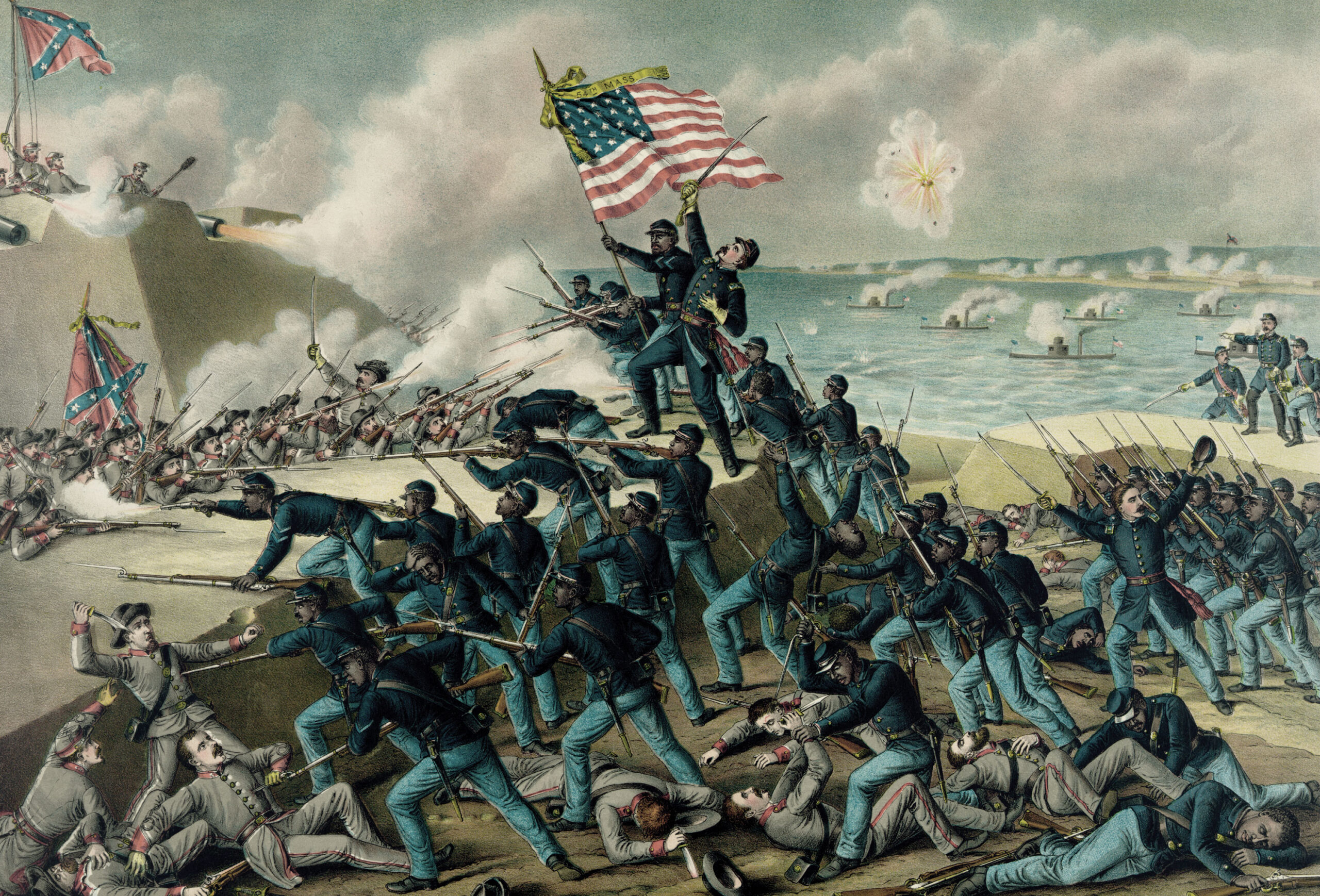
To counter the growing negative coverage of the 54th Massachusetts in the Democratic press, the Chicago Tribune published a letter from Lieutenant Colonel A.C. Hamlin, a U.S. Army medical inspector stationed in South Carolina, who noted of the regiment’s black troops at Wagner, “I saw them march along to the assault as steadily … as the most veteran of the battalion [and] plunge bravely into the terrible abyss of death.” Above: Kurz & Allison’s 1890 chromolithograph “Storming Fort Wagner.”
As for the 54th Massachusetts, the Tribune’s editors declared it “an atrocious libel” to denigrate the regiment’s performance at Fort Wagner. “Nothing could be meaner than the attempts to rob them of their well earned laurels.” Noting the Democratic press had leaned on an anonymous assessment by an alleged officer, the paper continued, “The falsity of this mean and atrocious attack is demonstrated by every account … from an authentic source. Official and non-official accounts … all unite in saying that the negroes fought bravely.”23
To fortify the case, the editors presented a letter from Lieutenant Colonel A.C. Hamlin, a U.S. Army medical inspector stationed in South Carolina, to Henry Wilson, a U.S. senator from the regiment’s home state. “Knowing that you feel an interest in the fate of the Fifty-Fourth Massachusetts,” Hamlin wrote, “I … assure you that slander will not affect the reputation of that regiment in the two battles” they fought. At Fort Wagner, “I saw them march along to the assault as steadily … as the most veteran of the battalion [and] plunge bravely into the terrible abyss of death.” That they fought manfully is attested to by “the long list of the wounded,” and “the fact of sixty being captured within the fort.” The Democratic newspapers might deny the mettle of the regiment, Hamlin exhorted, but it was even “admitted to me by the rebels under the flag of truce.” Further, he concluded, “I can testify that they bore their wounds with the fortitude of the most determined veterans, and that they died as nobly.”24 Reprinted in newspapers across the North, Hamlin’s letter was more credible than anything the hostile Democratic press had offered.
The power of Hamlin’s letter brought a lull to arguments over the 54th’s performance and claim of equality, but those arguments added fuel to the rhetoric of state and local elections that year. After Union army successes at Gettysburg, Vicksburg, and Chattanooga, the war news favored Republicans. So Democrats made emancipation the central issue, insisting the conflict might have been ended were it not for the Emancipation Proclamation. But for that, the South might be open to peace talks, Democrats argued, refusing to see emancipation and black troops as military necessities. In their opinion, there had to be a nonmilitary reason for the Republicans to insist on black troops—and they concluded it was the party’s embrace of racial equality.
A Democratic paper in Pennsylvania wrote, “The next argument will be, those who fight shall vote.” The purpose of praising black troops, the editor proposed, was to argue “negro troops are the equal of white soldiers”—in order to then conclude that “negro voters are the equal of a white freeman.” Make no mistake, the paper charged, the Republican Party’s “design is negro suffrage [and] equality.” Referring to the state’s upcoming gubernatorial election, the paper entreated “the people of Pennsylvania … to pronounce their decision on the question.”25
Ohio also faced an election for governor, and the Cincinnati Enquirer likewise alleged that Republicans were using the success of black troops to push for racial equality. As proof, the paper pointed to a resolution adopted by the Massachusetts Republican state convention. “Resolved,” it read, “the policy of employing colored soldiers is wise and just, and should … be liberalized by putting such soldiers on a perfect equality with whites as to rights and compensation.” This would be followed, the Enquirer insisted, by calls for racial equality in all things. Ohio voters were asked to remember, “A vote for Democrats … is a vote for the supremacy of your race.”26
 Library of Congress
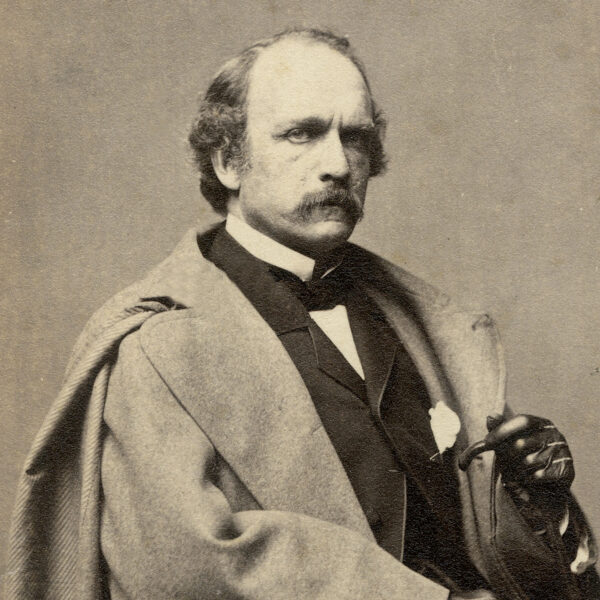
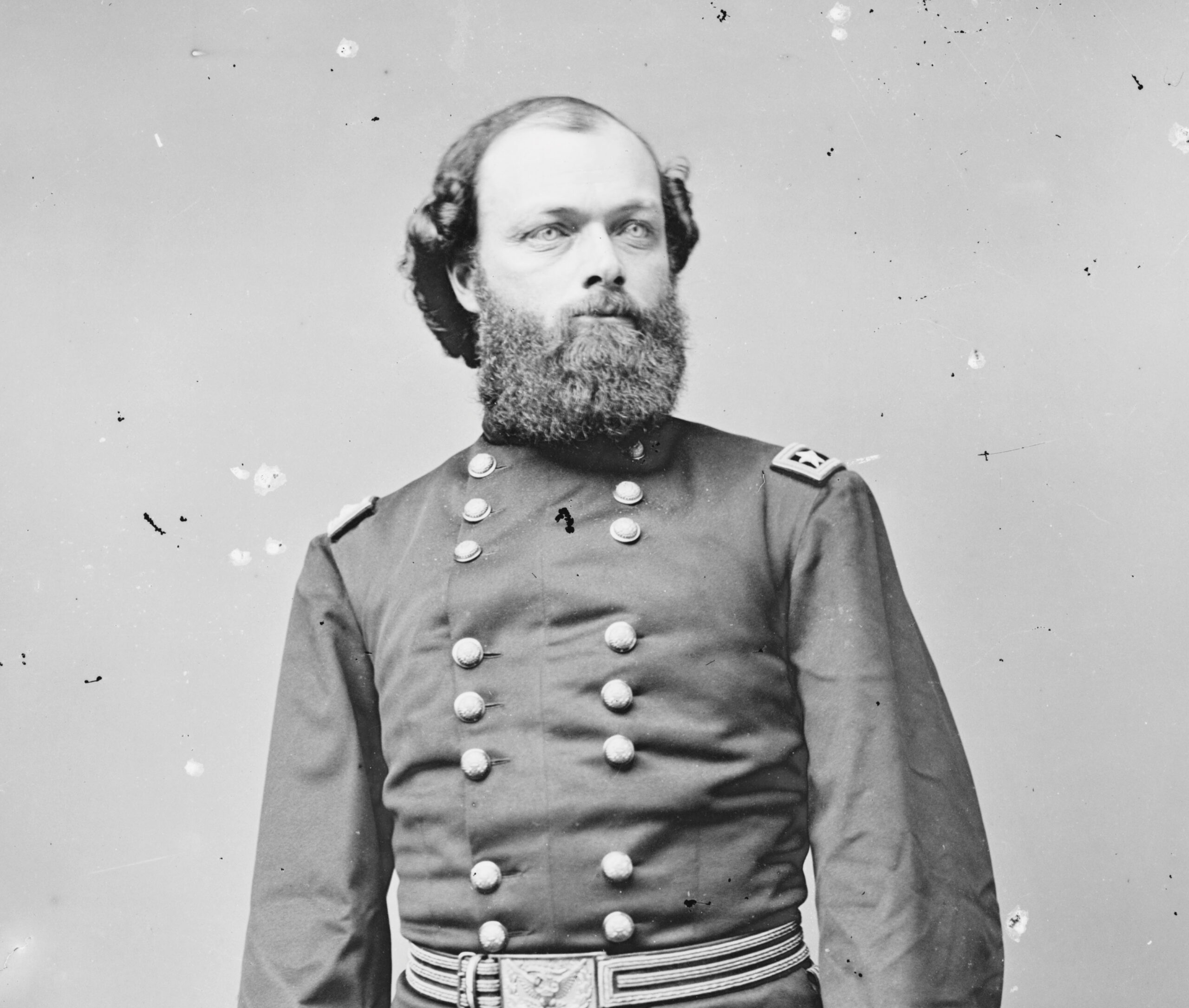
Brigadier General Quincy Gilmore
Ultimately, the war weighed heavier with voters than any trumpeted threat to white supremacy. Republicans retained the governorships of Ohio and Pennsylvania and gained in state and local offices everywhere except New Jersey. Democrats fretted over their losses, painting them as a triumph for racial equality. Radical Massachusetts is now “leading the Republican flock,” the Cincinnati Enquirer insisted, and will soon press Congress for “a perfect equality of the Negro soldier with the white.” This meant “making officers of Negroes for white soldiers to lift up their caps to, and means, when the war is over, the introduction of Negroes into the jury-boxes, the family tenement houses of the poor—in short a perfect equality.”27
Ebullient about their victories, Republicans mocked the constant Democratic racist harangues. “Negro Equality,” an Illinois paper asserted—“doubtless our readers have heard that expression before. There is not a Democratic paper in the country but what daily or weekly—and generally weakly—gives its subscribers a homily on the dangers of Negro Equality.” During the recent campaigns it had been “a powder … shot a great many times.” Democrats, the editors wrote, “have frightened many timid voters” with it in the past, but the election results demonstrate that the cry of “nigger equality” as a “political trick has lost its magical influence.” It is now “about ‘played out’ in the free states.”28
This was far from true.
In this same period of optimistic election results, the 54th’s morale plummeted. Perhaps because Republicans feared Democrats would use the pay issue against them in the elections as they had Lincoln’s retaliation order, the regiment still had not received equal pay. In October, they again refused the $10 a month and Colonel Montgomery (the brigade commander who had ordered them to burn Darien) angrily lectured them in words that found their way into some northern newspapers. “You ought to be glad to pay for the privilege to fight, instead of squabbling about money,” he told them. Furthermore, Montgomery said, they were not equal to whites: “You are a race of slaves. A few years ago your fathers worshiped snakes and crocodiles in Africa.”29
Soon after this, a Democratic paper in Ohio reported that Brigadier General Quincy Gilmore, commander of the Department of the South, had no faith in black troops after the Fort Wagner repulse, intending to use them now only for fatigue duty. The New York Times then published a letter from Gilmore himself disproving the allegation. Yet it certainly seemed true to the regiment, as George Stephens, a newspaper correspondent and member of the 54th, wrote home that it had become a group of “ditchers.” Sadly, he wrote, “The spade and shovel is [the regiment’s] only implement of warfare.” Despite the fame they had won and the change they had wrought in the image of black troops, the 54th Massachusetts was “in a state of demoralization.”30
Near the end of 1863 Democrats went on the offensive again, claiming the praise for the 54th in the wake of Wagner was now proven false. A Democratic paper in Ohio’s capital, for example, insisted Republicans had “manufacture[d] all kinds of false stories about the bravery and efficiency” of black troops. “We all remember the enormous accounts of the bravery of Colonel Shaw’s regiment of Massachusetts negroes at Fort Wagner; how they stormed the fort and fell gloriously on the parapet, and a great deal more of the same sort.” The paper insisted, “There was scarcely one word of truth in the whole account. The regiment never reached anywhere near the fort, and never stormed it at all.” It then addressed General Gilmore: “Don’t bother worrying yourself about losing a battle by trusting to the Negro regiments”; using them was a sure-fire way to increase his reputation. “Put them forward, and our word for it, the worst defeat you receive will be trumpeted as a glorious victory in which the blacks performed prodigies of valor never equaled by white soldiers.”
The paper went on to propose that the general choose troops with the darkest skin, because for the Republicans, the soldiers’ “bravery is in exact proportion to their blackness.”31
The editors turned then to their notion of racial equality. “Bravery, we know, is the first of all virtues,” they wrote. “Therefore if the Negroes make good fighters,” the Republicans feel “they are fit to vote and hold office.” Then, as a next step to creating an abolitionist “utopia,” the Radicals would propose “to marry every black soldier to a white woman.” The newspaper predicted Republicans would soon nominate a black man for president, but because they were sure to nominate Lincoln again in 1864, “We shall not be called upon to vote for a Negro President until 1868…. Why the abolitionists should put this off for another four years we really cannot understand. Better let us go the whole darkey at once.”32 The Democrats continued to hammer Republicans with the issue up to the presidential election, a contest Lincoln felt sure he would lose.
By the end of 1863, months after the Fort Wagner attack, officials had worked out the prisoner exchange problem. The Confederacy still refused to exchange black soldiers—but would not enslave them. While this meant many black troops soon languished in prison, it also meant many Confederate soldiers would stop allowing African Americans to surrender, shooting them dead instead. That fate befell some of the 54th’s men in their next major engagement at Olustee, Florida, in February 1864. In part because of such outrages, Ulysses S. Grant, when he became general-in-chief that March, ended prisoner exchanges altogether, which led to overcrowded prisons on both sides. A few months later in June, Congress finally equalized Union soldiers’ pay. The 54th had again earned national attention because of their performance at Olustee, and the government proceeded to aggressively recruit black troops.
Thus, the 54th Massachusetts Infantry’s conduct in battle did help black troops gain acceptance among many northerners, receive equal treatment of their prisoners (in theory), and, finally, achieve equal pay for all Union soldiers. But were they successful in achieving their primary goal of recognition of their manhood and citizenship rights? Sadly, despite slavery’s prohibition, the battle over African-American rights lasted well beyond the Reconstruction era. Further, Americans largely forgot the services of the 54th Massachusetts until Hollywood revived its fame with the 1989 movie Glory, an exceptional film that nevertheless provides no hint as to how virulently divided the era’s newspapers were on the regiment’s performance and on the issue of black citizenship.
Even today, long after the Civil Rights Movement’s successes of the 1950s and 1960s, issues such as voter suppression, gerrymandering, and disproportionate black incarceration all confirm that the security of African-American citizenship rights is debatably still unsettled. Disputes over such issues offer today’s press and social media outlets opportunities to demonstrate partisanship as rigid as ever was printed in those 19th-century newspapers.
Glenn David Brasher is a history instructor at the University of Alabama and a winner of the Center for Civil War Research’s Wiley-Silver Prize. This article is adapted from an essay he contributed to American Discord: The Republic and Its People in the Civil War Era (LSU Press, 2020).
Notes
1. James Henry Gooding, On the Altar of Freedom: A Black Soldier’s Letters from the Front (Amherst, 1999), 11; Burlington Free Press, June 5, 1863; Boston Daily Advertiser, May 28, 1863.
2. Boston Pilot quoted in The Liberator, May 15, 1863; Boston Courier quoted in Spirit of Democracy, April 8, 1863; New York World quoted in Daily Ohio Statesman, May 23, 1863.
3. Memphis Daily Appeal, June 18, 1863; New-York Tribune, July 2, 1863; New York Journal of Commerce quoted in Dollar Weekly Bulletin, July 2, 1863.
4. Luis F. Emilio, A Brave Black Regiment (Boston, reprint, 1995), 73–78.
5. Richmond Enquirer, July 21, 1862.
6. New York Herald, July 26, 1862.
7. New-York Tribune, July 27, 1863.
8. Ibid.; The New York Times, July 27, 1863.
9. New-York Tribune, July 27, 1863; The New York Times, July 27, 1863.
10. New York Herald, July 27, 1863; The New York Times, July 27–28, 1863; Christian Recorder, August 22, 1863.
11. Boston Herald, quoted in Daily Green Mountain Freeman, July 29, 1863; The New York Times, July 28, 1863; New York Herald, July 27, 1863.
12. New-York Tribune, July 27, 1863; Cleveland Morning Leader, July 28, 1863; Savannah Republican, quoted in Weekly Perrysburg Journal, July 29, 1863.
13. Frederick Douglass, The Life and Times of Frederick Douglass (Hartford, 1881), 347–348.
14. New-York Tribune, July 27, 1863.
15. Richmond Dispatch, August 17, 1863; New York Herald, July 27, 1863.
16. Abraham Lincoln, The Collected Works of Abraham Lincoln, 9 vols., ed. Roy P. Basler et al. (New Brunswick, NJ, 1953–1955), 9:48–49. Emphasis added.
17. Daily Green Mountain Freeman, August 3, 1863; Douglass Monthly, August 1863.
18. Harper’s Weekly, August 8, 1863.
19. Milwaukee Times, quoted in Manitowoc Pilot, August 7, 1863; Spirit of Democracy, August 12, 1863.
20. Buffalo Courier, quoted in Chicago Tribune, August 28, 1863.
21. Chicago Times, quoted in Indiana State Sentinel, August 24, 1863.
22. Chicago Tribune, August 28, 1863.
23. Ibid.
24. Ibid.
25. North Branch Democrat, September 16, 1863.
26. Cincinnati Enquirer, quoted in Dollar Weekly Bulletin, October 15, 1863; Ashland Union, October 7, 1863.
27. Cincinnati Enquirer, quoted in Dollar Weekly Bulletin, October 15, 1863.
28. Evansville Daily Journal, November 9, 1863.
29. George E. Stephens, A Voice of Thunder; The Civil War Letters of George E. Stephens, ed. Donald Yacovone (Champaign, IL, 1997), 47.
30. Columbus Ohio Daily Statesman, November 22, 1863; The New York Times, November 27, 1863; Stephens, Voice of Thunder, 47.
31. Columbus Ohio Daily Statesman, November 22, 1863.
32. Ibid.
Related topics: African Americans