Civil War soldiers stand in formation with their rifles.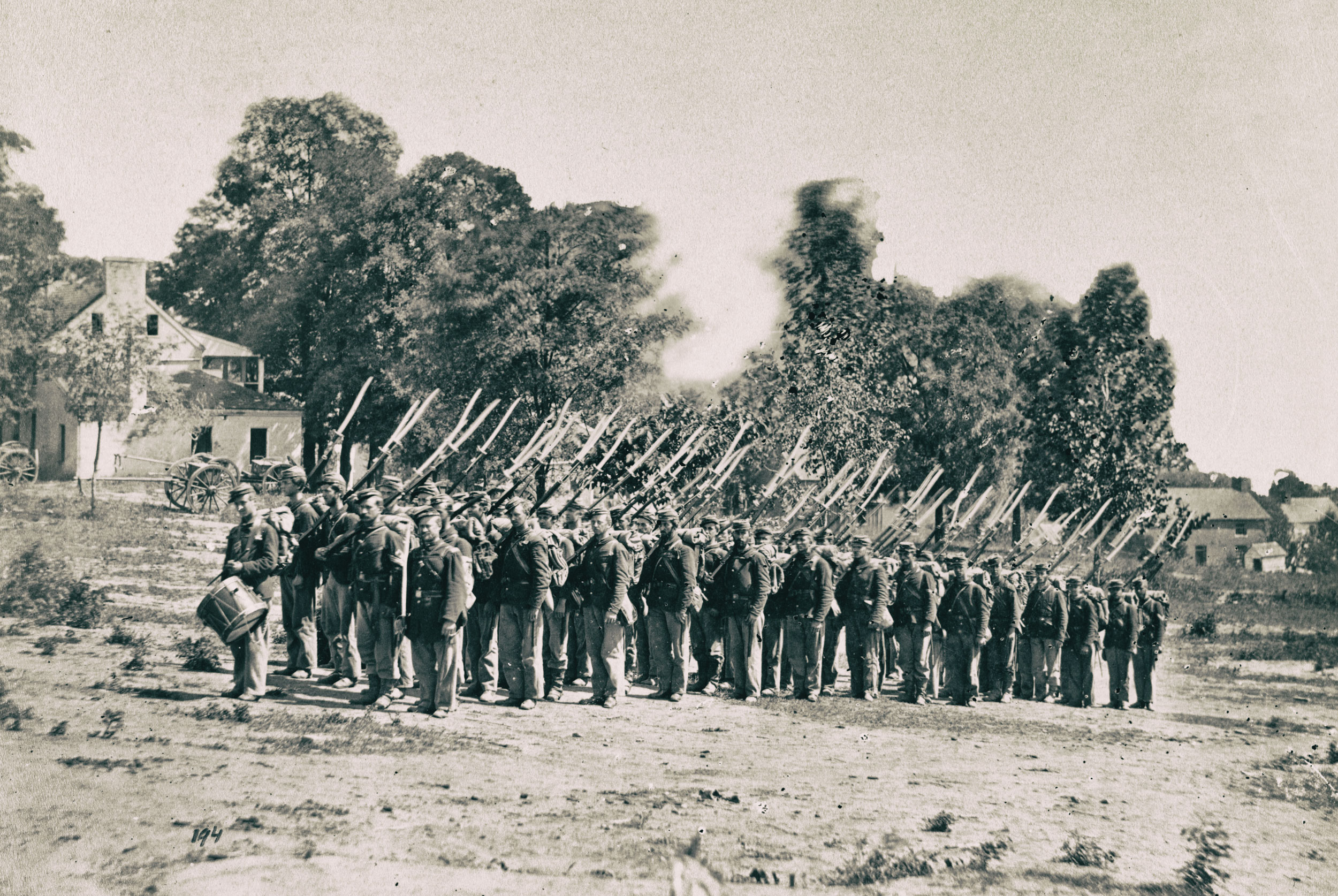 Library of Congress
In his memoir of the conflict, former infantryman Philip Stephenson wrote about a universal truth of Civil War soldiering: “the long stretches of marching” he and other troops routinely endured. “We walked any way we pleased or any where along the road, if muddy…. Caked with dust and perspiration, our clothes a solid brown, panting and dripping, we shuffled along,” he recalled of one particular trek. “Men dropped into sleep walking along, and if the column halted suddenly, as it often did, rank after rank would butt up against its forward fellow.” While a marching army might lose cohesion, suffer stragglers, and step “at will,” both the Union and Confederacy had formal regulations for armies on the march—from the quickness of pace to the arrangement of a column of troops.
Highlighted here are figures associated with some of the more fundamental of these rules.
Civil War Marching by the Numbers
Steps per minute when marching in double-quick time: 165
Maximum time suggested for marching at double-quick time in one stretch: 15 minutes
Steps per minute when marching in quick time: 110
Steps per minute “under urgent circumstances” in double-quick time: 180
Length of each step in common time and quick time: 28″
Length of each step in double-quick time: 33″
Space allotted for the width of an individual soldier in line: 24″
Space allotted for the depth of an individual soldier in a column: 12″
Space between lines of soldiers (ranks) in a column: 16″
Space between individual units in a column: 22 paces
Estimated amount of roadway that 40,000 soldiers, with artillery and wagon trains, occupied on the march: 16 miles
Estimated amount of roadway this same force would occupy after 10 miles of marching due to elongation, or “tailing out”: 24–32 miles
Estimated distance covered in one hour at common time in ideal conditions: 3 miles
Estimated distance covered in one hour at common time in less-than-ideal conditions: 1.5–2 miles
Estimated distance covered in one hour at double-quick time in ideal conditions: 5 miles
Length of hourly halts while the Army of the Potomac was on the march, as directed by General George B. McClellan in 1862: 10 minutes
Length of the Army of the Potomac’s midday halt: 30–60 minutes
Sources
John D. Billings, Hardtack and Coffee (1887); Silas Casey, Infantry Tactics, Vol. 1 (1862); Earl J. Hess, Civil War Infantry Tactics (2015); Nathaniel Cheairs Hughes Jr., ed., The Civil War Memoir of Philip Daingerfield Stephenson, D.D. (1995); United States War Department, The War of the Rebellion: A Compilation of the Official Records 129 vols. (1880-1901), Series I, Vol. 11, part 3; Arthur L. Wagner, Organization and Tactics (1895).