Civil War bayonet facts and figures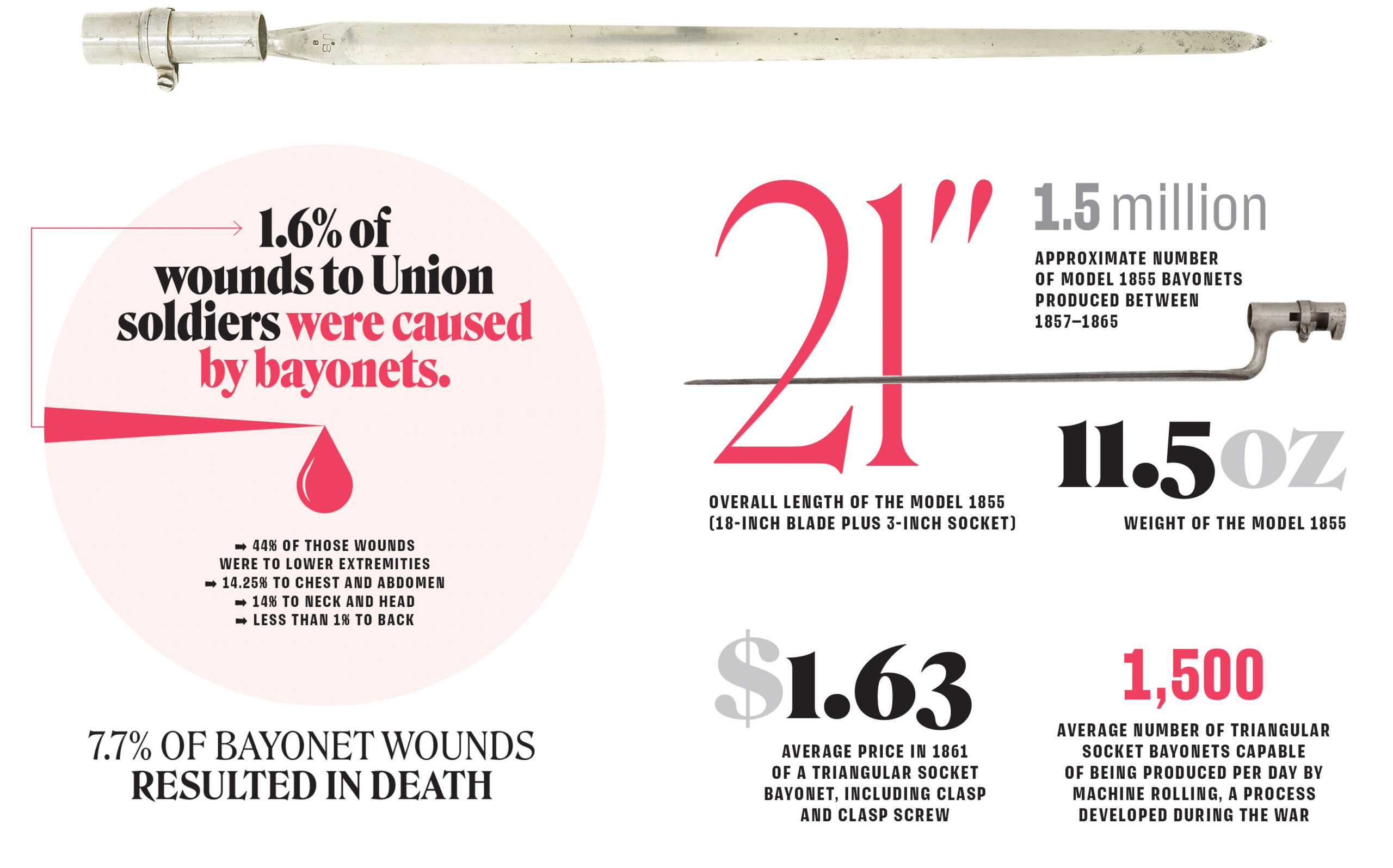 Heritage Auctions (HA.com)
“Perhaps every regiment in the army had to go through the experiment at one time or another, but it was finally dropped as useless. It is unnecessary to state that very seldom did the two armies come close enough together to indulge in the interesting pastime of making holes in each other’s anatomy. And even if they had, under the exciting circumstances it is not likely that any man would ever have remembered the first thing about the scientific instructions he had received in the best way of doing it.”
So wrote Joseph Crowley, a veteran of the 13th New Jersey Infantry, in his memoirs about the repeated and complex bayonet drills that he and his comrades had been subjected to during their Civil War service. Crowley was hardly alone in thinking that such training amounted to “a silly waste of time.”
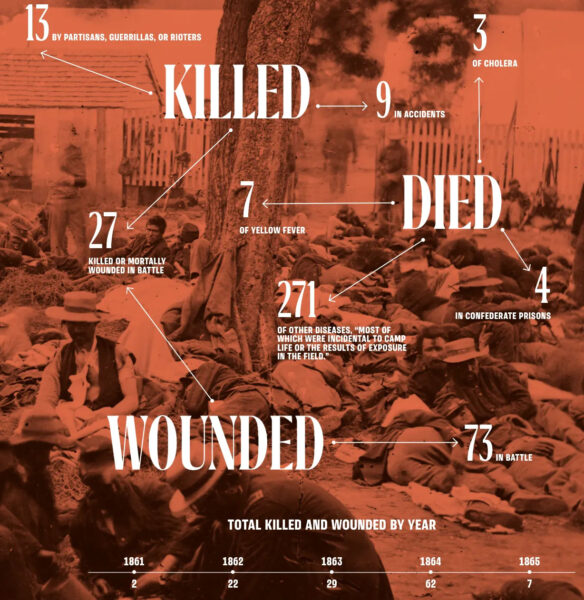
Affixed over the muzzle of a rifle in a variety of sizes and styles, from triangular to swordlike, the bayonet was undeniably intimidating in appearance—though rarely used as intended during the conflict. The average soldier was more likely to employ his bayonet—which he carried in a scabbard, attached by a leather loop, or frog, to his military belt—as a makeshift candleholder, a digging tool, a skewer on which to cook rations, or a tent stake than as a means to stab an opponent in hand-to-hand combat. Shown here are statistics associated with Civil War bayonets, in particular the triangular Model 1855 socket bayonet, the type most common to the conflict.
Sources
Charles H. Fitch, Extra Census Bulletin: Report of the Manufacture of Fire-arms and Ammunition (1882); Robert M. Reilly, American Socket Bayonets and Scabbards (1990; reprint, 1994); The Medical and Surgical History of the War of the Rebellion, Part III, Vol. II, Surgical History (1883); Revised Regulations for the Army of the United States, 1861 (1861); The Ordnance Manual for the Use of the Officers of the United States Army (1862); The Young Volunteer (1906). With thanks to Alex MacKenzie, curator of collections at Springfield Armory National Historic Site, and Ralph E. Cobb (worldbayonets.com) for their assistance.
Related topics: weapons