 Classicstock/Alamy Stock Photo
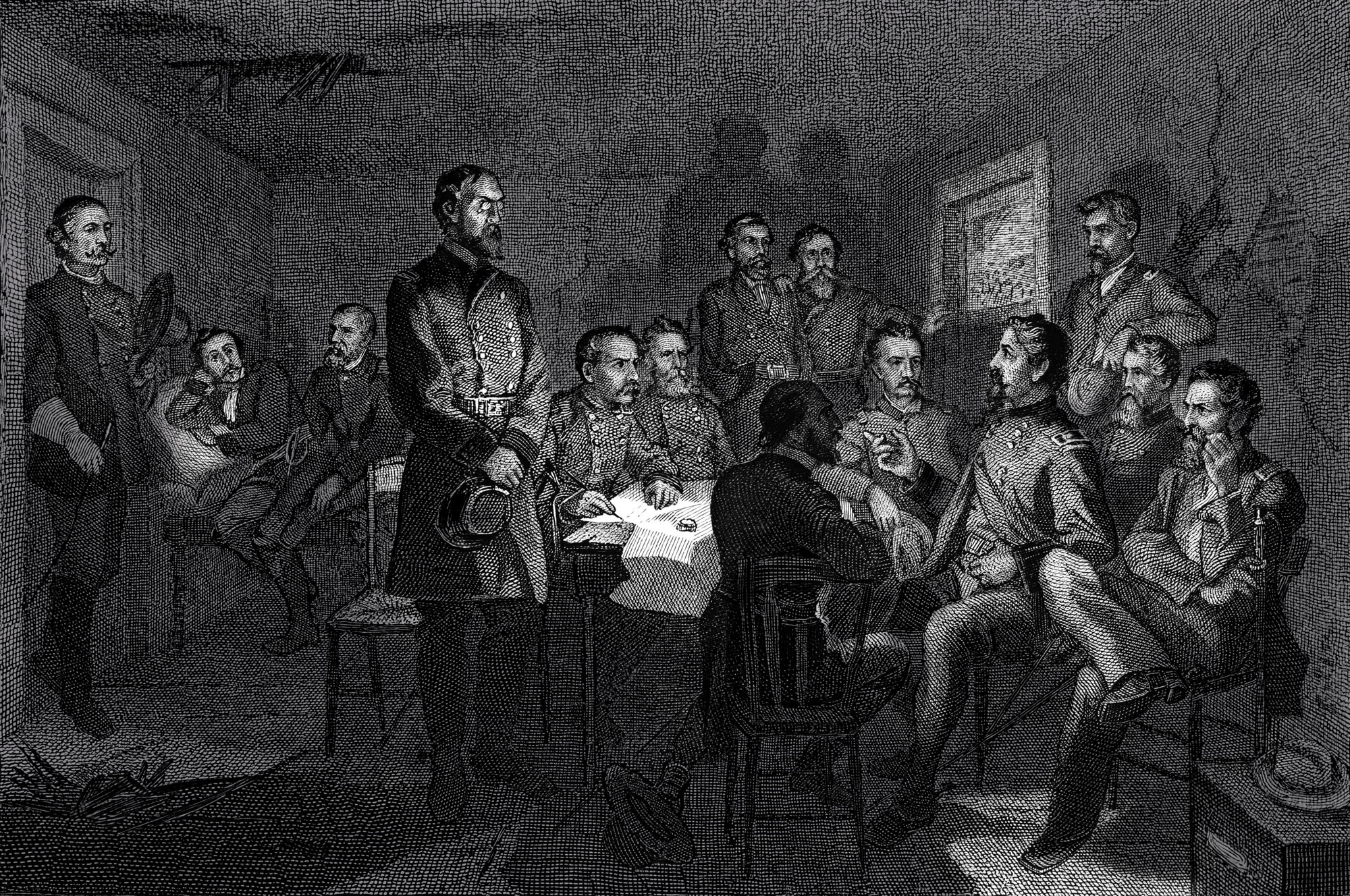
In this engraving by James E. Kelly, Major General George Gordon Meade (center, standing with hat in hand) listens to senior officers of the Army of the Potomac during the council of war he convened on the evening of July 2, 1863, the second day of the Battle of Gettysburg.
The 1861 edition of U.S. Army Inspector General Henry Lee Scott’s Military Dictionary defines “council of war” as “an assemblage of the chief officers in the army, summoned by the general to concert matters of importance.” Scott then moved on hastily to the next definition, as though council of war was a subject he preferred not dwelling upon at any length. William Duane’s Military Dictionary (which Scott’s had superseded) was only a little less terse in defining a council of war: “an assembly of great officers called by a general or commander, to deliberate with him on enterprizes and attempts to be made.”¹
No rules, procedures, or examples were recommended in either dictionary—and probably with good reason, since by the time Duane and Scott were writing, the idea of a council of war had become the closest to a confession of military incompetence any field commander could make without actually using the words. English author John Entick, summarizing the lessons of the Seven Years War in 1763, decided that armies could not be commanded by committees, and campaigns could not be managed by joint resolutions. If a military society was to be a hierarchical one, there was no room for sharing decision-making in chummy councils of war. Intelligent, responsible, and skilled generals did not need the advice that councils of war provided; those generals who did call them were simply fishing for endorsements for doing nothing. “When a commander in chief holds such councils to deliberate whether, or not, he shall carry his orders into execution,” wrote Entick, there:
is certainly great room to entertain suspicions of his conduct. From such cautious proceedings, we may be led to conclude, that he is either afraid of doing his duty; or that he has received some secret counter-orders to warrant his inactivity; and that, therefore, he chooses to screen himself under the resolutions of a council of war, as a colourable pretext for not pursuing his public and visible orders.
 Wikipedia
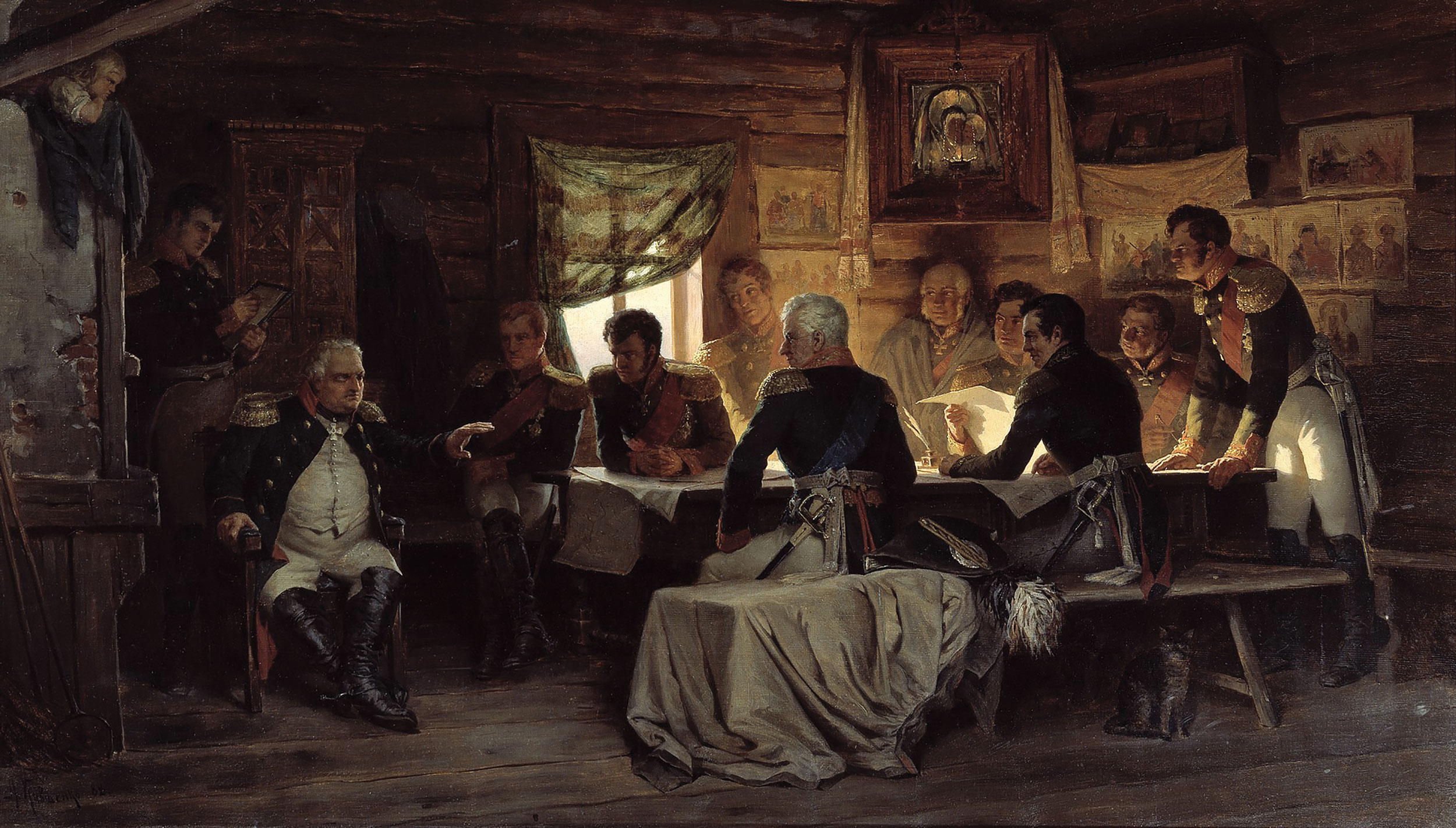
In this painting by Aleksey Kivshenko, Mikhail Kutuzov, commander in chief of the Russian army (seated far left), holds a council of war to decide whether to surrender Moscow to Napoleon in 1812. By the Civil War, the practice of holding councils of war had largely fallen out of favor with American generals.
A half-century later, famed Royal Navy admiral Lord Nelson echoed Entick’s scorn for councils of war. Nelson hated “Councils … between Military men; for if a man consults whether he is to fight, when he has the power in his own hands, it is certain that his opinion is against fighting.” And a half-century on from Nelson, Sir Charles James Napier, the commander in chief of Britain’s Indian forces, stringently warned:
Never call a council of war: a general is to command his officers, not to obey them. This need not prevent his receiving the opinion of any officer, or of every officer, in regard to their peculiar duties.… A general publicly avows his embarrassments when he tells inferior officers he does not know what to do, and that they do; the army loses confidence, magnifies every difficulty, and either becomes panic-stricken or despised the chief, or both.2
So we are not surprised, in the decade following Napier, to find that American generals were chary of calling councils of war and, when they did, often disregarded their advice. Winfield Scott called a council of war to prepare for the climactic assault on Chapultepec in 1848, but then overrode his officers’ apprehensions by ordering a direct attack. Thomas J. “Stonewall” Jackson called a council of war after evacuating Winchester in March 1862, confident that his officers would back his decision to retake the town; they didn’t, and “presently he cried out, in a tone almost savage, ‘That is the last council of war I will ever hold!’” Which it was. William Tecumseh Sherman, according to a smart-aleck copywriter in Harper’s Weekly, “holds his councils of war with himself.”
The different generals seem to listen rather than to suggest. The General speaks his thoughts aloud, and the words uttered on this occasion disclose the movement that he has in his mind for some day in the future.
Robert E. Lee called a council of war before orchestrating the moves that blunted George B. McClellan’s Peninsula Campaign, another just before crossing the Potomac River to invade Maryland in September 1862, and yet another after the Battle of Fredericksburg. But in the first case, Lee was disgusted by the ease with which his generals invented excuses for digging and retreating. “Stop, stop,” said Lee, “if you go to ciphering, we are whipped beforehand.” In the second, Lee simply overrode the advice of Stonewall Jackson to keep the Army of Northern Virginia together, and instead divided it into the portions that, unintentionally, nearly destroyed it. The worst example of what a council of war was likely to do occurred in February 1862, when Confederate generals John Floyd, Gideon Pillow, and Simon Bolivar Buckner held a council of war to determine what to do about Fort Donelson. That, of course, became the moment Pillow and Floyd fled to save themselves, and left Buckner to bear the humiliation of surrender.3
All of which creates an unusual and confusing context in which to consider what is probably the best known council of war called during the Civil War, the late-night consultation in the cottage of the widow Lydia Leister, held by Major General George Gordon Meade with the senior commanders of the Army of the Potomac on July 2, 1863.
What makes Meade’s council of war even more unusual is the nature of his circumstances. On the evening of July 2, Meade was the not-entirely-willing heir of two catastrophic problems. First, he had only been in command of the Army of the Potomac for a little over four days, two of which had been consumed with a battle he had not particularly wanted to fight, at Gettysburg. When Meade was abruptly handed responsibility for the Army of the Potomac by War Department chief of staff James Hardie in the wee hours of June 28, the then-commander of the V Corps was given a broad authority “to act as you may deem proper under the circumstances.”4 But at the moment, such authority had nothing in it but uncertainty. Meade knew neither the exact location of most of the Army of Northern Virginia nor the location of much of the Army of the Potomac. What he did know was that the Confederate invasion of Pennsylvania, which had spread northward to threaten Harrisburg as well as reaching westward toward York, was generating widespread fear that Lee’s next move would be toward Baltimore or Washington, and he would be expected to give shielding the capital the top priority.
Meade also knew that his political connections to George McClellan and the Democratic Party meant that any decision he made would be mistrustfully scrutinized, reviewed, and meddled with by President Abraham Lincoln, Secretary of War Edwin Stanton, and General-in-Chief Henry Wager Halleck. So to silence any wagging tongues in Washington, as well as to buy the time he needed to get effective control over the Army of the Potomac, Meade opted for laying out a defensive shield north of the capital at Pipe Creek, which flows into the Monocacy River. When Meade discovered, on June 29, that the left arm of Lee’s invasion beyond Harrisburg had turned away from the Pennsylvania state capital, he concluded that Lee was headed his way. He confided to Winfield Scott Hancock (the commander of the army’s II Corps) that he had “made up his mind to fight a battle on what was known as Pipe Creek,” and with that end in mind, he would “form line of battle with the left resting in the neighborhood of Middleburg, and the right at Manchester.” This was not, on the whole, a bad plan; in fact, considering the exactly 48 hours of command under his sash, it is hard to think of a better one.5
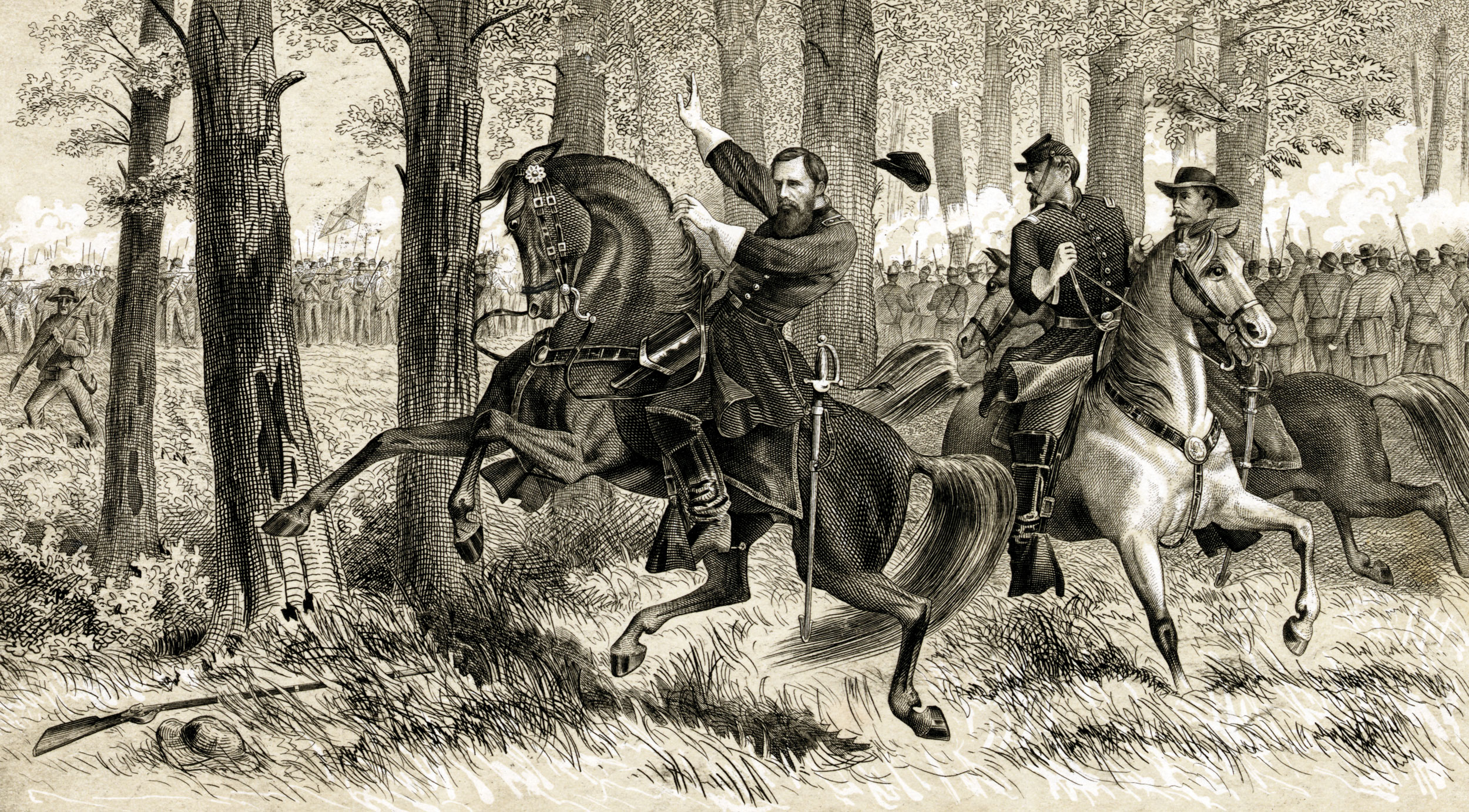
It was at that moment, however, that Meade’s second problem intruded. Meade established a temporary headquarters at Taneytown, Maryland, 17 miles south of Gettysburg, and the circular orders to concentrate the widely scattered seven infantry corps of the Army of the Potomac did not get into the hands of all of his corps commanders on June 30. Particularly, the Pipe Creek circular did not reach Major General John Reynolds, commanding the I Corps (and overseeing Dan Sickles’ III Corps and Oliver Otis Howard’s XI Corps as well). And when Reynolds received word on the evening of June 30 that the Confederate army was converging on Gettysburg, he determined to move to meet the Rebels there the next day, July 1. “General Reynolds,” recalled one of his staffers, “intended to move forward on Gettysburg from his own volition” and “without orders” from Meade “either to fight or retreat.”6 Reynolds was killed at the very outset of the fighting. But once he had committed the I Corps and XI Corps to fighting the Rebels at Gettysburg, Meade had little choice but to revoke the Pipe Creek circular and, late in the afternoon of July 1, order a concentration of the Army of the Potomac at Gettysburg instead.
 Harper's Weekly
In this sketch from Harper’s Weekly, Major General John Reynolds, commander of the Army of the Potomac’s I Corps, is shot and killed during the first day’s fighting at Gettysburg. Reynolds’ determination to confront the Confederates at Gettysburg forced Major General George Meade to alter his plan for taking on Robert E. Lee’s Army of Northern Virginia.
Meade did not share Reynolds’ enthusiasm for a stand at Gettysburg. The news that morning “that a battle was raging and that Gen’l Reynolds had been killed … caused him great annoyance and perplexity for he had just issued an order for a general Retreat of the whole line behind Pipes Creek.” When he arrived there himself between midnight and 2 a.m. on July 2, he would only say that he was glad they had at least held onto Cemetery Hill, “for it is too late to leave it.” It was, according to Major General Abner Doubleday, “an open secret” that Meade privately “disapproved of the battle-ground.” Still, Meade shrugged to Major General Carl Schurz, “we may fight it out here just as well as anywhere else.” Unhappily, the ensuing day’s fighting offered nothing but confirmation of Meade’s worst anxieties about Gettysburg as a place to fight Robert E. Lee. The sun went down on what Confederate general James Longstreet hailed as “the best three hours’ fighting ever done by any troops on any battlefield,” and the proof was there for all to see.7
In just two days, Lee’s Confederates had wrecked the I and XI Corps, then proceeded (on July 2) to mangle the III Corps and the V Corps, wrecked another division of the II Corps, and time and again came within inches of a complete Confederate breakthrough. At day’s end on July 2, Meade’s army had been reduced, in operational terms, to the VI Corps (which he relied on as his reserve), the XII Corps (whose two divisions he needed to hold Culp’s Hill), and two divisions of the II Corps (each of which had seen a brigade badly injured). And Meade had no clear idea of what fresh forces Lee might have at hand for the next morning. If there were any criteria that justified suspending judgment about councils of war, Meade clearly had met them on the evening of July 2.
Even before Lee’s army moved to the attack on July 2, Meade had been growing anxious that the position at Gettysburg could not be held. At 3 p.m. he dashed off a message to Henry Halleck, informing the general-in-chief that he had successfully “concentrated my army at this place to-day,” but if he detected any movement by the Rebels to get into “my rear and interpose between me and Washington, I shall fall back to my supplies at Westminster,” which was located conveniently just behind Pipe Creek. “I feel fully the responsibility resting on me, but will endeavor to act with caution.” In the months after the battle, Daniel Butterfield, the Army of the Potomac’s chief of staff (and a man whom Meade loathed as a disloyal holdover from the Army of the Potomac’s previous commander, Joe Hooker), would accuse Meade of going a step further—of asking Butterfield to draw up a contingency plan for a withdrawal to Pipe Creek, even making “a rough sketch showing the position of the corps” and how he wanted them detached from contact with the Confederates. Butterfield claimed to have written the order and shown it to Brigadier General John Gibbon, who happened to be at Meade’s headquarters. Gibbon was alarmed that the order even spelled out “the movement of army corps on specified roads to points in the rear.” “Good God,” Gibbon exclaimed, “Gen. Meade is not going to retreat, is he?”8
Six hours later, after the hurricane of Longstreet’s attack had struck, Meade’s anxieties had received more than enough in the way of confirmation. Alfred Pleasonton, commander of the army’s Cavalry Corps, found Meade in a state of “so little assurance … in the strength of his position” that he “directed me to gather what cavalry I could, and prepare to cover the retreat of the army.” And “soon after all firing had ceased” that evening, “a staff officer from army headquarters” was sent off to all the senior commanders, summoning them to Meade’s headquarters in the Leister cottage.9
This did not turn out to be as easy a procedure as it sounds. John Reynolds had been succeeded in command of the I Corps by his senior division commander, Abner Doubleday. But Doubleday was renowned for being an arch-Republican and arch-abolitionist, a “very religious man who never drank or used profane language,” and precisely the sort of self-righteous radical on whom Meade laid the blame for the war in the first place. “So great was Gen’l Meade’s animosity to Gen’l Doubleday founded [on] a past political difference,” wrote Doubleday’s adjutant Eminel Halstead, that Meade, as soon as he arrived at Gettysburg, sent Doubleday back down to division command and replaced him with John Newton, a fellow Democrat known as “Old Blinky” for the nervous tic of his eyelids, and so Newton would attend the council for the I Corps.10
A similar situation governed the representative of the III Corps. Dan Sickles had been struck by a Confederate bullet late in the action around the Trostle Barn, and was in the process of having his leg amputated. Normally, command of the III Corps would have fallen automatically to Sickles’ senior division commander, David Bell Birney. But again, Meade detested David Birney almost as much as he did Sickles. Birney was the son of a famous abolitionist and a zealous one himself, and he and Meade had publicly quarreled at Fredericksburg when Meade demanded Birney support Meade’s command. And so, not Birney but Winfield Scott Hancock was put in command of the III Corps, and Hancock turned over his own command, the II Corps, to his senior division commander, John Gibbon. Birney, however, was determined to assert himself, and so he reported to the Leister cottage for the council, welcome or not—which meant that the II Corps ended up with two representatives at the council, Hancock (who thought he was coming as commander of the III Corps) and Gibbon.
 National Archives (Birney); Library of Congress (other 11)
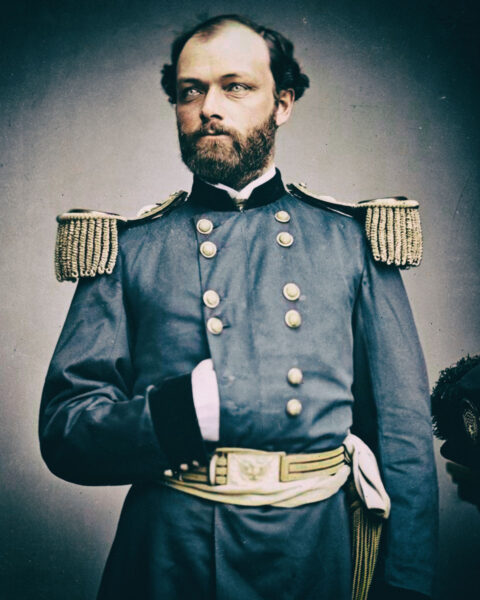
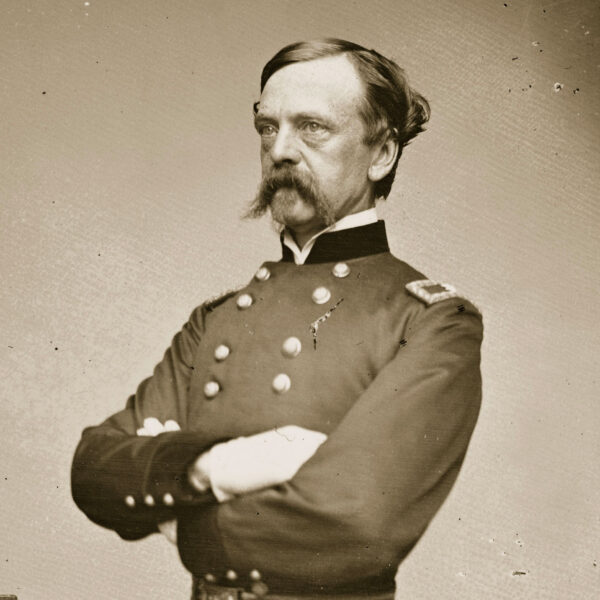
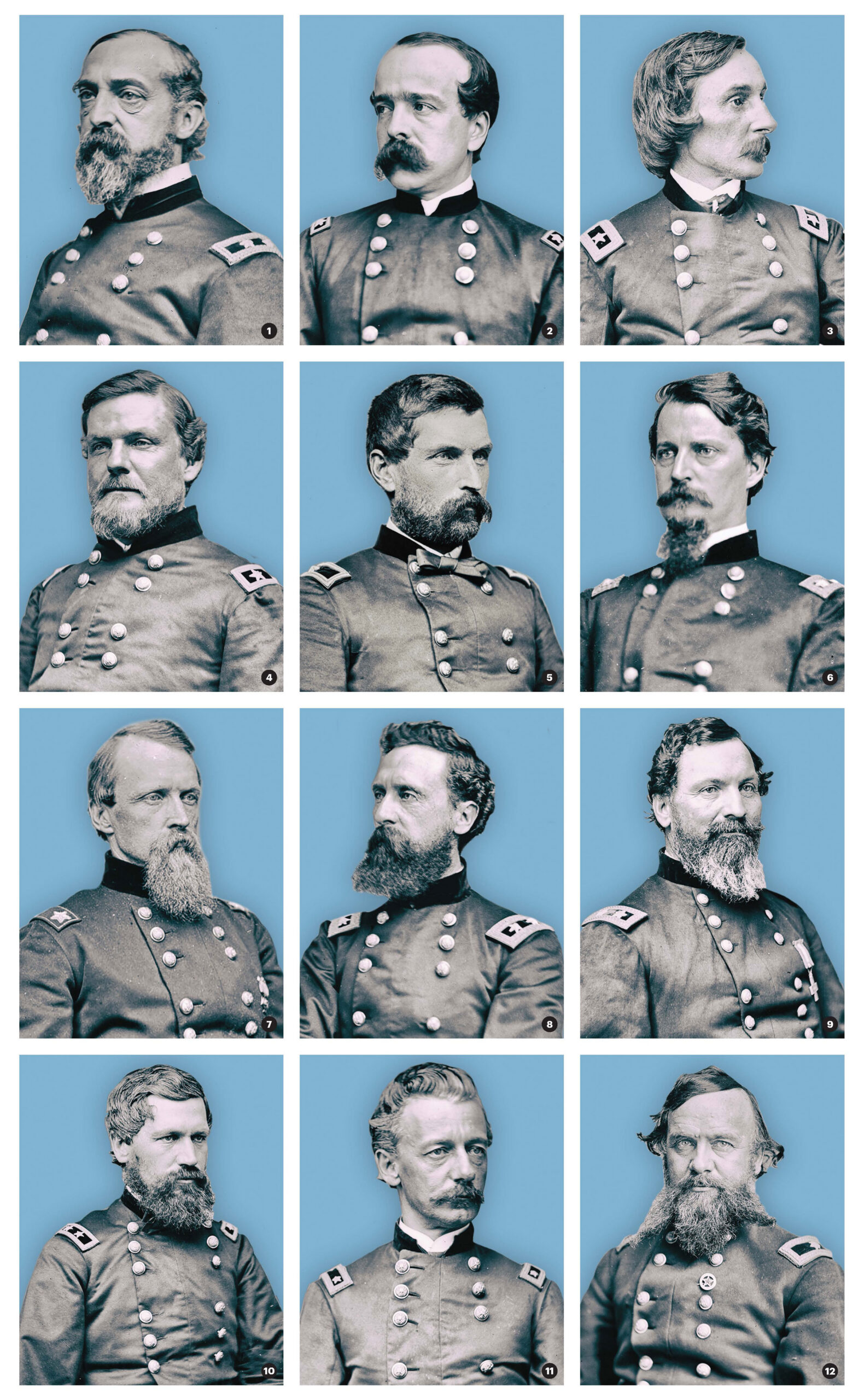
Attendees at the Council of War convened by Meade. (Numbered) 1. Major General George G. Meade (commanding), 2. Daniel Butterfield (chief of staff), 3. Gouverneur K. Warren (chief engineer), 4. Major General John Newton (I Corps), 5. Brigadier General John Gibbon (II Corps), 6. Major General Winfield Scott Hancock (III Corps), 7. Major General David Birney (on the assumption that he was representing III Corps), 8. Major General George Sykes (V Corps), 9. Major General John Sedgwick (VI Corps), 10. Major General Oliver Otis Howard (XI Corps), 11. Major General Henry Slocum (on the assumption that he was the successor to John Reynolds’ “wing” command of the I, III, and XI Corps), 12. Brigadier General Alpheus Williams (XII Corps), Not present: Major General Alfred Pleasonton (Cavalry Corps), Brigadier General Henry Hunt (artillery chief)
At least the major generals commanding the V, VI and XI Corps—George Sykes, John Sedgwick, and Otis Howard—showed up without confusing anyone as to why they were there. But Henry Warner Slocum, who commanded the XII Corps, arrived under the impression that he had succeeded the fallen Reynolds as overall commander of the I, III, and XI Corps. So Slocum brought himself in whatever capacity he imagined he was operating, and brought with him his senior division commander, Alphaeus Williams, as commander of record for the XII Corps. Gouverneur Warren, Meade’s chief engineer, was also there, along with Daniel Butterfield, the Army of the Potomac’s chief of staff. “These twelve men,” remembered John Gibbon, “were all assembled in a little room not more than ten or twelve feet square, with a bed in one corner, a small table on one side, and a chair or two.”11
They had no notice of what the subject of the council was to be, but a few them had their suspicions. Meade had tipped his hand slightly when he warned Henry Hunt, the Army of the Potomac’s artillery chief, that he was worried that “some corps had left behind parts of their ammunition trains” and that “he would not have enough amn.” to “carry us through the battle.” The impression that Meade was thinking in terms of a withdrawal thereafter took on a life of its own. “Gen. Sedgwick called” his chief of staff, Lieutenant Colonel Martin McMahon, “about nine [p.m.], saying that he had been called to a Council at General Meade’s headquarters” and “that General Meade was thinking of a retreat.” McMahon was aghast: “For God’s sake General, don’t you favor any such move. Why here we have been hunting for Lee for weeks, and now that we’ve got him here, don’t retreat. For if we get away from here, he will follow us.” The same rumor was carried by Major Charles A. Whittier, Sedgwick’s aide-de-camp, to another VI Corps staffer, Thomas Hyde. “Gloomy reports kept coming in,” wrote Hyde, “and near dark,” Whittier told him “that the general was going to the headquarters to a council of war” and that “we were going to march back twenty miles that night.”12
We owe it to Dan Butterfield that a set of minutes survives from Meade’s July 2 council. In addition, John Gibbon wrote a brief reminiscence of the council in 1887, and short notes on the council appear in post-battle letters and articles by Alphaeus Williams, Henry Warner Slocum, John Newton, and John Sedgwick, and in the testimony the generals would give the following March to the Joint Congressional Committee on the Conduct of the War.
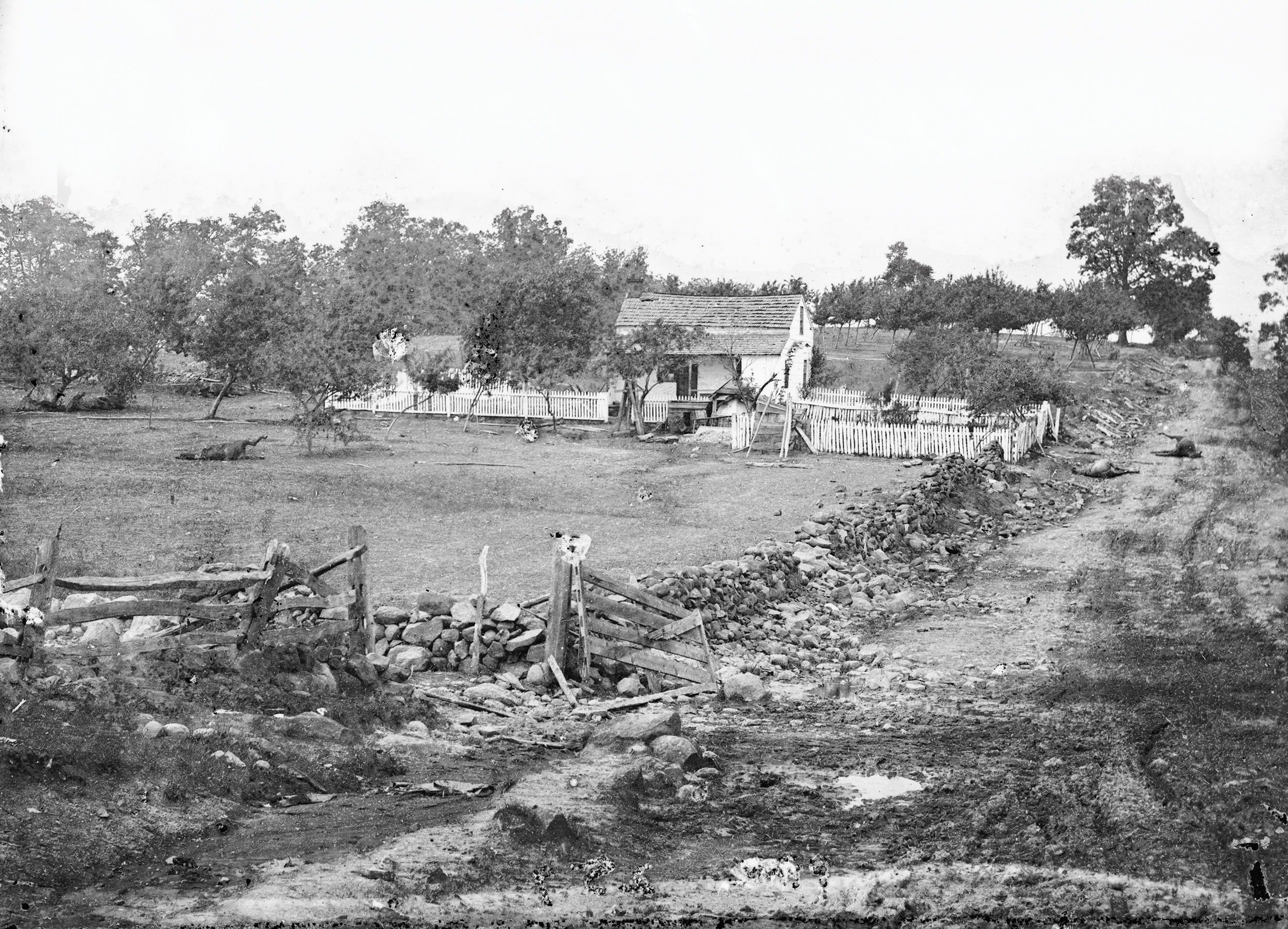 Library of Congress
Meade held his July 2 council of war in the two-room cottage of the widow Lydia Leister on Taneytown Road in Gettysburg, in which he had established his headquarters. The home is pictured here as it appeared shortly after the battle.
These accounts differ in some significant ways: Gibbon remembered that the meeting “was at first very informal” and consisted of each corps commander’s “comments on the fight” and “what he knew of conditions of affairs.” Alphaeus Williams, writing only four days after the council, recalled more specifically that Meade asked “for a field return of the number of his troops,” and such a tally appears in Butterfield’s minutes, although only at the end. Dan Butterfield remembered that “some were laying on the bed, some sitting around in chairs, just as they happened to come in.” At some point, however, matters turned to what John Newton called “the probabilities of the morrow,” suggesting that Gettysburg was “a bad position” and that Cemetery Hill in particular “was no place to fight a battle in.” Butterfield “suggested that it would, perhaps, be well” to “formulate” a series of questions to which everyone present could speak, “and when he had done so he read it off”:
1. Under existing circumstances, is it advisable for this army to remain in its present position, or to retire to another nearer its base of supplies?
2. It being determined to remain in present position, shall the army attack or wait the attack of the enemy?
3. If we wait [to] attack, how long?13
Newton’s, as it turned out, was the last voice raised in favor of abandoning Gettysburg, for with one consent, Meade’s generals “all agreed” that a retreat was the last thing the Army of the Potomac should consider. “By the custom of war,” wrote Gibbon, “the junior member votes first as on courts-martial,” and Gibbon turned in a polite demurrer—“Correct the position of the army” but do “not retreat.” This became the snowball at the start of the avalanche. Alphaeus Williams was next: “remain the following day, hold a defensive attitude, and await events.” David Birney and George Sykes both seconded Williams, and John Newton, who could now see how the avalanche was accumulating, conceded that perhaps it would be best to “not retreat,” even though he added a little truculently that “if we wait, it will give them a chance to cut our line” of supplies to Westminster. “Bob Lee is not a fool to attack us in this position,” Newton grumbled; he “did not believe that Lee was mad enough to attack us in that position we had, when he could turn it so easily.”
Otis Howard put the discussion back on the stay-put track, and even urged an attack if the Confederates had not themselves attacked by 4 the next afternoon. But it was Hancock, Sedgwick, and Slocum, as the senior major generals, who put any idea of retreat beyond the pale. “Let us have no more retreats,” Hancock declared. Hancock, who “got mad” at this point, added vehemently, “The Army of the Potomac has had too many retreats. Let us have no more flank movements. Let this be our last retreat.” Sedgwick also voted to “remain” and “await attack”; Slocum went last and, “with evident displeasure,” uttered only five determined words that would later be chiseled onto his Gettysburg monument: “Stay and fight it out.”14
Just what Meade thought of this poll is not clear. “Gen. Meade, himself, said very little except now and then to make some comment,” recalled Gibbon, “but I cannot recall that he expressed any decided opinion upon any point.” Gibbon, in the years after the war, “emphatically denied that General Meade made a single suggestion of utterance indicating that he thought of retreat.” John Sedgwick, only two months before his death at Spotsylvania, insisted that:
At no time in my presence did the General Commanding insist or advise a withdrawal of the army, for such advice would have had great weight with me, and I know the matter did not engage my serious attention. I am positive that the General commanding could not have insisted, much less have given the order to withdraw the army from its position.
Others remembered a very different response. Hancock believed that “Gen. Meade did not care or think it advisable to continue the battle on that ground.” Dan Butterfield, with no love lost between himself and Meade, informed Abner Doubleday that “General Meade arose” from where he had been sitting at Lydia Leister’s table, and grumpily conceded, “Have it your way, gentlemen, but Gettysburg is no place to fight a battle.” Henry Slocum agreed with Butterfield. Meade “thought it better to retreat with what we had, than run the risk of losing all,” and there was no doubt in Slocum’s mind that “but for the decision of his corps commanders,” Meade and the Army of the Potomac “would have been in full retreat … on the third of July.”15
The council broke up near midnight, just as Henry Hunt rode up to the Leister cottage. He quickly learned that “the question had been spoken of as to what they should do … about falling back,” but “there was no person at all in favor of leaving the ground we had then.” Meade, at some point, telegraphed Halleck that he would now “remain in my present position … but am not prepared to say, until better advised of the condition of the army, whether my operations will be of an offensive or defensive character.”16
Meade not only did not withdraw on July 3, but the Army of the Potomac staged a do-or-die defense of Cemetery Hill and Cemetery Ridge that broke the Army of Northern Virginia and forced the Rebels to do the retreating. Victor’s laurels, not a loser’s disgrace, now covered George Gordon Meade’s brow. But so did mutterings that he had nearly forfeited the battle through bad nerves—or perhaps, warned conspiracy-minded Radical Republicans in Congress, through disloyal designs. What was worse, Meade called not one, but two more councils of war to deliberate on the pursuit of Lee, the last of them over the direct orders of Henry Halleck on July 13, “Act upon your own judgment and make your generals execute your orders. Call no council of war.”17
In both of these post-battle councils, the result was that Meade played for caution, and in the end, the Army of Northern Virginia escaped across the Potomac and brought the entire Gettysburg Campaign to an unsatisfying end. “A great general,” sighed Captain Henry Abbott of the 20th Massachusetts Infantry, who was no Meade-hater, “would have intercepted Lee and fought another successful defensive battle decisive in its results,” but “Meade … makes no pretensions to be a great general.”18 The following March, Meade was called before the Joint Congressional Committee on the Conduct of the War, fully aware that Washington was teeming with rumors, innuendo, and accusations about his management of the Army of the Potomac. If Meade had had his way, charged Minnesota senator Morton Wilkinson on the floor of the Senate, “the whole army would undoubtedly have been retreating, broken, and ineffectual before the powerful forces of General Lee.”
I wish to say with regard to General Meade, that I believe he is a patriotic man. I believe he is as pure a gentleman as there is in the country. I believe he has the honor of his country at heart. I believe that he means and wishes to do his duty; but he has none of that “blundering audacity” of Grant, which will enable him to win battles and crown his army with glory.19
Three times, Meade appeared before the committee for grilling, and the issue of the alleged withdrawal order and the July 2 council of war became the chief point of contention. Meade was adamant that he had issued no such order, nor intended to (he wrote to John Gibbon on March 15, 1864, that “as true as there is a God in Heaven before whom I believe all men will be judged, and the secrets of the world made known I do solemnly aver that I have not the remotest remembrance of having given Butterfield any such directions”). On the final appearance, Meade’s temper (never his most winsome feature) fractured:
I utterly deny, under the full solemnity and sanctity of my oath, and in the firm conviction that the day will come when the secrets of all men shall be made known—I utterly deny ever having intended or thought, for one instant, to withdraw that army, unless the military contingencies which the future should develop during the course of the day might render it a matter of necessity that the army should be withdrawn.20
And this, in large measure, is where the matter has been allowed to rest for a century and a half. “The charge of a desire to retreat,” insisted Meade’s friends and defenders, consisted of nothing but “groundless aspersions,” ginned up by envious bitter-enders like Dan Sickles (who launched his own covert attack on Meade in the New York newspapers under the penname Historicus) and Abner Doubleday, both of whom either wanted cover for their own sins or revenge for imagined slights. But the hearings generated more than simply the sour vintage of Sickles and Doubleday. Albion Howe, who commanded a division in the VI Corps, frankly told the Joint Committee that Meade lacked “earnestness of purpose in the war to make every use of the means at his command to injure the enemy and carry on the war successfully” and “that there is copperheadism at the root of the matter.”21
In Meade’s defense, no one with any pretense to fairness can fault someone who seeks wisdom in a multitude of counselors. By July 2, Meade had enjoyed only four days in command of the Army of the Potomac, and was fighting in a position he had not chosen. What this does not deal with, though, is the fundamental question posed by Meade himself in calling such a council of war in the first place. Had Meade already made up his mind to stay and fight at Gettysburg, he certainly did not need a council of war to confirm his decision, and he could have limited himself merely to receiving verbal reports and casualty figures. Given the reputation of councils of war for recommending the least aggressive options, Meade’s council suggests at best a certain lack of confidence on his part.
This would not be entirely irrational, either. Four of these officers—Hancock, Howard, Slocum, and Sedgwick—had been Meade’s peers as major generals and corps commanders only a few days before, and Meade was hardly in a position to assume any toplofty attitude toward them. And calling a council of war would also have been consistent with the widely assumed notion that Meade had been appointed to command the army only as a placeholder until Lincoln did in 1863 as he had done a year before, and yielded the army once more to George McClellan. That Lincoln would have probably preferred poison to reappointing McClellan is clear to us now, but it may not have been then to the Army of the Potomac, where rumors swirled that “the administration was re-formed, and that McClellan was in Halleck’s place…. The story was sent round that McClellan was actually coming in person at the head of reinforcements.”22 Meade may simply have wanted to avoid making any unilateral decisions that McClellan might later disapprove—and, as he did to Charles Stone and John Pope, leave Meade to dangle for.
But helpful as these suppositions are for sympathizing with Meade, we also know that Meade certainly had not wanted to trigger a battle at Gettysburg. He had, until almost the last minute, been preparing for a defensive fight at Pipe Creek, and there would have been nothing illogical, from a military point of view, in pronouncing the stand at Gettysburg a mistake for which he was not responsible, and falling back to a line that was at once more defensible and more accessible to his supply base at Westminster.
If this was Meade’s overall mindset, then Butterfield’s and Pleasonton’s accusations that Meade was planning a fallback as early as midafternoon on July 2 take on a new strength, and the council of war itself acquires the darker, more suspicious hues painted by Slocum and Butterfield, that Meade intended to use the council, and its presumed agreement with him, as the cover under which to execute a prudent evacuation—cover, in this case, from the hail of radical political darts sure to fall on his head. For this, Meade might have quite truthfully said that the politicians, from Lincoln and Stanton on down to Thaddeus Stevens, had only themselves and their meddlesome ways to blame when, after trying to micromanage generals from afar, the generals took the path of least resistance.
Councils of war, as the 19th century understood them, are now obsolete; command is itself, in the 21st century, virtually an ongoing council of war, connected by high-tech communications. But the purpose has less to do with shared decision-making than with the gathering of awareness of situations out of sight of the officers responsible for decision-making. Actual councils are still called from time to time, but they are no more likely to be an occasion for joint questioning and an open floor of discussion than they were for Nelson or Napier. If they were, they would be seen as harmful to the principle of chain of command.
Meade’s council of war might on those terms seem like an abdication of command responsibilities, although it ought to be borne in mind that he was a commander with no particular seniority to render his decisions non-questionable, and on ground that he himself had not been responsible for choosing. Nor was it clear that he ever intended for the result of the council to be anything but his own decision. Yet, the calling of the council jarred 19th-century military sensibilities that had been shaped by the Nelson–Napier example, and his use of two further councils of war between Gettysburg and Williamsport only reinforced the suspicion that it was indecision, and not collegiality, that was governing Meade’s impulses.
What injects a final complication is the ques tion of politics: Was Meade’s default to a council of war solely a military decision, or was it intermixed with political anxieties? Much as American soldiers passionately profess the principle of the subordination of the military to civilian authority, and the exclusion of political calculation from military duty, the intrusion of politics into soldiering remains as current as Douglas MacArthur and Stanley McChrystal. Even John Gibbon acknowledged that “political considerations” had “an important bearing, not only upon appointments in the army, but also upon operations and movements of armies on the field, and it was not until the last year of the conflict that these last almost entirely ceased…. Generals commanding our armies in the field were judged, not by their military capacity but by their opinions upon the slavery question.”23
That George Meade had political opinions, and that they inclined more in the direction of George McClellan than Abraham Lincoln, is beyond doubt. “All the soldiers and officers are still strong McClellanites,” wrote John Reynolds’ staff officer, Stephen Minot Weld, in the days before the Battle of Gettysburg, “and General Meade among the number.”24 That Meade did not hesitate to make those sentiments known is also beyond doubt. When Pennsylvania’s Republican governor, Andrew Curtin, visited the Army of the Potomac in August to make a formal presentation of a “handsome testimonial” to Meade, Meade responded that it was “Sad, that in this country, a land flowing with milk and honey, and in which we are all brothers, we should raise our arms against each other, and such scenes should be enacted as I have been a participant in.”25 The question is whether Meade’s politics—or rather, the reputation his politics had earned for him—were making him hesitant to risk his neck on a battle, and at a place, where the fortunes of war seemed to be running against him and where defeat would be immediately chalked up to a career-ending McClellanism. If those fears inclined him toward playing safe, then a retreat to Pipe Creek would not be a surprising result, and the endorsement of his senior generals would be a very convenient device—as in fact it proved to be at the congressional hearings eight months later. But whether it was politics, or simply the sheer practicality of the Pipe Creek alternative, the preponderance of the evidence points toward the possibility that George Gordon Meade really did think that “Gettysburg is no place to fight a battle.”
Allen C. Guelzo is the Henry R. Luce Professor of the Civil War Era and Director of Civil War Era Studies at Gettysburg College.
Notes
1. H.L. Scott, Military Dictionary (New York, 1861), 202; William Duane, A Military Dictionary: Or, Explanation of the Several Systems of Discipline (Philadelphia, 1810), 732.
2. John Entick, The General History of the Late War: Containing It’s Rise, Progress, and Event, in Europe, Asia, Africa, and America (London, 1763), 3:40; Letters and Despatches of Horatio, Viscount Nelson, K.B., Duke of Bronte, Vice Admiral of the White Squadron, ed. J.K. Laughton (London, 1886), 291; William Napier, The Life and Opinions of General Sir Charles James Napier, G.C.B. (London, 1857), 1:236.
3. Timothy Johnson, Winfield Scott: The Quest for Military Glory (Lawrence, 1998), 201–202; “Address of Colonel William Allan” (October 30, 1878), in Army of Northern Virginia Memorial Volume, ed. J.W. Jones (Richmond, 1880), 267; G.F.R. Henderson, Stonewall Jackson and the American Civil War (London, 1900), 1:230; “General Sherman’s Campaign,” Harper’s Weekly, September 30, 1864; Jefferson Davis, “Robert E. Lee,” Southern Historical Society Papers 17 (January–December 1889): 369; Joseph L. Harsh, Taken at the Flood: Robert E. Lee and Confederate Strategy in the Maryland Campaign of 1862 (Kent, OH, 1999), 80–84; Bradley T. Johnson, The First Maryland Campaign: An Address by Gen. Bradley T. Johnson of Maryland (Richmond, 1884), 7; Yankee in Gray: The Civil War Memoirs of Henry E. Handerson, ed. C.L. Cummer (Cleveland, 1962), 54.
4. Halleck to Meade (June 27, 1863), in United States War Department, The War of the Rebellion: A Compilation of the Official Records 129 vols. (Washington, 1880-1901), Series one, 27(pt. 1), 61 (hereafter cited as OR); Herman Haupt, “The Crisis of the Civil War,” Century Magazine 44 (September 1892): 795.
5. “Testimony of General Henry J. Hunt” (April 4, 1864) and “Testimony of Major General W.S. Hancock” (February 26, 1864) in Report of the Joint Committee on the Conduct of the War (Washington, 1865), 4:403, 452; Curt Anders, Henry Halleck’s War: A Fresh Look at Lincoln’s Controversial General-In-Chief (Carmel, IN, 1999), 447; George Meade, Life and Letters of George Gordon Meade (New York, 1913), 2:3-4; Henry J. Hunt, “The Second Day at Gettysburg,” Battles & Leaders of the Civil War (New York, 1884-7), 3:291; Peter C. Vermilyea, “The Pipe Creek Effect: How Meade’s Pipe Creek Circular Affected the Battle of Gettysburg,” Gettysburg Magazine 42 (July 2010): 24.
6. E.P. Halstead, undated manuscript in James S. Wadsworth Papers, Library of Congress (my thanks to Zachery Fry for bringing this document to my attention).
7. E.P. Halstead, undated manuscript in James S. Wadsworth Papers, Library of Congress; O.O. Howard interview with Alexander Kelly (April 15, 1899) in Generals in Bronze: Interviewing the Commanders of the Civil War, ed. W.J. Styple (Kearney, NJ, 2005), 176–177; O.O. Howard, Autobiography of Oliver Otis Howard (New York, 1908), 1:423–424; C.H. Howard, “First Day at Gettysburg,” Military Essays and Recollections: Papers Read Before the Commandery of the State of Illinois, Military Order of the Loyal Legion of the United States (Chicago, 1895), 4:264; Abner Doubleday, Chancellorsville and Gettysburg (New York, 1882), 156; The Reminiscences of Carl Schurz, ed. F. Bancroft and W.A. Dunning (Garden City, NY, 1917), 3:21; David Gregg McIntosh, “Review of the Gettysburg Campaign,” Southern Historical Society Papers 37 (January-December 1909): 127.
8. “Testimony of Major General Daniel Butterfield” (March 25, 1864), “Testimony of General John Gibbon” (April 1, 1864), and Meade to Halleck (July 2, 1863) in Report of the Joint Committee on the Conduct of the War, 4:424, 442, 488; John Gibbon, Personal Recollections of the Civil War (New York, 1928), 139.
9. Alfred Pleasonton, “Report of Major General A. Pleasonton” (October 15, 1865) in Supplemental Report of the Joint Committee on the Conduct of the War (Washington, 1866), 2:10; Gibbon, Personal Recollections, 140.
10. E.P. Halstead, undated manuscript in James S. Wadsworth Papers, Library of Congress; Joann Smith Bartlett, Abner Doubleday: His Life and Times: Looking Beyond the Myth (XLibris, 2009), 20; Henry P. Goddard, journal entry for October 23, 1862, in The Good Fight That Didn’t End: Henry P. Goddard’s Accounts of Civil War and Peace, ed. C.G. Zon (Columbia, SC, 2008), 78.
11. John Gibbon, “The Council of War on the Second Day,” in Battles & Leaders, 3:313; Alphaeus Williams to H.W. Slocum (December 1863) in The Bachelder Papers, eds. David and Audrey Ladd (Dayton, OH, 1995), 1:69; “Testimony of Major General W.S. Hancock” (March 22, 1864) and “Testimony of Henry J. Hunt” (April 4, 1864) in Report of the Joint Committee on the Conduct of the War, 4:407, 452.
12. Martin McMahon, interview with Alexander Kelly (October 11, 1879), in Generals in Bronze, 84; Thomas W. Hyde, Following the Greek Cross Or, Memories of the Sixth Army Corps (Boston, 1894), 150–151.
13. Gibbon, “The Council of War on the Second Day,” Battles & Leaders, 3:313, and Personal Recollections of the Civil War, 140–141; “Minutes of council, July 2, 1863,” in OR, Series one, 27(pt. 1), 74; John Newton, “Further Recollections of Gettysburg,” North American Review 152 (March 1891): 276–277; Butterfield interview with Alexander Kelly (September 18, 1879) in Generals in Bronze, 71; Alpheus S. Williams, “My Dear Daughters” (July 6, 1863) in From the Cannon’s Mouth: The Civil War Letters of General Alpheus S. Williams, ed. M.M. Quaife (reprint edition: Lincoln, NE, 1995), 229.
14. “Minutes of council, July 2, 1863,” in OR, Series one, 27(pt. 1), 73; Newton, “Further Recollections of Gettysburg,” 276–277; Newton interview with Alexander Kelly (October 13, 1879) in Generals in Bronze, 76; Charles Elihu Slocum, The Life and Services of Major-General Henry Warner Slocum (Toledo, OH, 1913), 109; In memoriam: Henry Warner Slocum, 1826-1894 (Albany, 1904), 32.
15. Hancock interview with Alexander Kelly (April 6, 1885) in Generals in Bronze, 66, 68; Gibbon, Personal Recollections, 141; Henry P. Goddard, “Reminiscences of Major-General John Gibbon,” Journal of the Military Service Institution of the United States 36 (January–February 1905): 147; Sedgwick to Seth Williams (March 10, 1864) in Correspondence of John Sedgwick, Major-General (New York, 1903), 2:176; Doubleday, Chancellorsville and Gettysburg, 184; Slocum to L.H. Morgan (January 2, 1864) in William P. Fox, “Life of General Slocum,” in In Memoriam: Henry Warner Slocum, 1826–1894 (Albany, 1904), 84-85.
16. “Testimony of General Henry J. Hunt” (April 4, 1864) in Report of the Joint Committee on the Conduct of the War, 4:452; Meade to Halleck (July 2, 1863) in OR, Series one, 27(pt. 1), 72. Since this telegram is clocked in the OR as being sent at 8 p.m., ahead of the council’s meeting, it has sometimes been seized upon by Meade’s partisans as evidence that he had already made up his mind and was only calling the council for informational purposes. See Richard Sauers, “‘Rarely Has More Skill, Vigor, or Wisdom Been Shown’: George G. Meade on July 3 at Gettysburg,” in Three Days at Gettysburg: Essays on Confederate and Union Leadership, ed. Gary W. Gallagher (Kent, OH, 1999), 234. But the telegram contains information (e.g., about the death of Samuel Zook) and makes claims (“the enemy attacked me about 4 p.m. this day, and, after one of the severest contests of the war, was repulsed at all points”) that Meade could not have known at 8 p.m. Significantly, George Meade Jr. changed the clock on his father’s message to “11 P.M.” See Meade Jr. in Did General Meade Desire to Retreat at the Battle of Gettysburg? (Philadelphia, 1883), 25.
17. Halleck to Meade (July 13, 1863) in OR, Series one, 27(pt. 1), 92.
18. Henry L. Abbott to John C. Ropes (August 1, 1863) in Reports, Letters, and Papers Appertaining to 20th Mass. Vol. Inf. (Boston, 1868), 1:83.
19. “Army of the Potomac,” Congressional Globe, 38th Congress, first session (March 2, 1864), 897-898.
20. Bruce Tap, Over Lincoln’s Shoulder: The Committee on the Conduct of the War (Lawrence, KS, 1998), 183; Meade to Margaretta Meade (March 6 and April 2, 1864) in Life and Letters of George G. Meade, 2:169-173, 177; “Testimony of Major-General George G. Meade” (April 4, 1864) in Report of the Joint Committee on the Conduct of the War, 4:436; “Gen. Meade and the Battle of Gettysburgh,” The New York Times (March 7 and April 4, 1864); Richard Sauers, A Caspian Sea of Ink: The Meade-Sickles Controversy (Baltimore, 1989), 46; Gibbon, Personal Recollections, 187.
21. Freeman Cleaves, Meade of Gettysburg (Norman, OK, 1960), 156; George Meade Jr., Did General Meade Desire to Retreat at the Battle of Gettysburg? (Philadelphia, 1883), 23–25; Richard M. Bache, Life of General George Gordon Meade: Commander of the Army of the Potomac (Philadelphia, 1897), 315–316; Edwin B. Coddington, The Gettysburg Campaign: A Study in Command (New York, 1968), 451–453; “Testimony of General A.P. Howe” (March 4, 1864) in Report of the Joint Committee on the Conduct of the War, 4:328.
22. Henry L. Abbott to John C. Ropes (August 1, 1863) in Reports, Letters, and Papers, 1:95.
23. Gibbon, Personal Recollections, 21-22, 242.
24. Stephen Minot Weld, diary entry for June 28, 1863, in War Diary and Letters of Stephen Minot Weld, 1861–1865 (Boston, 1979), 228.
25. “From the Army of the Potomac,” The New York Times, August 31, 1863; Josiah Rhinehart Sypher, History of the Pennsylvania Reserve Corps (Lancaster, PA, 1865), 492.
Related topics: George Meade