Daniel Sickles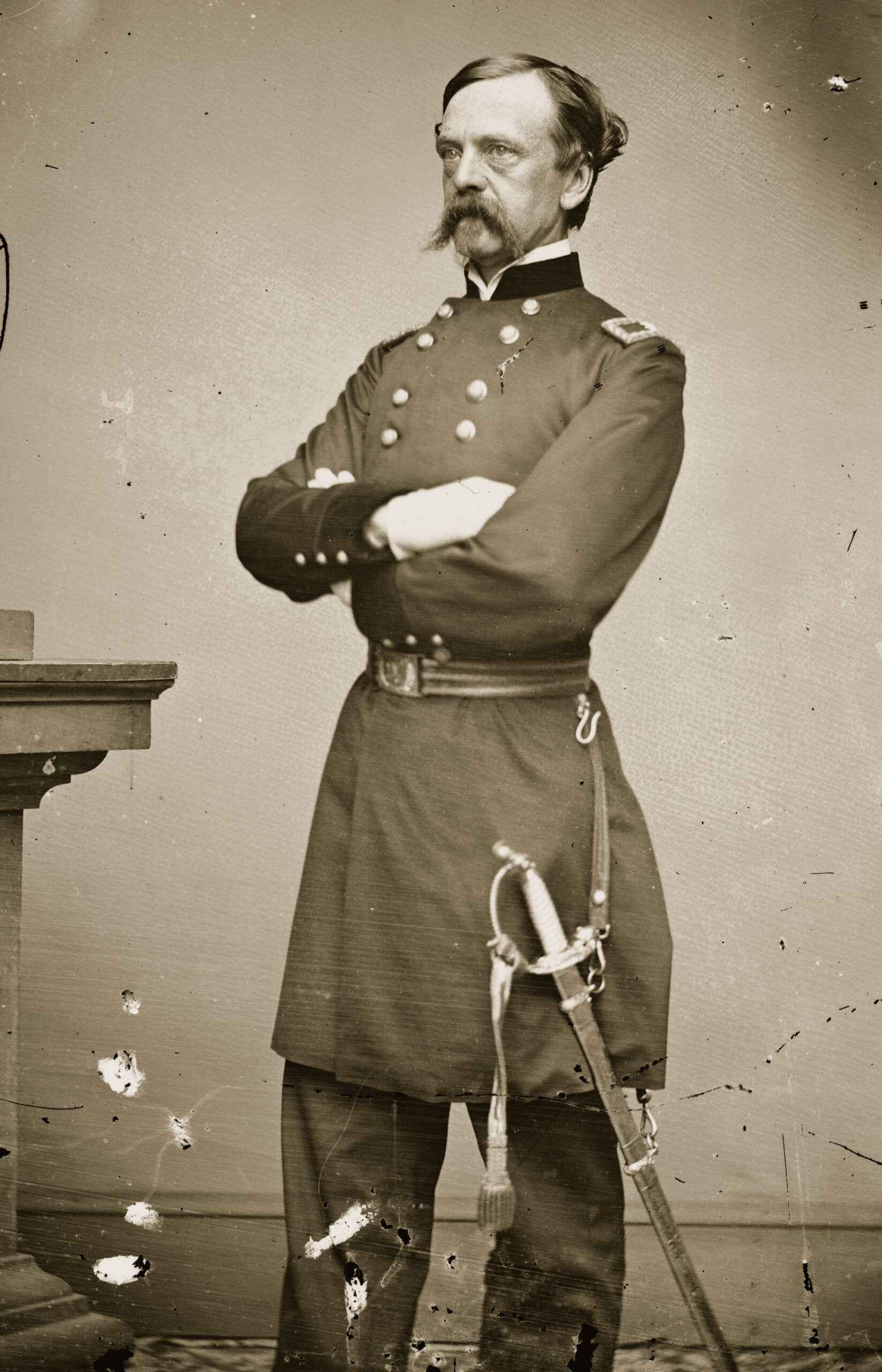 Library of Congress
Major General Daniel Edgar Sickles was an American original—in the very worst sense. He achieved his apex of notoriety—his detractors would have choked to call it fame—on the second day of the Battle of Gettysburg, when without authorization he placed the III Corps of the Army of the Potomac smack in the path of 25,000 elated Confederates and watched the Rebels grind his corps to dust. But Gettysburg was only the tallest peak in Mad Dan’s range of outrages, which included trying to destroy the reputation of Gettysburg victor George Gordon Meade, fomenting war with Spain, and committing embezzlement, fraud, and even one outright murder. From all offenses, however, Sickles walked away free and clean, adored by those who should have known better. Even Mark Twain wrote that Sickles “always seems modest and unexasperating” and “never made an ungenerous remark about anybody.” When it comes to the art of the con, bamboozling America’s skeptic-in-chief may be the ultimate achievement.1
Twain’s misplaced trust is a good marker of the peculiar spell that Dan Sickles was capable of casting. Born in 1819—or was it 1824, 1826, or another of the alternative birth dates he regularly handed out?—in New York City, where his father’s fortune in real estate guaranteed him the finest tutors and a limitless bankroll, Sickles was a spoiled child who matured into a suave, mustachioed, and pathological liar. He studied law, but his passion was politics, which in New York City meant Democratic politics. He made his first political speech on behalf of Martin Van Buren, took a seat in the New York state assembly, and got himself elected to Congress. Along the way, he became a genius of the glad hand and an organ grinder of boodle, “loved more sincerely, and hated more heartily, than any man of his day,” as Harper’s Weekly put it.2
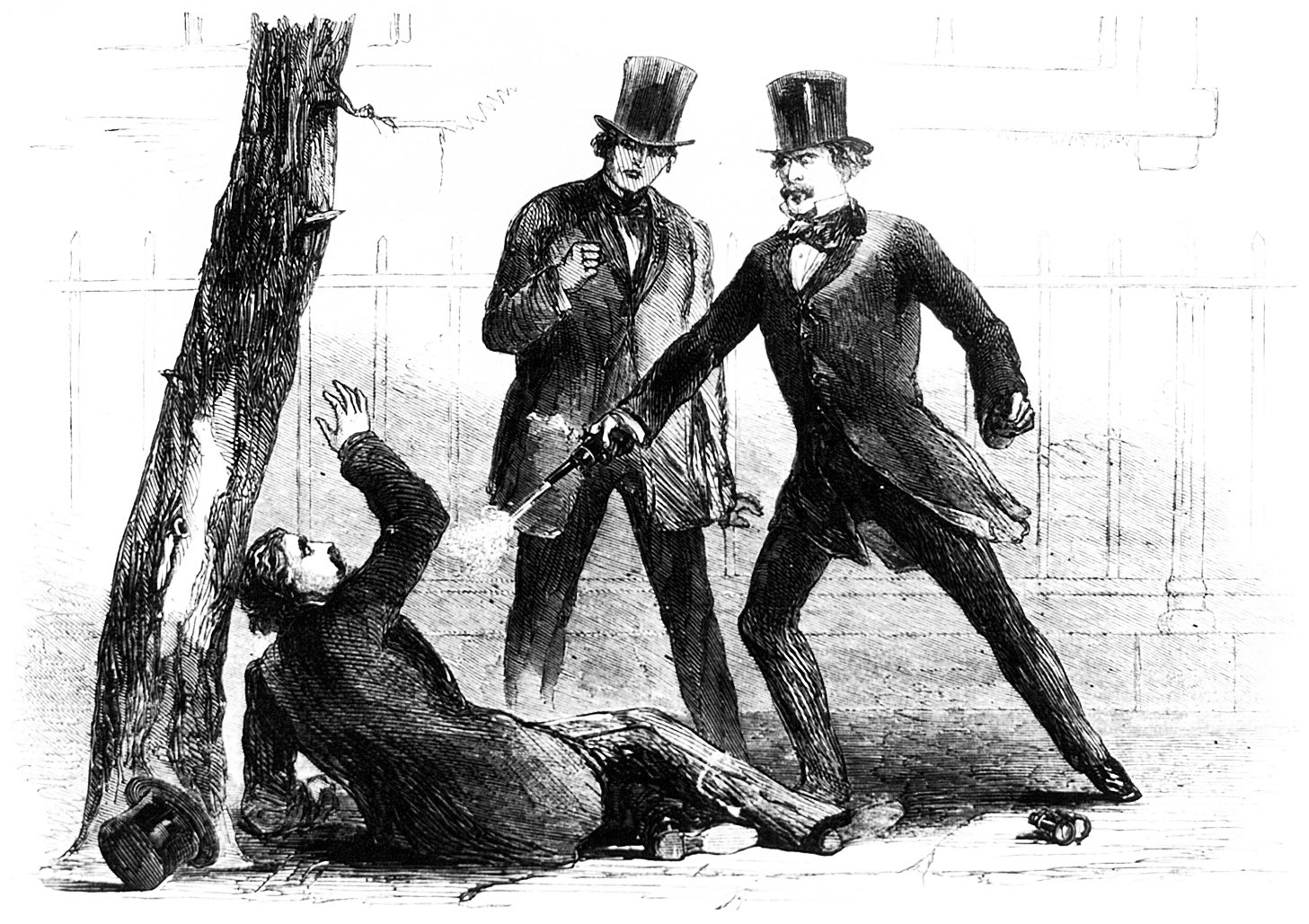
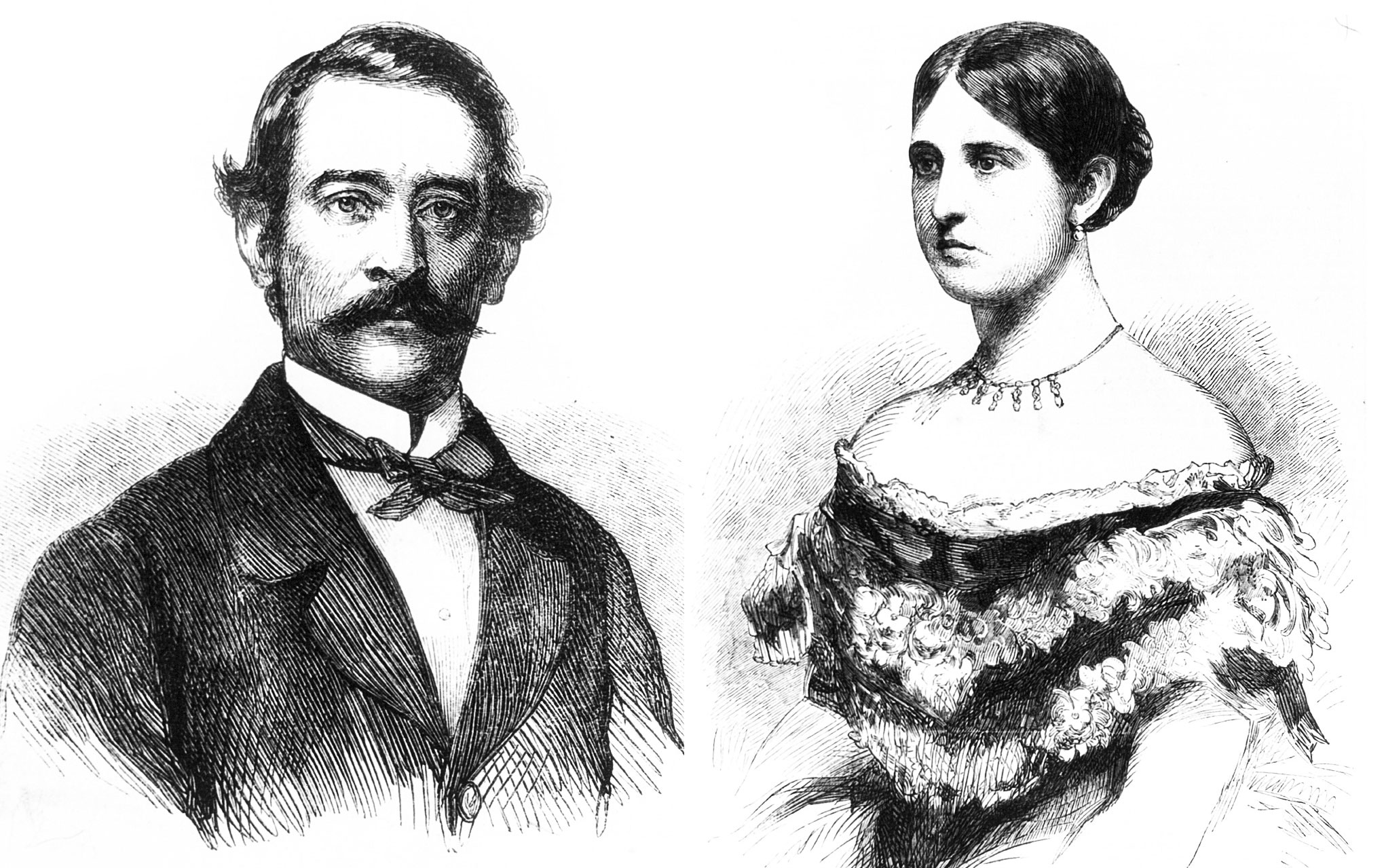
In 1852, at age 33 (if that birth date is reliable), Sickles married a “ravishing” 16-year-old Italian beauty named Teresa Bagioli. Any eyebrows raised by this mésalliance were even higher in 1859 when, after renting a lavish home on Lafayette Square in Washington, he caught Teresa in flagrante with Philip Barton Key, the U.S. attorney for the District of Columbia and the son of Francis Scott Key of “Star-Spangled Banner” fame. Enraged, Sickles pursued the unarmed Key and shot him to death after a clumsy scuffle on the curb across from the White House.3
 Library of Congress
Daniel Sickles fatally shoots an unarmed Philip Barton Key in the streets of Washington in this Harper’s Weekly illustration. Sickles had flown into a rage after discovering that his young wife, Teresa Bagioli, and Key were having an affair.
This was not the sort of publicity Sickles craved. A high-powered legal team, headed by soon-to-be Secretary of War Edwin M. Stanton, persuaded a jury that Teresa’s infidelity had induced a fit of temporary insanity. The jurors deliberated just 70 minutes before declaring Sickles not guilty. Astoundingly, three months later Sickles performed a moral somersault and reconciled with Teresa. The collective jaw of the nation dropped, and Sickles found himself shunned even on the floor of Congress, where he “was left to himself as if he had smallpox.” He prudently decided not to tempt public contempt by running for re-election, and he might have dropped soundlessly into the footnotes of American political history if not for the Civil War.4
As a loyal Democrat, Sickles was likely expected to fall in with the fellowship of New York City’s Lincoln-haters: August Belmont, Fernando Wood, Manton Marble. Instead, Sickles bound himself to President Abraham Lincoln and the Union cause, and set about recruiting the five-regiment Excelsior Brigade. The government happily attached them to the Army of the Potomac, but Congress balked at commissioning the likes of Sickles to command them. In 1861, however, Lincoln needed to rally all the bipartisan support he could muster, and the following spring the Senate very reluctantly confirmed Sickles as a brigadier general.
 Library of Congress
Philip Barton key (left) and Teresa Bagioli
Dan Sickles may have been the very epitome of Herman Melville’s shifty confidence man, but Mark Twain was just one of the “judicious men who rate Sickles very high.” Another was Union general Joseph Hooker, who thought Sickles a “gallant leader” and an “intrepid chief” and “one of the greatest soldiers of the day.” Sickles’ Excelsior Brigade was attached to Hooker’s division in the III Corps during the Peninsula Campaign, and when Hooker took command of the I Corps before Antietam, Sickles took over Hooker’s old division. When Hooker was given command of the Army of the Potomac in 1863, Sickles was rewarded with command of the III Corps and a major general’s commission as “an ideal soldier of volunteers.”5
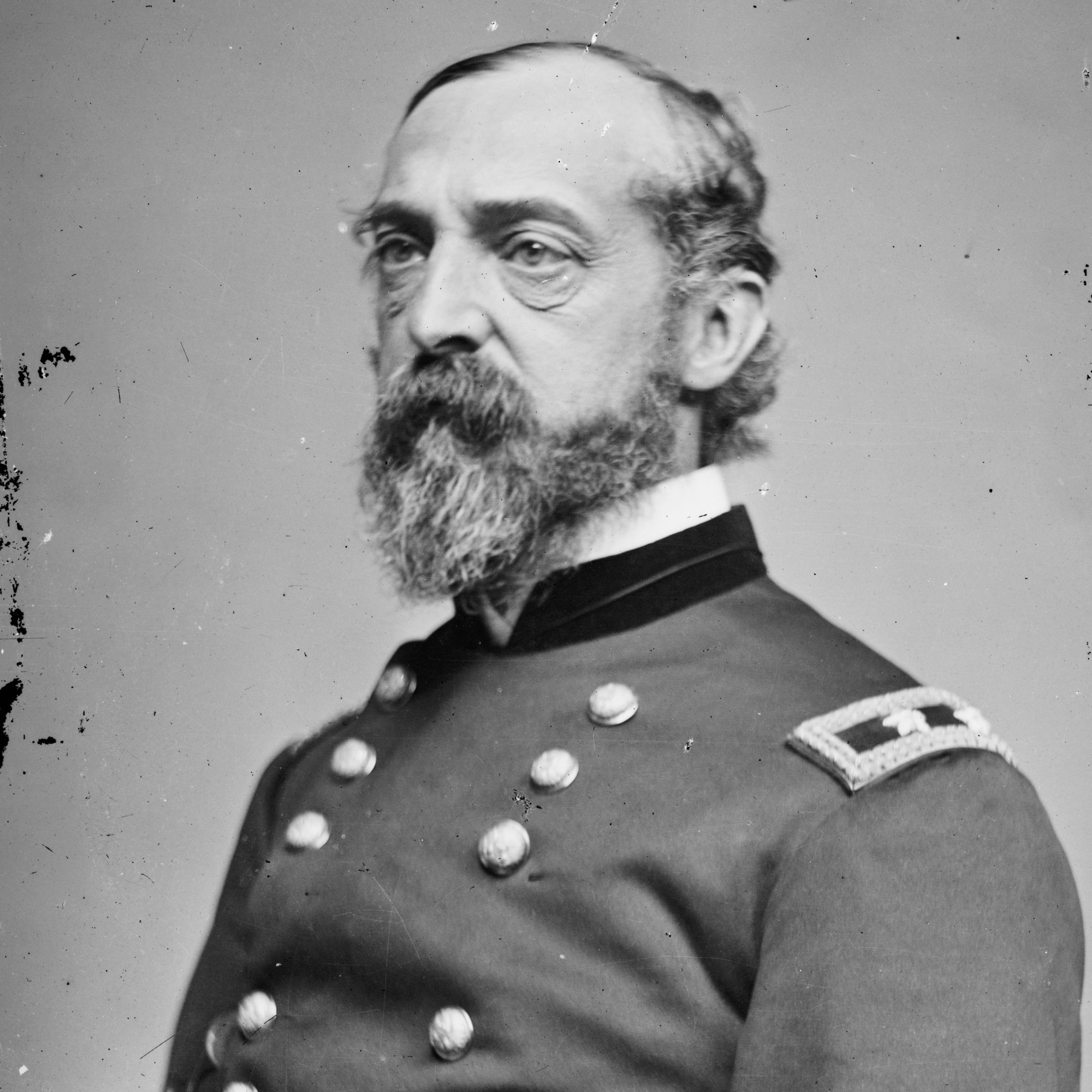
Sickles’ reinvention of himself as an “ideal soldier” was abruptly stalled by the collapse of his patron Hooker during the Union defeat at Chancellorsville in May 1863. Chancellorsville, curiously, was Sickles’ one moment of genuine tactical aplomb: He had spotted the movement conducted by Lieutenant General Thomas “Stonewall” Jackson that crushed Hooker’s right flank, only to have his warning waved away, and he advised Hooker not to evacuate the high ground at Hazel Grove, which the Confederates promptly converted into a perfect artillery platform. That, however, made no impression on Hooker’s successor, George Gordon Meade, a sharp-tempered West Pointer with a distaste for politicians in general and Sickles in particular. And as a Democrat, Meade viewed Sickles’ support of Lincoln as little better than a sell-out. Meade wished that “the rulers on both sides” would “terminate this unnatural contest,” and he frankly hoped that “the ultras” would somehow “be repudiated, & the masses of conservative & moderate men may compromise & settle the difficulty.”6
 Library of Congress
George Gordon Meade
Meade’s appointment to command the Army of the Potomac on June 28, 1863, caught nearly everyone by surprise, especially since the army was in hot pursuit of Robert E. Lee, who with his Army of Northern Virginia was launching the war’s second Confederate invasion of the North. Sickles was not only surprised, but apprehensive. He “knew [Meade] was hostile, dating from several incidents in the Chancellorsville campaign.” For his part, the less Meade saw of Sickles, the happier he was. Meade’s first two communications to Sickles had been nasty little reprimands for “the very slow movement of your corps yesterday,” and he pushed any thoughts of Sickles aside by placing the III Corps under the temporary “wing” command of John Reynolds.7
However, it was Sickles whom Reynolds turned to when fighting broke out on the morning of July 1 west of Gettysburg. “Tell General Sickles I think he had better come up” was one of Reynolds’ last orders before a Confederate skirmisher’s bullet killed him, and Sickles had most of the III Corps on the road to Gettysburg by mid-day. Sickles rode up to Gettysburg in advance of his corps, arriving at the battered Union position on Cemetery Hill just after dark. Meade himself arrived shortly thereafter, and Sickles chimed in with the army’s other corps commanders to recommend that Meade hold their ground at Gettysburg. “It is a good place to fight from, general,” Sickles announced. Meade, who had been ready to fight from positions prepared farther south behind Pipe Creek, grudgingly agreed. “I am glad to hear you say so, gentlemen, for it is too late to leave it.”8
Not that Meade was looking for advice from Dan Sickles. As the lead elements of the III Corps came up the Emmitsburg road to Gettysburg in the twilight, the only task Meade had in mind for Sickles was to shuffle the III Corps into place on Cemetery Ridge, the low crest that ran southward from Cemetery Hill. This put Sickles on the army’s left flank and out of sight, which tempted Sickles to conclude that Meade was deliberately shunting his corps away from its piece of the action. When Sickles’ last brigade arrived on the morning of July 2, they jangled Sickles’ memories of Chancellorsville by reporting a brushup against Confederate pickets somewhere beyond Sickles’ front. Determined not to be lulled into passivity, Sickles sent “a detachment of 100 sharpshooters” to the west side of the Emmitsburg road “with directions to feel the enemy.”9
When the sharpshooters did indeed collide with Confederate skirmishers, Sickles became frantic, convinced that Meade had left him alone in the path of a Confederate landslide. “I went in person to headquarters,” Sickles testified, “and reported the facts and circumstances which led me to believe that an attack would be made” on the III Corps, but he got nothing but a dismissive instruction to tie his right flank to the II Corps behind Cemetery Hill and his left flank to a conical hill that would become known as Little Round Top. When Sickles beseeched Meade to at least come over and have a look for himself, Meade irritably replied that “his engagements did not permit him to do that.”10
Sickles countered the rebuff with another request: If Meade had no plans for the III Corps, could Sickles at least move his men around to suit his own judgment? Yes, Meade snapped impatiently, within reasonable limits “any ground … you choose to occupy I leave to you.” Sickles also wrested assent from Meade to take the Army of the Potomac’s artillery chief, Henry Hunt, back to the III Corps position.11 As Sickles explained to Hunt, Cemetery Ridge declined imperceptibly by almost 50 feet as it snaked south from Cemetery Hill, so that at the point where the III Corps was bivouacked, his troops were actually sitting not on a ridge but in “a low marshy swale.” Not only was it in “a hole” compared to Cemetery Hill, it was actually 60 feet lower than a peach orchard they could see out at the Emmitsburg road. Sickles’ solution would be to post his junior division commander, Andrew Atkinson Humphreys, along the Emmitsburg road to secure the “commanding ground” down to the peach orchard, but then severely angle his other division (under David Bell Birney) back almost 90 degrees to trace a line toward Little Round Top. Could he do that? Hunt hesitated. “So far as it was a line for troops to occupy,” Hunt diplomatically replied, “it was a very good line.” But, Hunt warned, Sickles “should await orders from General Meade” before making such a dramatic move.12
Not for the first or last time would Sickles hear a no and pretend he had heard a yes. So the orders went out, and the divisions “advanced in a brilliant line,” as the 15-piece brass band of the 114th Pennsylvania Infantry thumped away to mark the time. A slightly bewildered Andrew Humphreys “sent out working parties” to take down “all the fences” and pieced out his three brigades along the Emmitsburg road. Birney’s division had its three brigades distributed from the peach orchard back to a stony ridge and then down to a massive, forbidding rock outcropping known as Devil’s Den. “The eye beheld battery and brigade extended from point to point,” wrote an officer in Humphreys’ division, full of “moving columns and gay banners.” But there were so few men available to cover the necessary yardage that Sickles, as an afterthought, sent off an appeal to the artillery reserve for any extra batteries they could spare.13
 Library of Congress
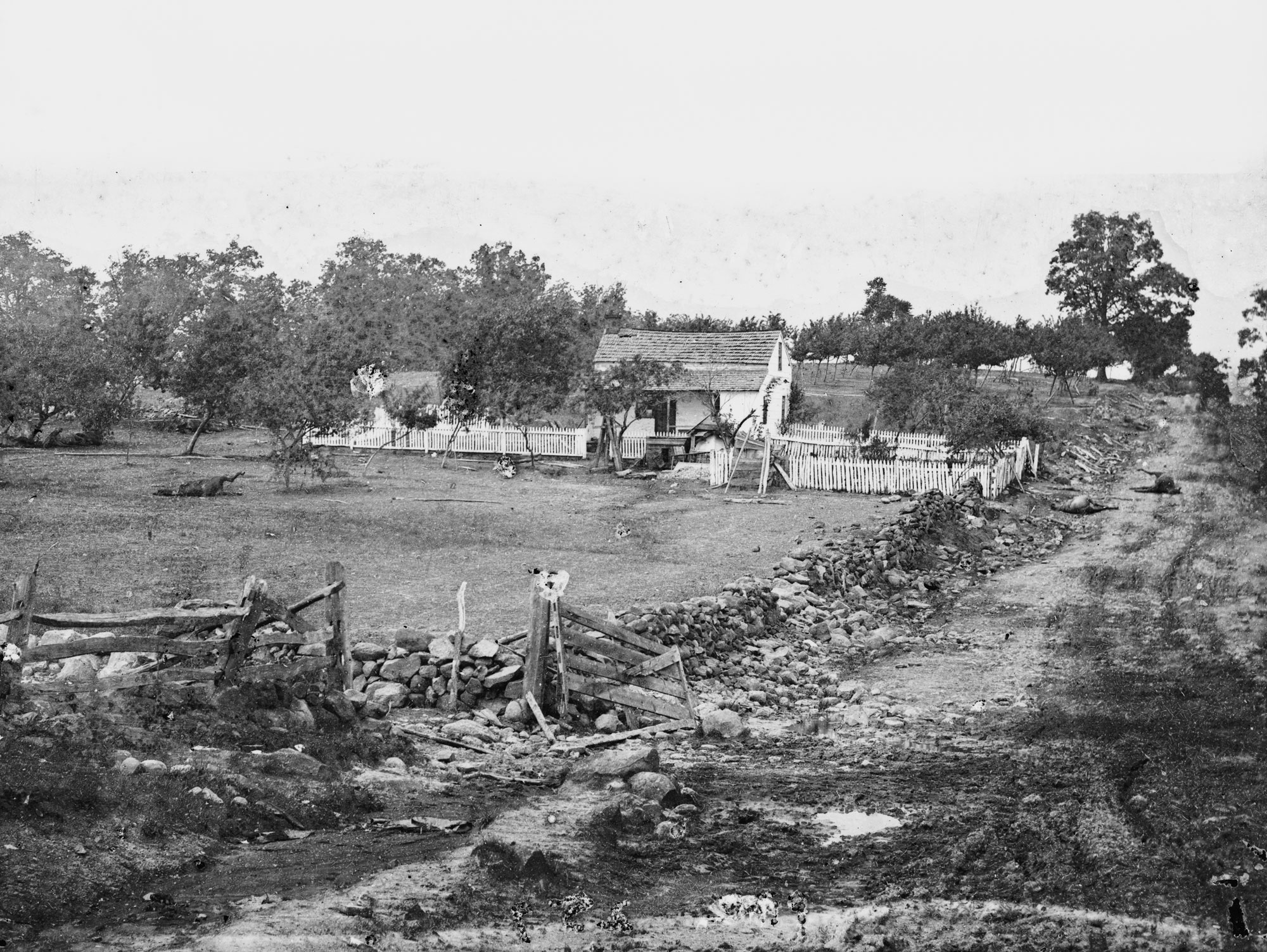
Given the location of his headquarters—the Widow Leister’s cottage, on the reverse slope of Cemetery Hill and pictured here—Army of the Potomac commander George Gordon Meade could not observe, and therefore was among the last to know about, Daniel Sickles’ brazen redeployment of his III Corps.
Astonished staffers in the neighboring II Corps stood up to offer commentary on “the comparative merits of the line” Sickles was acquiring. Winfield Scott Hancock, the commander of the II Corps, remarked, “Gentlemen, that is a splendid advance” and “beautiful to look at.” But he could not imagine that Meade had sanctioned this parade, and he predicted that “those troops will be coming back again very soon.” Actually, George Meade was one of the last people to learn about Sickles’ maneuver, and this was largely because his impromptu headquarters at the Widow Leister’s ramshackle cottage sat on the reverse slope of Cemetery Hill, out of sight of the Emmitsburg road. At 3 p.m., one of his staff strolled in and asked casually whether Meade was aware that Sickles had re-deployed the entire III Corps out to the Emmitsburg road. Meade erupted in Vesuvian proportions, and dispatched an aide to demand that Sickles report to him for an explanation.14
Sickles at first refused. He “sat upon his white horse, received the papers,” and told the courier, “Say to General Meade that it will be impossible for me to report at his Hd Quarters at this time as this battle will be precipitated upon us before I could reach his Hd Quarters.” Meade furiously sent off a second demand, and this time, Sickles obeyed. But as he went, “a shell passed over our heads, bursting in air far beyond…. The battle had Commenced.” When Sickles finally arrived at headquarters, Meade stopped him from dismounting, and told him to turn around back to his corps. Meade then followed, outracing his hastily mounted staffers to join Sickles at the peach orchard.15
Disregarding the artillery rounds sailing over their heads, Meade angrily told Sickles where his corps ought to have been—”between the left of the Second Corps and Little Round Top.” Sickles objected lamely, “I have made these dispositions to the best of my judgment.” And he had occupied the high ground. “General Sickles, this is in some respects higher ground than that to the rear,” Meade sliced in, slamming Sickles with sarcasm, “but there is still higher ground in front of you, and if you keep on advancing you will find constantly higher ground all the way to the mountains.” Very well, Sickles stiffly agreed, he would “be happy to modify” his position “according to your views.” Too late, Meade retorted. Artillery was the overture to infantry, and Confederate infantry would be on Sickles’ doorstep before any orders to fall back could be distributed. “No,” Meade said, “I will send you the Fifth Corps, and you may send for support from the Second Corps.” Then Meade rode off in “a heavy shower of shells.” From the wood line in the distance, long lines of Confederate infantry were stepping out and dressing their ranks.16
From that moment, Sickles lost all effective control over the ground he was supposed to be defending. The Confederate attack swept toward Devil’s Den, overrunning one of Birney’s brigades and lapping up the slopes of Little Round Top; more Confederates stove in Birney’s other brigade protecting the stony ridge, and still more of them flattened the remainder of the III Corps’ line along the Emmitsburg road. Only the dramatic intervention of the II Corps and the V Corps—and the fall of night—saved the Army of the Potomac from a second Chancellorsville, and Dan Sickles might have had little to look forward to at George Meade’s hands but a court-martial, which would have exceeded the Key murder trial in publicity.
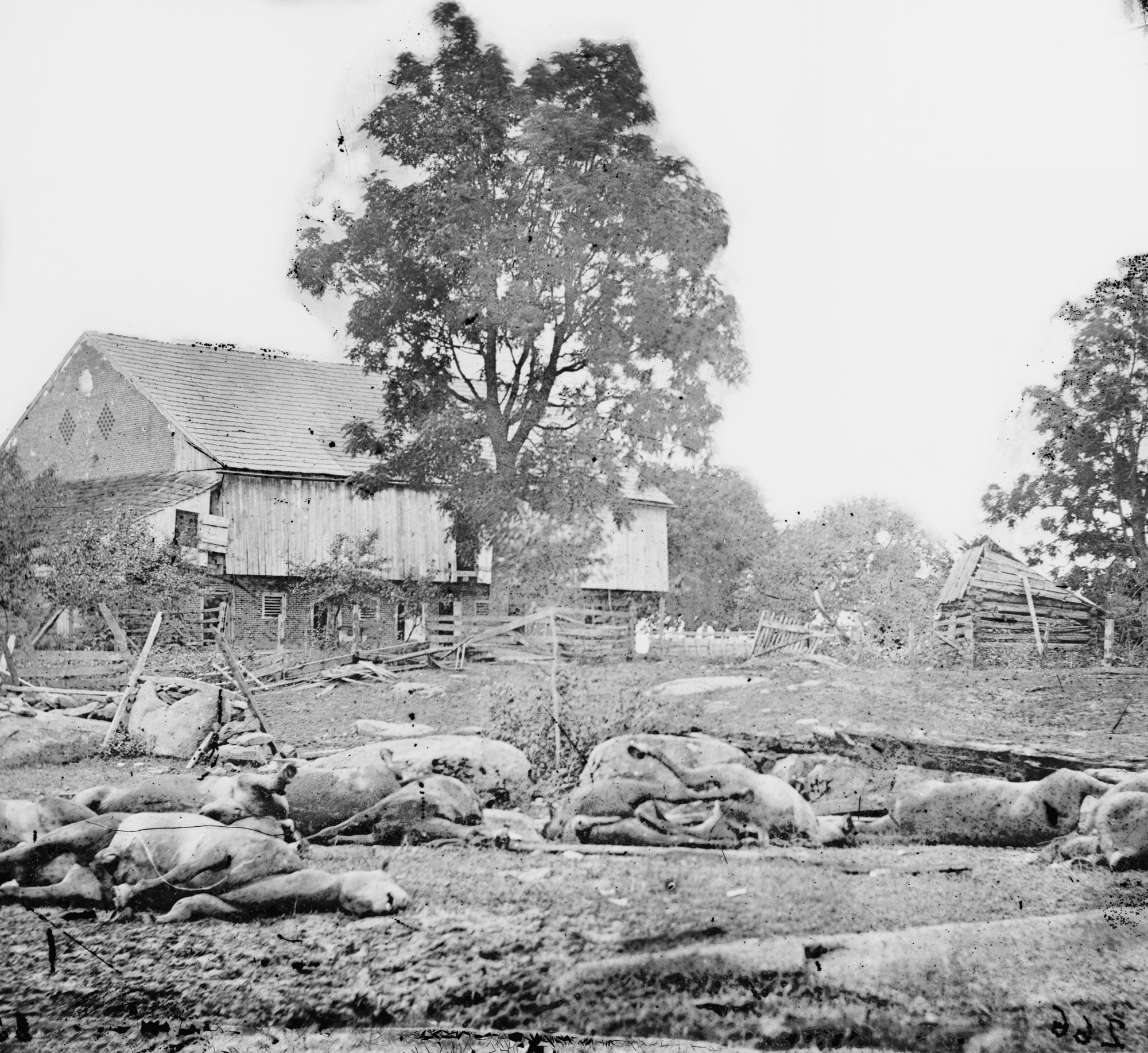
Characteristically, though, Dan converted this liability into his most heroic endorsement, for at about 6 p.m., while he sat astride his horse under a swamp oak behind farmer Abraham Trostle’s barn, a flying piece of Confederate ordnance cracked the bones of his right leg just below the knee. No one has ever known exactly what actually hit Sickles, and even Sickles was not sure. “I never knew I was hit,” he later recalled, and only realized something was wrong when he became “conscious of dampness along the lower part of my right leg.” Pulling his leg out of his “high-top boots,” Sickles “was surprised to see it dripping with blood.” As shock began to set in, Sickles slid off his saddle and hobbled painfully to the side of the Trostle barn, calling “Quick, quick! Get something and tie it up before I bleed to death.” A musician on stretcher duty rushed up with a “turnkey” tourniquet and managed to stop the bleeding.17
 Library of Congress
Horses killed during the Battle of Gettysburg litter Abraham Trostle’s farm. Sickles was behind the barn pictured here when he received the wound that would lead to the amputation of his leg.
The musician, William Bullard of the 70th New York Infantry, thought Sickles had only sustained “a compound fracture of the leg.” But it looked much worse—”so badly shattered that it hung merely by a shred,” according to Thomas Cook of the New York Herald. Private Bullard poured some brandy for Sickles, which seemed to revive him a little, and as Sickles was eased onto a stretcher, he had the presence of mind to ask Bullard, “Won’t you be kind enough to light a cigar for me?” Bullard fumbled around inside Sickles’ coat, found a cigar case, bit off the end of a “small” cigar, then lit it up and “placed it in the Gen. mouth.” The ambulance stopped at a two-story brick house on the Baltimore Pike, and on an improvised surgical table the III Corps’ chief medical director, Thomas Simms, chloroformed Sickles and amputated the butchered leg. “How much missed is his clear-sighted direction and his all-pervading energy,” wept the adoring New York Times. Those who did not adore Sickles had a different interpretation: that Sickles had been only slightly wounded, but ordered the amputation to engender sympathy and “save him from the mess he got in,” as Union general Alexander Webb put it.18
Sickles survived the amputation of his leg surprisingly well, convalescing exuberantly in Washington and filling the ears of politicians, all the way up to President Lincoln, with tales of how the III Corps had saved the Army of the Potomac from sure destruction. Word of this came back to a stony-faced Meade, and when Sickles returned to the army on October 18, expecting restoration to command, Meade made it clear that under no imaginable circumstances would he ever put Sickles in charge of anything in the Army of the Potomac.19
He did not foresee Sickles’ considerable powers of retaliation. Sickles began assiduously poisoning as many minds as he could on Congress’ Joint Committee on the Conduct of the War, whispering that Meade had been on the verge of abandoning Gettysburg on July 2 for Pipe Creek, a branch of the Monocacy River that Meade had originally selected as the concentration point for the Army of the Potomac, when Sickles forced the issue by moving forward to the Emmitsburg road. And unfortunately for the Army of the Potomac’s commander, Meade really had been strangely negligent about the threat to his left flank on July 2, and he had, in fact, favored a pullout for Pipe Creek at a council of war that night. “There is no doubt,” XII Corps commander Henry Slocum insisted, that if Meade had had his way “the army on the third of July would have been in full retreat,” and the Independence Day that followed it would have been “the darkest day ever known to our country.” Samuel Wylie Crawford, who commanded a division in the V Corps, assured Sickles in 1886 that a statement by “a staff officer of Gen. Meade … goes far to establish your assertions in regard to Meade’s determination to leave Gettysb[urg],” but the officer feared for his career, and nothing was ever made public.20
In February 1864, the Joint Committee (after some closed-door maneuvering from Dan Sickles) opened hearings into the Gettysburg battle. The first witness was Sickles, who insisted that Meade had deliberately conducted matters “to prevent a decisive attack upon General Lee.” Sickles gave his knife another twist on March 12, 1864—a week after Meade himself appeared before the committee—with a sensational 4,370-word article in the New York Herald that accused Meade of ignoring “the repeated warnings of that sagacious officer, General Sickles.” It was signed only Historicus, but few people doubted that it had been written by Dan himself. Meade blazingly demanded a court of inquiry “to ascertain whether Major-General Sickles has authorized or indorses this communication,” but the War Department declined to intervene, and after several back-and-forths in the Herald, the controversy finally burned itself out.21
 Library of Congress
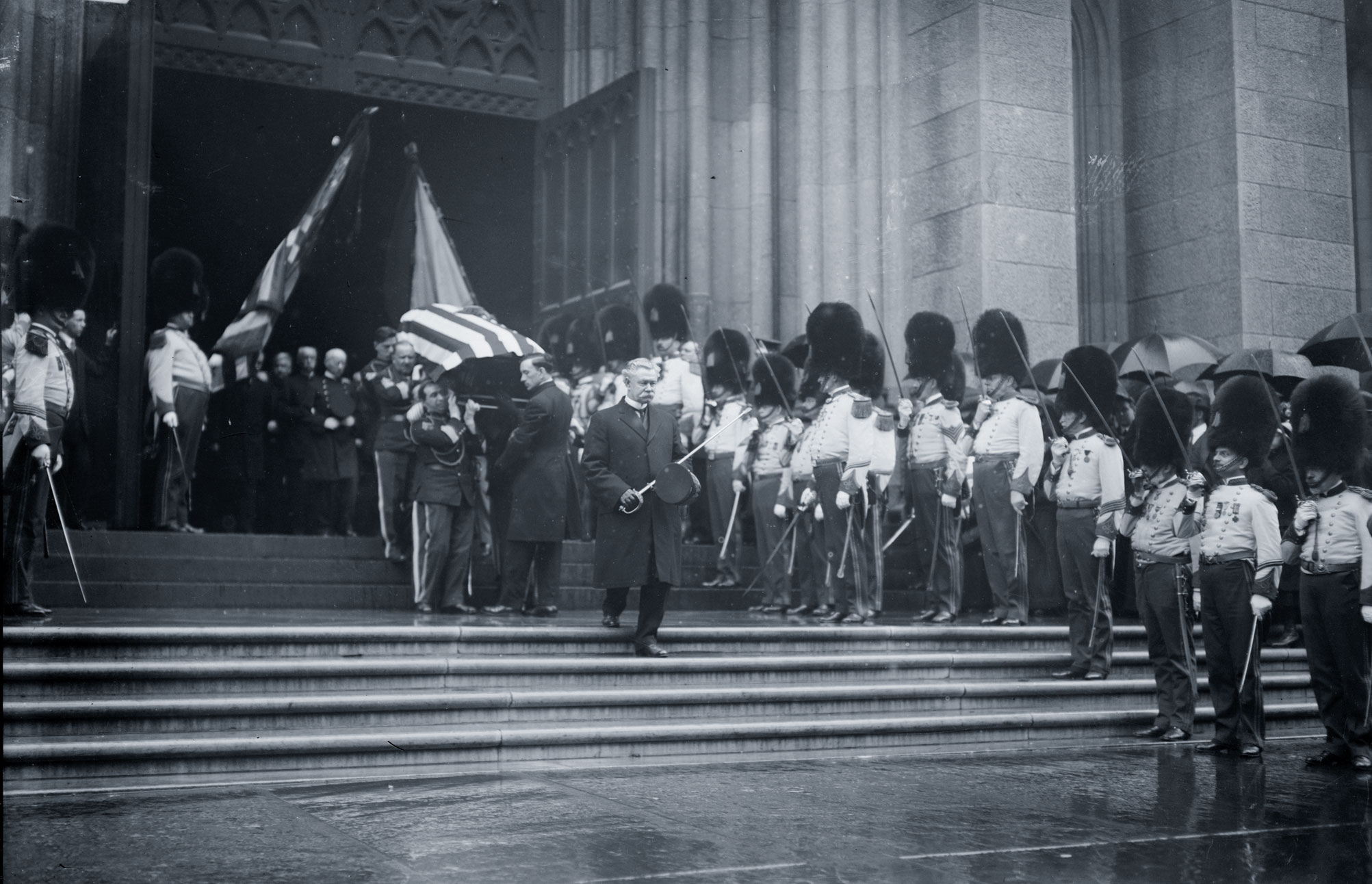
Daniel Sickles’ coffin is carried from the cathedral during his funeral in New York City on May 8, 1914.
Dan Sickles wasn’t done yet. Sickles outlived Meade—in fact, he outlived all the other senior Union officers at Gettysburg—and died in 1914 after attending the great 50th anniversary celebrations of the battle. In between, Sickles managed to get himself re-elected to Congress and appointed as American minister to Spain (where it was rumored he had an affair with Queen Isabella II). He also sponsored the legislation that converted the Gettysburg battlefield into a federally owned preserve.
He never ceased promoting his own self-complimentary interpretation of the battle: that the “real” battle had been fought on July 2; that the III Corps had sacrificed itself to save the Army of the Potomac; that George Meade had nearly betrayed the Union cause by planning to skulk, George McClellan-like, out of the fight until the all-seeing Sickles forced him to do the right thing. And he never ceased enjoying the adulation of his old III Corps veterans, of Congress (which bestowed the Medal of Honor on him in 1897), or of New York City (which gave him a state funeral, with thousands lining Fifth Avenue).22 But unlike the other Union major generals at Gettysburg, there is no monument to Daniel Edgar Sickles on the Gettysburg battlefield. Perhaps that is because no one could quite swallow the Sickles story completely in the end—or maybe because, as the story goes, the money raised for the monument had been embezzled by Mad Dan himself.
Allen C. Guelzo is the Henry R. Luce Professor of the Civil War Era at Gettysburg College, and the author of Fateful Lightning: A New History of the Civil War and Reconstruction (Oxford, 2012). His newest work is Gettysburg: The Last Invasion (Knopf, 2013).
Notes
1 Autobiography of Mark Twain: The Complete and Authoritative Edition, Harriet E. Smith, ed. (Berkeley, CA, 2010), 1:288, 291.
2 James A. Hessler, Sickles at Gettysburg: Sickles at Gettysburg: The Controversial Civil War General Who Committed Murder, Abandoned Little Round Top, and Declared Himself the Hero of Gettysburg (El Dorado, CA, 2009), 1-3; Thomas Keneally, American Scoundrel: The Life of the Notorious Civil War General Dan Sickles (New York, 2002), 127-128; Strong, diary entry for May 17, 1863, in Diary of George Templeton Strong, ed. Allan Nevins (New York, 1952), 3:323; “Biographical Sketch of Hon. D.E. Sickles,” Harper’s Weekly, April 9, 1859.
3 Hessler, Sickles at Gettysburg, 14, 17, 25, 27; “Speech of John Graham, Esq.” (April 9, 1859), in Trial of the Hon. Daniel E. Sickles for Shooting Philip Barton Key, Esq. (New York, 1859), 31.
4 G.W.D. Andrews to Sickles, August 13, 1858, in Daniel E. Sickles Papers, New-York Historical Society; Henrik Hartog, “Lawyering, Husbands’ Rights, and ‘the Unwritten Law’ in Nineteenth-Century America,” Journal of American History 84 (June 1997): 70-71;
5 W.A. Swanberg, Sickles the Incredible (New York, 1956), 57.
6 Meade to Margaretta Meade, May 5, 1862, in Life and Letters, 1:263; Meade to ‘Dear Doct,’ August 5, 1861, to Joshua Barney, September 7, 1861, to Margaretta Meade, November 24, 1861, to John Sergeant Meade, Match 29, 1862, and to Margaretta Meade, January 26, 1863, in George G. Meade Papers, Historical Society of Pennsylvania.
7 Sickles, “Further Recollections of Gettysburg,” North American Review 152 (March 1891): 259; “Orders” and “Circular,” June 30, 1863, in United States War Department, The War of the Rebellion: A Compilation of the Official Records 129 vols. (Washington, 1880-1901), Series I, Vol. 27(pt 3): 416-417, 421, 422-423, 424, 425 (hereafter OR).
8 S.M. Weld, diary entry for July 2, 1863, in War Diary and Letters of Stephen Minot Weld, 1861-1865, ed. H.W. Montague (1912; reprint, Boston, 1979), 231-232; Henry Edwin Tremain, Two Days of War: A Gettysburg Narrative and Other Excursions (New York, 1905),14.
9 C.A. Stevens, Berdan’s United States Sharpshooters in the Army of the Potomac, 1861-1865 (St. Paul, MN, 1892), 302, 303, 304-305, 308, 317; Elijah Walker to J.B. Bachelder, January 5, 1885, in The Bachelder Papers: Gettysburg in Their Own Words, eds. D. & A. Ladd (Dayton, 1994), 2:1093-1094; Thomas Rafferty, “Gettysburg—The Third Corps’ Great Battle on July 2,” National Tribune, February 2, 1888, and “Gettysburg,” November 7, 1883, in Personal Recollections of the War of the Rebellion: Addresses Delivered Before the New York Commandery of the Loyal Legion of the United States, 1883-1891, eds. J.G. Wilson & T.M. Coan (New York, 1891), 8-9.
10 “Testimony of Major General Daniel E. Sickles,” February 26, 1864, in Report of the Joint Committee on the Conduct of the War, at the Second Session, Thirty-Eighth Congress (Washington, 1865), 4:297-298 (hereafter RJCCW); Richard Meade Bache, The Life of George Gordon Meade, Commander of the Army of the Potomac (Philadelphia, 1897), 320, 323.
11 Sickles, “The Meade-Sickles Controversy,” in Robert Underwood Johnson and Clarence Clough Buel, eds., Battles and Leaders of the Civil War 4 vols. (New York, 1887-1888), 3:416; Tremain, Two Days of War, 55; Historicus, “Battle of Gettysburg—Important Communication from an Eye-Witness,” in OR, Series I, Vol. 27(pt 1):130; Tremain to Sickles, June 28, 1880, in Bachelder Papers, 1:670, 672-673; Meade, Life and Letters of George G. Meade, 2:70; “Testimony of Major General Daniel Sickles,” February 26, 1864, and “Testimony of Major General George G. Meade,” March 5, 1864, in RJCCW, 4:299, 331-332.
12 John Watts DePeyster, “The Third Corps at Gettysburg, July 2, 1863,” in Daniel E. Sickles Papers, New-York Historical Society; Richard A. Sauers, A Caspian Sea of Ink: The Meade-Sickles Controversy (Baltimore, 1989), 147; “Testimony of General Henry J. Hunt,” April 4, 1864, in RJCCW, 4:449, 450; Hessler, Sickles at Gettysburg, 116-117; Hunt, “The Second Day at Gettysburg,” in Battles & Leaders, 3:301.
13 “Testimony of Major General Daniel Sickles,” February 26, 1864, and “Testimony of Major General Andrew A. Humphreys,” March 21, 1864, in RJCCW, 4:298, 390-391; Rafferty, “Gettysburg—The Third Corps’ Great Battle on July 2,” National Tribune, February 2, 1888; Frank Rauscher, Music on the March, 1862-’65, With the Army of the Potomac, 114th Regt. P.V., Collis’ Zouaves (Philadelphia, 1892), 90-91.
14 “Testimony of Major General W.S. Hancock,” March 22, 1864, and “Testimony of General John Gibbon,” April 1, 1864, in RJCCW, 4:405-406, 440; Josiah Favill, diary entry for July 2, 1863, in The Diary of a Young Officer Serving with the Armies of the United States during the War of the Rebellion (Chicago, 1909), 245; “Statement of Lt. William P. Wilson,” in Bachelder Papers, 2:1194.
15 Robert K. Beecham, Gettysburg, the Pivotal Battle of the Civil War (Chicago, 1911), 162; Tremain, Two Days of War, 55-56, 61-62; “Testimony of Major General Daniel Sickles,” February 26, 1864, and “Testimony of General Henry J. Hunt,” April 4, 1864, in RJCCW, 4:298-299, 450; Frank E. Moran to Sickles, January 24, 1882, in Bachelder Papers, 2:772.
16 “The Battle of Gettysburg,” in OR, Series I, Vol. 27(pt 1):131-132; Meade, Life and Letters of George G. Meade, 2:78-79; Isaac Rusling Pennypacker, General Meade (New York, 1901),167-168; Tremain, Two Days of War, 63; Tremain to Sickles, June 28, 1880, in Bachelder Papers, 1:671-672; “Testimony of Major General George G. Meade,” March 5, 1864, and “Testimony of Major General David Birney,” March 7, 1864, in RJCCW, 4:332, 366.
17 John Bigelow to J.B. Bachelder and George Randolph to Bachelder, March 1866, in Bachelder Papers, 1:171-172, 239-240; “Sickles Recalls Fighting Battle of Gettysburg,” New York Evening Mail, December 2, 1909; Hessler, Sickles at Gettysburg, 204-205.
18 W.H. Bullard to Sickles, September 13, 1897, in Daniel E. Sickles Papers, New-York Historical Society; “Affairs at Gettysburgh,” New York Times, July 18, 1863; Alexander Webb interview with Alexander Kelley, October 7, 1904, in William B. Styple, ed., Generals in Bronze: Interviewing the Commanders of the Civil War (Kearney, NJ, 2005), 152-153.
19 John Watts de Peyster, “An Ideal Soldier,” National Tribune, July 19, 1889.
20 Slocum to L.H. Morgan, January 2, 1864, in Life and Services of Major-General Henry Warner Slocum, 134-136; Crawford to Sickles, September 7, 1886, in Daniel E. Sickles Papers, New-York Historical Society.
21 “Testimony of Major General Daniel Sickles,” February 26, 1864, in RJCCW, 4:301; “The Battle of Gettysburg—Important Communication from an Eye Witness,” New York Herald, March 12, 1864; Meade to Halleck, March 15, 1864, in OR, Series I, Vol. 27(pt 1):128; Sauers, A Caspian Sea of Ink, 49-58.
22 “Crowds Bare Heads at Sickles Funeral,” New York Times, May 9, 1914.