Dogs of war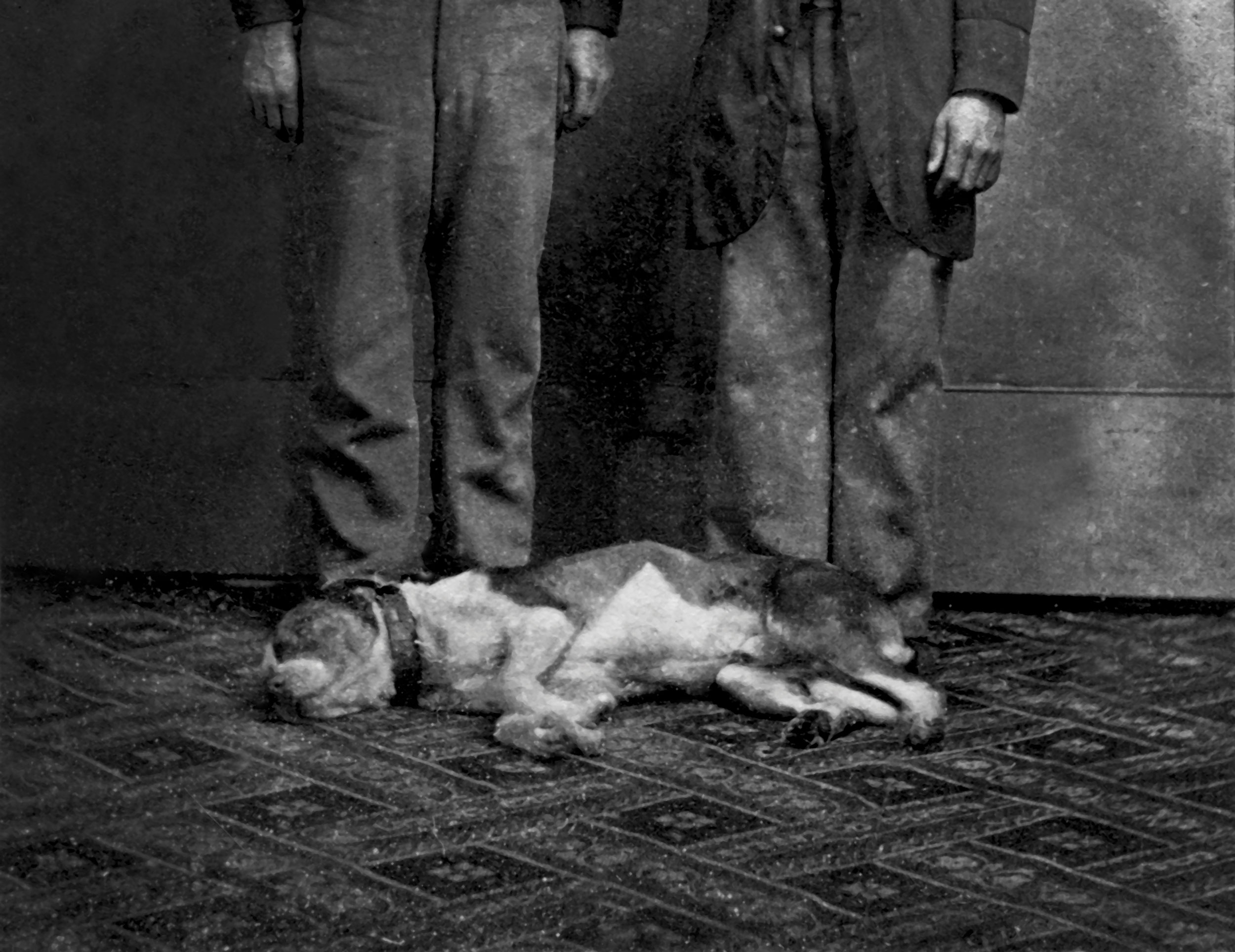 Ronald S. Coddington
The corporals of the 1st South Carolina Volunteers, a Union regiment comprising formerly enslaved men from South Carolina, Georgia, and Florida, warned their officers that “dogs are the detective officers of Slavery’s police.”1 They worried that when the 1st went into action, Confederates would deploy dogs against them. Some of their white officers were skeptical—until the men returned to camp with a dog’s carcass.
A sign that the corporals knew whereof they spoke came on September 13, 1863. A party of four soldiers from Company G, under the command of a lieutenant and the regimental chaplain, tried to tap the telegraph line between Charleston and Savannah to intercept Confederate dispatches. From Camp Shaw on Port Royal Island, the soldiers traveled up the Combahee River and attached a wire to the line a mile south of the railroad station at Green Pond. Unfortunately, the local road master spotted them and alerted Lieutenant Colonel William Stokes of the 4th South Carolina Cavalry. Stokes sent 15 men by rail to the scene and placed mounted pickets at several points between the railroad and potential escape routes. The Confederates chased the soldiers through dense swamps. Night fell. Stokes sent for the pack of “negro dogs” that Colonel Charles J. Colcock used for guarding, detection, and pursuit on the Charleston & Savannah Railroad. The next morning, the dogs found and captured the lieutenant, the chaplain, and two of the soldiers hiding in a marsh on the river.2
 The Black Phalanx (1897)
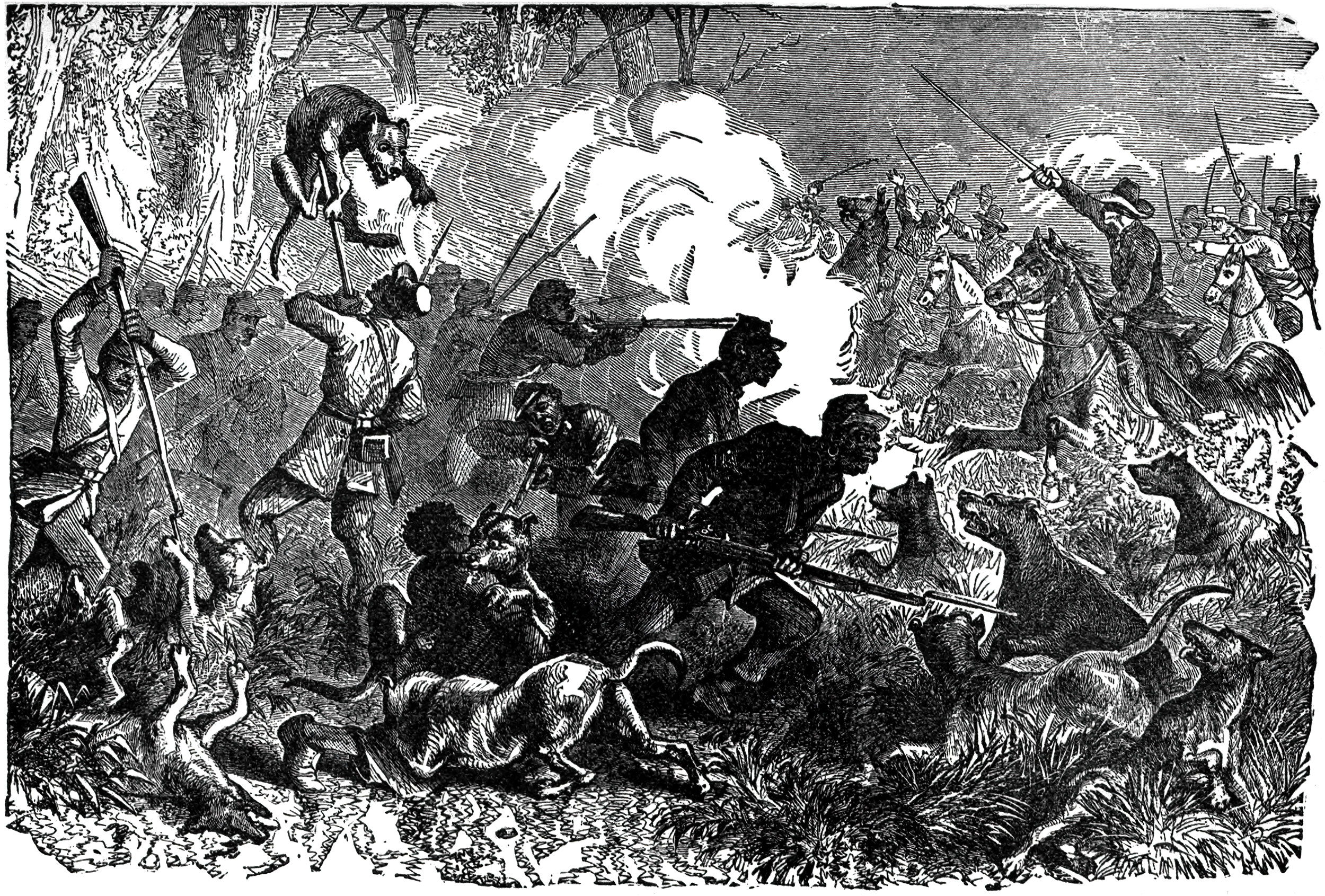
Formerly enslaved men in the ranks of the 1st South Carolina Infantry warned their skeptical white officers that Confederates would deploy dogs against them. Above: Members of the 1st fight off dogs during a skirmish in 1863.
The other two, Corporal Andrew Murray and Private John Layern, spent the next seven days “without food or nourishment” in the Combahee marshes, managing to elude the dogs. They were strong men in their mid-20s—Murray a machinist from Florida and Layern a yeoman from Georgia—who as formerly enslaved men knew about being hunted. The dense briars in the marshes blocked the dogs from following them and the men returned safely to Camp Shaw.3
This incident confirmed for the northern-born white officers of the 1st South Carolina the reports regularly published in abolitionist and Republican newspapers that one of the crimes of slavery was its “barbaric” use of “savage” animals to hunt and attack on command. But they still doubted that Confederates would use dogs to fight, as their troops claimed. They were wrong.
On November 24, 1863, two companies of the 1st, a total of 60 men, crossed from Port Royal Island to Barnwell Island and captured the Confederate pickets posted there. Sergeant Harry Williams’ detachment then went toward Pocotaligo and liberated 27 enslaved people from the Daniel Heyward Plantation. A dense fog delayed the boats that would take the party back to Camp Shaw, and as the men waited at the landing, a company of the 4th South Carolina Cavalry attacked, coming down the road in skirmish lines. In the lead were five dogs. Captain Alexander Heasley ordered his men to charge with bayonets fixed. Three of the dogs were speared and killed, and the men fired a volley that scattered the Confederates. Soldiers from the 4th then attacked 10 black soldiers posted in some woods near the landing, who killed the remaining two dogs. The boats arrived and the Federals embarked.4
 Library of Congress
“Found,” an 1868 lithograph by M. Henochsberg, depicts a more conventional understanding of the role of dogs during the Civil War: as mascots or, as shown here, loyal companions.
With them was a souvenir canine carcass the black soldiers brought back to Camp Shaw. “The men were delighted at this confirmation of their tales of dog-companies, which some of the officers had always disbelieved,” Thomas Wentworth Higginson, colonel of the 1st South Carolina, later recalled. He had the dog skinned and sent the trophy to New York to be stuffed and mounted. Representatives of the United States Sanitary Commission wanted to display the dog at their fair in Boston, but the skin spoiled on the passage.5
Historians have believed some of the stories they have heard about dogs in the Civil War, especially those including well-known regimental mascots, but like with the officers of the 1st South Carolina, it is taking them time to fully acknowledge the pervasive presence of dogs in the conflict. It is time to move beyond the heartwarming and poignant tales of dogs like Sallie, the bull terrier who stayed with her wounded comrades from the 11th Pennsylvania Infantry on the field at Gettysburg. Canines played a variety of roles in the conflict. They were more essential to policing enslaved people within the Confederacy after conscription had drained neighborhoods of white men. They tracked deserters, draft dodgers, and escaped prisoners. They guarded military prisons. In both the Union and the Confederacy they were probably, in their own way, therapy dogs. To northerners, they were a symbol of the brutality of the slave regime. During William T. Sherman’s March to the Sea, Union soldiers killed thousands of them in acts of hatred and revenge. From comrades to catch dogs, dogs were everywhere.
Canines were an essential feature of farm and plantation security in southern states in the 19th century. Nearly every landholder owned multiple dogs who guarded the property and accosted every traveler who walked down rural roads and paths. White southerners classified dogs according to the social status and race of their human keepers. “Nigger dogs” were the mongrels who lived in the quarters of enslaved people. “Every negro in the country has a dog following him,” a South Carolina state senator observed in the late 1850s.6 Enslaved people kept dogs for hunting small game, particularly squirrels, raccoons, and opossums. “Curs” belonged to poor whites who used them as guard and hunting dogs. “Hounds” were the dogs of the elite slaveholding class. Their prowess in hunting for sport was an essential part of gentlemanly honor; a man who could not effectively train or manage his pack lost status among the members of his hunting club. Hounds also policed enslaved people and tracked runaways. The label “hound” in the 19th-century South did not signify breed but rather status and function. In South Carolina, for example, the term usually indicated an English or Irish foxhound, deerhound, or mastiff.
 Collection of the Smithsonian National Museum of African American History and Culture
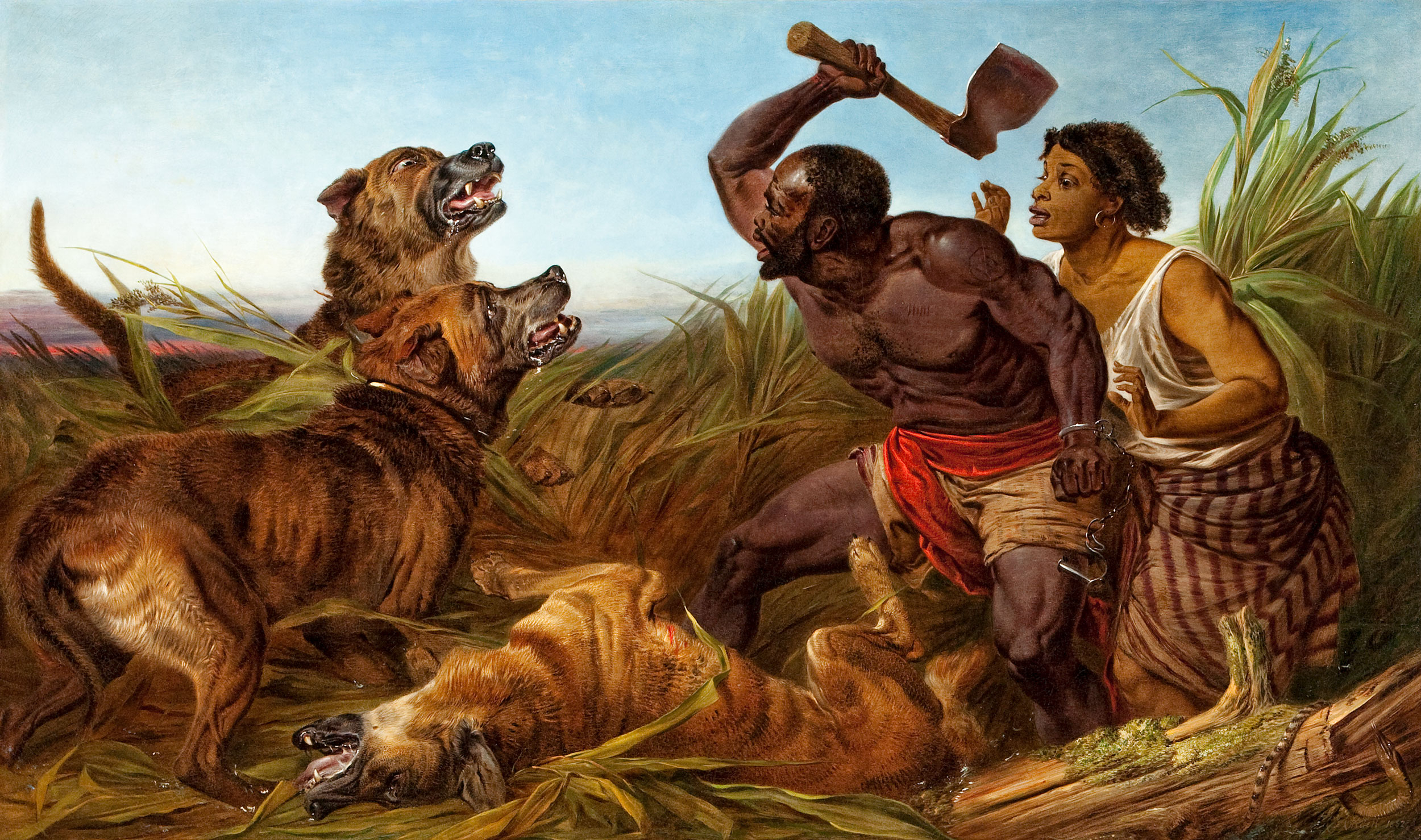
In addition to the common farm dogs (mongrels or hounds) that slaveowners used to intimidate enslaved people, most southern towns had a specialist who handled a pack of so-called “bloodhounds” for tracking and capturing runaways. Above: Richard Ansdell’s “The Hunted Slaves” depicts an escaped couple fighting off a pack of dogs.
Most slaveholders relied on ordinary farm dogs (curs or hounds) to manage enslaved people, but most southern neighborhoods had a specialist who owned and managed a pack of so-called “bloodhounds” that tracked and captured runaways. Local officials called for these trained dogs when the need arose. During the Civil War, the Confederate army enlisted trainers and their animals to guard prisoners, track deserters, and hunt runaway slaves. A handler named Baker controlled the dogs stationed with the 2nd South Carolina Cavalry at Adams Run Station. He received a private’s pay and a graduated reward for the captures his dogs made. The pack drew army rations, too. The term “bloodhound” did not indicate the well-known breed; Baker used English foxhounds bred in his family for generations to hunt human quarry and bring them to bay. He trained two “catch dogs,” part mastiff and part Irish deerhound, to attack at the end of the chase and hold the escaped human in place.7
Bloodhound packs became more important for policing enslaved people after the Confederate government implemented conscription in 1862. The draft decimated the mounted patrols, drawn from states’ militia, that slaveholders used in the antebellum period to control the movement of slaves. In South Carolina, which had nearly full enlistment in the Confederate army by 1864, patrols operated only sporadically and relied upon teenagers, the elderly, and injured veterans. The state passed laws to exempt men from military duty to oversee slave labor, as did the Confederate Congress, but with a majority black population (57 percent), the number of white men remaining in the state was not enough to police enslaved people without the use of dogs.
Citizens in South Carolina who petitioned the Confederate government for exemptions from the draft prioritized the men who managed packs of dogs. Twenty-two residents of Darlington District asked Secretary of War James A. Seddon to release John B. Rhodes, drafted into Company H, 21st South Carolina Infantry. “We and the soldiers’ families are continually annoyed by the depredations committed on us by the black population,” the petition read. Rhodes had “an excellent pack of dogs … which no person with any success can manage but himself. Have him discharged or detailed or otherwise as you think best so he can assist us. He will do more real good to us and soldiers families as ten other men.”8
When the War Department planned to transfer the 4th South Carolina Cavalry to Virginia in March 1864, and with it the men in charge of the unit’s dogs, overseers in charge of the rice plantations along the Combahee River protested. One wrote his employer to say that dogs maintained control of slaves. “You are in great danger of losing the negroes at night, as from the very small force here it is impossible to picket the country so as to prevent a series of successful raids, by the Yankees & Negroes, who know every path in this section,” he reported. “It will never do to allow the dogs to be sent off from here.” Without the handlers and their hounds, he claimed, “We will not only be left defenseless but will not even have the means of moving our negroes.”9
Already adept at using dogs for policing and tracking, Confederates deployed dogs to guard fortifications and military prisons. In Charleston Harbor, a dog ruined a clandestine Federal attack on the night of November 19, 1863. Major General Quincy A. Gillmore had sent 200 men in boats to probe the Confederate defenses at Fort Sumter. When the Federals were 30 yards from the small island, a dog barked. This awakened the Confederate garrison, who opened fire. The Federals withdrew.10
The Confederate garrison at Battery Wagner on Morris Island, which guarded the entrance to Charleston Harbor, left behind a “beautiful” white dog when they evacuated the place in September 1863. Union forces adopted her. “She will leave [Wagner] with any Regt. going back to camp, but will always return with the first one going to the front,” a captain in the 104th Pennsylvania Infantry wrote to his wife. The dog knew how to take cover from artillery fire directed against the fort. “Let the Man on the Watch but call out Cover-Johnson and away she scampers to the trench or bomb proof.”11
A pack of dogs was essential to the Confederate security plan for Camp Sumter, the infamous military prison at Andersonville, Georgia, that opened on February 24, 1864. Confederate authorities hoped that its remote location would keep it safe from Union armies, although its isolation also made it difficult to supply. Typical of the makeshift nature of Confederate prisons, Camp Sumter was an open-air stockade with no shelter for the men inside. On May 4, several prisoners tunneled out. Benjamin Harris, who owned a pack of dogs, used them to hunt down the escapees. When he earned a contract from prison authorities, Harris had his dogs make a circuit of the stockade every morning to catch the scent of any prisoners who may have escaped overnight. The dogs received rations from the prison cook house.12
As the number of prisoners increased that summer with the campaign season in Virginia, Corporal Edward C. Turner, 1st Georgia Reserves, brought his dogs to the camp. He received $30 for each escaped prisoner he captured and eventually earned hundreds of dollars. His dogs were integrated into the camp’s broad security environment outside the stockade. Sentry boxes located at intervals on the wall provided guards with a view inside the stockade and the ability to shoot at prisoners approaching the deadline, a low-rail fence located several feet inside the stockade beyond which prisoners were not allowed to pass. Three forts with artillery emplacements (one with eight guns), breastworks, and two rifle trenches were built outside the stockade. Dog kennels were positioned in the nearby woods. These animals were effective: On October 18, dogs tracked and caught 11 of 15 men who escaped that night.13
Although trained catch dogs could secure quarry without inflicting injury, canines did wound, maim, and kill what they tracked. Federals were terrified of so-called bloodhounds and had reason to be. When Major General Samuel Jones sent 1,500 Federal prisoners of war from Charleston to Columbia, more than 100 of them jumped off the train. When the rest of the POWs arrived in Columbia, guards brought before them the bitten and lacerated body of a lieutenant who had escaped and died a few hours after being found by catch dogs. The sight shocked and outraged the Federals.14 Prisoners who successfully escaped to Union lines circulated stories about southern bloodhounds mangling human beings (some true, some exaggerated), reinforcing perceptions Union soldiers had developed before the war from reading northern newspaper accounts of dogs tracking escaped slaves.
 Harper’s Weekly
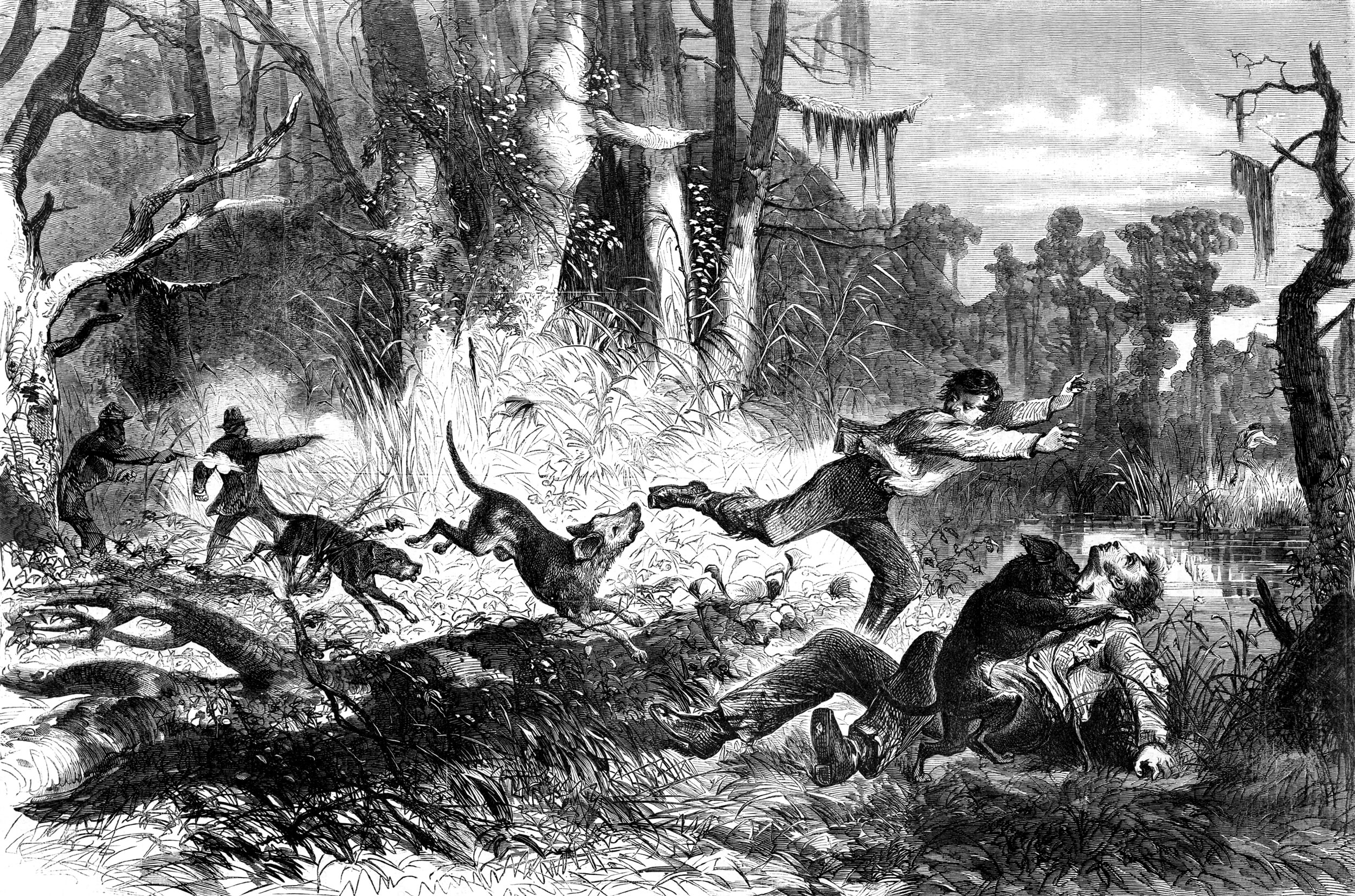
Confederates used dogs to help with security at southern prisons, in particular at Andersonville. By the time of the March to the Sea, southern dogs had such reputations that Union soldiers killed thousands of them during that campaign. Above: In a November 1863 sketch from Harper’s Weekly, southern guerrillas hunt down “Union men” with dogs.
To the Federals who invaded the Deep South in the winter of 1864–1865, canines represented the barbarity of slavery. Yankees hated southern dogs because they were soldiers for the rebellion. Indiana private Lessel Long believed the role of dogs policing enslaved people and Union prisoners was “of more real service to the Confederacy … than many regiments of soldiers would have been.”15
During Sherman’s march through Georgia to Savannah, and then north through South Carolina, Union soldiers killed thousands of dogs. “We were determined that no dog should escape, be it cur, rat dog, or blood hound,” an officer of the 63rd Ohio Infantry recalled. “We exterminated them all. The dogs were easily killed. All we had to do was bayonet them.” John Henry Otto, a cabinetmaker from Westphalia and a veteran of the 1848 German revolutions, was a captain in command of the foragers for the 21st Wisconsin Infantry. His men burned a slave market in Sandersville, Georgia, and killed dogs in multiple locations after that. They shot 10 hounds at a plantation while Otto lectured its mistress. “The boys are only executing your police, your nigger catchers. You see that it is a custom with the men to dispose of all the bloodhounds that come in their way,” he told her. “They have the foolish notion that it is barbarous and brutal to hunt a human being with voracious wild beasts.” At a farm in South Carolina in February 1865, a man opened his kennel and set a large pack of dogs on Otto’s foragers. “But the fellow had made a mistake in playing this trump. That was just the sort of sport the boys liked to indulge in, and ere a minute had passed every hound was laid low stretching his trembling limbs as a last farewell to slavery and rebellion,” Otto said.16
Northern outrage over the deployment of dogs against Federal prisoners of war found its outlet in the August 1865 trial by military commission of Captain Henry Wirz, the Confederate officer in charge of the prison stockade at Andersonville (another officer was in overall command of the Camp Sumter post). The first charge against Wirz was violating the laws of war by conspiring to “injure the health and destroy the lives” of Federal prisoners of war “to the end that the armies of the United States might be weakened and impaired.” Prosecutors listed multiple specifications under this charge. One of them was about dogs. Wirz “did keep and use ferocious and bloodthirsty beasts, dangerous to human life, called bloodhounds.” If a prisoner made his escape, the specification claimed, Wirz “did then and there willfully and maliciously suffer, incite, and encourage the said beasts to seize, tear, mangle and maim the bodies and limbs” of the fugitives. The prosecutors believed that dogs killed 50 Federal prisoners at Andersonville. The second charge against Wirz was murder, and here the prosecutors specified that on July 1, 1864, Wirz urged “ferocious and bloodthirsty” animals to attack and mortally wound an unnamed Federal soldier.17
A sizable portion of the testimony in the Wirz trial was about the breed of dogs kept at Camp Sumter. In northern propaganda, bloodhounds were not scent animals but savage ones whose only purpose was to chase and attack human beings. If the dogs at Andersonville were bloodhounds, that fact alone proved evil intentions toward Federal prisoners. Southern witnesses at the trial, Confederate officers and soldiers stationed at Camp Sumter, and citizens from the local area were puzzled at the insistence that the dogs were bloodhounds. Colonel George C. Gibbs, who took command of the post on October 9, 1864, said the dogs “were certainly not bloodhounds according to my understanding of what bloodhounds are; I think they were ordinary plantation dogs, a mixture of hound and cur, and anything else—the ordinary plantation dogs.” A member of the court asked, “Were they ferocious dogs or were they harmless?”
“I do not think they were harmless dogs,” Gibbs responded.
“Were they dangerous dogs?”
“I do not know about that.”
“Were they anything more than the ordinary farm dog?”
“They were the ordinary plantation dog.”
“Not at all ferocious or dangerous?
“Well, I do not know about that.”18
 Library of Congress
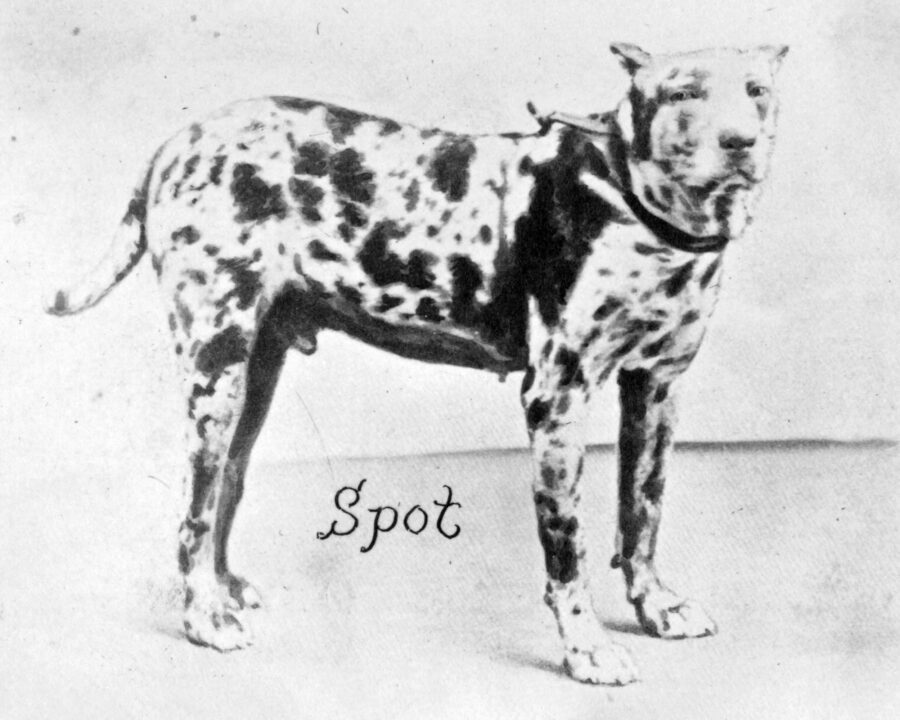
“Spot,” one of the dogs used against Union prisoners at Andersonville.
Nazareth Allen, a private in the 3rd Georgia Reserves who lived near Macon, Georgia, likewise testified about the “ordinary” nature of the dogs at Andersonville and was matter of fact about the role of dogs in southern society. “They were common plantation hounds, such as you find on all the plantations of the south,” he said. “They are hounds trained to run people.… They were common-sized dogs, about half as high as this railing [about four feet high].… They did not appear to be particularly ugly or savage, more than a common hound, as far as I saw.” Allen never saw the dogs at Andersonville chase anyone, but he knew they did because he heard them “crying in the woods.” “There is a particular sound when they are pursuing … it is a more ferocious sound than when they are pursuing in sport.”19
Another Confederate reservist from Macon who had been stationed at Andersonville, William Dillard, pointed out that the dogs were there to “catch our own men as well as prisoners. Our soldiers. They could be used indiscriminately to catch either the one or the other—Confederate or Union.” Dillard did not understand the fuss about bloodhounds. “They were not at all ferocious; they were common plantation dogs, such as are round the houses, and that the children play with; they were not different in any respect from our house dogs. They were just small dogs.”20
The questions from the court about “bloodhounds” during the Wirz trial revealed that many Federal soldiers imprisoned at Andersonville did not know much about southern dog breeds. Joseph D. Keyser, 120th New York Infantry, testified that the dogs at Camp Sumter were “spotted hounds and one of them was a bull terrier. I know what is generally called a fox dog. I do not think they were fox dogs. They had yellow and brown spots, long ears, middling broad and flapping, and a pointed head, rather of the hound style. I never saw a bloodhound. I do not know what a bloodhound is.” W.W. Crandall, of the 4th Iowa Infantry, admitted “I am not well posted enough in dogology to tell you what kind of dogs they were.”21
 Wikimedia Commons
Henry Wirz
The testimony established that the bloodhound breed of popular northern imagination did not exist, and the court acknowledged this at the end of the trial by striking out the word “bloodhounds” in the specifications against Wirz and substituting the word “dogs.” Everyone at the Wirz trial—from the prisoner himself to each witness and member of the court—acknowledged that dogs at Andersonville hunted escaped prisoners. Northern and southern witnesses had different perspectives about whether that was inherently barbaric, but what mattered for the fate of Wirz was whether he had personally incited the dogs to kill anyone.
There was credible, though uncorroborated, testimony in the trial that dog bites played a part in the death of at least two Federal prisoners at Andersonville. Dr. A.V. Burrows, of the 27th Massachusetts Infantry, reached Camp Sumter on May 18, 1864, and received a parole to attend two wards of the prison hospital, located outside the stockade. He was there until October 9, when he escaped to Florida. He treated two men who were mangled by dogs. One whose ear was torn off got well. The other, who was bitten in the neck, died of gangrene that manifested in the wound. Burrows testified that Wirz called for the hounds anytime a prisoner escaped from the hospital, but he had nothing to say about whether Wirz was on the scene when the dogs caught their quarry. Neither did Private John L. Younker, 12th U.S. Infantry, who witnessed an Indiana soldier die inside the stockade. The man escaped from the hospital, was caught by the dogs as he tried to climb a bush and was returned to the stockade. He made his way to the hole in the ground where a friend lived, next to Younker’s hole. His ear was nearly torn off and he had several bites on his legs. Younker tied up his wounds while the man gave his friend a picture of his mother to return to her in case of his death, which came the next morning. Whether the bites, or the underlying sickness, was the cause of death, the court could not establish.22
Witnesses, both Confederate and Federal, including Wirz himself in a written statement, placed him on the scene of only one dog attack. One Federal POW was a Canadian nicknamed “Frenchy,” a small, clever man who had escaped multiple times. Wirz sent him, along with 12 other men, to the provost marshal’s office, located near the railroad depot, to be chained together by the neck. The collars were not ready, so the provost marshal sent the men back to Wirz’s headquarters. On the way, Frenchy ran off. “That damned Frenchy has escaped again,” Wirz exclaimed. “Send for the dogs.” Frenchy headed for the swampy ground around the creek whose course ran through the stockade. The dogs found his scent, pursued him, and treed him. He fell into a mud hole, the dogs rushed him, and Wirz drove the pack off. Frenchy’s ragged pants gave some witnesses the impression that his legs were torn, but those who spoke to him testified that he had not been bitten.23
 Harper's Weekly
Among the charges brought against Captain Henry Wirz for his actions while in charge of the prison stockade at Andersonville were that he “did keep and use ferocious and bloodthirsty beasts, dangerous to human life, called bloodhounds.” Above: A sketch of Wirz’s August 1865 trial by military commission; Wirz lay on a couch during the proceedings because of his various ailments.
Second Lieutenant James Mohan of the 3rd Georgia Reserves challenged the court to reconsider their perspective that using dogs to catch Frenchy was “savage.” He reminded them that it was the duty of any prison guard, anywhere in the civilized world, to fire on a man trying to run away who did not stop when commanded. “In pursuing [Frenchy], it would certainly have been my duty to fire on him if he did not stop,” he said. “The dogs had this man at bay. It was more gentle to bring him at bay with the dogs than to fire at him and kill him.”24
Unable to prove the existence of “bloodhounds” at Andersonville, Judge Advocate Norton P. Chipman seized on testimony that each pack of the prison’s dogs had a specially trained catch dog. He portrayed “tracking” dogs as “usually harmless,” trained only to follow humans without inflicting injury. “Catch dogs,” on the other hand, were “fierce and bloodthirsty.” “If there were no desire to injure, why were they used at all?” he asked. Blending probable with improbable testimony, Chipman insisted that dogs at Andersonville maimed multiple prisoners and caused the death of three (significantly less than the originally alleged number of 50). Wirz was guilty of murder, he said, even if he was not on the scene of a dog attack, because by his own admission he sent dogs after prisoners. Chipman cited Thomas Starkie’s 1826 work, Practical Treatise on the Law of Evidence: “It is not essential that the hand of the party should immediately occasion the death; it is sufficient if he be proved to have used any mechanical means likely to occasion death and which do ultimately occasion it.”25
 Cornell University Library
Among the many soldiers who adopted dogs during their Civil War service was Massachusetts surgeon Burt Green Wilder, who discovered a constant companion in “Miff” (pictured above), a spaniel-setter mix that came to his tent one day in early 1864 while his regiment was stationed in Florida.
The court found Wirz guilty of murder, but changed the specification related to canines. Wirz did not “incite and urge … encourage and instigate … ferocious and bloodthirsty bloodhounds” to attack and wound escaped prisoners, but rather “caused ferocious and bloodthirsty dogs” to do so with his “knowledge.” Members of the court added an addendum to Wirz’s sentence of death by hanging; his guilt of causing the death of three prisoners “by means of dogs … has not and did not enter into the sentence of the court.”26
The Wirz trial focused on “track dogs” and “catch dogs,” but the testimony of William Dillard showed that such animals were also “companion dogs.” Unlike the trained packs managed by specialists, ordinary plantation dogs played with children, lived among families, and when commanded, tracked people.
Northern soldiers adopted dogs to play the companion role during their service in southern states. Canines were in camps, tents, and beds. Many soldiers did not care about animals, so they did not mention the presence of dogs when they wrote letters home or scribbled in their diaries. Reading their writings leaves an impression that Civil War infantry camps were human spaces invaded by lice and flies. But the men who loved animals tell a different story. Through their accounts, we see that canines and humans lived, slept, ate, and worked together in the spaces of the Civil War.
 Cornell University Library
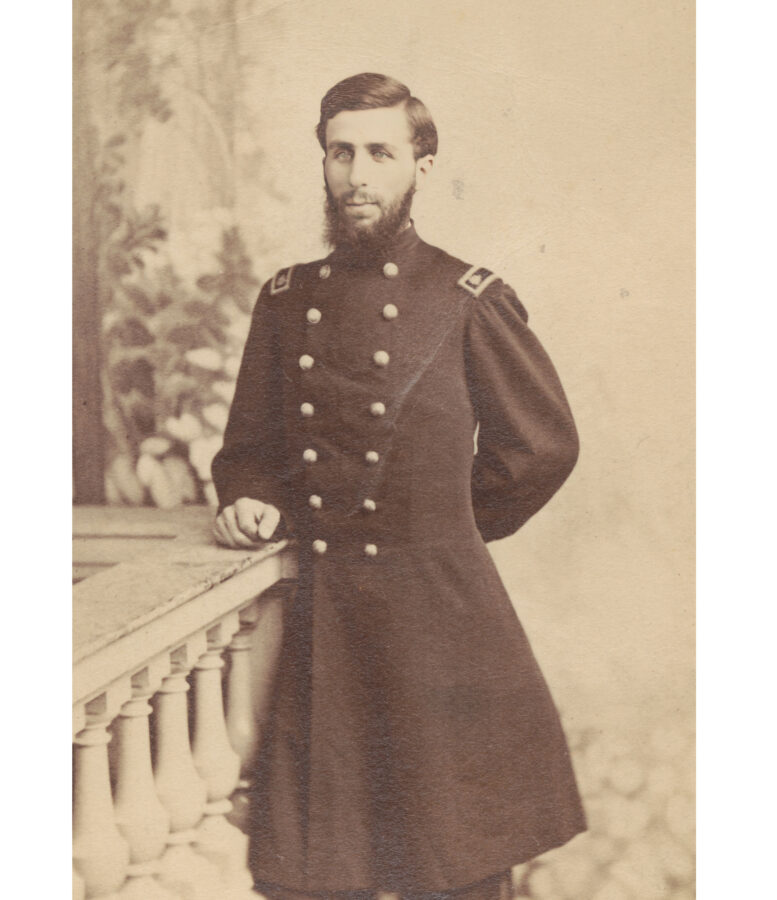
Burt Green Wilder
Burt Green Wilder was a keen observer of dogs in the letters that he sent to his fiancée. A Harvard educated zoologist and naturalist, Wilder was the assistant surgeon of the 55th Massachusetts Infantry, stationed in the Department of the South. (There he discovered a spider that was eventually named after him: Nephila wilder.) In January 1864, the 55th participated in the capture and occupation of Jacksonville, Florida, and four of its companies manned the picket lines that circled the city. As Wilder rode out to the pickets, the adjutant’s dog Fanny “followed him against orders.” He carried her back on his horse and returned her to her owner. A few days later, he wrote, “There came into my tent a very pretty little dog, supposedly having been brought in by some soldier. I have named her ‘Miff.’” She was a spaniel-setter mix.27
Miff became Wilder’s constant companion. She accompanied Wilder to Yellow Bluff, Florida, in February, when four companies of the 55th went there to build a stockade on a bluff overlooking the St. Johns River. “She is very lively and interesting and made friends with all on the boat,” Wilder said. “While the colonel was bathing she disrespectfully attacked his toes. She was transported to the dock in one of my large saddlebags.” Miff’s antics delighted Wilder: She hid his socks under the bed and attacked his toes, worried a lizard until it seized her nose, and cried piteously if Wilder left without her. “There is a large dog here and Miff vents her superabundant spirits on him,” Wilder wrote. “She attacks him furiously and he endures it without retaliating, although evidently astonished at her audacity.” Miff slept with Wilder, curling against him under the blanket.28
Wilder gave Miff a role in his medical practice; today we would call her a “therapy dog.” He took her with him to his daily sick call, which involved a half-mile walk to visit the men posted in various locations around Yellow Bluff. “I walk in front; then comes Miff, generally with a stick in her mouth; the nurses with the hospital knapsacks. During the call she frolics with the men, who make much of her,” Wilder said. “On the return trip, she goes first, with the stick, looking back frequently to see if I am following her; if I hide behind a tree she places the stick at the side of the path, hunts me up, and then regains it.”29
When the 55th returned to its camp at Folly Island, South Carolina, Miff continued her visits to the sick men of the regiment. Wilder became a veterinarian as well as a surgeon. Among the several dogs living with the regiment, one dislocated its right shoulder. Wilder put its head in a pillow case and dropped chloroform on its nose until the dog was sedated, then set the shoulder.
Folly Island was dangerous for Miff, however, and Wilder became increasingly concerned about her safety. A horse pawed her when she was bothering it and left her lame in one leg. Then came a kidnapping. “Miff was abducted by one of our soldiers,” Wilder wrote. A soldier from another regiment had posted a notice offering a reward for the return of his dog, a mutt with a white tail. The tip of Miff’s tail was white. “I supposed every member of the regiment was acquainted with her as my dog,” Wilder said. “The officer of the day took that view and sent the man to the guard house; I went there and talked with him and was sufficiently convinced of his ignorance to secure his release, but the other officers do not share my charitable view.”30
The final threat to Miff came from the Union high command. On July 1, 1864, Major General John G. Foster launched a demonstration against Charleston and its railroad line to Savannah. Two thousand Union soldiers advanced from Folly Island to the south end of James Island with the support of two monitors and several gunboats. This instigated nine days of combat on the islands around Charleston Harbor. Federal commanders believed the number of dogs accompanying soldiers and officers on the front lines threatened operations. Brigadier General Alexander Schimmelfennig “ordered all dogs to be shot lest they disturb our men or give a signal of our position.” Wilder sent Miff to the rear under the care of his personal servant.31
It was no longer tenable to keep Miff on Folly Island. “The sand is not good for her,” Wilder wrote, “and the knowing ones here say that she is too valuable to be left to the chance of loss or injury.” He sent her north to his fiancée, where Miff was to have “various adventures and a litter of puppies.” On a trip with the family to Washington, she was stolen, and so passed from the historical record.32
Miff is unlike other dogs in the Civil War only because we know her name, a snippet of her personal history, and her personality. Her life itself was not unusual. Thousands of unnamed and unknown canines frolicked in the picket lines and streets of regimental camps, accompanied officers on their rounds, provided soldiers warmth under a blanket, experienced the terror of shot and shell, and were lost and found and lost again.
Lorien Foote is Patricia & Bookman Peters Professor in history at Texas A&M University. She is the author of Rites of Retaliation: Civilization, Soldiers, and Campaigns in the American Civil War, which won the 2022 Organization of American Historians Civil War and Reconstruction Book Award.
Notes
1. Thomas Wentworth Higginson, Army Life in a Black Regiment and Other Writings (New York, 1997), 55.
2. Report of William Stokes, September 13–14, 1863, in United States War Department, The War of the Rebellion: A Compilation of the Official Records 129 vols. (Washington, 1880–1901), Ser. 1, Vol. 28, Pt. 1: 729 (hereafter cited as OR).
3. Andrew Murray and John Layern Entries, Vol. 1, Regimental Descriptive Book, 33rd USCI Regimental Books, Record Group 94, National Archives, Washington, D.C. (hereafter cited as NARA).
4. Rufus Saxton to Quincy A. Gillmore, November 30, 1863, and C.S. Walker to Thomas Jordan, November 26, 1863, OR, Ser. 1, Vol. 28, Pt. 1: 745–746.
5. Higginson, Army Life in a Black Regiment, 179; Christopher Looby, ed. The Complete Civil War Journal and Selected Letters of Thomas Wentworth Higginson (Chicago, 2000), 329–338.
6. “Columbia, December 13, 1858,” Keowee Courier (Pickens Court House, SC), December 17, 1859.
7. Luther Guiteau Billings Memoir, 96–97, 101–102, Rare Books and Manuscript Division, Library of Congress; “Statement of James Morgan,” Record Book of the Provost Marshal General, Hilton Head, South Carolina, RG 393, NARA.
8. Ira Berlin, et al., Freedom: A Documentary History of Emancipation, 1861–1867, ser. 1, vol. 1, The Destruction of Slavery (Cambridge, 1985), 806–807.
9. B.T. Sellers to Williams Middleton, December 5, 1863, March 29, 1864, Williams Middleton Papers, South Caroliniana Library, Columbia, South Carolina.
10. Madeleine Vinton Dahlgren, Memoir of John A. Dahlgren, Rear-Admiral United States Navy (Boston, 1882), 427.
11. Alfred Marple to Wife, November 16, 1863, Alfred Marple Diary and Letters, South Caroliniana Library.
12. Wayne Mahood, ed., Charlie Mosher’s Civil War: From Fair Oaks to Andersonville with the Plymouth Pilgrims (85th N.Y. Infantry) (Hightstown, NJ, 1994), 219; William Marvel, Andersonville: The Last Depot (Chapel Hill, 1994), 63–64.
13. “The Hut for the Bloodhounds Kept by Harris, Outside the Stockade, Andersonville Prison” and “Watercolor of Plan of Andersonville Prison,” Charles F. Bryan Jr. and Nelson D. Lankford, eds., Eye of the Storm: A Civil War Odyssey. Written and Illustrated by Private Robert Knox Sneden (New York, 2000), 230, 250; Marvel, Andersonville, 90–91; October 18, 1864, Civil War Pocket Diary of William H. Smith, University of Virginia Special Collections, Charlottesville.
14. “Statement of James Morgan,” and “Statement of J.L. Paston, November 14, 1864,” Record Book of Provost Marshal General, Hilton Head, SC, RG 383, entry 4295, NARA; A.O. Abbott, Prison Life in the South (New York, 1865), 124–131.
15. Lessel Long, Twelve Months in Andersonville: On the March – in the Battle – in the Rebel Prison Pens, and at Last in God’s Country (Huntington, IN, 1886), 175.
16. Oscar L. Jackson, The Colonel’s Diary: Journals Kept before and during the Civil War by the Late Colonel Oscar L. Jackson (n.p., 1922), 191–192; David Gould and James B. Kennedy, eds., Memoirs of a Dutch Mudsill: The “War Memories” of John Henry Otto, Captain, Company D, 21st Regiment Wisconsin Volunteer Infantry (Kent, OH, 2004), 299, 304, 329–330.
17. Trial of Henry Wirz, House Exec. Doc. No. 23, December 7, 1867 (United States, 40th Congress, 2nd Session, 1867–68), 2–8.
18. Trial of Henry Wirz, 26.
19. Ibid., 117, 120.
20. Ibid., 126.
21. Ibid., 97, 256.
22. Ibid., 46–47, 315–316.
23. Ibid., 121-132, 513–522, 536, 543, 557, 715–716.
24. Ibid., 132.
25. Ibid., 772, 784.
26. Ibid., 8, 806–808.
27. Richard M. Reid, Practicing Medicine in a Black Regiment: The Civil War Diary of Burt G. Wilder, 55th Massachusetts (Amherst, 2009), 114–115.
28. Ibid., 116, 122.
29. Ibid., 123.
30. Ibid., 155.
31. Ibid., 165.
32. Ibid., 169.