 National Portrait Gallery, Smithsonian Institution/Art Resource, NY
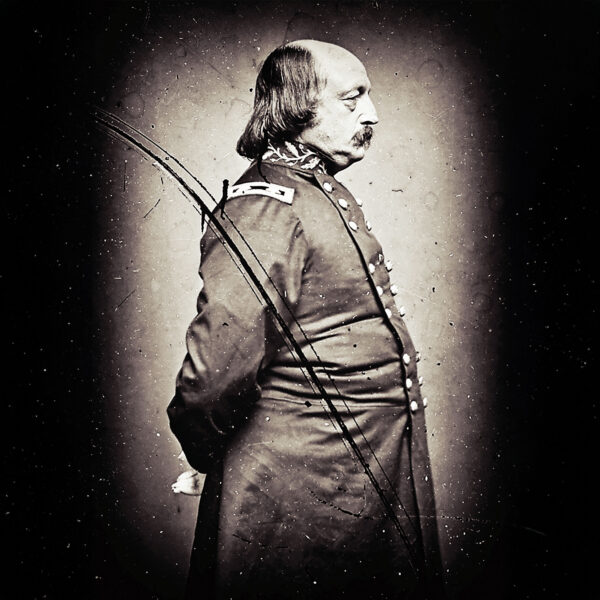
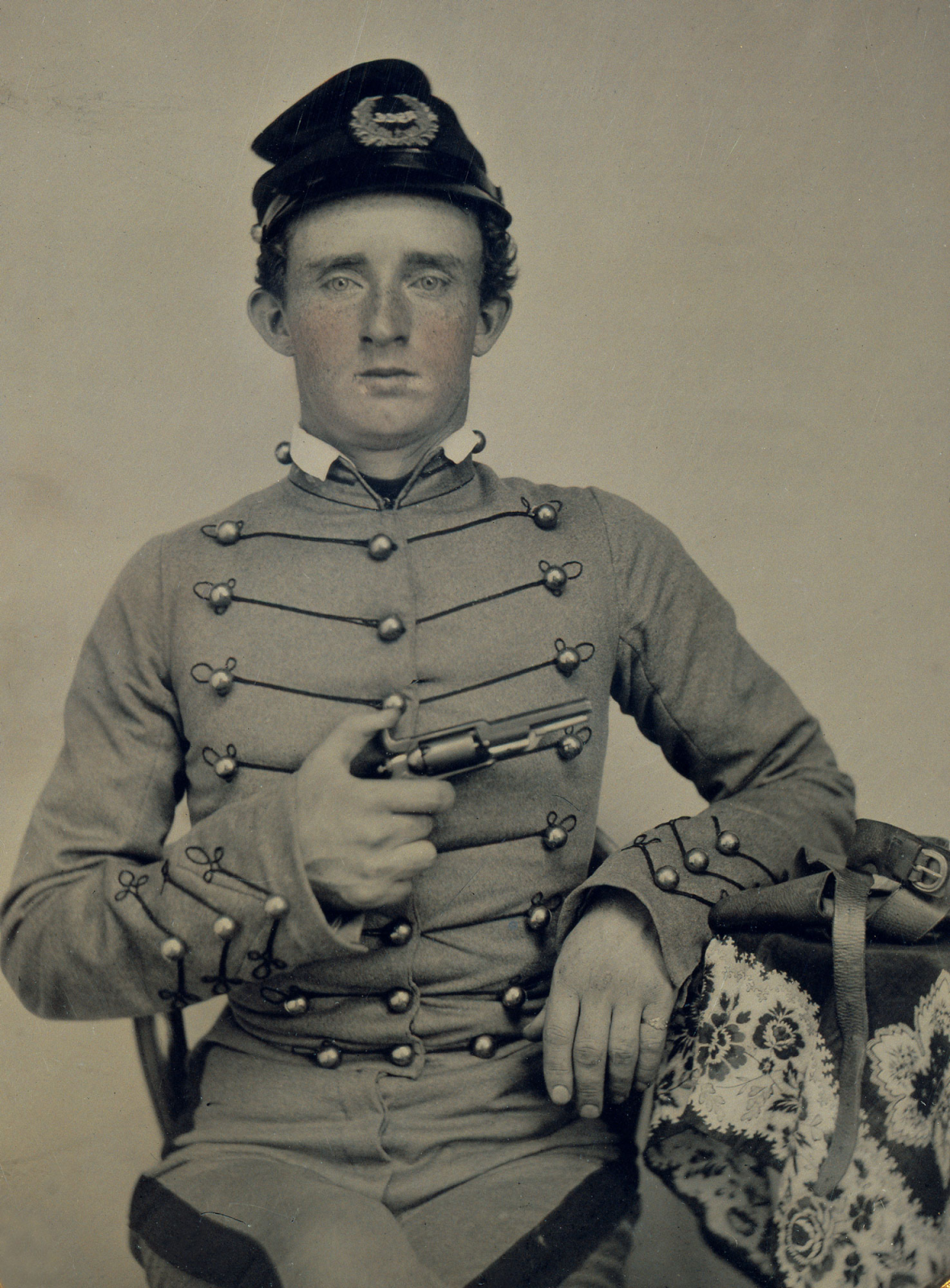
A young Custer, dressed in his West Point uniform, poses for the camera circa 1860.
Sometime in the late 1990s, I attended a parade of Civil War reenactors in Gettysburg, Pennsylvania, where one of the “living historians” stood out from the rest. He was mounted on horseback and obviously—at least to anyone who knew even a smattering of American history—was portraying General George Armstrong Custer, the Union cavalry officer who played a crucial role in defeating the Confederate army of Robert E. Lee on July 3, 1863, at Gettysburg.
The only problem was this: Custer was only 23 when the famous Civil War battle was fought; indeed, he was only 36 when he died in the equally famous Battle of the Little Bighorn against the Sioux in 1876. But this reenactor was clearly in his fifties; he could not hide the lines in his face or his furrowed brow. Now, granted, this fellow otherwise looked like Custer, with his long, golden locks, flamboyant uniform shirt with wide lapels trimmed in gold, bright red neckerchief, and very bushy blond moustache—the spitting image of “the Boy General.”1
But here’s the remarkable part: This Custer reenactor at one point dismounted because the parade had hit a bottleneck. He stood patiently, petting his horse’s neck, while he waited for the parade to advance. Then it happened. When the line got moving again, faux Custer took hold of the squat pommel of his McClellan saddle and, in one sweeping movement (without putting his foot in the stirrup), swung himself onto the horse with complete ease, like this was something anyone could do without thinking about it. So, despite the reenactor’s anachronistic age, I felt like I was actually witnessing George Armstrong Custer getting on his horse, for surely Custer never really needed a stirrup to gain his place in the saddle. Indeed, the real Custer was a master horseman. One of his officers remarked that he “sat his charger as if ‘to the manor born.'”2
So that’s how I think Custer would have occasionally mounted his horse, even though I have no historical proof. Like most Americans, I hold a picture of Custer in my mind’s eye that is nine parts Hollywood and one part history. Custer is surely one of America’s most famous—and recognizable—figures. That’s not to say he’s one of the most popular. Since the 1950s and 1960s, when the nation’s sensitivity to racial stereotypes became more prevalent, Custer has rarely been hailed as a hero. Custer’s Last Stand, which refers to his final battle on the Little Bighorn River against an overwhelming force of Indians, is a phrase that has become synonymous with utter failure. Since 1876, countless books and movies have either turned Custer into a myth of epic proportions or vilified him so thoroughly, even to the point of reducing him to a object of derision or jest, that there seems little left to say about him or his death on the dusty slopes overlooking the Little Bighorn in Montana. Except for the handful of academic and military experts who have studied the man and his deeds in great detail, the American public regards Custer as the personification of ineptitude: an incompetent military shepherd who led his flock to slaughter.
 Library of Congress
While he had his detractors, Custer—pictured here (reclining, at right) as a member of the staff of General Fitz John Porter in 1862—was widely liked and admired during the Civil War.
Plenty of Custer’s contemporaries held a low opinion of him, including a good number of his fellow officers, particularly those with whom he served in the West. Some of his troopers also despised him. In Texas during Reconstruction, one cavalryman described him bitterly: “He was only twenty-five years of age, and had the usual egotism and self-importance of a young man. He was a regular army officer, and had bred in him the tyranny of the regular army…. He had no sympathy in common with the private soldiers, but regarded them simply as machines, created for special purpose of obeying his imperial will.”3 This was a damning indictment, but it was only the first of endless complaints about Custer that would be sounded by his subordinates—and even some of his superior officers—for the rest of his life and beyond. Even after Custer was killed, Colonel Samuel D. Sturgis, the commander of the 7th U.S. Cavalry, could offer only faint praise for the young officer. Custer, he said, “was a brave man, but also a very selfish man.” When reporters asked him to elaborate, Sturgis did not hold back. Lieutenant Colonel Custer, he declared, was “insanely ambitious of glory,” displayed tyrannical tendencies as an officer “and had no regard for the soldiers under him,” and at the Little Bighorn he “made his attack recklessly, earlier by thirty-six hours than he should have done, and with men tired out from forced marches.” Another officer who served in the West, Colonel David S. Stanley, denounced Custer as “a cold-blooded, untruthful, unprincipled man … universally despised by all the officers of his regiment except his relatives and one or two sycophants.”4 Generals William Tecumseh Sherman and Philip H. Sheridan, two of Custer’s greatest admirers during the Civil War and afterward, condemned him after his death as rash and imprudent.
But there’s a problem with all this condemnation, both by those who knew him and by modern Americans who associate Custer only with failure. For one thing, not everyone who met or served with Custer thought badly of him; indeed, his friends and supporters numbered well beyond family members and the “one or two sycophants” mentioned by Colonel Stanley. For another, during the Civil War, when he rose quickly in the Union cavalry from the rank of captain to brigadier general, his troopers considered him “a glorious fellow, full of energy, quick to plan and bold to execute, and with us he had never failed in any attempt he has yet made.” One calvaryman explained, “Fighting … was his business.” This horse soldier admitted that Custer was “eager for laurels,” but he was not “a reckless commander.” Even a rival Union general, Wesley Merritt, called Custer “intrepid.” He won so many victories in battle that people began to talk about “Custer’s luck”—a streak of good fortune that was never broken during the war. No soldier who saw him in action, asserted a Union officer, “ever questioned his right to wear a [brigadier’s] star, or all the gold lace he felt inclined to wear.” He was, said the officer, “a favorite in the Army of the Potomac.”5
It is true that his quick rise to rank and fame, combined with a long string of successes in fighting the Confederates, fed a good amount of jealousy. Fellow officers resented his quick promotion to brigadier general just before the Battle of Gettysburg in 1863, making him the youngest general in the Union army, and many in the rank and file regarded him as a pompous peacock for wearing a flashy velvet uniform trimmed in gold braid (the red neckerchief, though, was not an affectation—it helped his men identify him on the battlefield). Some of his troopers proclaimed him “the Boy General of the Golden Lock.” After Appomattox, resentment again flared when he received a commission in the regular army from captain to lieutenant colonel and then to brevet major general, largely because Major General (and later Lieutenant General) Philip H. Sheridan, under whom Custer had served in the war, pulled strings to get as high a rank for his favorite cavalier as he possibly could. Custer’s close friend, General Nelson A. Miles, summed up the starkly different opinions that the Boy General sparked among people who knew him well or from afar: “Custer had devoted friends and bitter enemies. His brothers and strongest friends died with him, while his enemies lived to criticize and cast odium upon his name and fame; but it is easy to kick a dead lion.”6
 Library of Congress
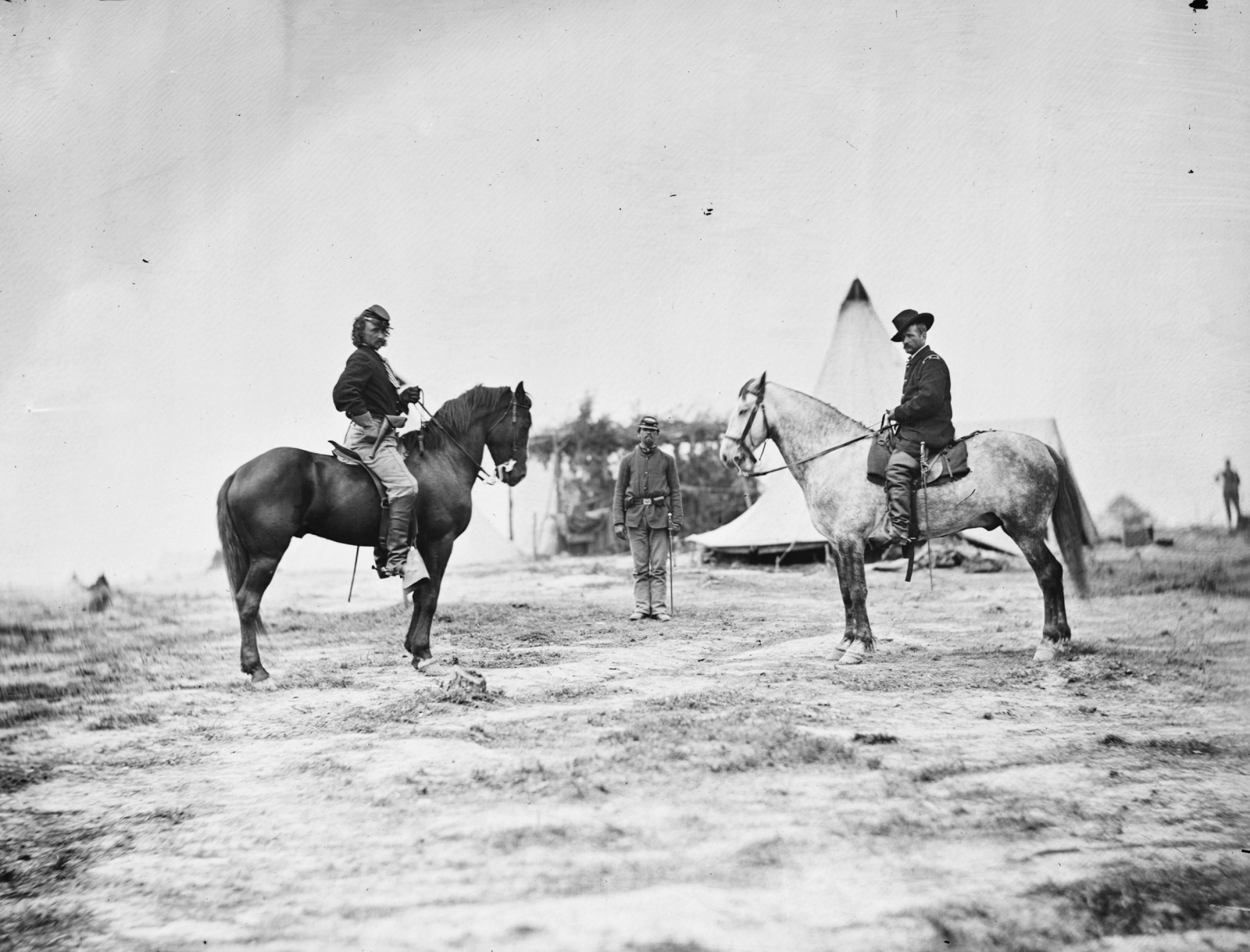
Custer won fame on the battlefield during the Civil War, his bravery at times bordering on recklessness. In this 1863 image, Custer (mounted, left) poses with his mentor, General Alfred Pleasonton, who promoted the young captain to brigadier general in June of that year.
The difficulty with Custer, then, is that one must try to make sense of both his brilliant performance as a Civil War cavalry officer battling Rebels in the East and his poor—or, at least, less than magnificent—showing as the field commander of the 7th Cavalry in the West. Some historians account for the difference between the Civil War Custer and the Indian Wars Custer by arguing that he struggled to find his true identity, first as a boy and then as a man. In the Civil War, he became a man out of the pressure of circumstances, but when the war was over the boy—the playful, irresponsible, and even reckless Custer—emerged again; throughout the course of his remaining 10 years, boy and man contested with no clear winner.7 This interpretation, in my opinion, successfully explains the inconsistencies and contradictions that made him so loved by some and so hated by others, not only 135 years ago but even today. What’s more, it is important to keep in mind that the war that Custer fought against the Confederates in the East was far different than the one he fought against Indians in the West. Indeed, the troops he led during the Civil War differed markedly from the ones he commanded in the Indian wars. These historical factors—realities beyond Custer’s or anyone’s control—help explain his path from Civil War triumphs to ignominious death at the Little Bighorn.
To be sure, Custer loved war and excelled at fighting what military analysts today call “set-piece battles” or “conventional warfare.” Toward the end of the Civil War, he wrote: “I shall regret to see the war end. I would be willing, yes glad, to see a battle every day during my life.” The war gave him the opportunity to shine, fighting battles against an enemy he could understand while using tactics that both sides, Union and Confederate, accepted within the broad confines of the rules of war. Unlike many generals, Custer learned to develop his intuition in the maelstrom of battle and to trust it. His flamboyance appealed to newspaper reporters who were only too happy to splash his name in headlines and copy. After his marriage to Libbie Bacon in February 1864, the couple spent the rest of the war together—she followed her “Autie” (his family nickname) on every campaign, and her beauty and charm played no small part in enhancing Custer’s reputation in the army and among the northern public. In the final year of the war, Custer came under the command of Philip Sheridan, who proved to be an aggressive practitioner of slash-and-burn tactics against the Confederates and their resources—the “hard hand of war” favored by President Abraham Lincoln, Lieutenant General Ulysses S. Grant, and Major General William T. Sherman.8
Although Custer ably applied these new tactics of modern warfare in his clashes with the enemy, including using harsh means to quell guerrilla raids in the lower Shenandoah Valley conducted by the elusive Confederate John Singleton Mosby and his rangers, his war remained a conventional one fought between two armies that used essentially the same weapons and the same tactics on open fields of battle. Just how conventional the Civil War was became more than apparent at Appomattox Court House on April 9, 1865, when General Robert E. Lee—who refused a subordinate’s suggestion to avoid capitulation by carrying on the fight as a guerrilla war—surrendered his Army of Northern Virginia to Grant. On the day of Lee’s surrender, Custer wrote a congratulatory letter to his men. “With profound gratitude toward the God of battles,” he said, “by whose blessings our enemies have been humbled and our arms rendered triumphant, your commanding general avails himself of this his first opportunity to express to you his admiration of the heroic manner in which you have passed through the series of battles which to-day resulted in the surrender of the enemy’s entire army. The record established by your indomitable courage is unparalleled in the annals of war.” Generals have often waxed poetic about their victorious troops, even to the point of Custer’s obvious exaggeration, but his sentiments were real and sincere. “Speaking for myself alone,” he continued, “when the war is ended and the task of the historian begins; when those deeds of daring which have rendered the name and fame of the Third Cavalry Division imperishable, are inscribed upon the bright pages of our country’s history, I only ask that my name be written as that of the commander of the Third Cavalry Division.”9 He could not know it then, but he would never again lead soldiers who were as dedicated, devoted, or willing to obey as the cavalrymen of the Third Cavalry Division of the Army of the Potomac were to Custer and his resourceful leadership.
 Library of Congress
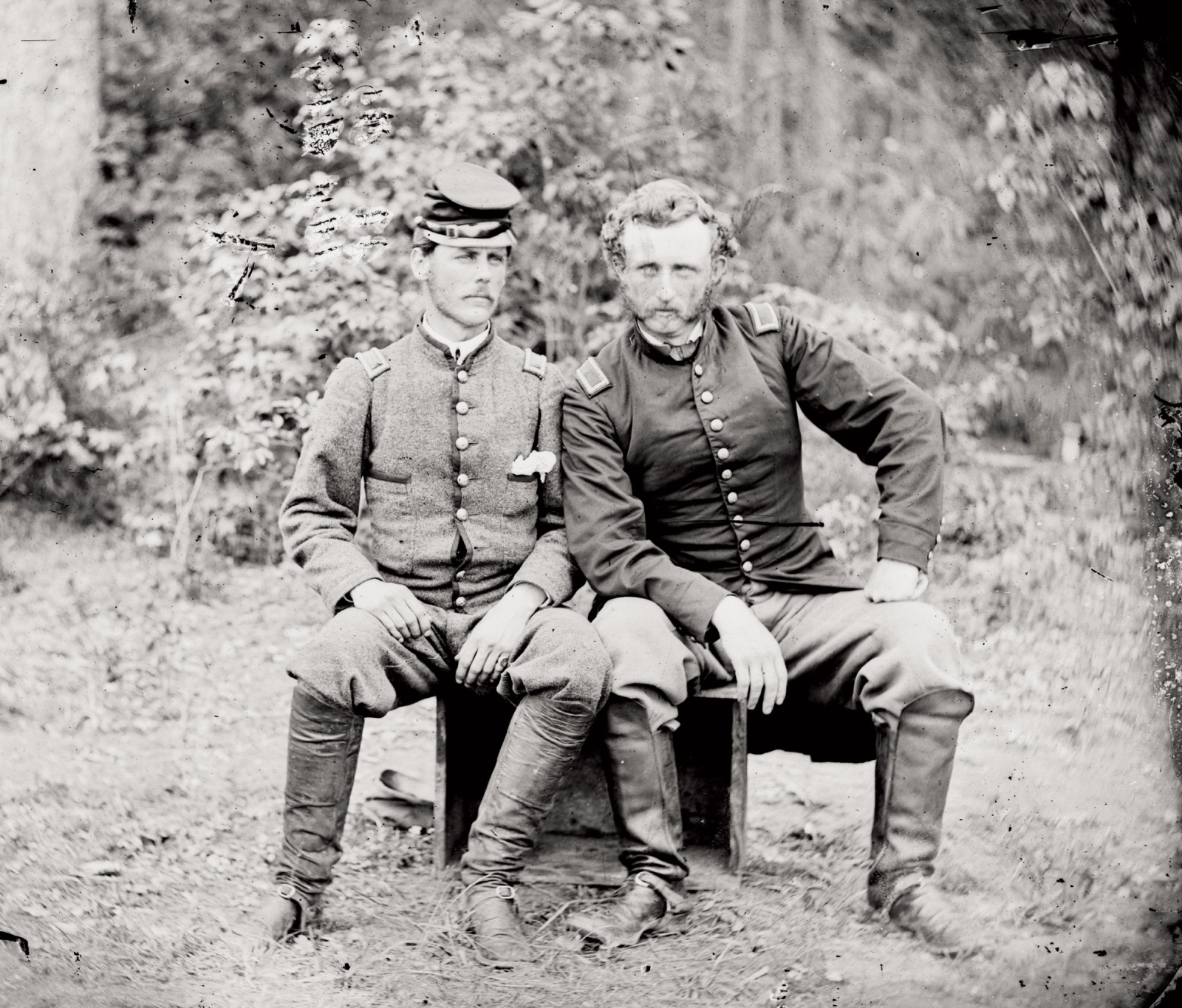
Custer (right), pictured here as a second lieutenant, sits with friend and former West Point classmate J.B. Washington, a Confederate officer taken prisoner at Fair Oaks in 1862. After the war, Custer would face a much different, and unfamiliar, enemy in the Plains Indians.
Northern volunteers (just like Confederate ones) were, for the most part, citizen soldiers who enlisted in the military for a wide variety of reasons, including patriotism, peer pressure, ideology, and even rage militaire against the enemy. Later recruits were drafted into service or were paid substitutes or “bounty men” who frequently deserted or proved to be such horrible soldiers that no one wanted to fight beside them. For the most part, though, volunteers like Custer’s men of the Michigan Cavalry Brigade or the Third Cavalry Division were, by the final years of the war, committed veteran soldiers who took their duty seriously, even as they longed for the day when peace would arrive and everyone could go home. Within the ranks, the volunteers sometimes did not get along—there were cliques and rivalries just as in any organization. Custer had disgruntled fellow officers—rivals like Wesley Merritt and Judson Kilpatrick—but his relationship with his men, so far as the record shows, was consistently sound; the volunteers under his command admired and respected him, and he felt the same toward them. As a token of their fondness, many of his troopers began wearing red neckties like the one he always sported after becoming a brigadier. “The command perfectly idolized Custer,” wrote a lieutenant of the 6th Michigan Cavalry. “The old Michigan Brigade adored its Brigadier, and all felt as if he weighed about a ton.”10
Custer understood how to command volunteers and knew that they could not be treated like regular soldiers. Perhaps he saw himself in them: loose manners, scornful of regulations, sometimes irresponsible without being insubordinate—and, most important—willing to ride into hell if necessary. The citizen soldiers of the Civil War, including the ones under Custer’s command, valued courage above anything. Even when the war dragged on, with no end in sight, Civil War volunteers persevered through weariness and growing cynicism. The courage of their leaders helped to raise their morale when the war threatened to grind them down. Under Custer’s leadership, there was never any doubt as to their general’s courage and determination. Yet citizen soldiers remained more citizen than soldier all through the war. Custer realized that his men could be led, but they could not be driven. That’s probably why they loved him so. One cavalryman wrote home that Custer “was not afraid to fight like a private soldier … and that he was ever in front and would never ask them to go where he would not lead.”11
Out West, much to his dismay, Custer learned that the regular troopers of the 7th Cavalry were nothing like the Civil War volunteers he had commanded. The regiment, consisting of 12 companies, was formed at Fort Riley, Kansas, in late 1866, when Custer was in Washington, D.C. Some of the recruits had gained combat experience during the war, particularly in the western theater, but for the most part the 7th was a hodge-podge of drunkards and outcasts drawn into the service by dreams of glory. Those illusions were quickly shattered by the tedium and harsh conditions of frontier postings, unfulfilled lust for gold and silver, or the failure to adjust to civilian life or find adequate employment back home after the war. Many of the troopers could not ride a horse or use a firearm effectively. A cavalry officer observed that “the men are never drilled at firing on horseback, and the consequence is that the horses are unused to fighting as the men themselves, and become unruly in action.” One trooper asserted that the 7th Cavalry consisted of “vile and wicked” men, “a set of thieves and gamblers yea murderers.”12 Cavalrymen, including officers, routinely tried to drown their miseries in booze.
 Library of Congress
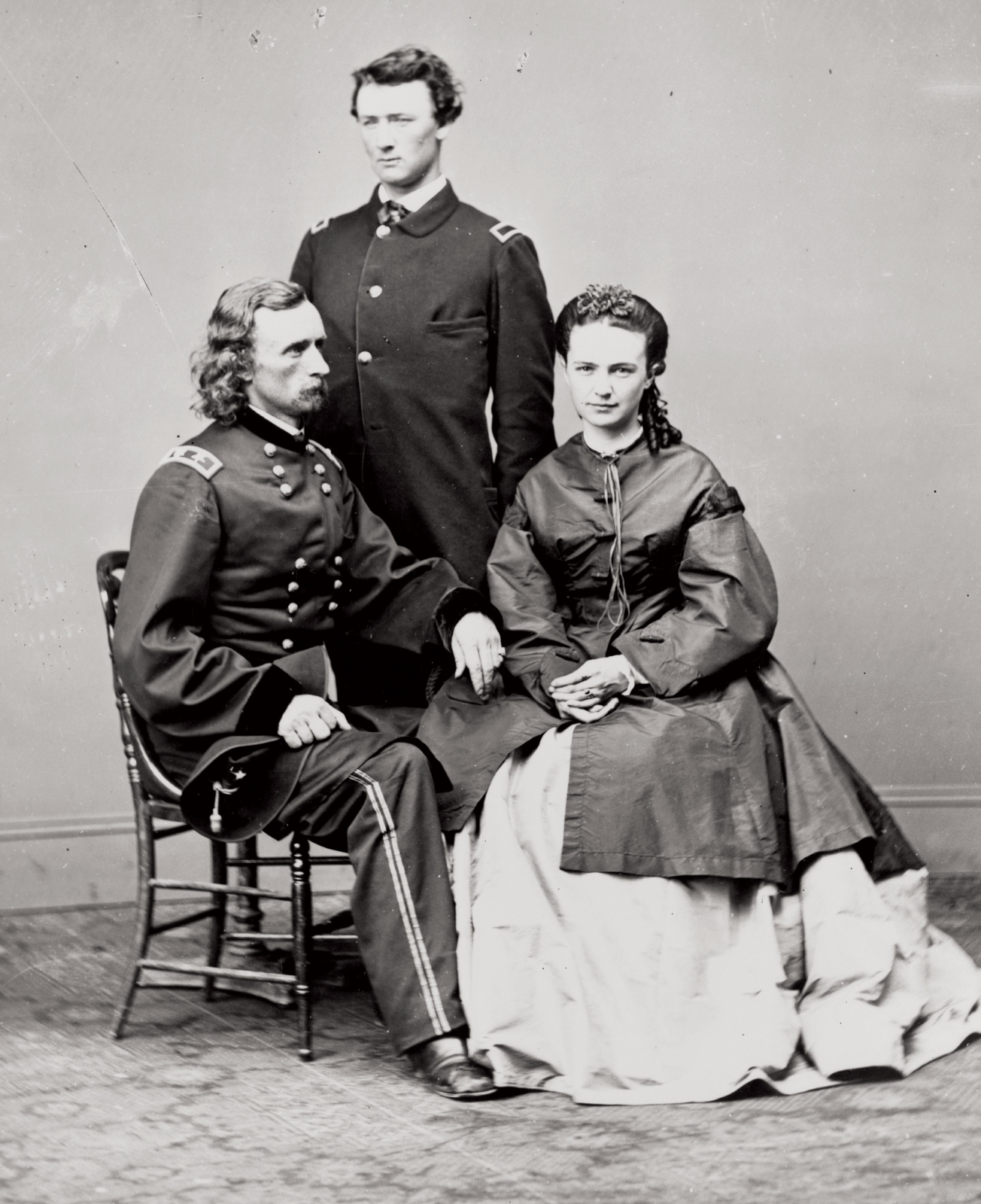
To compensate for a lack of camaraderie in the 7th Cavalry, Custer surrounded himself with friends and family, including his brother Thomas (standing) and wife, Libbie (right).
As to the frontier regulars of the postwar U.S. Army, one general remarked: “The enlisted personnel consisted largely of the dregs of the Union and Confederate Armies and of recent immigrants from Europe.” Ten percent of the 7th’s recruits enlisted in the regiment under an alias. The 7th Cavalry, noted Libbie Custer in what might be considered an understatement, was “a medley of incongruous elements.” There was no cohesion as had existed in Civil War regiments drawn from a single state, with companies often recruited from a single village or city neighborhood. The men of Custer’s 7th Cavalry, including the officers, had nothing in common, nothing that bound them together, other than the fact that 32 percent of the regiment was Irish by birth (12 percent were born in Germany, 4 percent in England, and others came from Canada, Scandinavia, France, Italy, Spain, and Russia). Even the assignment of the 7th’s different companies to various posts and forts across the plains worked against unit cohesion. The campaign against the Sioux in the spring and summer of 1876 that ended at the Little Bighorn was the first time all 12 companies of the 7th Cavalry had been brought together to operate as a regiment. Nevertheless, some recruits did gain pride in their regiment over time. One German trooper proclaimed: “You felt like you were somebody when you were on a good horse, with a carbine dangling from its small leather ring socket on your McClellan saddle, and a Colt army revolver strapped on your hip; and a hundred rounds of ammunition in your web belt and in your saddle pockets. You were a cavalryman of the Seventh Regiment. You were part of a proud outfit that had a fighting reputation, and you were ready for a fight or a frolic.”13 Unfortunately, too few troopers were as enthusiastic as this trooper about army life on the Plains.
Custer arrived at Fort Riley in December 1866 to take his place in the regiment, but from the moment he assumed field command of the 7th, he discovered that his leadership, which had almost never been questioned by subordinates during the Civil War, was now disputed by the officers under his command. Even Libbie realized that her husband would have his hands full bringing “that motley crowd into military subjection.”14 Discipline became Custer’s first challenge. Not only did the officers try to thwart him and his leadership, but they argued among themselves and vied, cut-throat fashion, for attention and advancement. Meanwhile, troopers in the ranks began deserting in droves. By the beginning of 1867, 90 soldiers out of 963 recruits had walked away from Fort Riley, never to return. This was not the U.S. Army that Custer had known. For the next 10 years, he demonstrated repeatedly that he never quite grasped how much the army had changed since the Civil War; as a result, he confronted those changes awkwardly and ham-handedly, even disastrously—more like a martinet than the competent and adored general he had once been.
Among his officers, two particular enemies emerged who successfully bewildered and bedeviled Custer. The man who most hated Custer was Captain Frederick W. Benteen, a brave and decorated veteran of the Civil War (he was a Virginian who remained loyal to the Union). Benteen criticized Custer’s every move. At the Little Bighorn, the captain played a crucial role in determining the outcome of the battle. Benteen was an acerbic, insolent, crusty malcontent who saw himself as nearly everyone’s superior. For the rest of his life (he would survive the Little Bighorn debacle), he never spoke a kind word about Custer. From his first meeting with his commanding officer, Benteen sized him up as a braggart. He didn’t much care for Mrs. Custer, either, whom he described as “about as cold-blooded a woman as I ever knew, in which respect the pair were admirably mated.”15 At first, Custer knew nothing of Benteen’s animus. When he reached out to the captain in friendship, Benteen belittled the effort as an indication of Custer’s desire to improve his standing in the regiment. Over the years, Benteen spouted venom and vitriol whenever he spoke or wrote about Custer. His hatred for Custer amounted to a pathological obsession. One gets the impression, reading his endless tirades, that he suffered from an immense inferiority complex, triggered not only by Custer but also by every other officer under whom he served. Interestingly enough, Benteen was the source of nearly everything negative, and especially scurrilous, that’s been said about Custer—that Custer had illicit sexual relations with his black servant Eliza; that he fathered a child with the Cheyenne woman Monahsetah; that Libbie had an affair with another 7th Cavalry officer, Captain Thomas Weir; and so on. Poor Benteen never stopped talking; he apparently thought that the more he disparaged Custer, the more believable he appeared. Every time he opened his mouth, however, he sounded shrill and petty. He kept bad-mouthing the Custers until his death in 1898.
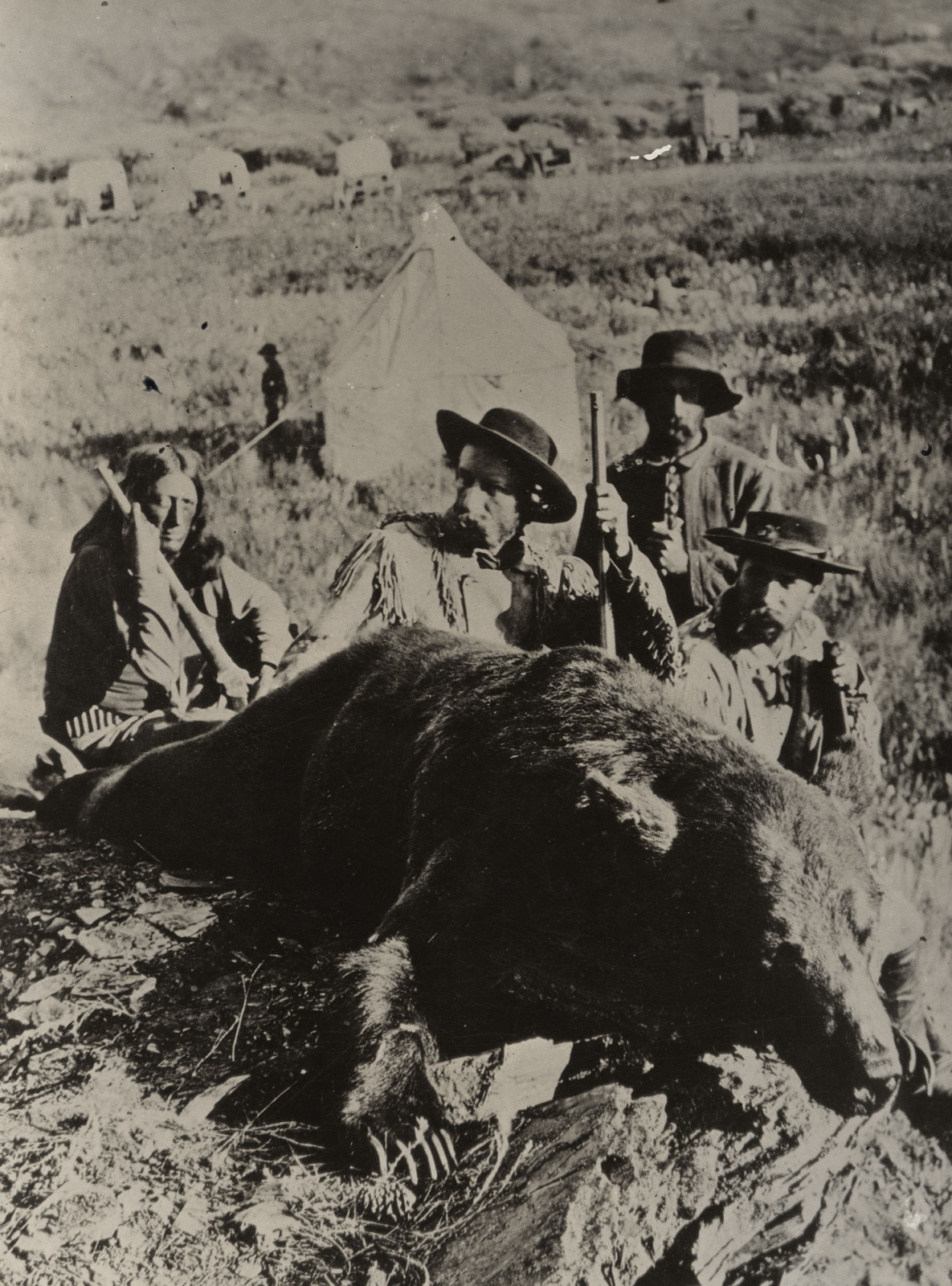 American Heritage Center, University of Wyoming
Custer (center) on one of the many hunting forays he took while posted in the Dakota Territory.
Another Custer enemy among the officers of the 7th Cavalry was Major Marcus A. Reno, a West Pointer from Illinois and a Civil War veteran. During the war, he saw action in Virginia and received a brevet promotion from captain to lieutenant colonel. Before the war ended, he became a brevetted colonel in command of the 12th Pennsylvania Cavalry. He received another promotion to brevet brigadier general before he was mustered out of the volunteer service. At first, Custer held Reno in high regard. “Reno I know well,” he wrote Libbie, “[and] he is a finished gentleman and a most capable officer. He served in the Shenandoah and is a good friend of mine.” Custer couldn’t be more wrong about Reno. Since the death of his wife in 1874, Reno had become withdrawn and sullen, unsociable and unpleasant. He took to the bottle, mostly drinking alone and wallowing in self-pity. Making friends required too much effort for him; as a result, his fellow officers disliked him intensely. He was assigned to detached service as an escort for the Northern Boundary Survey Expedition. When he returned to Fort Abraham Lincoln, the 7th Cavalry’s new home in the Dakotas, he found it difficult to fit in with his fellow officers, although he yearned to make a name for himself in the regiment. By the time of the Little Bighorn campaign, Custer’s opinion of Reno had hit rock bottom. When Reno failed to follow and attack a band of Indians while out on a scouting mission during the march to the Little Bighorn, Custer took the incredible step of writing an anonymous dispatch to the New York Herald castigating Reno for a “gross and inexcusable blunder” and for “violating his orders.”16
While Custer and Libbie spent the winter of 1875-1876 on leave in New York City, and then got quickly called back to Washington in March 1876 to testify before the House Committee on Expenditures in the War Department (which was investigating the corrupt policies of Republican President Grant’s secretary of war, William W. Belknap), Major Marcus Reno assumed field command of the 7th Cavalry. Custer’s time in Washington was onerous; he had become entangled in the corruption scandals that embroiled the Grant administration, not as a suspect, but as a witness to the fraud committed by Indian agents in the West. The Boy General overplayed his hand, however; his prominent associations with Democrats in New York and Washington came readily to Grant’s attention, and the president decided to punish Custer by depriving him of his command. (The fact that Custer had once arrested Grant’s son, Captain Fred Grant, for drunkenness could not have helped matters.) Although Custer perceived himself as handling politicians as skillfully as he handled Rebels and Indians, he lacked the good sense and discretion necessary to play the game of high-stakes politics that prevailed in the nation’s capital. Republican newspapers rebuked Custer for his disloyalty to Grant, the savior of the Union. Meanwhile, Custer pleaded his case through Sherman and Sheridan.
Just when he thought he had been restored to command of the 7th, he discovered that Grant still refused to allow his return to Fort Lincoln. Eventually Brigadier General Alfred H. Terry, who had been given overall command of the upcoming Dakota campaign against the Sioux, interceded on Custer’s behalf and won Grant’s approval. The news of Custer’s reinstatement nearly shattered Reno, who had assumed that the political mess Custer had helped create in Washington would keep him from participating in the approaching campaign. Reno was less vocal than Benteen in his loathing of Custer, but both men did their best to undermine their commander’s leadership and authority in ways that differed dramatically from the genial and convivial fellowship—the esprit de corps—that Custer had known at West Point or among his compatriots in the Army of the Potomac.
To compensate for this lack of camaraderie in the 7th cavalry, Custer surrounded himself with family and friends at Fort Lincoln. By the spring of 1876, he had created a “royal family” at the fort that included his brothers Thomas (who had won two Medals of Honor during the Civil War) and Boston; his brother-in-law, Lieutenant James Calhoun, who had married Custer’s sister Margaret; Harry “Autie” Reed, Custer’s nephew; and several favored officers, including Captain George W. Yates (and his wife, Annie), Captain Myles Moylan (and his wife, Lottie), Captain Thomas B. Weir, Captain Myles Keogh, Lieutenant Algernon Smith (and his wife, Nettie), Lieutenant Donald McIntosh (and his wife, Mollie), and Lieutenant William W. Cooke, Custer’s adjutant. Those officers not invited into in the “family” resented their exclusion. “Custer is not making himself at all agreeable to the officers of his command,” wrote Lieutenant Charles W. Larned, one of the outsiders.17 Meanwhile, Custer and his cohort enjoyed themselves by holding dances, amateur theatricals, picnics, concerts by the regimental band, horseback riding excursions, horse races, baseball games, and hunting forays. On one occasion Custer escorted the Russian Grand Duke Alexis on a buffalo hunt.
He never understood, however, how his creation of an insiders’ court enhanced his personal morale while lowering it for those officers and enlisted men debarred from the Custer club. Insiders look down on outsiders and vice versa. Custer also made sure that his most disagreeable officers received extended assignments away from Fort Lincoln. Captain Benteen, for instance, was posted at Fort Rice, 25 miles south of Fort Lincoln, and Major Reno at Fort Totten, about 130 miles to the northeast. In the end, Custer assumed that combat would forge cohesion and raise morale in the 7th Cavalry. Ironically, the opposite proved true. Combat between the cavalry and Indians did not happen often enough to bond the officers and enlisted men together or to satisfy Custer’s own urges. Campaigns against the Indians, which happened infrequently and might last months without any real fighting, could not match the nearly constant combat that fed Custer’s lust for battle during the final year of the Civil War.
So Custer, who was “true as steel” and dependable as an officer in the Civil War, became in the West a tyrannical dispenser of strict discipline and cruel punishments. His temper tantrums were legendary. An officer grumbled that Custer was “making himself utterly detested… by his selfish, capricious, arbitrary and unjust conduct.” John Burkman, Custer’s striker (horse handler), tried to excuse his commander’s behavior: “That’s the way he allus was, flyin’ off the handle sudden, maybe sometimes without occasion.” The troopers in the 7th called Custer “Hard Ass.”18 On one occasion, he ordered the heads of six men shaved because they had left their posts to buy fruit from a sutler (a merchant who traveled with the army or set up shop at a fort). Captain Albert Barnitz hardly could contain his anger over this punishment. “I am thoroughly disgusted with him!” he wrote of Custer. “He is the most complete example of a petty tyrant that I have ever seen.” Yet for all of Custer’s insistence on spit and polish and rough punishments, he found himself unable to muster the kind of discipline he expected from his officers and troopers. In the spring campaign of 1867, under the command of General Winfield Scott Hancock, Custer left his command behind and led a small cavalry escort to meet his wife at Fort Riley—a personal trip made without orders at the government’s expense. As a result, he faced a court-martial that found him guilty and suspended his rank and pay for one year. President Grant called the punishment too “lenient.” Custer was lucky not to have received a dishonorable discharge. Then he returned to service, his harsh treatment of his men continued, as did their rancor toward him.19
As for his enemies, the Indians, his opinions about them were ambivalent. On one hand, he viewed the natives as savages: “Stripped of the beautiful romance [found in literature], the Indian forfeits his claim to the appellation of noble red man. We see him as he is…a savage in every sense of the word…one whose cruel and ferocious nature far exceeds that of any wild beast of the desert.” On the other hand, he found much in Indian culture to admire and praised “their rude interchange of civilities, their barterings, races, dances, legends, strange customs, and fantastic ceremonies.” He respected their skill as warriors, hunters, and horsemen. “If I were an Indian,” he wrote tellingly, “I often think that I would greatly prefer to cast my lot among those of my people who adhered to the free open plains, rather than submit to the confined limits of a reservation, there to be the recipient of the blessed benefits of civilization, with its vices thrown in without stint or measure.” Yet his job largely entailed rounding up Indians who refused to go to the reservations or who had left the agencies for one reason or another. All in all, Custer never could manage to think like an Indian, and his inability to do so severely limited his effectiveness in fighting them. Red Star, an Arikara scout, claimed that “Custer had a heart like an Indian.”20 Custer certainly liked to think so, but when it came to comprehending Indians, he saw only the surface, never the core.
Even though Indians were not like Confederates (a good number of whom were Custer’s close personal friends from his days at West Point), he nevertheless tried to fight them using the tactics he had learned so well in the Civil War. Unlike his experiences in that war, Custer found himself leading charges against Indian villages that contained noncombatants, and inevitably women and children became casualties or suffered great hardships as a result of these lightning raids. At the Washita River, where Custer and the 7th Cavalry attacked a Cheyenne village in November 1868, he tried his best to keep troopers from harming noncombatants; in the end, the 7th took about 50 women and children prisoner. Reflecting his own ambivalence toward his enemy, Custer, like other officers, later raped some the women he had worked to protect (if Benteen is to be believed). In Virginia, where Sheridan and Custer so skillfully burned farms and gristmills to deprive the Confederacy of foodstuffs grown in the Shenandoah Valley, they never conducted operations against Virginia villages or towns that purposely put noncombatants into harm’s way.
The ability of Indians to move quickly and prevent an attack on their villages worked against the lessons Custer had learned in the Civil War about the necessity for good reconnaissance. One could well argue that Union victory was built on the solid foundation of effective intelligence. But when it came to Indians, Custer—and other Indian fighters—discovered that if they sent scouts too far forward, if they tried to get a lay of the land before developing a tactical plan, they risked being seen by the natives, which would eliminate the element of surprise and could easily result in the Indians fleeing across the countryside before cavalry companies could be deployed. The 7th’s Lieutenant Edward Godfrey pointed out that the “attack must be made with celerity and generally without the knowledge of the numbers of the opposing force.”21 Successful surprise, he said, depended upon luck.
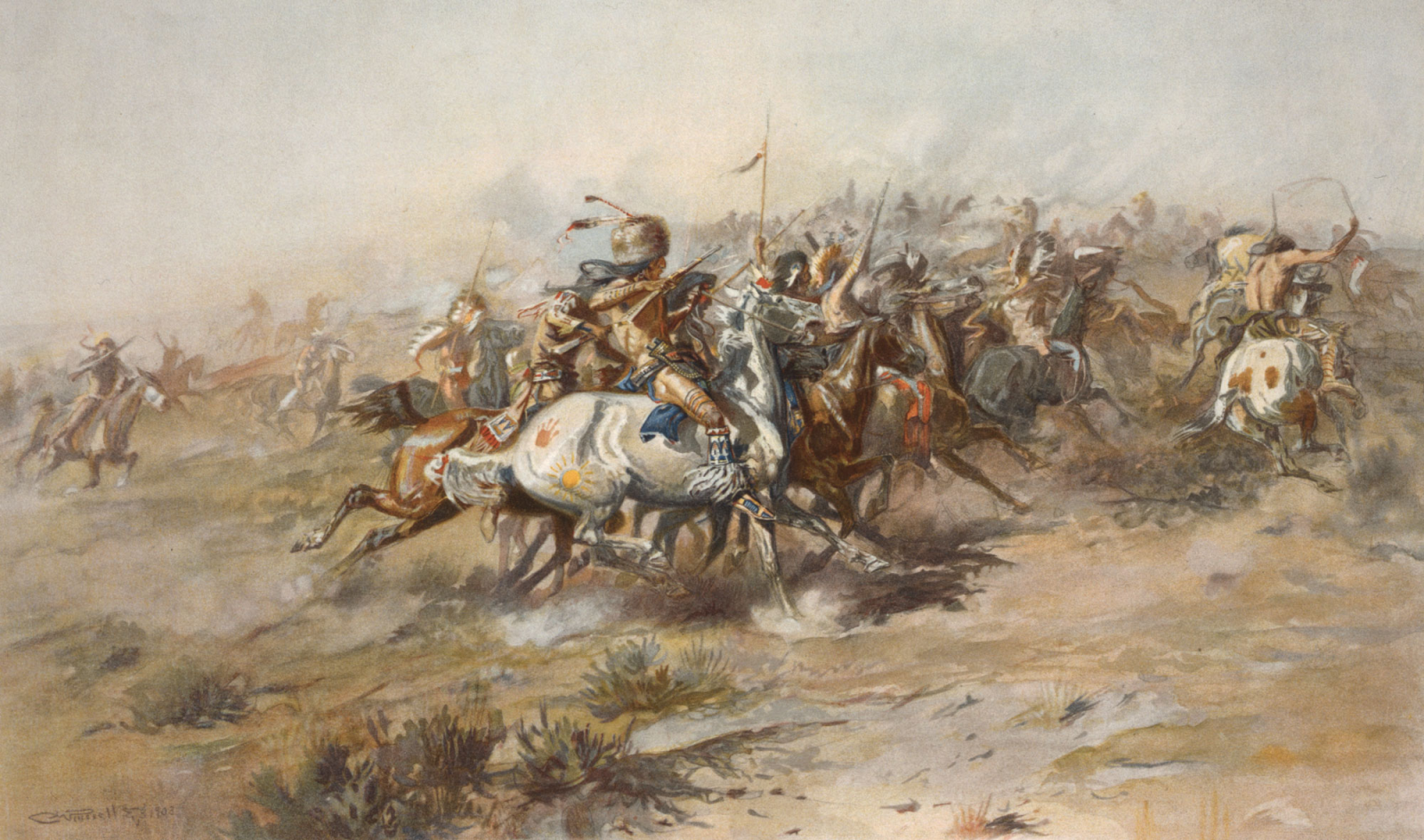 Library of Congress
Indians swarm around dismounted troopers of the 7th Cavalry at Little Bighorn. At the time of his death in this battle, Custer was only 36 years old.
After the disaster of the Little Bighorn, critics inside and outside the army blamed Custer for mistakes that had cost the lives of 262 of his men. President Grant condemned Custer for committing errors and behaving rashly (he could hardly censure himself for allowing Custer to resume command of the 7th or find fault with the army, since as president he was also the commander in chief). “I regard Custer’s massacre,” Grant said, “as a sacrifice of troopers, brought on by Custer himself, that was wholly unnecessary—wholly unnecessary.”22 Among Custer’s many blunders, said his detractors then and now, was his failure to conduct a proper reconnaissance of the Sioux and Cheyenne Indian village on the Little Bighorn before attacking it. Actually Custer hoped to scout the village on June 25 and make his attack on the following day, but events conspired against him. He received several reports that his column had been spotted by the Indians, convincing him not to delay the assault and let the Indians disappear from the banks of the river. Even though he had been told the Indian village was huge and contained hundreds of tepees (and, thus, probably thousands of warriors), he could have no real idea of its size or the number of warriors his men would face. Besides, Custer was confident that no Indian force could defeat the 12 companies of the 7th Cavalry, even if the cavalry column was outnumbered. Custer’s experience was that Indians did not stand and fight when attacked by a force of any considerable strength; he had never heard of Indians launching a counterattack against cavalrymen.
Some who later denounced Custer for his actions at the Little Bighorn claimed that he had disobeyed orders and thrown his soldiers into battle recklessly, either because of his incompetency or to prove his military prowess to political opponents including Grant and the Republican press and to political supporters in the Democratic Party. Truth be told, Custer was ambitious. After Washita, Custer wrote Libbie: “In years long numbered with the past when I was verging upon manhood, my every thought was ambitious—not to be learned, but to be great. I desired to link my name with acts of men and in such a manner as to be a mark of honor, not only to the present but to future generations.”23 By the time of the 1876 campaign, his biggest hope was that success against the Sioux would result in a promotion to brigadier general. Detractors voiced their belief that Custer actually wished to become the Democratic presidential nominee in that election year. That accusation has absolutely no basis, except for a single joke that Custer made to his Indian scouts. Custer was a soldier, not a politician. If he wanted anything, he craved a star on his shoulder straps. But he was also a good enough soldier, despite his earlier mishaps and missteps, to avoid disobeying orders during a campaign (his court-martial in 1867 had taught him some hard lessons).
When Custer and his column approached the Little Bighorn, he had developed only a sketchy plan for the assault and knew, because he could not take the risk of running reconnaissance, that the details would have to unfold on their own. In other words, Custer meant to rely on his instincts, which had served him so well in the past. Yet his instincts couldn’t tell him that several factors were working against him. High hills and deep ravines obstructed his view of the landscape, and impeded communication with two separate battalions under the command of Benteen and Reno. That he first divided his regiment into battalions before launching the assault (and into two additional wings as the fight developed) is something he was—and still is—criticized for, especially since it is a basic military tenet never to divide an advancing force in the face of a superior enemy. The problem was that Custer did not know how many Indians he and his men would be fighting. But even knowing that the numbers might be large, Custer continued to believe that the Indians would not stand and fight, no matter how numerous they might be. Dividing his force was bold, even risky, but Custer must have considered it a calculated risk, one that the situation warranted and, one could argue, demanded. His decisions turned out to be calamitous, not because he made bad judgments but because so much of what he could know—and so much that he could not reasonably anticipate—ended up working against him and his men.
If Custer suffered from faults, as indeed he did, one can argue that his shortcomings were shared by many young men of his generation, and encouraged by a nation with new goals and values. His fame made him more visible, and his flamboyance and recklessness made him controversial, even in his own lifetime, but he was not an anomaly. The Civil War had changed America; it had not only sent more than 620,000 of its young men to their graves, it had also exposed the survivors to horrors they otherwise could never have imagined and ordeals that altered their lives—and the very sense of their inner selves—for the rest of their days. After the fighting stopped, what these men had seen and experienced in the war could not be readily translated into everyday life. On both sides, men fought in the war to preserve life as it existed before the first shots were fired; when the war ended, everyone saw that the Old America had been obliterated, and a New America, a strange land that valued different manners and mores, had arisen, phoenix-like, from the ashes. The new, postwar America valued progress and the spread of civilization, which was precisely why men like Custer became necessary to remove from the path of settlement and the spread of commerce the last true vestiges of the Old America—the Indians. Appropriately enough, the first reports about Custer’s defeat at the Little Bighorn reached the East just as festivities began in Philadelphia to celebrate the centennial of the Declaration of Independence and the birth of the United States. The entire exhibit stressed the significance of American progress, know-how, and optimism. When news arrived about the Little Bighorn, the buoyant mood of the exhibit collapsed in disbelief and grief, a sadness that gripped the entire nation as the telegraph lines hummed with the details of Custer’s fate. As the reality of Custer’s death set in, white Americans now saw even greater justification for waging a hard war against hostile Indians who no longer served a purpose in the new Gilded Age of utilitarian industry and progress.
The U.S. Army, which sought to solve “the Indian problem” by driving the natives off their lands, relegating them to squalid reservations, or hunting them down and killing them, as the 7th Cavalry successfully did on the Washita and meant to do at the Little Bighorn, needed men like George Armstrong Custer who would be ruthless, relentless, and unforgiving. There was no longer a place in the army, given its task of policing the plains and the deserts, for a general like Robert E. Lee, who prided himself—despite his own proclivity for mowing down the enemy—on his noble demeanor, his aristocratic bearing, his selfless and genteel style of leadership. Even the model of Ulysses S. Grant, the get-the-job-done, pragmatic, plain-spoken general, no longer fit the military’s needs out West. Grant as president wanted a peace policy toward the Indians; the army, including his old friends Sherman and Sheridan, convinced him that peace could not be possible while hostile Indians roamed freely across the Great Plains. All of them—Grant, Sherman, Sheridan, and Custer (and the entire federal government)—became tools for the railroads, which sought and received generous subsidies from Congress, the War Department, and the Department of the Interior in the form of free land as rights-of-way for their tracks. The railroads pushed and procured political measures that enabled them to transport “civilization” on their rails, from the Atlantic to the Pacific, while also making astronomical profits on the backs of laborers and the Indians who stood in their way.
In nearly every respect, Custer became the model of the modern military general. Unfortunately for him, he perfectly suited the army and its desire to run down Indians; but he could not adjust to the new army, the regular army, that differed so greatly from the Civil War volunteer forces he had led so magnificently. Nor could he readily transpose the skills he had acquired fighting a conventional war against the Confederates to the fluid context of waging a frontier war against an enemy that used highly unconventional tactics, which usually involved guerrilla methods of stealth and surprise or that uncanny ability to vanish into thin air before a battle could even begin.
At the same time, Custer found out that he could do nothing to stop his officers and troopers from grousing about him or among themselves, even when he attempted to discipline them with harsh measures and cruel punishments. To a certain extent, he finally gave up trying. Instead, he sought to refashion the new army back into the old army that he had so fervently loved by encircling himself with family and friends. After exiling his worst enemies in the officer corps to other posts, and learning to rely on Philip Sheridan to smooth any feathers he ruffled in the War Department, Custer managed to live a nearly dulcet and mirthful life at Fort Lincoln. He was a lucky man, and he knew it. In an 1869 letter to Libbie, referring to a promotion that ironically never came to pass, Custer wrote that “if everything works favorably Custer luck is going to surpass all former experience.”24
Custer’s luck, of course, ran out at the Little Bighorn.
But his luck ran out not because he was a bad general or because he was irresponsible or because he was a reprobate or because he didn’t know what he was doing when he attacked the Indian village on the Little Bighorn. His luck, for all intents and purposes, ran out on April 9, 1865, when Lee surrendered at Appomattox—the day America took a great leap forward into the modern age, flying through the air toward the Centennial Exhibition, and left George Armstrong Custer, the Plains Indians, and a good number of other Americans, in the dust. I find it striking and haunting that one observer reported seeing Custer dead on Last Stand Hill with “a smile on his face.”25 Perhaps Custer realized in his final moments that his fondest dream—to be great—had come true and that his name would be remembered down through time. That’s why a smile also came to my own face when I remembered Custer and that nimble reenactor who, despite his inaccurate age and the surroundings of a modern town, captured the essence of Custer as he ably lifted himself in one motion into the saddle and rode his horse down the street, straight and proud, into the dusk—and, as I’d like to think, off to the sound of the guns.
Glenn W. LaFantasie is the Richard Frockt Professor of Civil War History and Director of the Institute for Civil War Studies at Western Kentucky University in Bowling Green. His most recent book is Gettysburg Heroes: Perfect Soldiers, Hallowed Ground (Indiana University Press, 2008).
Notes
1. James Donovan, A Terrible Glory: Custer and the Little Big Horn—The Last Great Battle of the American West (New York and Boston, 2008), 37.
2. Eric J. Wittenberg, ed., At Custer’s Side: The Civil War Writings of James H. Kidd (Kent, Ohio, 2001), 79.
3. Robert M. Utley, Cavalier in Buckskin: George Armstrong Custer and the Western Military Frontier (Norman, Okla., 1988), 38.
4. Ibid., 6; Evan S. Connell, Son of the Morning Star: Custer and the Little Big Horn (New York, 1984), 234.
5. Gregory J. W. Urwin, “Custer: The Civil War Years,” in Paul Andrew Hutton, The Custer Reader (Lincoln, Neb., 1992), 17; Kidd, At Custer’s Side, 80; U.S. War Department, The War of the Rebellion: A Compilation of the Official Records of the Union and Confederate Armies, 129 vols. (Washington, D.C., 1880-1901), Series 1, 36, Part 1, 813; Jeffry D. Wert, Custer: The Controversial Life of George Armstrong Custer (New York, 1997), 110.
6. Wert, Custer, 85; Nelson A. Miles, Serving the Republic: Memoirs of the Civil and Military Life of Nelson A. Miles (New York, 1911), 191-192.
7. See, especially, Utley, Cavalier in Buckskin, 210-211.
8. Nathaniel Philbrick, The Last Stand: Custer, Sitting Bull, and the Battle of the Little Bighorn (New York, 2010), 47; Donovan, A Terrible Glory, 39. On Sherman’s phrase, “the hard hand of war,” see Mark Grimsley, The Hard Hand of War: Union Military Policy toward Southern Civilians, 1861-1865 (New York, 1995).
9. Marguerite Merington, The Custer Story: The Life and Intimate Letters of General George A. Custer and His Wife Elizabeth (New York, 1950), 160-161.
10. Gregory J. W. Urwin, Custer Victorious: The Civil War Battles of George Armstrong Custer (Cranbury, N.J., 1983), 48.
11. James Donovan, Custer and the Little Bighorn: The Man, the Mystery, the Myth (Stillwater, Minn., 2002), 41.
12. Donovan, A Terrible Glory, 121-122.
13. Ibid., 122; Elizabeth B. Custer, Tenting on the Plains (New York, 1889), 433; Frazier Hunt and Robert Hunt, eds., I Fought with Custer: The Story of Sergeant Windolph, Last Survivor of the Battle of the Little Big Horn (New York, 1947), 53.
14. Custer, Tenting on the Plains, 434.
15. Connell, Son of the Morning Star, 206.
16. Donovan, A Terrible Glory, 93; New York Herald, July 23, 1876, quoted in W. A. Graham, The Custer Myth: A Source Book of Custeriana (Harrisburg, Pa., 1953), 237.
17. Robert M. Utley, “The Little Big Horn,” in Hutton, ed., Custer Reader, 245.
18. Eric J. Wittenberg, ed., One of Custer’s Wolverines: The Civil War Letters of Brevet Brigadier General James H. Kidd, 6th Michigan Cavalry (Kent, Ohio, 2000), 56; Louise Barnett, Touched by Fire: The Life, Death, and Mythic Afterlife of George Armstrong Custer (New York, 1996), 239; Glendolin Damon Wagner, Old Neutriment (Boston, 1934), 143; Don Rickey, Jr., Forty Miles a Day on Beans and Hay (Norman, Okla., 1963), 70.
19. Robert M. Utley, ed., Life in Custer’s Cavalry: Diaries and Letters of Albert and Jennie Barnitz, 1867-1868 (Lincoln, Neb., 1987), 50; Jay Monaghan, Custer: The Life of George Armstrong Custer (Boston, 1959), 303.
20. G. A. Custer, My Life on the Plains (New York, 1876), 12, 21, 18; Orin Grant Libby, ed., The Arikara Narrative of Custer’s Campaign and the Battle of the Little Bighorn (1920; Norman, Okla., 1998), 6.
21. E. S. Godfrey, “Custer’s Last Battle,” Century, 43 (January 1892): 367.
22. John Y. Simon et al., eds., The Papers of Ulysses S. Grant, 31 vols. to date (Carbondale, Ill., 1967- ), 27: 251.
23. Custer, Tenting on the Plains, 552-553.
24. Utley, Cavalier in Buckskin, 105.
25. Philbrick, Last Stand, 311.
Related topics: George Custer