 Library of Congress
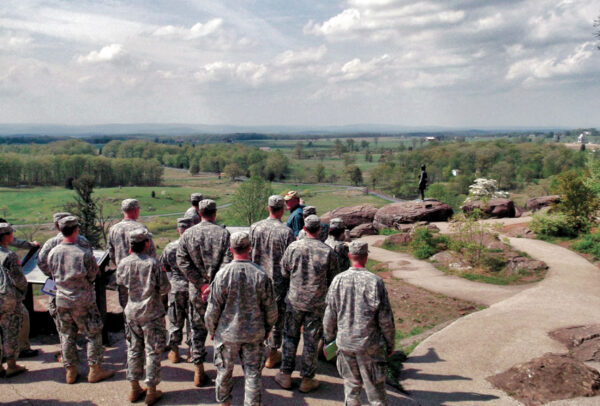
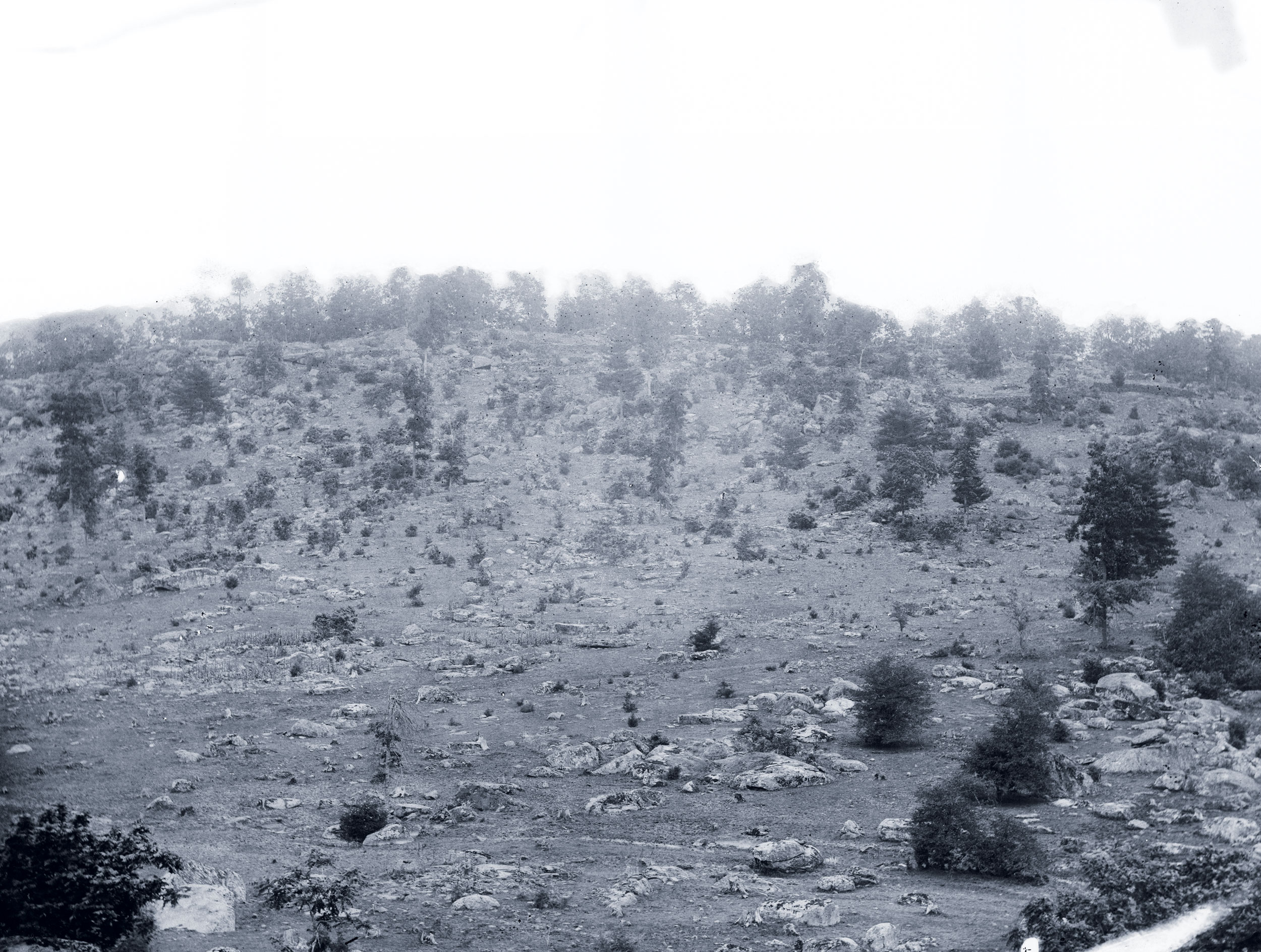
Little Round Top, as it appeared shortly after the Battle of Gettysburg. In the 20th century, various popular accounts of the epic engagement helped propel Joshua Lawrence Chamberlain, commander of the 20th Maine Infantry, into being remembered as one of the Civil War’s most famous heroes.
All great myths are “alive” in the sense that they inspire each new generation and have the ability to surprise those already closely acquainted with them. The American Iliad shares this attribute. But it is alive in another way as well. The characters and stories in Homer’s Iliad were established thousands of years ago and remain unchanging. But the canon of mythic tales embedded in the American Iliad grows and changes over time. One recent example of this process centers on Colonel Joshua Lawrence Chamberlain, who commanded the 20th Maine Infantry at the Battle of Gettysburg. The regiment’s stand on the lower slope of Little Round Top has become familiar to even casual students of the Civil War, and Chamberlain has become one of the conflict’s most famous heroes. This comes thanks to the success of Michael Shaara’s Pulitzer Prize-winning novel The Killer Angels, published in 1974, and its 1993 film adaptation, Gettysburg.
This is not to say that the story was unknown before the publication of Shaara’s novel. It received five pages in Edwin B. Coddington’s 1968 work, The Gettysburg Campaign, widely considered the best single-volume history of the battle.1 Yet it was not so prominent that it required telling. Edward J. Stackpole omitted the entire incident in his popular 1956 history, They Met at Gettysburg.2 Bruce Catton got its perceived significance just about right when he gave it four paragraphs in Glory Road, his 1952 popular history of the Army of the Potomac from Fredericksburg to Gettysburg, and as one of the American Iliad’s great bards, Catton’s retelling is an ideal introduction to the tale.3
On the afternoon of July 2, 1863, the battle’s second day, Little Round Top, a tall hill just beyond the left flank of the Union army, remained unoccupied. The Army of the Potomac’s chief engineer, Brigadier General Gouverneur K. Warren, recognized the hill’s crucial importance. “If the Rebels ever got Little Round Top,” Catton claimed, “the whole of Cemetery Ridge would have to be abandoned and the battle would be lost once and for all.”4 Warren spotted the danger just in time and was able to send a brigade under Colonel Strong Vincent scrambling up the hill to defend it.
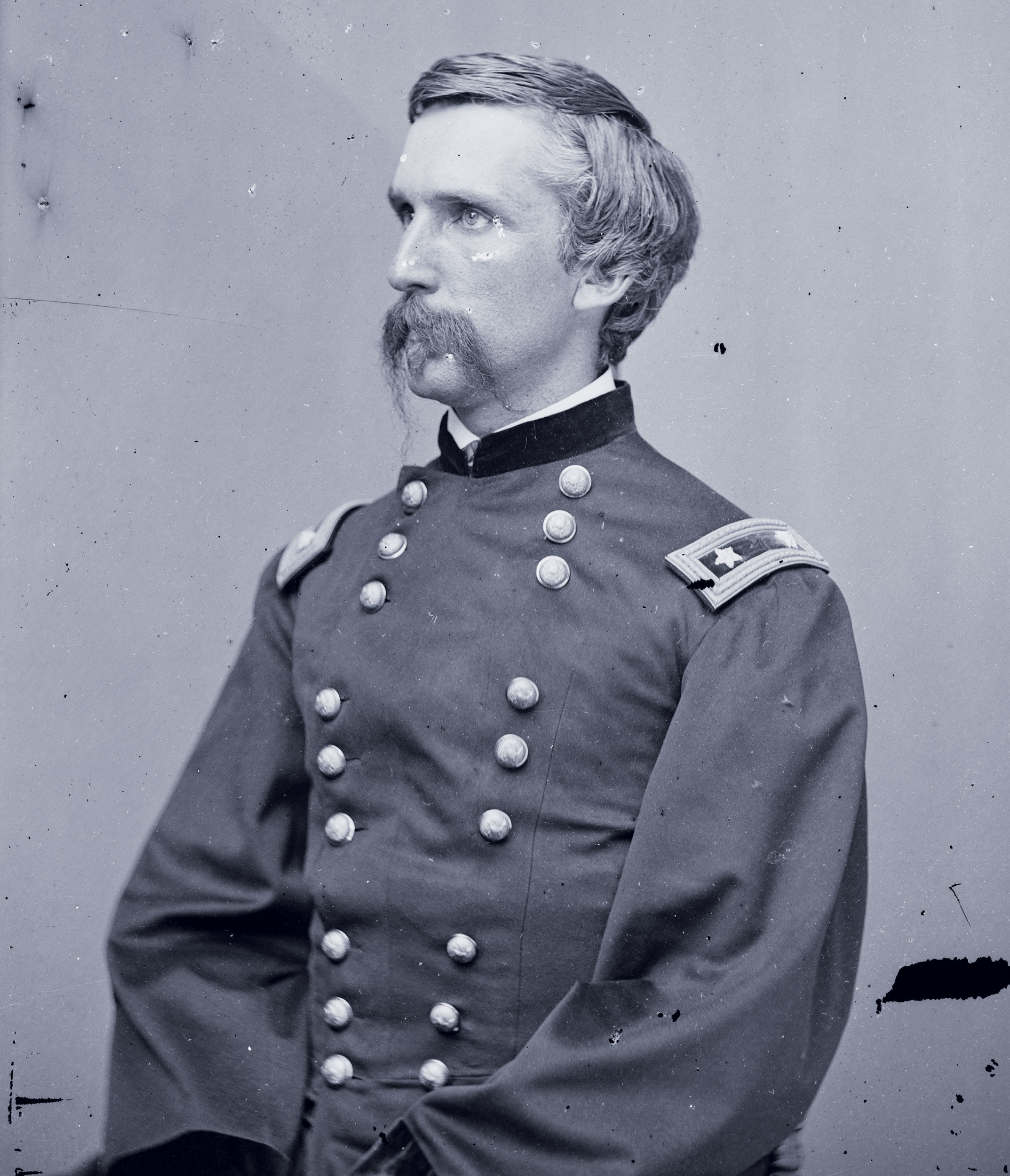
“At the extreme left of Vincent’s line was the 20th Maine led by Colonel Joshua Lawrence Chamberlain,” Catton continued, “who had been college professor and minister of the gospel before the war and who was becoming a good deal of a soldier.” Vincent directed Chamberlain to take his 350 men to the southern end of Little Round Top and “hold the ground at all hazards.” Chamberlain’s 20th Maine did precisely that, repelling several Confederate attacks and then, with its ammunition nearly exhausted, “Chamberlain ordered his men to fix bayonets and charge.”
 Library of Congress
Joshua Lawrence Chamberlain
Perhaps it worked because it was so unexpected. The Confederates fell into confusion as the charge hit them—Chamberlain remembered one Rebel officer firing a pistol with one hand while he held out his sword in token of surrender with the other—and the whole first line broke and ran. The second line collapsed a moment later, the Maine regiment swung over the slope of Big Round Top, and Chamberlain at last had trouble getting his men to halt and adjust their line, the men crying that they were “on the road to Richmond.” They sent upward of four hundred prisoners to the rear.5
Yet Catton’s breathless summary nonetheless insisted upon keeping the vignette in perspective. “If that wildly improbable counterattack had saved the army’s flank, it had saved it only for a moment”—and Catton went on to describe several other feats of valor at Gettysburg in terms just as stirring.6
It was Michael Shaara, a Korean War veteran and professor of English at Florida State University, who elevated Chamberlain’s defense of Little Round Top to the status of legend. The Killer Angels, his novel of the Battle of Gettysburg, highlighted two characters, Confederate general James Longstreet and Joshua Lawrence Chamberlain, with Longstreet portrayed as a world-weary realist and Chamberlain as an idealist who embodied and espoused all that was best in the American character. While Shaara treated both men sympathetically, Chamberlain was clearly the novel’s hero and the focus of its most compelling passages. Early on, when Shaara has Chamberlain explain what the Union cause is all about, he focuses on human freedom, a freedom that goes beyond the emancipation of slaves. “The fact of slavery upon this incredibly beautiful new clean earth was appalling, but more even than that was the horror of old Europe, the curse of nobility, which the South was transplanting to new soil. They were forming a new aristocracy, a new breed of glittering men, and Chamberlain had come to crush it.”7
To understand the impact of The Killer Angels, one needs only to visit Gettysburg National Military Park. The regimental monument to the 20th Maine is not located on the popular boulder-strewn western face of Little Round Top, with its panoramic view of the battlefield, but rather on an obscure wooded spur on the far-from-dramatic southern slope. When I first visited Gettysburg in 1973, only an expert could have located the monument. But after the publication of The Killer Angels, so many visitors clamored to see it that the National Park Service installed a sign directing them to it—“the only sign on the battlefield that directs visitors to a specific regimental marker,” writes historian Jennifer Murray.8 Workers also constructed a small parking lot next to the monument and a paved pathway leading from Little Round Top down to the monument. Gettysburg’s cadre of Licensed Battlefield Guides began to receive constant requests to visit the site of the 20th Maine’s defense, and it soon became a standard part of the basic two-hour auto tour.
In addition to popularizing the story of the 20th Maine’s defense, The Killer Angels helped inspire a new generation of scholarship about Little Round Top, particularly Thomas A. Desjardin’s Stand Firm Ye Boys From Maine: The 20th Maine and the Gettysburg Campaign (1995).9 This new attention enlarged upon the story and improved its historical accuracy, but also added needed context that contradicted the novel’s claims about its importance. The loss of Little Round Top, most historians now agree, would not inevitably have forced the entire Union army to retreat. At best, the Confederates could have wrestled only two cannon onto the restricted northern face of the ridge, and the Union army could—and surely would—have counterattacked to retake the ridge from its exhausted occupiers. But this is not the way most visitors see it.
Gettysburg is itself a major myth within the American Iliad. The battle marked the high tide of Confederate fortunes, and in popular imagination a southern victory there would have meant victory in the war as a whole. (As Chamberlain says early in the novel, “I think if we lose this fight the war will be over.”)10 If Little Round Top was the vital key to the Union position on July 2, and the 20th Maine’s stand was the action that saved Little Round Top, then the 20th Maine won the Battle of Gettysburg—and perhaps even the Civil War itself! (I have met more than one Civil War buff who has made this argument.)
That’s extravagant, of course, but it points us in the direction of Chamberlain’s mythic significance. Most of us live anonymous lives in which events control us. We are always hungry for tales that affirm the opposite: that a single person, or a small group, can seize control of history.
Mark Grimsley, a history professor at The Ohio State University, is the author of several books, including And Keep Moving On: The Virginia Campaign, May–June 1864 (2002) and The Hard Hand of War: Union Military Policy Toward Southern Civilians, 1861–1865 (1995). He has also written more than 50 articles and essays.
Notes
1. Edwin B. Coddington, The Gettysburg Campaign: A Study in Command (New York, 1968), 390–394.
2. Edward J. Stackpole, They Met at Gettysburg (Mechanicsburg, PA, 1956).
3. Bruce Catton, Glory Road: The Bloody Route From Fredericksburg to Gettysburg (New York, 1952).
4. Ibid., 291.
5. Ibid., 293.
6. Ibid.
7. Michael Shaara, The Killer Angels (New York, 1975), 27–28.
8. Jennifer M. Murray, On a Great Battlefield: the Making, Management, and Memory of Gettysburg National Military Park, 1933–2013 (Knoxville, 2014), 150.
9. Thomas A. Desjardin, Stand Firm Ye Boys From Maine: The 20th Maine and the Gettysburg Campaign (New York, 1995).
10. Shaara, The Killer Angels, 31.