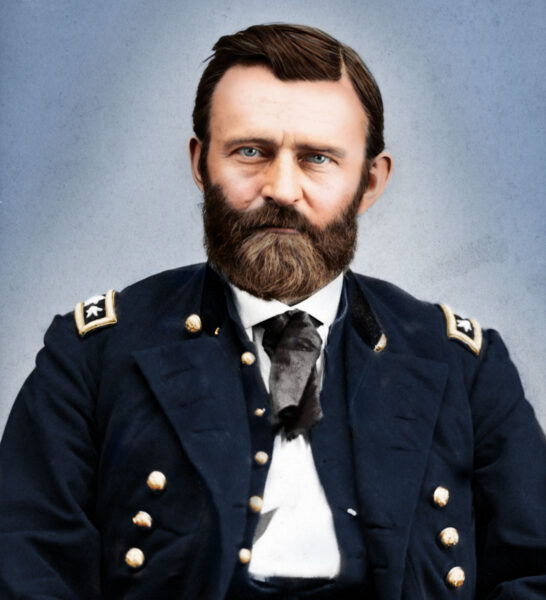
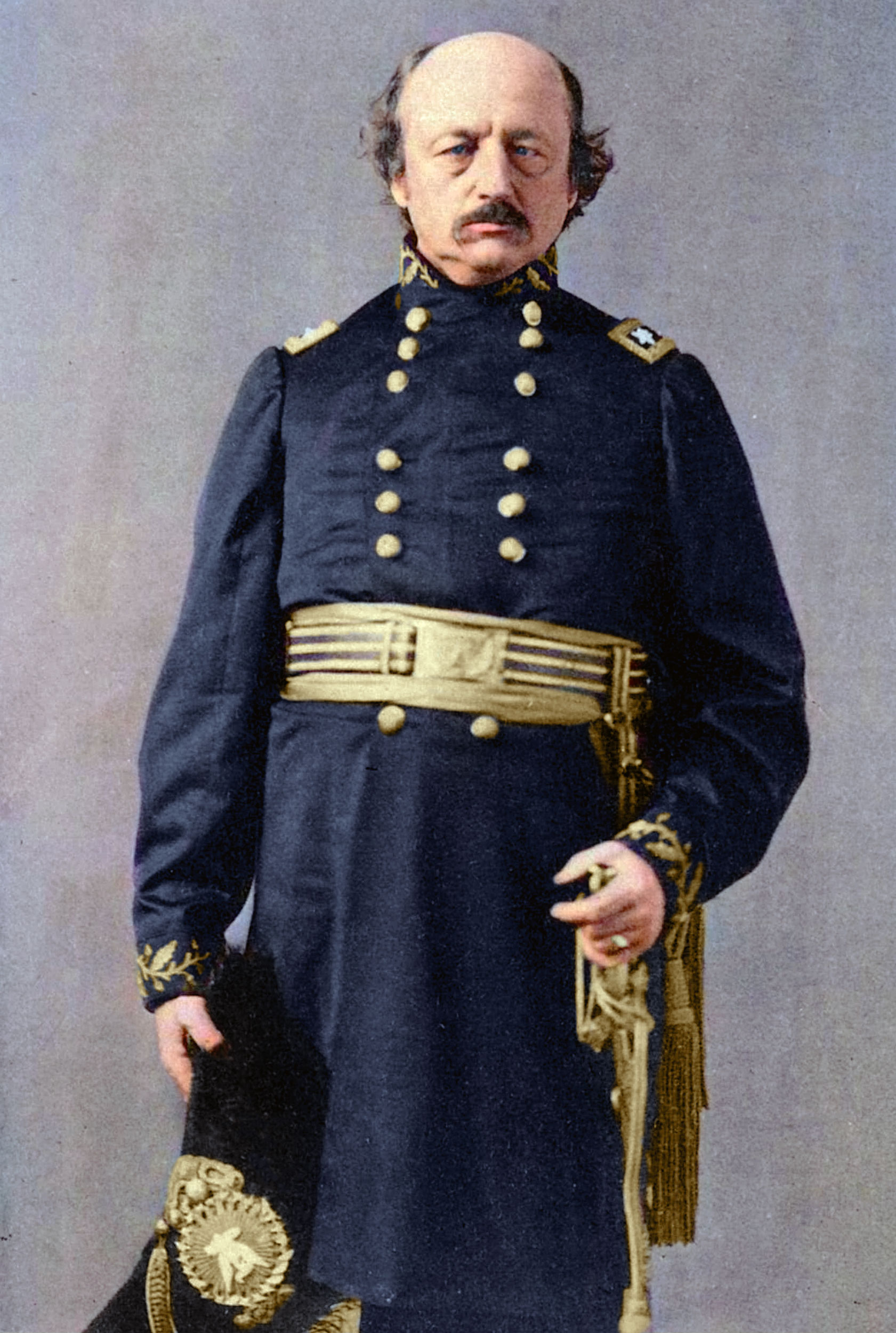
 Courtesy of Joe Normandy; colorized by Mads Madsen of Colorized History
Union General Benjamin Butler
My latest book, Benjamin Franklin Butler: A Noisy, Fearless Life, published last year, yielded many opportunities, for which I was grateful, to speak about the Civil War major general to audiences of various sizes and interests and in a range of formats and locations. Two questions have driven many of these talks: What led me to write the biography? In what ways does it reassess a popular reputation assigned to him in the caricatured epithet “Beast,” derived primarily from negative perceptions of the nature of his command of the Union occupation of New Orleans in 1862?1
I have, like almost all Civil War historians, been long acquainted with Butler. I have even been known to evoke the movie Forrest Gump by referring to him as “Forrest Butler” or “Butler Gump” in reference to the many times he has appeared in the course of my research and teaching on Civil War-related topics. This I did for nearly 30 years at Colby College, which until the 1860s was called Waterville College. Butler, Waterville Class of 1838, was in various ways “present” to me throughout my career at Colby. Although he found Waterville to be a rather uninteresting place, I am fond of the “Elm City” and still live just a short walk from both the college and the church where Butler routinely went to chapel (or was supposed to go to chapel but more often paid a fine for skipping the requirement). During my time at Colby, however, I observed that Butler never enjoyed the attention and reverence the college afforded to another Waterville alumnus, Elijah P. Lovejoy, the abolitionist newspaper editor martyred in 1837 by a pro-slavery mob. Lovejoy was a native son, born in nearby Albion, Maine, whereas Butler was born in Deerfield, New Hampshire, and moved as a child to Lowell, Massachusetts. Lovejoy, whose rabid anti-Catholic sentiments are typically ignored, was 34 when he was killed. Butler, on the other hand, lived a full if highly controversial life to age 74. Notwithstanding Colby tradition, I consider Butler the college’s most significant Civil War-era alumnus.
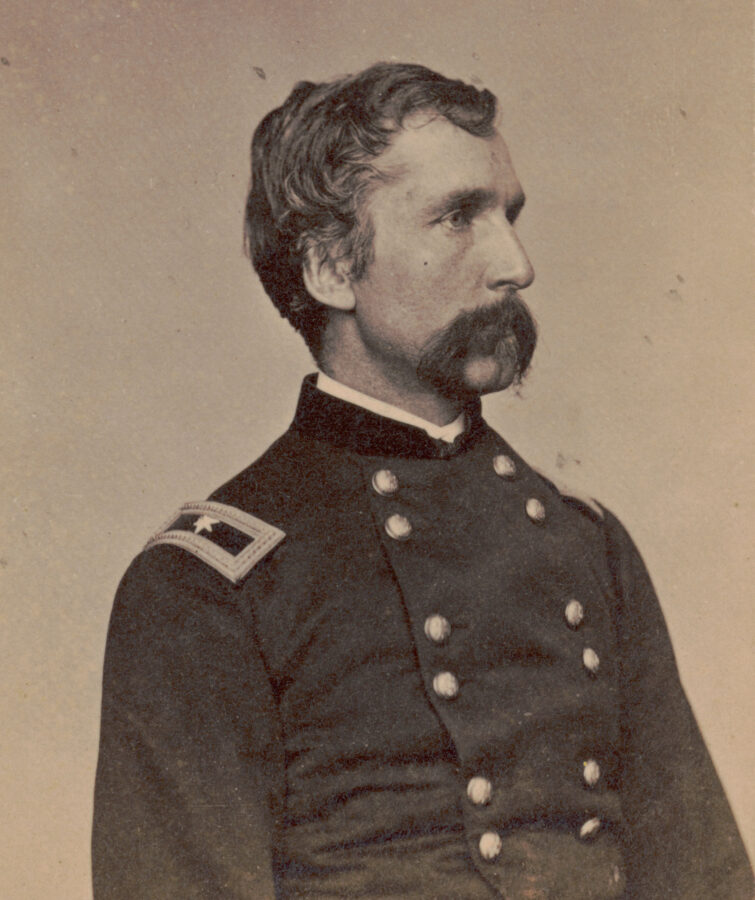 Library of Congress
Joshua Chamberlain
I had been acquainted with and interested in Butler for many years when a series of events led me to become his biographer. In 2013, while participating in the Virginia Sesquicentennial Signature Conference at the University of Virginia, I glibly remarked to Gary Gallagher, a Civil War historian and organizer of the event, that being the Civil War historian at Colby—not at our Maine rival Bowdoin—left me with a measure of what I called “Joshua Chamberlain envy.” Chamberlain was the professor of rhetoric and modern languages at Bowdoin College who left the school when war broke out in order to join and eventually command the storied 20th Maine Infantry, including at Gettysburg’s Little Round Top. After the war, Chamberlain served four terms as the state’s governor, and then returned to Bowdoin as its president.
Bowdoin has long honored Chamberlain—both his wartime and postwar deeds—and his statue stands proudly at a public entrance to the college quad. “All we have at Colby is goofy, unattractive Benjamin Butler,” I recall grumbling. “And no one even cares that he attended the school!” Gallagher immediately gave me a brief if light-hearted scolding, suggesting that perhaps it was time to look more deeply into Butler’s life and accomplishments before dismissing him out of hand, and learn why my Colby colleagues and students should be proud of him. Our conversation stuck with me.
 Colby College
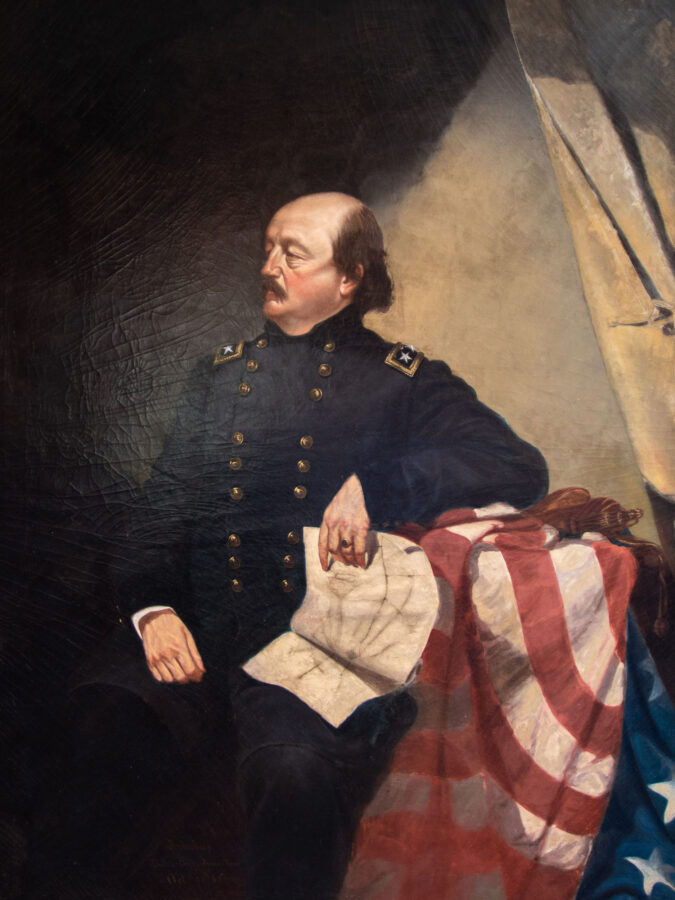
Benjamin Butler gave this 1864 portrait painted of him by John Antrobus to his alma mater, Colby (formerly Waterville) College, where it remains today on display.
Later that year, in time for Colby’s bicentennial, the administration returned to public display the restored 1864 portrait of Butler that Butler himself had given the college a few years before his death. As the faculty’s resident Civil War historian, I was asked to write the legend that would hang beside John Antrobus’ massive painting in the new alumni center entryway, an assignment that required me to begin precisely the sort of digging into Butler’s record that Gallagher had recommended. That led to my discovery of the trove of Butler materials residing in Colby’s Special Collections and Archives department, some of which replicates materials that can be found elsewhere (including in published form), but some of which one might call “Colby specific.”
Among those items was a 1964 Colby Library Quarterly article by my esteemed predecessor, Harold Raymond, a Harvard-trained historian who taught at Colby from 1952 (around the time the college established what is now called the Elijah Parish Lovejoy Award for Courage in Journalism) until 1993. In his article, “Ben Butler: A Reappraisal,” Professor Raymond concluded that, “When stripped of their more dramatic overtones, Butler’s weaknesses were those of the typical Northern politician, businessman, and amateur soldier,” and that while Butler surely had “his full share” of “failings,” his many accomplishments and successes “made a substantial contribution to the preservation of the Union and the advancement of social justice.”
Needless to say, on the heels of Gallagher’s caution about my “Chamberlain envy,” I was intrigued. My previous biographical work on another challenging historical figure from the era—President Abraham Lincoln’s judge advocate general Joseph Holt—had prepared me for the scholarly journey with Butler that culminated with this book. The early and steady encouragement I received from other historians and my publisher spurred me on. I was not sure how much I would “like” Benjamin Butler by the time I was done, but I can report that I came to admire him very much indeed, though I never felt blinded to his very human faults and foibles.
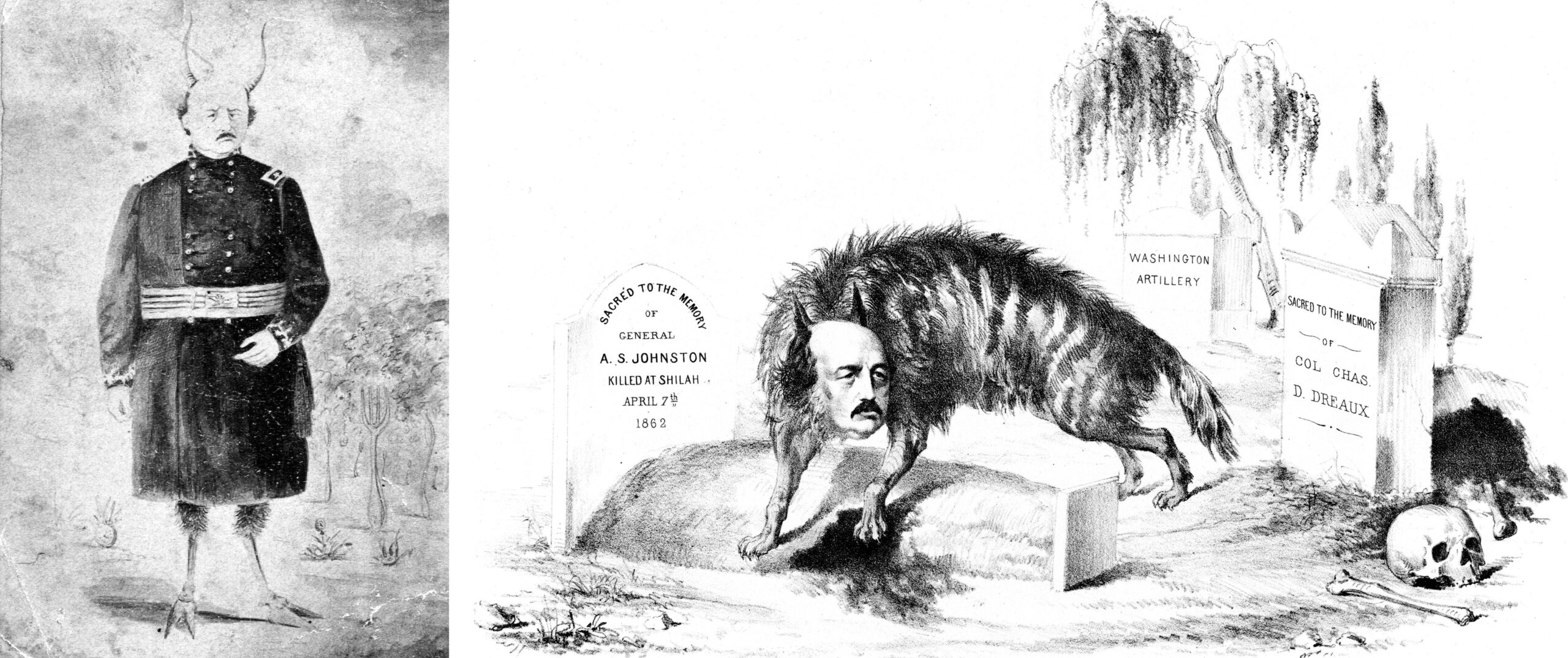 National Portrait Gallery (top); South Caroliniana Library
Benjamin Butler’s wartime reputation as a beastly character, which has followed him for the last 160 years, belies the love and admiration many contemporaries felt for him before, during, and after the conflict. Right: Butler is portrayed as a hyena scavenging among the graves of dead Confederates in a print that originated in New Orleans. Left: A satirical portrait of “Beast” Butler created sometime during the war.
Before I turn to the question of why I believe we should set aside once and for all the epithets that have followed Butler at least since his time in New Orleans—one particularly expressive Confederate woman described Butler as “a monster in whose composition the lowest of traits were concentrated,” and in late 1862, no less than Confederate president Jefferson Davis declared him “a felon deserving of capital punishment” and “an outlaw and common enemy of mankind” for his strict enforcement there of federal authority as well as humanitarian compassion toward the enslaved and the white poor—let me note two key through-lines in the biography.
First is the theme of development, growth, and change as capacities that human beings can display simultaneously with a profound kind of consistency. As I noted in my remarks at Butler’s 204th birthday commemoration in Lowell last fall, and as I hope I’ve demonstrated in the book, Butler’s life exhibits beautifully this pairing of change and consistency. In 1883, a decade before his death, he wrote: “God made me in only one way. I must always be with the underdog in the fight. I can’t help it; I can’t change, and upon the whole I don’t want to.” And my research suggests that he was unswerving throughout his life on this score. At the same time, Butler’s understanding of who the “underdogs” were changed and expanded over time, eventually encompassing laborers and the poor, women, immigrants, enslaved black Americans, and freedpeople. Significantly, Butler earned the devotion and respect of some—those he championed as well as their allies—and the hatred and denigration of others (Confederates, neo-Confederates, and many among the rich and powerful across the land). Regardless, he pressed on, determined, clever, irascible, humorous, noisy, fearless, imperfect.
A second through-line in the book is that perceptions of Butler have always depended greatly on the socioeconomic, political, gender, or racial identities of the observer and, for the historian, on the creators of the sources one is using. In my research I made a point of examining sources that had been largely if not entirely ignored in the past (importantly including source materials offering insights into black Americans’ perceptions of the man). I also asked new questions of sources that had been examined by Butler biographers before me. Why, I wanted to know, did certain individuals see and describe and relate to Butler the way they did, both during his lifetime and after? It seemed to me that to understand him better, these two approaches were essential and beneficial; they were also essential and beneficial to me as I tried to understand why he has dropped so far off the roster of popular historical understanding, being reduced to the caricature “Beast” or “Spoons,” further residue of his time in New Orleans, where some opponents accused him (without proof) of stealing silverware and other items of value from wealthy Confederate residents in order to increase his own personal wealth.
Drafting my manuscript, I seriously considered starting with Butler’s unexpected death in January 1893, in Washington, D.C., the popular responses to it, as well as the massive funeral and many memorial events that followed. Because while Butler is typically remembered today as a much-maligned caricature, I wanted to make clear to readers right from the start what a hugely important, widely known, and deeply loved and revered individual he was at the time of his death, who it was who loved and revered him most, and why they felt the way they did. In the end, I took the conventional biographer’s approach: birth, life, death. But I stand by the notion that the responses at the end of Butler’s life tell us a great deal more about who he was and what he contributed to our nation’s history than his birth in obscurity in Deerfield, or any minimizing epithet, ever could.
So why should we stop calling Butler his most fiercely persistent nickname, “Beast,” and clinging to the vicious caricature it both evokes and reflects, which have been perpetuated for over 150 years by Lost Cause apologists, their many sympathizers North and South, and countless others who find it easier to embrace a clownish representation of this complex historical figure? The simplest answer is that digging deeper for understanding is always a good thing, and in Butler’s case, as so often happens, a little digging goes a long way. Among other things, it enables us to grasp the scope of everything Benjamin Butler was able to achieve in his long lifetime (1818–1893), from his birth in poverty, to his childhood with a widowed mother and five older siblings, to an adulthood characterized by great professional, military, and political prominence, in the course of which he strove tirelessly—and often successfully, even against strong headwinds and bitter opposition—to make a host of meaningful, positive contributions to his community’s life, and to the nation’s.
Moreover, we learn that Butler’s efforts and impact were by no means confined to his months in New Orleans or even the four years the country was actively engaged in its violent and destructive war over slavery. Indeed, his work on behalf of the factory workers in Lowell, Massachusetts (especially women), for example, began decades before that war, and his dedication to social, economic, and racial justice more broadly continued for decades after it. In truth, I would argue that it is nothing less than a perverse distortion of history to limit our understanding of Benjamin Butler to what the Rebels in New Orleans thought about him after he had a local resident, William Mumford, hanged for tearing down the U.S. flag from the New Orleans Mint and dragging it through the streets, or when he issued his “Woman Order” in response to Confederate women spitting on the Union soldiers under his command or displaying necklaces made with the bones of the soldiers’ dead comrades.
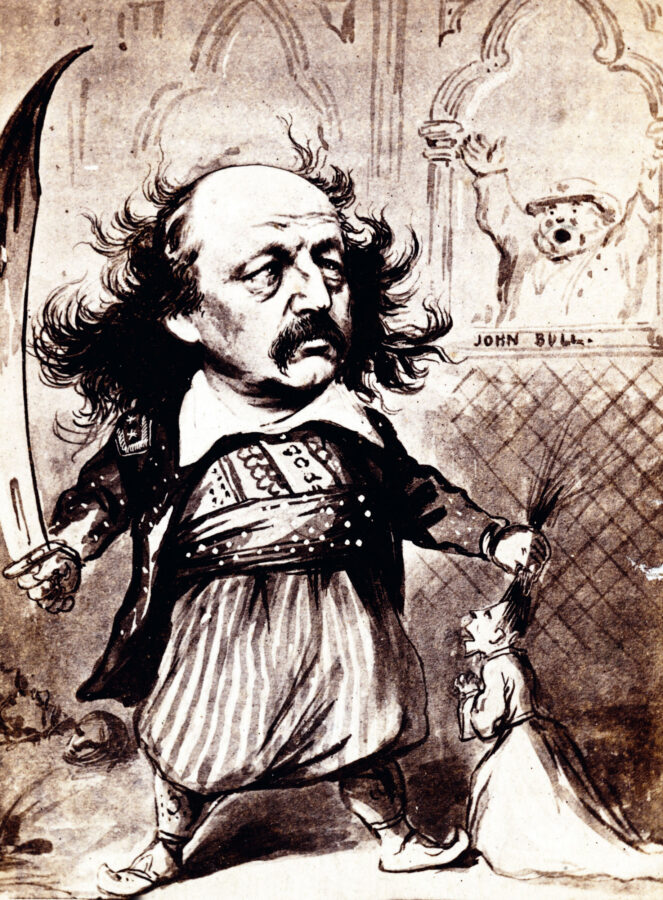 Library of Congress
 In this wartime carte de visite, Butler is depicted as the “Bluebeard of New Orleans,” another response to his challenging the behavior of the city’s Confederate women.
We should set the nickname and caricature aside, too, out of respect for Butler’s unyielding unionism, including, as a prominent and loyal representative of the disintegrating Democratic Party, his efforts to hold the nation together in 1860 and 1861. (It is, of course, true that Butler cast over 50 votes for Jefferson Davis as the party’s 1860 presidential nominee at the Democrats’ convention in Charleston, South Carolina. His thinking in connection with these votes, however, which he cast many months before the former secretary of war and sitting U.S. senator had given any indication that he would support and then lead a revolution to destroy the United States, is an important discussion in the biography.)
Moreover, as war loomed, in his capacities as a lawyer and businessman with good financial connections and as a respected leader in the Massachusetts Volunteer Militia, Butler energetically and without hesitation offered his services to defend the nation against the rebellion. In the weeks that followed, he also managed the difficult but successful deployment of the first federal troops to the U.S. capital (including the first ground troops to be fired on by the enemy as they passed through Baltimore, Maryland, on April 19, 1861), and also boldly and consequentially acted to keep that border state in the Union. It is hardly insignificant that the lead article in a June 1861 issue of the popular illustrated newspaper Harper’s Weekly—echoed in Butler’s own correspondence—reveals that in the early weeks of the war, many northerners believed the brave and praiseworthy Major General Butler would come to be remembered as the military figure most responsible for saving the nation, and saving it quickly.
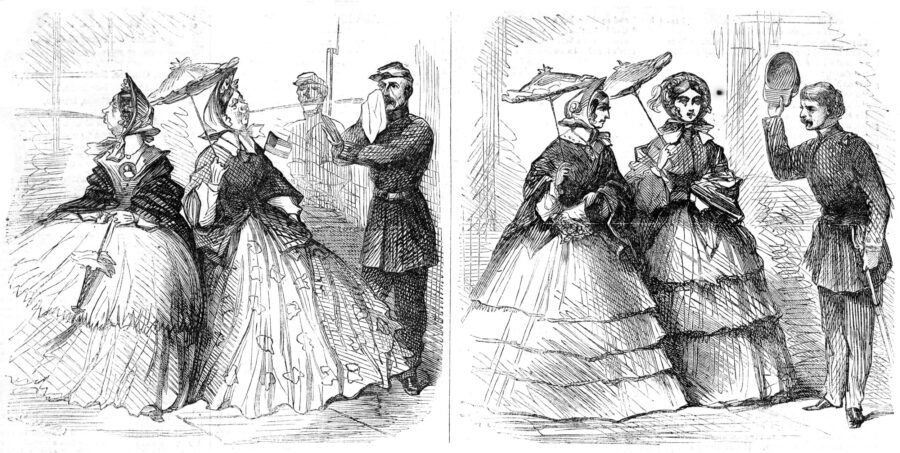 Library of Congress
 Butler’s bad reputation stemmed in large part from his tenure as military governor of New Orleans in 1862, during which he earned the ire of the city’s pro-Confederate residents. Above: Harper’s Weekly ran this illustration, depicting the behavior of the women of New Orleans before and after Butler issued his controversial “Woman Order” in response to incidents of Confederate women in the occupied city spitting on Union soldiers.
There is certainly an argument to be made for setting aside the epithet “Beast” as one way of honoring Butler’s brilliant and wily establishment of the so-called “contraband policy” while he was in command of Fort Monroe, Virginia, in May 1861. This unauthorized, unprecedented policy—devised in response to the request for protection of three escaped slaves, Sheppard Mallory, Frank Baker, and James Townsend—enabled enslaved people from states in rebellion to seek refuge behind Union lines, and undeniably and irrevocably exerted pressure on President Lincoln, his administration, and the United States Congress to take concrete steps in the direction of emancipation. It also factored significantly in Butler’s own transformation over the next three years into a committed and unrepentant advocate and leader in the work of ensuring black people their freedom; creating, commanding, and supporting the United States Colored Troops, to whom he was increasingly devoted, as they were to him; and advancing black Americans’ civil and human rights and their economic and other opportunities more generally.
And what of Butler’s April-December 1862 command of the Union forces in New Orleans, where the epithet and caricature of the “Beast” took hold in the first place? It is certainly true that Butler acted strictly there—against the rebel Mumford, against the self-proclaimed “she-rebels” who disrespected his soldiers, against a number of the foreign agents in New Orleans who sought to carry on their trade relations as before while evading any and all constraints Butler imposed on the city’s native-born Rebels. Butler was a stern occupation commander. But I believe it would be a mistake to suggest that his severity was disproportionate to his challenging assignment: namely, to suppress the raging and violent rebellion as it was manifested in this racially diverse, fiercely unruly, complicated, and vitally important Confederate center of slavery and commerce, hundreds of miles from Washington, D.C., and where yellow fever and grinding poverty were regular features of life, while also initiating previously untested measures designed to enable Reconstruction there and, subsequently, elsewhere. Indeed, one wonders why so many colorful and enduring tales of Butler’s harshness in New Orleans (along with assertions of his corruption and self-dealing—“Spoons”—which have never been proved) have come down apparently unquestioned to the present, but his successes (including transforming the black Louisiana Native Guard into Federal troops, feeding and employing thousands of desperately poor New Orleanians—black and white—to prevent their starvation, instituting quarantine and sanitation practices that kept yellow fever at bay, etc.) have been “forgotten.” And one might ask a related question about his wartime service in the field, so commonly remembered as a relentless muddle of failures. Why is it that Butler’s famous “failures” as a commander in the field (Big Bethel, Bermuda Hundred, Fort Fisher) are more commonly trotted out than are his successes (Annapolis, Baltimore, Hatteras)? And so much more frequently than similar “failures” by other Union commanders?
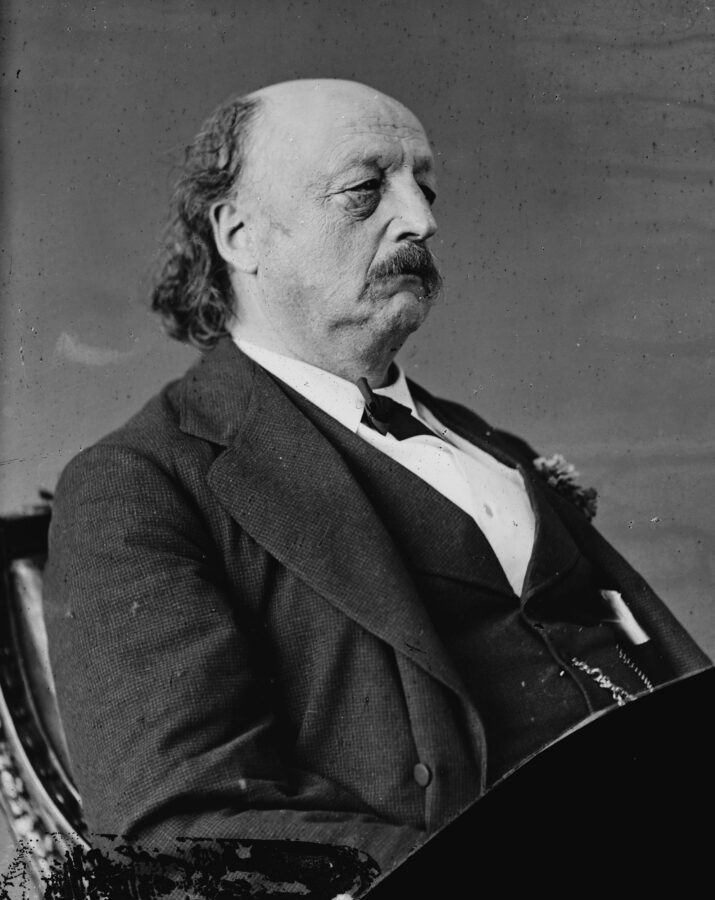
Butler’s 30 post-Civil War years—during which he served as a U.S. representative from, then Governor of, Massachusetts—were as productive and consequential, if not more so, as his wartime career was controversial. Above: Butler as he appeared in 1870.
Fleshing out some of Butler’s many wartime contributions to the Union cause is important. It is equally important, however, to examine his contributions over the nearly 30 years he lived after the war, given how utterly absent they are in popular memory. One could argue that any one of the following should have long since effaced the impact (and memory) of Butler’s votes in favor of Jefferson Davis as the Democratic Party’s nominee for president in 1860, or his blunders at Big Bethel: his 10 years as a U.S. representative from Massachusetts, during which he did everything he could in Congress and far more than many to “stick the landing” of Union victory in the war all while national sentiment shifted rapidly toward white sectional reconciliation at the expense of the freedpeople; his early and persistent leadership of the opposition to President Andrew Johnson’s lenient Reconstruction policies and benevolence toward the southern planter class, and the impeachment that followed (and regrettably failed); his earnest, full-throated, and effective advocacy of the Fourteenth and Fifteenth Amendments to the U.S. Constitution, the Civil Rights Act of 1875, and the anti-white supremacist Force Bills of 1871; his unwavering support for women’s suffrage and rights more generally (also reflected in his commitment to the many individual strong women—family members and friends—he cherished and encouraged); his dedication to pressing for economic and labor policies designed to lift working people and the poor; his leadership in the broad field of veterans’ affairs, as the founding and longtime head of the National Homes for Disabled Volunteer Soldiers and his work to ensure that all veterans, but perhaps especially black veterans, received the pensions they were due for their military service; and his efforts to desegregate the U.S. Military Academy by nominating young black men to West Point cadetships in hopes of reshaping the officer class in the regular army.
And then there was the year Butler served as governor of Massachusetts, during which, among other things, he investigated and exposed rampant corruption at the Tewksbury Almshouse (providing a model for similar investigations and reforms at almshouses and asylums around the country), and also appointed George Lewis Ruffin, the first African American to graduate from Harvard Law School (in 1869) to the Charlestown Municipal Court, making him the first known black judge in the United States. After leaving the governorship Butler went on to run for president in 1884 as the candidate of the Greenback and Anti-Monopoly parties. He won just 2% of the vote, but his campaign inspired many across the country to try building a new political party—a “people’s party”—that would enshrine and fight for the values he consistently represented and articulated. The inscription on Butler’s massive tombstone at the Hildreth Family Cemetery in Dracut, Massachusetts, reads: “The true touchstone of civil liberty is not that all men” (and I believe today he would readily include “and women”) “are equal but that every man has the right to be the equal of every man if he can.”
Over the course of his life, Benjamin Franklin Butler notably enjoyed the love and loyalty of his family members. He also earned the enduring affection, respect, and gratitude of many black Americans, both prominent—like Frederick Douglass—and “ordinary,” like the common soldiers and veterans of the USCT. He earned the same ardent praise from laboring people and the poor, women’s rights activists and many more. And yet, the way he is generally remembered today highlights the amount of enmity and derision he endured during the war and until his death, not only from Confederates and former Confederates, but also from powerful (and mostly wealthy) white northerners in Massachusetts and around the country who sought to diminish his influence and popularity and so undermine his egalitarian agenda. He was by no means perfect, and I am sure that my biography makes at least a number of his failings clear. As my predecessor Professor Raymond once wrote, however, “If Colby students would champion the underprivileged as fiercely and uphold the American Republic as faithfully as Benjamin Butler” did, then they, too, “would deserve to be honored” properly—as he has yet to be.
So let’s agree to set the epithet and caricature of Butler the “Beast” aside once and for all in our references to Butler … unless, of course, we choose the Urban Dictionary definition: “a person that is extremely talented at whatever they do and always displays great determination, dedication, and resilience to always win or want to win.” This may not be a perfect description of Benjamin Butler, but it’s much more accurate than the familiar one.
Elizabeth D. Leonard is Colby College’s Gibson Professor of History, Emerita. She earned her Ph.D. in U.S. history from the University of California, Riverside, in 1992 and is the author of several articles and seven books on the Civil War era including: Yankee Women: Gender Battles in the Civil War; All the Daring of the Soldier: Women of the Civil War Armies; and Lincoln’s Forgotten Ally: Judge Advocate General Joseph Holt of Kentucky, which was named co-winner of the Gilder Lehrman Lincoln Prize in 2012.
Notes
1. Citations to all of the quotes and specific material found in this article can be found in Benjamin Franklin Butler: A Noisy, Fearless Life (UNC Press, 2022).