 Library of Congress
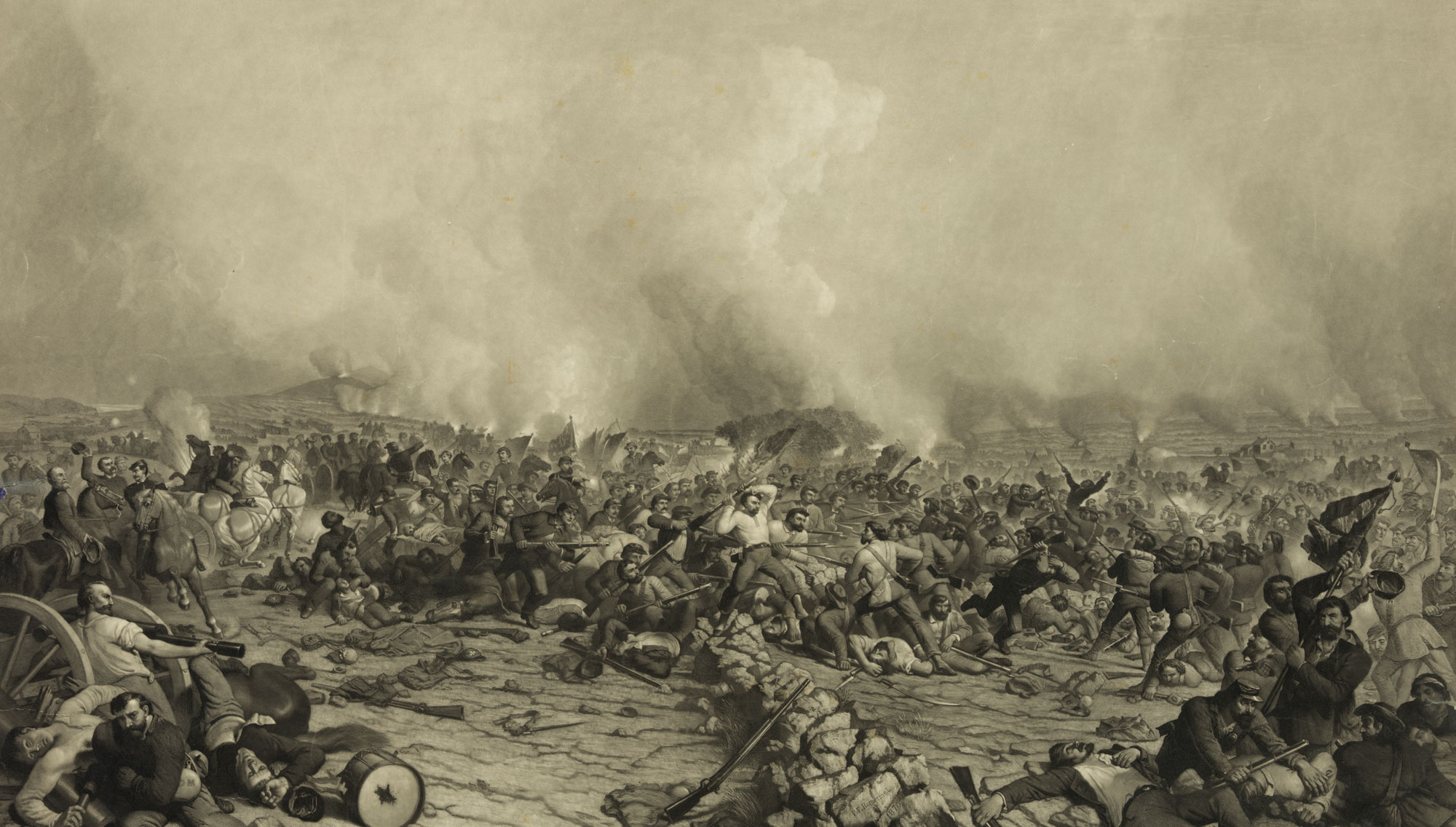
Union and Confederate forces clash during Pickett’s Charge in this engraving of Peter Frederick Rothermel’s 1870 painting “The Battle of Gettysburg.”
In Falmouth, Virginia, on the night of June 3, 1863, the Massachusetts men could peer across the Rappahannock River and see the glow. West of the battered town of Fredericksburg, flames rose along six miles of Confederate fortifications that they knew well. As daylight groaned across the sky, an unearthly silence settled on the area, even as the stunning truth dawned. The enemy’s charred fortifications stood empty, the Rebels of the Army of Northern Virginia gone. Rumors swirled while the men packed their knapsacks and awaited their fate.
One month later they rose again, this time along a badly congested roadway. The intervening march had been hellish: two weeks and 190 miles of rough tracks and river crossings, mountains and meadows. Rains had given way to sun and mud to dust, yet on they had trudged, snaking across the battle-scarred landscape of Virginia and Maryland, searching for the Rebels.
As they crossed the Pennsylvania state line on July 1, artillery concussions echoed from the north and smoke rose above the distant hills. The soldiers understood they now advanced toward the sound of guns, a prospect most of them welcomed. After all, they bore the insignia of the 20th regiment from the state of Massachusetts—one that had appeared on every major battlefield in the war’s eastern theater.
Battle was in their blood.
 Courtesy of the U.S. Army Heritage and Education Center
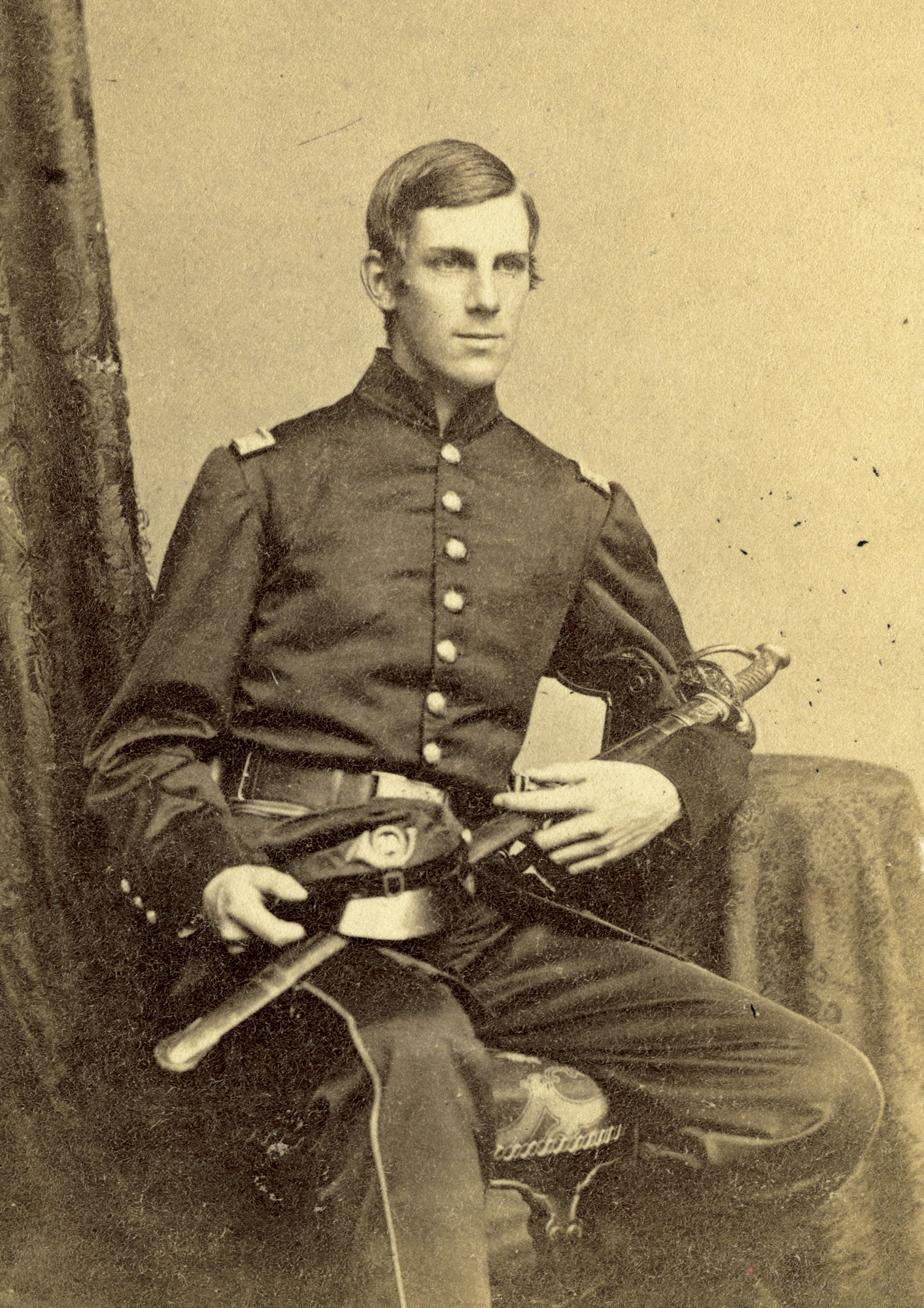
Lieutenant Oliver Wendell Holmes Jr.
BAPTISM
The officers, born and raised in Boston’s finest homes, left their white-collared pursuits or the halls of Harvard College in 1861 to recruit a gaggle of volunteers and whip them into military shape. Some of the Harvard men had experienced disciplinary problems while in school; only a few were truly good students. Many regarded volunteering as a method to bring value to their upper-crust lives. Mostly Democrats and unionists, they carried storied names like Revere, Abbott, Lee, and Holmes to Camp Massasoit near Readville. There, they faced down a crowd that included Nantucket seamen and Boston toughs, factory workers and farmers, laborers and craftsmen, even a photographer and a piano maker. Half of these volunteers were immigrants, mostly from Ireland and Germany, and few shared their officers’ genteel ways.1
On July 18, 1861, this motley assortment of 39 officers and 787 enlistees received the designation of 20th Massachusetts Volunteer Infantry. The regiment’s well-connected commander, 53-year-old Colonel William Raymond Lee, thought his new charges entirely deficient, but he and his officers continued to work with a stubborn and patriotic zeal. The volunteers responded in kind. Within weeks the unit displayed an impressive and well-earned martial acumen. When they broke camp in early September, the citizen-soldiers of the 20th were itching for a fight.2
Their baptism commenced on October 16. The regiment crossed the Potomac River at Ball’s Bluff to support an ill-designed thrust at Leesburg, Virginia. Counter-attacked and surrounded on some wooded heights along the river, 88 Bay Staters lay dead or wounded at the battle’s end, while Lee and Major Paul Revere—the 29-year-old grandson of the Revolutionary War hero—joined 21 other officers and 88 privates in captivity. Wounded badly in the neck but evacuated safely across the river, Lieutenant Oliver Wendell Holmes Jr. contemplated ending his life with a swig of laudanum until a doctor convinced him otherwise. The 20-year-old would recover quickly and rejoin the unit. The hard-nosed Lieutenant Henry Abbott—a diminutive 19-year-old—also survived the maelstrom. At first fearful of failure under fire, Abbott surprised himself and his compatriots with his ferocity and bravery. The two young officers, comrades first at Harvard and now at arms, would set a high standard indeed.3
 Courtesy of the U.S. Army Heritage and Education Center
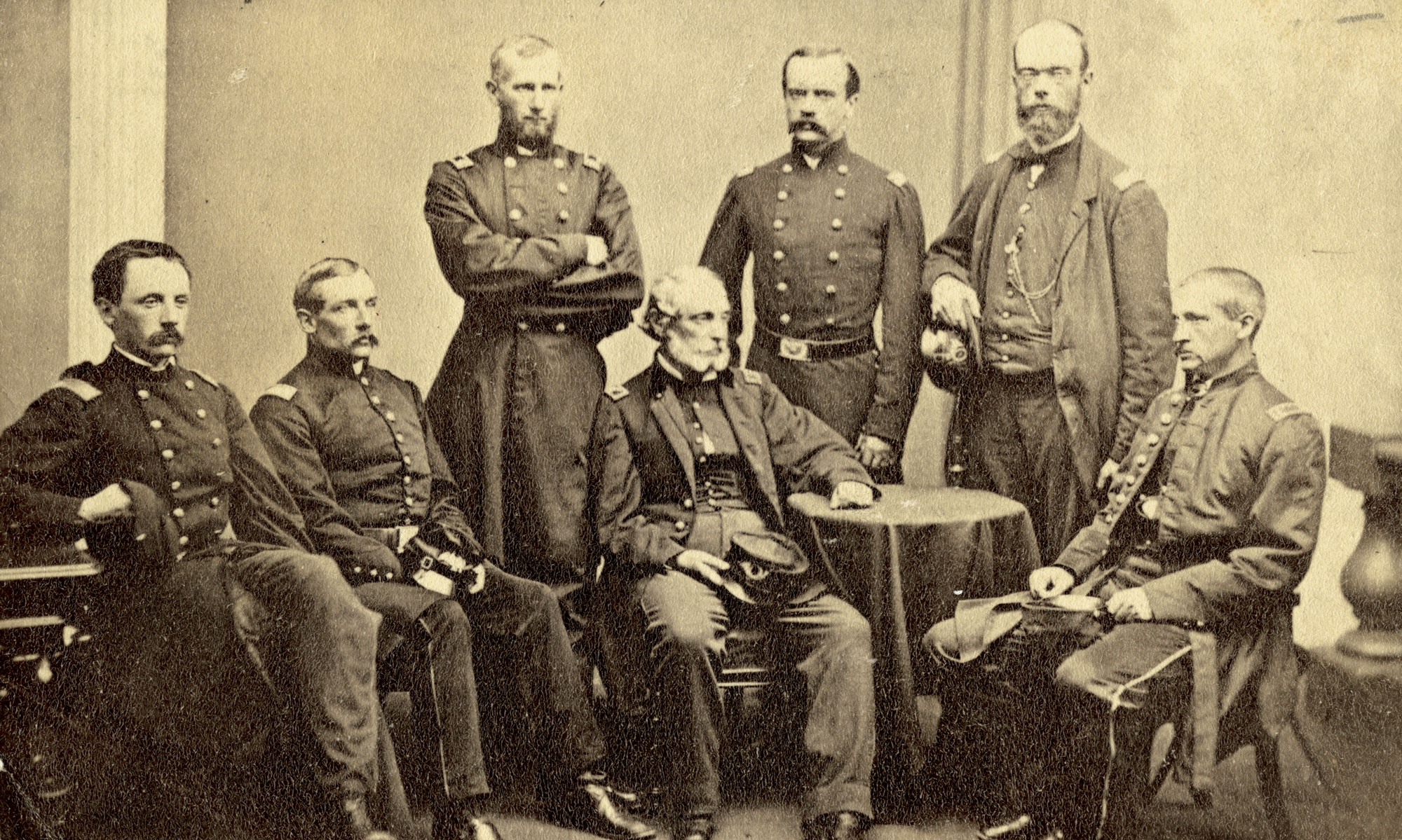
Among the 20th Massachusetts field and staff officers in this 1861 image are Major Paul Revere (far left)—the 29-year-old grandson of the Revolutionary War hero—and the regiment’s well-connected commander, 53-year-old Colonel William Raymond Lee (seated center). Both men were taken prisoner during the regiment’s first engagement at Ball’s Bluff in October 1861.
MEN OF WAR
After spending the winter patrolling the Potomac, the 20th received orders to join Napoleon Dana’s brigade of John Sedgwick’s division in General Edwin Sumner’s II Corps. So began their march into the cruel grind of war as a cog in General George B. McClellan’s Army of the Potomac.
On May 2, 1862—two weeks into McClellan’s ill-fated Peninsula Campaign—recently released prisoners of war William Lee and Paul Revere rejoined the regiment. Four weeks of hard campaigning later, the Bay Staters rushed to blunt an enemy attack near Fair Oaks, Virginia. In the ensuing battle, the victorious 20th gloried at the sight of retreating Rebels, and new recruit Lieutenant Henry Ropes—a bookish, 23-year-old Christian from Harvard—impressed all with his bravery under fire. Then, at the end of June during the Seven Days Battles, Henry Abbott took a bullet to the arm as the regiment again countered an enemy thrust near Glendale. During it all, brutal weather, short supplies, and debilitating disease waylaid the suffering soldiers. By the time the failed campaign ended and the regiment shuffled into camp at Harrison’s Landing on the James River, the regiment had been ground down to bare existence. Lee and Revere, already weakened by the brutality of their POW experience, lay prostrated by malaria. Abbott would soon depart to recover from both his wounds and the news of his beloved brother’s death in battle.4
So began a year of bloody frustration.
 Frank Leslie, The Soldier in Our Civil War
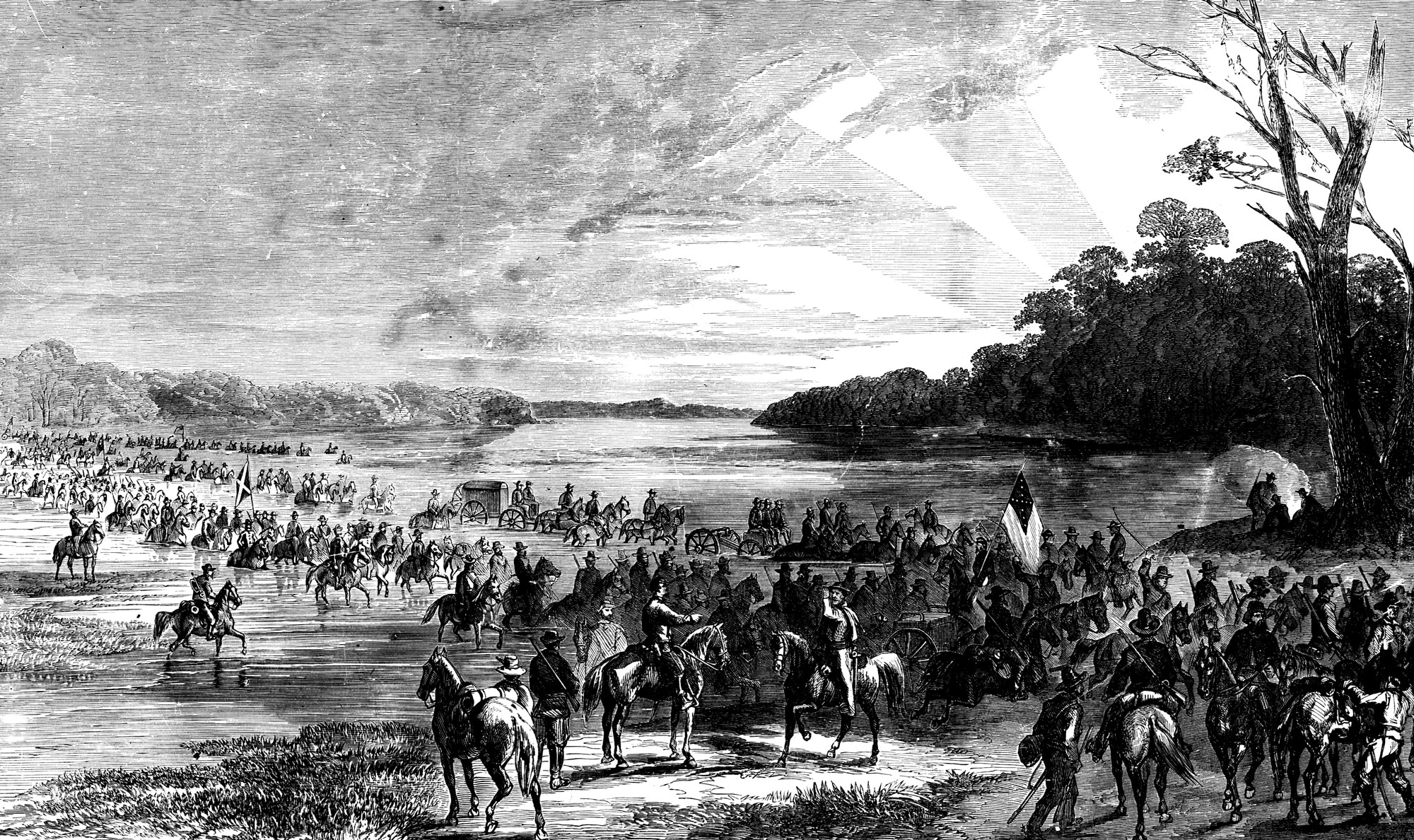
The Army of Northern Virginia crosses the Potomac River in mid-June 1863 during General Robert E. Lee’s second invasion of the North.
In August, Confederate general Robert E. Lee and his reinvigorated Army of Northern Virginia swept north, routing a polyglot Federal force led by General John Pope, then raiding across the Potomac into Maryland. McClellan pursued and engaged Lee near the town of Sharpsburg. There, fighting raged on September 17 from dawn until mid-morning, when Sumner launched his entire corps across the charnel house of a disputed cornfield, unaware that the westward axis of his attack put half the Rebel army on his left flank. The ensuing engagement and Federal rout swept Sumner—and the 20th—from the field. By day’s end, 137 more of Massachusetts’ finest—including Oliver Wendell Holmes—had joined the casualty list.5
Within a few days, Colonel Lee suffered a breakdown and left the regiment, never to return.6
Three months later, with Ambrose Burnside now commanding the army, the 20th participated in the vicious street fighting in Fredericksburg, Virginia. Now recovered from his Peninsula injuries, Henry Abbott’s courageous leadership under fire drew praise from his comrades, cementing his reputation as a wildcat in a fight. The regiment also joined the doomed December 13 assault on Marye’s Heights, a mismanaged attempt to break the impregnable Confederate defense along the Sunken Road. A day later, they would return to their camps in Falmouth across the Rappahannock River, defeated, disheartened, and angry.7
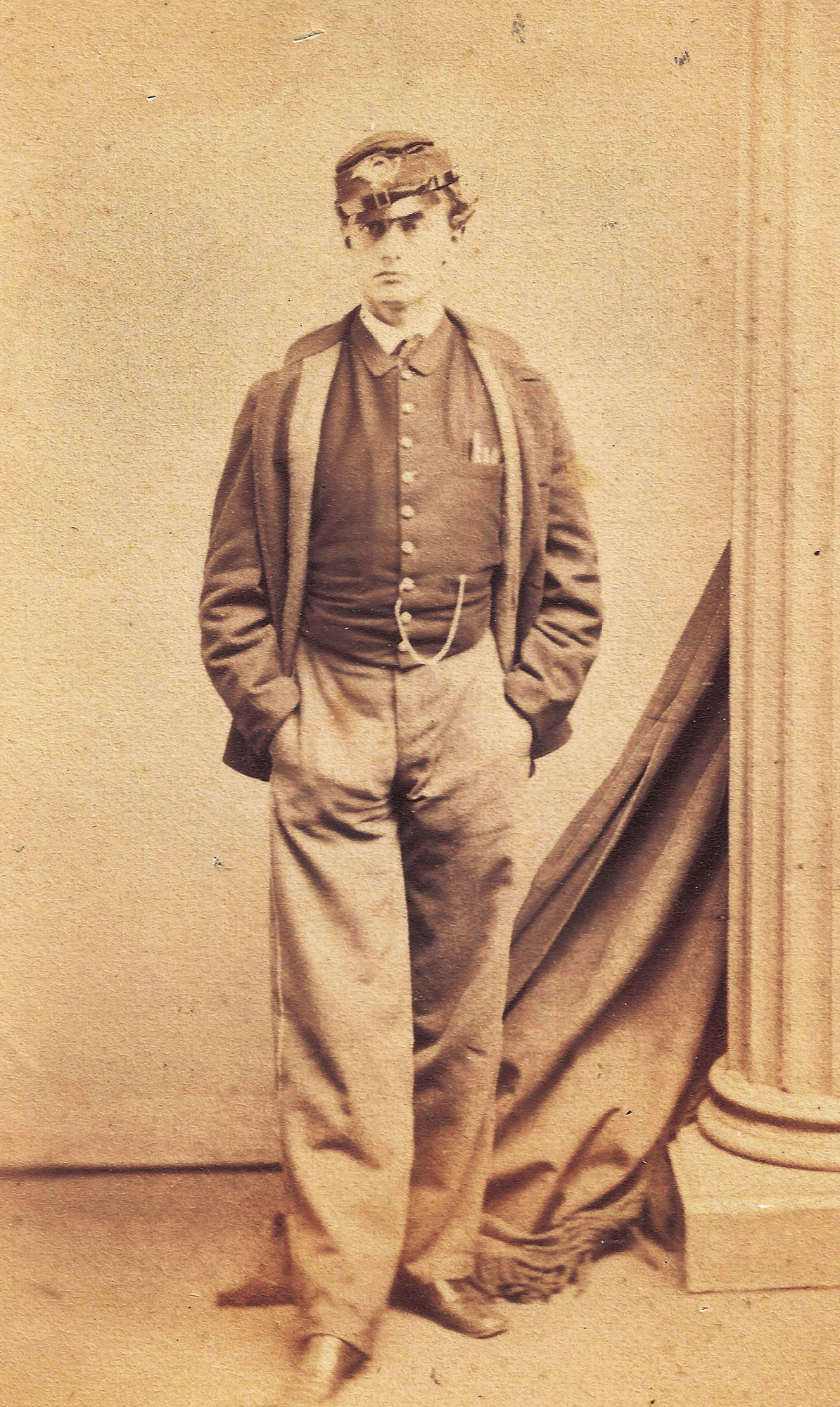 The National Civil War Museum
Lieutenant Henry Abbott
As the army lay in winter quarters, strong emotions rippled through the regiment, especially in the heart and mind of Henry Abbott. The young officer knew that Burnside had little acumen to lead an army: Besides the devastating defeat, disease was rampant, rations were terrible, and spirits were low. Although Abbott welcomed the possibility of McClellan’s return, he had lost confidence that the Confederacy could be defeated in battle. As a Democrat and a unionist, he also felt disgusted by Lincoln’s recent Emancipation Proclamation. For Abbott, as for many Union soldiers, emancipation of slaves had no business as a war aim. Only Burnside’s resignation and replacement by General Joseph Hooker in late January 1863 assuaged a portion of the young man’s bitter season of disillusionment. A vastly improved quartermaster corps and Hooker’s new, top-down efficiency raised the morale of soldiers, including Abbott, but most still felt the intemperate Hooker would fail, like McClellan and Burnside before him.8
One piece of army affairs rankled Abbott and his fellow officers like no other. The colonelcy of the regiment had become something of a political plum, and Massachusetts governor John Andrew decided to place Paul Revere in command, superseding the unit’s highly regarded acting leader, Major George Macy. Revere had left the regiment after the Seven Days Battles for a corps staff position and then suffered a wound at Antietam. When he recovered, he campaigned actively for the commission, a breach of decorum that Henry Abbott found both dishonorable and unforgivable.9
In late April, the war resumed. “Fighting Joe” Hooker flanked Lee’s forces along the Fredericksburg line, but the Confederate chieftain bluffed the northerner into a defensive cocoon in the tangled wilderness near Chancellorsville. For two days Lee pummeled his opponent, who ordered the 20th Massachusetts to join an assault across the December battlefield in an effort to relieve the pressure. Colonel Norman Hall—already a national hero for his service at Fort Sumter—now commanded the brigade and ably drove home his part of the attack. The 20th helped push the Rebels out of the infamous Sunken Road and across Marye’s Heights, but Hooker suffered a complete collapse of confidence and called for a general retreat back to Falmouth. The casualties in the 20th were few (although Oliver Wendell Holmes was struck in the heel), but that didn’t stop the growing rumblings among the men. Henry Ropes wrote to his brother about the “vast groan” emanating from the entire army over Hooker’s incompetence and the desire to see McClellan returned to command. It was clear that the Army of the Potomac had suffered yet another terrible defeat.10
In the wake of the debacle, fissures in the regiment erupted. Paul Revere openly espoused abolitionism, which drew some like-minded officers but enraged others. Captain John Putnam, who had lost an arm at Ball’s Bluff, not only supported Revere but also spoke critically of Macy and Abbott. Revere did himself few favors when he displayed a creaky grasp of basic drills, drawing snickers and worse behind his back. For his part, Abbott simply hoped for the day when he, Macy, and Holmes might take over the regiment from the dishonored Revere and “the cripples.”11
Meanwhile, the enlisted men drafted a letter to Governor Andrew complaining about the punishment meted out by a new arrival, Lieutenant Sumner Paine. The 18-year-old Harvard student had instituted harsh measures for any break of discipline and the soldiers had reached their limit. Paine himself could not have cared less. Divisional commander John Gibbon had ordered a crackdown, and Paine—a brawny, physical force—gladly complied.12
For a month, these tensions ran rampant. Then, the fires of June 3 lit the night sky.
In the morning, the Army of Northern Virginia had disappeared, its destination unknown.
Eleven days later, with news that the Rebels were headed north, the 20th Massachusetts broke camp and began its pursuit.
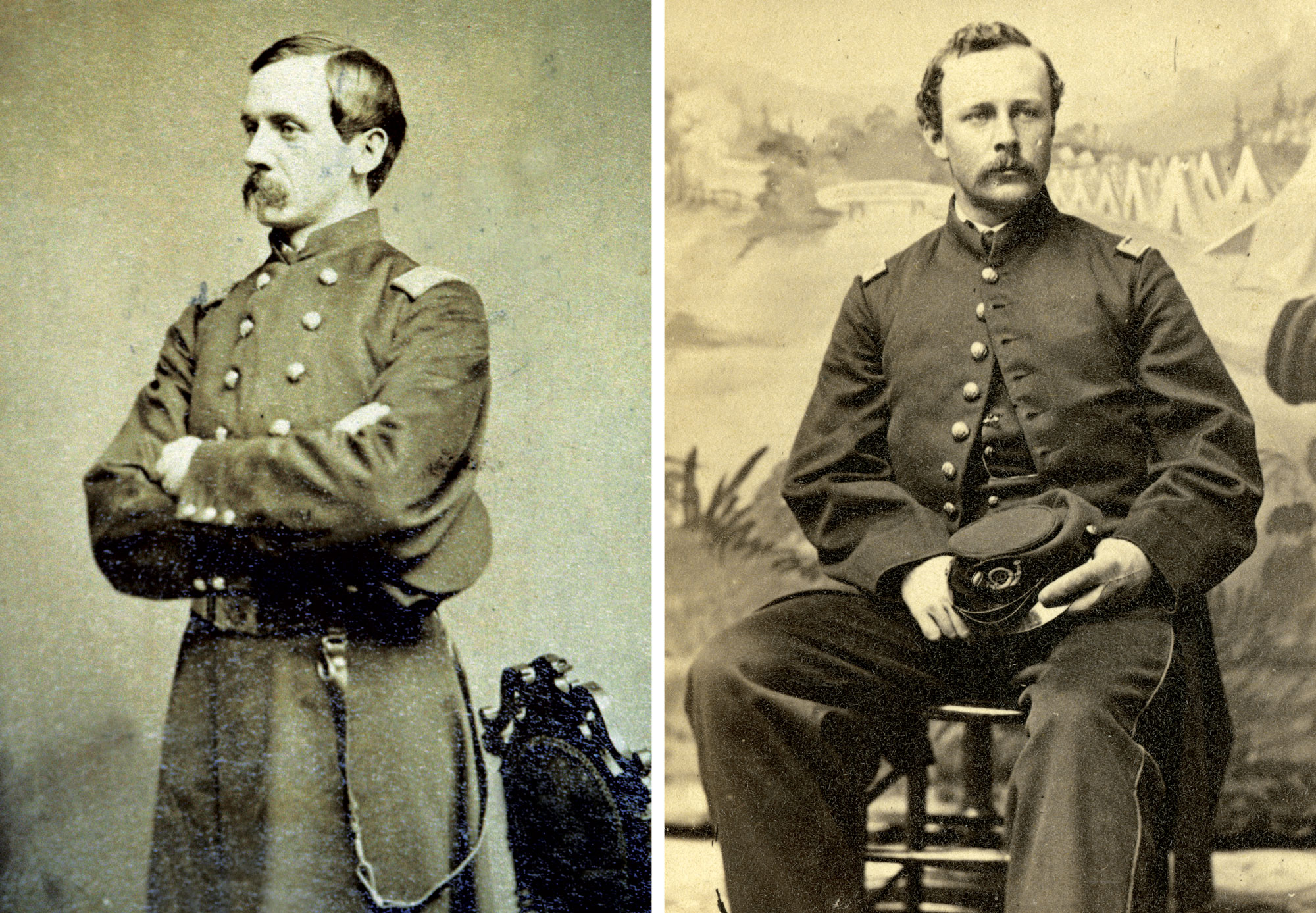 Military & Historical Image Bank (Revere); The U.S. Army Heritage and Education Center (Ropes)
Colonel Paul Revere and Lieutenant Henry Ropes
THE CHASE
By the time the 20th reached Thoroughfare Gap west of Manassas, hard information about the new campaign proved impossible to obtain. Camp talk included the possibility that Lee had reversed himself and was now marching west to join the Army of Tennessee. The men felt isolated and alone, and they grumbled about II Corps commander Winfield Scott Hancock and his long, hard slogs. On June 28, after the 20th crossed the Potomac River and swung into Monocacy Junction, Maryland, the men learned that V Corps commander George Gordon Meade had replaced Hooker as the head of the Army of the Potomac. Meade’s fine reputation was already well established, and the Bay Staters exulted in the change. Henry Ropes represented perhaps the entire regiment when he wrote to his brother of “better things to come”—but those better things were still two hard marches away.13
On June 29, the rancor of the past seemed to melt away in the rain as the men covered an astounding 30 miles. The officers proudly noted that stragglers were few and ranks were closed, although everyone—including Colonel Revere—joined in some foraging at the march’s end. The colonel had struggled mightily with his lingering malaria and Antietam injury but kept to his course during the march, an effort that deeply impressed Henry Abbott and Revere’s other rivals. As the regiment made Taneytown near midday on July 1, news that I Corps commander John Reynolds had been killed at the burgeoning conflict up ahead infused the 20th with even more determination. By day’s end, just three miles from the Pennsylvania town of Gettysburg, the Bay Staters settled into camp, old scores forgotten, new battles to fight.14
Night passed, and as the horizon brightened on July 2, Paul Revere scratched a letter to his wife. He warned her that a decisive fight seemed imminent, and he prayed, “For myself I feel that God will order what is best for all of us.” He signed it, then called his men to action.15
POSITIONS
The 20th Massachusetts—numbering around 300 men—marched second in the brigade column, which took to the adjoining fields to avoid the tangle along the Taneytown Pike. Around 6 a.m., they emerged at the base of a ridge running west of and parallel to the pike. To the north, Union troops crowded the crests of two hills. The brigade stood in line for an hour, and Abbott assumed they would soon move to support those lines. Suddenly, a flurry of riders distributing orders to the brigadiers quashed that thought. Under a barely overcast sky, the entire II Corps smartly turned left and deployed into battle line facing west on the ridge’s crest, the right flank connecting with the Federals on the westernmost of the two northern hills.16
Besides being on a modest but telling crest, the position enjoyed the protection of a sturdy stone wall typical of the area. There was one possible problem: John Gibbon’s division drew the assignment to man a section of the wall that zigzagged west then south to front a copse of trees. Gibbon placed General Alexander S. Webb’s brigade along the angle, then located three regiments of Colonel Norman J. Hall’s brigade on a line south. The wall here became a rail fence that the men threw down for protection. Perhaps reluctantly, the 20th Massachusetts formed the reserve, lying down in line about 30 yards east of the brigade and due south of the trees. Two regiments from Brigadier General William Harrow’s brigade repositioned themselves 300 yards to the front.17
Henry Abbott and Henry Ropes walked forward past the dismantled fence to get a look at their surroundings. This was good ground with open fields of fire. About 100 yards to the west on a slight rise, a Federal battery deployed. Less than a mile farther on, the Harvard men saw another ridge, tree-covered and slightly forbidding. Running in the valley between theirs and the opposing ridge was a roadway where the two regiments from Harrow’s brigade had already set up shop. Revere dispatched 30 skirmishers from the 20th in support; Abbott and Ropes watched as they angled toward a cluster of farm buildings on the roadway to the left front. Beyond the farm Abbott detected Federal supply wagons moving up the road rather leisurely. To the south, both men could see their ridge flattening into open fields and woodlots with twin hills rising about 2,500 yards away. Abbott considered the position somewhat dangerous.18
Except for intermittent rifle fire and the stray artillery report, the morning quietly drifted into the afternoon. Occasionally single aides and full staffs thundered up and down the Taneytown Pike. The II Corps’ leftmost division under John Caldwell expected General Daniel Sickles’ III Corps to come up and extend the line to the south. Instead, sometime past noon, soldiers reported elements of the III Corps engaged in some incomprehensible movements well to the south and west. Around 2 p.m., Abbott saw what seemed to be the entire left of the army moving to the west and adopting a new position. He thought it magnificent.19
Then, around 4 p.m., the unmistakable cacophony of battle began.
The army’s left was getting hit, and hard.
The noise began to roll and tumble as the battlefront grimly expanded. Dense smoke billowed, cutting off the Bay Staters’ view of the action. An hour passed, then another, and the roiling bedlam came closer, desperately so. Under orders, Caldwell’s entire division rose up and rushed into the maelstrom. Hall and Harrow were told to send two regiments apiece to join the fight. When the smoke occasionally dissipated, Abbott could see pockets of Dan Sickles’ survivors making short-lived stands against a tide of Confederate steel. Rebel shot and shell began to scour the ridge, wounding and killing some of the prone northerners. Paul Revere walked among the men, offering encouragement and comforting the wounded. Henry Ropes also rose to calm his people, but Abbott screamed at him to get down. Just then another enemy shell burst overhead. As Ropes hit the dirt, a fragment from the shell ripped through Paul Revere’s chest and lodged in his midsection. Startled calls for help quickly sounded, and soon a stretcher crew lifted up the stricken officer and bore him away.20
A horrid realization confronted the 20th: Were they witnessing the end of the Army of the Potomac?
 Military & Historical Image Bank
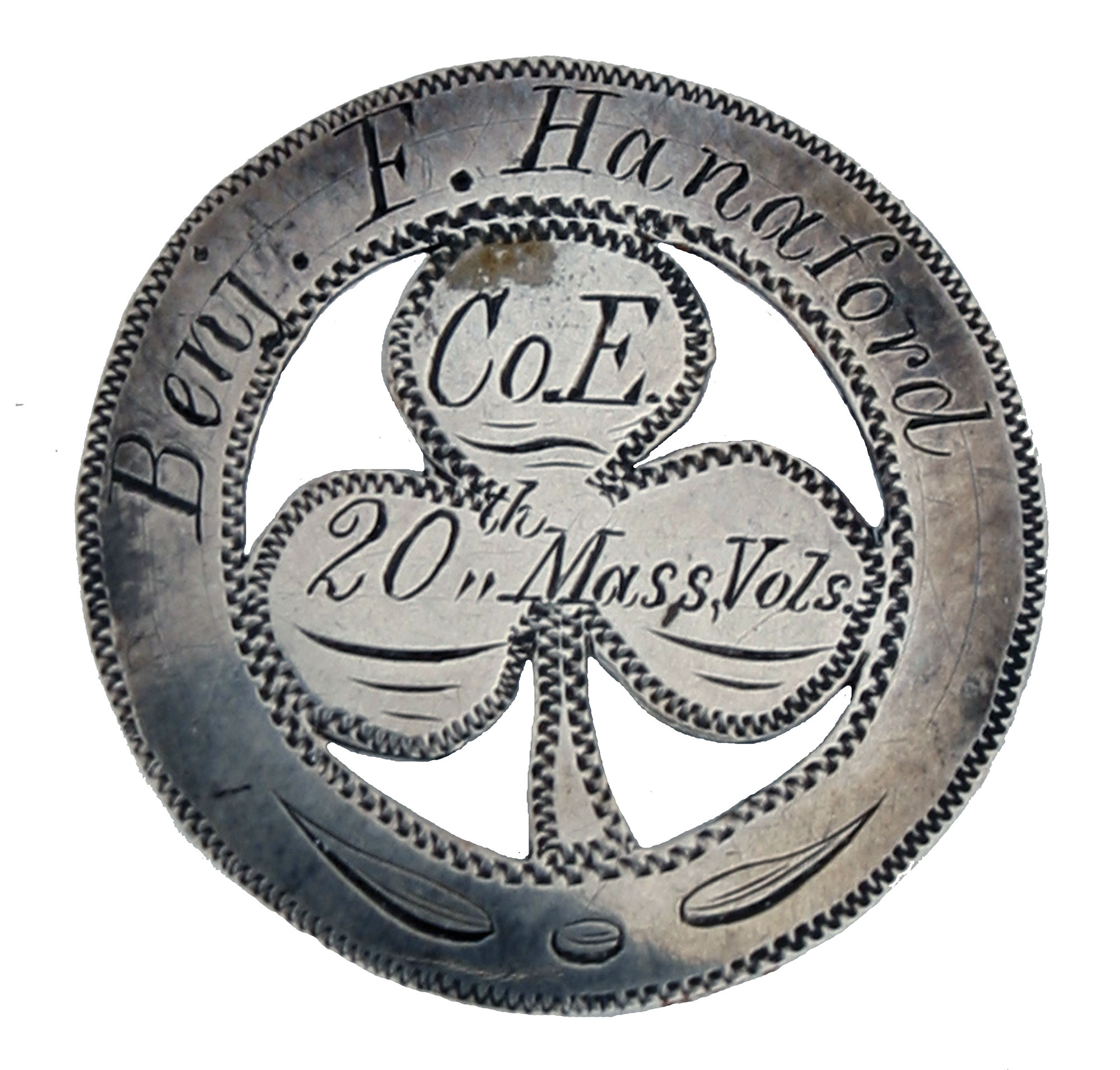
The silver II Corps badge worn by 20th Massachusetts soldier Benjamin Hanaford, who was wounded during the fighting on July 3.
ONE AMONG MANY
As the sun began to set on the turgid, smoke-filled horizon, a long Rebel battle line slid out of the darkness and crushed Harrow’s two regiments and the 20th’s skirmishers out near the farm buildings. That collapse in turn uncovered the Union battery in the field 100 yards to the west of Hall’s line and prompted its hasty retreat. Two of its guns raced through the 20th’s line and went into action directly to their rear. So near were their muzzles that the first shots burned a number of the men. The Confederate attackers followed in their wake, but the rifle fire from Hall’s remaining two frontline regiments, plus the Federals covering the copse of trees, blasted them back. But at the same time, perhaps 100 yards to the south, the Rebels plowed into the chasm left by Caldwell’s departure and muscled onto the crest of the ridge. The Rebels had pierced the Union center.21
Standing on the brink of the abyss, Henry Abbott turned toward a sublime scene. There rode the II Corps commander, Winfield Scott Hancock, with his hat in his hand. At the double-quick behind him raced two divisions of the I Corps. As Abbott and his mates cheered themselves hoarse, Hancock’s relief force surged past their position and slammed into the Confederate interlopers. The Rebels reeled and the crisis dissipated. In what seemed like a miraculously short time, the general’s timely arrival had turned disaster into victory.22
With night fully fallen, Norman Hall ordered the 20th Massachusetts to deploy as the leftmost of his three frontline regiments. While the men built a trench a foot deep and a foot high with the one shovel they could find, Henry Abbott took stock. About 10 of the Bay Staters in the main line had been killed or wounded, all by Confederate cannon fire. He counted another 10 of the skirmishers, including three officers, as additional casualties. With Revere’s severe injury, Lieutenant Colonel Macy rose to regimental command. Abbott would be his second.23
As Abbott calculated their losses, the hideous cries of the wounded and the dying filled the air. Henry Ropes’ Christian devotion drove him to action. He organized a relief party to convey the wounded from across the entire front to the rear, offering what comfort he could to Reb and Yank alike. Occasional picket fire did little to disrupt his errand of mercy. Sometime before dawn on July 3, Ropes returned to the trench.24
Four regiments now stretched north from the 20th’s right flank past the now familiar copse. An artillery section shared part of the line near the trees, and another battery deployed south of it. East of the 20th, the offending artillery from the previous day remained in place, now about 50 yards away. Behind those guns stood two more infantry regiments in support. To the south, off the 20th’s left flank, the Federal line ran as far as the eye could see, up and over the twin hills 2,500 yards away.
Near dawn, the noise of battle to the north swelled, then died. As the day brightened, desultory picket fire continued. Every now and then a stray artillery shell struck nearby. At 9 a.m., a Federal gunner decided to answer. As was his wont, Henry Ropes was reading a Charles Dickens novel when the artillerist’s reply exploded prematurely, almost directly over the 20th. A piece of shrapnel fractured a private’s arm. Another drilled into Ropes’ back and exploded through his chest. Macy and Abbott rushed to the scene, but Ropes died almost instantly. An ambulance soon drew up and carried the lieutenant’s body away.25
Ropes’ death was a single loss during a prolonged lull, an accident of fate, a cruel case of friendly fire. Perhaps that is why so many of his comrades thought the blow so heavy and cried so unabashedly.
Tears dried. Time, and the battle, moved on.
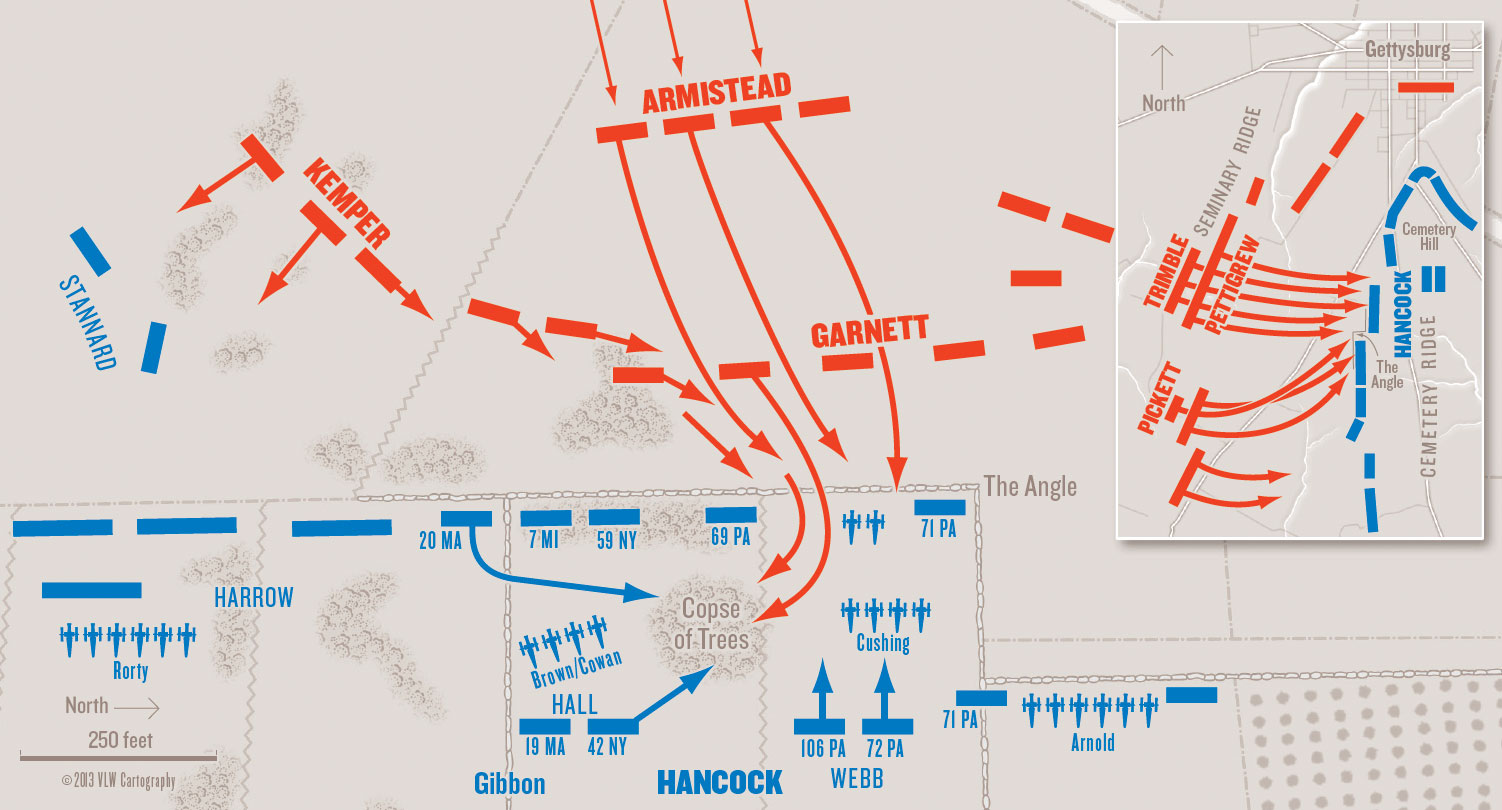
The Repulse of Pickett’s Charge | Gettysburg, Pennsylvania | July 3, 1863 – Determined to break through Union lines on the battle’s third day, General Robert E. Lee ordered three Confederate divisions—approximately 12,500 men—to advance against the Army of the Potomac’s positions on Cemetery Ridge. A massive artillery bombardment preceded the infantry attack, which launched at approximately 2 p.m. and proceeded over nearly a mile of open, undulating ground. Though decimated by Union rifle and artillery fire, the Confederate lines marched on. When the men of General George Pickett’s division—consisting of the troops of generals James Kemper, Lewis Armistead, and Richard Garnett—succeeded in piercing the Union line near a copse of trees, Union troops from other parts of the line, including the 20th Massachusetts, rushed into the breach and beat back the assault. With the charge’s failure, Lee decided to end the fight, withdrawing his army back toward the safety of Virginia.
THE LONG ROLL OF FIRE
The morning clouds soon lessened, and the July sun drove up the temperature well into the 80s. All across the Federal lines the soldiers sought shade by building shelters out of their tents, supported by whatever they could substitute for poles. Some jousting occurred at a farm west of the roadway and somewhat north of the 20th’s position. A barn burned and the opposing forces drew off. Then, as noon approached, silence.
Hancock, inspecting his lines, thought it ominous.26
Abbott, peering out at the fields, found the time terrible.
Some noticed Confederate artillery emerging from that forbidding, tree-shrouded ridge a mile to the west. Still, the silence dragged on. Then, near 1 p.m., a single Rebel gun fired off a round well to the south. Within moments, the enemy’s entire line exploded. The 20th Massachusetts got on their bellies and pressed up against their embankment.27
For the next two hours, the northerners endured a brutal, all-out bombardment, but the Sturm und Drang far outweighed the results. Within a few minutes, Macy and Abbott realized the avalanche of shot and shell was landing well behind the hunkering infantry front and doing much more damage to the artillery and the reserves well to the east. Be it a quirk of geography, poor aim, or just plain luck, the front line escaped the brunt of the storm.28
Smoke soon descended and cast an eerie pall. The world became a haze of detonation and concussion, a hallucinogenic series of barely connected events. Horses ridden and riderless streaked left and right. A caisson exploded to the north, near the copse. Some nearby guns took hits and had to be replaced. General Hancock rode across the front and offered firm words of encouragement, but many of the men realized they were in an unlikely position of safety, and some, lured by the incessant noise, fell asleep. Norman Hall thought it terrifying and grand, but Henry Abbott blessed the trench the men had dug and counted only four or five casualties among his charges.29
After two hours, the firing died off. The infantry stayed flat on the ground, but all stared to the west where the unmistakable movements of an army on the attack began to develop. From the 20th’s position, it looked like two equal forces had started to march. One seemingly rose up from the ground southwest of the farm where the pickets had fought the day before; Abbott thought this force the greater danger and quickly calculated two brigades in two lines. The other enemy formation rolled out of the trees on the ridgeline a mile directly to the west. Hall ordered his regiments to lay low and wait, but the view of the well-ordered Confederates so stirred some of the men that they cheered their enemy’s courage. That wouldn’t last. Even from this distance they could tell the assault was coming directly at them. Word passed up and down the line: This time the Federals would be defending the high ground. This would be the Union’s version of Fredericksburg.30
The temperature hit 87 degrees. Cumulus clouds drifted across the blue summer sky.
Not 400 yards to the south of the 20th, a mass of guns began to plant shot and shell in the Rebel ranks. More cannon opened from the hills anchoring the army’s flanks. Behind the Bay Staters and north near the copse, Union artillerists slammed their charges home and launched their metal at the flag-studded enemy lines. The aim was accurate, the results were obvious, but on the Rebels came.
The attackers to the southwest swept over the embattled farm and the fences lining the intervening roadway. Federal artillery shredded their right flank, causing some to slow down and face the fire, and others to bunch north and escape it. In the confusion, the Rebel formation angled northeast toward the copse, presenting what was left of its right flank to the Yankee riflemen. Still on they came.
Through the choking artillery smoke, Norman Hall, his sword in hand, began a deadly calculation. He waited until the enemy got within 200 yards of his front before barking out the order for his brigade to rise and fire. Macy, Abbott, and the regiment’s surviving officers called up their men. The 20th’s soldiers clambered to their feet, raised their muskets, took brief aim, and delivered a shivering volley.31
A wall of smoke poured from their guns and blanketed their front. Still, they could see uncounted Rebels crashing to the ground. They reloaded and sent a second volley into the gloom, then a third. Only a few shots rattled out in response, and Abbott saw four or five of his men fall. Then, as the haze cleared, they all beheld the bloody results of their work. The Rebel flags and their bearers were down. Clumps of two or three survivors ran about, panicked and disoriented, appearing to Abbott like headless chickens. The rest of the once-fearsome line either moved farther north or lay bleeding across the front, wounded, dying, or dead.32
The Bay Staters cheered wildly, with chants of “Fredericksburg! Fredericksburg!” ringing over the battle noise. Behind the lines, where Colonel Hall calmly took in this scene of victory and destruction, a member of John Gibbon’s staff—Lieutenant Frank Haskell—galloped up. Webb’s brigade defending the wall around the copse was in trouble. Could Hall assist him? Hall said he could. Haskell begged for speed. Hall said he would move at once. Haskell replied, “Good,” and watched as Hall called out for his men to prepare to move.33
Even as Hall and Haskell conferred, Lieutenant Colonel Macy tried to make out what was happening to the north. To his shock, he discovered that Rebels had broken the Federal front line and poured over the breach and into the copse of trees. Macy alerted Abbott to the danger and told him to realign the 20th to face it. Abbott ran over to Company I on the regiment’s right flank. Over the fearful noise, he tried to order them to fall back to form the right flank for the new line facing north. As the single company pulled off the front line, the rest of the regiment took their movement as orders for a general fallback. They too began to retire.
For a moment, Abbott panicked. He wondered, at this crisis of battle, would the 20th fail to pitch in to stem the gray tide? Might this be Antietam again, where the 20th was swept from the field? No. In the maelstrom, somehow Abbott drew Company I’s attention and commanded them to attack. With little regard to formation, some 30 men from Massachusetts drew up their rifles and raced with Henry Abbott toward the battle raging 100 yards away.34
 Courtesy of the U.S. Army Heritage and Education Center
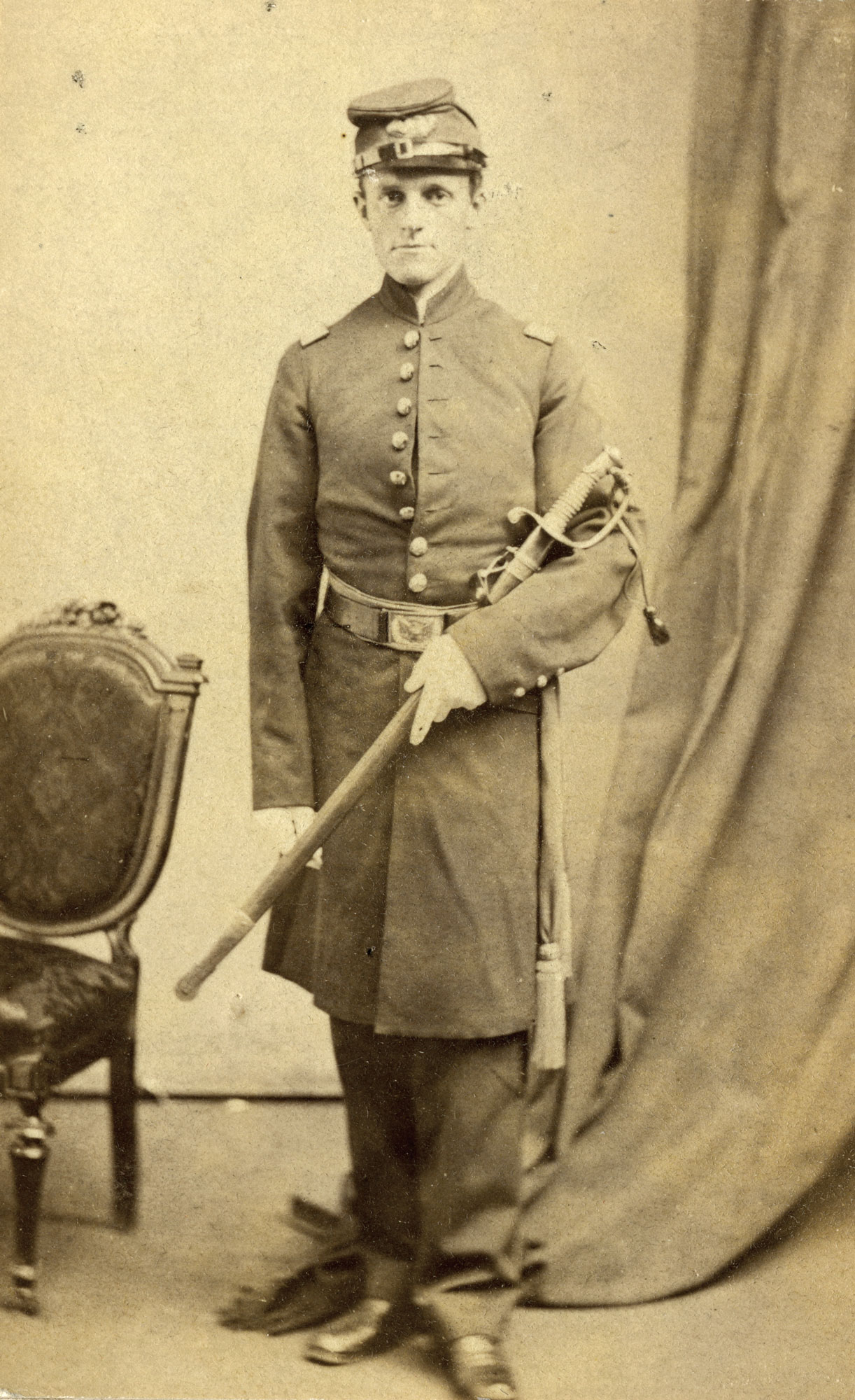
Lieutenant Colonel George Macy
THE COPSE OF TREES
Just as Macy called out for the rest of the regiment to follow Abbott, a spent shot knocked him to the ground and sent his sword flying. As more of his boys tore off for the new front, the officer struggled to his feet. Almost immediately after he righted himself, a bullet shredded his left hand, finally forcing him from the fight. Whether he knew it or not, Henry Abbott now commanded the 20th.35
Abbott sprinted along the ground just east of the Federal lines. Behind him stretched the rest of the 20th, either obeying Macy’s orders or mimicking Abbott’s heroic example. They passed Hall’s remaining two regiments, which were still exchanging blows with the Rebels in the fields to the west. Fifty yards to go, and the copse ahead seemed alive with battle, the noise deafening. Hancock and Gibbon had personally dispatched four regiments into the tangle to join Webb’s survivors in an effort to seal the breach. Already, the fighting was close quartered and brutal, a vicious, roaring slugging match, and the men were heading straight into its grip.
Abbott closed the final yards to the southwestern limit of the trees and began to feed his men into the melee. They pushed forward and found the enemy not 15 feet away. This was like nothing the men had ever seen. Rifles blazed away at point-blank range. A knot of screaming Rebels would press forward, only to be met by bullets, rifle butts, fists, and rocks. Any Federal thrust was greeted with the same. Abbott continued to direct more men into the cauldron, some from his 20th Massachusetts, others from the various Union regiments rushing to join the fight. The northerners stacked up six deep. A man would go down; another would press forward to take his place in a grinding destruction of human flesh.
 The U.S. Army Heritage and Education Center
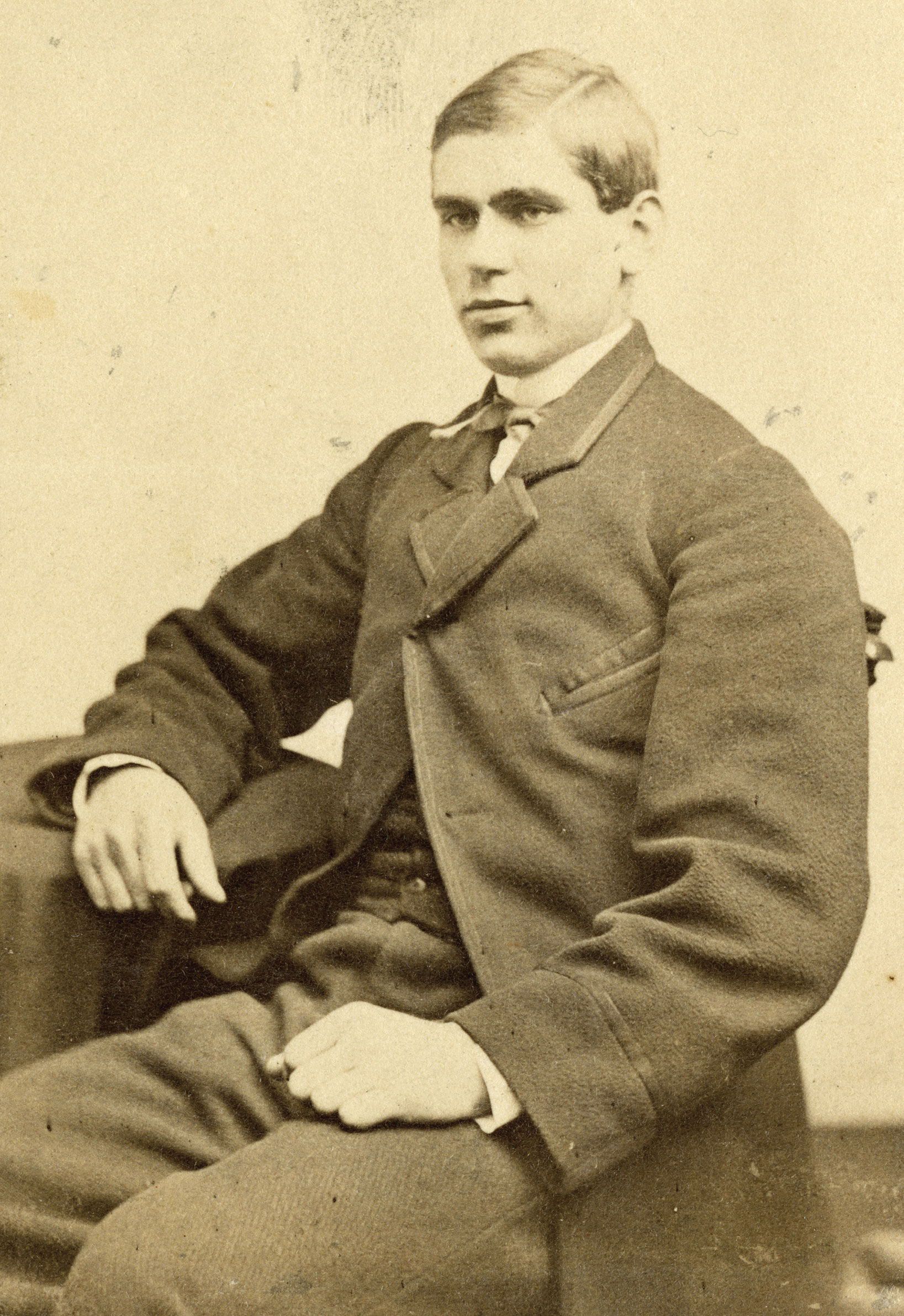
Lieutenant Sumner Paine
Lieutenant Sumner Paine raced up to the front, seemingly on fire in the excitement of the moment. With the battle swirling 15 yards ahead, the 18-year-old officer turned to a comrade and yelled, “Isn’t this glorious?” Almost immediately, a piece of shrapnel crushed his ankle and sent him sprawling, but from one knee he steadied himself and waved the boys forward. Two bullets then creased his chest, killing him.36
Among the smoke-shrouded branches and leaves, Union weight finally began to tell. The Rebels started to fall back, first through the trees, then up against the low stone wall they had captured 15 minutes before. Abbott admired their courage but grimly watched as his men shot the dead-enders down. Soon, most of the Rebels clambered over the wall and started the long march back across the valley. Those who stayed surrendered.37
henry abbott gathered what was left of his regiment. He counted 100 effectives. Only he and two other officers remained standing.
With the crisis over, the men of the 20th moved back to their original position. The next day, July 4, the entire army marked the birth of the country, a celebration made even more electric by the victory at Gettysburg and the news of the Confederate surrender of Vicksburg, Mississippi. The Bay Staters also learned that Paul Revere had died of his horrid wound.
Eventually Abbott calculated that in the two days at Gettysburg, 31 of his men had been killed and 93 wounded. Another three had gone missing. Around 90 of the casualties occurred in or near the copse of trees, a fight that lasted 15 minutes. Such numbers would have shocked the sensibilities of many, but for the 20th Massachusetts, it was a simple matter of duty.38
After all, battle was in their blood.
Epilogue
Late in the morning on May 6, 1864, the 20th Massachusetts again was swept up in the inferno of battle, this time in the Wilderness west of Chancellorsville, Virginia. Caught in a terrible crossfire, George Macy—who had returned from his Gettysburg wounds to lead the regiment—went down with a shattered knee. Moments later, Henry Abbott—who had commanded the 20th in Macy’s absence—took a slug in his abdomen. Macy would survive and eventually rise to provost marshal of the Army of the Potomac, but Henry Abbott died that afternoon.
Oliver Wendell Holmes Jr. had taken a staff position with the VI Corps and was near the front when he heard of Abbott’s death. Two months later he left the army for good, tired of the war he once embraced. He would become a successful Boston lawyer, then a justice of the United States Supreme Court, but the 20th Massachusetts and his friend Henry Abbott were never far from his mind. He published a poem about Abbott in October 1864, and on Memorial Day 20 years later, he again recalled his comrades with words that have taken on a life of their own: “The Generation that carried on the war has been set apart by its experience. Through our great good fortune, in our youth our hearts were touched with fire.”39
Patrick Brennan, a member of the Monitor’s editorial advisory board, is the author of Secessionville: Assault on Charleston (1996). A music producer based in Chicago, he has co-written two major television works, Fields of Fire: The Civil War in 3D for Discovery/SONY (2011) and Inside World War II for National Geographic (2012), as well as the music for over 250 broadcast documentaries.
Notes
1. Richard F. Miller, Harvard’s Civil War: The History of the Twentieth Massachusetts Volunteer Infantry (Hanover and London, 2005), 29, 34-35.
2. Ibid., 35.
3. Ibid, 51-83, for the 20th’s action at Ball’s Bluff; Mark de Wolfe Howe, ed., Touched With Fire: Civil War Letters and Diary of Oliver Wendell Holmes, Jr. (Cambridge, 1946), 23-27, for Holmes’ wounding and subsequent thoughts of suicide; Robert Garth Scott, ed., Fallen Leaves: The Civil War Letters of Major Henry Livermore Abbott (Kent, OH, 1991), 73-74, for Abbott’s self-discoveries under fire.
4. See Stephen W. Sears, To The Gates of Richmond (New York, 1992) for an overview of the Peninsula Campaign; Miller, Harvard’s Civil War, 127-131, 135, 147-151.
5. See Stephen W. Sears, Landscape Turned Red (New York, 1983) for an overview of the Antietam Campaign; Miller, Harvard’s Civil War, 139, 170-176; Richard Miller and Robert Mooney, The Civil War: The Nantucket Experience (Nantucket, 1994), 76-77; Howe, Touched With Fire, 64-66.
6. Miller, Harvard’s Civil War, 182-183.
7. See Frank O’Reilly, The Fredericksburg Campaign (Baton Rouge, 2003) for an overview of the campaign and battle; Miller, Harvard’s Civil War, 199-206, 208-213; Miller and Mooney, The Nantucket Experience, 87-90.
8. Scott, Fallen Leaves, 149, 152, 163-165.
9. Miller, Harvard’s Civil War, 218-220, 244; Scott, Fallen Leaves, 178-179.
10. See Stephen Sears, Chancellorsville (New York, 1996), for an overview of the campaign and the battle; Miller, Harvard’s Civil War, 233-237; Howe, Touched With Fire, 92-94. Holmes would not return to the regiment after his wounding.
11. Miller, Harvard’s Civil War, 244-246; Scott, Fallen Leaves, 178-183.
12. Miller, Harvard’s Civil War, 247-249.
13. Ibid., 250-252.
14. Ibid., 253-254.
15. Paul Revere to Lucretia Revere, July 2, 1863, Revere Family Papers, 1746-1964, Massachusetts Historical Society, Boston, Massachusetts.
16. Miller, Harvard’s Civil War, 256; Henry Abbott to John Ropes, August 1, 1863, in Reports, Letters & Papers Appertaining to 20th Mass. Vol. Inf. Vol. 1, (accessed March 29, 2013; hereafter cited as “Abbott to Ropes, August 1, 1863”).
17. Harry Pfanz, Gettysburg: The Second Day (Chapel Hill, 1987), 376-377.
18. Miller, Harvard’s Civil War, 257; Abbott to Ropes, August 1, 1863.
19. Miller, Harvard’s Civil War, 257.
20. Ibid., 258, 260.
21. Pfanz, Gettysburg: The Second Day, 381-389.
22. Miller, Harvard’s Civil War, 269; Abbott to Ropes, August 1, 1863.
23. Abbott to Ropes, August 1, 1863.
24. Miller, Harvard’s Civil War, 262.
25. Ibid., 264.
26. United States War Department, The War of the Rebellion: A Compilation of the Official Records 129 vols. (Washington, 1880-1901), Series I, Vol. 27, 372 (hereafter cited as OR).
27. Abbott to Ropes, August 1, 1863.
28. Ibid.
29. OR, Series I, Vol. 27, 437; Abbott to Ropes, August 1, 1863.
30. Abbott to Ropes, August 1, 1863.
31. OR, Series I, Vol. 27, 439.
32. Ibid., 445; Scott, Fallen Leaves, 188.
33. Frank A. Haskell, The Battle of Gettysburg, ed. by Bruce Catton (New York, 1958), 107-108.
34. Abbott to Ropes, August 1, 1863.
35. Miller, Harvard’s Civil War, 271.
36. Edwin R. Root and Jeffrey D. Stocker, “Isn’t This Glorious!”: The 15th, 19th, and 20th Massachusetts Volunteer Infantry Regiments at Gettysburg’s Copse of Trees (Bethlehem, PA, 2006), 36.
37. Abbott to Ropes, August 1, 1863.
38. OR, Series I, Vol. 27, 447.
39. Holmes speech on Memorial Day, May 30, 1884, https://speakola.com/ideas/oliver-wendell-holmes-memorial-day-speech-1884 (accessed June 4, 2026).