 National Portrait Gallery
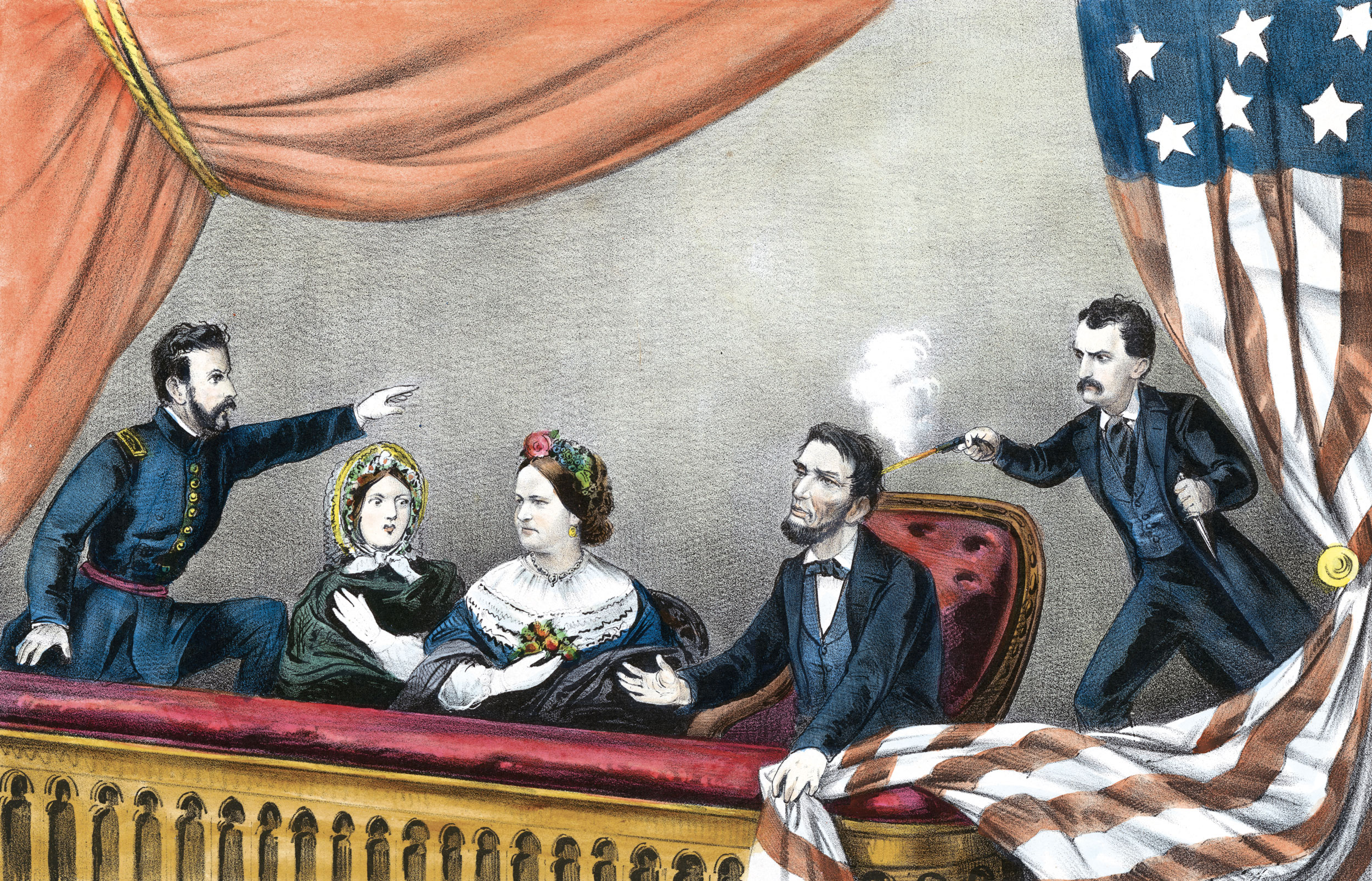
In this Currier & Ives lithograph, John Wilkes Booth shoots President Abraham Lincoln at Ford’s Theatre on the night of April 14, 1865. After Lincoln’s death the next morning, doctors wasted little time in performing an autopsy.
It was Good Friday, April 14, 1865, in Washington, D.C., when President Abraham Lincoln, his spirits elevated after the surrender of Robert E. Lee’s Army of Northern Virginia five days earlier, decided to attend the play Our American Cousin at nearby Ford’s Theatre. Arriving late, he and his wife, Mary, took their seats in the Presidential Box to a round of applause from the audience.
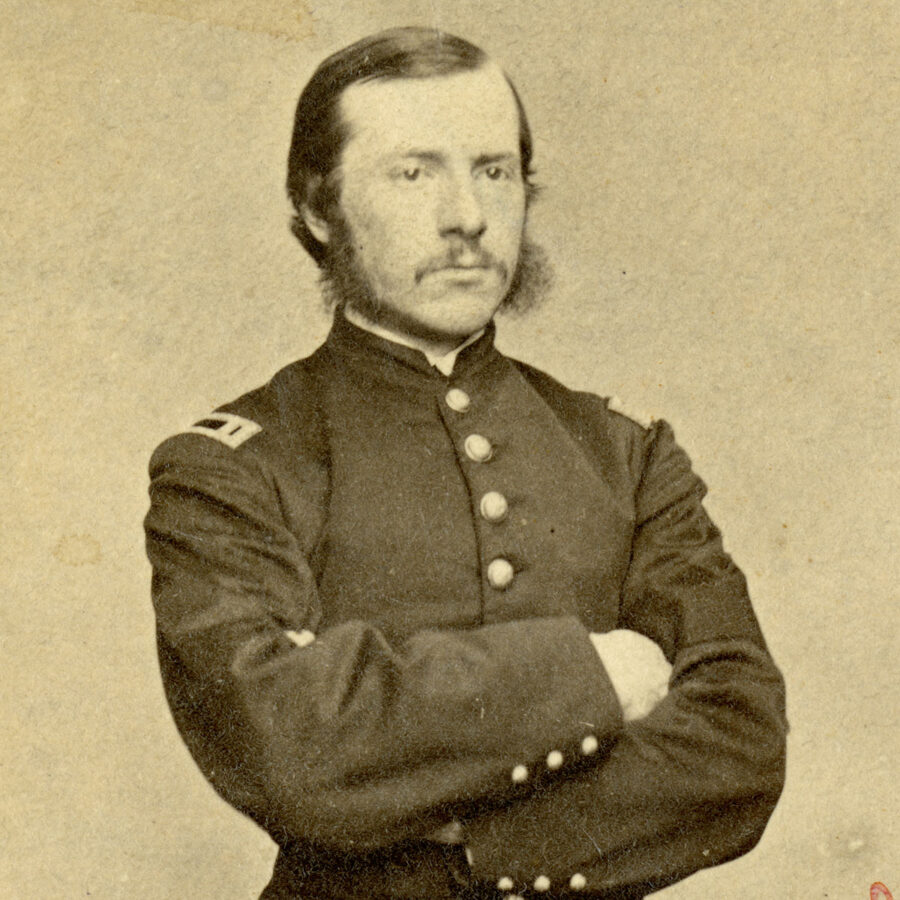
During the performance, at approximately 10:30 p.m., actor John Wilkes Booth silently slipped into the box and fired a single shot into the back of Lincoln’s head, then leapt onto the stage and escaped out a back door. The outburst of screams prompted a young military physician in the audience, Dr. Charles Leale, 23, to run to the box hoping to render aid.
 Library of Congress
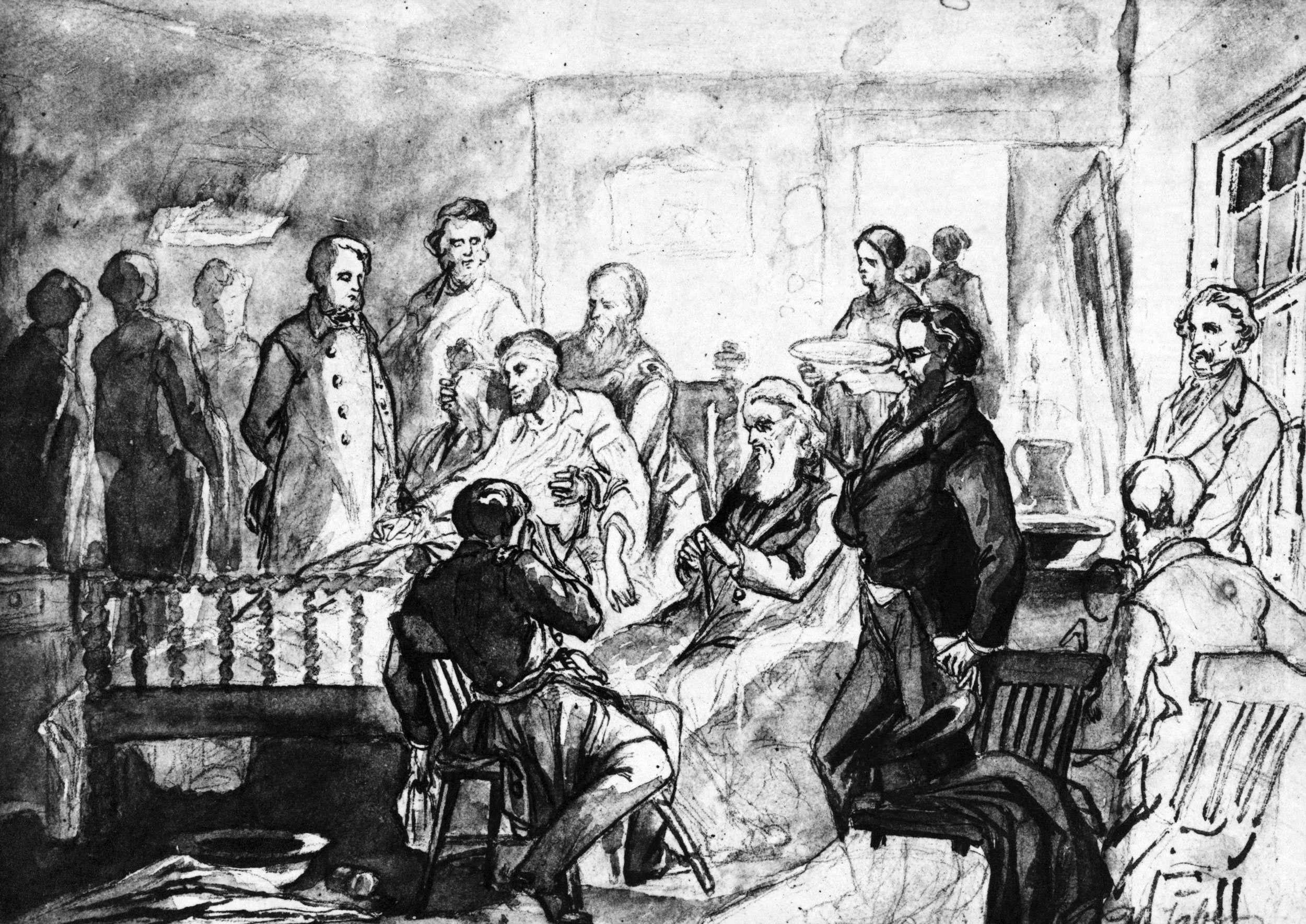
The mortally wounded Lincoln was transported across the street to a room in the home of William Petersen. Hermann Faber, an artist on the surgeon general’s staff, made this and another sketch of the scene in the room before it was cleared.
Only six weeks out from his medical school graduation, Leale helped lay the president on the floor and searched for his injury—at first thinking it was a shoulder wound because of the blood on Lincoln’s shirt, but quickly discovering the wound in the back of the skull. Other physicians began arriving in the box, and after a quick consultation, they decided to move the stricken president to a suitable location.
With Lincoln comatose and his breathing labored, Leale recognized the president would not survive the seven blocks back to the White House, suggesting instead he be taken to a house across the street. Four soldiers from the Independent Pennsylvania Artillery who had attended the play offered to help, gently picking Lincoln up by the torso and legs while the physicians cradled his head and shoulders. Exiting the theater onto a street filled with a shocked crowd, the group noticed a man standing at the top of the stairs at a house across the road, holding a candle and beckoning them to come his way.1
It was the home of William Petersen, a tailor who lodged borders in the house’s upper rooms, one of whom, Henry Stafford, was the man with the candle. The men carried Lincoln to the house, where Stafford directed them down a narrow hall to a small back bedroom. While trying to lay the president on a bed, it became apparent that his 6-foot-4-inch frame was too long except to fit on the diagonal with his head and shoulders supported by pillows.
They stripped Lincoln of his clothes, looking for other injuries, and finding none covered him with blankets. Noticing the president’s lower extremities were “very cold from his feet to a distance several inches above the knees,” Leale instructed that hot water bottles and warm blankets be applied to Lincoln’s legs and abdomen.2
 National Library of Medicine
Dr. Charles Leale
The physicians knew from the start that it was a fatal wound and only a matter of time before death would occur. The only treatment they had, and which simply prolonged the inevitable, was to periodically dislodge the clotted blood from the entrance wound so blood could flow out, decreasing pressure on the respiratory center in the brain and allowing Lincoln to temporarily breathe more easily.
A solemn vigil continued through the night with dozens of sorrowful people going in and out of the small room to view the dying president while doctors constantly monitored Lincoln’s heart rate and respiration. Then at 7:22 a.m. on April 15, 1865, nine hours after Booth had fired the fatal shot, Abraham Lincoln breathed his last.
With the president dead and his killer on the loose, Secretary of War Edwin Stanton was collecting evidence linking Booth to the assassination. A murder had been committed and so the Surgeon General of the Army, Dr. Joseph K. Barnes, determined that a “postmortem examination of the remains” was indicated “as might be necessary to establish officially the fact of death by homicide.” He would have members of his staff perform the autopsy back at the White House.3
Lincoln’s nude body was carefully wrapped in an American flag and placed in a newly made-to-fit wooden casket. A contingent of cavalry from the Union Light Guard then escorted a hearse bearing the casket along rain-soaked streets back to the Executive Mansion.
Upon arrival at the White House, the military guard carried Lincoln’s body to a second-floor bedroom in the northwest corner of the mansion, known at the time as the Prince of Wales Room after the British royal had stayed there during an 1860 visit. A framework of boards constructed in preparation of the autopsy dominated the room, except for “a large heavily-curtained bed” known today as the Lincoln Bed, even though Lincoln never slept in it and it was not used during the autopsy. The soldiers placed the body on the board frame. This was the same bedroom in which Lincoln’s beloved son Willie had died, probably of typhoid fever, three years earlier, and ever since which Mary Lincoln had refused to enter. She stayed in a room across the hall during the autopsy.
 Gift of the Medical Society of the County of Kings, National Museum of American Histor
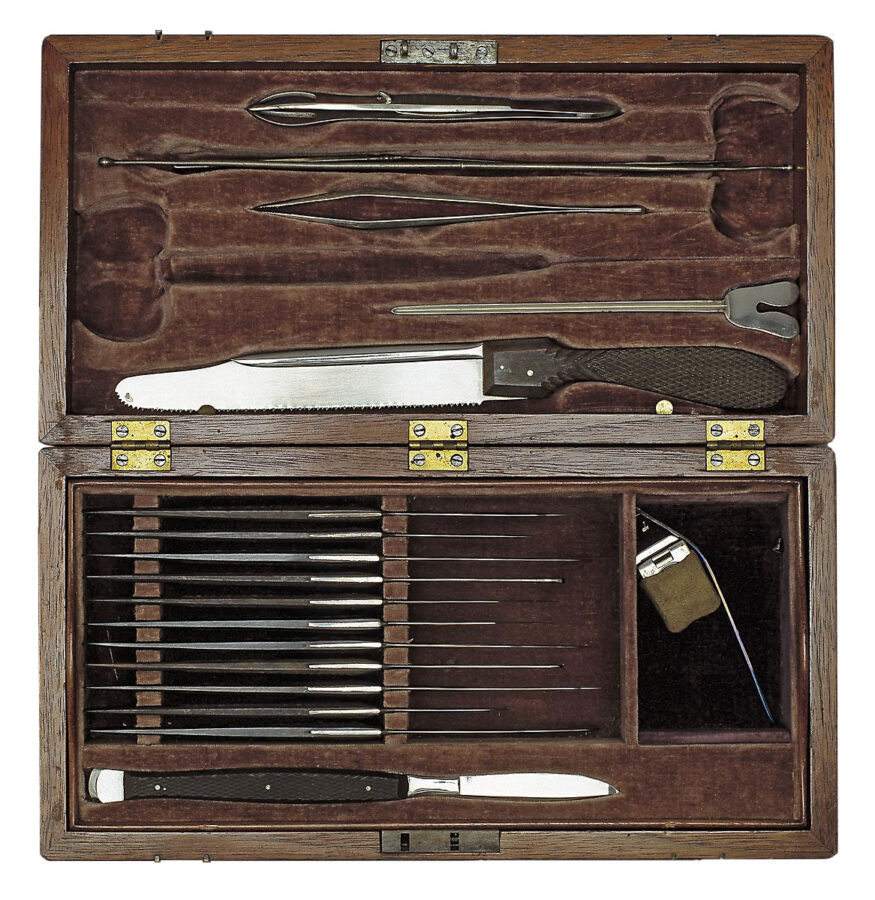
The surgical instruments Woodward used at the autopsy.
Barnes designated U.S. Army Assistant Surgeon Dr. J. Janvier Woodward to perform the postmortem examination. Working as what today would be called a pathologist, Woodward was responsible for the collection of medical reports and specimens from military physicians for the Army Medical Museum in the capital (which in 1949 would become the Armed Forces Institute of Pathology and is now the National Museum of Health and Medicine). Assistant Surgeon Edward Curtis, who worked alongside Woodward at the museum, would assist him with the autopsy.
Several other physicians, including Dr. Barnes, were present as observers: Robert K. Stone, the Lincoln family doctor; U.S. Army Assistant Surgeon Charles S. Taft; and Assistant Surgeons William M. Notson and Charles H. Crane, both members of the surgeon general’s staff. It was Dr. Stone’s intention to invite other physicians to view the examination, but finding “everything had been advanced” so rapidly he was not afforded time to do so.4
Who, besides the physicians, were in the room at the time remains unclear. Lincoln’s personal friend and former U.S. Senator Orville Browning was apparently present because he recorded some details of the procedure in his personal diary. Major General Daniel Rucker of the Quartermaster Department, who had procured the casket, may have been in the room. Thirty years after the fact, Dr. Lyman Beecher Todd, cousin to Mary Todd Lincoln, reported that he and another individual witnessed the autopsy. Although Dr. Todd was present for a time at the Petersen House, neither he nor his friend’s presence at the autopsy is mentioned in any of the accounts of those who were there. Some newspaper accounts erroneously reported Andrew Johnson, Lincoln’s vice president, as being in attendance.5
Seeing the “cold and immovable” body that lay before him as he entered the bedroom, Dr. Curtis voiced surprise at Lincoln’s physique. In life, he thought the president’s “spare, slightly stooping figure” gave the impression of a tall but not muscular man. Yet in seeing the corpse, he discovered “well-rounded muscles built upon strong bones, and perfectly outlined beneath a clear skin free of underlying fat.” Earlier at the Petersen House, Secretary of the Navy Gideon Welles had been similarly impressed by Lincoln’s sturdy frame, noting in his diary: “His large arms, which were occasionally exposed, were of a size which one would scarce have expected from his spare appearance.”6
 National Library of Medicine
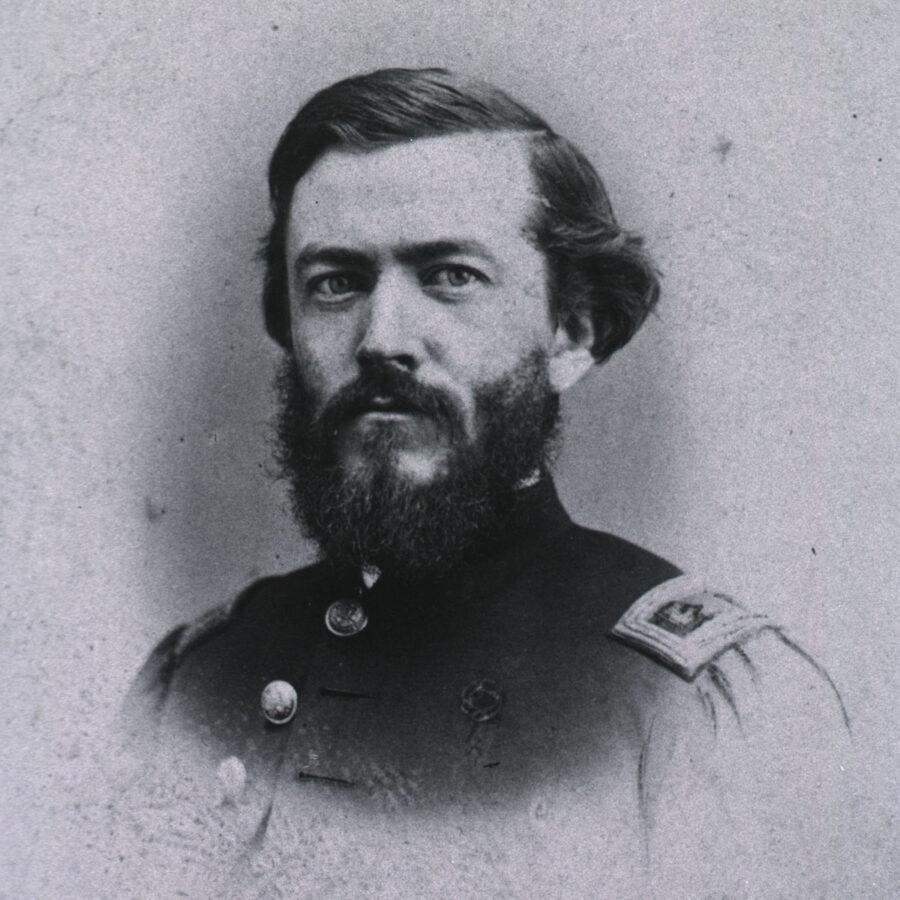
U.S. Army Assistant Surgeon Dr. J. Janvier Woodward (pictured above) began the autopsy on Lincoln precisely at noon on April 15, 1865. Upon seeing the president’s corpse, one physician assisting in performing the autopsy was surprised by Lincoln’s impressive physique, his “well-rounded muscles built upon strong bones, and perfectly outlined beneath a clear skin free of underlying fat.”
With the audience assembled and the instruments ready, Dr. Woodward started the autopsy at precisely 12 p.m. He began by describing the outward appearance of the president’s face. He noted the eyelids and surrounding parts were very much bruised, with the eyes themselves “somewhat protuberant from effusion of blood into the orbits.”7
Turning then to the entrance wound at the back of the skull, Woodward described the scalp as thickened by hemorrhage into the tissues. The opening was a “clean cut gaping slit through the scalp,” with the hair around the wound being “not in the least burnt,” according to Dr. Stone—indicating the gun barrel had been at least 3 to 4 feet away at the time of discharge; otherwise the muzzle flash was likely to have seared the surrounding hair and left tattoos of powder in the skin.8
Taking a scalpel, Woodward continued by splitting the scalp from ear to ear across the head. The scalp was then pulled forward and laid over the face to expose the skull, the top of which was removed by using a small chisel and saw to uncover the brain.
With the skull cap removed, a more detailed examination of the entrance wound revealed the ball had penetrated the occipital bone in the back of the skull 1 inch to the left of midline. The hole was circular in shape with smooth and beveled edges as if made “with a sharp punch.” As it passed through the thick bone, the bullet produced a larger hole on the inside surface of the skull than on the outside, an effect typical of exit wounds.
Woodward then used a surgical knife to slice and remove thin sections of the brain from the top down to locate the track of the ball. Finding it in the left hemisphere of the brain, he noted the path was full of clotted blood, with the brain tissue around it being “pulpy” or “pultaceous and livid from capillary hemorrhage.” A small piece of the ball that had broken off as it exited the inside surface of the skull was also found near the orifice.9
Details of the autopsy findings, particularly documentation of the bullet’s path through Lincoln’s brain, come primarily from notes Woodward wrote immediately upon completion of the procedure and that he would later use to complete his official report to the surgeon general. Additional specifics are provided in the writings of Dr. Stone, who took his own careful notes on sheets of paper from a blank prescription pad. Both describe the ball as entering the brain just above the left lateral sinus (a large vein inside the back of the skull) and travelling forward into the left posterior lobe of the cerebrum (one of the two large hemispheres of the brain).10
From there the bullet traveled through a fluid-filled cavity in the brain called the left lateral ventricle before stopping just above the left corpus striatum (a bundle of nerves in the anterior brain that regulate body movement and cognition). Besides the small piece of ball found near the entrance wound, the track also contained several fragments of bone that broke from the skull as the bullet ploughed into the brain—with two of the larger pieces being found 2 1/2 and 4 inches from the entrance, respectively.
The bullet entering the left side of the skull presents an interesting situation from a ballistics standpoint: Lincoln must have been looking away from the stage at the moment he was shot. He sat in a rocking chair in a corner of the box from which the stage would have been below right and the chair was probably angled somewhat rightward. Entering through the first door of the box behind the president would have placed Booth to the right of the chair, a position in which only that side of Lincoln’s head would be visible to the assassin. For the bullet to enter the left side of the skull, Lincoln must have been looking the other way, to his left, when Booth pulled the trigger. There is at least one witness (and possibly two) to that point.
 Library of Congress
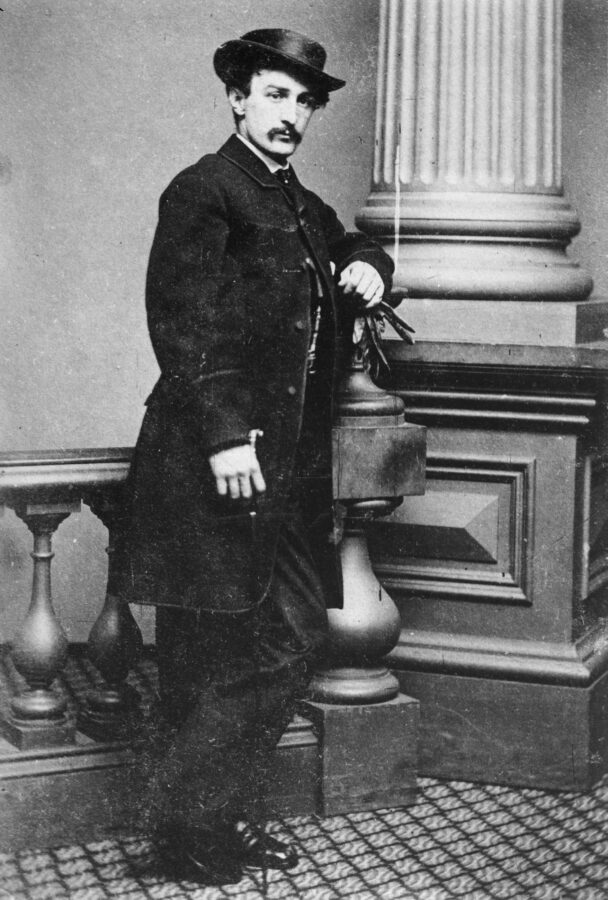
John Wilkes Booth
James P. Ferguson, a local restaurant owner who was in the audience, testified during the conspirators’ trial that he was gazing at the Presidential Box when Booth fired his derringer. “At the moment the President was shot,” Ferguson said, “he was leaning his hand on the railing, looking down at a person in the orchestra; holding the flag that decorated the box aside to look between it and the post. I saw the flash of the pistol right back in the box.” The orchestra pit was below left from Lincoln’s seat, and in order for the left side of his head to be facing Booth, he must have been positioned similarly to what Ferguson describes.11
Isaac G. Jaquette, another man in the audience, also testified that Lincoln was “leaning forward” past an intervening flag a few minutes before the pistol fired. The New York Herald reported, “But a moment before the attack was made, the President was leaning forward, resting his head on his hand in his accustomed careless way….”12
Although able to observe the bullet’s path, the postmortem physicians did not see the ball itself lodged at the end of its track. Having sliced the brain down as far as possible with it still in the skull, Woodward determined the entire organ would need to be removed to locate the bullet and determine its final resting point. But as Dr. Curtis slowly lifted the brain from the skull cavity, the ball suddenly “dropped out through my fingers and fell, breaking the solemn silence of the room with its clatter, into an empty basin that was standing beneath”—the result of which meant the final location of the ball would remain unknown.13
Examination determined it was .41-caliber bullet and had become flattened in shape as it passed through the thick occipital bone of the skull. Using his penknife, Dr. Stone marked it for future identification by carving the president’s initials “A.L.” into the soft lead. He later sealed the bullet in an envelope that he gave to Secretary Stanton after the autopsy. Placing Stone’s envelope in another with his own signature, Stanton kept the bullet until the military trial of the conspirators, where the envelopes were opened, and the ball entered as evidence.14
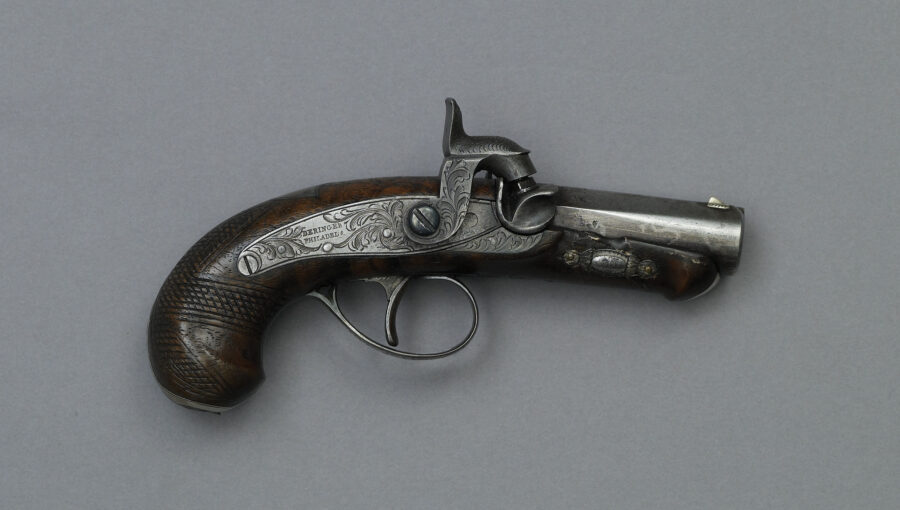
The single-shot Philadelphia Deringer Booth used—and dropped in the box after firing it—had a .44-caliber rifled barrel. To muzzle-load such a weapon, the diameter of the bullet had to be at least slightly smaller than that of the barrel, which is why the fatal ball was .41-caliber in size. Because of the size difference, Booth would have wrapped the round ball in a “patch,” likely a piece of cloth, to seat it in the barrel and keep it from rolling out.
Woodward finished the autopsy by recording the presence of blood under the dura mater (a thick tissue that surrounds the brain) on both the right and left sides, along with fractures in the bones that form the roof of the eye sockets, the fragments of which were “pushed upwards toward the brain.” He ended his report noting both orbits were “gorged with blood.”15
The finding of fractures in both eye sockets with the fragments pushed up when the bullet did not strike them or the anterior portion of the skull led to some follow-up discussion in the contemporary medical community as to how that could occur. One unsupported hypothesis proposed that the wounded president fell forward and struck his face on the railing of the box. The most prevalent theory, and the one printed in several newspaper accounts at the time, was that the fractures were contrecoup (or, counter strike) injuries.
The contemporary explanation of a contrecoup injury held that the force of the bullet striking the back of the skull caused a deformation in the bone itself, the force of which was transferred forward with sufficient energy to cause the secondary fractures in the thin bones of the eye sockets. The bone fragments were then pushed up into the skull cavity by the engorged blood in the orbits.
The closest explanation at the time as to what happened was a speculation that a sudden impulse in the brain tissue occurred as the bullet entered the organ and the forward force caused the brain itself to strike and fracture the orbital plates.
 Library of Congress
The bullet John Wilkes Booth fired entered the left side of Lincoln’s skull, indicating that the president must have been looking away from the stage at the moment Booth pulled the trigger. Above: the .44-caliber derringer pistol Booth used to assassinate Lincoln.
Modern ballistic experimentation has shown that as a bullet enters soft tissue, the velocity produces a wave of positive and negative pressures that alternate through the wound track. In an enclosed area such as the skull cavity, the cavitations of a pressure wave in the gelatinous tissue of the brain can cause a brief vacuum-like phenomena to occur in the skull, the degree of which is proportional to the speed of the bullet. Although the derringer Booth used had a relatively low muzzle velocity, weapons of similar power can produce enough of a pressure wave to fracture the paper-thin bones of the superior orbital plates and possibly pull the fragments up into the skull cavity.16
Toward the end of the autopsy, Mary Lincoln sent word across the hall requesting a lock of her husband’s hair from the physicians. Dr. Stone cut a portion of strands for her from near the entrance wound, then took the liberty of cutting additional segments for himself and fellow physicians in the room.
With the postmortem completed, Dr. Curtis suggested Lincoln’s brain be weighed as discussions concerning the comparative brain sizes of men known for intelligence was a matter of debate in 19th-century science. After carefully washing the brain, he tried to obtain an accurate measurement of its weight. An unknown amount of brain tissue had been lost as blood drained from the open wound in the now more than 14 hours since the assassination, resulting in a weight total “so low as to suggest the probability of serious error,” according to Curtis. Although he did not record the weight, Curtis opined that even with allowances made for the missing tissue, Lincoln’s brain was not above the average size for someone of his stature.17
What then happened to Lincoln’s brain remains a matter of conjecture. Apart from the suspect narrative of Dr. Todd, none of the autopsy accounts document whether the brain was replaced back into the skull or disposed of. Because it was removed, the brain would not have been preserved with the embalming of the body after the autopsy and would have decayed over time if placed back into the skull. Nevertheless, in reference to the care and respect taken to preserve Lincoln’s body, and nothing about it being noted, the assumption is typically made that the brain was placed back inside the skull instead of left behind in pieces after the autopsy.
With the postmortem complete, the skull cap was replaced, followed by the scalp being pulled back and sewn into place, effectively hiding the fact that an examination had taken place. As the doctors left, an embalmer entered to prepare Lincoln’s body for burial.
 National Library of Medicine
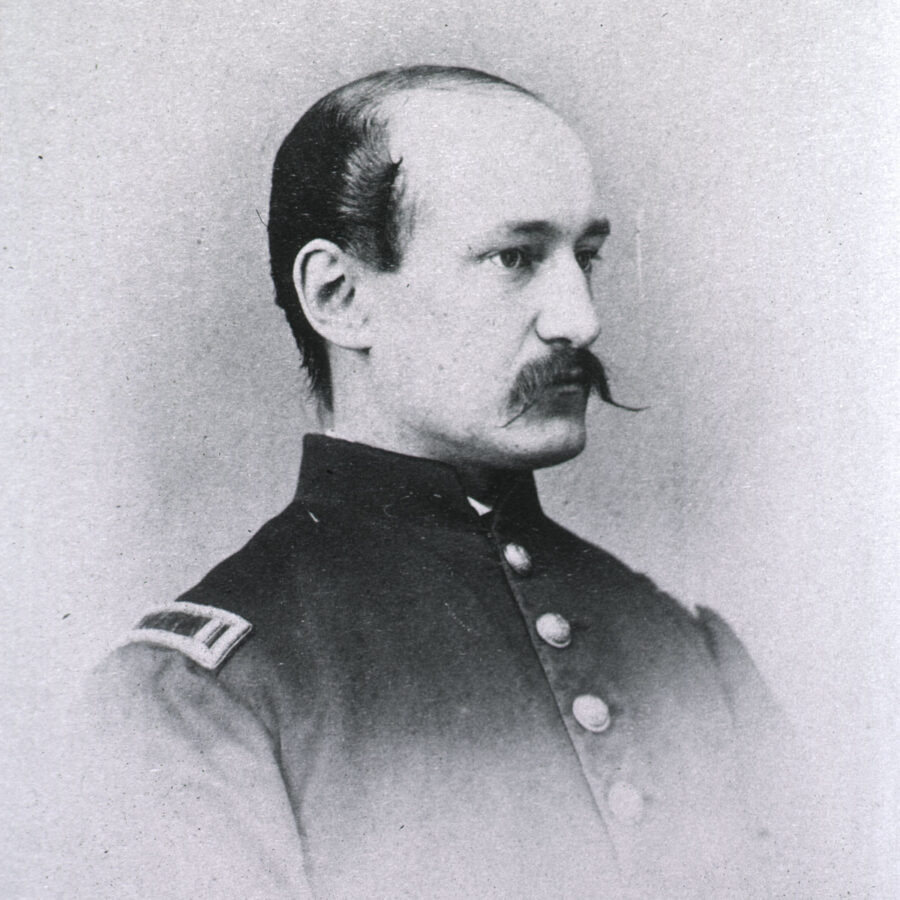
 Dr. Edward Curtis
In the weeks to months following the autopsy, a discrepancy emerged concerning the bullet’s path through Lincoln’s brain. Dr. Taft—who has the distinction of being the only physician present at Ford’s Theatre, the Petersen House, and at the autopsy—made his own personal notes that day after the autopsy. Contrary to what Drs. Woodward and Stone recorded as to the ball’s final position on the left side of the brain, Taft’s account notes the track of the ball extended “from the external wound in the occipital bone obliquely across from left to right through the brain to the anterior lobe of the cerebrum immediately behind the right eye.”18
A week later, on April 22, 1865, an article written by Taft detailing Lincoln’s last hours and the autopsy appeared in the medical journal The Medical and Surgical Reporter. In accordance with his notes, Taft describes the bullet’s path as traveling from left to right across the brain and ending “immediately behind the right orbit.” But this contradicts something earlier in the same article.
When detailing the hours spent at the Petersen House, Taft recounts that at 2 a.m. Surgeon General Barnes inserted a silver probe through the wound in the president’s head in an effort to determine the bullet’s location in the brain. The first probe was too short, so a longer Nélaton probe was obtained. This type of probe was designed to locate a lead bullet as it had an unglazed porcelain ball at the end of the probe. When an obstacle was encountered in a bullet track, the tip of the probe was rubbed against the object and then examined. If the obstacle were lead, small gray marks were found on the porcelain indicating the bullet had been located, whereas a bony object would leave no marks.
After Dr. Barnes had passed the Nélaton probe approximately 5 inches along the track, “the ball was distinctly felt,” according to Taft (although he also reports that no marks were made on the porcelain tip), and slightly beyond that, at the end of the track, the “fragments of the orbital plate of the left orbit were felt” (emphasis added).
Taft admits in the article that “some difference of opinion existed as to the exact position of the ball” following the probing, “but the autopsy confirmed the correctness of the diagnosis upon first exploration.” He, however, had described the probing as indicating the bullet track ended on the left side, while later writing in the same article that the autopsy revealed the ball had stopped behind the right orbit.
To make Taft’s versions more puzzling, in his personal notes written after the autopsy, he did record that the probe “struck the orbital plate of the right orbit,” but the entry was crossed through with a pencil at some point afterward, and unless it was a misprint, was obviously changed to the left orbit for the article. In another journal article by Taft in 1893, which is largely a reproduction of the 1865 article, the inconsistency persists without correction. The reason for the discrepancy in Taft’s writing remains unanswered.19
Several newspapers that briefly reported on the autopsy, and whose source of information was likely to have been Taft, as the wording is almost identical to his, also report the bullet’s track as crossing over to the right side. Yet those accounts are no less confusing, as several of them also describe later in the same article the bullet being lodged in the “west” or left hemisphere of the brain.20
Surgeon General Barnes added to the controversy during his testimony in the 1867 trial of conspirator John Surratt, in which he recalled the autopsy showing the ball ranged “forward and upward toward the right eye, lodging within half an inch of that organ.”21
The surgeon general’s recollection, however, was not always in line with what happened during the autopsy. When asked at the trial if any marks were put on the ball during the postmortem, Barnes replied, “Not that I know of.” Yet Dr. Stone had clearly marked the ball with the president’s initials at the autopsy and he acknowledged such two years earlier when he identified the bullet during his testimony in the first conspirators’ trial in May 1865.
Barnes’ testimony at the Surratt trial is also the source of the often-repeated belief that the fatal bullet was made not of lead but of the harder substance Britannia, a tin, antimony, and copper alloy. But when Dr. Stone had been asked by the prosecutor in the May 1865 trial if it was “a leaden ball,” he replied: “Yes, sir, a hand made ball, from which the tag on the little end had been cut by hand.”22
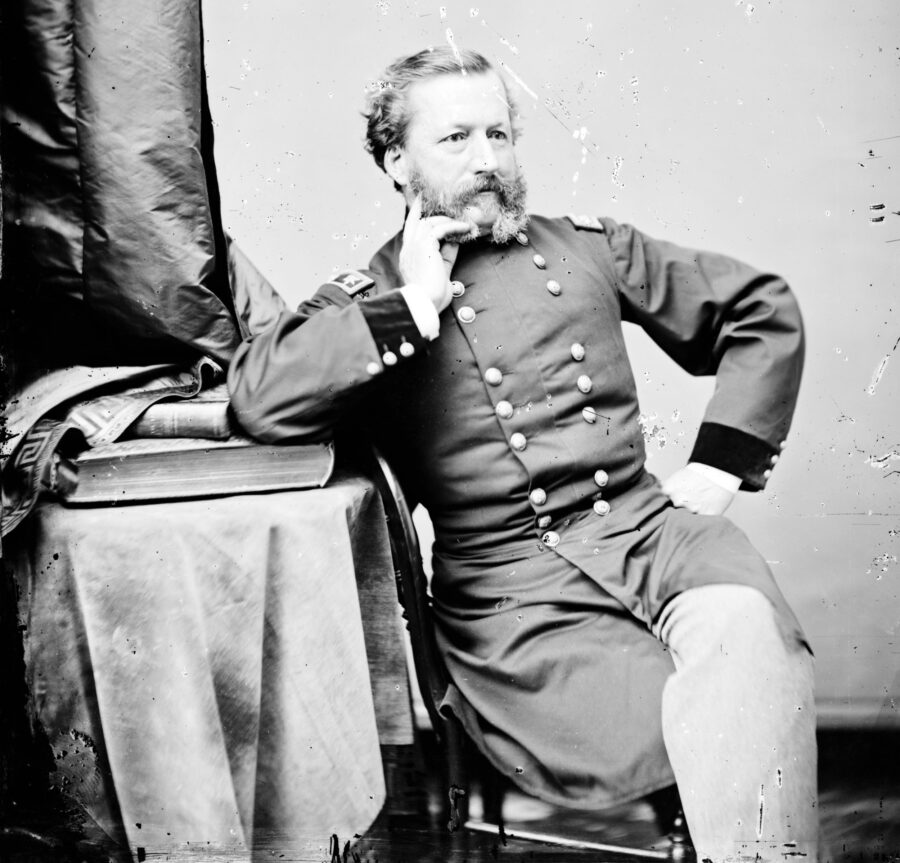 Library of Congress
After the autopsy, discrepancies emerged about the bullet’s path through Lincoln’s brain. Surgeon General Joseph K. Barnes (above) added to the controversy when, at the trial of John Surratt, he stated that the bullet had ranged “upward toward the right eye”—contrary to the conclusions of Drs. Woodward and Stone that the ball had lodged in the left side of the brain.
Browning’s diary entry for April 15, 1865, tells of his arrival at the White House that morning along with his own observations of his friend Lincoln’s body. In his brief description of the autopsy, he relates the bullet entered the brain and ranged “upward and transversely in the direction of the right eye.” In contrast, although neither is mentioned as being present during the postmortem, John Nicolay and John Hay, Lincoln’s personal secretaries, held in their later writings that the ball entered the left side of the skull and “passing through the brain, had lodged just behind the left eye.”23
Dr. Curtis, who assisted Woodward in performing the autopsy, was less precise in describing the bullet’s path in his writings. In an April 22, 1865, letter to his mother recounting the event, he wrote the ball entered the left side of the skull and passed “almost directly forwards” through the brain where it lodged—perhaps a tacit indication it had not crossed to the other side.24
Applying modern forensic science knowledge to the postmortem lends support to the ball having remained on the left side of the brain. When a bullet penetrates bone, it bevels out the bone in the direction in which it is traveling. The fact that the entrance wound in Lincoln’s skull was “circular in shape” with smooth edges, as if made “with a sharp punch,” would indicate the bullet struck the skull straight on instead of at an angle. Thus, the trajectory of the ball would have it moving “directly forwards” as Curtis writes, instead of at an angle that would take it across the brain to the right side.25
Beginning in 1870, the U.S. Surgeon General’s office began publication of the six-volume work The Medical and Surgical History of the War of the Rebellion—a vast compilation of medical statistics and case reports from both the Union and Confederate armies. The first surgical volume published in 1870 contains the report of Lincoln’s death and autopsy without using his name, the identification being simply “A.L.” Included in the report is a reference to the 1865 writings of “Acting Assistant Surgeon C.S. Taft” published in The Medical and Surgical Reporter, whereby the volume editor attempts to put the debate to rest by noting “among other inaccuracies, the reporter describes the ball as passing into the right hemisphere [of the brain].”26
In the end, Dr. Woodward’s postmortem report, which is supported by modern forensic science, remained the official autopsy record: President Abraham Lincoln died on April 15, 1865, as a result of a single derringer bullet that entered the left side of his brain through the back of the skull, traveling forward and lodging in the same-side anterior portion of the cerebrum.
Mathew W. Lively is a practicing internal medicine physician in Morgantown, WV. He is the author of several articles on medical history and his book Calamity at Chancellorsville: The Wounding and Death of Confederate General Stonewall Jackson was published by Savas Beatie in 2013.
Notes
1. Frank Reeves, “The Pittsburgh Soldiers Who Carried the Dying President,” Pittsburgh Post-Gazette, April 12, 2015.
2. Charles Leale, “The Assassination and Death of Abraham Lincoln, President of the United States,” Records of the Adjutant General’s Office, National Archives, Washington, D.C.
3. Edward Curtis, “The Autopsy in the Case of President Lincoln,” Ida Tarbell Collection, Pelletier Library, Allegheny College.
4. Robert K. Stone. “Abraham Lincoln’s Final Hours, Death, and Autopsy,” undated manuscript, Shapell Manuscript Foundation.
5. Lyman Beecher Todd, “An Account of Two Visits to Abraham Lincoln; His Last Hours—The Autopsy,” Ida Tarbell Collection, Pelletier Library, Allegheny College.
6. Curtis, “Autopsy in the Case of President Lincoln”; Diary of Gideon Welles, Secretary of the Navy Under Lincoln and Johnson Volume II (New York, 1911), 286.
7. George A. Otis, ed. “Case – A.L.” Medical and Surgical History of the War of the Rebellion, Part I, Vol II (Washington, 1870), 305–306 (hereafter cited as MSHWR; all references are to Part 1, Vol. II).
8. Ibid; Stone, “Abraham Lincoln’s Final Hours.”
9. Otis, MSHWR, 306.
10. J. Janvier Woodward. “Autopsy of President Abraham Lincoln.” Handwritten notes dated April 15, 1865. Fenimore Art Museum, Cooperstown, NY; Robert K. Stone. “Notes Autopsy of Pres. Lincoln.” Handwritten notes dated April 14, 1865. Fenimore Art Museum, Cooperstown, NY.
11. Brad Pitman, ed., “Testimony of James P. Ferguson,” in The Assassination of President Lincoln and the Trial of the Conspirators (New York, 1865), 76.
12. William C. Edwards, Edward Steers, eds., “Testimony of Israel Jaquette,” The Lincoln Assassination: The Evidence (Illinois, 2009); New York Herald, April 16, 1865.
13. Curtis, “Autopsy in the Case of President Lincoln.”
14. Pitman, ed., “Testimony of Dr. Robert King Stone,” The Assassination of President Lincoln and the Trial of the Conspirators, 82.
15. Otis, MSHWR, 306.
16. Vincent DiMaio, Gunshot Wounds: Practical Aspects of Firearms, Ballistics, and Forensic Techniques (Boca Raton, 2016), 233.
17. Curtis, “Autopsy in the Case of President Lincoln.”
18. Charles S. Taft, “Notes of the Circumstances Attending the Assassination of Abraham Lincoln.” Handwritten notes dated April 15, 1865, Joseph N. Nathanson Collection, McGill University
19. Ibid.
20. Chicago Tribune, April 19, 1865; The New York Times, April 17, 1865; Baltimore Sun, April 17, 1865.
21. “Testimony of Joseph K. Barnes,” Trial of John H. Surratt in the Criminal Court for the District of Columbia (Washington, 1867), 121.
22. Pitman, ed., “Testimony of Dr. Robert King Stone.”
23. James G. Randall, ed., The Diary of Orville Hickman Browning, Vol II (Springfield, 1933), 20; John G. Nicolay and John Hay, “Abraham Lincoln: A History,” Century Illustrated Monthly Magazine, Vol XXXIX (January 1890): 435.
24. Curtis, “Autopsy in the Case of President Lincoln.”
25. DiMaio, Gunshot Wounds, 100.
26. Otis, MSHWR, 305–306.
Related topics: Abraham Lincoln