Mayhem at the Mule Shoe Battles and Leaders of the Civil War
The noise filtered through the morning darkness, rain, and fog. The officers and men of Brigadier General Samuel McGowan’s brigade by now knew instinctively that the tearing sound of musketry and boom of cannon fire portended a summons. They had not long to wait until marching orders arrived at about daylight on Thursday, May 12, 1864, outside Spotsylvania Court House, Virginia.1
The South Carolinians filed into columns, stepping out around 6 a.m. in “a torrent of rain,” according to one of them. If an onlooker had asked who they were, to a man the answer would likely have been that they were the finest soldiers in the country’s finest army. They had fought on many of the eastern theater’s bloodiest fields, but as they moved north away from the crossroads village toward the fighting, these veterans could not have known that ahead of them waited something beyond their experience. What they could hear conjured a terribleness unlike any other during the Civil War.2
 Library of Congress
At the Battle of Spotsylvania Court House, Samuel McGowan (above), a lawyer before the war, commanded a brigade of South Carolina regiments that had been raised by Maxcy Gregg and led by him until his death in December 1862.
Organized fully as a brigade in June 1862, McGowan’s command comprised five infantry regiments: the 1st, 12th, 13th, and 14th South Carolina and the 1st South Carolina Rifle Regiment (or Orr’s Rifles). Brigadier General Maxcy Gregg commanded the brigade at its formation. A wealthy lawyer in Columbia, South Carolina, before the war, Gregg had advocated strongly for disunion. Individuals who knew the short, stocky, slightly deaf officer described him as dignified and elegant, with an erect, distinctive bearing. He proved a formidable fighter and capable brigadier.3
Gregg’s officers and men served in Major General A.P. Hill’s Light Division. The South Carolinians had distinguished themselves in 1862 during the Seven Days Battles, in particular at the Confederate victory at Gaines’ Mill, where Gregg’s bravery and leadership moved one of his men to call him “the sublimest spectacle I ever saw.” The weeklong series of engagements cost the brigade 939 casualties, the second-highest total of any brigade in the army.4
Two months later at Second Manassas, Gregg’s South Carolinians anchored the left flank of Thomas J. “Stonewall” Jackson’s defensive line behind an unfinished railroad bed. At one point on August 29, during repeated Union assaults against them, Gregg told his troops, “Let us die here, my men, let us die here!” His troops held and, on the next afternoon, a Confederate counterattack from the army’s right front swept the Federals from the field.5
Some three months later, Gregg was dead. Riding in front of the 13th South Carolina at Fredericksburg, he apparently mistook charging Union troops for retreating Confederates. A minie ball struck his spine, and the wounded general was taken to a nearby residence. Jackson visited him before he died two days later on December 15. In January, McGowan of the 14th South Carolina was promoted over two senior colonels in the brigade.6
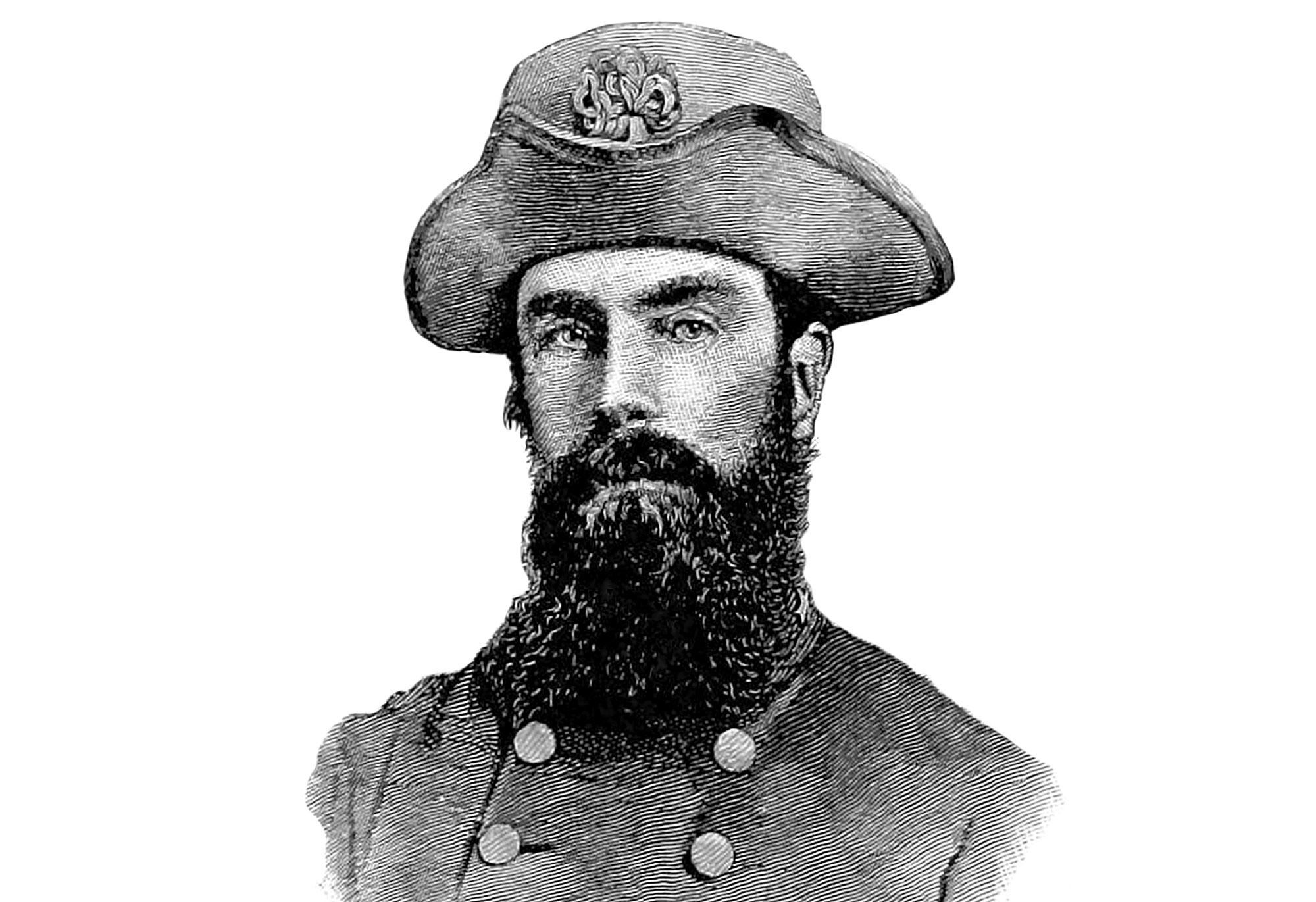 Battles and Leaders of the Civil War
Maxcy Gregg
Like Gregg, McGowan had practiced law before the war. He served as a volunteer quartermaster and staff officer during the Mexican War. When the Civil War began, McGowan served as a staff officer until he was appointed lieutenant colonel of the 14th South Carolina. He was promoted to colonel in the spring of 1862 and led the regiment during the Seven Days Battles. Hill cited McGowan in his report for McGowan’s conduct at Gaines’ Mill and Glendale. Severely wounded at Second Manassas, McGowan missed the Antietam Campaign.7
McGowan distinguished himself in the fighting at Fredericksburg, moving a North Carolina soldier to describe him later as “that gallant & jolly South Carolina gentleman (which means everything that is noble, brave & good).” With his promotion to brigadier after Gregg’s death, he led the brigade at Chancellorsville, where on May 3, 1863, he suffered a serious leg wound. Colonel Abner Perrin of the 14th South Carolina commanded the brigade in the Gettysburg Campaign and during operations in the fall and early winter. McGowan returned to active duty in late February 1864. A large man, weighing 260 pounds, he now needed a cane when he was on foot.8
In McGowan’s absence, his South Carolinians had demonstrated further their prowess in battle. At Gettysburg on July 1, they charged with other units, routing Union ranks on Seminary Ridge. They bragged afterward that they had been the first Confederate troops to enter Gettysburg’s town square. Perrin claimed that Robert E. Lee told him the brigade was the best in the Army of Northern Virginia.9
Upon his return, McGowan saw that his brigade and their fellow soldiers had been suffering a difficult winter in campsites south of the Rappahannock and Rapidan rivers. Shortages of rations for the men and feed for the horses and mules plagued the army. North of the streams lay the winter camps of their old nemesis, the Army of the Potomac. Around their evening fires, both armies awaited spring and the renewal of active campaigning. They shared a common belief that the coming struggle would end the conflict—every man certain that their cause would prevail.10
The reckoning came on a bright spring day, May 4, 1864, when 119,000 Federals began crossing Ely’s and Germanna fords on the Rapidan. Lee reacted by marching his Second and Third infantry corps toward the enemy. The clash occurred the next day in the Wilderness of Spotsylvania, a demonic landscape of stunted trees and congested underbrush. The fighting centered on two roads, Orange Turnpike and Orange Plank Road. In the words of a Yankee, the combat became “a blind and bloody hunt to the death, in bewildering thickets rather than a battle.”11
McGowan’s South Carolinians served in Major General Cadmus Wilcox’s Third Corps division. Wilcox’s four brigades joined with Major General Henry Heth’s division in a late afternoon assault along Orange Plank Road. The Confederates advanced through the woods toward the Brock Road intersection. “McGowan’s brigade swept through the Wilderness like a tornado,” Wilcox said, “driving everything before it—far in advance of the line—and had to be recalled.”12
Darkness halted the fighting, but Wilcox’s and Heth’s ranks were badly intermingled and close to the enemy. That night at Union headquarters, General-in-Chief Ulysses S. Grant, who had accompanied the army, decided to seize the tactical initiative, ordering a dawn attack along both roads. Hill’s chief of staff said later, “We expected an attack in overwhelming numbers at the first blush of dawn.”13
Minutes before 5 a.m. on May 6 more than 30,000 Union officers and men assailed Wilcox’s and Heth’s disorganized ranks, routing them. Lee rode into the midst of the fleeing troops and encountered McGowan. “My God, General McGowan,” he exclaimed, “is this splendid brigade of yours running like a flock of geese.”
“General Lee, the men are not whipped,” McGowan replied. “They only want a place to form, and they will fight as well as ever they did.”14
The timely arrival and fierce counterattack by two divisions of James Longstreet’s First Corps saved Lee’s army from perhaps a decisive defeat. An afternoon assault by Longstreet’s troops ended the fight along the plank road, while to the north Richard Ewell’s Second Corps veterans had repulsed the enemy offensive. Combined casualties in the two-day engagement exceeded 28,000.15
The armies marched away from “the deeply hated Wilderness” on the night of May 7, angling southeast toward Spotsylvania Court House. The Confederates won the race to the crossroads village by the narrowest of margins, blocking the Union advance at Laurel Hill. Clashes ensued as the armies converged throughout the day and into the night of May 8. Veterans in both armies erected fieldworks along their lengthening lines.16
After dark, Major General Edward Johnson’s division of Ewell’s Second Corps arrived, extending the army’s lines farther to the east and halting on a thickly wooded rise. They were on Woodshaw Farm, a 600-acre property owned by Neil McCoull, a prosperous farmer. He was absent, probably on business, but his three sisters—Eliza, Mary, and Milly—occupied the clapboard house that lay 300 or 400 yards behind Johnson’s men.17
Johnson had ordered his exhausted and hungry troops to begin work on earthworks, but most of them ignored the instructions and slept. Construction began the next morning with the men using their bare hands, plates, tin cups, and canteen halves to dig. Some men took up axes to hew pine and oak trees. Refinements to the works would continue until May 11. When completed, the log and dirt breastworks stood 4 feet high, with a 2-foot trench behind them. They built steps and added a head log with a firing slot. A series of three-sided traverses, built of felled trees and dirt and running perpendicular to the main works, finished the constructed defenses.18
The completed earthworks formed, in the words of a Georgia officer, “an awkward and irregular salient to the northward.” The salient extended more than a half-mile deep with a width near the McCoull house of about 1,160 yards, or less than three-quarters of a mile, and covered approximately 250 acres of ground. Slight curves or angles marked the east and west ends of its 300-yard broad, flat apex. Major General Robert E. Rodes’ division held the works on Johnson’s left, and from Rodes’ left flank to the end of Johnson’s right flank the defenses extended for more than two miles. Soldiers dubbed the crescent-shaped salient a “horse shoe” or “mule shoe.” History labeled it the Mule Shoe.19

A Union attack on the western face of the Mule Shoe on the evening of May 10, led by Colonel Emory Upton, encouraged Ulysses S. Grant that another, greater assault could break the Confederate defenses. Above: Upton’s May 10 attack, as depicted in an illustration from Battles and Leaders of the Civil War.
Lee inspected the position and bulge in his lines on the morning of May 9, meeting with Ewell, to whom he allegedly said: “This is a wretched line. I do not see how it can be held.” The Second Corps commander argued that if they abandoned the rise, the enemy would seize the higher ground for artillery. Lee yielded, directing that artillery batteries be placed in the salient in support of the infantry and that a reserve line of works be built at the salient’s base. It was, however, Lee’s initial judgment that proved correct.20
An infantryman in the salient understood the Mule Shoe’s vulnerabilities, noting, “It was so liable to be enfiladed by artillery and would be a dangerous trap to be caught in should the line be broken on the left or right.” Confederate artillerist E. Porter Alexander considered it “a piece of bad engineering, certain to invite an attack as soon as the enemy understood it.”21
Although the Federals did not know the size of the Mule Shoe, the length of the works, and the number of infantry and artillery defenders within the position, their initial attack came on the evening of May 10. A dozen infantry regiments stacked in four lines, under the command of Colonel Emory Upton, crossed roughly 150 yards of open ground, striking the works of a smaller bulge—later called Doles’ Salient—along the Mule Shoe’s western face. Upton’s veterans scattered the ranks of Brigadier General George Doles’ North Carolina brigades. The oncoming Yankees widened the breach, penetrated deeper into the Mule Shoe, and overran a battery. Confederate reserves counterattacked, blunting the assault, and reclaiming the works. Upton ordered a withdrawal.22
News of Upton’s brief success convinced Grant that another assault with a larger force could succeed in breaking Lee’s defenses. Reconnaissance by his staff officers yielded scant intelligence on the Mule Shoe and its defenders. On the afternoon of May 11, Grant designated Major General Winfield Scott Hancock’s four II Corps divisions as the main attack force, with Major General Ambrose Burnside’s IX Corps joining in. Grant sent his instructions to the army’s commander, Major General George G. Meade. He expected the assault for 4 a.m., Thursday, May 12.23
Lee, meanwhile, had been receiving reports from signal officers, scouts, and skirmishers that indicated a possible enemy movement away from Spotsylvania Court House. He rode to Ewell’s headquarters at the Edgar Harrison house located south of the salient’s reserve works. While he was there, he received a dispatch from his son, Major General William H.F. “Rooney” Lee, reading: “There is evidently a general move going on. Their [Burnside’s] trains are moving down the Fredericksburg Road, and their columns are in motion.”24
If Grant were moving south once more, as he had done on May 7, Lee wanted to pursue, either barring the route toward Richmond or attacking the enemy columns. His son’s dispatch convinced Lee that Grant was undertaking such a movement. To expedite his army’s march, Lee ordered the withdrawal of 29 cannon from the salient, replacing them with two batteries of eight cannon. The reports of an enemy withdrawal, however, “proved erroneous.” The artillerist Alexander observed later, “The withdrawal of these guns was the one fatal Confederate blunder of this whole campaign.”25
The 20,000 officers and men of Hancock’s II Corps gathered at the John and Elizabeth Brown farm, located about three-quarters of mile north of the Mule Shoe’s broad apex. The march in the darkness and rain to the farm proved to be “the worse march we had to endure up to this time,” according to a veteran officer. “It was so dark that it could almost be felt,” an enlisted man remembered. They lay down on the wet ground and tried to sleep.26
Hancock met with three of his four division commanders—Francis Barlow, John Gibbon, and David Birney. Information on the Confederate defenses and the nature of the terrain remained uncertain. As Hancock reported later, they determined the direction of the assault with a compass, toward “a large white house [McCoull’s] known to be inside the enemy’s works near the point we wished to attack.” Rain and fog delayed the advance until 4:35 a.m.27
In the Mule Shoe, meanwhile, reports of “unusual movements” to the north from scouts and skirmishers kept filtering into the salient. One message stated, “there was a steady rumbling in front, indicating that a large force was being massed in front or passing around to our right.” Johnson became convinced that the Federals were planning to attack his position and persuaded Ewell to order the return of the artillery batteries. Johnson then directed his approximately 4,000 officers and men into the trenches an hour or so before daylight.28
Uncertain of the terrain surrounding the Confederate defenses, Union II Corps commander Winfield Scott Hancock focused his May 12 attack toward “a large white house [McCoull’s] known to be inside the enemy’s works.” Shown above: The McCoull house.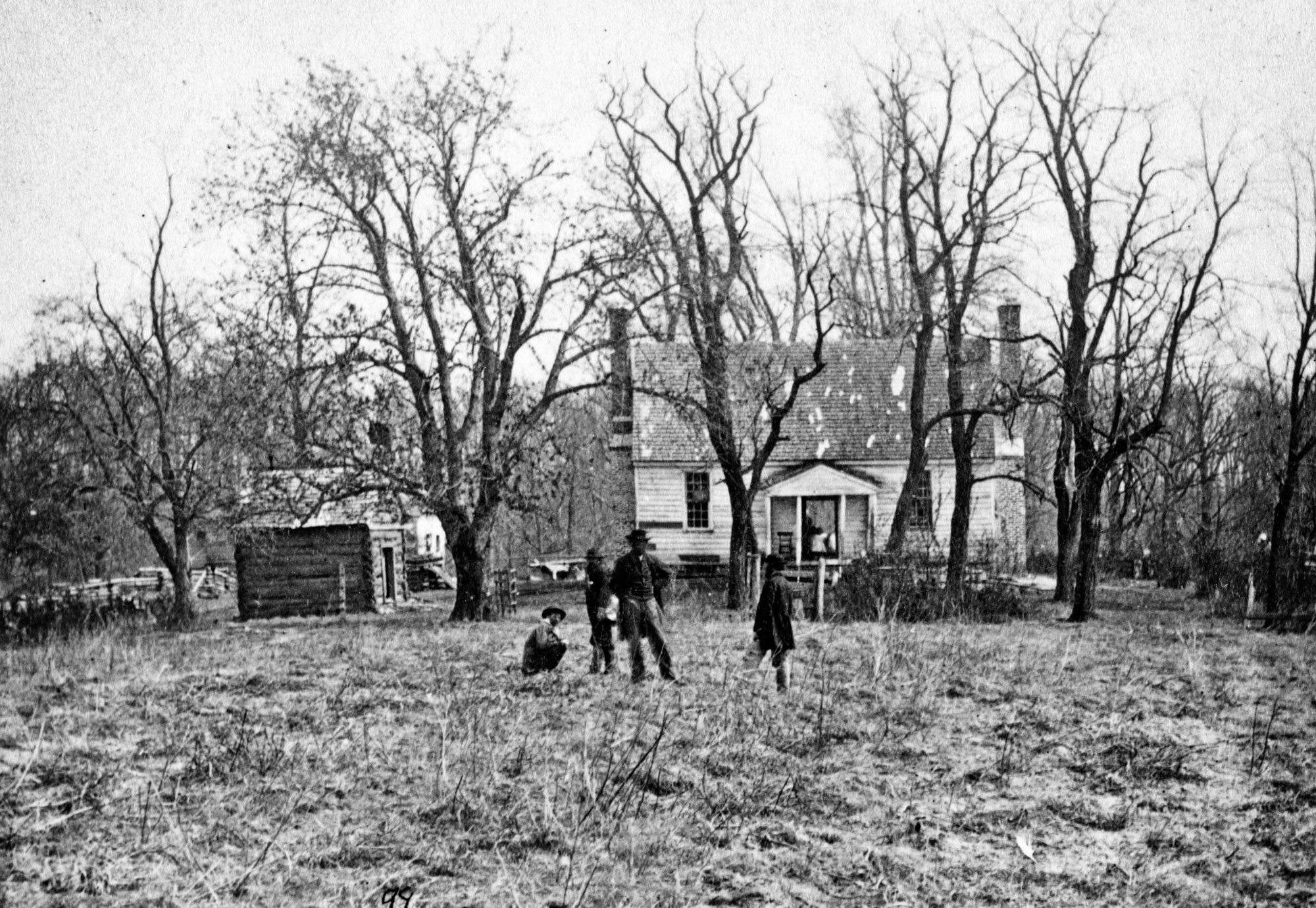 Library of Congress
Gordon reacted instinctively to the mounting fury by counterattacking with one of his brigades and shifting his other two brigades to the reserve works at the Mule Shoe’s base. The latter units—Virginians and Georgians—repulsed the Union penetration and then counterattacked toward the salient’s eastern face. Along the trenches on both sides of the Mule Shoe other Rebel troops blunted the Yankee advances.30
The efforts of Gordon and others resulted in a brief impasse. The Army of Northern Virginia, however, faced imminent disaster. Lee had ridden into the Mule Shoe, endeavoring at one point to rally Johnson’s fleeing men. He and key subordinates, notably Rodes, reacted to the crisis. Lee instructed an artillery officer to mass cannon south of the salient to cover the army’s right flank, directed staff officers to collect Johnson’s survivors, and assigned engineer officers to the construction of a new defensive line several hundred yards in the rear of the Mule Shoe’s base.31
First Rodes, then Lee called upon veteran brigades to counterattack, drive back their foes, and retake the original works and traverses. Entering into a hellish ordeal that would surpass anything in their previous experience, the brigades came in succession—Cullen Battle’s Alabamians, Stephen Dodson Ramseur’s North Carolinians, William Wofford’s Georgians, Nathaniel Harris’ Mississippians, Perrin’s Alabamians, and McGowan’s South Carolinians.32
 Library of Congress
A segment of Confederate entrenchments at the Mule Shoe, from a photo taken after the battle.
The South Carolinians had been posted on the army’s right flank since May 9, guarding Fredericksburg Road. During the night of May 11, they had been moved to a position a half-mile north of the crossroads village and roughly two miles from the Mule Shoe’s apex to the north. They had received marching orders at daylight but did not step out until 6 a.m.33
McGowan halted his column of roughly 1,750 officers and men near the base of the salient. Lee joined them in the falling rain, just after 8 a.m. He told McGowan that the line had been broken but added, “we will have it all right very soon.” He instructed McGowan to continue north and to report to Ewell for orders.34
 Battles and Leaders of the Civil War
Determined to break Robert E. Lee’s defenses at Spotsylvania Court House, Ulysses S. Grant ordered an assault for May 12, 1864, on a salient, or outward bulge, in the Confederate trench line. Rain and fog delayed the attack on that spot, known for its shape as the Mule Shoe, until about 4:30 a.m. The advancing Union forces initially overwhelmed the Confederates, who soon after launched a series of desperate counterattacks, one of them (around 8 a.m.) spearheaded by Samuel McGowan’s brigade of 1,750 South Carolinians. The struggle for control of the Mule Shoe became a hand-to-hand fight that lasted for hours. While the fighting ground on, the Confederates worked to construct a new defensive line about a mile to the south of the salient, which they completed around 3 a.m. on May 13. Lee’s men withdrew to the new works soon thereafter, leaving the Mule Shoe to Union forces.
Ahead, the Mule Shoe was “carnage infernal,” in the words of a Maine private. The Alabamians, North Carolinians, Georgians, and Mississippians had recaptured sections of the original breastworks and had clawed forward from one traverse to another, wresting them from their foes often in hand-to-hand combat. Units from the Federal VI Corps had joined Hancock’s troops and, along the eastern face, Burnside’s IX Corps had attacked at last, hours behind schedule.35
The South Carolinians drove deeper into the salient. “The very air smelled of a fight—as old soldiers called it,” one veteran remembered. According to Colonel Joseph N. Brown of the 14th South Carolina, the rout of the brigade on May 6 in the Wilderness still gnawed at them. “This disaster to their prestige was mortifying in the extreme to our brave soldiers,” Brown said later, “and their minds were well prepared to retrieve it at the next opportunity.” He added that they seemed “lost to all sense of fear.” Where McGowan led them now, it was good that they feared not.36
Union artillery and musketry greeted them. McGowan met Ewell near the McCoull house and was directed to Rodes for orders. Rodes soon appeared and asked the unit’s identity. “McGowan’s South Carolina Brigade,” was the reply. “There are no better soldiers in the world than these,” exclaimed Rodes. “You South Carolinians will do. Boys, go right in.”37
 Library of Congress, Colorized by Mads Madsen of Colorized History (Ewell); Battles and Leaders of the Civil War
Richard Ewell (left) and Robert E. Rodes
McGowan shifted his five regiments into a battle line by the McCoull house. The signs “indicated disaster,” Colonel Brown thought. McGowan told the regimental commanders to keep aligned on the McCoull farm lane, which angled crookedly to the northwest. The brigade’s battalion of sharpshooters stepped in front. McGowan shouted, “Forward! My brave boys.” His men cheered and, as one of them said, “now we entered the battle.”38
The South Carolinians pushed ahead into “a whirlwind of rifle balls,” halting at a low reserve line of works behind the salient’s western face. McGowan reportedly dismounted, stood on the entrenchments to locate the Federals, and was soon struck in the right arm by a bullet. He relinquished command to senior Colonel Benjamin T. Brockman of the 13th South Carolina. Within minutes, Brockman went down with wounds to his head and left arm and Brown succeeded to command.39 (Surgeons amputated Brockman’s arm but he died in Richmond on June 8.)
McGowan sought medical attention in the rear. He again met Lee and said, “General, I am wounded am now seeking a surgeon.” The commander reportedly smiled as he remarked: “Only wounded! I am agreeably surprised that you were not killed. You are the largest officer in the army, General McGowan, and you ride the largest horse.”40
McGowan’s officers and men, meanwhile, had crossed over the inner works and started up the wooded rise, toward the original works at the west angle and along the apex. At the forefront of the advance was Private Charles E. Whilden, carrying the flag of the 1st South Carolina. An unlikely soldier, Whilden was 40 and had epilepsy. He could have been exempt from military service but tried to enlist numerous times until he was accepted only that January. As he led the regiment’s charge up the slope, Whilden was shot in the left shoulder but still waved the flag, which he would keep for 40 years.41
Behind Whilden on the slope lay the regiment’s lieutenant colonel, Washington P. Shooter. He had just minutes before assumed command of the 1st South Carolina when Colonel Camillus W. McCreary fell wounded. Now, Shooter collapsed into a traverse with a mortal chest wound from a minie ball. When his men came to his aid, he said, “I know that I am a dead man; but I die with my eyes fixed on victory.” Nearby his brother Lieutenant Evander C. Shooter lay dead. Another brother, Sergeant Van Shooter, had been killed a week earlier in the Wilderness.42
Shooter’s veterans kept going and, “with a terrific yell,” swarmed up the rise toward the original works at the west angle and along the apex. “The sight we encountered was not calculated to encourage,” wrote Lieutenant James F.J. Caldwell. “The trenches, dug on the inner side, were almost filled with water. Dead men lay on the surface of the ground and in pools of water. The wounded bled and groaned, stretched, or huddled in every attitude of pain. The ground was crimsoned with blood.” It was probably not yet 10 a.m., and this was only the beginning.43
In a frenzy of hand-to-hand fighting, the South Carolinians seized the entrenchments and nearby traverses from the Union attackers. At this point, according to one of them, “It was plainly a question of bravery and endurance.” It would prove to be even more than that as they had entered into “one of the fiercest and most bloody struggles of the war,” in the judgment of one officer. A member of the 1st South Carolina described the frenzy around them: “The musketry then roared, we became mixed up with other troops [Harris’ Mississippians], every man fighting for himself. The place was too hot for orders. You could scarcely get your head above the works unless you would get a bullet into it.”44
For Rebel and Yankee veterans alike, nothing in the past three years at such terrible battles as Antietam, Fredericksburg, and Gettysburg rivalled the bloodletting on this rainy Thursday. The killing and maiming came in many places along the works only at the length of a rifle barrel. “One traverse would be filled with our men and another with the enemy side by side with in a few feet of each other,” wrote a South Carolinian in a letter home, “and the fire so heavy that neither would raise their heads the outside of the works was lined by the enemy.” A fellow soldier thought the nature of the combat was “the forlorn attempt to hold its assailants at arm’s length.”45
Hour after hour the struggle continued without cessation. “The heavens and earth seemed convulsed,” recalled one Yankee. The ground inside and outside the Mule Shoe appeared awash in carnage. “At noon,” recalled a Rebel, “the water so bloody in the ditches, that one inexperienced would have taken it for blood entire.” He thought the gory mix to be a foot deep. A South Carolinian declared, “all the bitterness and hate of the enemy seems concentrated in this desperate crusade against us.”46
Amid the relentless slaughter, men on both sides climbed on to the breastworks and stood firing into their enemies as comrades passed them loaded muskets. Few survived. Among the traverses, point-blank musketry fire and hand-to-hand struggles were common. While Union soldiers could be relieved, the Confederates had become trapped in a nightmare, defending the Mule Shoe to buy time for their comrades to construct a new defensive line. A reality had engulfed them. The 1st South Carolina’s Lieutenant Caldwell admitted afterward, “The question became, pretty plainly, whether one was willing to meet death, not merely to run the chances of it.”47
 National Museum of American History
The stump of a red oak tree that was sawed off by the relentless musket and artillery fire during the Mule Shoe fight.
Around 2 p.m. the fighting paused along sections of the apex and near the west angle. In the swirling confusion each side believed that the other had surrendered. Some soldiers, whether Rebel or Yankee remains uncertain, raised white handkerchiefs. Opposing officers stepped forward and conferred for several minutes. “To those who reflected a moment,” said Caldwell, “it should have been plain that we were deceiving ourselves…. But a general infatuation prevailed—a silly infatuation, if it had not involved so much. So the two lines stood, bawling, gesticulating, and what not.”48
Among those standing was a Mississippian, who years later recounted: “The field presented one vast Golgotha in the immensity of the dead. The ground [to the north] was almost covered with the dead and wounded, while between the lines they were literally piled…. [I] counted fifteen stands of colors lying between the lines, some of them having fallen against our breastworks—the brave hands which had borne them now lying cold in death.”49
The momentary lull proved illusory, as Caldwell noted afterward. When a Confederate soldier fired at a Union officer, the savagery resumed—ceaselessly into the evening. Those graycoats behind the entrenchments and in the traverses understood, in the view of a newspaperman with the army, what was at stake. “Each man knew he was fighting the battle for the possession of Richmond,” the journalist wrote days later, “the battle, indeed for the independence of the Confederate states and the thought of yielding to the foe never once entered his mind.”50
As the day darkened, the Mule Shoe gathered more of the dead and maimed. It was as if a terrible whirlwind had blown in and tarried over this small piece of Virginia soil, possessing all those within its confines. At no place did the winds swirl more fearfully than the section of the earthworks on both sides of the slight curve or west angle in the salient. Here, down the western face and a hundred yards along the apex, the defenders were Harris’ Mississippians and McGowan’s South Carolinians.
“The dead were piled in swaths and windrows, both outside and inside the works,” said a Yankee who fought near the angle. A South Carolinian claimed that the trenches “ran with blood,” while another Confederate said, “If a man wants to see hell upon earth, let him come and look into this black, bloody hole.” Yankees called it “Hell’s Hole” and, by the end of the fighting, Rebels knew it as the “Bloody Angle.”51
Lieutenant Colonel Horace Porter of Grant’s staff wrote: “The battle near the ‘angle’ was probably the most desperate engagement in the history of modern warfare and presented features which were absolutely appalling.” When he rode to the “Bloody Angle” after the fighting, Porter saw a “mass of torn and mutilated corpses.”52
Throughout the night the gunfire slackened at times, then flared once more. Thunderstorms rolled through, and the rain poured. “It was the most miserable night of the war—mud, bullets, rain, no supper, no breakfast,” in one Confederate’s description. Exhaustion was also extreme. “Numbers of the troops sank, overpowered, into the muddy trenches and slept soundly,” Caldwell wrote.53
A red oak tree stood within the Mule Shoe east of the Bloody Angle. At midnight it crashed to the ground, injuring some South Carolinians. The relentless musketry and artillery fire for nearly 20 hours had sawed it off about five feet above the ground. “The foliage of the tree was trimmed away effectually as though an army of locusts had swarmed its branches,” wrote a correspondent. A Confederate surgeon measured the stump later, noting its 61-inch circumference and 22-inch diameter. (Today, that stump is among the collections of the Smithsonian’s National Museum of American History.)54
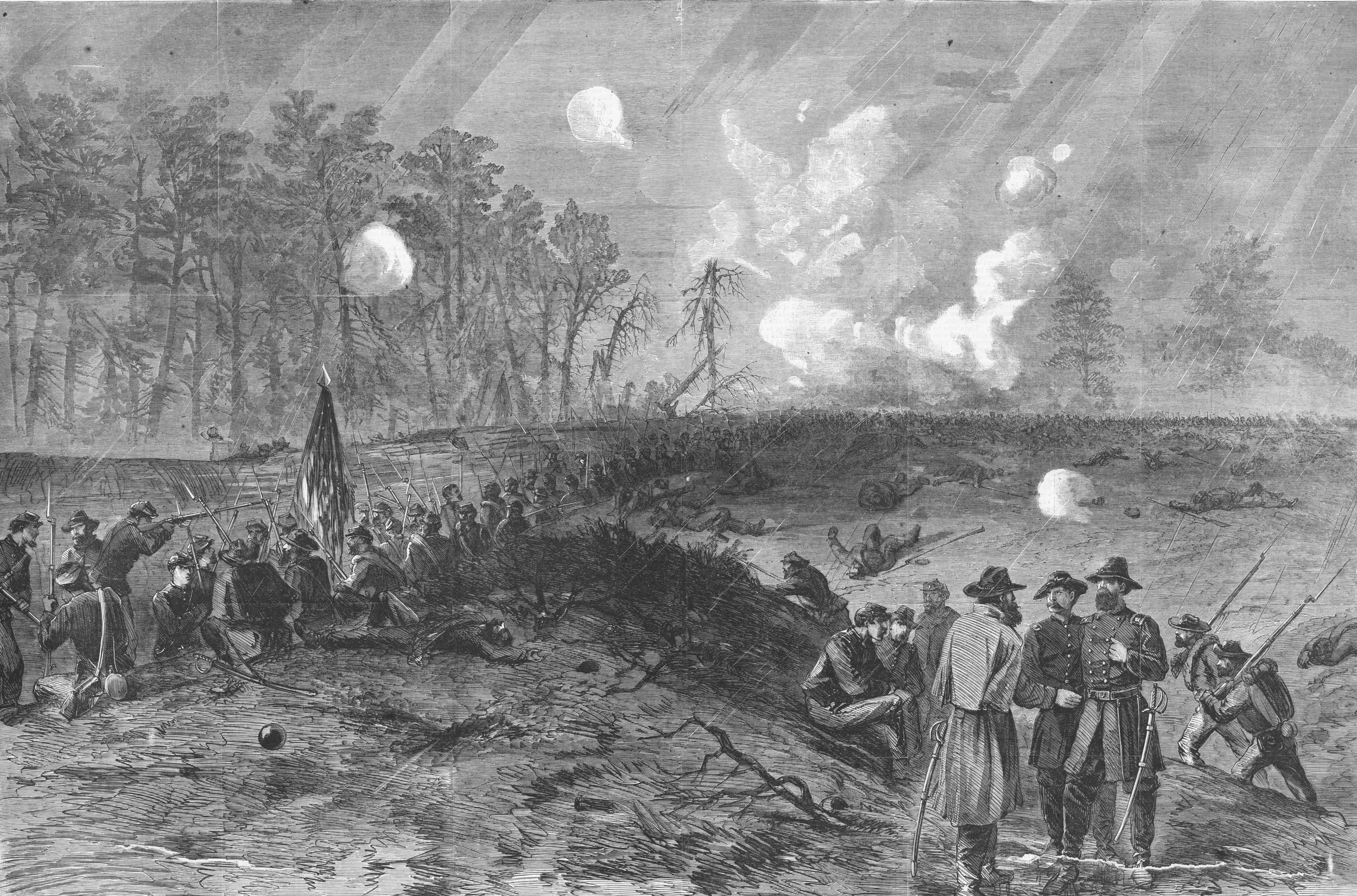 Library of Congress
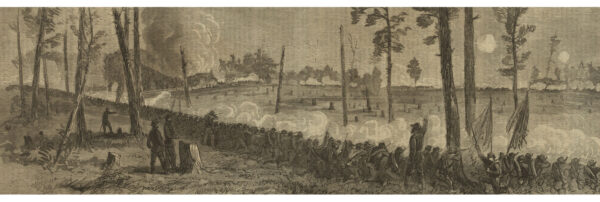
In this sketch from Harper’s Weekly, Union officers confer as the fight for the Mule Shoe swirls behind them.
About 3 a.m. on May 13, the Mule Shoe’s defenders received word that the new defensive line had been completed on a ridge nearly three-quarters of a mile south of the salient’s apex. Orders for a withdrawal accompanied the information, and officers issued instructions for abandonment of the salient’s trenches and traverses a regiment at a time. The veterans slipped away “slowly and noiselessly.” Caldwell said afterward, “We conducted it so well that the enemy were not aware of the movement, or else, (as I think most likely,) they had become so dispirited by our stubborn resistance … that they had left only a skirmish line to keep up appearances.”55
Along with their fellow southerners, the exhausted South Carolinians halted in the rear behind the new defensive works and ate cornbread, hardtack, and bacon for breakfast. In words that could have applied to every one of the salient’s defenders on this Friday morning, a North Carolinian wrote, “Everyone looks as if he had passed through a hard spell of sickness, black and muddy as hogs.”56
Union troops entered the abandoned Mule Shoe after daylight. Headquarters ordered Hancock to do reconnaissance “to ascertain where the enemy is and his position.” The II Corps veterans scattered some enemy skirmishers before coming upon the newly built Confederate earthworks. They withdrew and reported the intelligence.57
Within and outside the Mule Shoe, the gruesome work of burying the dead and gathering the wounded proceeded. The Union detail concluded its efforts on the morning of May 14 and moved away. The Confederate burial detail moved in. When they had finished, hundreds of graves scarred the McCoull farmland. Upward of 55,000 Americans—38,000 Federals and 17,000 Confederates—had fought in the engagement. Total casualties amounted to 17,500, making it one the bloodiest days of fighting in the war’s eastern theater.58
The opposing armies remained around Spotsylvania Court House for eight days after the Mule Shoe engagement until Grant began another movement south, followed by Lee. The Confederate commander had recognized the stalwart performance of his officers and men. Lee and his army had confronted perhaps their greatest crisis, but bravery and combat prowess had prevented a possible disaster. He issued a congratulatory address on May 16, which read in part: “The heroic valor of this army, with the blessing of Almighty God, has thus far checked the advance of the principal army of the enemy and inflicted upon it heavy loss. The eyes and hearts of your countrymen are turned to you with confidence, and their prayers attend you in your gallant struggle.”59
It had been officers and men from across the South who had answered a fearful summons and possibly saved the vaunted Army of Northern Virginia from a crippling, if not fatal, defeat. In words that could be applied to all of the Mule Shoe’s defenders, McGowan said of his fellow South Carolinians to a newspaperman in 1867, “[I]f ever troops ‘held their own’ under the most difficult circumstances and immortalized themselves, my brigade in ‘the bloody angle’ on the 12th of May, I think it may be said, with perfect modesty and entire truth, that nothing in the history of the world surpasses it.”60 
Jeffry D. Wert is the author of several books on the Civil War. His most recent is The Heart of Hell: The Soldiers’ Struggle for Spotsylvania’s Bloody Angle (UNC Press).
Notes
1. The War of the Rebellion: Official Records of the Union and Confederate Armies (Washington, D.C., 1880–1901), Ser. 1, vol. 31, pt. 1, 1093 (hereafter cited as OR, with all citations from Series 1 unless otherwise indicated); J.F.J. Caldwell, The History of a Brigade of South Carolinians, Known First as “Gregg’s” and Subsequently as “McGowan’s Brigade” (reprint, Marietta, GA, 1951), 140; Newberry Herald and News (Newberry, South Carolina), July 16, 1909.
2. Varina D. Brown, A Colonel at Gettysburg and Spotsylvania (reprint, Baltimore, MD, n.d.), 93; Confederate Veteran Magazine (reprint, Wilmington, NC, 1987–1988), 33: 376 (hereafter cited as CV); William C. Davis, ed., The Confederate General (Gettysburg, PA, 1991), 3: 41–43.
3. Caldwell, History of a Brigade, 7; Davis, Confederate General, 3: 41, 42; Douglas Southall Freeman, Lee’s Lieutenants: A Study in Command (New York, 1942–1944), 1: lv, 518.
4. Davis, Confederate General, 3: 42; Freeman, Lee’s Lieutenants, 1: 605n; Robert K. Krick, The 14th South Carolina Infantry Regiment, of the Gregg-McGowan Brigade, Army of Northern Virginia (Wilmington, NC, 2008), 8.
5. Freeman, Lee’s Lieutenants, 2: 117.
6. Ibid, 2: 355, 356, 375; Mike Wadsworth, The 13th South Carolina Volunteer Infantry C.S.A. (Wilmington, NC, 2008), 29; Davis, Confederate General, 4: 123.
7. Davis, Confederate General, 4: 122–123; Freeman, Lee’s Lieutenants, 1: 529, 651.
8. Krick, 14th South Carolina, 13, 19; Davis, Confederate General, 4: 123; Freeman, Lee’s Lieutenants, 2: 418, 590; 3: 237; Gary W. Gallagher, ed., Spotsylvania Campaign (Chapel Hill, 1998), 99; Rosalind Todd Tedards, Orr’s Rifles (Wilmington, NC, 2017), 48.
9. CV, 33: 376; Jeffry D. Wert, The Heart of Hell: The Soldiers’ Struggle for Spotsylvania’s Bloody Angle (Chapel Hill, 2022),132; Krick, 14th South Carolina, 19.
10. Wert, Heart of Hell, 2–4, 14, 16, 17.
11. Ibid., 18–20; Jay Winik, April 1865: The Month That Saved America (New York, 2001), 91.
12. Wert, Heart of Hell, 22, 23; Tedards, Orr’s Rifles, 53; Gordon Rhea, The Battle of the Wilderness, May 5–6, 1864 (Baton Rouge, 1994), 195–204, 222–229, 241, 242.
13. Rhea, Battle of the Wilderness, 264–267, 283–285; Noah Andre Trudeau, Bloody Roads South: The Wilderness to Cold Harbor, May–June 1864 (Boston, 1989), 78, 79.
14. Wert, Heart of Hell, 24, 25; Davis, Confederate General, 4: 123.
15. Wert, Heart of Hell, 26–28; Rhea, Battle of the Wilderness, 416–425, 435, 436; Alfred C. Young III, Lee’s Army During the Overland Campaign: A Numerical Study (Baton Rouge, 2013), 235.
16. Wert, Heart of Hell, 33–38; OR, vol. 36, pt. 2, 551, 552; Gordon Rhea, The Battles for Spotsylvania Court House and the Road to Yellow Tavern (Baton Rouge, 1997), 39–47, 52, 57, 77, 85; Memoir, Harold C. George Papers, Library of Congress, Washington, D.C. (hereafter cited as LC).
17. “Harrison Gazeteer, vol. 1,” Jedediah Hotchkiss Papers, LC; Montgomery (AL) Daily Advertiser, May 28, 1864; Gary W. Gallagher, ed., The Spotsylvania Campaign (Chapel Hill, 1998), 81, 82.
18. CV, 28: 384, 34: 8; Gallagher, ed., Spotsylvania Campaign, 83; Boston Globe, May 12, 1914; Columbia (SC) Democrat, July 2, 1864; Philadelphia Weekly Times, February 20, 1886; Varina D. Brown, A Colonel at Gettysburg and Spotsylvania (reprint, Baltimore, n.d.), 135.
19. Robert Grier Stephens, ed., Intrepid Warrior: Clement Anselm Evans Confederate General from Georgia, Life, Letters, and Diaries of the War Years (Dayton, OH, 1992), 389; Edgefield (SC) Advertiser, June 1, 1864; Brown, A Colonel at Gettysburg, 94; Southern Watchman, June 1, 1864; Gallagher, ed., Spotsylvania Campaign, 82.
20. Donald C. Pfanz, Richard S. Ewell: A Soldier’s Life (Chapel Hill, 1998), 378; Southern Historical Society Papers, 14: 529 (hereafter cited as SHSP).
21. Richmond Dispatch, August 27, 1905; Rhea, Battles, 90–101; Peter Cozzens, ed., Battles and Leaders of the Civil War, Vols. 5 and 6 (Urbana, IL, 2002–2004), 5: 488 (hereafter cited as B&L).
22. OR, vol. 36, pt. 1, 661, 667; Rhea, Battles, 164, 166, 169; Portland (ME) Transcript, June 11, 1864; David A. Ward, The 96th Pennsylvania Volunteers in the Civil War (Jefferson, NC, 2018), 225, 231, 235, 240; Wert, Heart of Hell, 53–56.
23. OR, vol. 36, pt. 1, 191, 192, pt. 2, 629, 635, 637, 638, 641, 642; Gallagher, ed., Spotsylvania Campaign, 48; Rhea, Battles, 86, 108, 317; Horace Porter, Campaigning with Grant (reprint, New York, 1961), 99, 100.
24. Pfanz, Richard S. Ewell, 382, 383; SHSP, 21: 240; Terry L. Jones, ed., Campbell Brown’s Civil War: With Ewell and the Army of Northern Virginia (Baton Rouge, 2001), 253, 255; A.L. Long, Memoirs of Robert E. Lee: His Military and Personal History (New York, 1886), 339.
25. OR, vol. 36, pt. 1, 1024, 1037, 1044; SHSP, 21: 240; Pfanz, Richard S. Ewell, 382, 383; Cozzens, B&L, 5: 490; Graham T. Dozier, ed., A Gunner in Lee’s Army: The Civil War Letters of Thomas Henry Carter (Chapel Hill, 2014), 244.
26. Philadelphia Weekly Press, October 27, 1886; Montpelier (VT) Examiner, June 27, 1896; Francis A. Walker, History of the Second Army Corps in the Army of the Potomac (reprint, Gaithersburg, MD, n.d.), 468; J.W. Muffly, ed., The Story of Our Regiment: A History of the 148th Pennsylvania Vols. (reprint, Baltimore, 1994), 257, 258.
27. OR, vol. 36, pt. 1, 335; Walker, History of the Second Corps, 459; Rhea, Battles, 224; Anderson (SC) Intelligencer, August 23, 1905.
28. OR, vol. 36, pt. 1, 1044, 1072, 1080, 1086; SHSP, 21: 240, 3: 336, 337; Richmond Times, April 2, 1893; Raleigh (NC) Daily Conservative, May 21, 1864; Wert, Heart of Hell, 81–83.
29. Wert, Heart of Hell, 87, 100–104.
30. Ibid, 104–110.
31. Ibid, 110–118.
32. Ibid, 110–132.
33. OR, vol. 36, pt. 1, 1093; Caldwell, History of a Brigade,140; Newberry (SC) Herald and News, July 16, 1909; Gallagher, ed., Spotsylvania Campaign, 95; CV, 33: 376; Gordon C. Rhea, Carrying the Flag: The Story of Private Charles Whilder, the Confederacy’s Most Unlikely Hero (New York, 2004), 175.
34. OR, vol. 36, pt. 1, 1093; Young, Lee’s Army, 246; Augusta (GA) Chronicle, August 14, 1898; Gallagher, ed., Spotsylvania Campaign, 95.
35. Ruth I. Silliker, ed., The Rebel Yell and the Yankee Hurrah: The Civil War Journal of a Maine Volunteer (Camden, ME, 1985), 153.
36. OR, vol. 36, pt. 1, 1093; Augusta (GA) Chronicle, August 14, 1898; Brown, ed., A Colonel at Gettysburg, 93, 94.
37. OR, vol. 36, pt. 1, 1093; Caldwell, History of a Brigade, 140–141; Rhea, Carrying the Flag, 207, 208; Anderson (SC) Intelligencer, May 4, 1882; Augusta (GA) Chronicle, August 14, 1898.
38. OR, vol. 36, pt. 1, 1093; Caldwell, History of a Brigade, 141; Newberry (SC) Herald and News, July 16, 1909; Anderson (SC) Intelligencer, May 4, 1882; Rhea, Carrying the Flag, 207, 208.
39. Gallagher, ed., Spotsylvania Campaign, 99; Rhea, Carrying the Flag, 210, 211; Yorkville (SC) Enquirer, May 25, 1894; Abbeville (SC) Press and Banner, May 10, 1876; Newberry (SC) Herald and News, July 16, 1909.
40. Abbeville (SC) Press and Banner, May 10, 1876.
41. Rhea, Carrying the Flag, 72, 80, 211, 214, 215, 216; Gallagher, ed., Spotsylvania Campaign, 100, 102; Caldwell, History of a Brigade, 141; Charleston (SC) Daily Courier, May 28, 1864; Yorkville (SC) Enquirer, May 22, 1879.
42. Brown, A Colonel at Gettysburg, 95, 96, 122; Caldwell, History of a Brigade, 146, 149; Charleston (SC) Daily Courier, May 28, 1865; Anderson (SC) Intelligencer, May 4, 1882; Wert, Heart of Hell, 134, 135.
43. Caldwell, History of a Brigade, 143; Charleston (SC) Daily Courier, May 28, 1864.
44. Gallagher, ed., Spotsylvania Campaign, 100; Caldwell, History of a Brigade, 141; Charleston (SC) Daily Courier, May 28, 1864; Yorkville (SC) Enquirer, May 22, 1879; Augusta (GA) Chronicle, August 14, 1898.
45. Gallagher, ed., Spotsylvania Campaign, 100; Wert, Heart of Hell, 135, 136; Manning (SC) Times, June 1, 1904; Caldwell, History of a Brigade, 145.
46. Silliker, ed., Rebel Yell, 157; Francis E. Rew-My dear Parents, May 12, 1864, Francis E. Rew Civil War Letters, Richmond National Battlefield Park, Richmond, VA; Wert, Heart of Hell, 148, 149.
47. Wert, Heart of Hell, 135–136; Gallagher, ed., Spotsylvania Campaign, 100; Augusta (GA) Chronicle, August 14, 1898; Manning (SC) Times, June 1, 1904; Caldwell, History of a Brigade, 145.
48. OR, vol. 36, pt. 1, 373; Jackson (MS) Clarion-Ledger, June 11, 1864; Rhea, Carrying the Flag, 223; Tedards, Orr’s Rifles, 57, 58; Laurens (SC) Advertiser, August 6, 1895; Pickens (SC) Keowee Courier, August 31, 1910; Caldwell, History of a Brigade, 143, 144.
49. Gallagher, ed., Spotsylvania Campaign, 107–108; Wert, Heart of Hell, 158.
50. Caldwell, History of a Brigade, 144; Edgefield (SC) Advertiser, June 1, 1864.
51. OR, vol. 36, pt. 1, 1094; Robert Stoddard Robertson, Personal Recollections of the War: A Record of Service with the Ninety-Third New York Vol. Infantry (Cincinnati, 1884), 106; Vermont Union, January 18, 1896; Southern Watchman, June 1, 1864; Berry Benson, Berry Benson’s Civil War Book: Memoirs of a Confederate Scout and Sharpshooter, ed. by Susan Williams Benson (Athens, GA, 1992), 77.
52. Porter, Campaigning with Grant, 110.
53. Brown, A Colonel at Gettysburg, 98; Montpelier (VT) Examiner, June 27, 1896; Caldwell, History of a Brigade, 147.
54. Rhea, Battles, 92, 109; CV, 22: 473, 33: 128; Richmond Examiner, June 1, 1864; New Bern (NC) Times, November 10, 1865; Opelousas (LA) Courier, December 8, 1878.
55. Cadmus Wilcox-Brother, December 17, 1864 [?], Cadmus Wilcox Papers, LC; Wert, Heart of Hell, 174–176; Caldwell, History of a Brigade, 147.
56. Columbus (MS) Weekly Dispatch, June 6, 1907; Augusta (GA) Chronicle, August 14, 1898; Wert, Heart of Hell, 176; Hugh Buckner Johnston, ed., The Civil War Letters of George Boardman Battle and of Walter Raleigh Battle of Wilson, North Carolina (Wilson, NC, 1953), 28.
57. OR, vol. 36, pt. 1, 448, pt. 2, 703, 764; Wert, Heart of Hell, 178.
58. Wert, Heart of Hell, 178–183.
59. Charlotte (NC) Democrat, May 14, 1865
60. Wilmington (NC) Journal, November 8, 1867.