Roughly 200,000 strong, they joined the fight for their independence from all parts of the continent. Some had escaped with no more than tattered rags on their backs from masters determined to keep them in perpetual servitude. Other slaves, displaced by invading federal armies, crossed into Union-controlled territories and enrolled in the army. Some soldiers had gained their release, either thanks to benevolent owners who glimpsed a future where freedom reigned, or from practical-minded individuals who saw the end of slavery in sight. And still more were sons of men and women who fled thralldom along the Underground Railroad and settled in the northern states and Canada during the decades before the war.
The majority were illiterate. Some had been taught elementary reading, writing, and math skills by abolitionists or Christian charities. A precious few had attended college.
These men experienced a fraction of the freedoms they fought to establish. The spirit of unity that prevailed during the war began to erode even as the Confederate armies disarmed. Flames of hatred and prejudice not extinguished after four years of bloody conflict soon burned bright.
Those pictured on the following pages played an important though little remembered role during a critical period in which the fate of the disunited states was far from certain, and the future of freedom and democracy hung in the balance.
Portrait photograph of Charles Mudd, Corporal, Co. C, 108th U.S. Colored Infantry, seated in uniform with hat.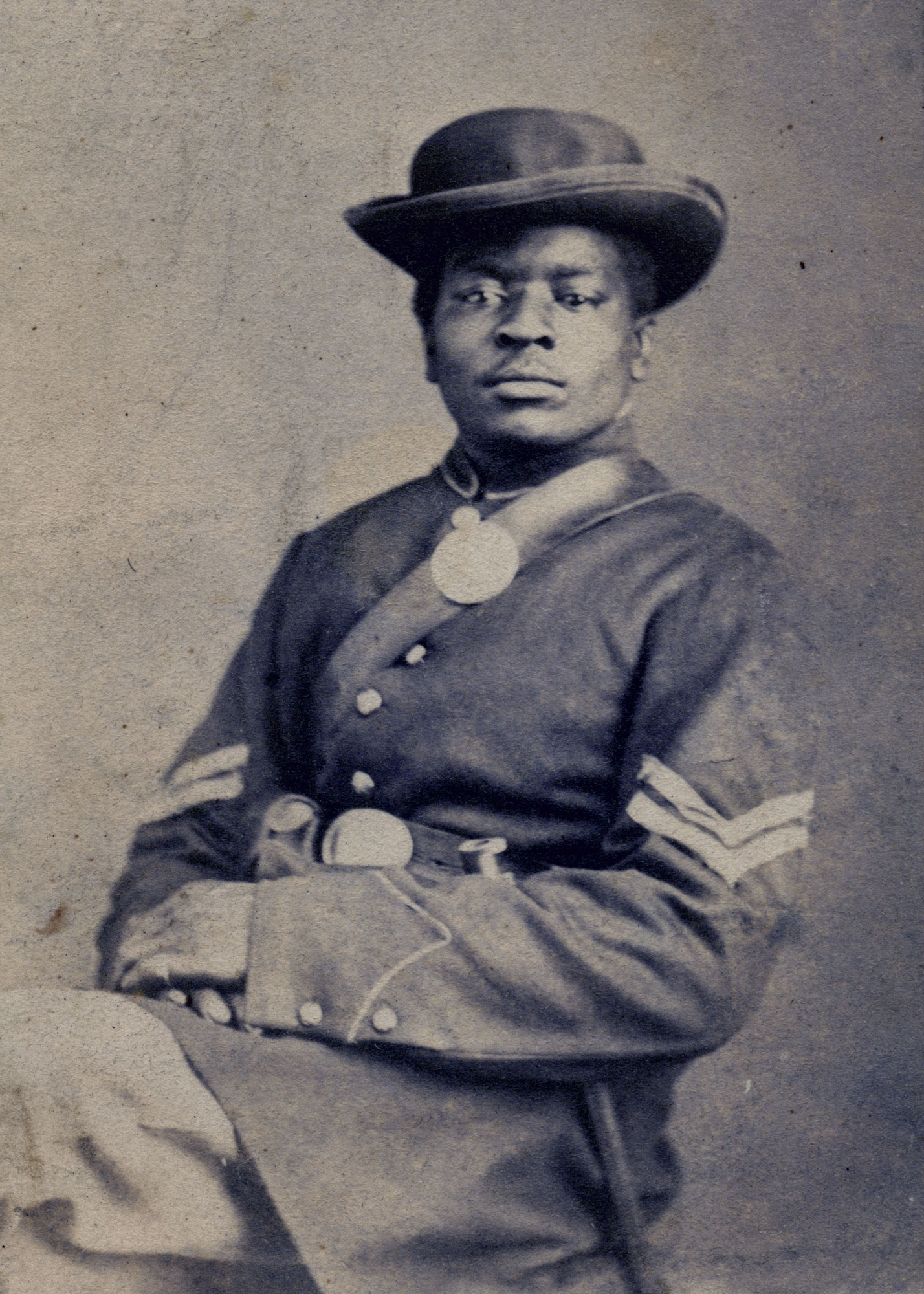 Collection of the Gettysburg National Military Park Museum
Charles Mudd
Corporal, Co. C, 108th U.S. Colored Infantry
Charles Mudd of Kentucky was one of five brothers, all slaves, who served during the Civil War. Known as Charlie, he joined the 108th U.S. Colored Infantry in the summer of 1864 without his master’s consent. Soon after, he fell seriously ill when measles swept through the regiment. He recovered after two weeks in the hospital, rejoined his comrades, and served with distinction until he mustered out of the army in 1866. Mudd made his way home to Kentucky and became a farmer. The following year he married a local woman. She died in 1872, leaving him to care for a three-year-old son. Mudd remarried later that year. He lived until about age 74, dying of influenza in 1915.
Full-length portrait photograph of William Wright, Private, Co. H, 114th U.S. Colored Infantry, standing in uniform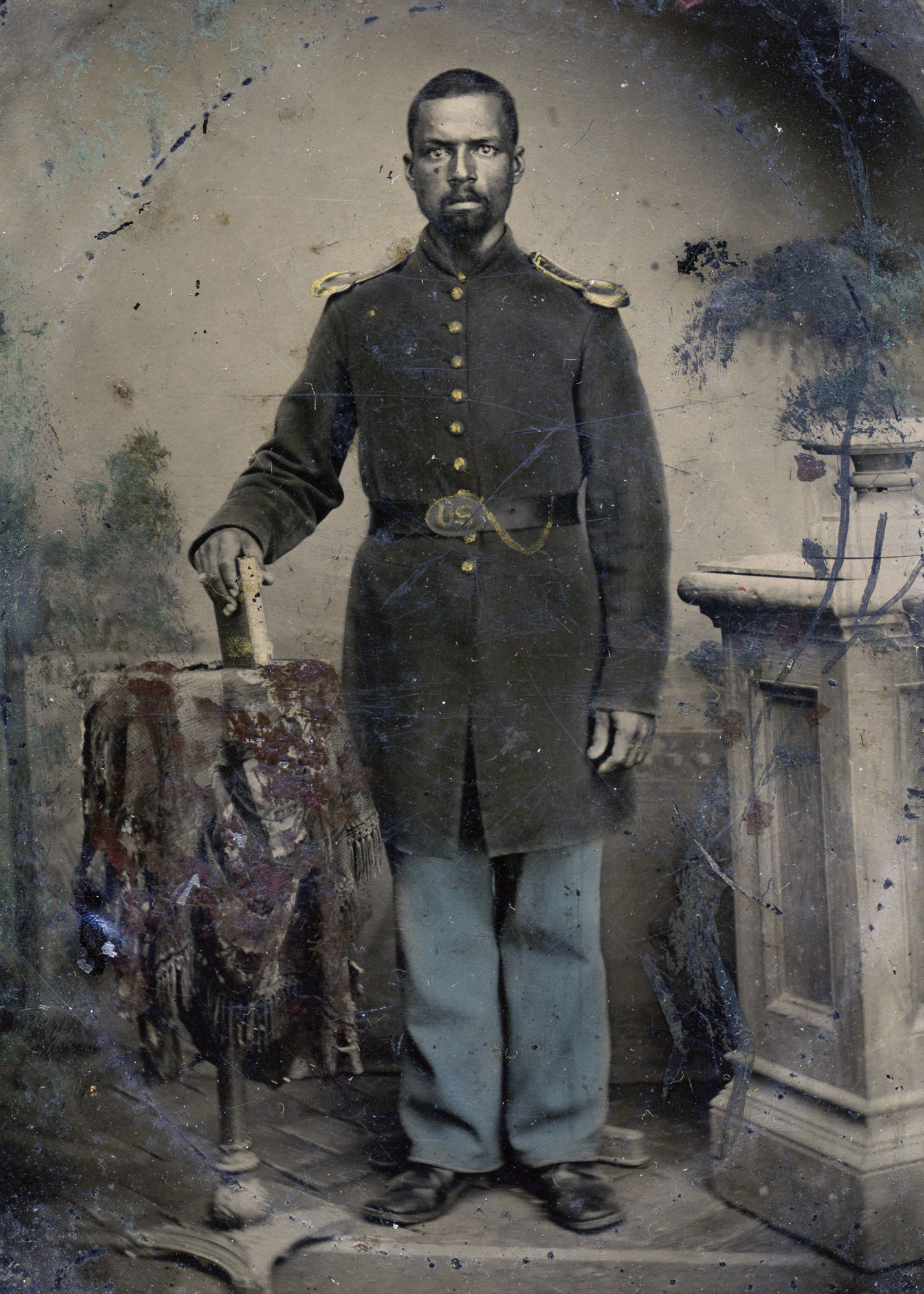 Author's Collection
William Wright
Private, Co. H, 114th U.S. Colored Infantry
On April 3, 1865, Private William Wright and his comrades in the 114th U.S. Colored Infantry numbered among the first Union troops to enter Richmond after the fall of the Confederate capital. A slave born of African and German descent, Wright was raised on a Kentucky farm. His owner, a unionist with a reputation as a humane master, gave Wright his freedom and escorted him to an army recruiting station in the summer of 1864. Nine months later Wright marched into Richmond. He mustered out of the army with his comrades in 1867 and returned to Kentucky. He later fled to Iowa after angry whites sought to reestablish their superiority. He died in 1901 at age 63. His second wife and several children survived him.
Portrait photograph of George Mitchell in Union Army uniform with sergeant’s stripes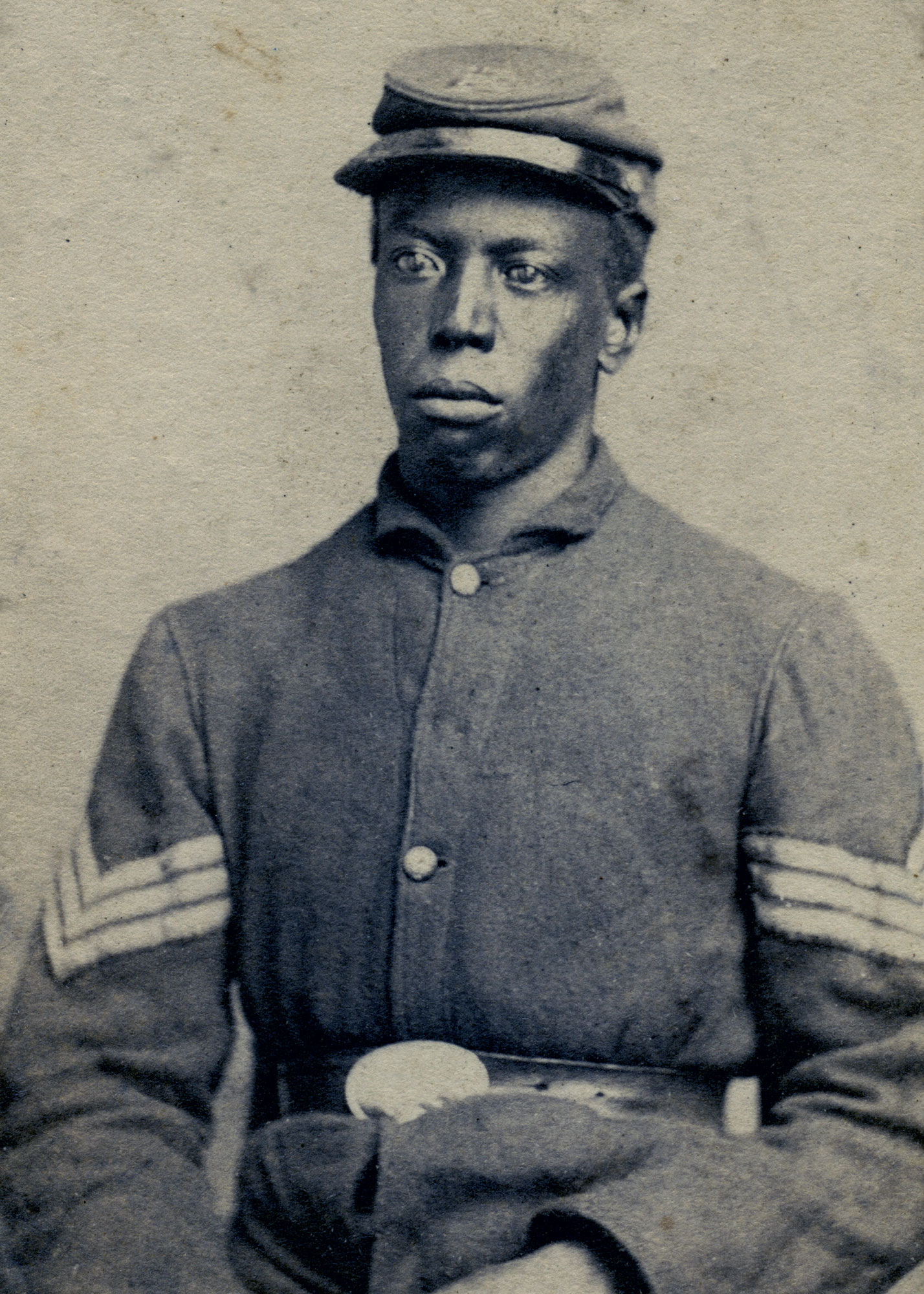 Collection of the Gettysburg National Military Park Museum
George Mitchell
Sergeant, Co. D, 62nd U.S. Colored Infantry
Prior to his enlistment, Mitchell toiled as a slave south of St. Louis. Four different men owned him; the last, John Dean, freed him after the issuance of the Emancipation Proclamation. In the summer of 1863, Mitchell joined the 62nd U.S. Colored Infantry. He enrolled as a private with the name George Dean, later changing to the surname of his first master, Mitchell. He advanced to sergeant in the autumn of 1864. About this time Mitchell and his regiment reported to Brazos Island in southern Texas. In May 1865, the 62nd and other troops fought at Palmito Ranch, the last battle of the Civil War. Mitchell and his company fired the final shots of the fight. Mitchell survived the war. He died in 1892.
Full-length portrait photograph of Abram Garvin in Union Army uniform, standing beside a decorative column. Collection of the Gettysburg National Military Park Museum
Abram Garvin
Sergeant, Co. F, 108th U.S. Colored Infantry
Abram Garvin, an enslaved farmhand and blacksmith in Kentucky, left home in the summer of 1864 to join the army with the consent of his master. He enlisted in the 108th U.S. Colored Infantry. That autumn, Garvin reported with his regiment for duty at the Confederate prisoner of war camp at Rock Island, Illinois. Frigid temperatures and heavy snows during the winter resulted in illness for numerous troops, including Garvin, who suffered a severe cold that settled in his lungs. Although unable to attend to his duties for large periods of time, he remained in the ranks until the end of his enlistment in the spring of 1866. He returned to Kentucky, where he died of consumption in 1879 at about age 37.
Portrait photograph of Henry C. Gaither, Sergeant, Co. H, 39th U.S. Colored Infantry, seated in uniform with hat and sword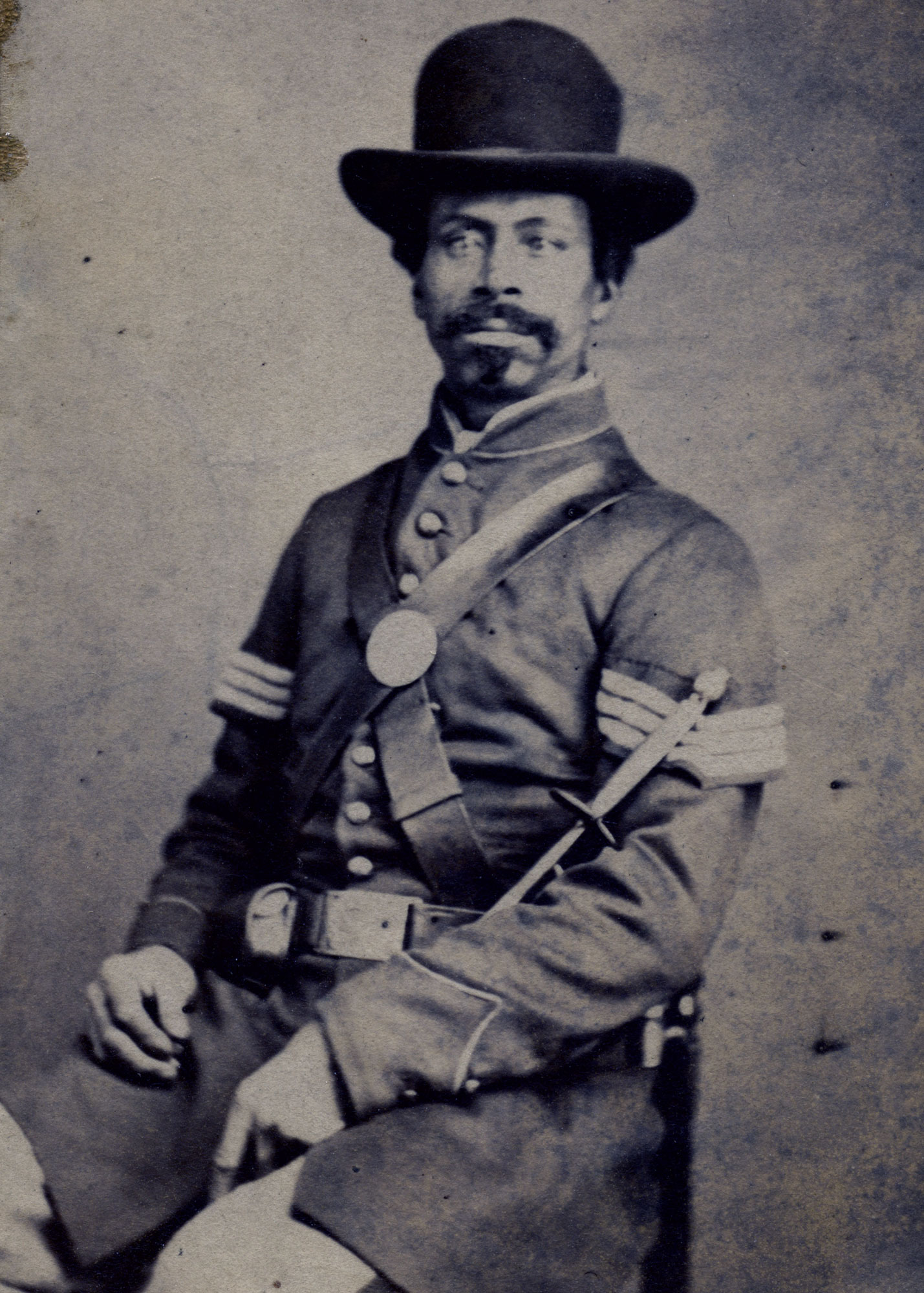 Collection of the Gettysburg National Military Park Museum
Henry C. Gaither
Sergeant, Co. H, 39th U.S. Colored Infantry
Henry Gaither and his comrades in the 39th U.S. Colored Infantry numbered among the last troops to enter the Battle of the Crater on July 30, 1864. By the time they arrived, the mine detonation that had obliterated a section of Confederate earthworks along the Petersburg defenses left a gaping hole filled with trapped Union soldiers, both living and dead. The regiment marched into a hail of fire and held part of the line until forced back. Gaither survived, although 195 of his comrades became casualties. Gaither later participated in the capture of Fort Fisher and the Carolinas Campaign. After the war, he returned to his home and family in Baltimore, where he had worked before his army enlistment. He died in 1880 at about age 60.
Portrait photograph of James Monroe Trotter in Union Army uniform, seated and holding a hat. Collection of the Gettysburg National Military Park Museum
James Monroe Trotter
Second Lieutenant, Co. G, 55th Massachusetts Infantry
When word spread to the 55th Massachusetts Infantry that they would receive a $10 monthly salary instead of the standard $13 promised by politicians (and paid to white soldiers), Sergeant Major James Trotter confronted the paymaster. He led a protest, refusing to accept any money until full pay was restored. The son of a white Mississippi planter and a slave, Trotter was an outspoken advocate for equal rights. Due in part to his efforts, all African-American soldiers eventually received full pay. Trotter served with distinction in South Carolina and Georgia. He became an officer in June 1865, shortly before the regiment ended its enlistment. Trotter was a political activist after the war. He died of tuberculosis at age 50 in 1892.
Full-length portrait photograph of Jesse Hopson in Union Army uniform, holding a rifle. Collection of the Gettysburg National Military Park Museum
Jesse Hopson
Private, Co. F, 108th U.S. Colored Infantry
Sometime in 1864, Jesse Hopson made his break for freedom. He disappeared into swamplands near his master’s 2,500-acre farm in the western Kentucky town of Golden Pond. The master hunted him through the swamps for a week before giving up. Hopson made his way to Union-occupied Paducah, about 50 miles away. He soon enlisted in the 108th U.S. Colored Infantry and became a solid soldier. During his 21 months in uniform, he guarded captives at the Rock Island prisoner of war camp and helped to build a telegraph system in Louisiana. After the war, he worked as a day laborer near Golden Pond, where he might have crossed paths with his former owner.
Ronald S. Coddington is publisher of Military Images, a magazine dedicated to showcasing and preserving photos of Civil War soldiers and sailors.
Related topics: African Americans