Library of Congress
Secessionist-sympathizing Virginia farmers fire at unarmed Union soldiers attempting to cross the James River in this 1862 pencil sketch by Alfred R. Waud.
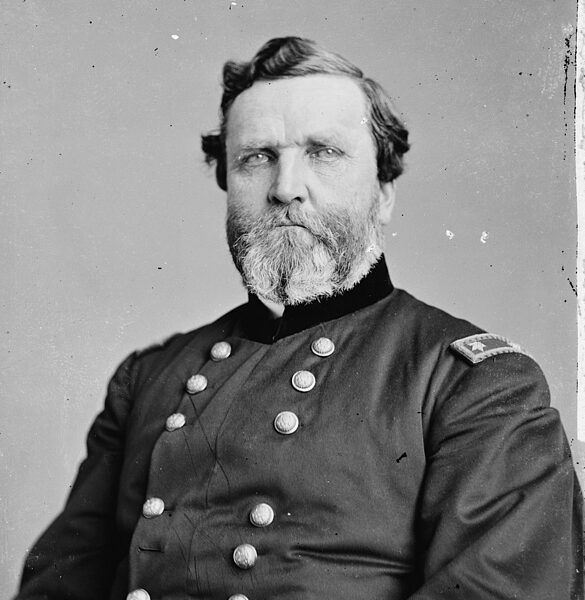
During the first 18 months of the Civil War, the majority of U.S. military and political leaders believed that in order to restore the fractured Union, the contest needed to remain limited to a struggle between armies. Many worried openly about the consequences of extending the boundaries of the war to include southern civilians. After all, it was unclear how much support for secession existed within the new Confederacy, and more than a few northern leaders believed they could capitalize on loyalist sentiment if the Union proceeded carefully. Among the most vocal of these was Major General George B. McClellan, who repeatedly warned his soldiers against harming civilians or their property as they moved into the western counties of Virginia in May 1861. McClellan delivered a proclamation to the people in that region, promising that his soldiers came as “friends and brothers,” and informing them, “[Y]our homes, your families, and your property are safe under our protection.”1
More than a year later, despite an embarrassing push back from the outskirts of Richmond during the Seven Days Battles on the Virginia Peninsula, McClellan remained committed to keeping the southern people out of the war. In what would become a widely publicized letter to President Abraham Lincoln, written from Harrison’s Landing, Virginia, in July 1862, McClellan claimed that the Union effort “should not be a war looking to the subjugation of the people … it should not be at all a war upon population.”2 And while McClellan was not the only Union leader who still embraced this message, those expressing similar views were becoming fewer by the day.
What became increasingly obvious by the war’s second summer was that the southern people were tightly woven into the very fabric of the contest. Their farms provided food for the Confederate army. They cared for the wounded in their homes. They told the Rebels about the position and movement of Union forces. And, most notably, they often engaged in violent resistance to the Union presence, waging guerrilla warfare against the invaders. For these reasons, it became more and more difficult for Union commanders in the field to keep civilians on the sidelines.
While the most renowned Union campaigns against civilian property (including William T. Sherman’s infamous march across Georgia) occurred during the war’s final year, examples of U.S. policies and actions against noncombatants were common well before. Upon assuming command of the Union forces in Missouri in November 1861, for example, Major General Henry Halleck appealed to Washington to authorize martial law in the state, stating that “the mass of the people here are against us.”3 At about the same time, a Union commander stationed near Wardensville in western Virginia declared that the local population would be held “strictly accountable” for any acts of violence in the area, and that “the only way to save their houses from conflagration was for them to defend their territory from incursions of all lawless bands of guerrillas.”4
It did not take long for U.S. units throughout the occupied South to make good on such promises of tough treatment for civilians. By the summer of 1862, confiscation and destruction of civilian property was becoming commonplace in many areas, such as the Mississippi Valley, where Sherman concluded, “All in the South are enemies of the North,” and took to burning towns along the river whenever residents fired on Union boats from its wooded banks. Meanwhile, U.S. troops in Missouri were setting fire to towns where civilians were suspected of supporting guerrilla activity.5 By the time that President Lincoln began to formulate his plans for emancipation in the late summer of 1862, the notion of conciliation was dead or dying in areas throughout the South.
Viewed in retrospect, this relatively rapid erosion of the boundaries of war is not surprising. The very nature of a civil war, where neutrality is often not an option, almost inevitably blurs the line between combatant and noncombatant. In 1861 and 1862, those living in the areas of the South where guerrilla warfare was prevalent were most likely to witness the hardening of the civil-military relationship. The occupying Union soldiers and their Confederate opponents learned, painfully, that hopes for keeping the hardship and destructiveness of war limited to the armies were outdated. The people would be—had to be—included in the contest.
This enduring truth has been rediscovered time and time again over the past 150 years, right up to our current conflicts in Afghanistan and Iraq. From the confiscation of property to the regrettable and tragic deaths of civilians, our counterinsurgency fights refuse to be confined to the conventional battlefield. Unlike our experience during the Civil War, however, our armed forces now attempt to maintain those boundaries to the best of their ability. There has been no Shermanesque campaign against civilian property, and it is highly unlikely that the American public would support one. And the limited, albeit unforgivable, intentional acts of violence against noncombatants by U.S. soldiers have been thoroughly investigated and those responsible prosecuted to the fullest extent of military law—an uncommon practice during the Civil War.
Does this mean that the United States Army has evolved into an enlightened, self-restrained fighting force over the past century and a half? Or does the army’s current policy against targeting noncombatants simply serve to illustrate the difference between the limited nature of our current conflicts and that of the Civil War? Can we say with any certainty that we would resist making war against civilians and their property if the very survival of our nation were at stake? Perhaps advancements in technology and the globalized media would serve as a corrective hindrance to such a regression. Or perhaps we would find that the boundaries of war still can be expanded to include civilians if the stakes are deemed high enough. We can only hope that we never need to find out.
Clay Mountcastle, a lieutenant colonel in the U.S. Army, currently serves as the Professor of Military Science at the University of Washington in Seattle. He holds a Ph.D. in history from Duke University and is the author of Punitive War: Confederate Guerrillas and Union Reprisals (University Press of Kansas, 2009).
Notes
1 Major General George B. McClellan, Proclamation to the People of Western Virginia, May 26, 1861, in United States War Department, The War of the Rebellion: A Compilation of the Official Records 129 vols. (Washington, 1880-1901), Series I, Volume 2, 48-49 (hereafter cited as OR).
2 McClellan to Lincoln, July 7, 1862, OR, Ser. I, Vol. 11, pt. 1, 73-74.
3 Halleck to McClellan, November 26, 1861, OR, Ser. I, Vol. 8, 818-819.
4 Report of Lieutenant Colonel Stephen W. Downey, May 20, 1862, OR, Ser. I, Vol. 15, 457.
5 William T. Sherman, Memoirs of General W.T. Sherman (New York, 2000), 245; Clay Mountcastle, Punitive War: Confederate Guerrillas and Union Reprisals (Lawrence, KS, 2009), 75-76.