USAHEC (Johnston); Library of Congress
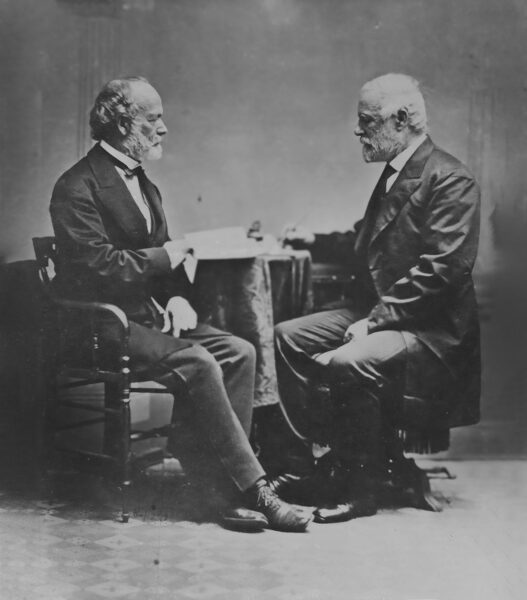
Confederate general Joseph E. Johnston (left) and John Bell Hood
In June, I was privileged to participate as a faculty member in the 2023 Summer Conference of the Civil War Institute at Gettysburg College. The institute’s director, Peter Carmichael, and his staff assembled a stellar lineup of public and academic historians and other experts who, with the conference attendees, explored a wide variety of Civil War topics.1 This year’s conference was my second at CWI and it was my good luck to take part in sessions on generalship in the Confederate Army of Tennessee, John Bell Hood’s Tennessee Campaign of 1864, and the leadership and military career of Joseph E. Johnston. On the latter panel, which included historians Keith Bohannon, Cecily Zander, and (rather dauntingly) Johnston biographer Craig Symonds, we confronted some interesting questions. Common to Johnston and his generalship (aside from the many jabs at his penchant for retreating) were the themes of assessment and evaluation. Namely, why and how historians should think about generals in the Civil War, and whether we ought to rethink our approaches altogether.
A central theme I have hoped to bring out in every installment of this column is that decisions and decision-makers matter in war. Certainly, the historical concepts of agency and contingency, or the capability of humans to alter events or circumstances through their actions and decisions, are familiar ground to military historians and aficionados of Civil War history. Contingency in particular is a theme I have written about extensively, attempted to incorporate into my own historical thinking, and labored diligently to elucidate to my students and to audiences at talks, panels, and conferences. But the discussion about Johnston, certainly one of the war’s most criticized commanders—whose detractors are probably overmatched only by haters of Braxton Bragg, John Bell Hood, and George B. McClellan—forced me to confront my own preconceptions yet again. As I listened to my fellow panelists and participated in the give-and-take about Johnston’s strategic, operational, and tactical shortcomings, it dawned on me that I was falling back on the familiar, and committing some of the cardinal errors in historical thinking that I have long warned others against.
My first mistake was easy to make: I, like practically all historians, had been enticed by the lure of the “performance evaluation” view of Civil War military history. In discussing Johnston’s approach to command, we defaulted to the comfortable thinking about war as a chess match, and the general’s actions and decisions as the most important focus of our analysis. For many years, this has been how to think about military history, and Civil War historians (and buffs) have long thought that the most useful way to look at that history is with hypercritical analysis of the command decisions of generals. This is an error that I have specifically written against, and still I found myself erring again.2 Make no mistake, I do not argue that historians should abandon criticisms of historical figures’ decisions and performance. Professional military educators and planners analyze historical command decisions through case studies, and these kinds of analyses provide important and valuable object lessons for application in contemporary warfare.
However, as an academic historian, moreover, as a 21st-century historian equipped with the advantages of hindsight, primary sources, historiography, and the time and leisure to reflect, it would be presumptuous, even arrogant, to anoint myself judge of Johnston’s shortcomings and failures. We do not and cannot know all of the circumstances and the whole context attached to Johnston’s decisions, and while the historical record can provide us a picture of things in 1864, historians are not omniscient. It is important to remind ourselves, as historian Steven E. Woodworth does, that “the game of chess bears only the vaguest theoretical resemblance to the hard business of war” and “military command is not solely, or even mostly, a matter of strategy and tactics either.”3
It may take decades of debate to reach some consensus as to whether a historical figure’s decisions were right or wrong, clever or incompetent; even then, we do not always agree, and sometimes even change our minds. Amid the complexity and confusion of war, generals like Johnston had to make momentous decisions in days, hours, even minutes or seconds. Perhaps the antidote, then, to my first mistake would be empathy; to place myself in Johnston’s boots and, as nearly as possible, try to see the decision trees before him from his perspective more than mine. Perhaps it is empathy that can lead us to a clearer understanding of the why and how of military decisions, rather than the more beguiling but less useful performance analysis we so often undertake.
My second mistake in assessing Johnston’s generalship is not unrelated to my first and that is an unconscious tendency to conflate hindsight with historical understanding. It is very easy when looking at military leaders to be artificially selective in reconstructing and untangling command decisions and actions in war. Because we, in 2023, know the actual outcomes and consequences of past actors’ decisions, we often unconsciously allow that knowledge to color our perception of the very decisions we hope to understand. For example, when we assume that because the Army of Tennessee and its generals behaved in certain specific ways or won and lost various battles, those outcomes can take on an air of inevitability. Contingency, a fundamental historical concept, says otherwise; what actually happened did not have to happen in a particular way or in a specific manner or sequence. Hindsight, then, can lead us unawares to making value judgments about events, evidence, and outcomes. Johnston did not have a complete picture of circumstances when he made command decisions; why, then, should we, as historians, interpose hindsight on Johnston when he could not, nor could he ever, have had the same temporal and informational advantages?4
If there is a lesson in all this, I believe it is that we ought to approach the subjects of war and command with a healthy dose of humility. Civil War generals like Johnston and the rest are certainly important symbols with significant cultural and political meaning, and the forces of section, ideology, race, and memory all have their interests in using or abusing these figures for their own purposes. Generals’ place in our thinking was, and remains, a contested one, and the temptation to critique and evaluate them is strong. Empathy, understanding, and a more expansive, even generous view of the human element in military decision-making will, I hope, yield fruitful insights if we are wise enough to practice those virtues. 
Andrew S. Bledsoe is associate professor of history at Lee University in Cleveland, Tennessee. He is the author of Citizen-Officers: The Union and Confederate Volunteer Junior Officer Corps in the American Civil War (LSU Press, 2015); co-editor, with Andrew F. Lang, of Upon the Field of Battle: Essays on the Military History of America’s Civil War (LSU Press, 2019); and author of the recently released Decisions at Franklin: The Nineteen Critical Decisions That Defined the Battle (University of Tennessee Press).
Notes
1. For more information on the Civil War Institute and its Summer Conference, visit their website at gettysburg.edu/civil-war-institute/summer-conference/.
2. Andrew S. Bledsoe, “Beyond the Chessboard of War: Contingency, Command, and Generalship in Civil War Military History,” The Journal of the Civil War Era 9:2 (June 2019): 275–301.
3. Steven E. Woodworth, introduction to The Art of the Command in the Civil War, ed. Steven E. Woodworth (Lincoln, 1998), ix.
4. For more on the complicated subjects of contingency and presentism, see Richard Ned Lebow, “Learning from Contingency: The Case of World War I,” International Journal 63 (June 2008): 449, and Matthew A. Sears, “Partisans Assail Historians for Judging the Past by Today’s Standards. Here’s Why They’re Wrong,” Washington Post, July 12, 2018.