The Texans arrived after a grueling overnight march. As the sun rose over south-central Pennsylvania on the morning of July 2, 1863, they were ordered to a creek called Willoughby’s Run, west of the small town of Gettysburg, where water would be plentiful for a short breakfast before they were to take their battle positions. Soon after they settled, some members of the unit—once called Hood’s brigade and now, as a part of General Robert E. Lee’s Army of Northern Virginia, Hood’s division—likely witnessed a historic and sober gathering of the Confederate leader and his top commanders: James Longstreet, A.P. Hill, and John Bell Hood, for whom the Texans had taken their name. Lee had great respect for Hood and his men; originally composed of the 1st, 4th, and 5th Texas Infantry, the men had gained fame and victory during the war, though at terrible human cost. Lee considered it the finest brigade in his army. Yet here was Lee in the soft July morning light, near the Texan camp, seemingly uneasy.
Lee, who knew Hood from his years as the superintendent at West Point, when Hood was a cadet, turned to him and said, “The enemy is here, and if we do not whip him, he will whip us.” Lee was in command, but the chances for victory rode largely on Hood’s shoulders.
The Texans had arrived through a long and dangerous route. Initially assembling near Houston in 1861, the brigade was an ill-shod, rarely uniformed and oddly armed lot. They looked—and were looked upon—as ragged frontiersmen. They excelled at foraging, even against orders, and picked farm and chicken houses alike perfectly clean. But they would build a fearful reputation for bravery earned with considerable bloodshed.
 Library of Congress
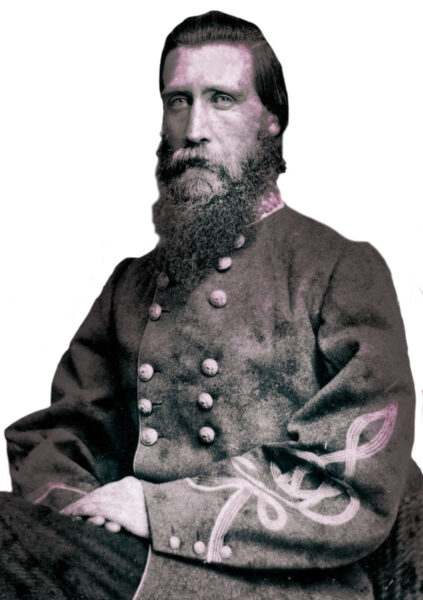
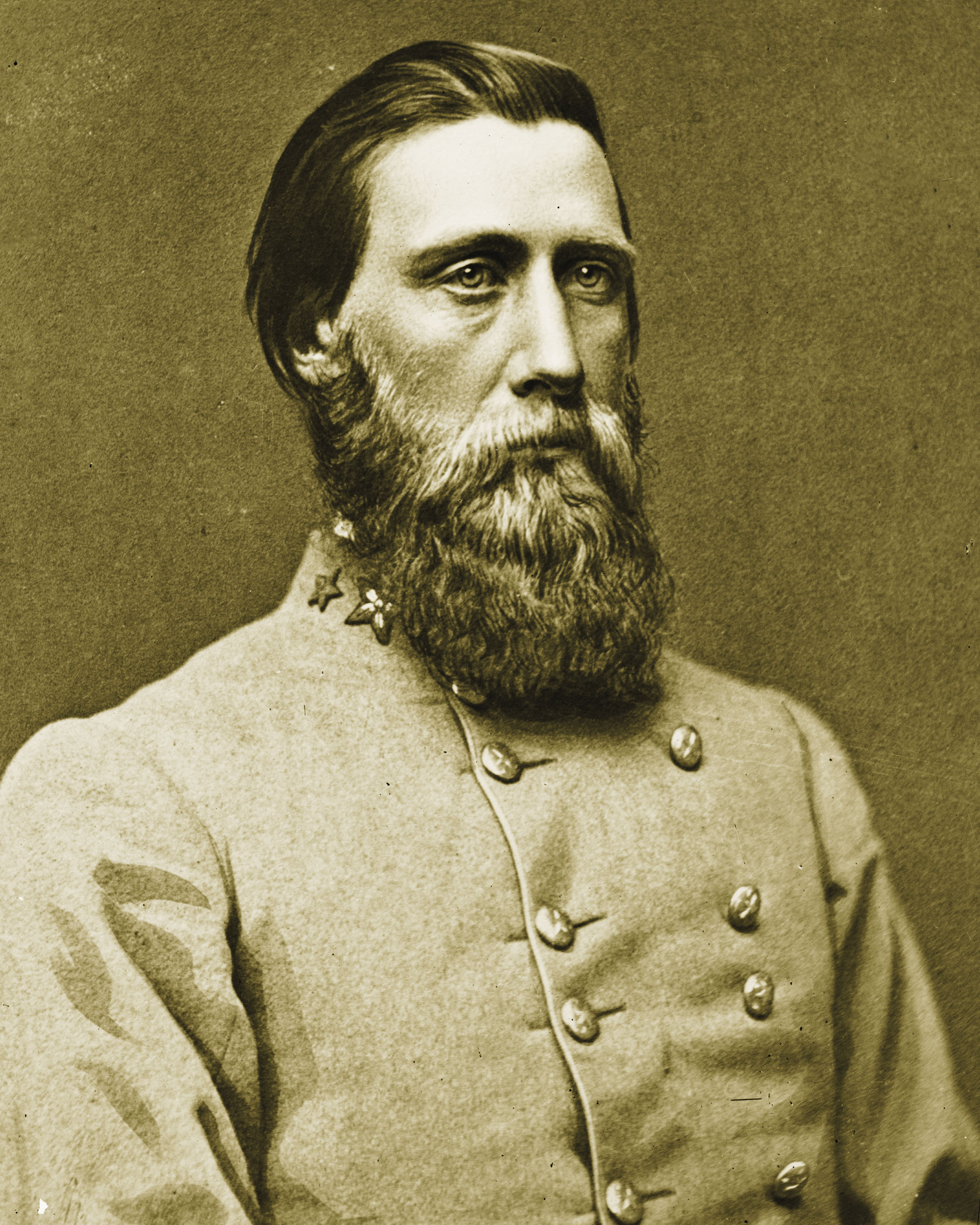
Confederate general John Bell Hood, whose Gettysburg division included his own fiercely proud Texas Brigade.
Oddly for a unit so proud of its Texas roots, the men selected Hood, a native of Kentucky, as their commander. Not that Hood was a complete stranger to the Lone Star State. After West Point, he had served on the Texas frontier in the cavalry and fought the Comanches at Fort Mason, in the sparsely populated center of the state. With the outbreak of the Civil War he resigned his Union commission and donned the Confederate gray as a captain, quickly rising to colonel.
Hood and his men fought with ferocious bravery at the Battle of Gaines’ Mill in June 1862, rushing past cowering Confederates and charging into the Federal lines over 100 yards away with fixed bayonets and a blood-curdling rebel yell. They broke through the Union lines, which proceeded to crumble. Aided by the 18th Georgia, the Texans then withstood a charge by Union cavalry, killing 150 of the enemy before the rest withdrew. The Confederate army took notice, and Hood was promoted to major general.
The Texans won further acclaim at Antietam, where one of the brigade’s regiments, the 1st Texas, lost 186 of its 226 men as casualties. “That those ragged, filthy, wretched, sick, hungry and in all ways miserable men,” wrote a New York Herald reporter, “should prove such heroes in the fight is past explanation. Men never fought better.”
After resting for most of the winter in Virginia and being supplemented with troops from Arkansas, Georgia, and Alabama, the Texans were reorganized into a division under Hood. Crossing into Maryland near Williamsport on June 24, they made camp with a confiscated batch of federal whiskey and proceeded to get falling-down drunk. Some didn’t catch up to their units for 15 hours afterward. The Texans went on to raid farms for eggs, chickens, honey, and even shoes on the way north, watched by angry Pennsylvanians wrapped in Union colors on their front porches. “They are the ones,” said one, “who have killed so many of our soldiers.” But the shenanigans came to end as Lee concentrated his forces for battle later in the month.
At Gettysburg, Lee ordered Hood to fight under General James Longstreet, whose corps was lined up along the Union’s left flank. Longstreet said he would be relying heavily on Hood, since 5,000 additional troops under George Pickett had not yet arrived. “I never like to go into battle with one boot off,” he told Hood.
Hood, directed to take the lead along with several regiments of Alabamans, moved out that afternoon. The men, on foot, moved rapidly for five miles along the Emmitsburg road. As they moved, Hood received intelligence from his scouts that the Union flank stopped just south of a hill called Big Round Top. Hood thought a victory could be snatched if that position could be seized.
This article is excerpted from Disunion, a New York Times online series following the course of the Civil War as it unfolded. Read more at www.nytimes.com/disunion.
Three times Hood asked Longstreet for permission to shift to the right to take advantage of the Union’s weak flank. But Longstreet steadfastly insisted the attack go straight forward, through a rocky terrain full of Union sharpshooters called Devil’s Den. In the fighting, Hood’s troops veered to the south, and ended up assaulting a smaller rise just below Big Round Top called Little Round Top. In a brief but ferocious fight the Confederates overwhelmed the Federals at Devil’s Den. On horseback, Hood was hit by shrapnel and one arm was shattered, but his men fought on, convinced that victory at Little Round Top could turn the entire Union flank and win the battle.
But the Union troops used their cover tenaciously, and the Confederates were now caught in the saddle between the two Round Tops—an area that would thereafter be known as the Slaughter Pen, the scene of bloody, vicious hand-to-hand fighting as the Federals only grudgingly gave way, inch by inch, withdrawing up Little Round Top. Repeated assaults by Texans and Alabamans failed to get to the crest.
Eventually the tide turned decisively against the southerners, particularly the Alabamans in Hood’s division. Trying to advance once more up Little Round Top they faced the plucky 20th Maine Infantry. Running low on ammunition, the Maine men fixed bayonets and charged down the hill at Hood’s men, killing and scattering the remainder—saving Little Round Top and, effectively, turning the tide of both the Battle of Gettysburg and the American Civil War. As night fell, the Texans and their comrades withdrew.
As the third day of the battle dawned, it became apparent that Longstreet’s two divisions—one under Hood—had been “bled white on the previous day.” Most held fast on the Confederate right as Pickett’s disastrous charge unfolded; only the 1st Texas went into action, successfully repelling a group of Federal cavalry that threatened the Confederate flank.
Once again, the Texans had suffered immensely. Hood’s division was shattered, with 2,289 casualties, including 343 killed, 1,504 wounded, and 442 missing. Casualties included top officers and company commanders.
On the evening of July 4, Lee withdrew from the battlefield, headed back to the safety of Virginia. Rain poured down and roads turned to mud as the remnants of the Confederate force headed south.
The Potomac River flooded and the shallow fords now impassable, the Texans had to wait in Maryland, risking a follow-up Union assault, until the waters receded.
Ten days later, with the rains still falling, the Texans decided they could wait no longer, and a brigade crossed into Falling Waters, Virginia, around dawn. As they arrived on shore they found Lee himself watching from atop his horse, Traveller. The Texans saw the general and “each soldier bared his head. There was no salute, no cheer and no word was spoken as the men marched silently by.”
The Texans fought for nearly two more years, mostly in Georgia and Tennessee. Lee would personally lead them in a desperate charge at the Battle of the Wilderness. Back once more in Virginia—ragged, starving, and down to their last bullets—just 600 of the 3,500 men who left Texas were still standing in uniform when Lee surrendered.
Hood surrendered with a small force in Mississippi on May 31, 1865, over a month after Lee’s surrender at Appomattox. His arm forever useless after Gettysburg, he died 14 years later, in New Orleans. Fort Hood, Texas, is named for him, and a 35-foot marble shaft stands as a memorial to the general—and his Texans—on the manicured grounds of the state capitol in Austin.
Richard Parker writes for the McClatchy-Tribune syndicate, the Columbia Journalism Review and The New Republic.