 Library of Congress
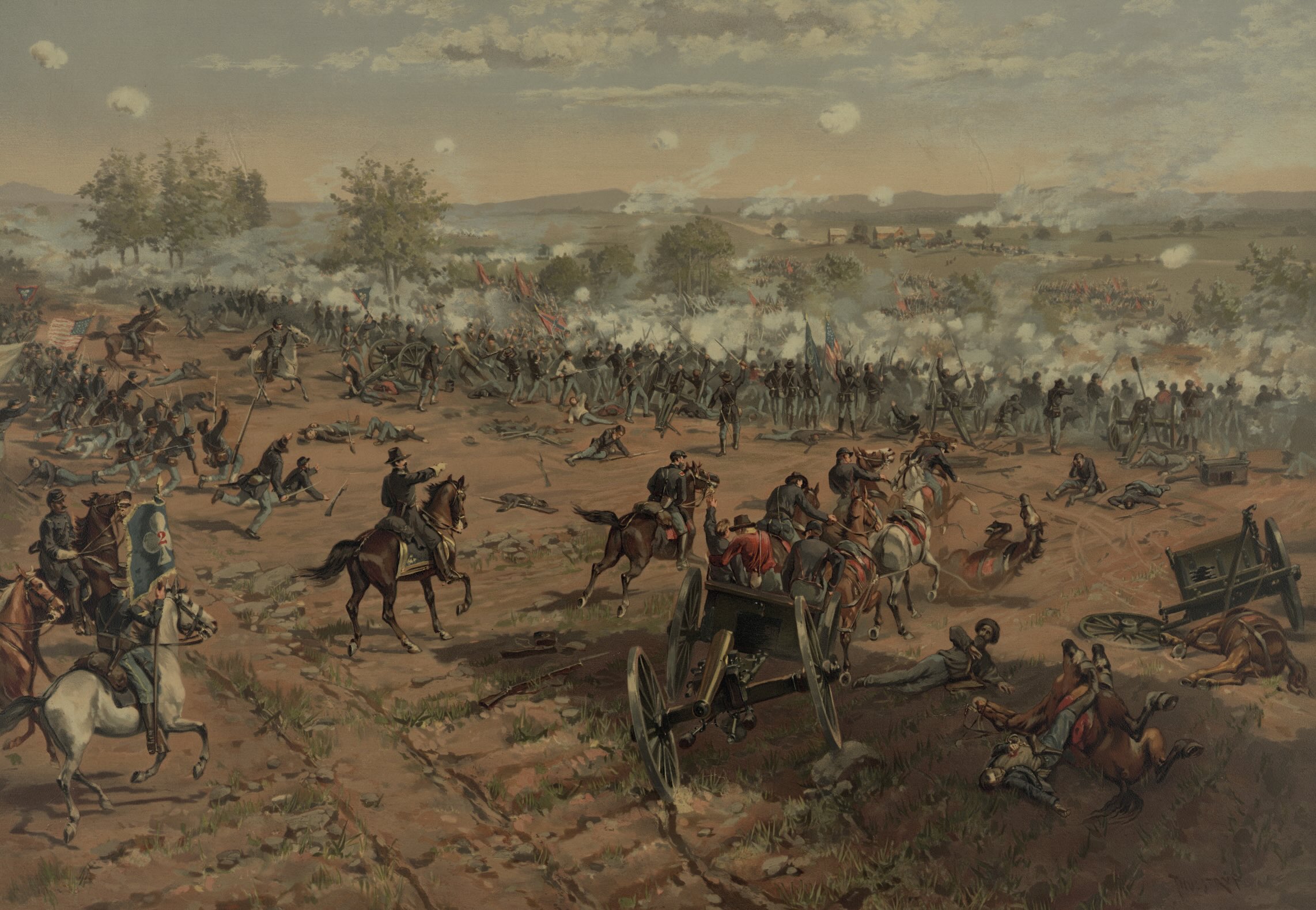
This painting by Thure de Thulstrup depicts Union soldiers fending off advancing Confederates during Pickett’s Charge at the Battle of Gettysburg.
At Gettysburg on July 3, 1863, Billy Yank and Johnny Reb faced each other on a day that would be a defining moment—the defining moment in many eyes—of America’s Civil War. Most of the men in the Army of the Potomac and Army of Northern Virginia were citizen-soldiers who had left their homes and peaceful pursuits to serve and defend their country. Once the great crusade for the Union—or for southern independence—was finished, they planned to lay down their arms and return to their homes, maintaining the citizen-soldier tradition for their descendants to follow in the world wars of the 20th century. Not least among the factors that explain the place Joshua L. Chamberlain enjoys in memories of the Civil War was that he was an exemplar of the citizen-soldier tradition, a professor turned Union general, stepping up to serve his country with honor, courage, and ability in its hour of danger, then returning to peaceful pursuits.
Dominating the high commands of the two armies, however, were men who belonged to a different tradition. These men entered the U.S. Military Academy at West Point as teenagers, then spent most, if not all, of their adult lives as officers in the U.S. Army. These were the regulars, the centurions who built and manned the posts on the nation’s land and water frontiers and fought what Rudyard Kipling later labeled “the savage wars of peace” that enabled the rest of their countrymen to go about their own pursuits. While dedicated to service to the republic, the academy and Regular Army fostered in officers a sense of separation and distinction from the civilian world. In contrast to an America that prized individualism and personal liberty, the academy and army taught officers to subordinate self-interest to the needs of society, respect hierarchy and authority, and appreciate the value of institutions that impose order and direction. As a result, and not surprisingly, West Point and the army were viewed with no little suspicion by many civilians in both the North and the South, which reinforced the sense of corporateness and distinctiveness among the regulars.
The uneasy and at times tense relationship of America with her officer corps went back to a meeting that took place on another July 3, this one in 1775. The place was Cambridge, Massachusetts, where George Washington first set eyes on the men the Continental Congress had just given him direction over. To the task of forging a Continental Army, Washington brought a vision of military leadership rooted in admiration for the British army, in which a much younger Washington had yearned to be an officer. While he appreciated the enthusiasm these men (whom Ralph Waldo Emerson described as “embattled farmers” in his celebratory hymn of 1837) brought to their duties, Washington wanted to forge in the Continental Army qualities he admired in the British regulars. With the assistance of Baron von Steuben and others who shared his views, Washington labored to make the Continental Army a respectable force in line with the standards and ethos of the European standing armies he admired. His efforts received their validation with the great siege at Yorktown—conducted alongside French regulars in line with European practice—that brought the military contest between Great Britain and the United States to a triumphant end.
 Anne S.K. Brown Military Collection
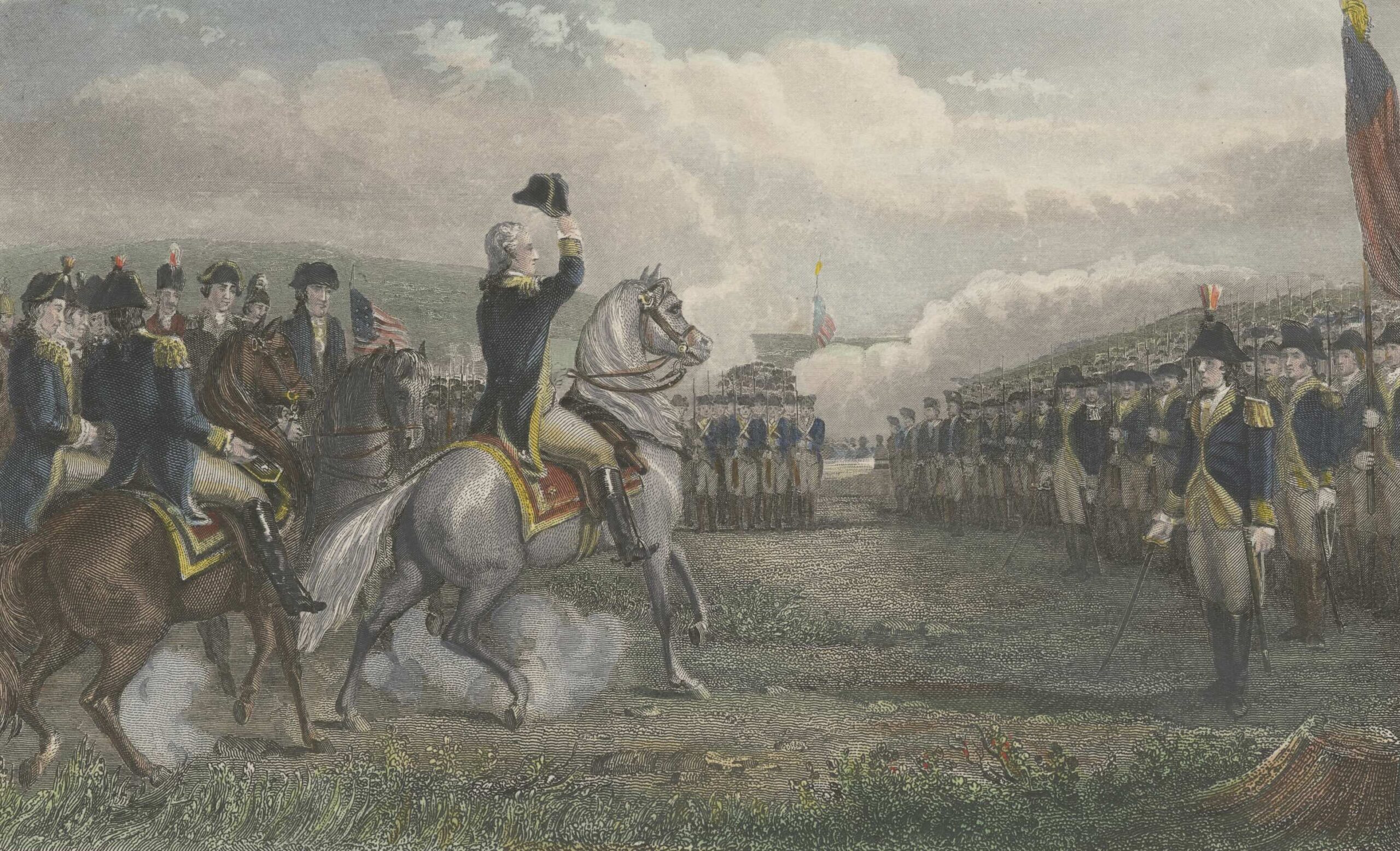
This 1859 engraving depicts George Washington, center, taking command of the Continental Army at Cambridge, Massachusetts, in July 1775.
Washington’s vision for the country’s land forces was evident after Yorktown, with his leadership of the effort to replace the Articles of Confederation motivated in no small part by the obstacles it placed in the way of what was necessary to raise and maintain an effective regular army. As first president and commander in chief under the Constitution, Washington pressed for a robust, well-regulated regular force, as was evident in his support for Anthony Wayne’s effort to build an American Legion for war in the Ohio Country.
Despite Washington’s prestige and expertise when it came to military affairs, his efforts met with resistance. As opposition to the Constitution and Washington’s administration demonstrated, many Americans wanted to keep the central government small and its ability to tax, arm, and regulate limited. Washington’s desire for a robust regular army constructed along European lines was, they argued, incompatible with the distinctive character of the American republic. They preferred land forces composed of—and led by—citizen-soldiers and argued a permanent and robust standing army would be a drain on taxpayers in peacetime whose values were incompatible with those of a liberal republic. The triumph of this viewpoint after 1801 would play no small role in the problematic performance of U.S. land forces in the second war with Great Britain, which saw the humiliating burning of Washington D.C.
The War of 1812 would, however, see seminal moments in the debate over America’s land forces take place at Queenston Heights and Chippewa. At Queenston Heights in October 1813, American land forces would suffer a humiliating defeat when New York militia refused to cross the Niagara River to aid regular army units under Winfield Scott that were engaged with the British. While in British custody afterward, Scott would have the opportunity to watch up close how British regulars performed. Like Washington, Scott came away from the experience impressed by the British regulars and convinced that the United States needed to emulate their example when it came to its own Regular Army. After his release, Scott would apply what he learned. When the time came to cross the Niagara again, Scott did so at the head of a force whose tactical proficiency, order, and discipline not only won the Battle of Chippewa in 1814, but also impressed his British opponents. His British counterpart famously exclaimed, “Those are regulars, By God!”
 Wikimedia
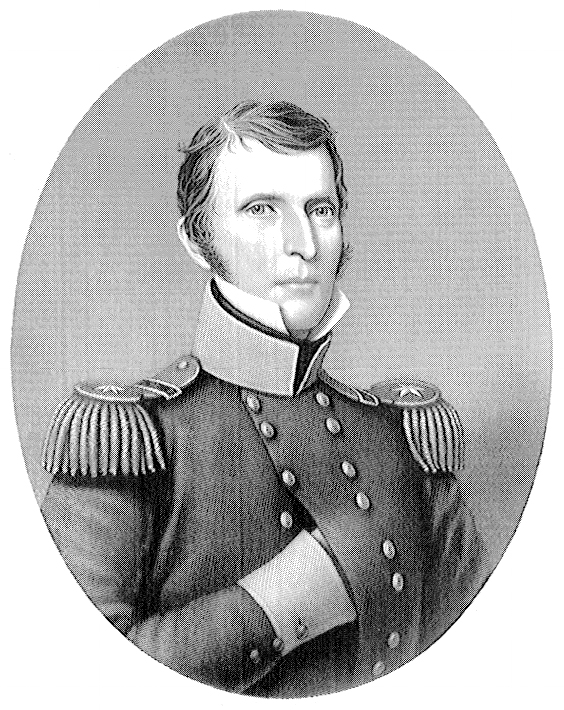
Henry Leavenworth
Among those at Chippewa who carried the Regular Army legacy forward was Henry Leavenworth. In 1827, a force of regulars under Leavenworth’s direction established a post on the Missouri River where, after the Civil War, army leaders founded a school for fostering professional leaders, in line with the Washingtonian vision. This school would prepare the regulars who went on to lead the army in the great popular crusade wars and the “savage wars of peace” of the 20th and 21st centuries, including John J. Pershing, Matthew Ridgway, Colin Powell, H.R. McMaster, and future Gettysburg resident Dwight D. Eisenhower. Notably among the regulars with Leavenworth when he established the fort that would bear his name was Samuel Wellington Hunt, accompanied by his young son Henry J. Hunt. On July 3, 1863, it would be Henry Hunt behind the guns defending Cemetery Ridge.
Twenty years after the establishment of Fort Leavenworth, the success of Scott and his fellow professionals in their effort to reform the nation’s land forces would be evident. Only 33 years after the U.S. Capitol and Executive Mansion had been burned due to the inadequacy of America’s land forces, forces under Scott’s command paraded in Mexico City after a campaign that led no less than the Duke of Wellington to proclaim Scott the “greatest living soldier.” Scott proclaimed his victory as validation of the U.S. Military Academy that had been at the center of his efforts to professionalize and develop the regulars in line with his and Washington’s vision. In words that generations of cadets would commit to memory to remind them of the heritage of the institution they were part of, Scott declared, “I give it as my fixed opinion that but for our graduated cadets, the war between the United States and Mexico might, and probably would have lasted some four or five years, with, in its first half, more defeats than victories falling to our share; whereas, in less than two campaigns, we conquered a great country and a peace, without the loss of a single battle or skirmish.”
Sixteen years after Scott led an army that included Robert E. Lee, Winfield Scott Hancock, George Pickett, Cadmus Wilcox, Henry Hunt, and James Longstreet to victory in Mexico, those products of West Point and the Regular Army would on July 3, 1863, face each other at Gettysburg. On their presence and their decisions—their service and their vision—rested the outcome of that great battle in American history. They bore testimony to the direction the American army had taken 88 years earlier, when one man’s arrival in 1775 Cambridge marked that army’s birth.
Ethan S. Rafuse is professor of military history at the U.S. Army Command and General Staff College at Fort Leavenworth, Kansas.