 Library of Congress
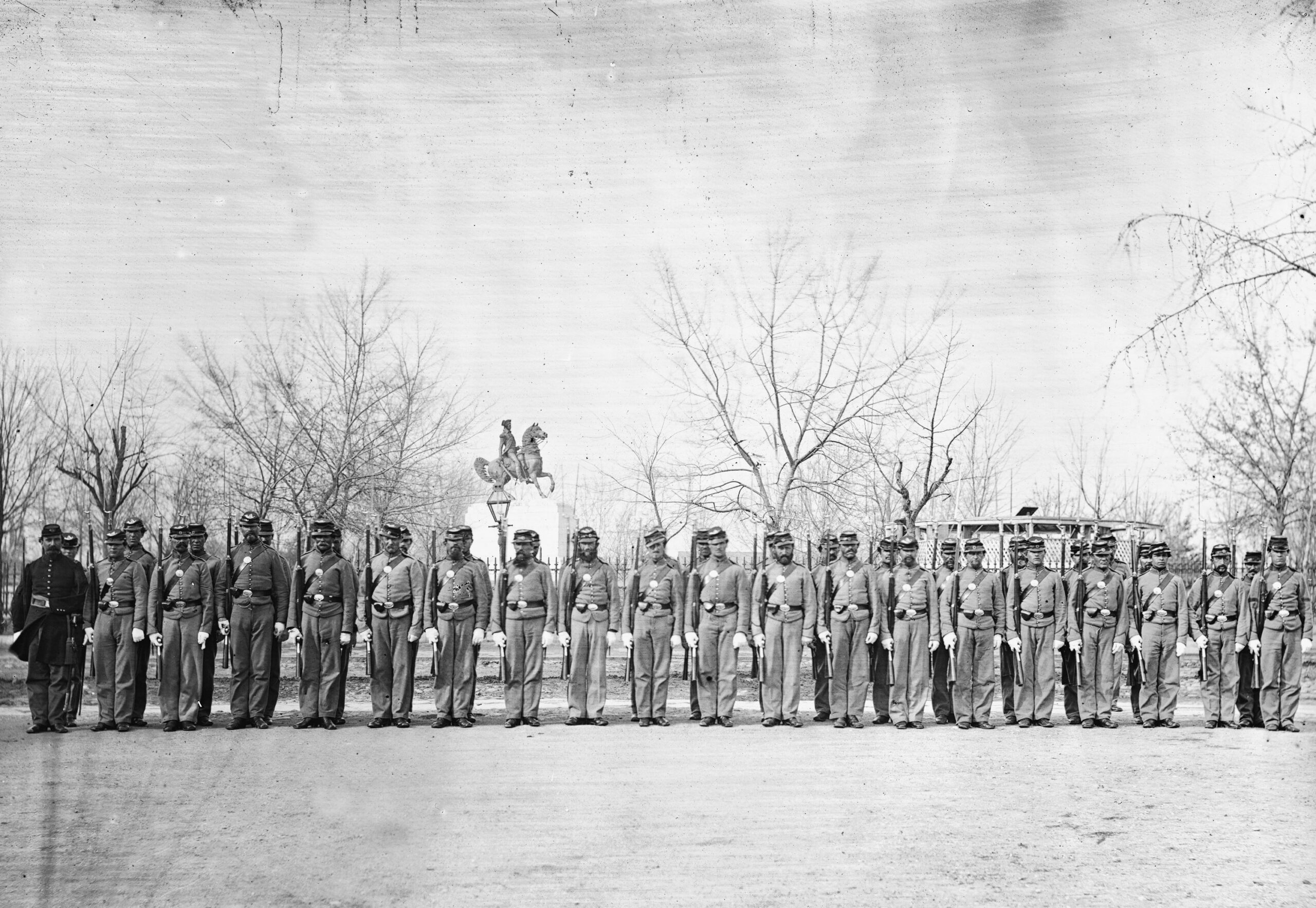
Members of the 10th U.S. Veteran Reserve Corps pose for the camera in Washington, D.C., at war’s end. Created within the Union army, the organization—previously known as the Invalid Corps—allowed partly disabled or infirm soldiers to perform light duties, freeing able-bodied troops for the front line.
George Farnum did not like being a “hospital bummer.”
After the 22-year-old from New Hampshire, a regimental musician, was shot in the shoulder at the Battle of Fredericksburg, he was confined to the New Hallowell Hospital in Alexandria, Virginia, for months while the wound healed. Hospital life was tedious, and convalescing soldiers were subjected to routine “inspections,” where the attending surgeon toured the wards. The men had to sweep their rooms and make their beds, then sit perfectly at attention (buttons and boots polished) for the exam. The soldiers, Farnum wrote to his hometown newspaper, The Farmer’s Cabinet, “remain as still and mute as statues until all is over and the ‘medicine man’ makes his exit with as much pomposity as a new made prince.”1 When the surgeon was satisfied, the soldiers were rewarded with a trip to church.
Farnum itched to get out of the hospital, and hoped he would be transferred back to his unit, the 5th New Hampshire Infantry. Instead, he found himself sent to an altogether new unit: the Invalid Corps. He wrote to The Farmer’s Cabinet, “here I am, an unwilling member of the … ‘United States Paupers.’” His bitter quip summed up how many men felt on being transferred to the Invalid Corps. The creation of the corps was at least partly justified by the desire to keep disabled soldiers honorably in uniform, in the belief that continued service would ward off feelings of uselessness and despair, but many soldiers saw the unit as a stigmatizing purgatory.
 Library of Congress
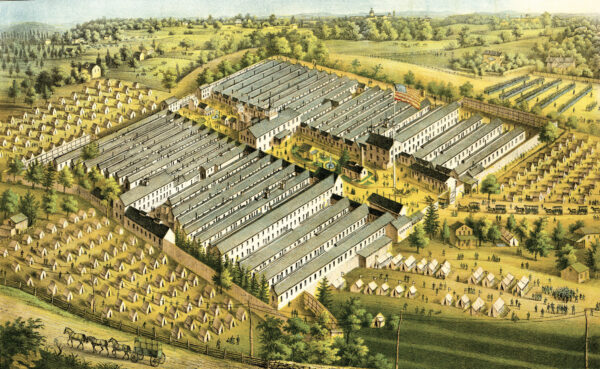
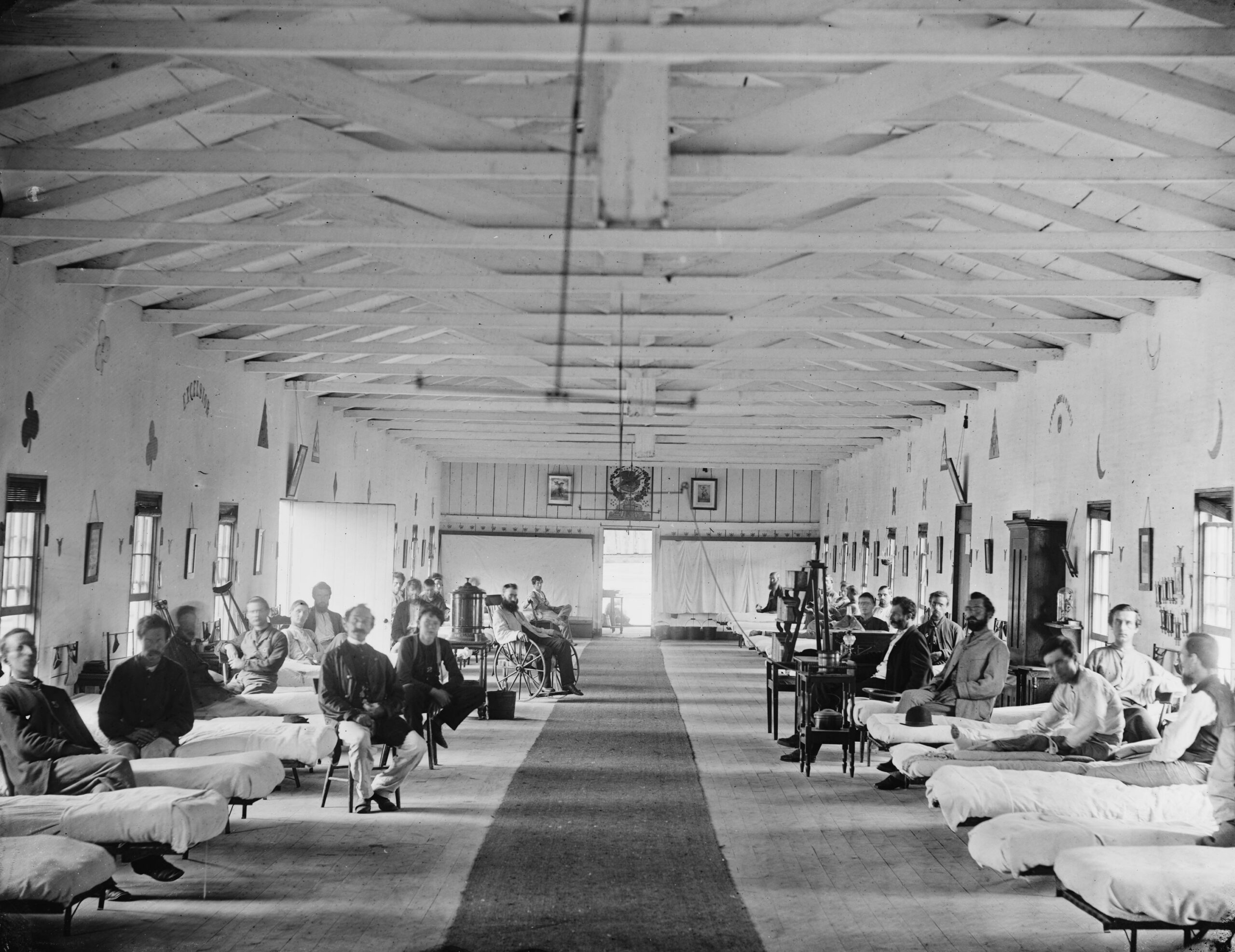
Union soldiers convalesce in Armory Square Hospital in Washington, D.C. From 1863 to war’s end, many injured or infirm troops released from hospitals found themselves sent to the Invalid Corps—instead of to their old regiments or to their homes. The move dismayed men like New Hampshire veteran George Farnum, who complained that “here I am, an unwilling member of the … ‘United States Paupers,’” after his transfer to the corps.
By 1863, the federal government was increasingly concerned about troop strength in the Union army. While the federal forces were always greater than their Confederate counterparts, and the North had a larger male population of military age to draw on, Union soldiers were required to perform tasks beyond the battlefield, such as maintaining the defenses of Washington, D.C., and waging conflicts against Native Americans in the West. In the spring of that year, the government began a series of efforts to ensure that the army remained as large as possible. In March, the Enrollment Act, congressional legislation that authorized the first draft, was enacted. Two months later, the War Department issued General Order 143, which allowed for the enlistment of black men in the Union army and established the United States Colored Troops. Given these attempts to expand enlistment, some in the Union army and War Department questioned whether the army’s medical staff were perhaps too cavalier with disability discharges and convalescent policies. Was it possible that able-bodied men were getting out of their enlistments with injuries that should not disqualify them from service?
It made sense to question the protocols for discharge and recuperation. The army did have large numbers of soldiers who were too sick or injured to serve on the front lines, but well enough not to be bedridden. Soldiers such as George Farnum, whose wounds required long-term rest and care, were sent to large general hospitals in Alexandria, Washington, and other cities for treatment. But once a soldier had survived the most critical part of his convalescence, it wasn’t always clear what to do with him. Recovering soldiers took up hospital beds, chafed at hospital rules, were bored, and got into trouble. Farnum recalled that convalescing soldiers took in the amusements of Alexandria, particularly flocking to theaters and the circus. Men at the Satterlee Hospital in Philadelphia regularly got drunk and played cards, which didn’t counter the general perception that hospitalized soldiers were malingerers trying to get out of reentering the ranks.
Many surgeons considered discharges the simplest solution. Others got rid of restless convalescents by sending them home on furlough, reasoning that having them finish their recovery at home was better than having them take up beds and hospital labor—except, however, that numbers of them never returned, causing yet another set of problems. Army surgeon Roberts Bartholow declared that authorizing discharges was one of the most critical duties of military surgeons. He estimated that by May 1863, more than 143,000 men deemed disabled had been discharged—and Bartholow speculated that a good portion of them were not deserving of the ticket home.
 Library of Congress
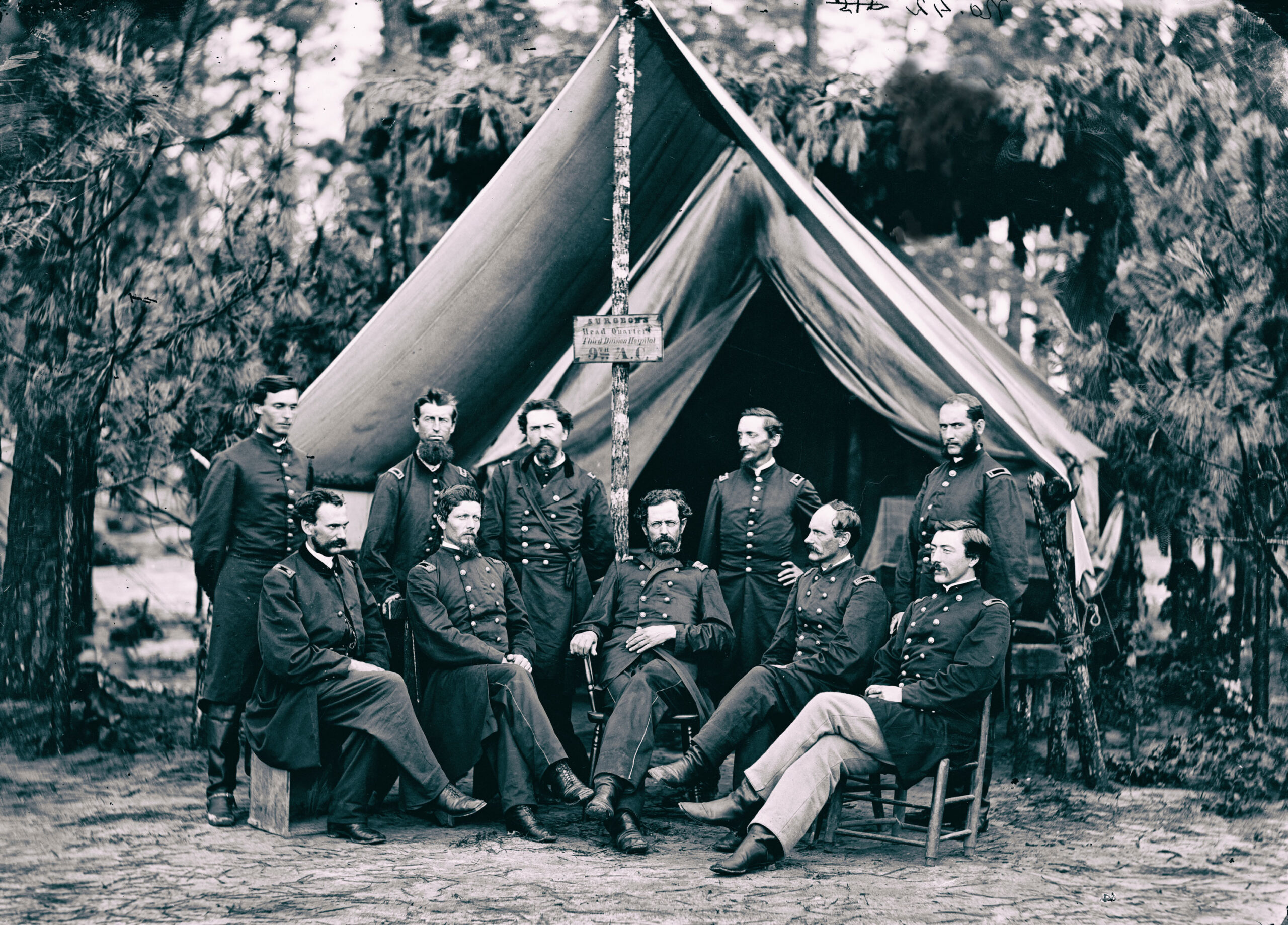
Before the creation of the Invalid Corps, Union surgeons mainly dealt with the problem of restless convalescents by issuing discharges. By May 1863, more than 143,000 men deemed disabled had been released from the service. Above: Surgeons of the Third Division, IX Corps, Army of the Potomac, in August 1864.
When the army tried to solve its manpower issue by making use of convalescing soldiers, it did little to sharpen the line between soldier and patient. A directive from the War Department in April 1862 allowed the chief medical officers of each city to use any “convalescent, wounded, or feeble men who can perform such duties” as nurses, cooks, or hospital attendants instead of giving them disability discharges. Ostensibly, this meant that the army could benefit from the labor of recovering soldiers—but just weeks later, Secretary of War Edwin Stanton issued another order authorizing medical officers to discharge any men they believed would be unfit for duty for at least 30 days if the soldier so requested. Few men would choose hospital labor over the opportunity to go home, and even when they did, the system was chaotic and disorganized. No one tracked how long soldiers had been on light duty, nor were there clear guidelines for when a soldier should be sent back to the ranks—all the decisions made by surgeons. The men who remained in hospitals, even those who were engaged in hospital work, were quickly labeled “hospital bummers” and accused of avoiding the front lines. Annoyed by the large numbers of recuperating soldiers loitering in hospitals, surgeons still found disability discharges the easiest solution.
The War Department also worried that hospital work was detrimental to soldiers. Most such work was done by women; the men working in hospitals were mostly black. Nursing, cooking, and light handy work were mainly seen as inappropriate for white men who should be doing the “real” work of soldiering. Invalid Corps adjutant general John W. De Forest noted in his report at the end of the war to Provost Marshal General James B. Fry that “invalids” who performed hospital work “were useful indeed,” but they “ceased to be soldiers in fact and spirit.”2 What good was it to keep soldiers occupied if the work made them less rather than more fit for active duty?
How to engage disabled soldiers in work that was both critical to the army’s operations and possible for men labeled unfit for field duty to perform in a controlled and organized fashion? The answer was the Invalid Corps, born in April 1863. Under Secretary Stanton’s General Order 105, only men with specific injuries automatically qualified for a disability discharge: men with amputations (though they could choose, instead, to enter the Invalid Corps), men with certain severe ailments, and men whose recuperation would outlast their remaining enlistment term. No other men were to be granted disability discharges. Instead, upon examination by a medical officer, they were to perform suitable hospital work, and it would be a medical officer who determined whether they should return to their ranks or be transferred to the Invalid Corps. There were few injuries too severe for the Invalid Corps, even genital ones. Typically, conditions deemed disqualifying were those that could cause a disturbance in the ranks or involved cognitive impairment, such as insanity or a severe head injury, or presented problems of hygiene, such as wounds that affected bowel or bladder function.
So most soldiers were transferred to the Invalid Corps, as was Farnum; discharged soldiers could reenlist to join it. The corps comprised two battalions. First Battalion included soldiers considered “the most efficient and able-bodied,” who could still shoulder arms, march, and perform guard duty.3 Second Battalion was drawn from soldiers with more severe injuries or ailments and those who had lost a hand or arm. Initially, the plan was to place soldiers who had lost a foot or leg into a third battalion, but that plan never materialized, so lower limb amputees were assigned to Second Battalion. Since amputees could request a discharge instead of an automatic transfer to the corps, Second Battalion was always smaller than First Battalion. Still, by late 1863, the corps had grown to include 16 regiments, 203 companies, and 18,255 men.4
 Library of Congress
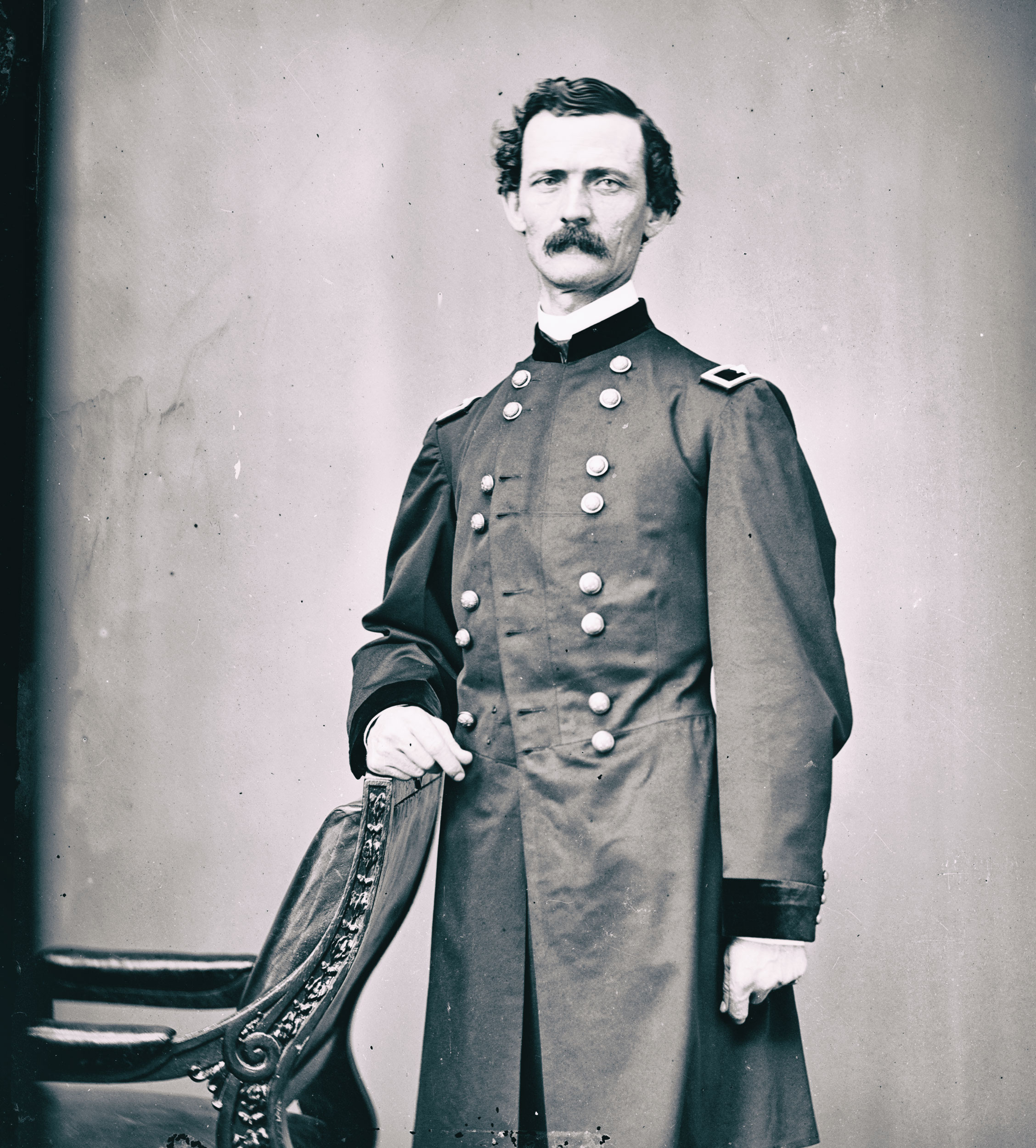
Provost Marshal General James B. Fry
The Invalid Corps answered to the Provost Marshal, and its members performed a variety of support tasks according to their abilities. First Battalion typically performed work that required greater physical ability, including escorting new troops to the front lines, guarding prisons, or serving as military police. Because they were allowed to carry arms, soldiers in First Battalion occasionally found themselves pulled into scrapes. Some First Battalion soldiers participated in a skirmish at Fort Stevens in 1864; others had been injured (and one died) trying to control protesters during the New York City draft riots in July 1863. Alfred Bellard, an Invalid Corps private formerly of the 5th New Jersey Infantry, recalled how, serving as prison guards, they had to use their supposedly “unfit” bodies to carry drunken soldiers to the barracks on their backs. Second Battalion performed less physically arduous tasks, serving as orderlies, cooks, nurses, clerks, and supply workers.
The Invalid Corps marked a new conception of a soldier’s obligation to the army and to the nation. A war wound, though lauded as evidence of bravery, did not represent the culmination of a soldier’s duty. Instead, if it was deemed severe enough to make a soldier unfit for field service, it could mean other renewed duty. The Invalid Corps was founded on the notion that there were many ways to serve the nation in its time of need—and not even shedding blood on its behalf was enough to get a citizen-soldier out of that responsibility. Further, the War Department styled the Invalid Corps as a way for soldiers to preserve their manhood. In the fall of 1863, Provost Marshal General James B. Fry wrote to Stanton about men serving in the corps, that “the pride and soldierly spirit which produced their battle scars is fostered and protected by giving them useful and honorable employment, instead of leaving them inactive and in want, a burden to themselves and to the community.”5 Fry was not alone in viewing disability as synonymous with dependency and emasculation; even the most honorable war wound had the potential to ruin a man. The Invalid Corps offered an escape from that fate by keeping soldiers occupied in worthy war work as long as possible.
It might seem that to a fighting army with plenty to worry about, the fate of its disabled soldiers would be of little concern. But in 1863 that army was also fighting on the homefront for civilian belief in the war as moral and righteous.
If the army broke the bodies of thousands of citizen-soldiers, then sent them home to become charity cases, it risked being perceived as callous and mercenary, chewing men up and spitting them out. Next to death, war wounds represented the ultimate sacrifice of a citizen-soldier—a small offering in the great national bloodletting. These soldiers were worthy of honor. At the same time, war wounds resulted in disability, which Civil War-era Americans struggled to see as anything but negative. Most of them, like Fry, believed a disability meant becoming a dependent, a person incapable of achieving economic independence. While some members of society were understood to be naturally dependent—women, children, and non-whites—white men were expected to be the opposite, providing for those who could not provide for themselves. The unworthy poor were labeled paupers, stigmatized as not just physically disabled but morally degraded. A white man who relied on charity was not only less able than his fellow man, but was also corrupted, sapped of manhood, and pathetic. And while the War Department and federal government clearly viewed war wounds as honorable, their fears that disabled veterans would become paupers revealed a certain discounting of the soldiers’ patriotic sacrifices.
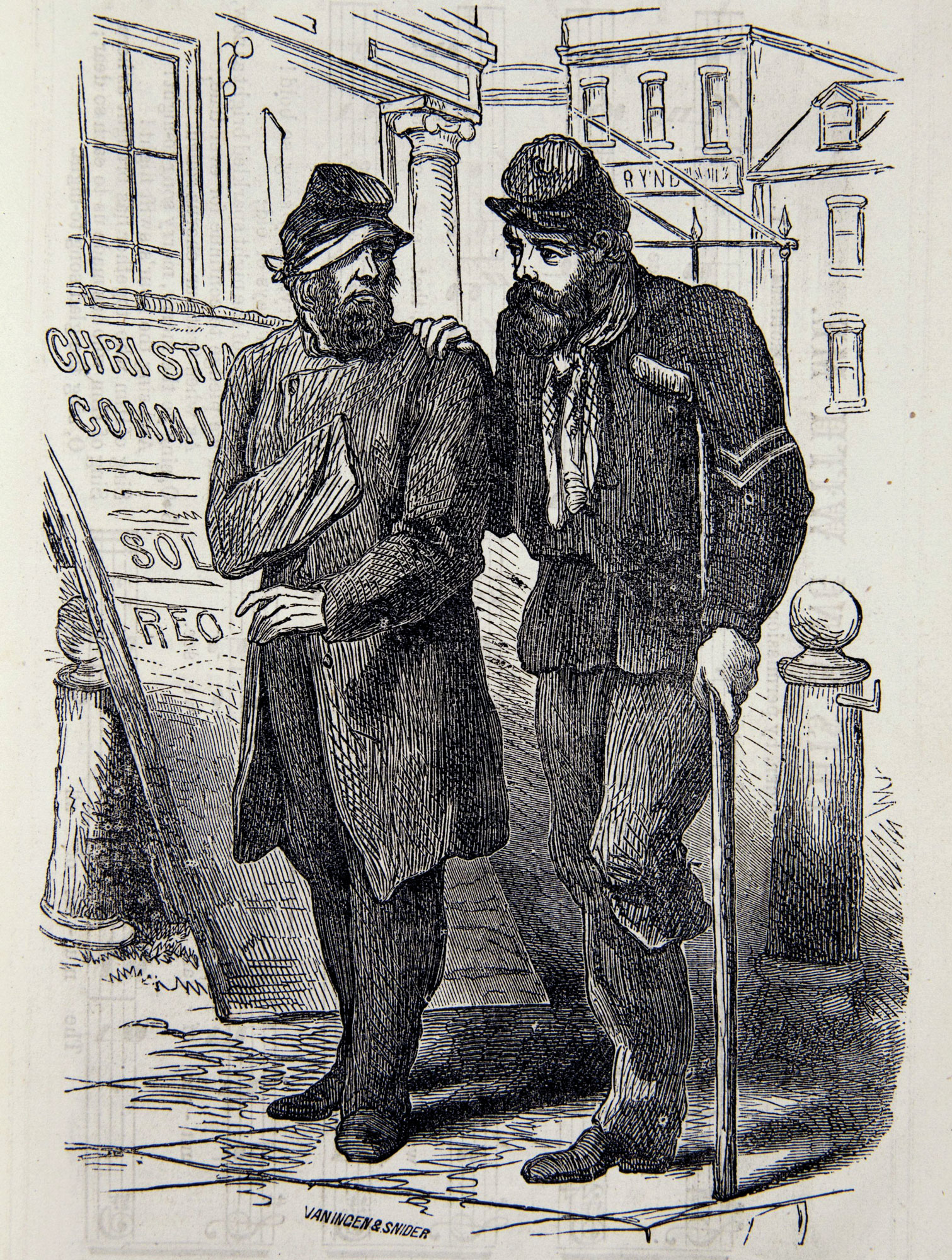 The Mothers’ Journal and Family Visitant
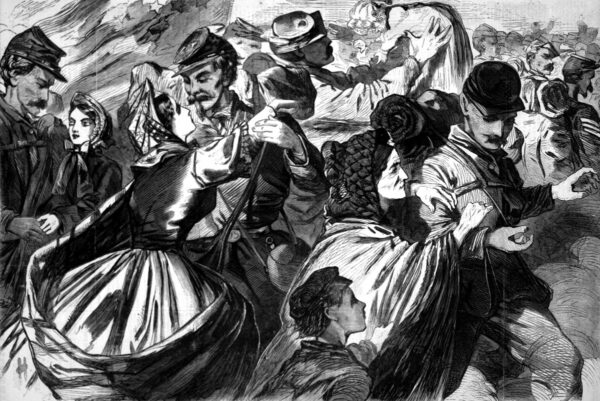
In the minds of many in the War Department and on the homefront, the creation of the Invalid Corps served as a way to save disabled veterans from being relegated to public charity. Above: This wartime sketch shows two “suffering soldiers”—the sort of men thought to be helped by enrollment in the corps—walking the streets.
That the Invalid Corps had been created to save soldiers from pauperism seemed to be the popular interpretation on the homefront. The New Hampshire editors of The Farmer’s Cabinet wrote that “the great object of this Corps is to give honorable employment to those who have lost health or limbs in the service, and are unfit for other employments.”6 Several newspapers suggested that disabled soldiers should be thankful for the Invalid Corps for saving them from a future degraded dependency. One Maryland newspaper proclaimed of the corps, “the maimed and enfeebled soldier is provided for, and the citizen is no longer deterred from enlisting in the army, for fear of beggary, should the fortune of war deprive him of the means of support by his labor.” Those already wounded, the editors went on, were now “not to be cast upon the charity of the world as no longer of value.”7 Clearly, battle scars alone were not sufficient to preserve the manhood of a disabled soldier.
There was another more practical reason the War Department wanted to keep disabled soldiers in the ranks: It would save the federal government a lot of money while boosting manpower. Keeping disabled soldiers in the ranks, even in a segregated unit, to do essential but noncombat tasks like guarding prisons and supply work, meant physically fitter soldiers manning the frontlines. But more important, it meant the federal government would not have to pay discharged disabled soldiers their pensions. Passed in 1862, the Act to Grant Pensions provided a government pension to each Union soldier disabled during his time in the army. Soldiers transferred to the Invalid Corps received their same army rate of pay. Had they been discharged, they would be eligible for pension payments—for which they owed the government no labor in exchange—and probably replaced by a new recruit, doubling the expense for the government.
The War Department’s intentions in creating the unit were one thing; what Invalid Corps soldiers actually thought about serving in it were another. While their labor might have been critical to the smooth operation of the army, their new tasks were not the stuff of patriotic songs or stories. Even the way they entered the corps irked some soldiers. While enlisting resonated with cultural beliefs about citizen-soldiers doing their duty for their country, a medical transfer to a unit of invalids, where you spent your time doing what seemed like busy work, felt like an insult. George Farnum resented not being sent back to the 5th New Hampshire to serve out his enlistment with his comrades, and chafed at being labeled an invalid, a term that carried effeminate overtones. His feeling was more anger than grief or low spirits, attended by disgust and a little shame at being forced into the unit. In his letters to his hometown newspaper, Farnum regularly referred to the corps in terms associated with pauperism: an “almshouse,” the “United States Paupers,” and the “cripple corps.”
Many Invalid Corps soldiers longed for their old units. William Dunn was only a teenager when he was shot in the throat at Chancellorsville serving with the 11th New Jersey Infantry. After a long convalescence, he hoped to be allowed to return to his regiment, but instead found he was being sent to Second Battalion of the Invalid Corps. He reacted with grief: “As soon as I am mustered in the I.C. I have nothing more to do with the 11th Regiment of NJ or that with me, my name is then crossed off all company books.” After months of camaraderie in the ranks and bonding under fire, Dunn grieved the loss of his regiment. Such feelings were known to be a problem by the leadership of the corps; in his end-of-war report on the unit, De Forest wrote that soldiers often begged to stay in their original regiments or be discharged rather than be transferred to the Invalid Corps.
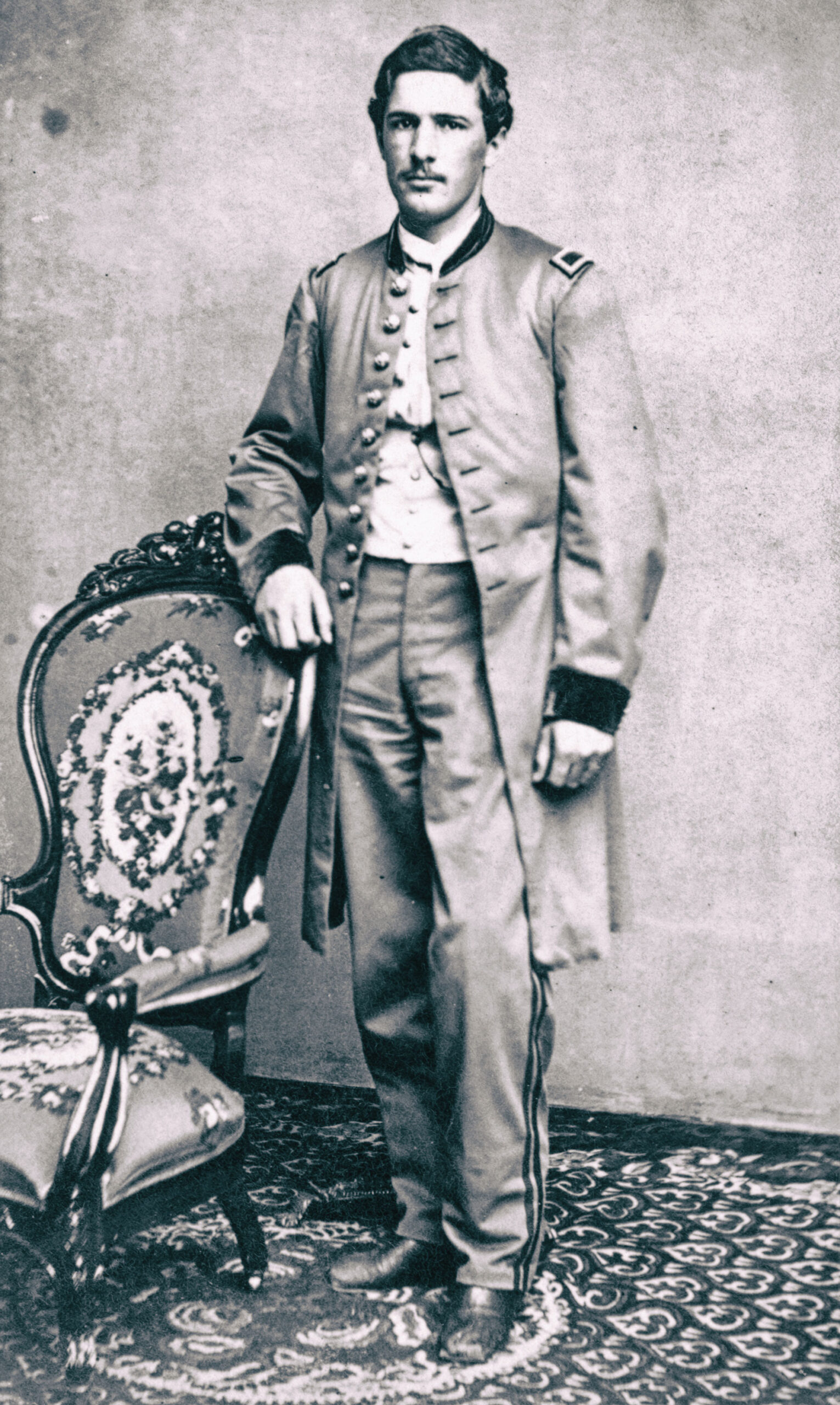 Library of Congress
Many members of the Invalid Corps chafed at being labeled invalids and then separated from their old regiments. They also disliked their new sky-blue uniforms, which reinforced their sense of separation from the rest of the Union army, whose men wore dark blue. Above: A member of the Invalid Corps in his light-blue uniform.
Membership in the corps made soldiers feel disconnected from their former identity as combat troops, relegated now to the fringes of the “real” army. They also felt marked as disabled and unfit—a feeling exacerbated by their uniforms. Rather than the federal blue worn by most of the army, Invalid Corps uniforms were sky blue, trimmed with dark blue. The idea was to visually differentiate Invalid Corps troops from field troops, so that soldiers working behind the lines wouldn’t be suspected of shirking or straggling. But the effect was that Invalid Corps soldiers felt even more separate from the identity they had cultivated in the ranks. Many believed they had earned the dark blue Union uniform, and resented losing that mark of honor. The light blue uniforms didn’t just mark soldiers as members of the Invalid Corps, but as disabled, which many nondisabled soldiers interpreted as a sign of inferiority. When a corps officer Colonel Charles F. Johnson briefly assumed command of regular regiments in defense of White House Landing in June 1864, he wrote to his wife that the soldiers “did not like the idea of ‘coming into the field to be commanded by an Invalid,’ they did not like the light blue.”8
And then there was the name. Rather than emphasizing the sacrifices the corps’ sick and disabled soldiers had made in the war effort, “invalid” instead brought to mind images of bedridden weakness and effeminacy. Worse still, the initials I.C. were army shorthand for spoiled or useless supplies. When a quartermaster received a crate of rotten meat, for instance, it was stamped I.C., which stood for “Inspected, Condemned.” Soon, this became a general epithet for the soldiers of the corps, who were “condemned” to its service. Confederate prisoners, guarded by Invalid Corps members, called their captors “Condemned Yanks.” Even the soldiers sometimes thought of themselves as condemned to the corps; E.C. Fisk, medically transferred to the unit, wrote that he felt part of a “set of condemned & great part useless men.”9 The problems became serious enough that in March 1864, the Adjutant General’s Office issued a general order changing the name to Veteran Reserve Corps, suggesting not incapacity but that these soldiers had been battle-tested and achieved veteran status.
Name change or no, the corps (and its soldiers) continued in a sort of limbo—a unit of tried and true battle veterans and a repository for soldiers who could no longer fight. Not only was this reflected in the media and army jokes, but also in the popular culture. Frank Wilder’s song “The Invalid Corps” poked fun at the soldiers as a ridiculous group: “Some were too fond of bitters,/some had ‘cork legs’ and some ‘one eye,’/with backs deformed and crooked,/ I’ll bet you’d laugh’d til you cried/to see how ‘cute’ they looked.”10 Another song, also called “The Invalid Corps,” tells the story of a soldier with one eye who eventually drank himself out of the service. Far from tales of brave, wounded veterans, these visions depict an absurd corps full of damaged, immoral, and “cute” rejects.
The Invalid Corps remained in service through the end of the war, and portions of it continued in the United States Army into 1869. In total, an estimated 60,000 soldiers served in the ranks of the corps.11 While it certainly played a role in the success of the Union army, its legacy may have been more ideological. In the creation and implementation of the Invalid Corps, the federal government was forced to confront the paradox disabled soldiers represented: that even the most patriotic war wounds had the potential to turn soldiers into dependent paupers, and that the government had to find a way to stave off such a crisis. (This was to become the defining conflict of later political fights over the swelling pension rolls, which centered on whether pensions—designed to keep veterans from becoming paupers—were actually encouraging dependency by giving disabled men cash payouts.)
For Invalid Corps soldiers, the frustrating position they found themselves in foreshadowed the line that disabled veterans would have to walk, adhering to notions of manhood while being a wounded warrior. In the postwar era, soldiers learned to craft narratives about their lives in an attempt to prove they were not just looking for handouts when they sought their promised pensions. Their dilemmas predicted how even now Americans react to war-related ailments with lavish patriotic rhetoric, while simultaneously feeling unsettled at their “burdens” on the nation’s social services. The Invalid Corps reminds us that our beliefs about war wounds and our assumptions about disability are not unrelated, but deeply and painfully entwined.
Sarah Handley-Cousins is a clinical assistant professor of History and associate director of the Center for Disability Studies at the University at Buffalo. She is the author of Bodies in Blue: Disability in the Civil War North. She also serves as an editor of the history blog Nursing Clio and is a co-producer of Dig: A History Podcast.
Notes
1. “Letter from a Member of the New Hampshire 5th,” The Farmer’s Cabinet, April 30, 1863.
2. John W. DeForest to Brigadier General James B. Fry, November 30, 1865, in United States War Department, The War of the Rebellion: A Compilation of the Official Records 129 vols. (Washington, 1880-1901), Series III, Vol. 5, 543 (hereafter cited as OR).
3. Circular No. 14, OR, Series III, Vol. 3, 225.
4. Paul A. Cimbala, “Federal Manpower Needs and the U. S. Army’s Veteran Reserve Corps,” in Sanders Marble, ed., Scraping the Barrel: The Military Use of Substandard Manpower, 1860-1960 (New York, 2012), 8.
5. James B. Fry to E.M. Stanton, November 17, 1863, OR, Series III, Vol. 3, 1046.
6. “Men Wanted for the Invalid Corps,” The Farmer’s Cabinet, September 3, 1863.
7. “Miscellaneous. The Invalid Corps—What Its Duties Are,” National American, November 20, 1863.
8. Fred Pelka, ed., The Civil War Letters of Colonel Charles F. Johnson (Amherst, 2004), 238. Emphasis in original.
9. Cimbala, “Federal Manpower Needs and the U. S. Army’s Veteran Reserve Corps,” 13.
10. Frank Wilder, “The Invalid Corps, Song & Chorus,” Johns Hopkins University, Levy Sheet Music Collection, Box 088, Item 095 (jscholarship.library.jhu.edu/handle/1774.2/23854).
11. Margaret E. Wagner, Gary W. Gallagher, and Paul Finkelman, eds., The Library of Congress Civil War Desk Reference (New York, 2002), 442.
Related topics: medical care, veterans