 Library of Congress
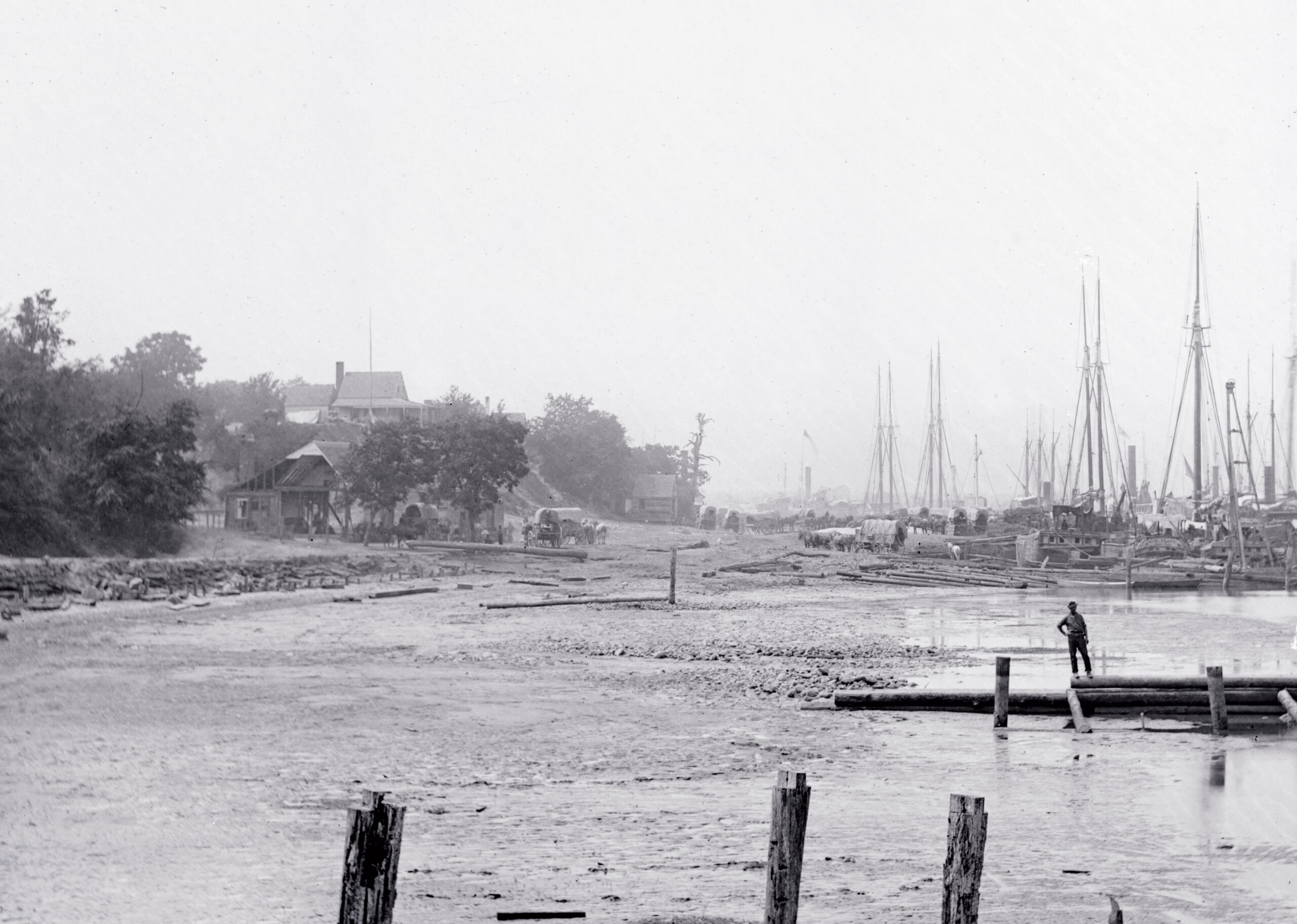
Wagons stand ready to receive supplies at the wharf at City Point, Virginia, the site of Ulysses S. Grant’s headquarters during the Siege of Petersburg—and where Abraham Lincoln paid a brief but memorable visit in June 1864.
In June 1864, a military correspondent for the New York World said of the man named in march to command the union army, “General Grant is fertile in resources, he is enterprising and tenacious, and if one plan fails, he is ready to adopt another.”1 When Grant woke on June 20 in his headquarters tent at City Point, Virginia, he was well on his way to proving the reporter right.
Grant’s initial plan, begun in early May, directed the Army of the Potomac into central Virginia to engage and defeat Robert E. Lee’s Army of Northern Virginia. Major General George Meade commanded the Federal force, with Grant headquartered nearby. A month later, after a series of hard-fought engagements and marching that brought Union forces to east of Richmond, Grant had to accept that the plan had failed. Both sides had suffered serious losses—the Confederates almost 35,000 and the Federals nearly 60,000—but the Rebel army remained a force to be reckoned with.
A new plan was needed and Grant devised a bold stroke. The Army of the Potomac disengaged from Lee’s forces, marched southward across a long pontoon bridge spanning the James River, and struck at the critical Rebel transportation hub at Petersburg, Virginia, catching Lee uncharacteristically unprepared. Grant was now directing two cooperating armies, the second—the Army of the James—a much smaller one that had tried unsuccessfully to menace Richmond from below, operating across a peninsula-like area known as Bermuda Hundred.
 Library of Congress
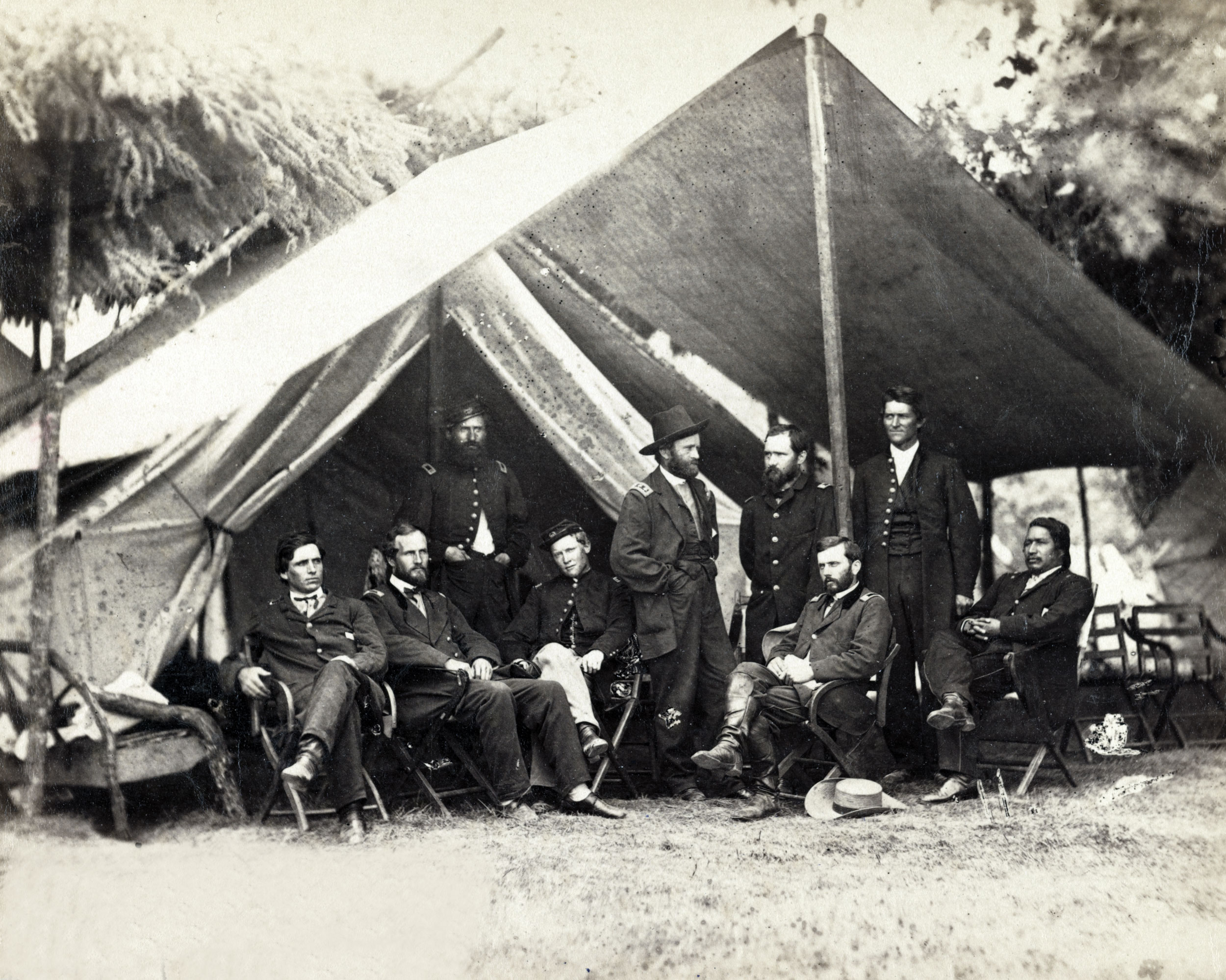
In May and June 1864, Ulysses S. Grant (shown here with his staff in the summer of 1864), the Union army’s newly minted general-in-chief, formulated several plans to defeat Robert E. Lee’s Confederates in Virginia. After the third of them failed, Grant received an unexpected visitor in the person of Abraham Lincoln.
From June 15–18 elements of the two Union armies tried to batter their way into Petersburg. Nothing worked as it should. Coordination between two different chains of command was poor, the combat-fatigued Army of the Potomac was performing at low efficiency, and the outnumbered Rebel defenders were heroic in protecting Virginia’s second-largest city. A preexisting line of earthworks shielding the city’s eastern approaches was overrun, but an improvised backup line held, and the Federals ran out of steam. The second plan had also failed its objectives, meanwhile adding 2,500 to the Rebel casualty lists and nearly 13,000 to the Federal lists.
Two days later, after he awakened on June 20, Grant devised a third plan with as many distinct elements. The Union lines spread southward along Petersburg’s eastern side and angled southwestwardly to touch a major thoroughfare known as the Jerusalem Plank Road. Element one was to swing two army corps around the end of that flank, bringing them up against the Rebel city’s south-facing defenses and cutting the Weldon Railroad. At roughly the same time, a large cavalry force was to march farther south before heading west some 50 miles to interdict traffic on two southern supply routes—the South Side and the Richmond & Danville railroads—destroying as much track as possible.
 Library of Congress
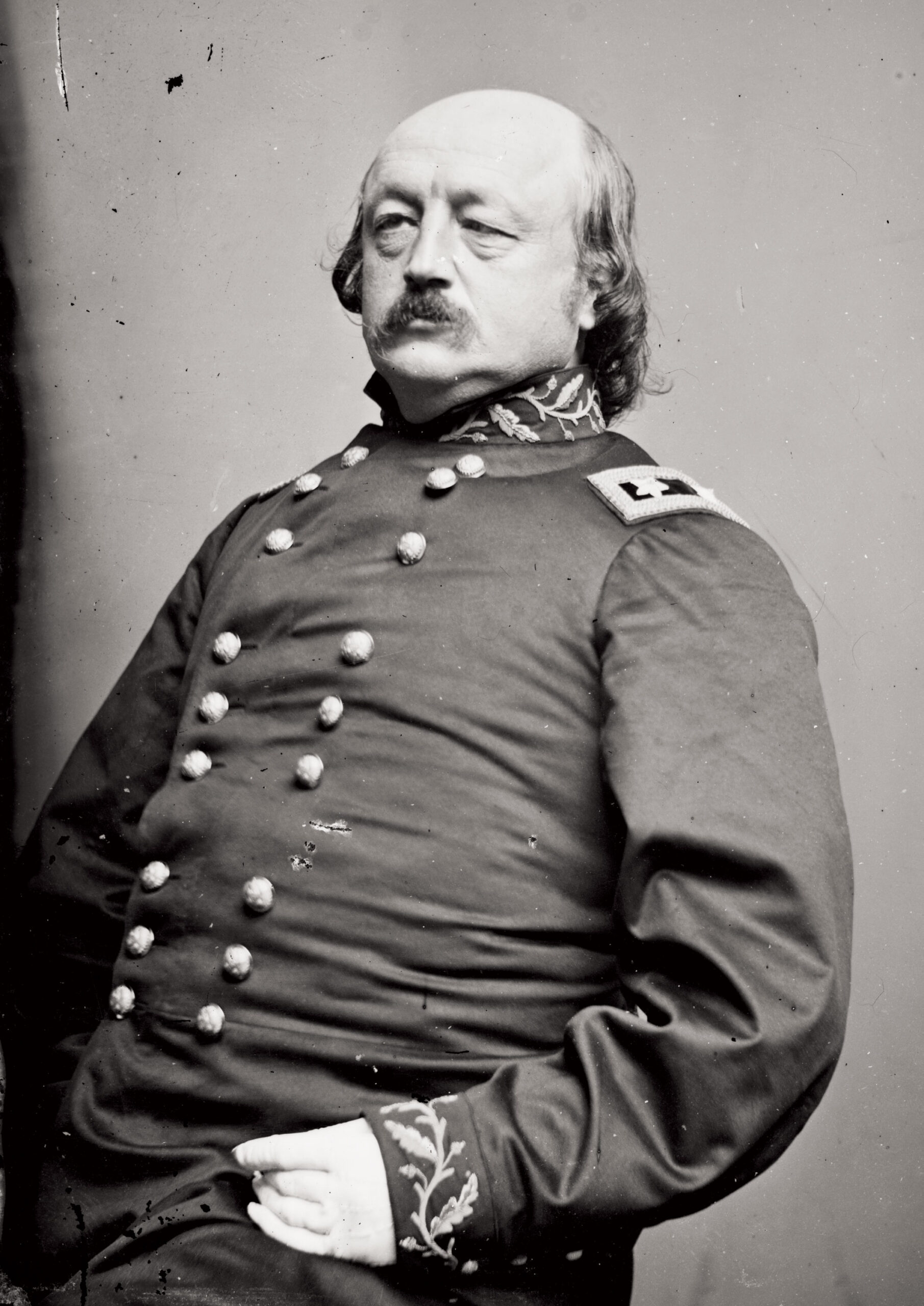
Major General Benjamin F. Butler, commander of the Army of the James.
The last element in this plan involved the Army of the James under its commander, Major General Benjamin F. Butler. One of his army’s two corps, the XVIII, was already confronting Petersburg. Grant now plucked a brigade from Butler’s other corps, the X, on Bermuda Hundred, sending it north across the James River over a pontoon bridge at a point called Deep Bottom. There the soldiers entrenched a beachhead to facilitate later Union incursions, something that Lee would surely challenge. While all this was happening, Grant had to acknowledge that there would be no quick victory at Petersburg. He ordered the army’s siege train—all its most powerful cannon and least mobile weapons—down from Washington to populate the growing network of forts and batteries that were spread along the entrenched lines and required decisions about their placements.
So, Grant had a lot on his breakfast plate that morning, not just another plan for Petersburg, but also his responsibilities as commander of all Union forces throughout the country. The last thing he needed was a distraction, and he was about to receive an unexpected one in the person of the commander in chief.
 Library of Congress
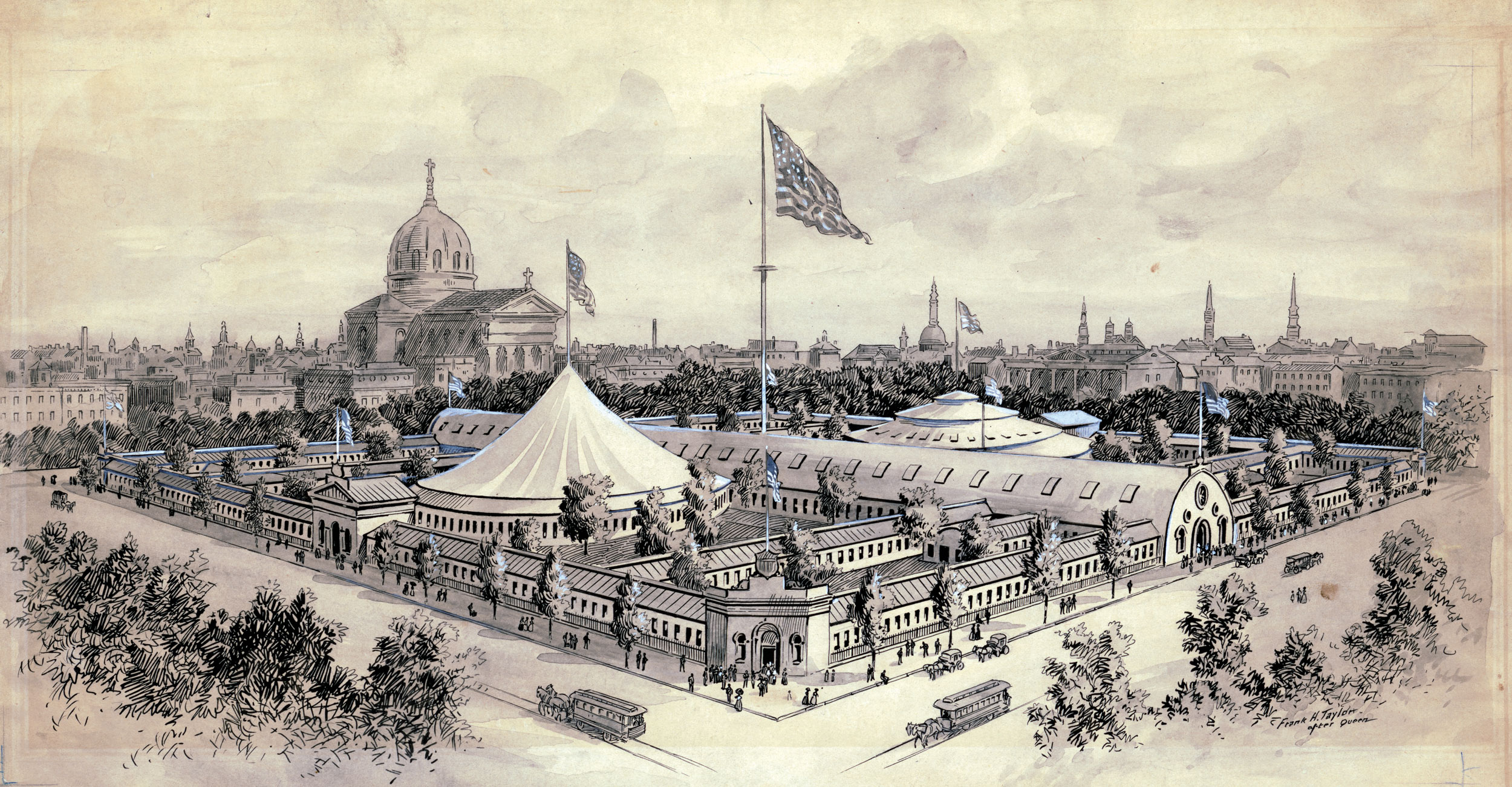
On June 16, 1864—only days before he decided to visit Grant at City Point—Lincoln attended Philadelphia’s Great Central Fair (depicted here in a drawing by Frank H. Taylor), where he acknowledged that three years of war had “carried mourning to almost every home.”
A few days before, on June 16, even as Federal forces were struggling at Petersburg, President Abraham Lincoln was speaking in Philadelphia at the Great Central Fair on behalf of the U.S. Sanitary Commission, a civilian operation that tended to soldier welfare at the front. He bluntly acknowledged that three years of war had “carried mourning to almost every home.” He also firmly linked his and Grant’s determination to win the war: “General Grant is reported to have said, I am going through on this line if it takes all summer. This war has taken three years; it was begun or accepted upon the line of restoring the National authority over the whole national domain, and for the American people, as far as my knowledge enables me to speak, I say we are going through on this line if it takes three years more.”2
Lincoln was back in Washington the next day. Reports continued to arrive at the War Department from Petersburg: Fighting was sharp, results inconclusive. A message received the evening of June 19 told of Federals entrenching their advanced positions and the city’s Rebel defenders being reinforced. It did not take a military specialist to conclude that Grant’s bold attempt to seize Petersburg had fallen short.
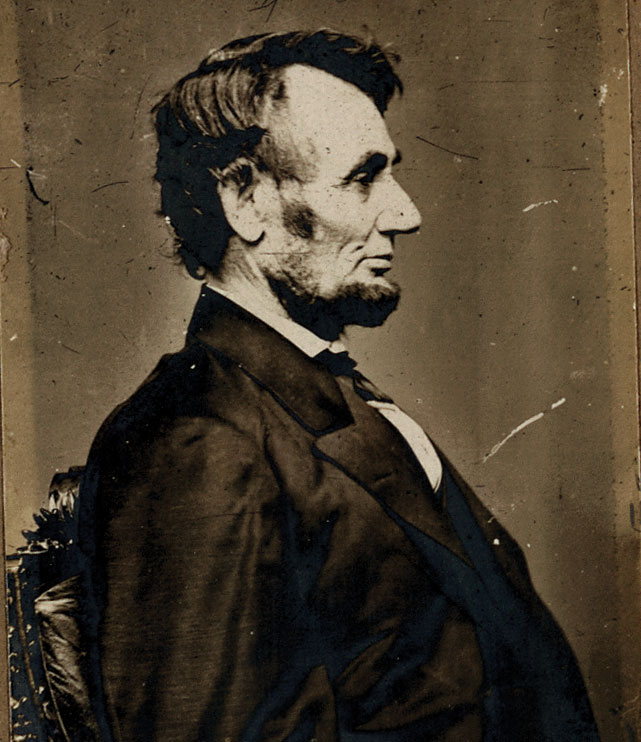 Library of Congress
Lincoln as he appeared in 1864.
Most probably it was June 18 or 19 when Lincoln decided to visit Grant’s headquarters at City Point. He called on his go-to man for practical matters nautical, Assistant Secretary of the Navy Gustavus V. Fox, to arrange the transportation. The rotund Fox, a retired naval officer, secured USS Baltimore, a captured Rebel sidewheel steamer pressed into official U.S. Navy service for carrying everything from supplies to personnel. Lincoln knew the vessel, having been ferried to Hampton Roads in 1862, not long after the ironed warships USS Monitor and CSS Virginia clashed there. Lincoln asked Fox to come along, and Fox boasted to his wife that there was “no other company.”3 (He wasn’t counting Lincoln’s son Tad, also aboard.)
Several contemporary accounts identify a third passenger, named as “Col. [H.A.] Chadwick of Willard’s Hotel, who acted as chief caterer of the Presidential party.”4 Chadwick, who would have a long career in Washington as a lawyer, real estate speculator, and hotel owner, was with the Lincoln party when it arrived on June 21, but then he dropped from view and played no part in events.
The trip was veiled in secrecy as Lincoln had taken pains that there was no leak about it. When the editor of Washington’s Daily National Republican found it out, the president asked him to sit on the story. As the editor afterward wrote: “It was his purpose and wish that his mission to the James river, while he was absent, should be as private as possible, so far as announcement by the press was concerned.” (The rival Washington Star ignored any such embargo, announcing the president’s departure in its June 21 edition, prompting the Republican’s editor to grumble “that others have violated what seemed to us a simple act of duty.”5)
Fox’s boss, Secretary of the Navy Gideon Welles, was not happy with Lincoln’s going to City Point. He blamed his assistant, who he believed (without evidence) “favored and encouraged the President in this step…. It has been my policy to discourage the President in these excursions.”6 Nevertheless, around 1 p.m. on June 20, USS Baltimore steamed away from Washington with Lincoln aboard. Fox, whose oversight duties had made him something of a commuter between Washington and City Point, described the trip to his wife as “a delightful run of 20 hours.”7 There were no stops; it happened to fall during a full moon period, allowing Baltimore to steam along the Chesapeake Bay coast after sunset and through the night.
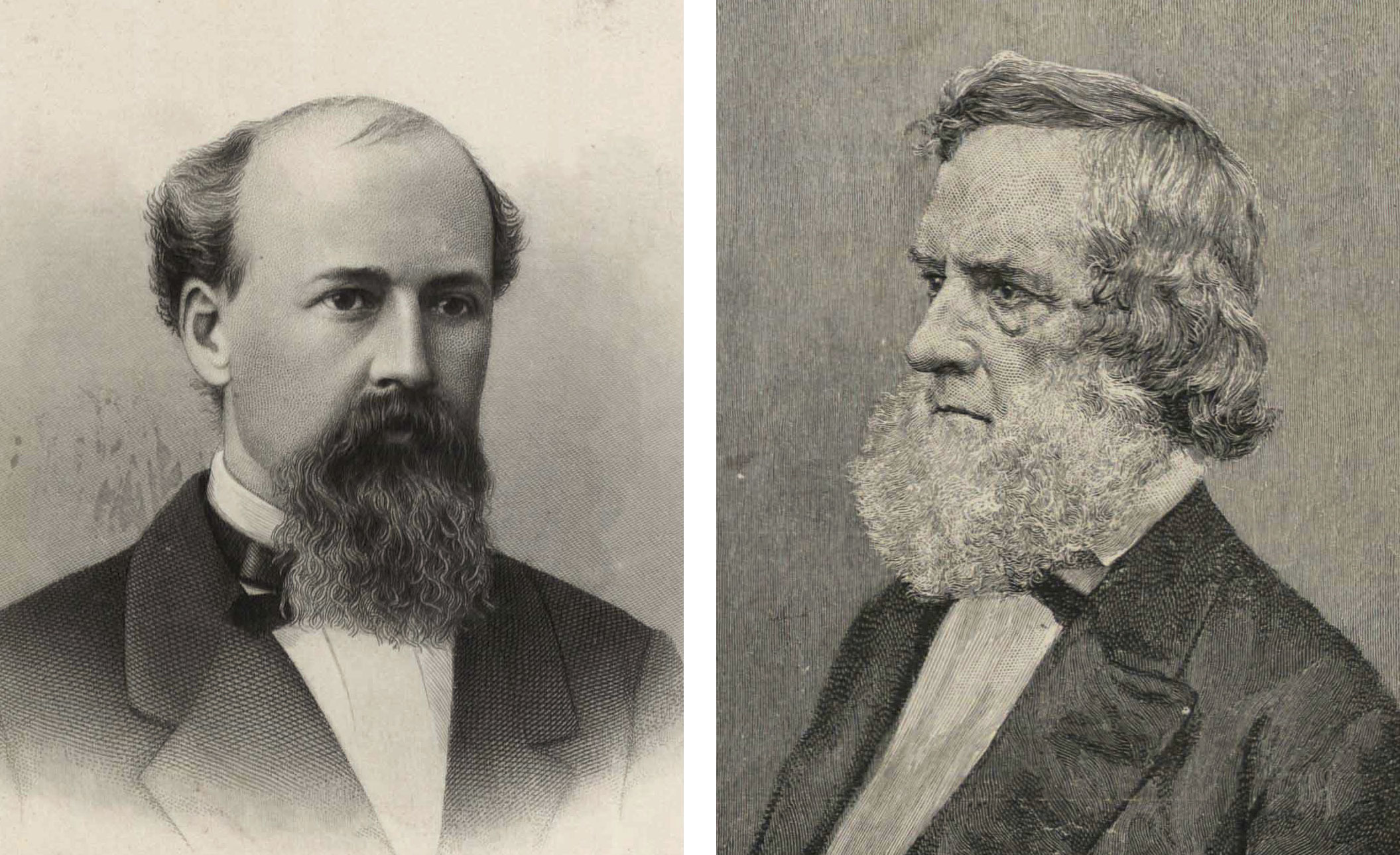 USAMHI
Gustavus V. Fox (left) and Gideon Welles
City Point was in the throes of dynamic transformation that month. It had been Petersburg’s prewar portal to the world for its ability to handle oceangoing deep draft merchant shipping, but once Virginia seceded, the Union navy controlled Hampton Roads and its opening onto the Atlantic. City Point quickly withered and Rebel defense efforts were concentrated on protecting Petersburg, 10 miles west. It had been taken over by units from the Army of the James when Butler launched his May campaign across Bermuda Hundred. On June 9 City Point was the operational base for a halfhearted Union strike against Petersburg.
The arrival of the Army of the Potomac and establishment of Grant’s headquarters on top of a bluff near the Epps family residence noticeably increased City Point’s traffic. But not until Grant grudgingly accepted that the Petersburg operation was to be a marathon rather than a sprint did the place undergo a major expansion to handle the tremendous volume of men and material that would pour through it.
The improvements and management systems had yet to cope with the increasing traffic on the day Lincoln arrived. A New York Herald reporter noted at the time that “the James was covered with vessels and transports which had followed the army with supplies.”8 Baltimore, with no cargo to unload and its special passenger unannounced, probably halted just offshore to allow the president to board a rowboat at about 9 a.m. on June 21. When he came ashore he would have seen large numbers of laborers (white and black) building additional wharves, along with growing mounds of quartermaster’s and commissary stores awaiting distribution.9 Lincoln forged ahead of the others (Assistant Secretary Fox with Tad in tow, plus Colonel Chadwick) and probably headed up the nearest roadway (modern Pecan Avenue) leading toward Grant’s headquarters, which was clearly marked with a large U.S. flag.
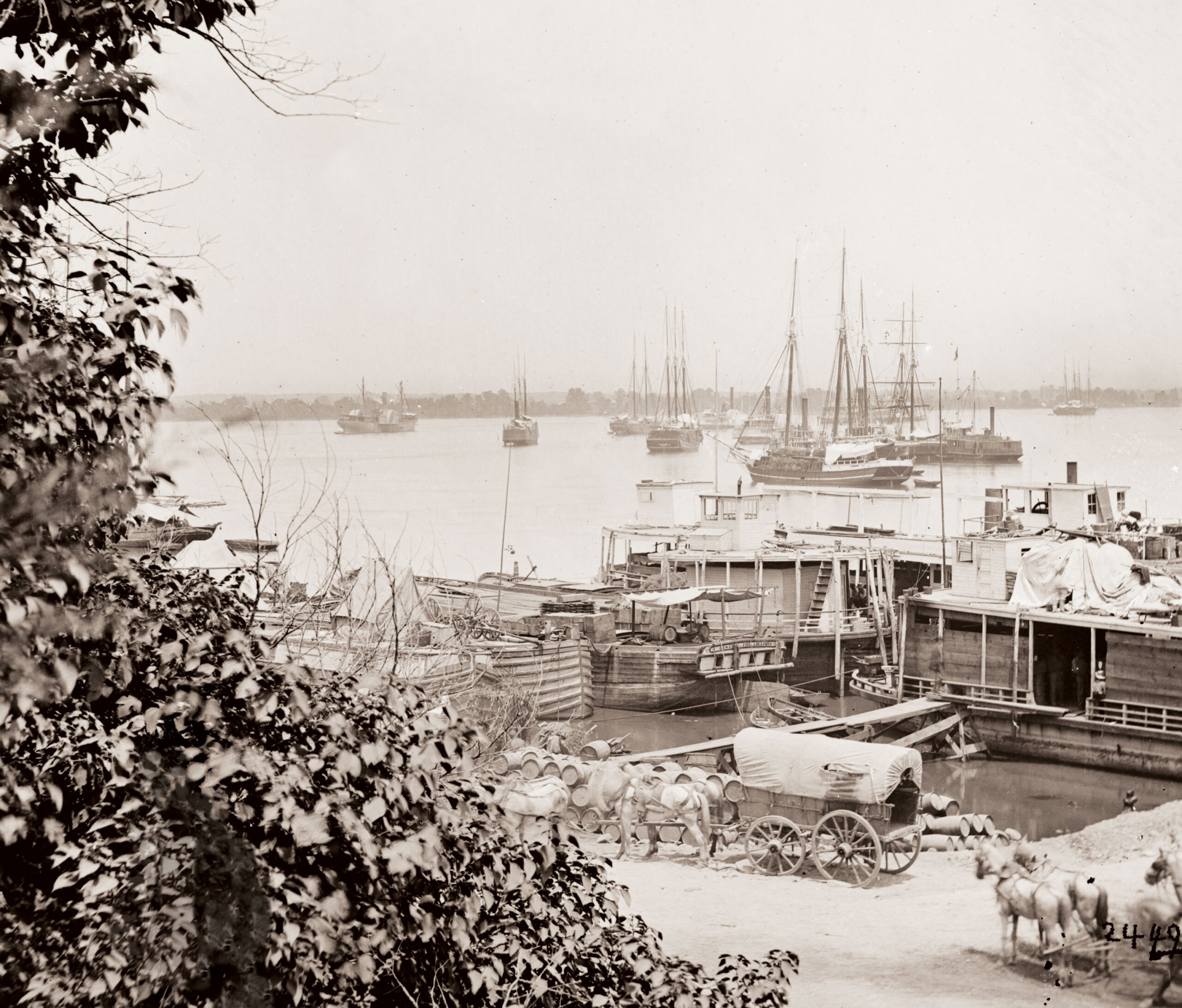 Library of Congress
Lincoln took pains to ensure that his excursion to City Point (shown here around the time of the president’s visit)—for which Assistant Secretary of the Navy Gustavus V. Fox arranged transportation—remained a secret. Fox’s boss, Secretary of the Navy Gideon Welles, was not happy with the trip or his subordinate, who he believed “favored and encouraged the President in this step….”
Two New York Herald correspondents, Sylvanus Cadwallader and William H. Merriam, filed pieces on the president’s unexpected arrival. They reported that Lincoln “undertook to reach the General’s tent by scrambling through a hedgerow and coming in the back way alone.” There he was confronted by “the sentinel stationed at the south gate of the enclosure [who] challenged the Chief Magistrate, … disputing the President’s further progress. A captain upon [Grant’s] … staff passing, and recognizing the stranger, set the matter right, and conducted the President to the Lieutenant General’s tent.”10
Merriam wrote that Lincoln “was greeted pleasantly by the Lieutenant General, who shook hands with him, and the several gentlemen of the staff happening to be present, who merely, but decorously, saluted the President by raising their caps. After a brief, but, as I observed it, an exceedingly animated conversation, in which the Presidential gestures were both numerous and awkward, the distinguished party retired to the mess tent….” Among the staff present was Lieutenant Colonel Horace Porter, who in a letter to his wife described Lincoln as “dressed all in black, and looking very much like a boss undertaker.” He recalled a fragment of that animated conversation, quoting the president as saying: “I just thought I would jump aboard a boat and come down to see you. I don’t expect I can do any good, and in fact I’m afraid I may do harm, but I’ll put myself under your orders and if you find me doing anything wrong just send me away.” Porter also remembered Grant bluntly assuring Lincoln “he would certainly do that.”11
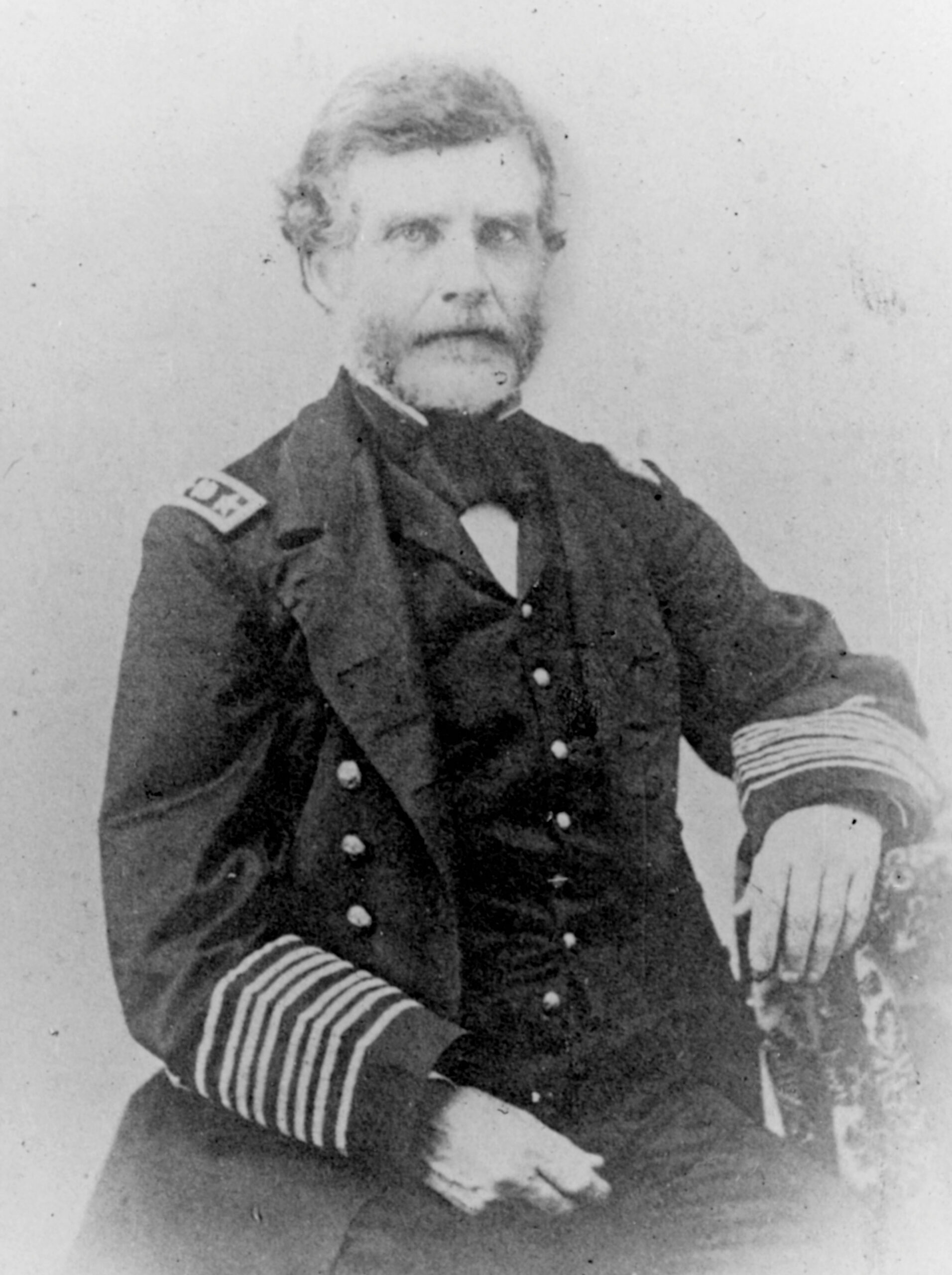 U.S. Naval History and Heritage Command
 Acting Vice Admiral Samuel P. Lee, one of several individuals Lincoln wanted to meet during his City Point visit.
When the president indicated that his visit would last through the next day, a schedule of activities was worked up, after which Grant disappeared from time to time to manage operations, having turned Lincoln over to the staff officers and others on hand. Grant’s operational oversight was greatly facilitated by his personal telegrapher, Samuel Beckwith, who handled his message traffic. There was an exchange with Army of the Potomac commander George Meade (then with the II Corps) over some confusion about the deployment plans for the flank movement slated for the next day, and an update from Butler on the force he had pushed across the James River at Deep Bottom. The flanking plans required use of the VI Corps, then holding a section of trenches near the Appomattox River, and Grant had to pry troops from Butler to replace them that very evening.
On top of all this, Butler was notified of Lincoln’s calling on him the next day and asked to alert Acting Vice Admiral Samuel P. Lee, whom Lincoln also wanted to see. Once it was determined when the president would visit the Petersburg front lines, Grant made sure that Meade knew the time and place.
Lunch for the president was, Merriam reported, “plain and substantial though by no means a frugal meal.” Young Tad, wearing his custom military uniform and praised by the reporter as “a perfect boy,” was a center of attention. Porter recollected that Lincoln “told stories all the time,” accompanied by much handshaking. Finally, around 3 p.m., Lincoln, those with him, Grant, and a gaggle of headquarters staff departed City Point, escorted by a detachment from the 5th United States Cavalry. The president was riding “Cincinnatus,” one of Grant’s personal horses, while Tad rode a black pony named “Jeff Davis.”
The group probably traveled along the City Point Road. Their objective was Major General Horatio G. Wright’s VI Corps headquarters, near a spot shown on maps as the Friend House. As they rode, Lincoln could observe the Construction Corps hard at work replacing five miles of rotted ties and previously removed rails along the City Point Railroad line, as well as narrowing the track gauge from 5 feet to 4 feet 8½ inches to accommodate Union cars and engines. (The line would be open for business on July 5.) According to Fox, the roads were “horribly dusty,” leading Porter to observe that the president “was completely covered with dust, and the color of his clothes had changed to Confederate gray.”12
It took about an hour to reach VI Corps headquarters. General Wright had been forewarned, so the corps band was ready to play Hail to the Chief followed by a medley of national airs as Lincoln arrived. It was here, Fox wrote to his wife with slight exaggeration, “we saw most of the generals of the Army of the Potomac.” Among them was Meade, who informed his wife that the president “was so gracious as to say he had seen you in Philadelphia.”13 Maps were produced and Lincoln provided with an overview of the position of forces. Porter was impressed that the commander in chief “did not ask and said he did not want to know Grant’s plans.”14
Lincoln was taken to an observation point where he could enjoy the view. A week later a Philadelphia reporter would stand on the same spot and detail what he saw, writing, “The shade trees on the slope of the hills are finely grown oaks, cherry, apple, beech, and of other varieties. Nearby are out-houses of wooden construction, for the tenancy of slaves, horses, and vehicles, and for kitchen use…. Within a range of 2½ miles, we distinguish five church spires and many large brick-built tobacco warehouses in Petersburg.” Merriam’s account adds: “The President took a long and lingering look at Petersburg, and strained his eyes toward the rebel capital.”15 The visit ended after some 90 minutes at which time the presidential party retraced its route.
News of the Lincolns’ visit to the front had “soon spread, and on the return ride the roads were lined in many places with weather beaten veterans, anxious to catch a glimpse of Old Abe,” reported Cadwallader.16 With the VI Corps in the process of shifting southward for Grant’s flanking effort, those soldiers Lincoln encountered were from the XVIII Corps, which had an African-American division and two white divisions. White witnesses described the president passing “amid the deafening cheers of the army,” and being met with “Enthusiasm among the troops.”17 When he saw a familiar face from Illinois in the crowd, Lincoln stopped and shook his hand.
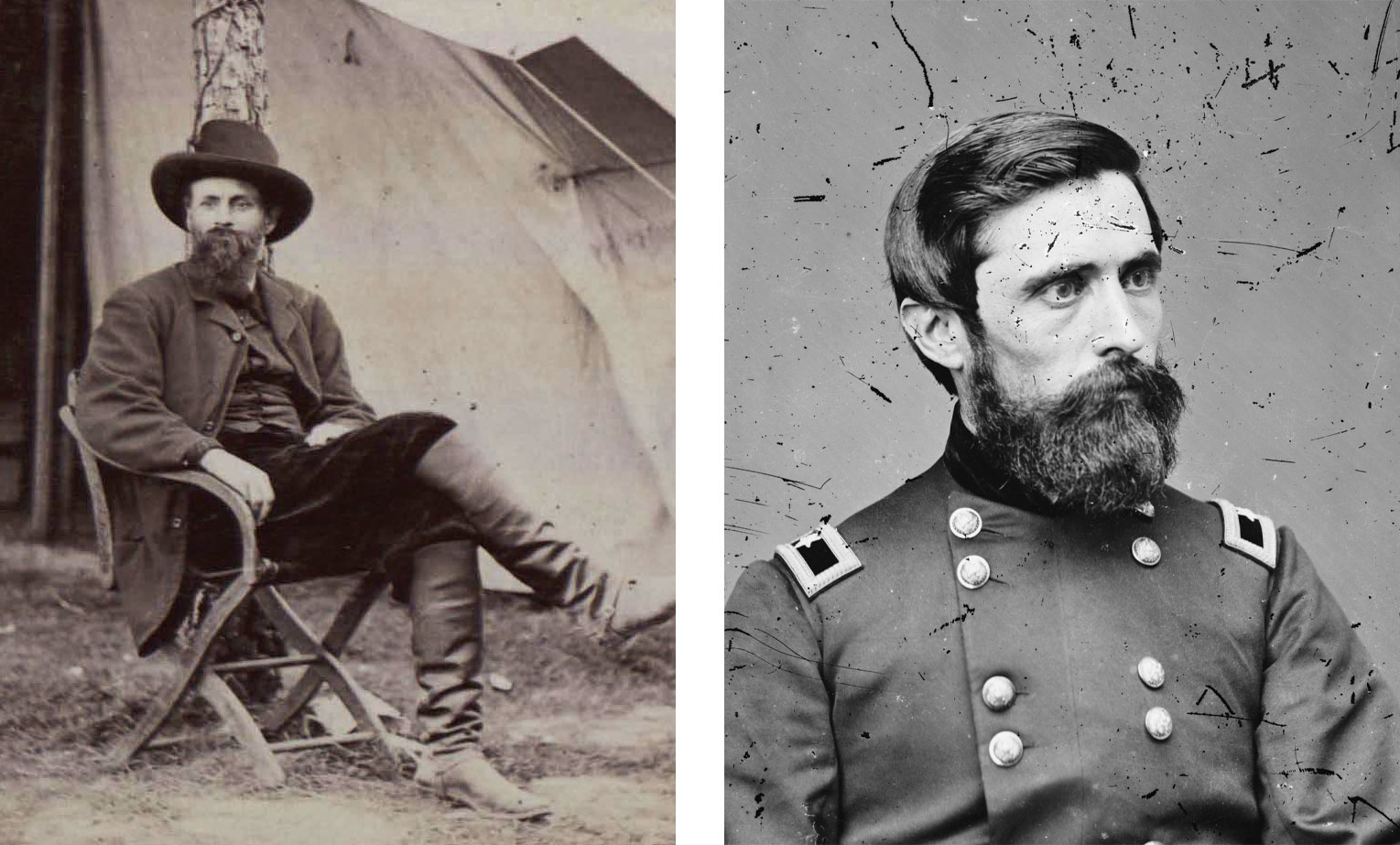 Library of Congress (Rawlins); USAMHI (Dana)
News of Lincoln and Grant’s visit to the front on June 21 soon spread among the troops, who cheered the commander in chief as he rode past. “It was a memorable thing to behold the President,” noted Charles Dana (left), a War Department official who accompanied the group. “Their honest, hearty hurrahs for the man … went up to Heaven I am sure,” observed Grant’s chief of staff, John Rawlins (right).
Sergeant Christian Fleetwood of the 4th United States Colored Troops (USCT), a future Medal of Honor recipient, recollected that his fellow black soldiers “cheered loudly as [the party] … passed through the camp,” while a white officer of the 5th USCT noted that his men “lined both sides of the road and cheered.” A contributor on the scene for the New York-based Anglo-African newspaper observed that Lincoln and Grant “appeared to be much pleased. Three hearty cheers rang from the mouths of the dark warriors as the visitors passed, and they did not forget to wave their hands in response, as if they appreciated that sort of reception.”18 Also riding with the group was Charles Dana, a War Department official seconded to Grant’s command. “It was a memorable thing to behold the President,” he wrote, “whose historic fortune it is to represent the principle of emancipation, passing bareheaded through the enthusiastic ranks of these negroes armed to defend the integrity of the American nation.”19 Added Grant’s chief-of-staff John Rawlins, “Their honest, hearty hurrahs for the man whom they regard as their liberator went up to Heaven I am sure.”20
“We returned [to City Point] about dusk [Rawlins puts the time at 8 p.m., Cadwallader closer to 9], and after a cup of tea with the General and his officers, we went on board our boat to sleep,” wrote Fox, ending Lincoln’s first day at City Point.21
When Grant alerted Butler of Lincoln’s intention to visit him on June 22, he said he would accompany the president and they would set off at 8 a.m. Neither came to pass. Grant’s flank movement against the Petersburg defenses, involving the II and VI Corps, launched at dawn. Some Federal probing the day before had been met with sharp Confederate response—meaning today would be a fight. The cavalry strike against southern railroads was also in motion, so Grant couldn’t leave his telegraph terminal.
Choreographing that morning of June 22 suggests some preplanning. Wheels began to turn after 7 a.m. at Butler’s headquarters. Posted there was the New York Herald’s Merriam, who said that at that hour “Major General Butler and his staff were in the saddle, en route to Point of Rocks, to take the General’s steamer, the Greyhound, with a view of joining the President and party at Bermuda Hundred, whither they had arrived … in the United States steamer Baltimore.” (The name Bermuda Hundred applied to both the 30-square-mile peninsula-like area as well as a James River landing dock facility on its east side, about 2½ miles north of City Point.)
Merriam described the meeting of Butler and Lincoln as one of “exceeding cordiality…. It was frank and zestful, and carried the conviction that the two eminent men were in entire accord upon all public and social issues.”22 Butler was a prolix correspondent who saved every scrap of official and private paper, most of which he printed in multiple volumes during and after the war. However, no snippet regarding this day spent with Lincoln has come to light.
Meanwhile, at 7:50 a.m., Admiral Lee left his flagship, USS Malvern, anchored a short distance from Trent’s Reach, the nautical no man’s land between the Union and Rebel navies, and transferred to a smaller gunboat, USS Agawam. His party got underway and steamed slowly downriver until, at 9:40 a.m., Agawam pulled alongside Baltimore. It is probable there was a delay in the boat’s passage while the Deep Bottom pontoon bridge was opened to permit river traffic. Once at the president’s vessel, Admiral Lee clambered aboard to be greeted by Lincoln and Butler. Then Baltimore, followed by Agawam, steamed upriver toward Trent’s Reach. Fox proudly observed that “all the vessels cheered the President as he passed.”23
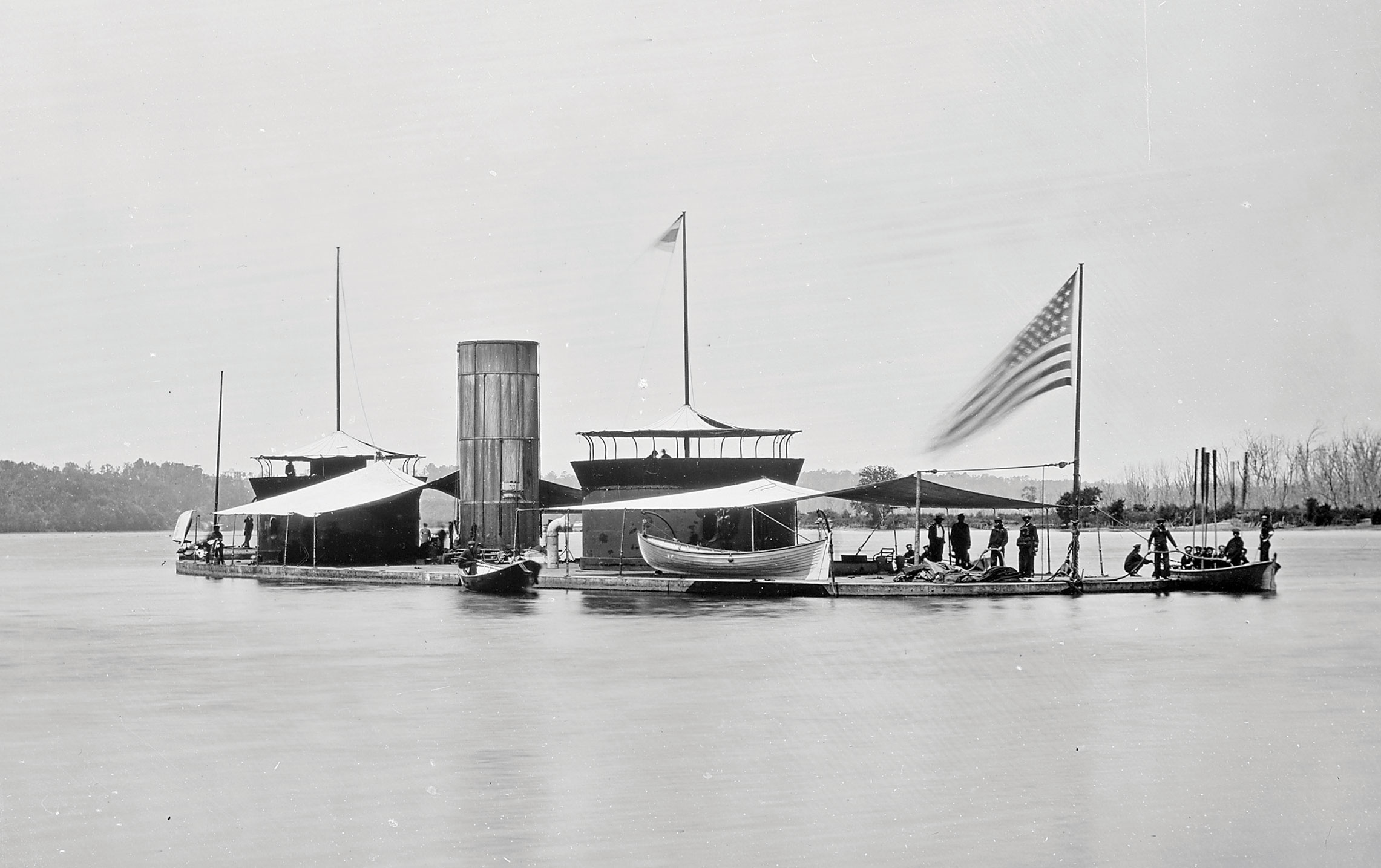 Library of Congress
Among the stops on Lincoln’s schedule on June 22 were a brief visit to one of the more technologically advanced monitors in the Union fleet, USS Onondaga (above), and dinner at a spot in Maryland called Point of Rocks, on the Appomattox River.
Just before reaching Malvern, Baltimore drew alongside one of the more technologically advanced monitors in the Union fleet, the double-turreted, iron-hulled USS Onondaga. Lincoln made what amounted to a brief courtesy call. (Fox wrote that they “went on board,” while the warship’s deck officer recorded that the president “visited” the vessel.24) Then it was back to Baltimore and onto Malvern, arriving at 10:30 a.m. This put the Lincoln party well within range of a powerful Rebel battery not 2 miles distant. A worried Fox wondered why “they did not open fire.”25 After a quick greeting with some of the ship’s officers, the president, the deck officer noted, “accompanied by Ass’t Secretary Fox and A.R. Admiral Lee landed at Lookout Tree Landing.”26 Since General Butler is not named it is possible that he preceded them to ensure that ground transportation was waiting. (Also not named in any inventory is Tad Lincoln, who apparently stayed behind this day, perhaps watched over by Mr. Chadwick.)
The landing place was just below where a Union lookout tower nicknamed “The Crow’s Nest” would be built. Once they had climbed up the slope, recollected Fox, they “took horses and rode across Butler’s lines.”27 The troops they encountered were almost entirely from Butler’s X Corps and associated artillery. Unlike yesterday, Lincoln’s visit here was anticipated. “We were apprised of the fact that our worthy President, Abraham Lincoln, was near us,” recalled a Connecticut soldier, “and all that were not engaged on duty were ordered to appear near the regimental quarters and render a proper salute.” One of the first camps they encountered was that of the 117th New York Infantry, where a soldier-diarist named John Humphrey recorded, “Prisedent Lincen and Gen Buttler rode along the lines visiting the troops.” A more cynical comrade in those ranks wrote his father the next day that there “is quite an object now for him to be familiar with the soldiers.”28
Soldiers in the camp of the 7th Connecticut Infantry had their fun when, first spotting Lincoln by the rising image of his tall hat, they joked that “it was a monitor’s turret coming overland.” Two other regimental witnesses noted the president appeared “careworn,” while one added “even to haggardness,” and the other “troubled.”29 That tall hat caused another incident when it was brushed off Lincoln’s head by a low-hanging tree branch. “There were a dozen young officers whose duty it was to get it and give it back to the President,” Dana remembered, “but Admiral Lee was off his horse before any of those young chaps, and recovered the hat for the President. Admiral Lee must have been forty-five or fifty years old. It was his agility that impressed me so much.”30
Among the soldiers in the middle section of Butler’s line was one who had just come through some hard fighting. In a letter home he wrote of Lincoln, “A tall gaunt sad man, he seemed to have the burden of the war on his shoulders, as he stopped to speak to some of us, where we sat, shaking but trying to write home and tell the folks, once again, we are safe.” To a regimental comrade, the president was “a very ordinary looking personage,” though he added that “he is a man that cannot be judged by his looks.” Another in that brigade testified that he and his companions “greeted the immortal President with enthusiastic cheers.”31
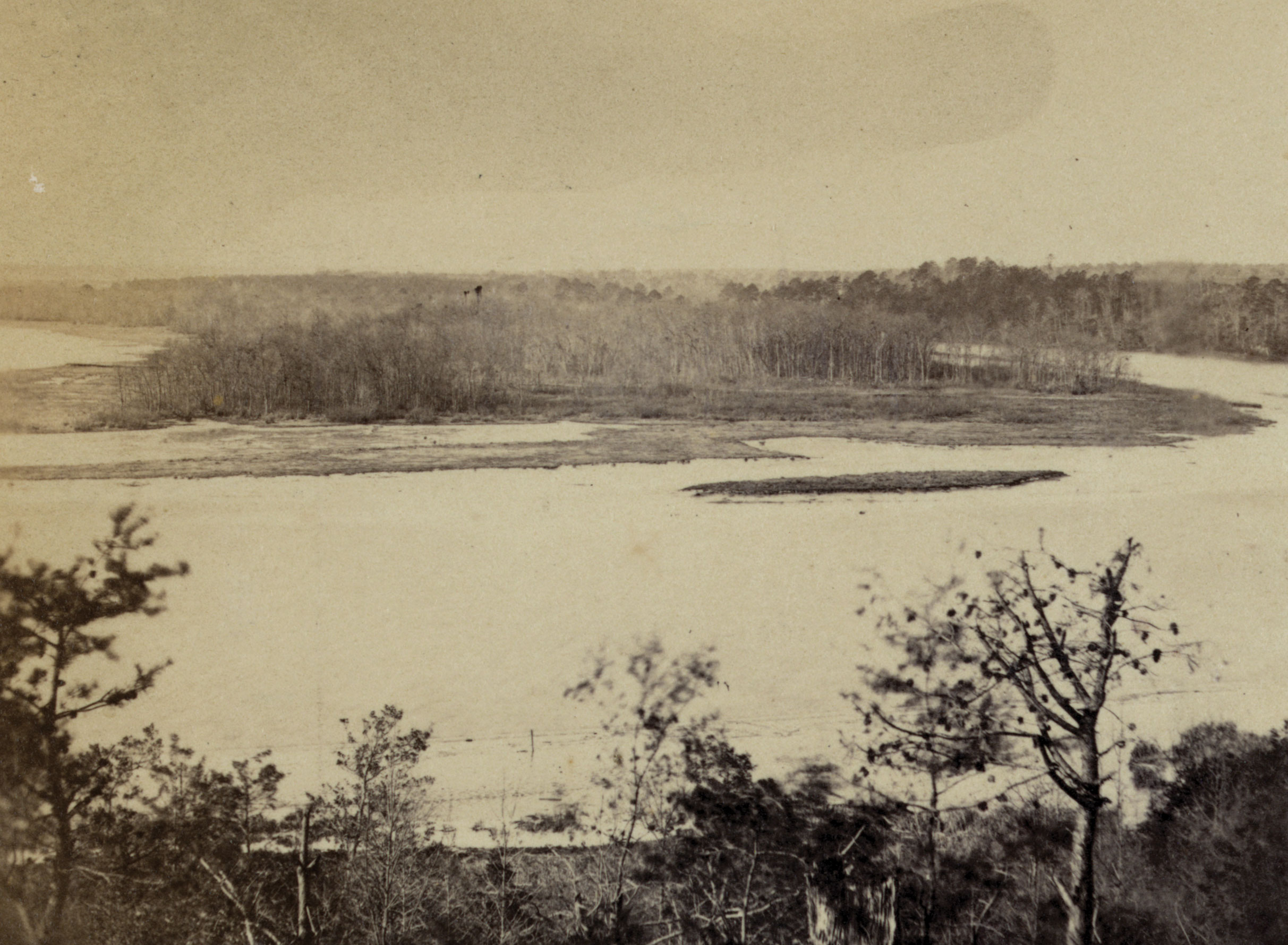 Library of Congress
A view of the Appomattox River from Point of Rocks in December 1864.
Along the way the party passed close to several Union artillery encampments. A New Jersey gunner thought Lincoln “a very plain man,” while a Connecticut artilleryman was surprised at how “awkward and even peculiar the President looked to us.” The sudden appearance of the party caught the Connecticut battery sentry by surprise and he blurted, “Great God! Turn out the guard! Here’s old Abe, and Beast Butler.”32
Due to Grant’s constant siphoning off of Butler’s Bermuda Hundred units to plug holes along the Petersburg front, the Army of the James commander had backed up the southernmost section of his entrenched line with about 1,800 Ohio soldiers enlisted for 100 days, a term that was nearly up. One account indicates that as the party passed, some of the Ohioans demonstrated their unhappiness with their assignment, which Butler quieted without disturbing the president. As the large mounted party approached the camp of the 130th Ohio Infantry a sentry called out “Who goes there?” A voice from the group answered “Abraham Lincoln.” For the rest of his long life, that sentry, Fred Ballmos, believed it was Lincoln himself he had heard and he told that story often.33
According to Fox, the party followed Butler’s lead “and dined with him, at a place on the Appomattox [River] called Point of Rocks. After dinner we took a boat in the river and run down to City Point, where our own boat was waiting to receive us. Here we had an hour’s visit from General Grant.”34 The information Grant had at this point concerning the offensive in progress was inconclusive, but the general would have remained hopeful. Lincoln’s comment, recalled years later by Porter, was: “I cannot pretend to advise, but I do sincerely hope that all may be accomplished with as little bloodshed as possible.”35 Three days later the president would recount fragments of his talk with the lieutenant general to Orville Hickman Browning, a former U.S. senator and political activist present at the founding of the Republican Party. Browning recorded Lincoln’s words in his diary the next day. Grant said: “you Mr. President, need be under no apprehension. You will never hear of me farther from Richmond than now, till I have taken it. I am just as sure of going into Richmond as I am of any future event. It may take a long summer day, but I will go in.”36 Fox, present for the conversation, confirmed Grant’s words in his letter to his wife, adding: “and that, though he will have some rebuffs, he will surely win.” Fox ended his recollection with the observation, “and I think he will.”37
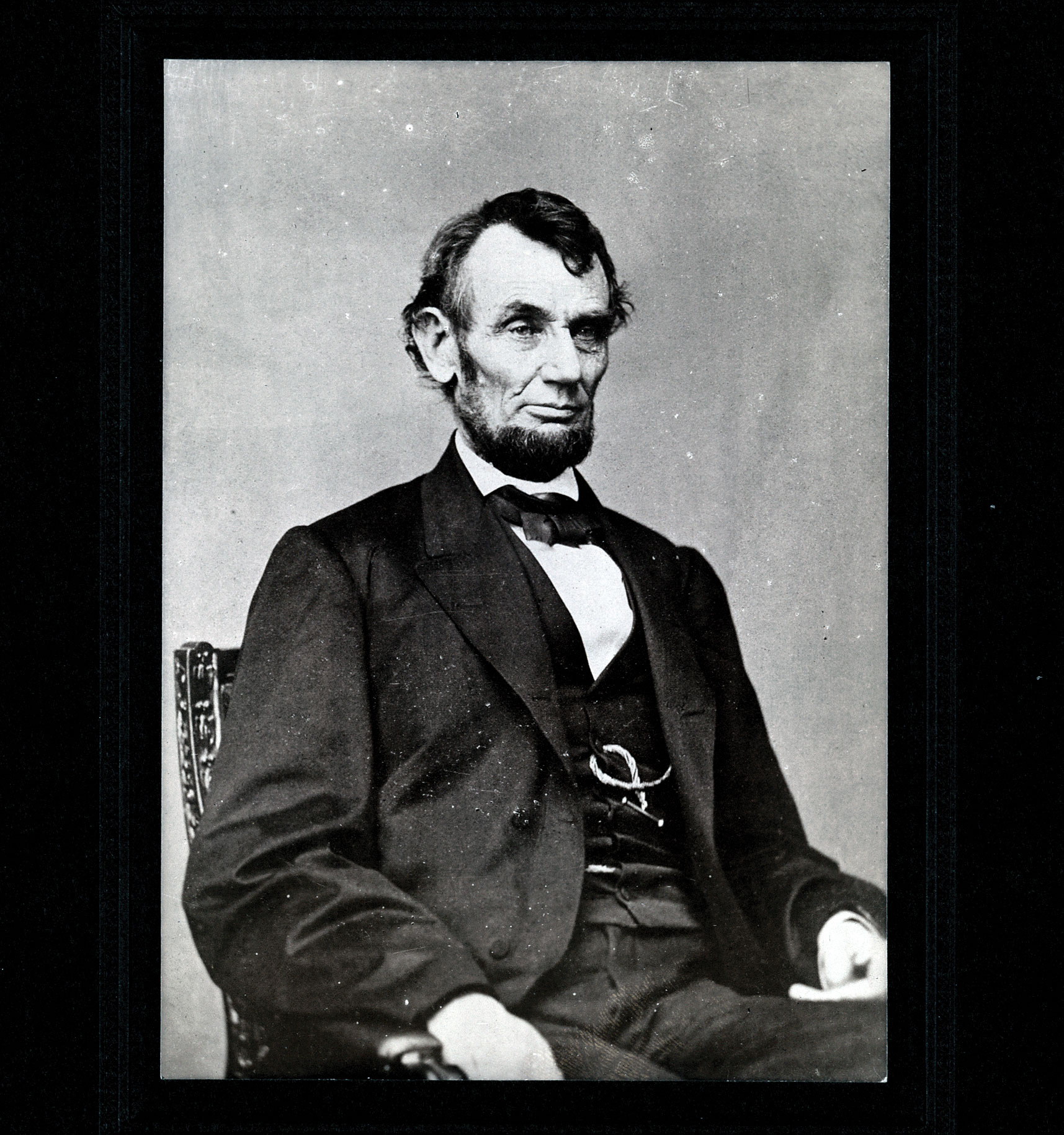 Library of Congress
Abraham Lincoln in 1864
Grant would be in for some bad news after the president departed. Although initial reports suggested that the movement of the II and VI corps had scored some successes, the general soon came to realize that the “affair … was much worse than I had heretofore learned.”38 Neither corps had come within artillery range of the Weldon Railroad on June 22, and both had been shoved back to their starting positions with high losses in prisoners taken. On the next day, a VI Corps detachment touched the railroad, tore up about a half mile of track, then hustled back, leaving most of their tools as presents when defenders suddenly appeared in force. The Rebels pressed eastward, caught portions of Wright’s corps misaligned, capturing even more men.
The cavalry raid did not wind up until July 1 and the end wasn’t pretty. Cut off from friendly lines by what they believed were superior Rebel forces, the Federals dispersed and made their way back in weary packs of troopers, hundreds without horses. Gone too were all their cannon and nearly 900 from their ranks. The Confederates would have both railroad lines in full operation within a month. By then Grant was fully engaged in another new plan to break the enemy’s hold on Petersburg.
“Our trip back [to Washington] was smooth and pleasant,” Fox wrote, “and the President himself delighted.”39 It appears that Baltimore’s return passage wasn’t as speedy as the trip down. City Point accounts have Lincoln departing late in the afternoon, and Washington observers record him arriving mid-to-late afternoon the next day, making the travel time roughly 22–24 hours. Perhaps navigating on the Potomac after dark wasn’t as safe as on the more open Chesapeake Bay on the way down, forcing Baltimore to anchor for a couple of hours near the river’s mouth until it was light enough to proceed.
There were some, Navy Secretary Welles at the head of the line, who believed that Lincoln’s motive in traveling to the Petersburg front was his “intense anxiety” over Grant’s handling of the campaign to that point. The consensus was more positive upon Lincoln’s return, led by Welles’ subordinate Fox, who affirmed that “the President came back in fine spirits.” Lincoln sent a June 24 telegraph to his wife, who was visiting Boston, describing himself and Tad as “safe and sound.” John Hay of Lincoln’s personal staff viewed his boss as “sunburnt and fagged but still refreshed and cheered. He found the army in fine health good position and good spirits; Grant quietly confident.” Attorney General Edward Bates agreed that Lincoln was “encouraged by Grant’s persistent confidence.” The editor of the Daily National Republican, still smarting over sitting on the story, now proclaimed that “the President found and left Gen. Grant in the very best of spirits and confident of a successful result.”40
The sum of these comments confirms that the president’s main purpose in going was not anxiety, but to provide very public support for Grant, who had taken some beatings in the press and Congress over the recent campaigns and whose lengthy casualty lists had not been offset by any significant victories. By not announcing it, Lincoln had ensured that Grant would not be distracted wondering why the commander in chief was making a personal call. Lincoln’s first words on meeting Grant preempted any pressure the visit might have caused. The president’s upbeat mood upon returning did not stem from relief, but rather from deep affirmation that his relationship with Grant remained strong and his trust in Grant’s leadership was well placed.
The distinctive image of Lincoln passing nearby during his visit touched many who witnessed it, some more than others. Frank Johnson, a young soldier in the 142nd New York Infantry, saw the president riding with General Butler. “Lad that I was, the expression I then saw on his face has never left me,” Johnson recollected in 1914. “Anxiety, pity, love, courage, and faith, were all depicted there, showing that he was a man of sorrow, and one carrying a heavy burden. When our boys raised up and gave him a real old St. Lawrence county cheer, his face lighted up, his eyes brightened, and I am sure his faith was strengthened that he would be permitted to bring his people out of the wilderness of war, and into the shining path of peace.”41
Ahead lay 10 months of steady combat at Petersburg as Grant methodically ground down the city’s defenders. As fate would have it, Lincoln returned to City Point in March 1865 as U.S. victories marked the beginning of the end of the Civil War. The plan that decisively ended the campaign was Grant’s 11th since May 1864.
Noah Andre Trudeau is the author of numerous military history articles and eight Civil War history books, including The Last Citadel (1991), Like Men of War (1998), and Gettysburg: A Testing of Courage (2002). His latest book, Lincoln’s Greatest Journey, tracks the experiences of Abraham Lincoln while at City Point, Virginia, in March-April 1865.
Notes
1. New York World, June 10, 1864
2. Roy P. Basler, ed., The Collected Works of Abraham Lincoln (New Brunswick, 1953), vol. 7, 394–395.
3. Gustavus Fox to wife, June 19, 1864, Gustavus V. Fox Papers, Naval History Society Collection, New York Historical Society (hereafter GFP).
4. New York Tribune, June 25, 1864.
5. Daily National Republican, June 23, 1864.
6. William E. and Erica L. Gienapp, eds. The Civil War Diary of Gideon Welles (Springfield, IL, 2014), 428.
7. Gustavus Fox to wife, June 25, 1864, GFP.
8. Benjamin P. Thomas, ed., Three Years with Grant As Recalled by War Correspondent Sylvanus Cadwallader (New York, 1955), 231.
9. Activities noted in the Washington Evening Star, June 21, 1864, and the Daily National Republican, June 28, 1864.
10. Both accounts appear in the New York Herald, June 25, 1864.
11. William H. Merriam, New York Herald, June 25, 1864. Porter’s letter to his wife as reprinted in Bruce Catton, Grant Takes Command (Boston, 1969), 305.
12. Horace Porter, Campaigning with Grant (New York, 1906), 218.
13. George Gordon Meade Jr., ed., The Life and Letters of George Gordon Meade (New York, 1913), II: 206.
14. Porter letter in Catton, Grant Takes Command, 305.
15. Philadelphia Press, July 2, 1864; New York Herald, June 25, 1864.
16. New York Herald, June 25, 1864.
17. B.S. DeForest, Random Sketches and Wandering Thoughts (Albany, 1866), 166; Charles Paul Diary, June 21, 1864, U.S. Murray G. Smith Collection, Army Heritage and Education Center.
18. Christian Fleetwood, letter dated June 26, 1864, in New York Anglo-African, July 9, 1864; Elliott F. Grabill, letter dated June 22, 1864, Oberlin College Archives; “Veritas,” letter June 28, 1864, in New York Anglo-African, July 16, 1864.
19. Charles A. Dana to Edwin Stanton, June 21, 1864, in Edwin M. Stanton Papers, Library of Congress.
20. John Rawlins, letter dated June 21, 1864, in James Harrison Wilson, The Life of John Rawlins (New York, 1916), 236.
21. Fox letter, June 25, 1864.
22. New York Herald, June 25, 1864.
23. Fox letter, June 25, 1864.
24. Fox letter, June 25, 1864; USS Onondaga deck log entry June 22, 1864, National Archives.
25. Fox letter, June 25, 1864.
26. USS Malvern deck log entry June 22, 1864, National Archives.
27. Fox letter, June 25, 1864.
28. Charles K. Cadwell, The Old Sixth Regiment (New Haven, 1875), 96; John Humphrey diary, June 22, 1864, Civil War Collection, Hamilton College Library, Clinton, New York; Harry F. Jackson and Thomas F. O’Donnell, eds., Back Home in Oneida: Hermon Clarke and His Letters (New York, 1965), 144.
29. The New York Times, July 10, 1864; Daniel Eldredge, The Third New Hampshire (Boston, 1893), 504; Cadwell, The Old Sixth Regiment, 96.
30. Charles A. Dana, Recollections of the Civil War (New York, 1902), 224–225.
31. Lodewick S. Green, letter dated August 12, 1864, published in “Chronicles of Saratoga: Letters from the Richmond Front,” The Saratogian, January 24, 1964; Charles Kline, letter to sister June 22, 1864, Library of Congress, Manuscripts Division; Abraham John Palmer, History of the Forty-eighth regiment New York State Volunteers (Brooklyn, 1885), 156.
32. James Horrocks, My Dear Parents (New York, 1982), 88; Herbert W. Beecher, History of the First Light Battery Connecticut Volunteers (New York, 1901), II: 461.
33. “Toledo Sentry Challenged Abe,” undated clipping from the Toledo Blade in the Lincoln Financial Foundation Collection, Reminiscences about Abraham Lincoln, Folder B-Bar, archive.org.
34. Fox letter, June 25, 1864.
35. Porter, Campaigning with Grant, 233.
36. Theodore Calvin Pease and James G. Randall, eds., The Diary of Orville Hickman Browning, Volume I: 1850–1864 (Springfield, 1925), 673.
37. Fox letter, June 25, 1864.
38. John Y. Simon, ed., The Papers of Ulysses S. Grant, Volume 1: 1837–1861 (Carbondale, IL, 1967), 123.
39. Fox letter, June 25, 1864.
40. Gienapp and Gienapp, eds., The Civil War Diary of Gideon Welles, 428; Fox letter, June 25, 1864; Basler, ed., The Collected Works of Abraham Lincoln, vol. 7, 406; Michael Burlingame and John R. Turner Ettlinger, eds., Inside Lincoln’s White House (Carbondale, IL, 1997), 210; Howard K. Beale, ed., The Diary of Edward Bates, 1859–1866 (Washington, 1933) 378; Daily National Republican, June 24, 1864.
41. “When Frank Johnson saw the Emancipator,” The Ogdensburg Journal, February 16, 1914.
Related topics: Abraham Lincoln