CIVIL WAR MYTHBUSTING
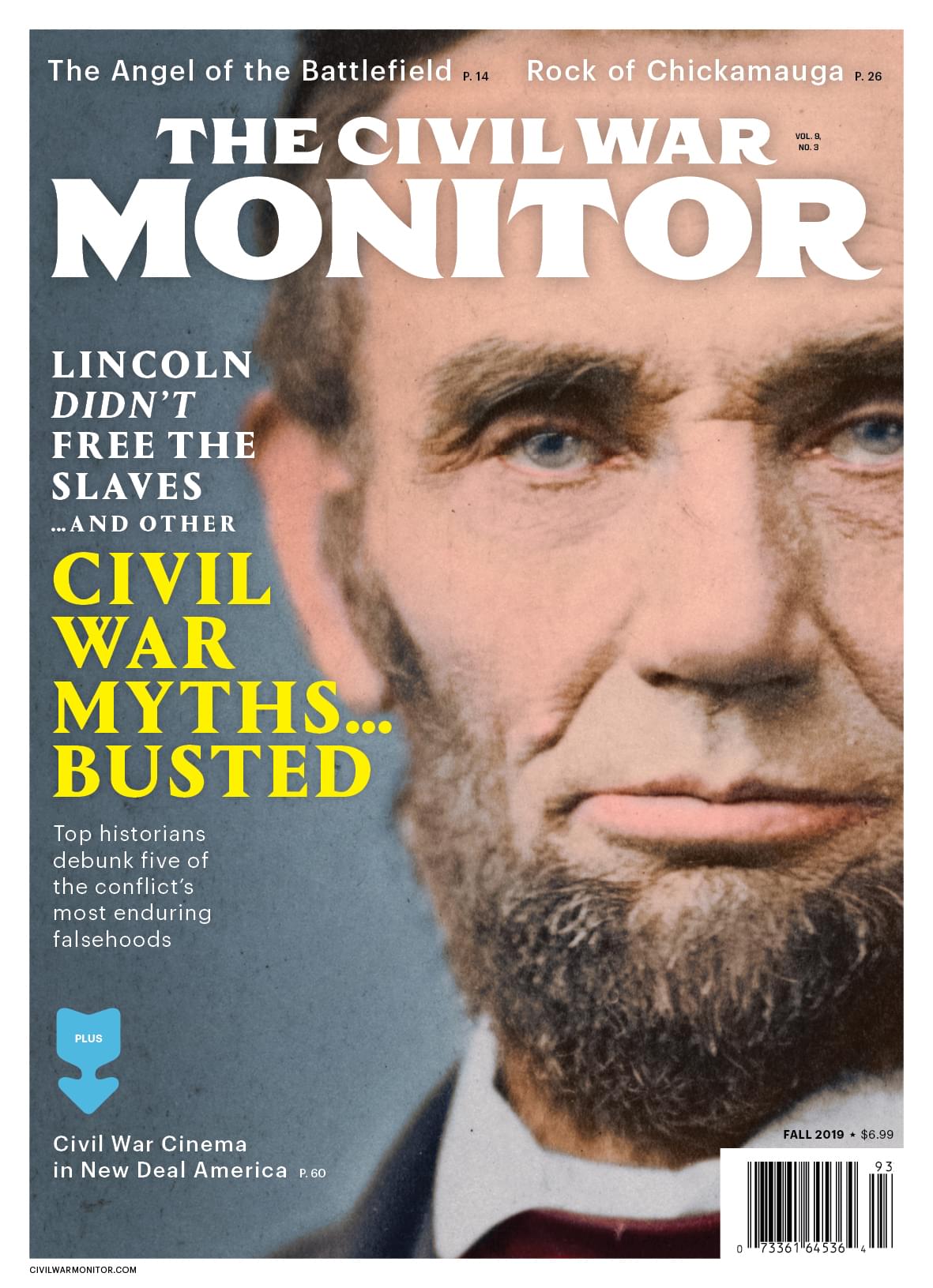
I found two of the mythbusting essays—on the Emancipation Proclamation and the surrender at Appomattox—in your most recent cover story [“‘The Real War Will Never Get in the Books,’” Vol. 9, No. 3] of value, but the other three seemed more about propagating myths than debunking them. I am puzzled at Brooks Simpson’s piece [“Myth 4: Ulysses S. Grant Had Free Rein”], as I’ve not come across anyone in recent memory who’s made the argument that President Lincoln played little or no role in the direction of the war after Ulysses Grant’s move to the war’s eastern theater. Simpson’s article thus seems more about straw man demolishing than mythbusting.
I am not puzzled at Gary Gallagher’s entry [“Myth 2: The War’s Outcome Was Inevitable”], as it seems to be another part of his endless quest to diminish the war in the West. His argument is a lost cause to my mind in more ways than one, but he seems to be trolling more than ever here by suggesting that scholarship in the 1970s buttressed the contention that the South had no material chance of winning. And then there is Earl Hess’ essay [“Myth 3: The Civil War Was the First Modern War”], which mentions rifled muskets but not repeating rifles, and armies but not navies. Moreover, the question about civilian deaths deserves better from Hess than semantics about direct action at enemy hands, particularly when civilians found death—perhaps as many as 50,000 civilians, primarily southern, died during the war—frequently at the hands of their own governments, whether fighting in Baltimore or rioting in New York, or being executed at Shelton Laurel. Partisan rangers and provost marshals, anyone?
Robert Burg
Via email
* * *
In his essay in the Fall 2019 issue, Earl Hess is correct to point out that war fighting is a continuously developing process. Picking “the first modern war” is not particularly useful.
The Civil War did, however, exhibit more features of modern warfare than are referenced in Hess’ essay. In addition to the logistical prowess displayed by the Union armies, the war saw the first uses of aerial reconnaissance and electronic communication, as well as naval technology that proved steam and iron had ended the reign of wood and sail. The stalemate of trench warfare was also on prominent display.
Some of Hess’ points are understated. A fivefold increase in the range of a rifled musket should not be trivialized. The first machine guns were developed if not used. Infantry tactics may have changed more between 1861 and 1865 than implied.
Warfare has evolved along with civilization. Every war will both share some elements with previous conflicts and create new ways of waging war. The Civil War displayed many of the features that would be recognizable to militaries fighting in wars today. Rather than debating whether the Civil War should be called the “first modern war,” it might be better to consider that it provided the first warnings about the costs and dangers of a modern war.
Craig E. Ward
Via email
THE BEST CIVIL WAR MOVIES
I recently came upon your article about Civil War movies [“The Best Civil War Movies of All Time,” Vol. 9, No. 2]. Though I may be a lot older than most, I could not help wondering why you left off one particularly great movie, whose story does not (like so many) focus on the period after the war or just before it, but rather is set in the middle of the conflict. Its title is Drums in the Deep South, and it portrays the Confederates as the good guys for a change. If you have not viewed this fine movie from the 1950s, I encourage you to do so.
Mike Brooks
Dallas, Georgia