It’s a story most Civil War enthusiasts are at least partly familiar with: Not long before President-elect Abraham Lincoln was to depart Springfield, Illinois, and head by rail to Washington, D.C., rumors began to circulate that secessionists might somehow attempt to prevent his inauguration. Taking the chatter seriously, the president of the Philadelphia, Wilmington and Baltimore Railroad enlisted the aid of celebrated detective Allan Pinkerton, who had made a name for himself as a specialist in nabbing counterfeiters and solving train robberies in Illinois.
Pinkerton took the case and soon headed for Baltimore, which contained a sizable pro-Confederate population and through which Lincoln’s train would travel. There, he and his detectives uncovered what they believed to be a possible plot to assassinate Lincoln when his train arrived in the city. Pinkerton helped convince the president-elect to alter the timing of his trip’s final leg, having him board a private car and reportedly disguising him in a shawl and beaver hat. Whatever threat there had been was averted; Lincoln would be inaugurated a few weeks after his successful arrival in the capital.
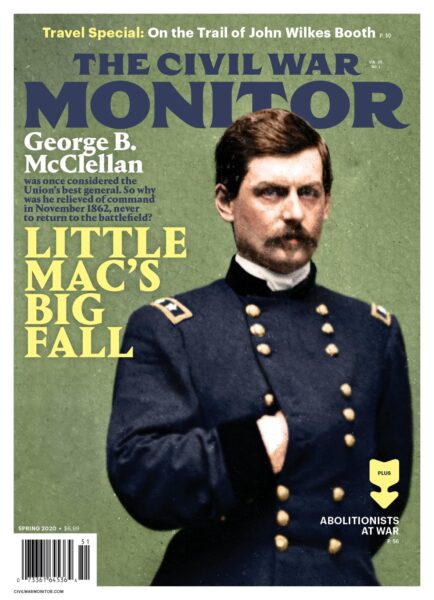
Within months, the Civil War erupted with the firing on Fort Sumter, and Pinkerton received another important assignment, this time at the request of George B. McClellan, the ambitious young general who assumed command of the force that would become known as the Army of the Potomac shortly after the disastrous Union defeat at the Battle of Bull Run. For the next two years, Pinkerton was tasked with discerning the size of the Confederate force facing McClellan. As Stephen Sears notes in this issue’s cover story (“An Unholy Alliance,” p. 24), the famed sleuth soon became a rubber stamp for McClellan’s persistent overestimation of the strength of the enemy, reinforcing the general’s penchant for trepidation and delay. It was, as Sears shows, a relationship that, in the end, did few if any favors for the Union war effort.
Want to share your thoughts about this or other articles in this issue? Send your emails to [email protected].