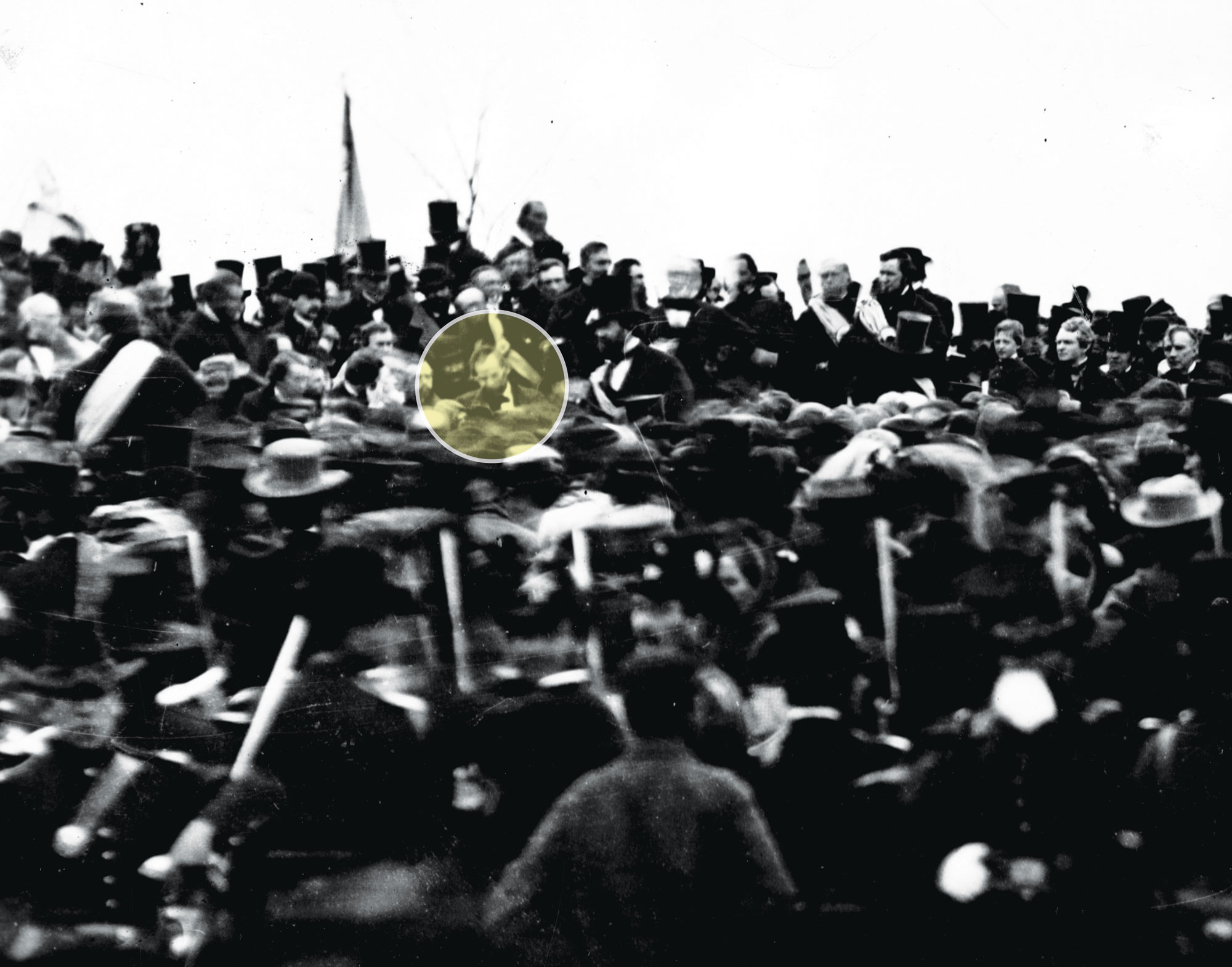
A crowd of dignitaries and onlookers gathers around the speakers’ platform during the dedication ceremony of the Soldiers’ National Cemetery in Gettysburg, Pennsylvania, on November 19, 1863. President Abraham Lincoln can be seen in the highlighted circle.
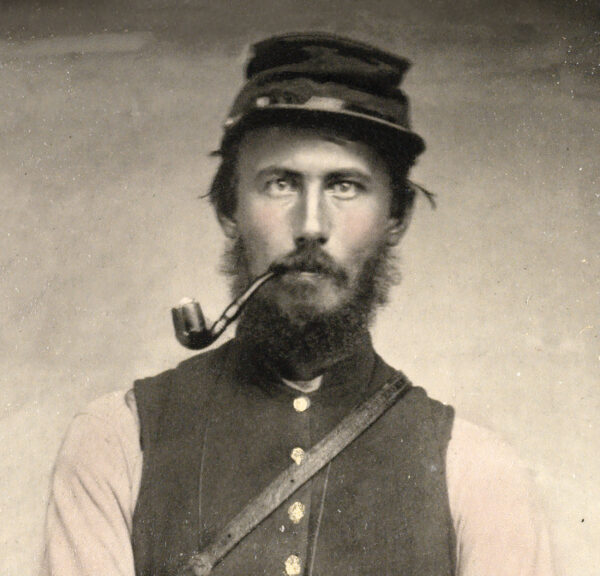
On the afternoon of July 2, 1863, Sergeant George W. Reynolds of the 20th Maine Infantry fell wounded on the slopes of Little Round Top at Gettysburg. His regiment turned back repeated attacks by the 15th Alabama Infantry and several companies of the 47th Alabama Infantry—assaults that every Civil War scholar, student, or enthusiast knows well, for it was the counterattack of the 20th Maine that saved the Union army’s left flank at Gettysburg that day and made a hero of the regiment’s colonel, Joshua L. Chamberlain. Twenty-year-old Reynolds, however, was not as fortunate. Struck three times by enemy minie balls, Reynolds lay on the hillside for six days before comrades found him and transported him to the field hospital of the V Corps, Army of the Potomac, less than a mile east of Little Round Top. By that time, Reynolds believed he was dying. For two weeks, he rested on straw in a barn, still suffering mightily from his wounds. Eventually he was transferred to a general army hospital in nearby York, Pennsylvania, where he began to recover.
By November 19, Reynolds was well enough to join 40 of his comrades on a train back to Gettysburg, where many of the battle’s Union dead would be reinterred in the newly established Soldiers’ National Cemetery. The country’s first national burial ground, it was situated on Cemetery Hill, the site of crucial fighting. President Abraham Lincoln saw the dedication ceremony as a chance to define the meaning of the war for the northern people. For Reynolds, now on crutches, it was a bittersweet journey. After arriving in Gettysburg, he took a few moments to visit Little Round Top, where his regiment had saved the day and he had been so severely wounded. On Cemetery Hill, Reynolds found a spot up front, not far from the speakers’ platform where famed orator Edward Everett sat with other dignitaries, President Lincoln among them. For two hours, as Everett delivered a sweeping, epic address comparing the Battle of Gettysburg to the great battles of classical antiquity, Sergeant Reynolds remained near the platform, weary no doubt, but steady on his crutches. Then Lincoln, “gaunt and with the burden of every death written on his face,” rose and made his remarks. The president finished so quickly that Reynolds and his comrades “hardly realized that they listened to immortal words.” What they did understand, said Reynolds more than 60 years later, was that Lincoln “was the man for whom they had fought; and here he was, telling them that they had done a good job, done it well”—though they could not know he would also “inspire Americans thruout the ages.”1
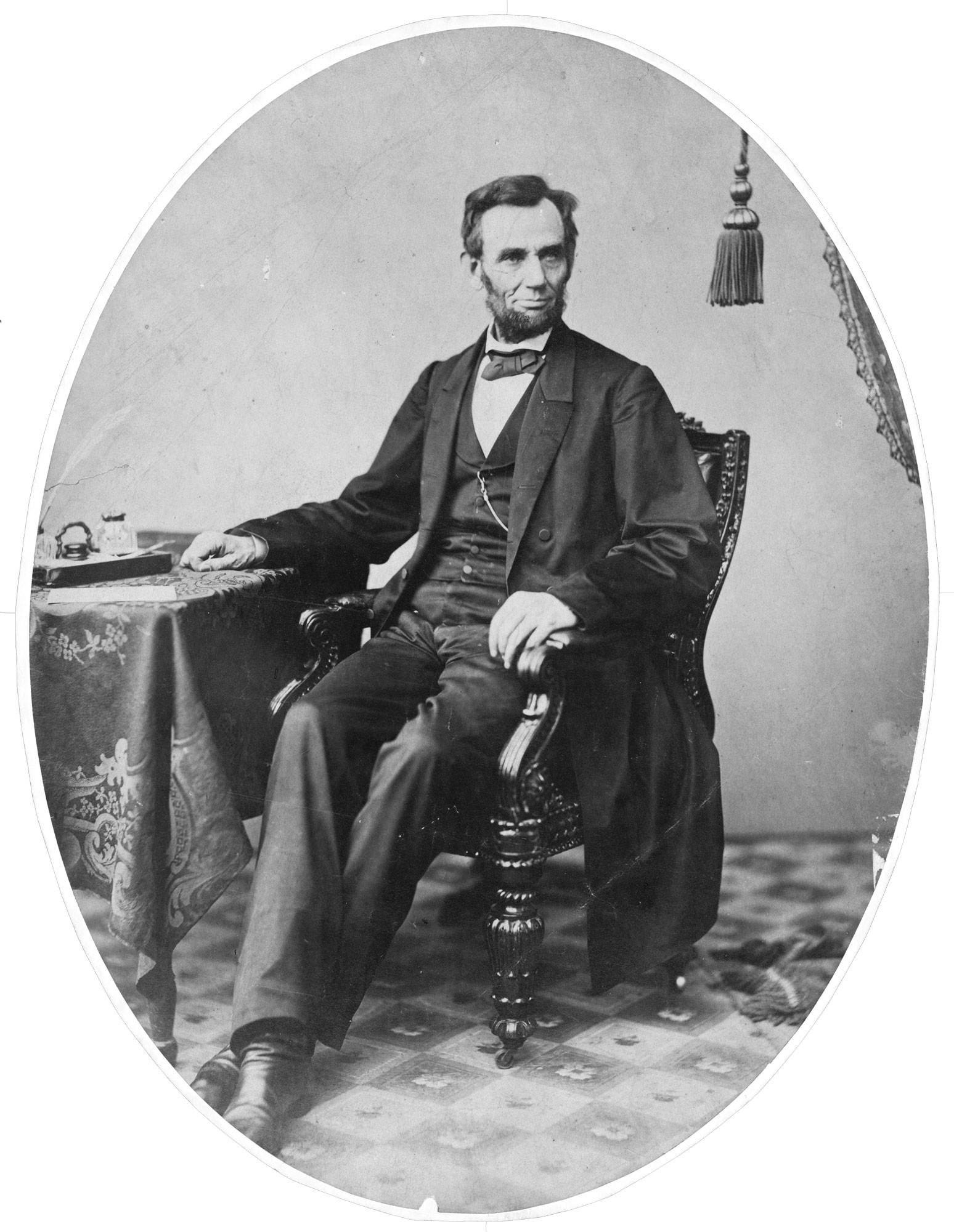 Library of Congress
Lincoln as he appeared on November 8, 1863, little more than a week before he gave the famed speech.
Reynolds’ reaction to our nation’s most famous speech reveals a paradox that has troubled historians since Lincoln gave his address. The soldier claimed to hear and understand what Lincoln said, but he also confessed his belief that most people in the crowd probably did not comprehend the president’s words. Other contemporary observers are also contradictory: Some claim that Lincoln’s speech was too short to hear or digest; others maintain that few people remained to hear the president after Everett’s oration. Newspaper reports differ over what Lincoln said, how many people heard him, and whether the audience responded with applause. In 1925, William E. Barton, one of Lincoln’s biographers, identified (somewhat tongue-in-cheek) the mass of contradictions that historians inevitably encounter when they research the Gettysburg Address: “He delivered the address without notes; he held his notes in his left hand and read them in part and in part spoke without them; he held the manuscript firmly in both hands, and did not read from it, or read from it in part, or read from it word for word as it was therein written. The address was received without enthusiasm and left the audience cold and disappointed; it was received in a reverent silence too deep for applause; it was received with feeble and perfunctory applause at the end; it was received with applause in several places and followed by prolonged applause.”2
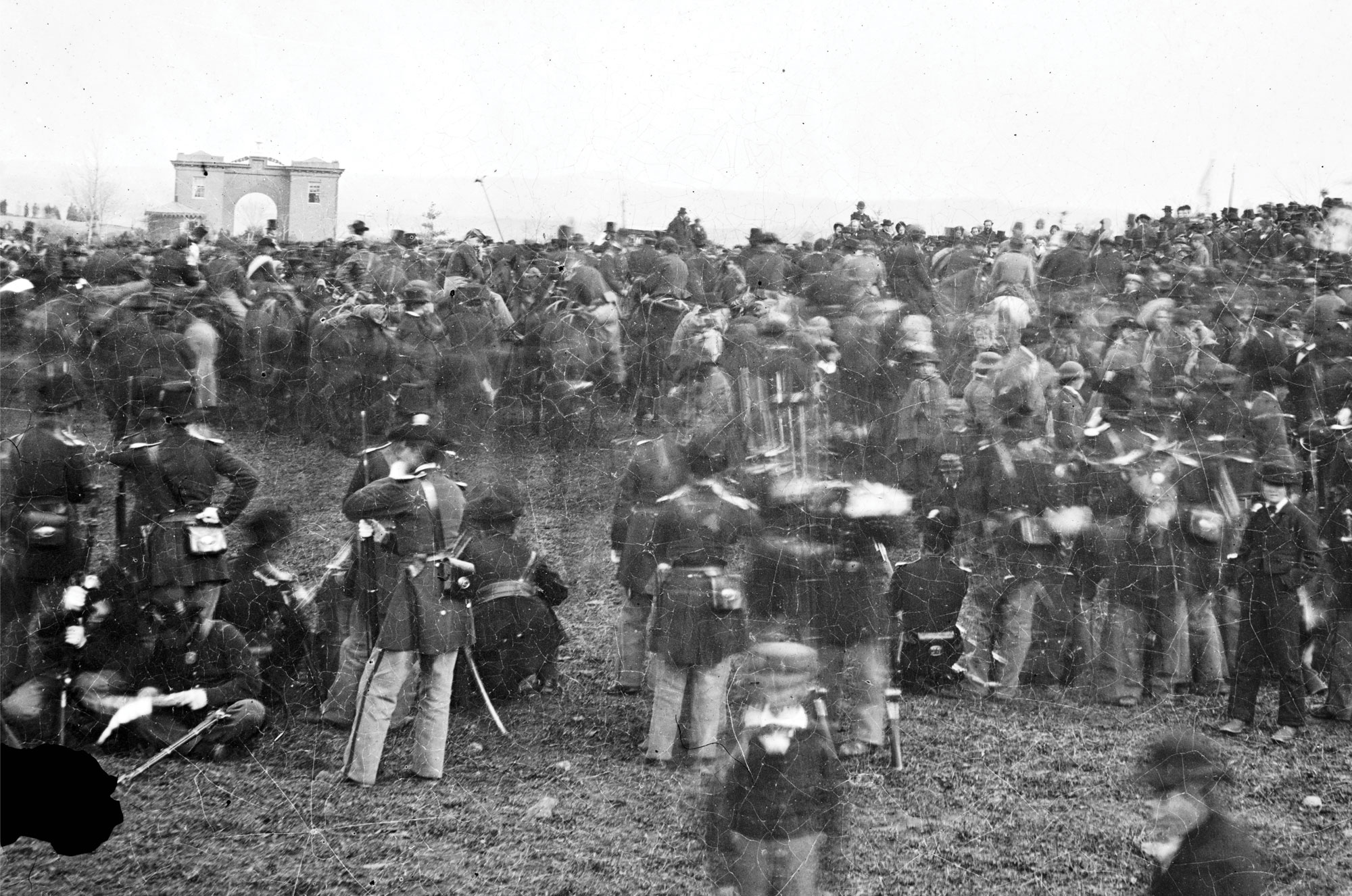
Despite the inconsistencies, some facts about the event are unchallenged, enough to give a picture of the moment beyond the few fuzzy photographs snapped on Cemetery Hill that November day. By all accounts, the crowds were enormous. People had come from nearby townships and boroughs and as far away as Harrisburg and Baltimore to attend the dedication. Streets leading into Gettysburg were clogged, a newspaper reporter wrote, “by citizens from every quarter thronging into the village in every kind of vehicle—old Pennsylvania wagons, spring wagons, carts, family carriages, buggies, and more fashionable modern vehicles, all crowded with citizens.” The armies had long since left Gettysburg, but now the town was overwhelmed by a new “invading host” who came by wagon, by train, by horse, and by foot to witness history.3
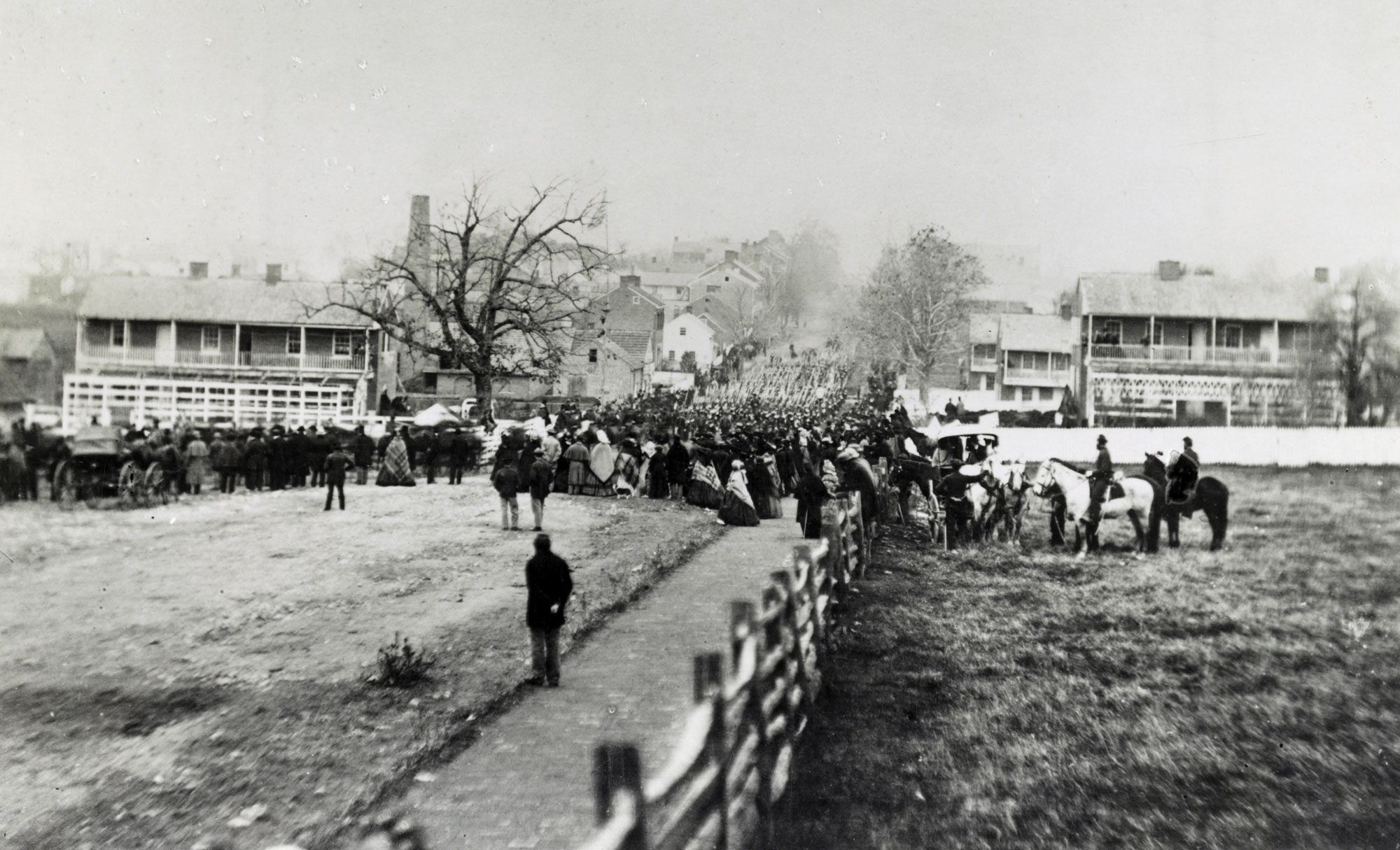 Library of Congress
Soldiers and civilians crowd the streets of Gettysburg as a military procession makes its way to Cemetery Hill, where President Lincoln would deliver the Gettysburg Address.
On the night before the dedication, the crowd turned the town into something resembling a fairground. Along the streets, torches lit the way for the surging mass of people who jammed taverns, hotels, and boardinghouses. The noise was almost deafening. Bands played, people sang, and rowdies shouted—not the kind of backdrop one would associate with the solemn occasion of a cemetery dedication.4 Men were drinking, and some were drunk. Even John Hay and John Nicolay, Lincoln’s private secretaries, imbibed a few glasses of whiskey. Nicolay, said Hay in his diary, “sung his little song of the ‘Three Thieves,’ and then we sung ‘John Brown.'”5
Hoping to see Lincoln, the crowd serenaded him that evening at the home of David Wills, where the president was spending the night, and called for him to come out. Lincoln stood in the doorway for a few minutes, then slipped back inside. Later a larger crowd gathered and made a terrible racket, calling for the president from beneath a window. A military band played, a male quartet serenaded, and a group of young women sang “We Are Coming Father Abraham, Three Hundred Thousand More.” Then Lincoln reappeared, the crowd asked him to speak, something he did not like doing without a prepared text, but he did make a few extemporaneous remarks. Lincoln retreated quickly, however, and the crowd moved next door and found William Seward, the secretary of state, who was more than willing to deliver a speech. Lincoln spent the rest of the night writing and briefly conferring with Seward. Around midnight, the president went to bed, but it is hard to imagine anyone getting much sleep amid the high spirits and loud revelries of the merry multitudes.6
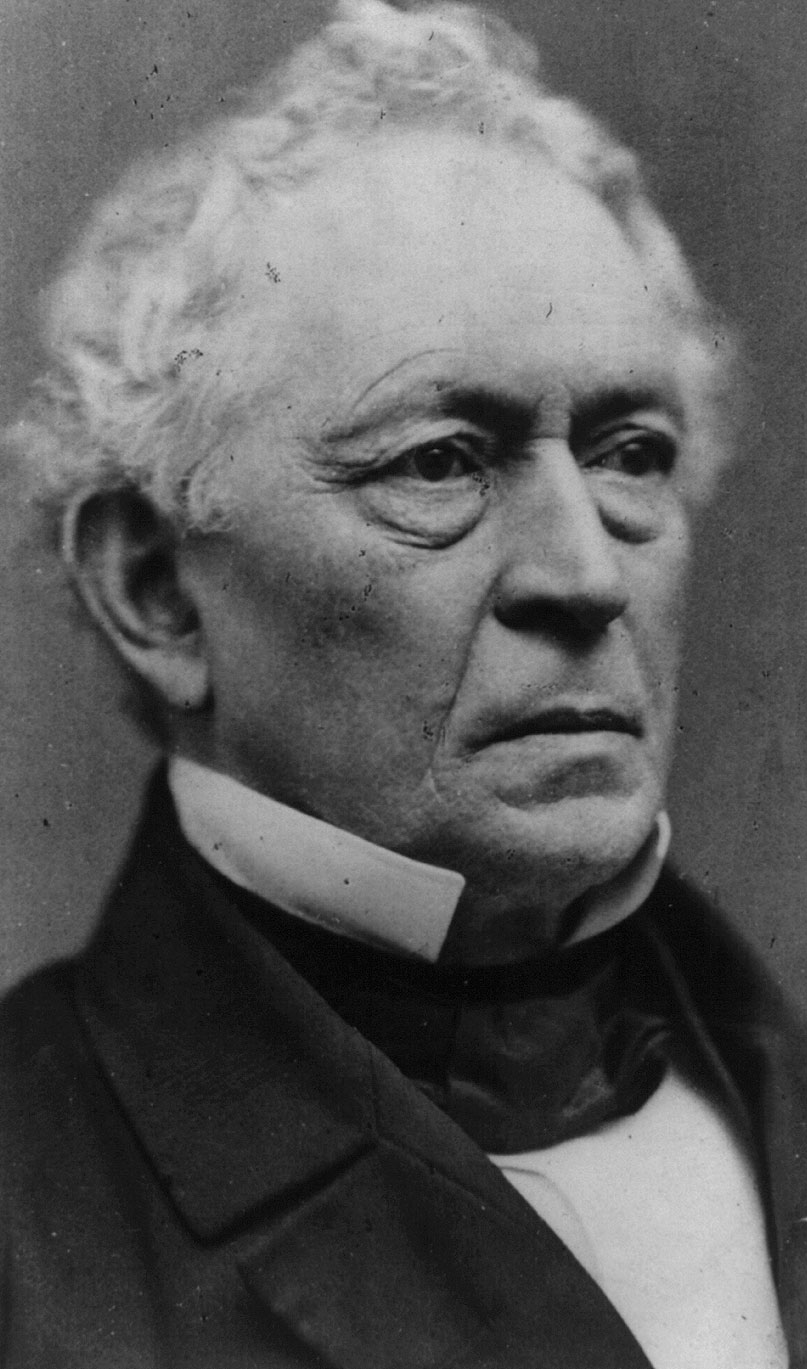 Library of Congress
The event’s principal speaker, renowned orator Edward Everett, delivered a lengthy and detailed history of the Battle of Gettysburg.
With the daylight it was easier to guess the size of the crowd. Some observers thought that there were as many as 50,000 people in town (one person guessed 150,000), although a more reasonable estimate is 15,000. Then the president emerged from the Wills house to join the procession of dignitaries marching to the cemetery, the crowd greeted him with “three hearty cheers,” and clumps of people surged toward him, arms outstretched to shake his hand or touch him. At first the mass of people was orderly, but soon people began jostling Lincoln and cramming in all around him. Finally Ward Hill Lamon, marshal-in-chief of the day’s events and Lincoln’s unofficial bodyguard, ordered the crowd to move back. The people slowly retreated, but not before issuing a few more cheers for “Father Abraham” and “honest Old Abe.”7
It was a perfect day for the ceremony. “The sky was cloudless,” remembered a Gettysburg resident, “and the sun shone out in glorious splendor.”8 The procession soon flowed up Cemetery Hill to the marching tunes of four military bands. A little before noon, the proceedings began, and the crowd watched in awe and wonder as a grand ceremony unfolded, the likes of which few there had ever seen and none would forget. As one observer noted years later, “We had heard very much more that day than we dreamed of.”9
The crowd was ready for something momentous, and they did not have to wait long. After a dirge from Birgfield’s Band of Philadelphia, the Reverend T. H. Stockton, chaplain of the U.S. Senate, offered a prayer, a soulful entreaty for the nation to remember that “in the freshness of their young and manly life, with such sweet memories of father and mother, brother and sister, wife and children, maiden and friends, they died for us.” His words struck a deep chord. The New York Times reported that Stockton’s invocation, which concluded with the Lord’s Prayer, “was touching and beautiful,” and the Philadelphia Press remarked that “there was scarcely a dry eye in all that vast assemblage.” Lincoln was among those noticeably moved, and his “falling tear” was seen as proof of the “sincerity of his emotions.”10
After a reading of the lengthy regrets of important people who could not attend, the U.S. Marine Band played. Finally, the event’s principal speaker, Edward Everett, was introduced. His address soared in rhetorical flourishes as he gave a long, carefully researched history of the Gettysburg battle. The crowd was enraptured and distracted by turns. Everett was a masterly speaker and knew precisely how to hold an audience, but for some reason, perhaps because most of his listeners were forced to stand during his oration, the crowd began to dwindle around its edges. Some people wandered toward the unfinished gravesites or to the slopes of the hillside and the crest of the ridge where the deadly fighting had taken place four months earlier. At last Everett finished his speech, and as he did, the strollers drifted back to the platform for the next installment of the program.11
 Library of Congress
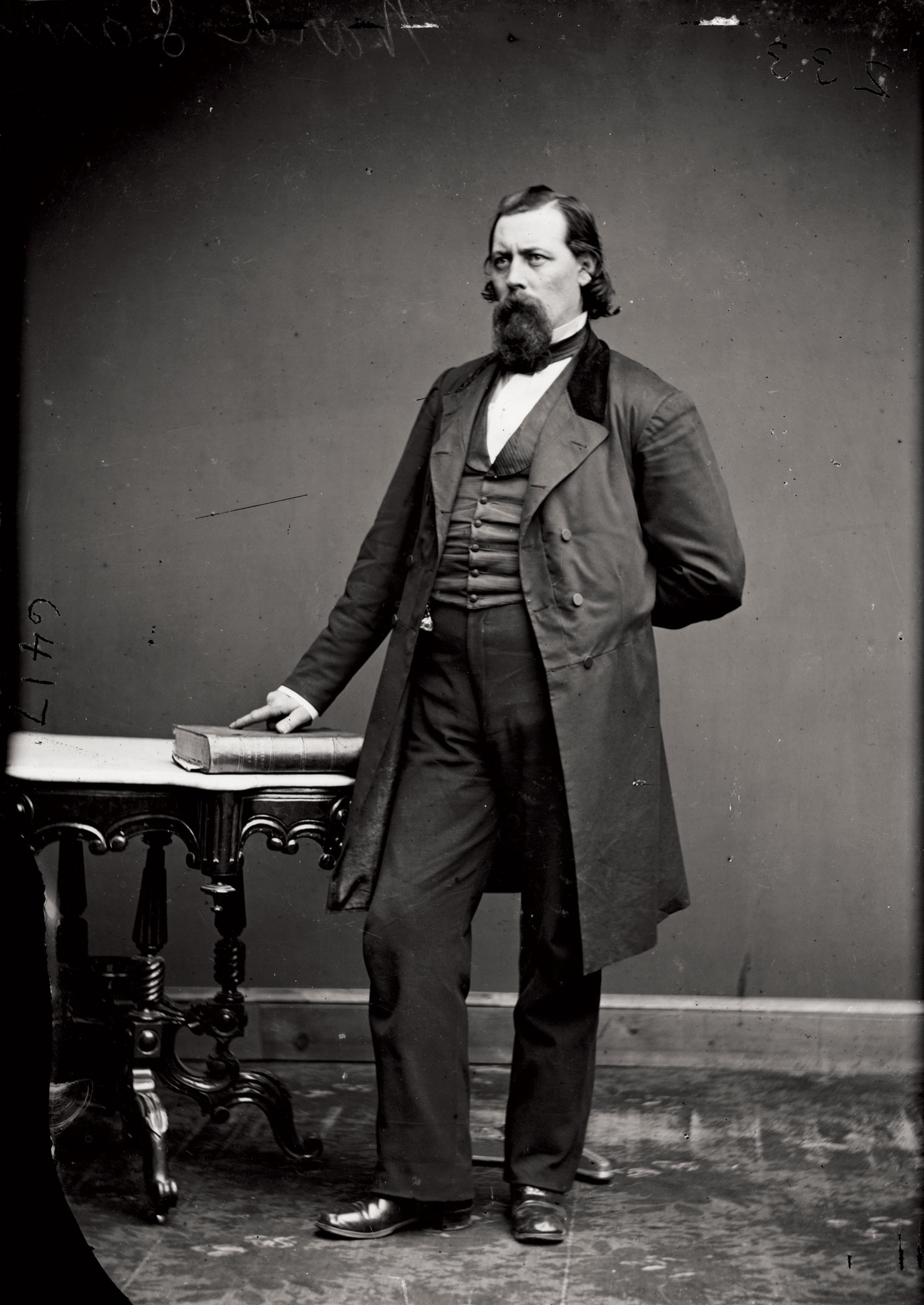
Ward Hill Lamon, Lincoln’s unofficial bodyguard and marshal-in-chief of the day’s events, had the honor of introducing his friend, “the president of the United States.”
A poem composed for the occasion was sung as a hymn by the Baltimore Glee Club. Then Ward Lamon walked to the center of the platform and proudly introduced his friend, “the president of the United States.” Precisely what occurred during the next two or three minutes cannot be known. It is certain that Lincoln delivered his brief remarks, or at least a version of what we today know as the Gettysburg Address, but the details are lost to history. As John Hay matter of factly recorded in his diary, “The President in a firm free way, with more grace than is his wont said his half dozen words of consecration and the music wailed and we went home through crowded and cheering streets. And all the particulars are in the daily papers.”12
We do know that there was—and is—more to the Gettysburg Address than Hay reports. If indeed some magic did take place, a spiritual connection that touched the soul of America, then presumably we should be able to account for its impact and significance in the reactions of the thousands who heard him speak that afternoon. Yet, when it comes to the accounts of those who claimed to be present (including dignitaries, soldiers like George Reynolds, ordinary citizens, and newspaper correspondents), everyone, to a remarkable degree, left differing records of what they had seen and heard. None of Lincoln’s other speeches—either as president or in his long political career leading up to the election of 1860—leaves more frustratingly inconsistent evidence than the Gettysburg Address. The most glaring inconsistencies surround the crowd’s reaction, with amazingly different accounts purporting that those in attendance responded either enthusiastically or stoically, with great emotion or with great silence. Some observers said that the crowd ardently received Lincoln’s words, even to the point of interrupting the address with applause. Benjamin B. French, who wrote the glee club’s hymn, claimed that Lincoln’s “every word at Gettysburg” was met by a “hurricane of applause.” Someone else remembered that when the president had finished, the crowd lustily gave him three cheers. Joseph L. Gilbert, the Associated Press correspondent who transcribed Lincoln’s words, included in brackets the five places where the crowd interrupted Lincoln with applause, although many years later Gilbert acknowledged that he had inserted them arbitrarily and could not remember any clapping at all. Other witnesses, however, were absolutely sure that no applause occurred. W.H. Cunningham, a reporter, maintained that there was perfect silence during and after the speech. He was confident the audience had uttered “not a word, not a cheer, not a shout.”13
But how could that be possible? How could some witnesses remember thunderous applause and others recall only a hush? Historians have not helped to solve the contradiction. They tend to take sides, some favoring the idea of a silent crowd, others believing that the audience erupted in deafening cheers. But if we consider that both stunned silence and excited applause are acts of extreme emotion, we begin to see them as vital clues about the impact of Lincoln’s speech.
What the evidence really says is that those who heard Lincoln’s speech reacted emotionally—that is, with what they individually considered to be the appropriate emotional response—to the president’s words. Some people apparently clapped enthusiastically; others regarded the address as a solemn expression of sentiment and stood in silent awe of the man and his eloquence. Such a large crowd, whatever its actual number, could not all have heard everything Lincoln said; the audience was spread out over a wide area adjacent to Gettysburg’s local burial ground, the Evergreen Cemetery, and many people stood beyond the range even of Lincoln’s powerful tenor voice. Many reporters found a convenient place near the speakers’ platform, but others were scattered hither and yon. What individuals heard and saw from their own vantage points, good or bad, could not be exactly the same. That’s asking too much of history and of human beings. Yet the common thread is that the emotional response to Lincoln’s address was deep, visceral, and vast.
Already the day had been filled with emotion. The crowd was in high spirits. Reverend Stockton’s soulful prayer had brought tears to many an eye. Edward Everett’s speech had stirred patriotism and sadness, pride and sorrow. And now Lincoln, with a slight 272 words, had touched the deepest chord of all.
It was so deep, in fact, that it took many listeners completely by surprise. When Lincoln stopped talking, some were not sure if he had finished and, according to one eyewitness, “the awe-struck people, apparently deeply moved, gave no sign of approval or appreciation.”14
 Library of Congress
A view of the sprawling crowd that attended the dedication ceremony. Some wandered the cemetery grounds during the speeches, unable to get close enough to the speakers’ platform to hear the words.
Captain Oliver N. Goldsmith, ordered to Gettysburg with his regiment to participate in the ceremony, asserted with confidence that he had heard Lincoln’s speech and that “there were no frills” about it. “We understood him and listened intently to those profound words,” Goldsmith told a newspaper reporter in 1913. One official who participated in the ceremony said he spoke afterward with a soldier who maintained that Lincoln’s speech was “one of the most impressive and touching addresses he ever heard.” This official, probably an officer in a regiment that marched in the pre-ceremony parade, surmised that the soldiers in the audience “appreciated its tender, sympathetic character better than those who took no part in suppressing the rebellion.” The officer affirmed that he had “never seen an orator … command such an intense interest. It was one of those supreme moments, when a person feels he is taking part in a scene which will live in history and be referred to by one’s children’s children.”15
Some who heard the address but reported little or no reaction by the audience concluded—unfairly or not—that Lincoln’s speech had been a failure. Ward Lamon, Lincoln’s close friend and the event’s marshal-in-chief, later claimed that “the lack of hearty demonstrations of approval immediately afterward, were taken by Mr. Lincoln as certain proof that it was not well received,” although it seems unlikely that Lincoln thought his speech as much a failure as Lamon maintained.16 According to Lamon, Lincoln turned to him after speaking and said, “Lamon, that speech won’t scour. It is a flat failure and the people are disappointed.” Lamon also claimed that while on the platform—with Lincoln out of earshot—Seward and Everett both called the speech a failure. Finally, Lamon said, after they had returned to Washington, Lincoln remarked, “I tell you Hill, that speech fell on the audience like a wet blanket. I ought to have prepared it with more care.” Most historians believe, however, that Lamon invented Lincoln’s disappointment. Evidence shows, in fact, that Everett marvelled at Lincoln’s words and later told him so in a note. The other attributions seem to be products of Lamon’s overly active imagination.17
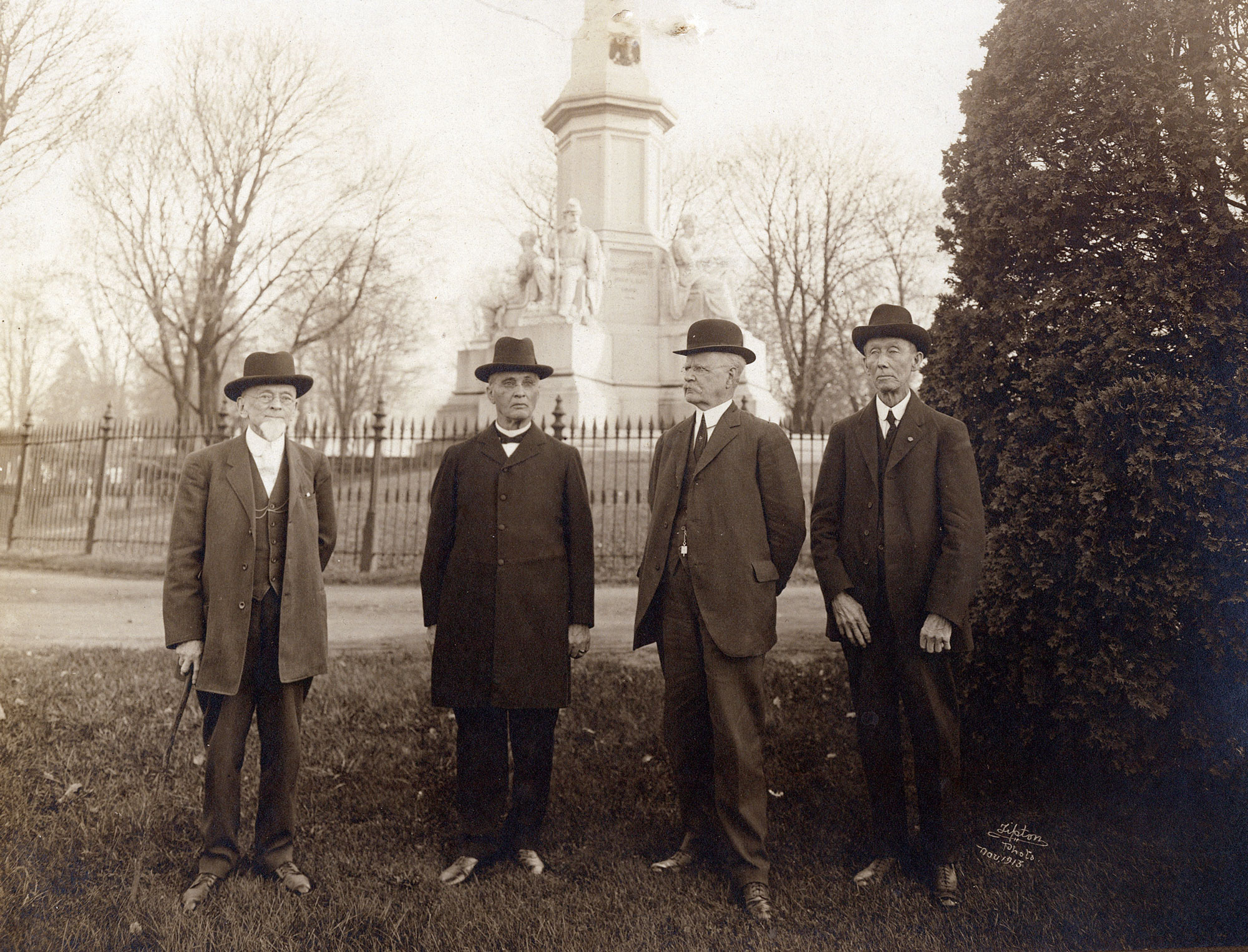
In any case, some people were so taken aback, either by Lincoln’s brevity or his words’ emotional power, that they did not respond in any outward manner. “It was a sad hour,” recalled a Gettysburg man. “Any tumultuous wave of applause would have been out of place.”18 Trying to recall the reaction, Philip H. Bikle, a professor at Gettysburg College, wrote: “I do not remember that there was any applause, but I do remember that there was surprise that his speech was so short.” Edward McPherson, a former Pennsylvania congressman, asserted that the address was “imperfectly heard and faintly appreciated.” A New York reporter admitted that it was “probably not appreciated to its true merit by the audience, many of whom had dispersed over the battle-field.”19 Senator Cornelius Cole thought the audience had missed the whole performance. When Lincoln took his seat so suddenly after his short address, Cole remembered, “it was such a disappointment to everybody that there was no applause of any kind.”20
 Adams County Historical Society, Gettysburg, Pa
Four men who heard Lincoln deliver the Gettysburg Address gather at Soldiers’ National Cemetery on the 50th anniversary of the event in 1913. Philip H. Bikle, second from right, remembered “surprise that his speech was so short.”
But, according to more than one observer, “at intervals there were roars of applause” amid the great solemnity. Mostly, the crowd was overcome by emotion—quiet gravity for some, earnest applause or tears for others. One schoolgirl had a very personal reaction. “Cry? Of course I cried,” she said in an interview long after the event. “Every word spoken [by the president] was so real, so full of meaning. Then there came to our ears the words, ‘The brave men, living and dead, who struggled here, have consecrated this ground far above our power to add or detract,’ it meant all those ghastly days of fighting and dying.” She stood near a neighbor, a mother who had lost two sons to the war. “I cried for her,” she said solemnly, “as I can cry now when I think about it.”21
One Union officer, Major A.H. Nickerson of the 8th Ohio Infantry, was powerfully—and spiritually—moved. As the president spoke, the officer realized that they all stood “almost immediately over the place where I had lain and seen my comrades torn in fragments by the enemy’s cannon-balls—think then, if you please, how these words fell on my ears.” For this army officer, Lincoln’s address brought forth a moment of pure epiphany: “If at that moment the Supreme Being had appeared to me with an offer to undo my past life, give back to me a sound body free from the remembrance even of sufferings past and those that must necessarily embitter all the years to come, I should have indignantly spurned the offer, such was the effect upon me of this immortal dedication.”22 When the president told the crowd that the world could never forget what the soldiers of the North had accomplished at Gettysburg, an unidentified army captain sobbed openly and then, according to a reporter, “lifted his eyes to heaven and in low and solemn tones exclaimed ‘God Almighty, bless Abraham Lincoln.’”
Isaac Arnold—who was not there but gained his information from Governor William Dennison of Ohio—said that “before the first sentence was completed, a thrill of feeling, like an electric shock, pervaded the crowd.”23 Others who were not there that day agreed nonetheless that Lincoln’s words were positively thrilling. As George William Curtis, editor of Harper’s Weekly, put it, “The few words of the President were from the heart to the heart. They cannot be read, even, without kindling emotion.” The emotional appeal was also felt by an editorial writer for the Philadelphia Evening Bulletin, who noted: “The President’s brief speech of dedication is most happily expressed. It is warm, earnest, unaffected, and touching. Thousands who would not read the long, elaborate oration of Mr. Everett will read the President’s few words, and not many will do it without a moistening of the eye and a swelling of the heart.”24
Trying to weigh the contradictory evidence surrounding the Gettysburg Address is exasperating. One cannot argue, for instance, that the same people who thought the speech a failure also recorded that there was no applause, or that those who said they heard cheers were the ones who called it a success. In fact, the available documentation shows no such correlation, despite the fact that one recent historian has asserted that “when hostile reports carried the speech they often included applause and some papers … in addition to noting ‘applause’ and ‘immense applause,’ mentioned the speech being interrupted with shouts of ‘Good, good.’”25 Apart from newspapers (and not just hostile ones), civilian eyewitnesses also commented on the crowd’s reaction to the address. “Several times,” wrote a crowd member, “the silence was broken by spontaneous applause, and the wonderful fitness and beauty of the language were certainly appreciated by many present.”26
Nor can one simply dismiss the reports of applause, cheers, or outright silence. The witnesses whose accounts contradict others were not prevaricating. Even Lamon’s untrustworthy memories must be accepted for what they are—another eyewitness report that does not fit snugly with any other. If historians believe, as they seem to, that Lamon lied, they have forgotten that other testimony about the day is riddled with as many statements of unreliability and even incredibility as Lamon’s own. The passage of almost 150 years does not help. Interwoven into so many of the accounts of the speech are all the encumbrances of the 16th president’s martyrdom and the desire of his contemporaries to be regarded as an intimate, a congenial acquaintance, or even just a plain admirer, a phenomenon that renowned Lincoln scholar David Herbert Donald so aptly phrased “getting right with Lincoln.”27 As a result, when it comes to the Gettysburg Address, it’s nearly impossible to know whom to trust among the plentiful array of eyewitnesses.
In the end, we are brought full circle. There is no feasible way to describe with certainty the audience’s reaction to the Gettysburg Address, just as there are many other unresolved mysteries and contradictions about the speech. The evidence, conflicting and incongruous, incomplete and meager, simply does not tell us, cannot tell us, what we want to know or what historians—a disagreeable lot, if ever there was one, especially when it comes to inconclusive evidence—believe they need to know about Lincoln’s most famous speech. All we can conclude, unsatisfactory as it may be, is that those who heard the address in person reacted emotionally but differently, depending on where they stood in the mass of thousands and what they could honestly remember after standing with Lincoln on that hallowed ground.
Yet we can, despite these barriers, still reach a definitive conclusion about the Gettysburg Address. It was a success; it remains a success. No matter what the listeners at the cemetery’s dedication heard or thought they heard, if they applauded or didn’t applaud, despite what they missed or misconstrued, the nation as a whole has taken Lincoln’s speech into its heart, cherishing its message and its eloquence. His words live in a place of national affection and appreciation, where they will remain for all time. Perhaps we can reconcile ourselves to the fact that the soldiers in the audience, many of whom suffered from wounds and sickness earned in the Union army, appreciated Lincoln’s words with more emotion than the civilians in the crowd, whether they applauded the president’s performance or not. Lincoln’s “simple words,” wrote J. Howard Wert, a Gettysburg resident, in 1909, “spoke to their very souls.” Herman H. Hahn, another soldier in attendance at the dedication, stated bluntly that he believed the Gettysburg Address “was the greatest speech ever made.”28 Even if that blunt assessment goes too far, we may at the very least acknowledge that Hahn’s emotional response to Lincoln’s speech, given his military service to the Union, is something we can completely understand.
Glenn W. LaFantasie, a frequent contributor to the Monitor, is the Richard Frockt Family Professor of Civil War History and the director of the Institute for Civil War Studies at Western Kentucky University.
 White House Historical Association (White House Collection)
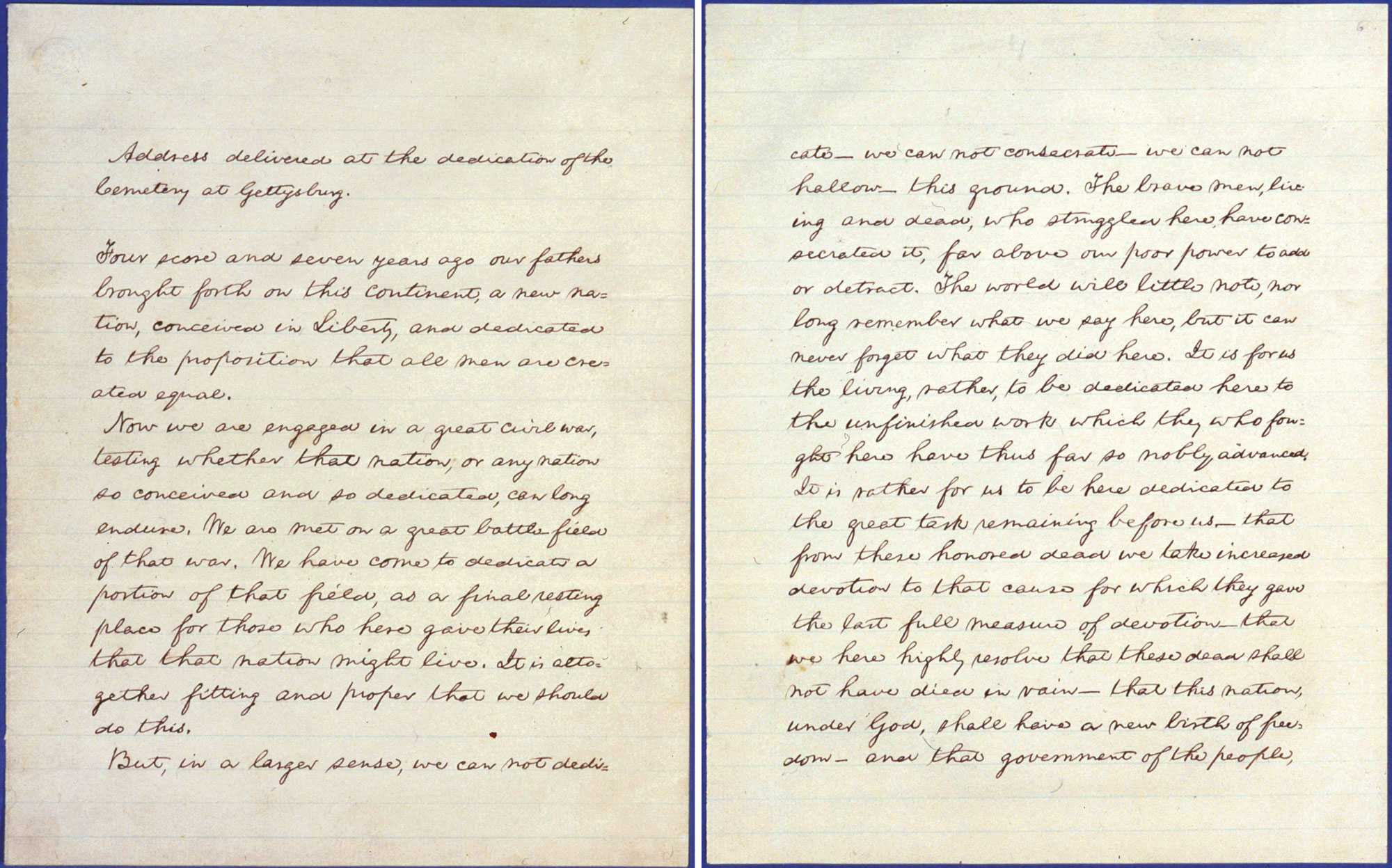
Handwritten manuscript of the Bliss Copy of the Gettysburg Address.
The Gettysburg Address
Although newspapers published “verbatim” texts of the words that Lincoln spoke on November 19, 1863, they differed wildly from those we know and recite today. And Lincoln himself produced five copies of the speech in his own hand, each with minor variations.
Most historians agree that the copy Lincoln read from on the platform was what is now known as the Nicolay Copy, or First Draft, which the president gave as a gift to his secretary, John G. Nicolay, who accompanied him to Gettysburg. The other extant copies are the Hay Copy, also called the Second Draft; the Everett Copy, a gift from Lincoln to Edward Everett, the featured speaker that day; the Bancroft Copy, which Lincoln wrote at the request of historian George Bancroft; and the Bliss Copy, the only one signed and dated by Lincoln, which was written out in March 1864 for Colonel Alexander Bliss, a publisher who wanted to issue a facsimile of the address.
The Bliss text, printed and pictured below, has become the standard version—the one memorized by students, emblazoned on the Lincoln Memorial, and still displayed prominently in the Lincoln Room at the White House. –GWL
Address delivered at the dedication of the Cemetery at Gettysburg.
Four score and seven years ago our fathers brought forth on this continent, a new nation, conceived in Liberty, and dedicated to the proposition that all men are created equal.
Now we are engaged in a great civil war, testing whether that nation, or any nation so conceived and so dedicated, can long endure. We are met on a great battle-field of that war. We have come to dedicate a portion of that field, as a final resting place for those who here gave their lives that that nation might live. It is altogether fitting and proper that we should do this.
But, in a larger sense, we can not dedicate—we can not consecrate—we can not hallow—this ground. The brave men, living and dead, who struggled here have consecrated it, far above our poor power to add or detract. The world will little note, nor long remember what we say here, but it can never forget what they did here. It is for us the living, rather, to be dedicated here to the unfinished work which they who fought here have thus far so nobly advanced. It is rather for us to be here dedicated to the great task remaining before us—that from these honored dead we take increased devotion to that cause for which they gave the last full measure of devotion—that we here highly resolve that these dead shall not have died in vain—that this nation, under God, shall have a new birth of freedom—and that government of the people, by the people, for the people, shall not perish from the earth.
Abraham Lincoln
NOVEMBER 19, 1863
Notes
1. “Lincoln’s Great Speech,” National Tribune, April 15, 1926.
2. William E. Barton, The Life of Abraham Lincoln 2 vols. (Indianapolis, 1925), 2:218.
3. Quoted in Frank L. Klement, “Ward H. Lamon and the Dedication of the Soldiers’ Cemetery at Gettysburg,” Civil War History 31 (December 1985): 299.
4. Philip B. Kunhardt Jr., A New Birth of Freedom: Lincoln at Gettysburg (Boston, 1983), 109; Louis A. Warren, Lincoln’s Gettysburg Declaration: “A New Birth of Freedom” (Fort Wayne, Ind., 1964), 66–67.
5. Kunhardt, New Birth, 110.
6. Warren, Lincoln’s Gettysburg, 66–67; William E. Barton, Lincoln at Gettysburg (Indianapolis, 1930), 60–65.
7. Kunhardt, New Birth, 198–99; Klement, “Ward H. Lamon,” 300.
8. Statement of Philip H. Bikle, in Barton, Lincoln at Gettysburg, 180. On the weather conditions that day, see also Warren, Lincoln’s Gettysburg, 75–76.
9. Barton, Lincoln at Gettysburg, 74–76, 182.
10. Ibid., 76; Carl Sandburg, Abraham Lincoln: The War Years 4 vols. (New York, 1939), 2:467, 470; Warren, Lincoln’s Gettysburg, 88–89.
11. Kunhardt, New Birth, 198–203; Warren, Lincoln’s Gettysburg, 110.
12. Michael Burlingame and John R. Turner Ettlinger, eds., Inside Lincoln’s White House: The Complete Civil War Diary of John Hay (Carbondale, Ill., 1997), 113.
13. Barton, Lincoln at Gettysburg, 170, 191; Klement, “Ward H. Lamon,” 305; Kunhardt, New Birth, 215.
14. Statement of Joseph A. Gouldon, in Barton, Lincoln at Gettysburg, 188.
15. “Heard Lincoln Make Speech at Gettysburg,” Chicago Daily Journal, November 19, 1913; J.F.F., “Lincoln at Gettysburg,” Springfield [Mass.] Republican, December 22, 1879.
16. Statement of Ward Hill Lamon, in Barton, Lincoln at Gettysburg, 201.
17. On Lamon’s lack of credibility, see Frank L. Klement, “Lincoln, the Gettysburg Address, and Two Myths,” Blue and Gray Magazine 2 (October-November 1984): 7–11.
18. Statement of Henry E. Jacobs, in Barton, Lincoln at Gettysburg, 183.
19. Statement of Philip H. Bikle, in ibid., 179; “Lincoln’s Gettysburg Address,” Springfield [Mass.] Republican, July 20, 1887.
20. Statement of Cornelius Cole, in Barton, Lincoln at Gettysburg, 163.
21. Statement of Horatio King, in ibid., 167; “Her Memories of War Days,” New York Evening Post, February 13, 1909.
22. Statement of A. H. Nickerson, in Barton, Lincoln at Gettysburg, 186.
23. Statement of William Dennison, in ibid., 165; Klement, “Lincoln, the Gettysburg Address, and Two Myths,” 11.
24. Barton, Lincoln at Gettysburg, 119.
25. Gabor S. Boritt, The Gettysburg Gospel: The Lincoln Speech That Nobody Knows (New York, 2006), 329.
26. “Lincoln’s Gettysburg Address,” St. Johnsbury Caledonian, July 28, 1887.
27. David Herbert Donald, “Getting Right with Lincoln,” in Donald, Lincoln Reconsidered: Essays on the Civil War Era (1956; 3rd ed., New York, 1989), 3-14.
28. J. Howard Wert, “Lincoln at Gettysburg,” Harrisburg Patriot, February 13, 1909; “Brainerd Man Heard Gettysburg Address,” Duluth News-Tribune, June 18, 1915.
Related topics: Abraham Lincoln