 Library of Congress
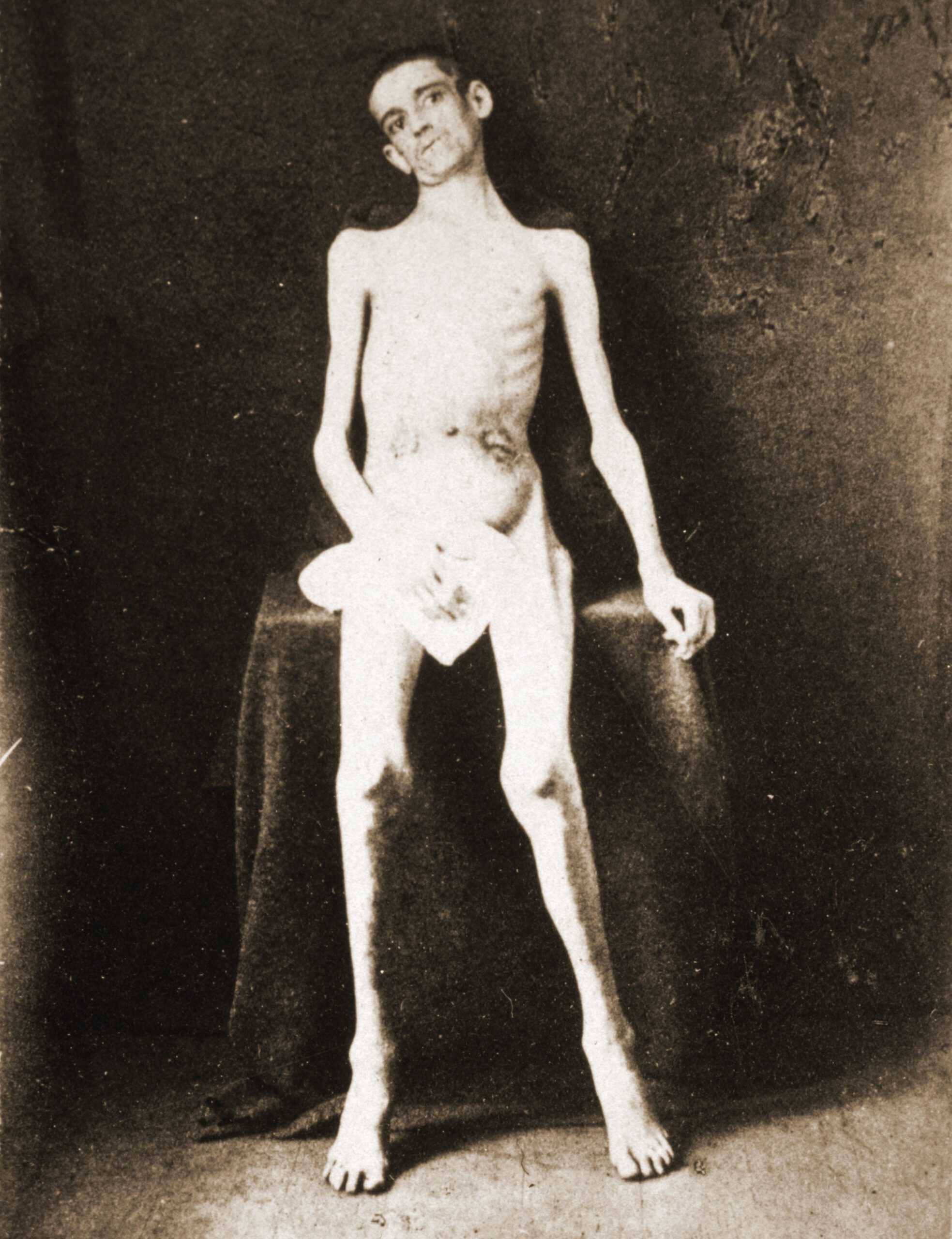
An emaciated Union POW, recently released from captivity, poses for the camera.
Shortly after 11 a.m. on June 15, 1882, nearly 2,000 blue-coated veterans crowded into Memorial Hall on the campus of the National Soldier’s Home in Dayton, Ohio. Just a few moments later, old soldiers completely filled the chairs that lined the parquet floor of the flag festooned auditorium, requiring many veterans to take their seats in the galleries.
Following the invocation, Joseph O’Neall, formerly a private in the 35th Ohio Infantry, delivered welcoming remarks. “This is no ordinary meeting,” he explained. “It is a meeting of ex-prisoners who preferred to starve and rot rather than sacrifice their honor, or falter in the discharge of their duty.” O’Neall was a survivor of Andersonville, the Confederacy’s infamous military prison in southwestern Georgia. He and his comrades assembled in Dayton that morning for the third annual reunion of the Ohio Union Ex-Prisoners of War Association, one of at least 61 local, state, and national organizations fashioned by the survivors of Confederate prison-pens.1
 The Rutherford B. Hayes Presidential Center
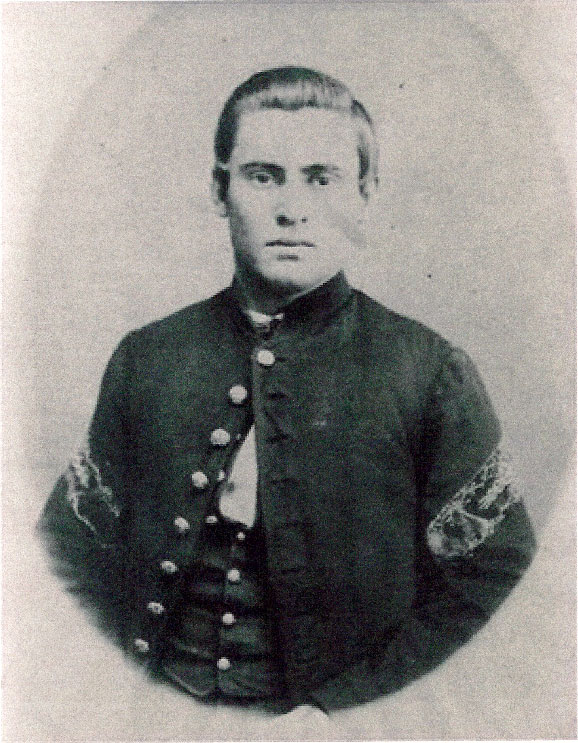
Gustavus Gessner
In the postbellum years, thousands of “living witnesses,” such as those who convened in Dayton, became impatient custodians of what Walt Whitman called the war’s “interior history.” Some were determined to compile a public catalog of Confederate cruelties. “It is a sacred duty we owe to our fallen comrades, to ourselves, and to posterity,” maintained Andersonville survivor Gustavus Gessner, “to spare no effort to make the true story of our sacrifices and sufferings as inmates of rebel prison-pens a part of the history of the war for the Union.”2 Others shared their stories in an attempt to help those around them understand the realities of the Civil War and what it often entailed. “How I wish every man and woman in the North could understand,” one ex-POW lamented.3 Still others searched for a way to come to terms with their own experiences. As Andersonville survivor Alson Blake asked an assembly of former prisoners, “Can it be possible that I endured all that suffering and am still living to tell this dreadful tale?”4
Whatever their goals, accomplishing them in the complicated aftermath of a deadly and destructive fratricidal conflict soon proved daunting. Rebel prisons were simply too incompatible with the sanitized Civil War narrative that captivated the public’s imagination in the late-nineteenth century; tortured and starved ex-POWs were hardly convincing characters in the popular “brother’s war” epic of the 1870s and 1880s. As a result, prison survivors turned inward to perform the necessary work of remembrance and healing.
When the U.S. began enlisting African-American troops in the summer of 1863, incredulous officials in Richmond responded by ceasing the prisoner of war exchanges that had characterized the war’s early months. Before long, Confederate authorities needed a new location to house the mounting numbers of Union captives. In February 1864, what would prove the most notorious of these new prison hells, Andersonville, located a dozen miles from Americus, amid the thick, pine forests of southwestern Georgia, began receiving captives. By summer, nearly 33,000 prisoners crowded into the prison, each inmate receiving barely 34 square feet of living space.5 Nineteen feet within the stockade wall ran a row of stakes marked the ‘dead-line.’ Prisoners who dared put “so much as…a foot” over the line faced being shot by one of Andersonville’s many well-perched sentinels.6
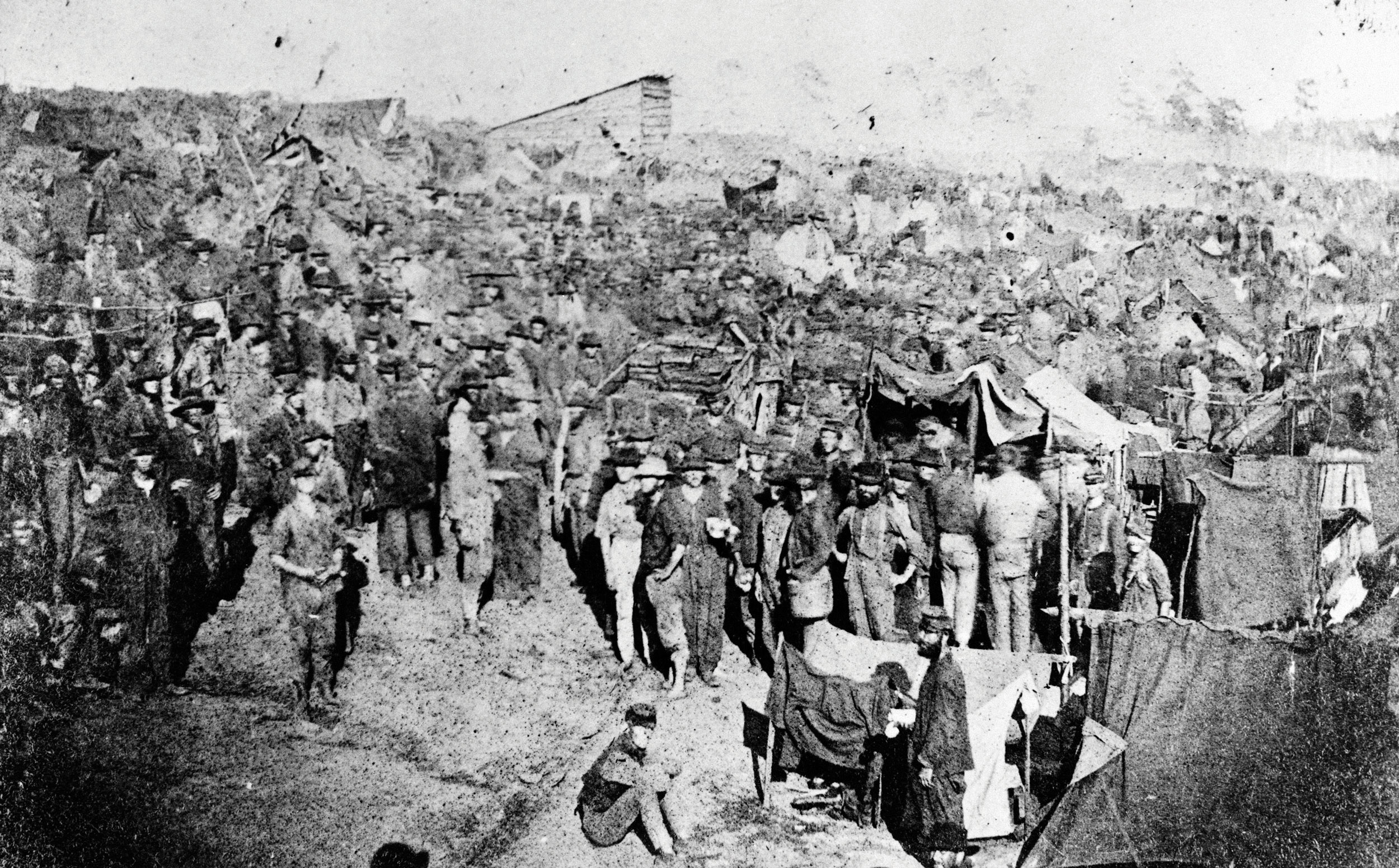
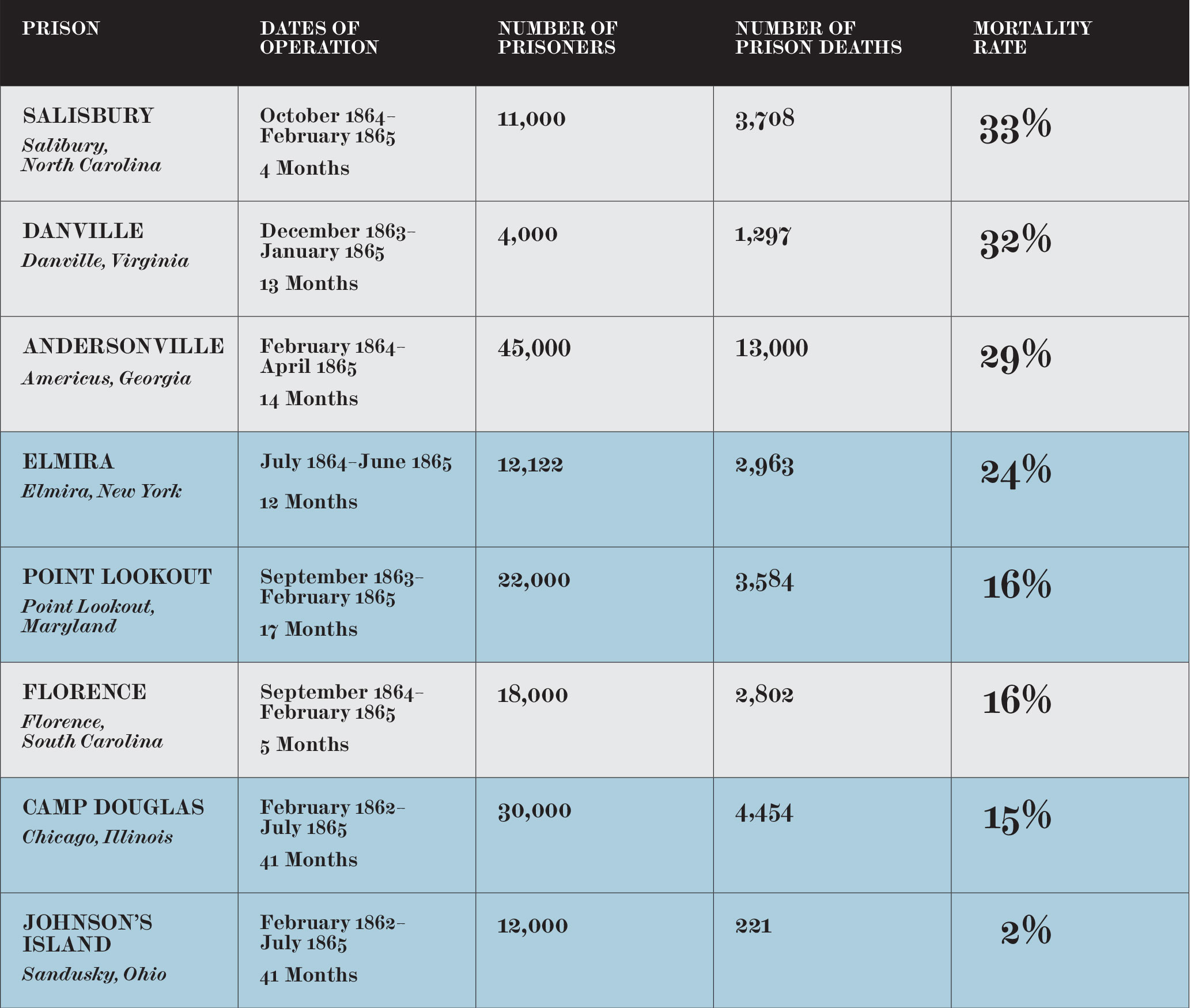
Incarceration at Andersonville was dehumanizing, robbing inmates of their dignity. “Of all places of distress and misery and suffering which I have ever seen this is the worst,” observed inmate Ira Forbes, who was captured from the ranks of the 16th Connecticut Infantry at Plymouth, North Carolina, in April 1864. Prisoners described Andersonville as a “restless, broken sea of human misery.” From a distance, the tightly packed inmates seemed to ebb and flow as if one, savage organism. “It is shocking to humanity,” another Connecticut inmate concluded, “to see the condition of some of the prisoners,” many of whom wallowed in mud and water “like hogs.” Because Confederate authorities did not devise a plan to provision prisoners, rations were virtually nonexistent. Malnourishment reduced men to skeletons. “Their sunken eyes, extended cheek bones, and regular claw fingers, they seemed to haunt me for days,” Private Lessel Long of the 13th Indiana wrote of his time at Andersonville. The prisoners’ only water source was a shallow stream choked with filth, excrement, and decaying bodies. Violent epidemics of scurvy, diarrhea, and dysentery distressed the captives, who lacked adequate medical care. During the summer, up to 100 prisoners died every day. By the time Andersonville closed in May 1865, some 13,000 of the 45,000 men incarcerated behind the so-called “gates of Death” had died of disease, exposure, or starvation.7
The men held captive at Andersonville experienced not only extreme physical suffering, but also endured acute mental trauma. Homesick and disheartened under these conditions, prisoners became lethargic. “I believe that the loss of health, exposure to privation and physical suffering…are not the saddest effects of our present captivity,” Forbes posited, “but that which is most lamentable I think is the mental debility which under the present state of things, we necessarily experience. The finer feelings, that which makes man lovely as a social being—love, affection, friendship, kindness, sympathy, courtesy are being constantly deadened.” One “weak and wasted” Andersonville ex-prisoner recalled “a deep sense of despair” settling in among the inmates, “with their upturned, wildly-ghastly, staring faces, and wide-open eyes.” Remembering the stockade’s surreal environment, Ohio survivor Solon Hyde recalled it was “no uncommon thing to see men wandering in idiocy, —reason, sense, feeling, all dead.” Diaries pulsed with descriptions of tortured and weary minds “going wild,” and utilized such phrases as “prison fever,” “idiocy,” “nostalgia,” and “homesickness.”8
Even once liberated, prisoners found it difficult to escape the war. “I was more than glad to be at home,” Connecticut veteran A.A. Hyde noted, “although the home was new to me. Several times each night for many nights I awoke feeling intensely…of that wretched misery.” Richard Thatcher, an Illinois drummer boy taken prisoner during the Atlanta Campaign, confessed to a fellow ex-prisoner, “Right in the abominable Andersonville, right there I received impressions that have followed me ever since.” Rhode Island cavalryman Gilbert Sabre became “deeply absorbed” in “still fresh” scenes of Andersonville life flashing before his eyes; his mind, he wrote, “lurk[ed] mournfully in the dark sepulchers of the past.”9
 National Archives
Andersonville prisoners line up to receive their meager rations. Malnutrition and disease reduced many inmates in Andersonville and other Civil War prisons to skeletons.
Andersonville, in short, was a callous nightmare that stalked its disbelieving survivors. “A period of captivity in Andersonville can never be effaced,” ex-prisoner Joseph Waters explained. “It is a plague we remember by its holocaust.” Many survivors were likely suffering from what modern-day war psychiatrists label post-traumatic stress disorder. “On my arrival at home,” Pennsylvania survivor Ezra Ripple explained, “meeting my friends braced me up so that for a time I forgot my sickness, but when I went to bed that night, I was to remain there…most of the time in delirium, in which the dogs, the prison, the rebel cavalrymen who took me back, and the old transport all contributed to keep me in terror and trouble night and day.” Elizabeth Maher, the granddaughter of an Andersonville survivor from New York, recalled that her grandfather feared starvation for the rest of his life.10
Many survivors, unable to cope with “moans of starving and dying comrades ringing in [their] ears” and “eyes yet retain[ing] the mental picture of the utter wretchedness” sometimes found homecoming literally unworkable. Haunted by Andersonville and gripped by rage, Simeon Haun, a Pennsylvania private captured at Gettysburg, was emotionally unable to return to his family. Once paroled at Harrisburg’s Camp Curtin, he decided to take work in a nearby hotel dining room. By decade’s end, he secured a coveted homestead tract in the West, leaving behind his kin and prewar life for the isolation of Dakota Territory.11
Unlike Private Haun, most veterans of Confederate prison-pens returned to their homes seeking to share their stories; they wanted to explain to civilians just what they had endured. Many, like Ohio artillerist and Andersonville survivor Henry M. Davidson, opted to write accounts of their ordeals. Convinced that “the Northern people” did not understand the horrible conditions of their incarcerations, Davidson and his comrades “pledged ourselves to each other if any of our number should ever make his way to the North, to do all in his power to spread abroad a knowledge of our treatment and arouse the sympathies of our friends to action in our behalf.” When compiling his memoir, Warren Lee Goss, a Massachusetts sergeant incarcerated at Richmond’s Libby and Belle Isle prisons, selected “scenes of prison life best fitted to convey to the minds of general readers” its characteristic horrors. “Are not the scenes through which [we] passed worthy of commemoration and remembrance in the hearts of his fellow country-men?” he asked.12
During the war’s final year and immediately after Robert E. Lee’s surrender at Appomattox, ex-POWs found an enthusiastic audience for their writings among a northern populace hungry for retribution. Stories of Confederate abuse of Union captives had circulated in the North since 1864, when the U.S. Sanitary Commission, a volunteer relief agency, launched an investigation of “the true physical condition” of the prisoners. The commission’s report, based on depositions taken from both a dozen furloughed survivors and the U.S. medical officers who cared for them upon release, accused Confederate policy makers with intentionally “denying food and clothing” to their captives. Little more than a year later, a military tribunal convicted Andersonville’s commandant, Henry Wirz, of “violations of the laws and customs of war,” based largely on the testimony of over 100 survivors of the prison. In July 1867, the U.S. House of Representatives, in an effort to provide “the country a faithful and true official history of the wrongs and sufferings” endured at Andersonville, appointed a select committee on Confederate prisons. The committee examined nearly 150 ex-prisoners and produced a 1,200-page report that validated some of the survivors’ most horrible tales.13
 Sources: Andersonville National Historic Site; Lonnie R. Speer, Portals to Hell: Military Prisons of the Civil War (Mechanicsburg, PA, 1997), 323-340; David S. and Jeanne T. Heidler, eds., Encyclopedia of the American Civil War (New York, 2000).
Mortality in Civil War Prisons
The figures above provide a comparative analysis of life and death in Civil War prisons. Even these numbers, however, do not tell the whole story, as death registers for notorious rebel stockades such as Cahaba (Alabama), Millen (Georgia), Goldsboro (North Carolina), Blackshear (Georgia), and Belle Isle (Virginia), are either incomplete or nonexistent. And, of course, what tables such as these cannot convey are the emotional costs of captivity, which haunted survivors for the rest of their lives.
With a sympathetic audience, prisoners wrote—and publishers printed—stockade reminiscences at a brisk pace during the immediate postwar years. Nineteen prison memoirs appeared in 1865 alone, followed by seven more in 1866, three in 1867, and five in 1868. As the Sanitary Commission put it, “Every returned prisoner has brought his tale of suffering, astonishing his neighborhood with an account of cruelty and barbarity on the part of the enemy.” The return of pale and emaciated survivors—a familiar scene in many northern towns and villages in the first summer after the war—lent credence to prisoners’ horrid tales. “Their arms and legs look like coarse reeds with bulbous joints,” remarked the editor of a journal called the Chicago Medical Examiner. “Their faces look as though a skillful taxidermist had drawn tanned skin over the bare skull, and then placed false eyes in the orbital cavities.”14
Before long, however, the northern public’s appetite for such scenes waned; images of broken bodies and ruined landscapes were steadily replaced in the civilian psyche by more alluring panoramas of heroism, glory, and sacrifice. Mounting war weariness was mostly to blame; having seen the country pass through unprecedented death and destruction, northern civilians yearned to let bygones be bygones, no longer willing to reckon with the late conflict and its cause, enormous costs, and complex consequences. Upon coming home in 1866, Phineas Whitehouse, a New Hampshire corporal who lost an arm in battle, noted the changing mood. “The returning wounded, with powerless arms, shattered legs, or bloody and fearfully disfigured faces,” he lamented, “were objects [too] dreadful to look upon.”15
Ex-prisoners were among the most affected by the shift in civilian opinion. Indeed, within a few years of the war’s end, it seemed the more reminiscences that the former POWs produced, the less sympathetic the public became. In an 1867 review of former prisoner Warren Lee Goss’ The Soldier’s Story of His Captivity, one periodical observed, “We do not like to read such narratives. They are too remindful of the late sorrow, and we would for our own taste discourage their publication.” Others began doubting the genuineness of prison tales. After finishing Andersonville survivor John McElroy’s book about his POW experiences, a Kansas man wrote to a local survivor mentioned in the tome. “I have been reading a book…on Southern prisons, and I would ask you if the truth is told in regard to them,” he queried. To this and other civilians, McElroy and his fellow survivors seemed “fuller of bitterness than of patriotism.” As the Sanitary Commission observed, “The public have been made very uneasy by these reports. One class have accepted them as true; another have felt them to be exaggerated; still another have pronounced them wholly false, fictions purposely made and scattered abroad to inflame the people.”16
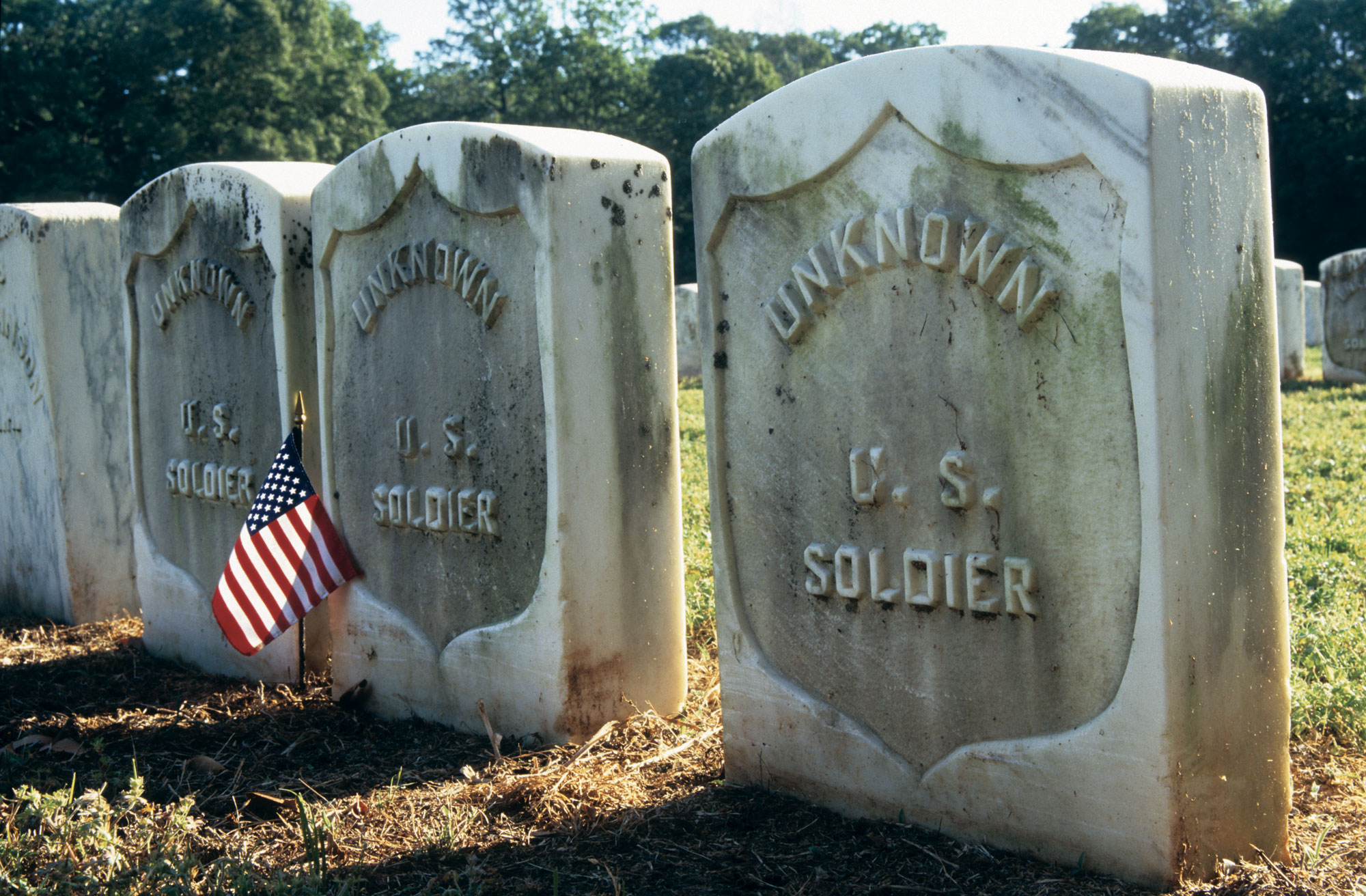 Courtesy Chris Heisey
Andersonville, behind whose walls some 13,000 inmates died during the conflict, ranked among the deadliest of all Civil War prisons. Above: Headstones mark the graves of soldiers buried in the Andersonville National Cemetery.
By 1869, the previously frenzied production of prison narratives had ground to a halt. Most major publishers now refused to produce prison reminiscences, perceiving them as destined for commercial failure. Former prisoners looking to see their stories in print either turned to local bookbinders, self-published, or reluctantly shelved their unpublished manuscripts. Many ex-prisoners lamented the new reality. In the manuscript of his unpublished memoir, survivor Ezra Ripple complained: “Where hundreds have written of the battles on land and sea for the Union, not more than a score or two have written of the horrors of the Southern prisons. The subject is not a pleasant or attractive one. We would all sooner listen to a description of a grand battle where all the bravery and dash of trained soldiers in assault and defense is portrayed in the most vivid and glowing colors than to a tale which has little in it but that which is revolting, sickening, and sorrowful.” John McElroy echoed the sentiment in the preface to his own Andersonville opus: “The country has heard much of the heroism and sacrifices of those loyal youths who fell on the field of battle, but it has heard little of the still greater number who died in the prison pen.”17
While keenly aware of the public’s growing reservations about the late war, ex-prisoners were hurt by the implication that their sacrifices were not worthy of publication. Survivor H.B. Hoffman “refrained giving a description of many scenes that I have witnessed,” deeming them “unfit for publication.” One Connecticut ex-prisoner conceded that sections of his account would “be skipped by those who are unwilling to know the truth,” while another feared people would “think that he was making up a story.” Warren Lee Goss explained that there existed “such a misunderstanding” of prisons that veterans required aid “in giving to the public anything which will more thoroughly convince [them] that Andersonville was not a myth but a hell that tried American endurance and fidelity and courage more than its battlefields.” As the New Orleans Times Picayune trenchantly observed in 1869, Union ex-prisoners were becoming “intensely absorbed in the apprehension that a fading away of the painful memories of the war” was writing them out of history.18 In the minds of a growing number of survivors, the “fervid atmosphere” of the Civil War seemed, as Walt Whitman cautioned, “in danger of being totally forgotten” by decade’s end.
With few exceptions, media outlets in the 1870s and 1880s treated ex-prisoners no better, denying those who refused to moderate their tone the opportunity to publish narratives about their experiences. Promoting sectional reconciliation, major periodicals commissioned veterans—mostly high-ranking officers—to compose war narratives intended to “soften controversy.” The most successful of these publications was Century Magazine, which, in the mid-1880s, printed hundreds of articles emphasizing the mutual courage and patriotism of Union and Confederate soldiers. At first, the series excluded any discussion of Confederate prisons from its pages. The unrivaled commercial success of the project, however, eventually convinced editors to begin accepting submissions from ordinary enlisted men, including ex-prisoners. Even so, Century did its best to soften the polemical writings submitted by ex-inmates. Editors required survivor Thomas Mann to delete “nearly all the explosive adjectives and personal opinions” from his articles on Andersonville. Warren Lee Goss encountered similar obstacles. “The Century people have been very kind to me in the matter of letting me have my own way,” he commented upon submitting his essay, “but they sometimes take exceptions to sharp things which I believe justice required to be uttered.”19
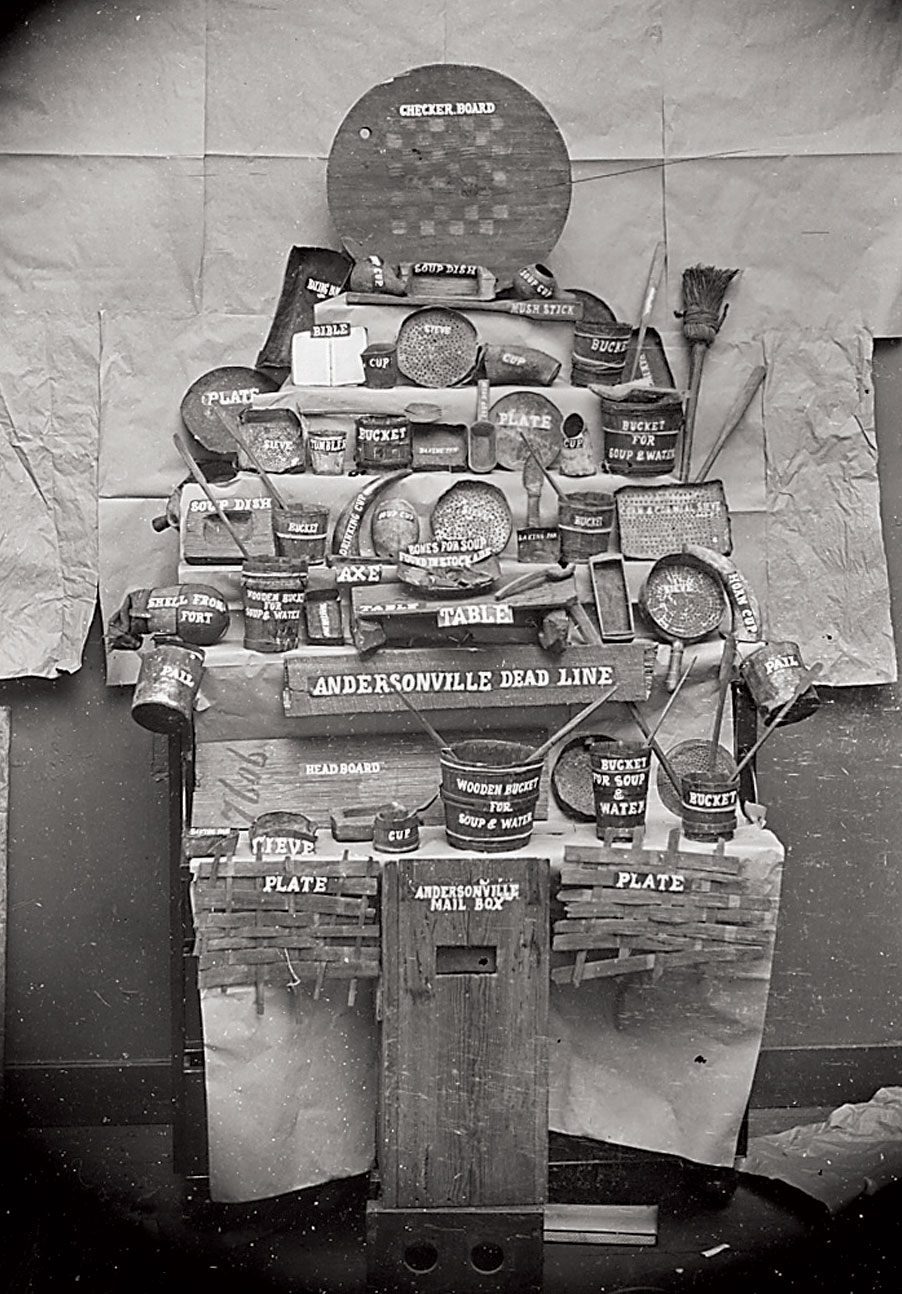 National Archives
Former POWs often bedecked their meeting places with prison relics, visual reminders of their wartime experiences. Mathew Brady photographed this group of Andersonville artifacts, assembled from the personal collections of survivors, in 1866.
Faced with a civilian population that eagerly embraced a sanitized interpretation of the war, one that also pervaded the ranks of the U.S.’s largest veterans’ organization, the Grand Army of the Republic, ex-POWs increasingly turned inward to perform the work of remembrance, embracing each other as fictive kin. “Though no man holds dearer his regimental comrades, there is a stronger affection that binds together in remembrance of hardship and suffering those who were prisoners of war,” declared former Libby inmate George Bliss. “No one who has not had experience of the miseries of confinement in southern prisons,” New York veteran Lester Phelps maintained in a moving letter to his fellow Andersonville survivor George Whitney, “can realize or imagine suffering and horrors there endured nor the patriotism and loyalty of those who endured it.” Scores of survivors addressed postwar letters to “brother captive” and signed them “fellow prisoner.” Many others functioned as custodians of information relating to prison life. Ex-POWs could often rely on a fellow survivor to supply crucial, authenticating details. “It is very kind of you to send me the papers containing the articles pertaining to our prison life,” Charles Johnson told Ira Forbes. “They brought back afresh to my memory many things that occurred while we were at Florence.” Robert Kellogg, who moved to Ohio from Connecticut after Appomattox, frequently referenced his personal library of prison memoirs upon the request of an ex-inmate.20
From these informal networks of attention and understanding, survivors fashioned an array of ex-prisoner organizations. In 1873, Warren Lee Goss and his fellow ex-prisoner Charles Shaw formed “The National Union Survivors of Andersonville and Other Southern Military Prisons,” which synchronized the activities of some 20 state ex-prisoner associations. These orders sought to strengthen “ties of fraternal fellowship and sympathy” among survivors and to “secure justice” by the reiteration of “the truths of our hardships.”21 Ex-prisoner associations not only became sites of memory and mourning, but exclusive spaces wherein survivors shared and worked through the trauma that the “burning, scalding crucible of the rebel prison pen” imposed upon them.22
Membership in these organizations helped validate the experiences of former prisoners. Applications required aspiring veterans to provide the details of their capture, imprisonment, and release, as well as to affirm that they had never sworn an oath of allegiance to the Confederacy. Ex-prisoners prized the membership certificates issued by the associations. Printed on parchment in gilt and color, and adorned with signatures and seals, these elaborate diplomas not only “certified” an ex-prisoner’s membership in the organization, but also established the truth of his tale. For a small fee, members could also obtain elegant brass badges, which they affixed to their lapels with blue ribbon and often personalized by adding brass bars stamped with the names of the stockades in which they suffered. Association meetings were exclusive affairs. After a ritual roll call, the club’s president would recite the names of various Confederate prisons. Upon hearing their incarceration site called, members responded with an enthusiastic ‘Aye’ and stood for acknowledgement.23
More important to ex-prisoners were the stories they exchanged at such meetings. None of the dismissive disbelief that greeted former POWs elsewhere intruded on their utterances; here, inmates “expressed themselves frankly and freely,” drawing strength from each other’s tales and finding meaning in their shared ordeals. It was “a great jollification,” as the Boston Journal put it, for former inmates to listen to “the stories of the suffering and the hardships endured.” At one gathering in Centralia, Illinois, a member’s “graphic” recital of “the horrors of Andersonville…got the boys thoroughly enthused.” Ex-prisoner Christ Engel wrote to thank a fellow member of the Ohio Association who had narrated his stockade miseries in titillating detail at one of their meetings. “Your address at the reunion of the Prison Association reminded me of the Old times,” Engel noted, “and carried me back to when I spent nine months at that hell hole of Andersonville Prison.”24
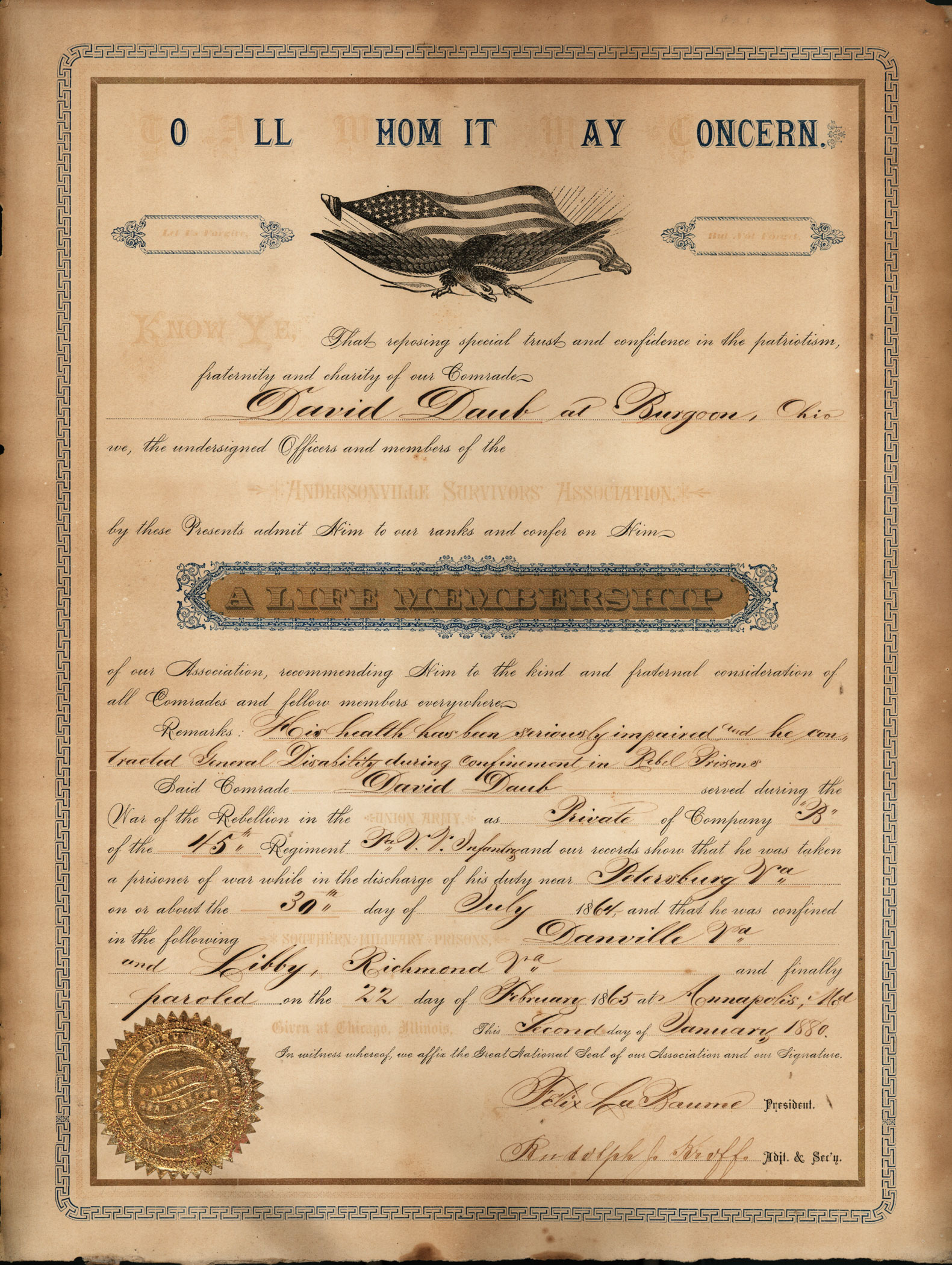 The Rutherford B. Hayes Presidential Center
Veterans who joined ex-prisoner associations prized the membership certificates they received. The Andersonville Survivors’ Association issued this certificate to member David Daub, who served during the war in the 45th Pennsylvania Infantry.
Beyond the symbolic spaces that these organizations opened for survivors, ex-prisoner associations established physical locations for former POWs to perform the work of healing. In April 1887, after meeting in various hotel lobbies, fraternal lodges, and members’ homes, the District of Columbia Association leased two adjoining rooms downtown in the Corcoran Building—a space of their own. “It was the desire of the officers and comrades that all should make these rooms their resting place when down city in the evening,” the association’s minute-book noted. “The rooms will be kept open every evening,” the Washington Post announced, “and all ex-prisoners are cordially invited to the rooms, to talk over their old battles, and smoke the pipe of peace and friendship.” Association member John McElroy contributed a “handsomely framed” copy of fellow survivor Thomas O’Dea’s “Andersonville Prison,” a bird’s-eye rendition of the stockade produced from memory, for display in one of the rooms. The affecting lithograph brought “tears to many eyes” of those who assembled for an evening of storytelling.25 Having found both a secure place and understanding counsel, members of the District of Columbia Association worked through their grief together.
Former captives often readied their meeting spaces for the work of remembrance by bedecking them with prison relics. After calling meetings to order with pine gavels fashioned from stockade timbers, association presidents often invited members to highlight their own treasured items. “[Prison relics] are precious, and should be preserved with care,” wrote survivor Robert Kellogg. At one Connecticut State Association meeting, Norman Hope displayed, “with touching appeal,” his “small but unique collection” of broken Andersonville knives, forks, and spoons. Clark Wakeman, a private from the 21st Michigan who was captured at Chickamauga, “exhibited a few relics” of his months in Andersonville, including the small tin cup that had held his scant rations, at a Michigan Association banquet. And ex-prisoner Frank Smith, who ventured to the infamous Georgia stockade to collect souvenirs in 1883, prepared an arresting exhibition for the Tri-State Association that included a deadline stake he had removed himself.26
Associations became custodians of the prison experience, challenging those who sought to revise history. In 1876, when media outlets published a fiery letter in which former Confederate president Jefferson Davis posited that the mortality rate for Rebel prisoners in the hands of federal authorities exceeded that of U.S. soldiers in Confederate prisons, the National Union Survivors of Andersonville responded in kind. Drawing on official reports and the testimony of Confederate leaders, Warren Lee Goss, the group’s president, demonstrated that the mortality rate in southern prisons “was about three times as great as that in Union prisons.” And when news of a proposed memorial to the Confederate soldiers who died in Chicago’s Camp Douglas reached Goss’ office in 1895, his group promptly issued an acerbic protest. In their minds, emphasis on the shared suffering of Union and Confederate prisoners was simply too objectionable. “When we remember the condition of those Confederate prisoners from Camp Douglas as compared with that of our comrades coming from Confederate prisons for exchange, we feel that we cannot remain still… . Would those who rear this memorial at Chicago wish us to depict the Union prisoner as he was, on a like shaft at Andersonville?”27
Ex-prisoners also transformed accounts of captivity into stories of sacrifice; their rhetorical alchemy was a demonstration of how much the public demanded tales of daring and bravery. Homer Sprague, one-time lieutenant colonel of the 13th Connecticut and a survivor of North Carolina’s Salisbury Prison, argued that it was “comparatively easy to face death in battle,” for the soldier “swept along with the mass,” beholding the “gleaming lines, the dense columns, the smoking batteries, the dancing flags, the cavalry with flying feet.”28 William Lyon, a Massachusetts infantryman who survived Andersonville, devoted an entire chapter of his memoir to “the contrast” between the “loyalty and bravery” required on the field of battle and that necessary in the prison-pen. “The prisoner has nothing to inspire or encourage him,” Lyon maintained. “The music is gone. There are no words from his officers to help him but the long, monotonous days and dreary, sleepless nights.”29 And while Amos Stearns of the 25th Massachusetts “did not receive a wound” on the battlefield, he alleged to “carry more scars than many of my old comrades” after Andersonville.30 Insisting that those who suffered and died in Confederate prisons “gave their lives for their country as though they had fallen in battle,” ex-inmates attempted to expand the public’s constricted definition of the gallant warrior.31 “For more than twenty-three centuries civilized mankind has drawn inspiration and example from the patriotism and valor of those who fell on the field of Marathon in delivering Greece from the yoke of Persia,” veteran Gustavus Gessner explained. “It ought not to be considered inappropriate to speak of the heroic dead of Andersonville.”32
In a further attempt to establish their place in the pantheon of the war’s heroes, prison survivors demanded a prominent place on government pension rolls. Initially reserved for soldiers who were wounded in battle or otherwise disabled as a result of their service, federal pensions required veterans to supply affidavits—usually from a regimental surgeon or commissioned officer—testifying to the merits of their claim. Ex-prisoners found it difficult to support their declarations of injury. “From the peculiar circumstances surrounding [ex-prisoners], it is utterly impossible in almost all cases to furnish these proofs,” one petitioner argued. Moreover, the pension bureaucracy did not recognize mental trauma as a legitimate disability; only those veterans whose psychological problems coexisted with physical disease had hope of securing a pension. “I need not recount the fact that ninety-nine out of every hundred who were incarcerated in rebel prisons and lived to return home came broken down…wrecks of their former selves; and that our pension laws are wholly inadequate to give relief to this class of soldiers,” the Iowa State Association president declared. In demanding pensions, ex-prisoners argued that mental trauma was as authentic and debilitating as bodily injury. “It was impossible for one to spend any length of time there without injury to both physical and mental faculties,” one petitioner from New York asserted.33
Frustrated with the existing process, and convinced that such a measure would signal the ultimate reception of their message, former POWs petitioned Congress for legislation authorizing the creation of prisoner pensions. “The passage of this measure,” the Toledo Association maintained, “would indicate a desire on the part of the government to recognize the claims [of survivors].” Members of the Iowa Association urged Congress to accept the proposal, and thereby “teach us that Republics are not ungrateful.” Former sergeant Lyle Adair, who prior to his incarceration at Andersonville had been a recruiting agent for a regiment of United States Colored Troops, argued that prisoner pensions were hardly charity, “but an act of justice.”34
Despite their persistent appeals, survivors met continued opposition. At least four attempts to extend federal pension benefits to ex-POWs failed to secure Congressional approval. Even some of the most liberal proponents of veterans’ pensions dismissed the need for a specific ex-prisoner pension bill. “I do not complain so far as a dollar of it was necessary to relieve real distress,” Connecticut senator Joseph Hawley vowed. “If this bill passes as it stands,” one Grand Army of the Republic post resolved, “it will include many who are not entitled to a Pension because having no disability.”35 Though some ex-POWs became the beneficiaries of private pension legislation, as a fraternity, survivors of Rebel prisons failed to extract the public gratitude they desired. When the ink dried on the 1890 Dependent Pension Act, which extended a monthly pension to “all persons who served ninety days or more” in the U.S. Army during the Civil War, ex-prisoners found themselves subsumed into a universal class of aging, blue-coated veterans. Their psychological suffering would continue to go unrecognized in the nation’s collective memory of the Civil War.
Ultimately, Union ex-POWs failed to convince northern civilians—who, in search of national healing, enthusiastically embraced a sanitized Civil War—of the truth of their suffering. But we should hardly dismiss what ex-prisoners of war were able to accomplish in their postwar gatherings. Thumbing through prison memoirs, donning tiny brass badges and bars, reciting troublesome tales, responding to ritual roll calls, gathering for annual banquets, collecting stockade remnants, and demanding pensions, prison survivors crafted for themselves a coherent narrative of their traumatic experiences. Today, at the dawn of the Civil War’s sesquicentennial observance, a celebration that shares far more with the dismissive incredulity of late-nineteenth-century civilians than we might care to admit, and as a nation at war once more, we need to hear the insistent message of the Union ex-prisoners more than ever.
Brian Matthew Jordan, a 2009 graduate of Gettysburg College, is currently pursuing his Ph.D. in U.S. History at Yale University, where he is working on a dissertation titled “When Billy Came Marching Home: The World of Union Veterans.”
Notes
1. Joseph O’Neall, Constitution and By Laws of the Ohio Association of Union Ex-Prisoners of War, Together With Register of Members and Proceedings at the Reunion Held at Dayton, June 14 and 15, 1882 (Columbus, 1883), 6-7; “Great Preparations for Forthcoming Reunion of Ex-Prisoners,” Cincinnati Daily Gazette, June 6, 1882; Edwin Beach, “To Ex-Prisoners of War,” Cincinnati Commercial Tribune, June 12, 1882; “The Ex-Prisoners Reunion,” Cincinnati Daily Gazette, June 15, 1882; [Chicago] Inter Ocean, June 15, 1882.
2. Gessner, notes for address, Ohio Ex-Union Prisoners of War Reunion [c. 1890], Gustavus A. Gessner Papers, Box 1, Folder 4, Rutherford B. Hayes Presidential Center [RBHPC], Fremont, OH.
3. Opium Eating: An Autobiographical Sketch, by An Habituate (Philadelphia, 1876), 27.
4. Alson Blake, “Speech About Andersonville Imprisonment,” [1920], Blake Papers, MSA 278, Series IV, Folder 10, Vermont Historical Society, Barre, VT.
5. Ovid Futch, History of Andersonville Prison (Gainesville, Florida, 1968), passim; James M. McPherson, Battle Cry of Freedom (New York, 1988), 796.
6. Norman Hope, “The Story of Andersonville,” lecture notes, Hope Papers, Connecticut State Library [CSL].
7. Forbes diary, May 3, 1864, Manuscripts and Archives, Sterling Memorial Library, Yale University, New Haven, CT; S.J. Gibson diary, May 5, 1864, Connecticut Historical Society [CHS]; on mud, see H.B. Hoffman, unpublished manuscript, Hoffman Papers, Andersonville National Historic Site Archives [ANHS] Andersonville, GA; Lessel Long, Twelve Months in Andersonville (Huntington, Indiana, 1886), 102; Oliver Gates diary, May 3, 1864, CHS; Futch, History of Andersonville Prison.
8. Forbes diary, August 24, 1864; Kellogg to Whitney, June 3, 1908, Whitney Papers, RG 69:23, Box 5, CSL; Opium Eating, 20; Solon Hyde, A Captive of War (New York, 1900), 228; “In the Prison at Andersonville,” Saturday Evening Post, July 1, 1865; Albert Hyde, “Life of a Connecticut Soldier in Confederate Prison During the Stormy Days of the War,” undated memoir manuscript, A.A. Hyde Papers, CSL; Ezra Ripple, Dancing Along the Deadline, ed. Mark Snell (Novato, Calif., 1996), 91-92; Luther Billings, unpublished memoir, Billings Collection, Manuscript Division, Library of Congress, Washington, DC; G.E. Sabre, Nineteen Months A Prisoner of War (New York, 1865), 69; Inter Ocean, October 9, 1879.
9. Albert Hyde, “Life of a Connecticut Soldier in Confederate Prison During the Stormy Days of the War,” A.A. Hyde Papers; Richard Thatcher to Boston Corbett, letter, September 7, 1882, Boston Corbett Papers [microform], Kansas Historical Society [KHS], Topeka, KS; W.W. Hensley, “What a Soldier Never Forgets,” National Tribune, May 10, 1883; Sabre, Nineteen Months, 9.
10. Joseph Waters, address, Kansas Union Ex-Prisoners of War, March 5, 1898, Topeka Weekly Capitol, March 8, 1898; for PTSD, see American Psychiatric Association, Diagnostic and Statistical Manual of Mental Disorders, 3rd ed. (Washington, DC, 1987), 250; Ripple, Dancing Along the Deadline, 148; Elizabeth Maher to “Violet,” February 6, 1967, ANDE 284, ANHS.
11. Long, Twelve Months in Andersonville, 5; Haun, “War Record,” unpublished typescript, Haun Collection, ANDE 5086, ANHS.
12. Henry M. Davidson, Fourteen Months in Andersonville (Milwaukee, 1865), vii; Warren Lee Goss, The Soldier’s Story of His Captivity at Andersonville, Belle Isle, and Other Rebel Prisons (Boston, 1866), 3-4.
13. United States Sanitary Commission, Narrative of Privations and Sufferings of United States Officers and Soldiers While Prisoners of War in The Hands of Rebel Authorities (Philadelphia, 1864), 64; Norton Parker Chipman, The Horrors of Andersonville Rebel Prison: The Trial of Henry Wirz, The Andersonville Jailer (San Francisco, 1891), 12-18; House Special Committee on the Treatment of Prisoners of War and Union Citizens, Report on the Treatment of Prisoners of War Kept By the Rebel Authorities During the War of the Rebellion, 40th Congress, 3rd session, 1869, H. Rept. 45.
14. Ann Fabian, The Unvarnished Truth (Berkeley, California, 2000), 226n13; United States Sanitary Commission, Narrative of Privations and Sufferings of United States Officers and Soldiers While Prisoners of War in The Hands of Rebel Authorities, 19; “The Starvation of Prisoners,” Chicago Medical Examiner (June 1865).
15. Phineas Whitehouse, “My First Battle,” manuscript dated August 1866, in William Oland Bourne Papers, Manuscript Division, Library of Congress, Washington, DC.
16. “New Publications,” Flag of Our Union, March 2, 1867; J.T. Gist to Corbett, March 16, 1882, Boston Corbett Papers; Springfield [Massachusetts] Republican, August 11, 1886; Narrative of Privations and Sufferings of United States Officers and Soldiers, 19.
17. Ripple, Dancing Along the Deadline, 5-6; John McElroy, Andersonville (Toledo, Ohio, 1878), xv.
18. Hoffman, unpublished manuscript, ANHS; Hyde, “Life of a Connecticut Soldier in Confederate Prison during the Stormy Days of the War,” A.A. Hyde Papers; Redpath, “Defense of Slavery,” The Independent, August 10, 1865; Goss to Hamlin, August 6, 1885, Hamlin Papers, MOLLUS Collection, Houghton Library; “An Andersonville Column,” Times Picayune, June 9, 1869.
19. On Century, see David Blight, Race and Reunion: The Civil War in American Memory (Cambridge, Mass., 2001), 173-179; T.H. Mann, “A Yankee in Andersonville,” Century 40 (July 1890): 447-461; Century 40 (August 1890): 606-622; Goss to Hamlin, August 14, 1885, Hamlin Papers.
20. Richard Thatcher to Corbett, September 17, 1882, Corbett Papers; see also National Tribune, May 10, 1883; D.L. Jewell to Kellogg, March 9, 1908, Whitney Papers; “Survived Horrors,” Worcester [Massachusetts] Daily Spy, October 19, 1895; Phelps to George Whitney, March 12, 1905, CT Andersonville Monument Commission Records, CSL; Johnson to Forbes, April 23, 1907, CT Andersonville Monument Commission Records; Kellogg to Whitney, November 21, 1921, Whitney Papers, and Kellogg to Norman Hope, July 19, 1922, Hope Papers.
21. Constitution of the National Union Survivors of Andersonville and Other Southern Military Prisons (New York, 1882), 1-2; “Prisoners of War,” Hartford Daily Times clipping, Robert Kellogg Vertical File, OHS; program for NY Association Memorial Service, Connecticut Andersonville Monument Commission Records; Robert Beath, History of the Grand Army of the Republic (New York, 1889), 680, and Sydney Phillips, Patriotic Societies of the United States (Broadway, NY, 1914), 130-131.
22. J.E. Wilkins, remarks, September 5, 1883, quoted in Proceedings of the Annual Reunion Iowa Prisoners of War Association (Des Moines, 1883), Petitions and Memorials Referred to Committees (HR 48A-H34.4), Committee on Invalid Pensions, 48th Congress, Records of the House of Representatives, RG 233, NA; “Iowa Prisoners of War Association,” National Tribune, November 23, 1882.
23. Certificate of Membership, New York State Union Ex-Prisoners of War Association, for William T. Ackerson, April 19, 1884, Folder 4, Collection 109, Ackerson Papers, Monmouth County Historical Association Library, Freehold, NJ; Certificate of Membership, Andersonville Survivors’ Association, for David Daub, Miscellaneous MSS, RBHPC; Constitution of the Illinois State Association of Union Prisoners of War, Corbett Papers; “Meeting of Ohio Ex-Prisoners of War,” Cincinnati Commercial-Tribune, May 15, 1884; “The Andersonville Survivors,” Boston Daily Globe, April 10, 1875; “Union Ex-Prisoners Dine,” NY Tribune, December 22, 1891; Constitution of the National Union Survivors of Andersonville and Other Southern Military Prisons, 12; “Prisoners of War,” Inter Ocean, October 21, 1880; “Andersonville,” Inter Ocean, October 9, 1879.
24. Illinois Prisoners of War Association handbill, November 1, 1881, Corbett Papers; “Days Recalled of Prison Life,” Boston Journal, August 16, 1904; “Prison Tales Retold,” Boston Daily Globe, April 8, 1892; “Survivors of Prison Pens,” Inter Ocean, October 28, 1886; Engel to Gessner, February 6, 1890, Gessner Papers.
25. DC Union Ex-POW Association, minutes, April 4, 1887, minute-ledger, Associated Survivors of the Sixth Army Corps Papers, Manuscript Division, LC; “Union Ex-Prisoners of War,” Washington Post, April 5, 1887; “The Ex Prisoners of War,” Washington Post, April 9, 1887.
26. “Survivors of Prison Pens,” Inter-Ocean, October 28, 1886; Kellogg to Richard Atwater, January 4, 1909, Dorence Atwater Papers, CSL; “Andersonville Relics,” clipping, Ira Emory Forbes Papers, CSL; “Michigan Ex-Prisoners of War,” National Tribune, December 21, 1882; “Frank Smith’s Visit to Andersonville,” National Tribune, September 20, 1883.
27. “Reply to Jefferson Davis,” New York Times, February 8, 1876; Farmer’s Cabinet [Amherst, NH], February 16, 1876; “Union Ex-Prisoners Protest,” Washington Post, May 30, 1895.
28. Homer B. Sprague, Lights and Shadows in Confederate Prisons (New York, 1915), 134; A. C. Roach, A Prisoner of War, and How Treated (Indianapolis, 1865), 64.
29. William Franklin Lyon, In and Out of Andersonville Prison (Detroit, 1905), 106-109.
30. Amos E. Stearns, Narrative of Amos E. Stearns (Worcester, Mass., 1887), 57.
31. John Read, as quoted in Boston Daily Globe, August 16, 1904.
32. Gessner, reunion speech mss., Box 1, Folder 4, Gessner Papers.
33. “Petition to the Honorable Senators and Representatives of New York at Washington,” Petitions and Memorials Submitted to Committees (HR 47A-H10.2), Committee on Invalid Pensions, 48th Congress, Records of the House of Representatives, RG 233, NA; J.E. Wilkins, remarks, September 5, 1883, in Proceedings of the Annual Reunion Iowa Prisoners of War Association (Des Moines, 1883), Petitions and Memorials Referred to Committees (HR 48A-H34.4), Committee on Invalid Pensions, 48th Congress, RG 233, NA; NY State Association of Union Prisoners of War, “Appeal in Behalf of the Union Ex-Prisoners of War,” February 1, 1882, Petitions and Memorials Referred to Committees (HR 47A-H10.2), Committee on Invalid Pensions, 47th Congress, RG 233, NA.
34. “Resolutions of Toledo Association Union Ex-Prisoners of War, Relative to Pensions,” Petitions and Memorials Referred to Committees (HR 51A-10.1), Committee on Invalid Pensions, 51st Congress, RG 233, NA; J.J. Stuckey, “Memorial of Iowa Prisoners of War Association,” April 26, 1890, ibid.; Lyle Adair to Committee on Invalid Pensions, April 7, 1884, Petitions and Memorials Referred to Committees (HR 48A –H11.4), Committee on Invalid Pensions, 48th Congress, RG 233, NA.
35. “Gen. Hawley On Pensions,” [Montpelier, VT] Argus and Patriot, April 16, 1890; Hays Post to Committee on Invalid Pensions, March 27, 1882, Petitions and Memorials Referred to Committees (HR 47A –H10.2), Committee on Invalid Pensions, 47th Congress, RG 233, NA.
Related topics: prisons and prisoners