 Andrew J. Russell
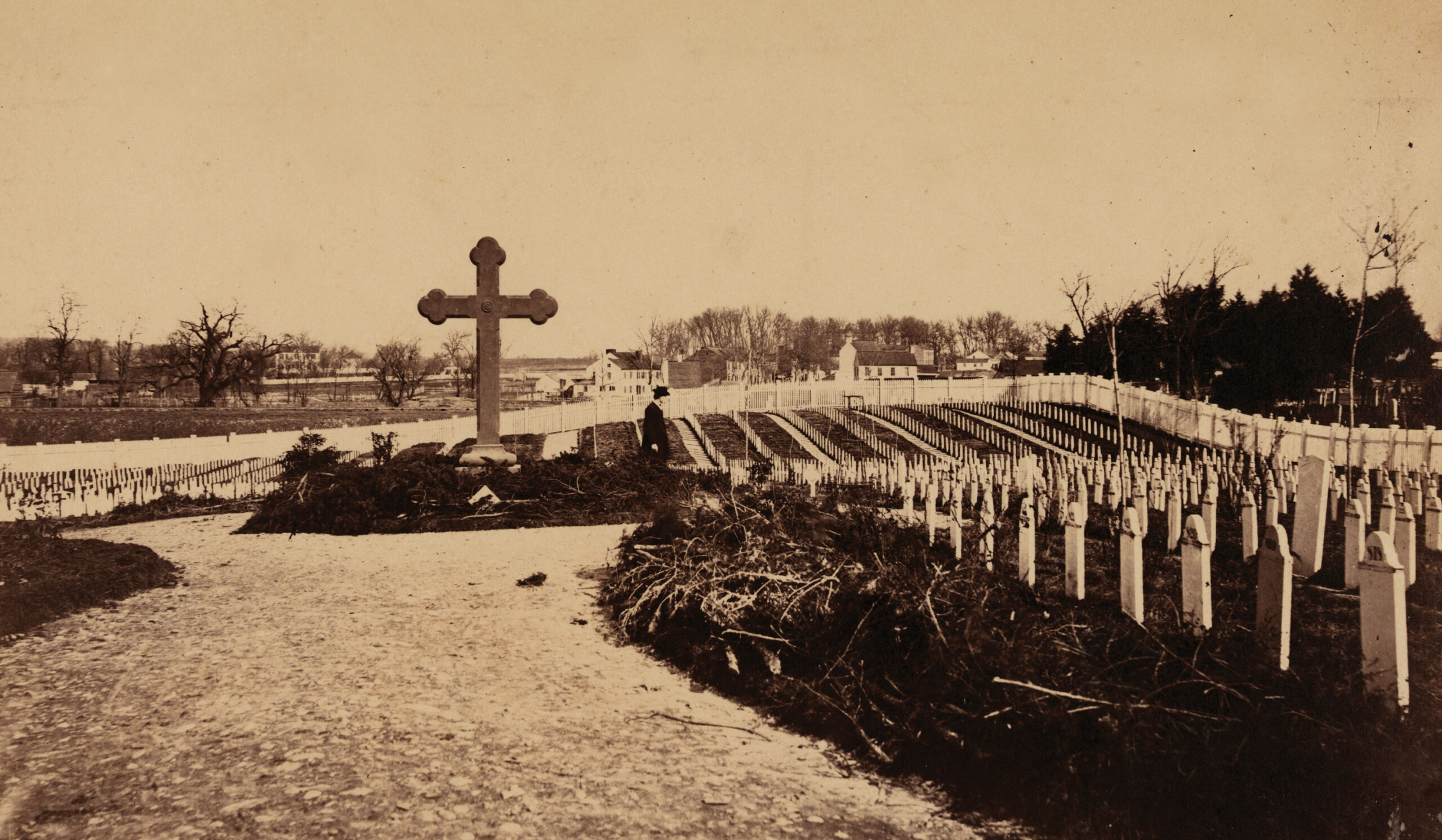
In this wartime image by Andrew J. Russell, a man stands among the graves at Soldiers’ Cemetery in Alexandria, Virginia.
All wars exact terrible tolls.
The American Civil War proved especially brutal, with soldiers and civilians falling to myriad effects, often unintended. Death had a way of uniting individuals on both sides of the conflict, particularly when lives were lost off the battlefield. When one pro-Confederate family, living along the path of the war between Manassas and Washington, D.C., lost their patriarch, a Union officer who had come to know them reacted with understanding. “Such is life,” he observed, “we are all passing away.”1 That so many soldiers and citizens made the ultimate sacrifice due to noncombat causes made such losses particularly poignant.
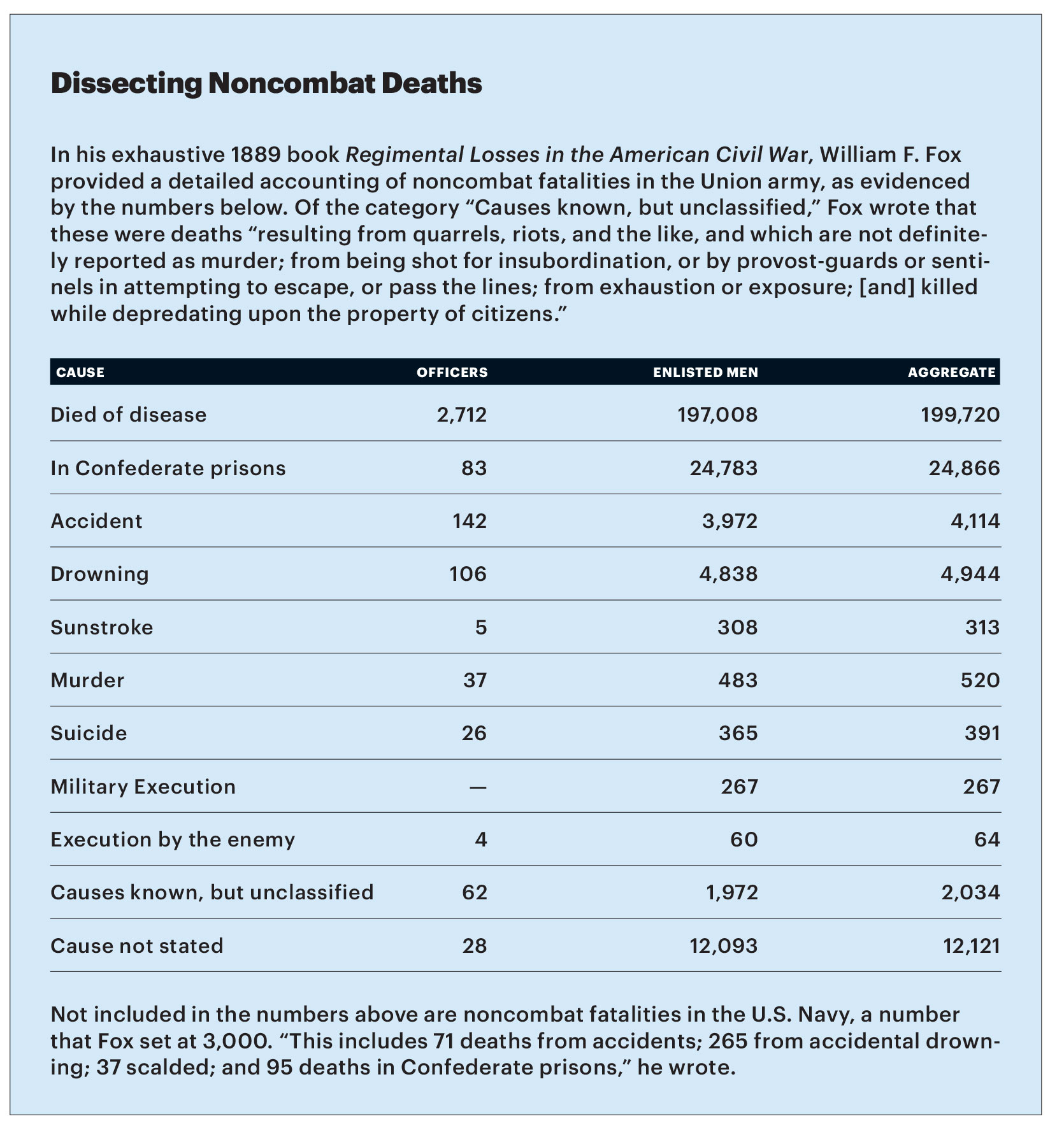
Union and Confederate newspapers and letters conveyed the news of fatal accidents and illnesses to readers and loved ones at home with daunting regularity. Soldiers’ diaries and journals recorded many instances of the same perils. Each one underscored the fact that most who perished in the war were not destined to do so in lines of battle next to their comrades. Historian James I. Robertson Jr. observed that of 360,222 Union deaths, only about 110,000 were “enemy-induced.” Illness accounted for the largest number of the others, as would be true for the Confederates, too, causing him to label this effect “the grimmest reaper.”2
At the outset of the conflict, the ideas of war, especially in the minds of the young and the uninitiated, were of banners flying and glory won over the din of battle. The stark reality offered a different view, as two examples illustrate. On February 12, 1861, two months before the bombardment of Fort Sumter, Noble Leslie DeVotie, a 24-year-old chaplain, fell from a gangplank and drowned as he attempted to board a steamer with Alabama troops bound for Fort Morgan, outside Mobile. Then, on March 20, when U.S. troops left Texas, First Lieutenant James B. Witherell stumbled while boarding a steamboat at the mouth of the Rio Grande and disappeared into the murky waters below.3 At Fort Sumter itself, the war’s first fatalities came not during the bombardment, but when a crew at the surrendering garrison fired a salute for the departing Union troops. A premature explosion ripped through one of the artillerists, Private Daniel Hough, tearing away his right arm and resulting in his death shortly after. Nearby rounds also detonated, sending shards of metal and pieces of the damaged masonry into several men who were too close to the blasts. One of them, Private Edward Galloway, died a few days later.4
Men were prepared to fall in headlong charges or under galling blasts of battle. Yet the men and the public that sent them to war were not prepared for the large number of fatalities from noncombat situations. A Vermont newspaper informed its readers in early 1863, “The excess of the mortality due to disease and accident, over that due to wounds in action, is a noticeable fact in the volunteer army of the United States, as in all other armies, two-thirds of the deaths of officers and five-sixths of those of the men resulting from disease and accident; the remaining one-third and one-sixth, respectively, being caused by wounds received in battle.”5
A depiction of life and death that appeared in the Corning Journal of New York on May 30, 1861, may best summarize the challenges beyond combat that faced the new recruits. “The casualties of the camp and the field, the hardships that rack the frame and make disease a frequent visitor, the exposures and scanty supplies of food and clothing that render the pestilential air of the malarious regions deadly effective … these are the dangers that must cross the path of the gallant volunteers, before they can hope to return to their homes.”6
 Library of Congress
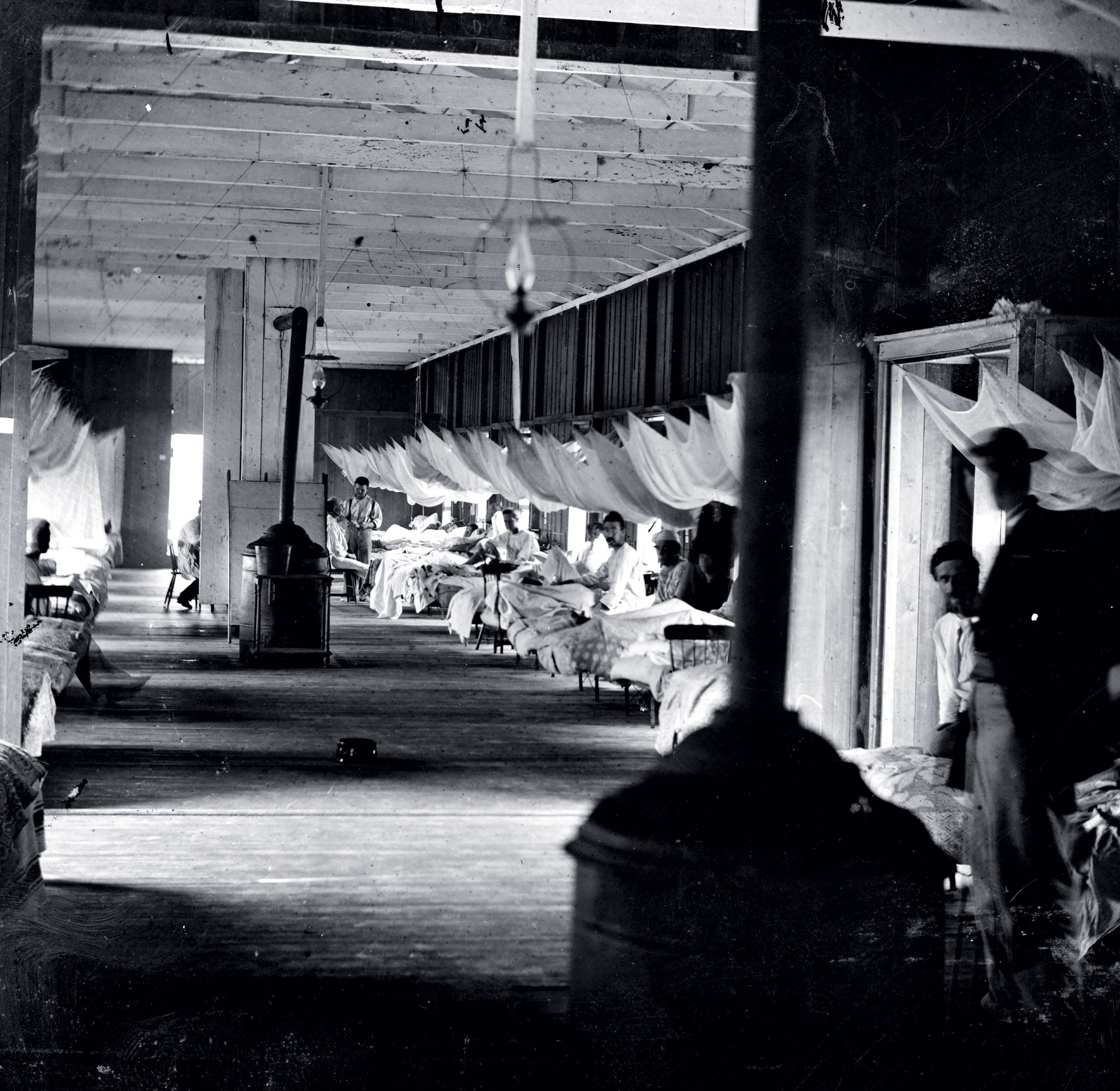
Sick and wounded Union soldiers convalesce in one of the wards of Harewood General Hospital in Washington, D.C. During the Civil War, more men died due to disease than to combat, a fact that troubled many of their comrades. “I think I would have preferred sudden death from a cannon shot, to a lingering illness,” wrote one Confederate soldier upon learning of the demise of an army friend due to sickness, “which would inevitably result in a dissolution of body and soul.”
G.C. Phillips, a surgeon posted in Kentucky, recalled watching men die from the ravages of illness with the observation, “It was worse than a battle.” Years later, Phillips concluded, “It was no fault of theirs that they did not live to be killed at Shiloh, Vicksburg or Franklin, where so many of the regiment were killed, and whose resting places are marked by headstones and beautiful monuments—erected by loving descendants and friends in memory of their heroism, courage and glorious death.”7 Lieutenant Henry Lyon of the 34th New York Infantry recorded the failing health of a compatriot in his diary. When the man finally succumbed to illness, he wrote, “Poor fellow—it seems worse to us than it would if he had fallen on the field of Battle.”8
Some of these men died of disease without ever firing their weapons in combat, while others died after surviving earlier battlefield ordeals. When he learned that a friend had perished to illness, Confederate Robert Patrick remarked, “He died at Tuskegee, Alabama, of consumption, the disease having been brought on by exposure during the siege of Vicksburg. Poor fellow! He had escaped all the shells and balls to linger a few months and die in an obscure village.” Patrick noted candidly, “I think I would have preferred sudden death from a cannon shot, to a lingering illness, which would inevitably result in a dissolution of body and soul.”9
New Yorker Charles W. Gould wrote home in September 1861, “Death comes to us by many a way…. Many here to[o] has bit the dust.” He hoped to “prepair to meet the Monster Death as he is daily staring us in the face. He is calling many of our friends from among us.”10 Indeed, disease had taken such a toll on Confederate soldier Mason Hill Fitzpatrick’s comrades that he retreated to the only solace that he thought the situation offered in his letter home: “Pray for me.”11 Another soldier lamented in late 1862 that if combat did not occur soon, “there will be no army to fight with.”12
For the men in the field, issues relating to health and disease were intensely personal. Connecticut soldier Charles Sherman wrote with conviction in a letter to his family in October 1862 regarding health care for the troops. “I have known men that has been told that nothing was the Matter with them and before midnight thay was Dead men,” Sherman explained. Camp physicians seemed powerless to stem the dismal tide. “That is the Class of Doctors we have with us and if Justice was meated out to one that is with us he whouled be hanging on the first Tree the Boys couled get him to.”13 Certainly, many in the ranks shared a disdain for the surgeons charged with their care, but the price paid during the war by these medical officers was heavy as well, including nine who perished in accidents and 285 who died of disease.14
 Library of Congress (4)
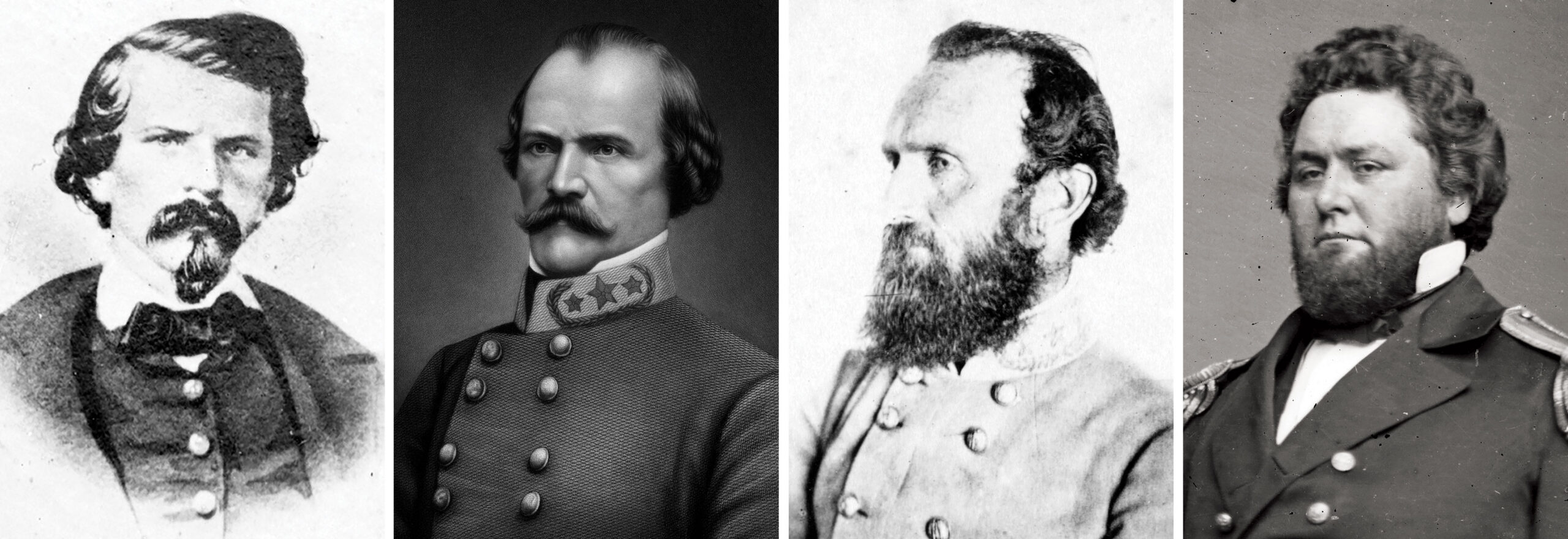
Especially cruel were deaths at the hands of comrades, both accidental and intentional. Among the more prominent soldiers who suffered such a fate were (above, left to right) Earl Van Dorn, Albert Sidney Johnston, Thomas J. “Stonewall” Jackson, and William “Bull” Nelson.
A particularly tragic tale befell the crew of J.S. Chambers, a Union vessel on blockade duty off Florida in 1864. Acting Master’s Mate John F. Van Nest wrote a series of letters home that detailed the devastating effects of illness among the officers and crew. As July gave way to August, innocuous references turned ominous: “The weather is very warm and makes me feel very uncomfortable and millions of Mosquitoes, and they almost eat me up and I can scarcely sleep at night for them. I hope that I shall not have to spend another summer down on this coast for it will use me up for I can not stand this weather.” On August 7 he noted that the ship’s surgeon insisted “it is not the yellow fever” that was ravaging the crew, but men quickly began expiring nonetheless. “They are sick but a few days,” he noted. Somehow, Van Nest managed to remain well, although on August 10 he wrote, “Two more of the men died this morning and I think more will die…. It is hard to see men die and still this vessel lies here on the Blockade.” Eventually the psychological toll proved too great. The officer who had assumed command after the ship’s captain died reported, “At 6 p.m. on the 18th instant, Acting Master’s Mate J.F. Van Nest in, it is supposed, a fit of derangement jumped overboard and was drowned in spite of every effort made to save him.”15 The war had claimed another life.
Misfortune, incompetence, mismanagement, and simple neglect also led to soldiers’ unnecessary deaths. Men who died from disease might yet obtain a level of nobility for their stoicism in the face of death. However, those who perished at the hands of friendly forces, by their own hand, in transportation or industrial accidents, or simply by being at the wrong place at the wrong time failed to achieve even that sense of meaning. Even routine duties, such as felling trees for quarters or improving earthworks, could go horribly awry.
Death at the hands of comrades was especially cruel. In the chaos and confusion of battles ranging from Big Bethel and First Manassas to the Wilderness and Franklin, Tennessee, soldiers fell from the fire of comrades. While Confederate generals Albert Sidney Johnston (at Shiloh) and Thomas J. “Stonewall” Jackson (at Chancellorsville) were the most famous men to die under such circumstances, many others perished in a similar manner. Perhaps more troubling were instances of honor gone awry, often tinged with the presence of alcohol or explosive tempers, that cost the lives of several officers, including William “Bull” Nelson, Earl Van Dorn, and John A. Wharton, as well as men of lesser rank. “Poor Tobe,” one soldier noted of a comrade slain accidentally while on picket duty, “he was a good soldier and had passed through many battles and skirmishes, and it seemed hard that he should thus fall at the hands of a friend.”16
Bursting artillery tubes and misfires also caused unintended fatalities. Admiral David Dixon Porter became alarmed at the frequency of accidents related to Parrott rifled guns, noting the loss of numerous gun crews and maintaining in understated fashion that the situation had “disconcerted the crews of the vessels” in which the incidents had occurred.17 No doubt just as disconcerting were the situations in which faulty powder or aiming caused rounds to drop on friendly troops.
Foolishness was perplexing, especially for men who had experienced much of the war and its inherent dangers. “Two men killed by our own men shooting at hogs,” wrote one Union surgeon in August 1864.18 Tempers could flare at any point during heated boxing matches or card games and lead to the demise of one or more participant.
Life in army camps was often tedious and routine, but there always seemed to be room for questionable behavior, sometimes with deadly outcomes. William Henry King of the 28th Louisiana Infantry noted several instances of mishandled artillery shells causing fatalities. “One shell was found unexploded, & Albert Spurlin & his mess appropriated it to the use of a fire log. It exploded, wounded Spurlin mortally, & Drew Malone slightly.” King’s reaction to another incident represents the sense some of the soldiers had for the fatal mischief that could arise in camp. On March 17, 1863, King explained that the presence of an artillery shell had proven too great a temptation for members of a Louisiana mounted unit. “Two men belonging to the La. Cavalry attached to this division, in playing some tricks with a shell, it exploded, killing one, & wounding two others.” He concluded, “‘Tis passing strange that men have no more prudence.”19
Union general Francis Walker was particularly harsh in his assessment of the parties he held responsible for such incidents. “I have known several cases of soldiers opening shells, pouring out all the powder (they always pour out all the powder), and then dropping in a coal or a match to see if there were any powder left. Out of all the lives lost in this way, I never once knew the original idiot to be injured.”20
Some soldiers—who fought internal demons or found the strain of facing battle more than they could tolerate—chose to end their lives. Confederate general Philip St. George Cocke and Union general Francis Engle Patterson were among the more prominent officers to select this path. The great irony for such individuals was that in dying by their own hands they retained some measure of control over their fates, though they sacrificed their lives to war as surely as those who fell in formalized engagements.21
Shipboard fatalities were not uncommon for crews exposed to tropical extremes, but the most gruesome death for a naval crew member was arguably that of Edward Tibbetts of the sloop-of-war USS Kearsarge. In July 1862, while Tibbetts was enjoying a swim off Algeciras, Spain, a shark attacked and killed him.22 Another bizarre noncombat death was recorded by a Union ship captain named Charles Henry Davis. He noted, “A man was killed in the mortar fleet this morning in a curious way. He had a cylinder of loose powder over his shoulder and a lighted cigar in his mouth.” Davis added matter of factly, “His head was blown off.” No other details appeared to be necessary, but the officer concluded of the incident and the victim, “These mortar men are said to be very careless.”23
 Library of Congress
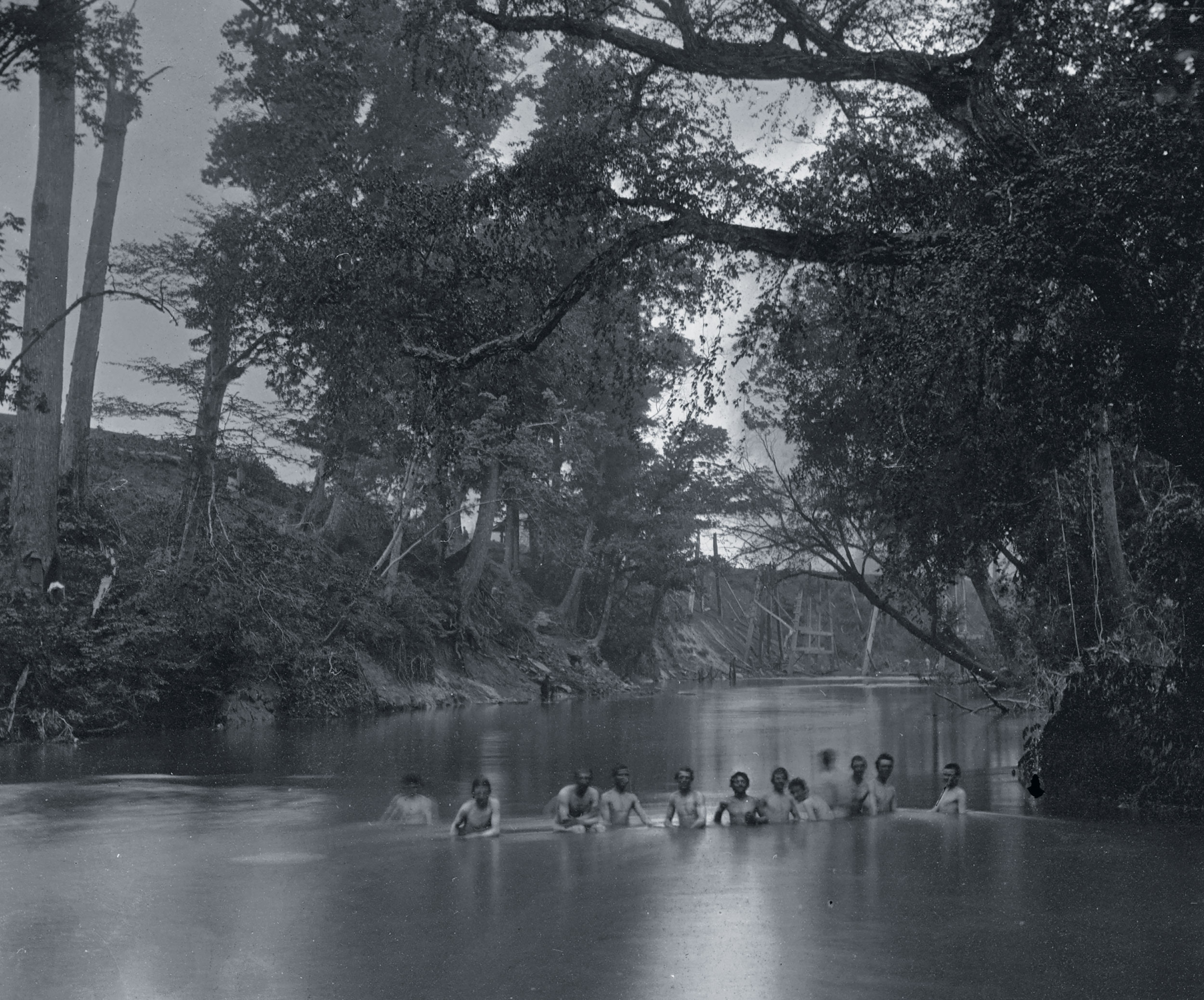
Union soldiers bathe in the North Anna River during a break in the Overland Campaign in May 1864. For soldiers and sailors alike, bodies of water—even those that seemed harmless—could prove deadly.
For sailors and soldiers alike, bodies of water—even those that seemed harmless—could prove deadly. On more than one occasion, a simple desire for cleanliness or refuge from summer’s heat led to dire results. In June 1861, a Cincinnati newspaper reported, “A soldier named McNally, attached to the ‘Greenup Invincibles,’ from Greenup County, Ky., was drowned in the river, while bathing yesterday.”24 Artidore Bear was close to his native Waynesboro, Virginia, after a year serving in the saddle for the Confederacy when he reached a crossing of the South River. “He was almost home,” a writer observed, “and his great anxiety to reach home, made him venture to ford the river, which was at the time very high and rapid, and he lost his life in the attempt.”25 Captain Edward H. Mix of the 16th Connecticut was on his way home aboard a transport in March 1864. A “blow from the boom” struck Mix and propelled him overboard, where the burden of his coat and heavy boots caused him to drown before help could reach him. The 16th’s historian, who had also served in the regiment, observed that the accident “snatched [Mix] from the bloody glory of dying in his country’s cause, to perish alone and uncheered—no banner above him but the silent clouds—no sounds around him but the rush of waters.”26
The White River in Missouri was the scene of a particularly harrowing accident that resulted in several deaths, according to the diary of Union soldier Benjamin F. McIntyre. He had noticed the tenuous nature of a crossing using loaded flatboats and a rope line and “shuddered at the thought of how frail a link connected them from accident and death.” Then, the unthinkable happened as a loaded boat became unmanageable and sank, ejecting the human and animal passengers. “The river presented a Scene I do not again wish to witness—Men and mules struggling in the water for life, many clinging to the Sunken boat—the water was icy cold & the current setting from the shore required a superhuman effort to reach it. While we as gazers on could render no assistance & be only witness of their death Struggle.” Some of the men came agonizingly close to shore before giving out “raising their hands above their heads and you could see the agony on their face and hear the cry—O cannot you save me—then sunk to rise no more.” The veteran remained traumatized by the event that unfolded before him. “I have seen death in many forms—have seen my companions fall at my Side in battle and without a feeling of sorrow passed on to revenge them—I have seen those expire who have been wounded…. But to die as our companions have today—to sacrifice all for the sake of their country and then to find Such a grave.”27
Violent storms were often the most dramatic illustrations of the noncombat dangers the men faced in the field. Strong winds and heavy downpours could prove deadly. While the chance of perishing from lightning strikes was not significant, it was not nonexistent, as some troops learned. On June 16, 1862, Confederate marine Henry Lea Graves recorded the aftereffects of a storm-related incident at his camp at Drury’s Bluff, Virginia. “One of the same crew was killed yesterday by a stroke of lightening…. I saw the body this morning and a horrible looking sight it was.” He worried that the war had desensitized him. “Such sights do not affect me as they once did.”28
 Library of Congress
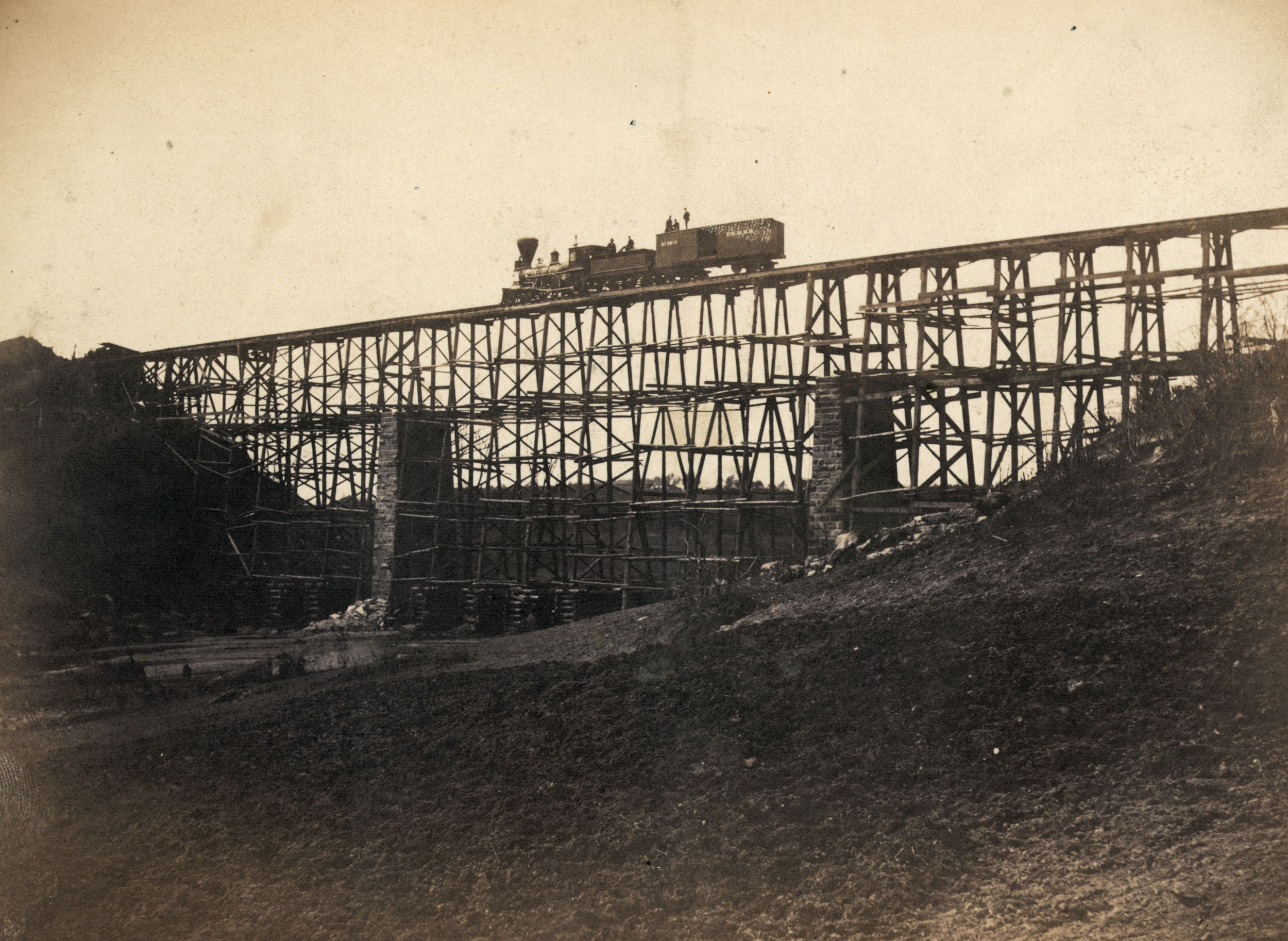
A train uses the Potomac Creek Bridge to cross over Potomac Creek in Virginia during the Civil War. Transportation accidents—including train derailments and collisions—caused their share of noncombat deaths.
Other unmerciful extremes in weather added to the death tolls. A Union surgeon observed of the effects of blistering summer heat, “It was something new to me to see men fall as if shot and die almost as quickly, from sun stroke. A moment previous to falling he would be marching on as if nothing unusual was to pay, when a stagger and fall, and in some instances death, followed each other in a few moments time.”29 Wintry conditions could present just as much of a threat.
Even when the weather was clear, transportation accidents on land and water—from railroad wrecks, derailments, and boiler explosions to ship sinkings, scaldings, and steamer or transport collisions—caused their share of deaths. Men were swept from the rooftops of box-cars by low bridges or caught between the cars during sudden movements on the tracks. Others simply fell while trying to enter or exit the trains, or were trapped or crushed by vehicles on the rails. Some died in freakish accidents on horseback or when ambulances or wagons overturned. Storm-tossed oceans and rough surf, or a misstep along a wharf or canal could spell doom with equally unexpected swiftness.
Some regimental records reflected the diversity of causes other than disease for the noncombat deaths of their men. One account for a North Carolina brigade recorded “20 men met accidental or violent non-battle deaths. Four were murdered, 1 committed suicide, 4 were killed by militia taking up deserters, 6 were killed in accidents, most involving discharge of a weapon, and 6 others were killed by falling trees or in railroad accidents.” Three members of the brigade faced charges for murder.30
The 4th U.S. Cavalry had approximately 112 men die from battle-related wounds, including 68 known to have perished and others injured and presumed dead. Another 91 men fell to fatal illness. As was the case with other units on both sides, there were a number of other noncombat deaths, including three men who died from “unknown” causes and nine from accidents. The rolls attributed four of the command’s deaths to drowning, three to “murdered by citizens,” one to a “skull fracture,” and another to stab wounds received in a house of ill repute. One wounded trooper killed himself.31 Historian Joseph Glatthaar found that, compared to their white comrades, noncombat deaths among members of the United States Colored Troops were staggering, with neglect, indifference, and racism exhibited by some of the physicians among the contributing factors. For example, pneumonia struck down 5,233 of these men, producing a mortality rate five times greater than among white volunteers with the same malady. A lieutenant in a USCT regiment posted in Louisiana observed, “The mortality in our Regt. beats anything I ever saw.”32
Civilians too paid a terrible, if frequently unheralded, price during the conflict. Among the most well-known individuals to perish as combat swirled through their communities were Judith Henry, an elderly woman killed by an artillery shell fired into her home during the battle at First Manassas, and Mary Virginia (“Ginnie” or “Jennie”) Wade, a 20-year-old resident of Gettysburg shot by an errant bullet while baking bread in her sister’s kitchen. Higher-profile figures were not immune. Both presidents lost children—Abraham Lincoln’s son Willie died of typhoid fever in 1862, and Jefferson Davis’ son Joseph died after an accidental fall in 1864—as did Union general William T. Sherman, whose son died of disease in 1863, an event that haunted Sherman for the rest of his life.
Citizens of cities including Charleston, Vicksburg, Atlanta, and Petersburg perished during siege operations when ordnance dropped on homes, businesses, or streets. As one Union soldier observed, “let me tell you spherical case, and shell don’t discriminate between those who are combatants and those who are not.”33
Even for those who lived far from the war’s battlefields, the fatal impact of war still hovered. Mayhem presented itself in myriad forms and places—in the city streets, the hospital wards, and the manufacturing and industrial centers. In Washington, D.C., the demand for war supplies turned sprawling facilities such as the Washington Arsenal and the Navy Yard from storage to production centers, with the attendant dangers of explosions and fires. As new personnel filled the workshops, civilian fatalities were inevitable.
Richmond saw a similar surge in industrial production—and accidental disasters—as the Confederacy geared up for a war of indeterminate size and duration. The most notable such Confederate calamity occurred on March 13, 1863, when explosions rocked a government laboratory on Brown’s Island, raining bodies and debris onto the surrounding streets. Dozens of workers, many of whom were women and girls, died instantly or suffered lingering agony before finally giving way to their injuries.34
In August 1863, an exasperated William Christie, a member of the 1st Minnesota Light Artillery, wrote home from Vicksburg, Mississippi. “Father, I am sick of reading in the papers of ‘the glory’ of war. The truth is, there is no glory in it; Everything about it is simply horrible.” He had seen the many ways that death intruded into both soldiers’ and civilians’ lives: “Is there glory in the cry of the mother as she sees her child’s head swept off by a cannonball? Is there glory in the weeping of widows and orphans? Is there glory in the burning cities and the desolated homes that War leaves behind him?”35 If the noncombat deaths of soldiers and civilians were less glorious in their circumstances than battlefield deaths, those they left behind still mourned and strove to accept and understand the losses. The outcome they had most dreaded when their kinfolk and community members went off to war had indeed occurred.
In his own style, Milton Barrett of the 18th Georgia Infantry noted the long-lasting impact of the deaths of comrades from his post in Virginia: “ther vakens in ranks can be fill with others but in the sirkle of friends at home and a round fiar side tha neve can be fild. We bered them in the oners of war and mark the place so ther friends may find ther graves.”36 Even so, soldiers like Barrett feared that the sacrifices they and their comrades witnessed or experienced away from the battlefield would be lost to posterity. One Union veteran explained of a fallen comrade, “He will soon be forgotten and the incidents attending his death be lost amoung the things of the past so far as his regiment is concerned, and the country will forget such a man ever existed.”37 Of course, their efforts at recording these incidents in wartime references and postwar reminiscences were a small measure of ensuring that the country would not forget these sacrifices. Certainly, the lives lost, regardless of the circumstances, are an essential part of the human story and toll of America’s greatest conflict.
Brian Steel Wills is director of the Center for the Study of the Civil War Era and a professor of history at Kennesaw State University. He has authored numerous works on the war, including Inglorious Passages: Noncombat Deaths in the American Civil War (University Press of Kansas, 2017).
Notes
1. “My dear Ellen, Alexandria, Va., April 13, 1862, in Civil War Letters of General Robert McAllister, ed. by James I. Robertson Jr. (New Brunswick, NJ, 1965), 133.
2. James I. Robertson Jr., Soldiers Blue and Gray (Columbia, 1988), 145, 147.
3. Lonnie R. Speer, Portals to Hell: Military Prisons of the Civil War (Mechanicsburg, 1997), 4.
4. W.A. Swanberg, First Blood: The Story of Fort Sumter (New York, 1957), 328.
5. “Mortality and sickness of the United States Volunteers,” Caledonian (St. Johnsbury, VT), January 30, 1863.
6. Corning Journal (Corning, New York), May 30, 1861.
7. Berry Craig, Kentucky Confederates: Secession, Civil War, and the Jackson Purchase (Lexington, 2014), 180–181.
8. “Dear Brother, Camp near Harrisons Springs Va. July 30th 1862,” in “Desolating This Fair Country”: The Civil War Diary and Letters of Lt. Henry C. Lyon, 34th New York, ed. by Emily N. Radigan (Jefferson, NC, 1999), 135.
9. “Mobile, Alabama, Saturday, March 26, 1864,” in Kenneth W. Noe, Reluctant Rebels: The Confederates Who Joined the Army after 1861 (Chapel Hill, 2010), 138.
10. “Dear Sister, HEADQUARTERS Washington REGT., 3rd CAMP Caldwell Co. I Washington D.C. Sep 9, 1861” in Dear Sister: The Civil War Letters of the Brothers Gould, compiled by Robert F. Harris and John Niflot (Westport, CT, 1998), 5, 7.
11. M.H. Fitzpatrick to “Dear Amanda A P Hill’s Division Hospital Near Richmond, Va. August 10, 1862,” in Letters to Amanda: The Civil War Letters of Mason Hill Fitzpatrick, Army of Northern Virginia, ed. by Jeffrey C. Lowe and Sam Hodges (Macon, GA, 1998), 23.
12. Quoted in Jeffry D. Wert, The Sword of Lincoln: The Army of the Potomac (New York, 2005), 91.
13. “Dear Wife & Chirldren, Camp Kerney, October 20, 1862,” in Letters to Virtue: A Civil War Journey of Courage, Faith and Love, ed. by Ann K. Gunnin (Alpharetta, GA, 2014), 107.
14. J.R. Weist, “The Medical Department in the War,” Sketches of War History Ohio Commandery (Cincinnati, 1888; reprint edition, 1991), II: 90.
15. “Yellow Fever on the Blockade of the Indian River: A Tragedy of 1864,” Florida Historical Quarterly, Vol. 21, No. 4 (April 1943): 352–353, 355–357; United States War Department, The War of the Rebellion: A Compilation of the Official Records 129 vols. (Washington, 1880–1901), Series I, Vol. 17, 748, 749.
16. Samuel H. Sprott, Cush: A Civil War Memoir, ed. by Louis R. Smith Jr. and Andrew Quist (Livingston, AL, 1999), 127–128.
17. David D. Porter, The Naval History of the Civil War (New York, 1886), 696–697.
18. “Sunday August 28, 1864, Holly Springs Mississippi,” in James A. Black, A Civil War Diary: Written by Dr. James A. Black, First Assistant Surgeon, 49th Illinois Infantry, ed. by Benita K. Moore (Bloomington, 2008), 231.
19. I No Pardons to Ask, nor Apologies to Make: The Journal of William Henry King, Gray’s 28th Louisiana Infantry Regiment, ed. by Gary D. Joiner, Marilyn S. Joyner, and Clifton D. Cardin (Knoxville, 2006), 72, 87.
20. Francis A. Walker, History of the Second Army Corps in the Army of the Potomac (New York, 1886), 501.
21. Diane Miller Sommerville, “‘A Burden Too Heavy to Bear’: War Trauma, Suicide, and Confederate Soldiers,” Civil War History Vol. 59, No. 4 (December 2013): 453–491.
22. Steven J. Ramold, Slaves, Sailors, Citizens: African Americans in the Union Navy (DeKalb, IL, 2002), 174.
23. C.H. Davis, Life of Charles Henry Davis, Rear Admiral, 1807–1877 (Boston, 1899), 236.
24. “Soldier Drowned,” Cincinnati Daily Press, June 17, 1861.
25. “Soldier Drowned,” Staunton [VA] Spectator, March 3, 1863.
26. Quoted in Lesley J. Gordon, A Broken Regiment: The 16th Connecticut’s Civil War (Baton Rouge, 2014), 126.
27. “1863 Camp at Forsyth Mo., Sunday March 1st,” in Federals on the Frontier: The Diary of Benjamin F. McIntyre, 1862–1864, ed. by Nannie M. Tilley (Austin, 1963), 116-117, “Camp at Forsyth Mo March 1863 Monday 16th,” 124, and “Camp at Forsyth Mo (April 1863) Wednesday 15th,” 138.
28. “Camp Walker, Drury’s Bluff, Va., June 16, 1862,” in A Confederate Marine: A Sketch of Henry Lea Graves with Excerpts from the Graves Family Correspondence, 1861–1865, ed. by Richard Harwell (Tuscaloosa, 1963), 59.
29. Daniel M. Holt, A Surgeon’s Civil War: The Letters and Diary of Daniel M. Holt, M.D., ed. by James M. Grenier, Janet L. Coryell, and James R. Smither (Kent, OH, 1994), 12.
30. Aldo S. Perry, Civil War Courts-Martial of North Carolina Troops (Jefferson, NC, 2012), 156.
31. John L. Herberich, Masters of the Field: The Fourth United States Cavalry in the Civil War (Atglen, PA, 2015), 253.
32. Joseph T. Glatthaar, “The Costliness of Discrimination: Medical Care for Black Troops in the Civil War,” in Inside the Confederate Nation: Essays in Honor of Emory M. Thomas, ed. by Lesley J. Gordon and John C. Inscoe (Baton Rouge, 2005), 251, 262, 264, 266.
33. “Dear Brother, Before Vicksburgh, June the 6, 1863,” in Thomas Christie and William Christie, Brother of Mine: The Civil War Letters of Thomas and William Christie, ed. by Hampton Smith Sr. (St. Paul, MN, 2011), 136–137.
34. David L. Burton, “Richmond’s Great Homefront Disaster: Friday the 13th,” Civil War Times Vol. 21, No. 6 (October 1982): 36-41.
35. “My Dear Father, Vicksburg, Aug. 6, 1863,” Brother of Mine, 161.
36. “Dear Brother and Sister, Camp Winder Richmond, Oct 14, 1861,” in The Confederacy Is on Her Way Up the Spout: Letters to South Carolina, 1861–1864, ed. by J. Roderick Heller III and Carolynn Ayres Heller (Athens, 1992), 27–28.
37. “White House Ranch July 29th, 1864,” in Federals on the Frontier, 381.