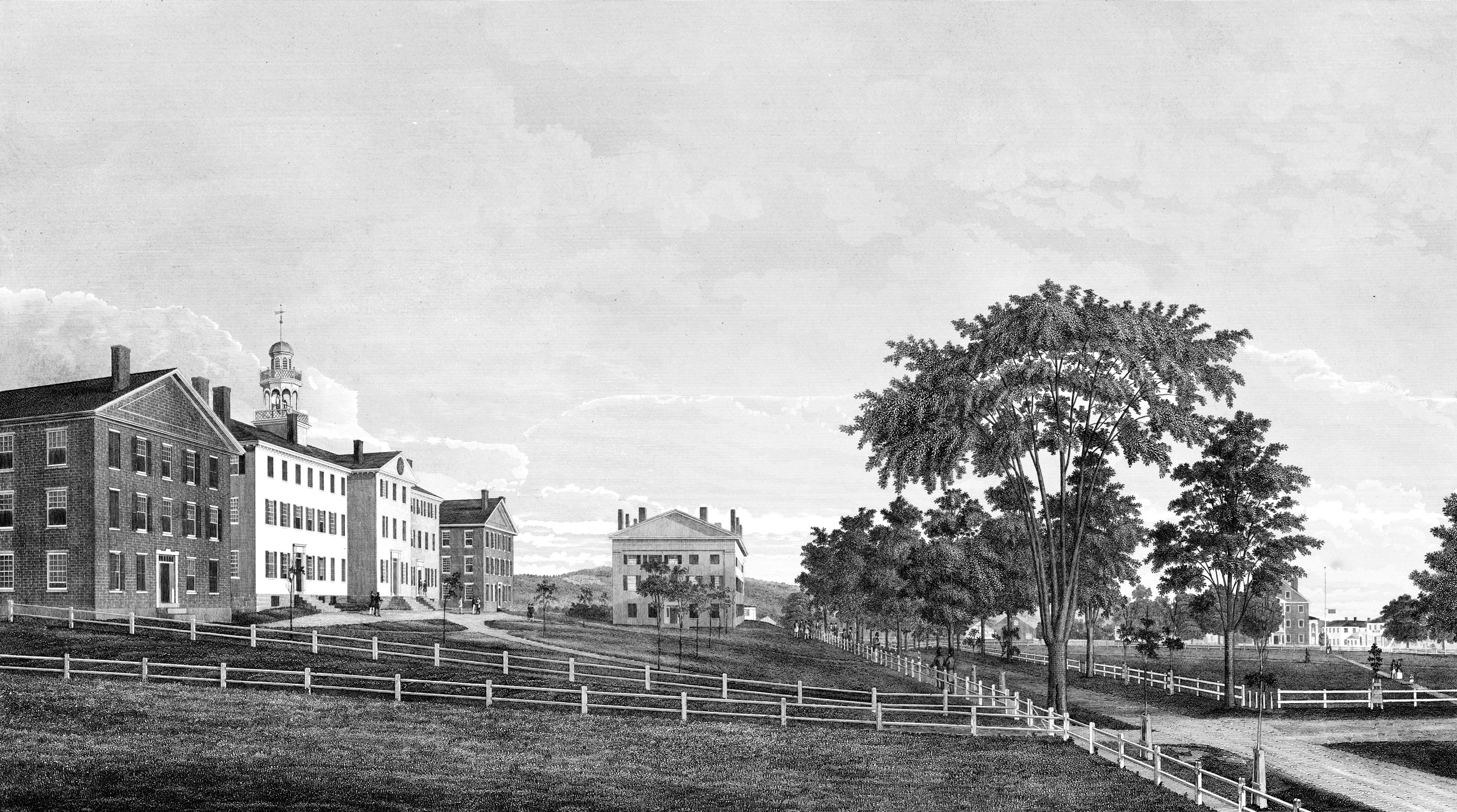
 Library of Congress
In 1862, scores of well-to-do college students in New England—many of them from Dartmouth College (shown here as it appeared in the 1850s)—helped form the Dartmouth Cavalry, a volunteer company. Their 90-day stint in the Union army left a lifelong impression on the young men.
Edwin Stanton shut down recruiting for the Union Army on April 3, 1862, just six weeks after taking over Abraham Lincoln’s war department.
Three days later came the Battle of Shiloh, in which 10,000 union soldiers were killed or wounded.
Then fighting started up in Virginia, while disease was taking a heavy toll in all the camps. On May 19 Stanton sheepishly inquired among state governors how quickly they could raise new regiments. some replied that the interruption in recruiting would make it difficult to do, if at all; the more optimistic thought it might take weeks, or months. Stanton still asked them to try.1
Those requests had hardly gone over the wire when Stonewall Jackson chased Nathaniel Banks’ little army out of the Shenandoah Valley and across the Potomac River into Maryland. News of that disaster reached Washington late on May 25, sending Stanton into hysterics. The enemy was “here,” he wailed, as though Jackson were at the district boundary instead of 70 miles away. Union troops numbering three times Jackson’s force lay within reach of Washington, yet Stanton begged the governors for new regiments and militia—right away—offering to accept units raised for as little as three months’ service.2
Postmaster General Montgomery Blair’s sister doubtless echoed Blair’s depiction when she portrayed Stanton “telegraphing all creation & trying to affright the world by his own scare[,] which is described as dreadful.” Congressman Henry Dawes scorned Stanton’s frenzied appeals for troops as “the flurry of a girl who meets a cow in the street.”3
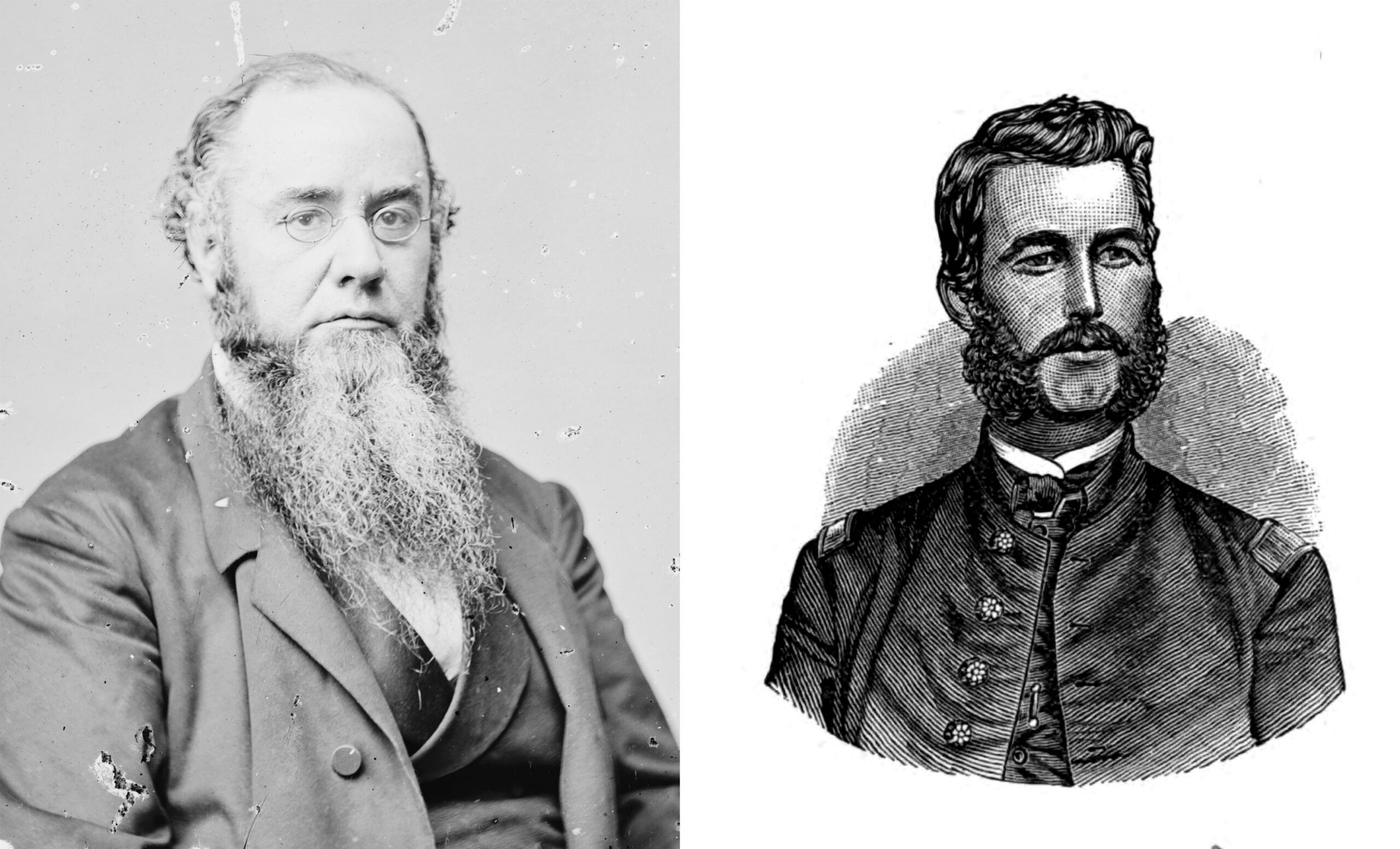 Library of Congress (Stanton); The College Cavaliers (1883)
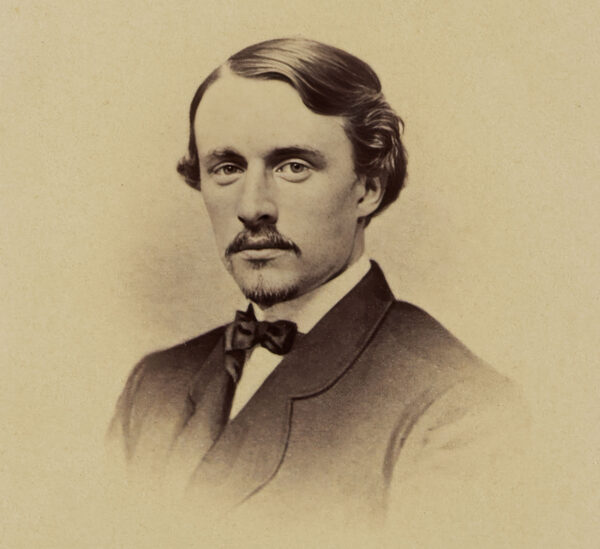
Secretary of War Edwin Stanton (left), In the wake of the secretary of war’s frantic call in 1862 for new recruits, Dartmouth College student Sanford S. Burr (right, in his army uniform) began raising a company of cavalry among his fellow students. “It will be a great thing for us—cavalry tactics and camp life at Washington,” mused one of them.
The president also reacted with alarm, ordering the very changes in military operations that Jackson had hoped to induce, but when Lincoln heard about the three-month call, he told Stanton to rescind it. Hours passed before the revocation messages were delivered to the state capitals, and four states had already begun raising anywhere from two to 10 regiments of 90-day militia apiece. Treasury Secretary Salmon P. Chase reminded Stanton that a new federal statute prohibited three-month levies, but instead of correcting his mistake, Stanton allowed at least 21 militia regiments to finish recruiting. Evidently he obtained executive permission to do so, letting him veil his latest gaffe from the public and avoid aggravating the governors with his erratic instructions.4
Stanton asked Rhode Island’s Governor William Sprague if he didn’t have some mounted cavalry he could forward at once. Sprague immediately set out to raise some troopers for the same three-month term as the two infantry regiments Stanton had allowed him to send. A manufacturer started raising one company in Providence, and Sprague sent a member of his staff to Hanover, New Hampshire, to interview a Dartmouth College student who was interested in recruiting another company.5
Sanford S. Burr was just finishing his junior year at Dartmouth when the plea for three-month troops caught his interest. The timing of the appeal and the nominal term of service meshed nicely with the academic calendar, and professors supposed that a summer’s absence would not interfere with coursework. Burr emphasized that point in his pitch for classmates to join a company under his command. All the other 90-day troops consisted of infantry, but Burr hoped for more glamorous duty in the cavalry. Save for Sprague, no New England governor showed any interest in short-term mounted troops. Most of the men would hardly have learned to ride before their time was up, which also should have dissuaded the federal government from accepting them, but Sprague seemed to have Stanton’s ear.6
Burr secured commitments from 32 other Dartmouth underclassmen, along with one graduating senior and an 1856 alumnus. That left him well short of the minimum number for a company, but Norwich University lay barely a mile away in Vermont, on the other side of the Connecticut River. It was a private military academy, and most of the junior and senior classes had gone into the army by the spring of 1862, but Burr found 23 students who were willing to throw in with him. Most of that year’s juniors and a dozen underclassmen signed up, including 16-year-old Henry Phillips. Cadet Henry Alvord, the son of a well-to-do Massachusetts lawyer, wheedled his father’s permission to enlist with the assurance that they would see “no real service.”
“Three months will no more than drill us well,” Alvord predicted. “It will be a great thing for us—cavalry tactics and camp life at Washington. I can stand it three months sure.”7
Four students from Bowdoin College, in Maine, joined the company, and one each from Amherst and Williams colleges, in Massachusetts, but Burr finally had to recruit 17 clerks, tradesmen, farmers, and laborers, mostly from Woodstock, Vermont. From those 17 came the company’s wagoner, farrier, and musicians.8
The Dartmouth–Norwich contingent gathered in Hanover on the evening of June 18, surrounded by fellow students who came to cheer their departure. The first stop on their road to war was the rail depot at White River Junction, Vermont, a walk of less than five miles from the Dartmouth Green. But these prospective cavaliers could hardly travel by shanks’ mare: They hired carriages for a more stylish leave-taking, boarding the night express to Boston at two o’clock in the morning.9
Seventy-five bleary-eyed young men in wrinkled Sunday suits arrived in Providence at noon on June 19. After a hasty repast of cheese and crackers, they raised their hands for the oath of enlistment and shuffled off to a warehouse full of quartermaster stores, exchanging their civilian apparel for regulation Union blue. State officials then led them nearly two miles to a few acres of open land called Dexter’s Training Field, where they counted off into messes and raised Sibley tents alongside those of the Providence recruits. Because the 12 companies of the 1st Rhode Island Cavalry had composed the first six squadrons, the two new ones entered the adjutant general’s records as the Seventh Squadron. On the toss of a coin the Providence detachment became Company A, under the man who had enlisted them, leaving Company B to the college boys, who elected Sanford Burr their captain. In looking back, the collegians frowned on Company A as mainly city roughs and “foreigners,” but the names on the roster hint at nothing more foreign than a dozen or two Irishmen.10
Within a few days the half-dozen recruits from Bowdoin, Amherst, and Williams entered camp. Brown University students visited the training field and invited some of the novice troopers to fraternity events. (None of the Brown scholars seemed inclined to partake of even summer soldiering.) On the evening of June 24, Company B marched downtown to a banquet provided in its honor by Governor Sprague and his staff. One of the evening’s speakers lavishly praised the recruits for their patriotism.11
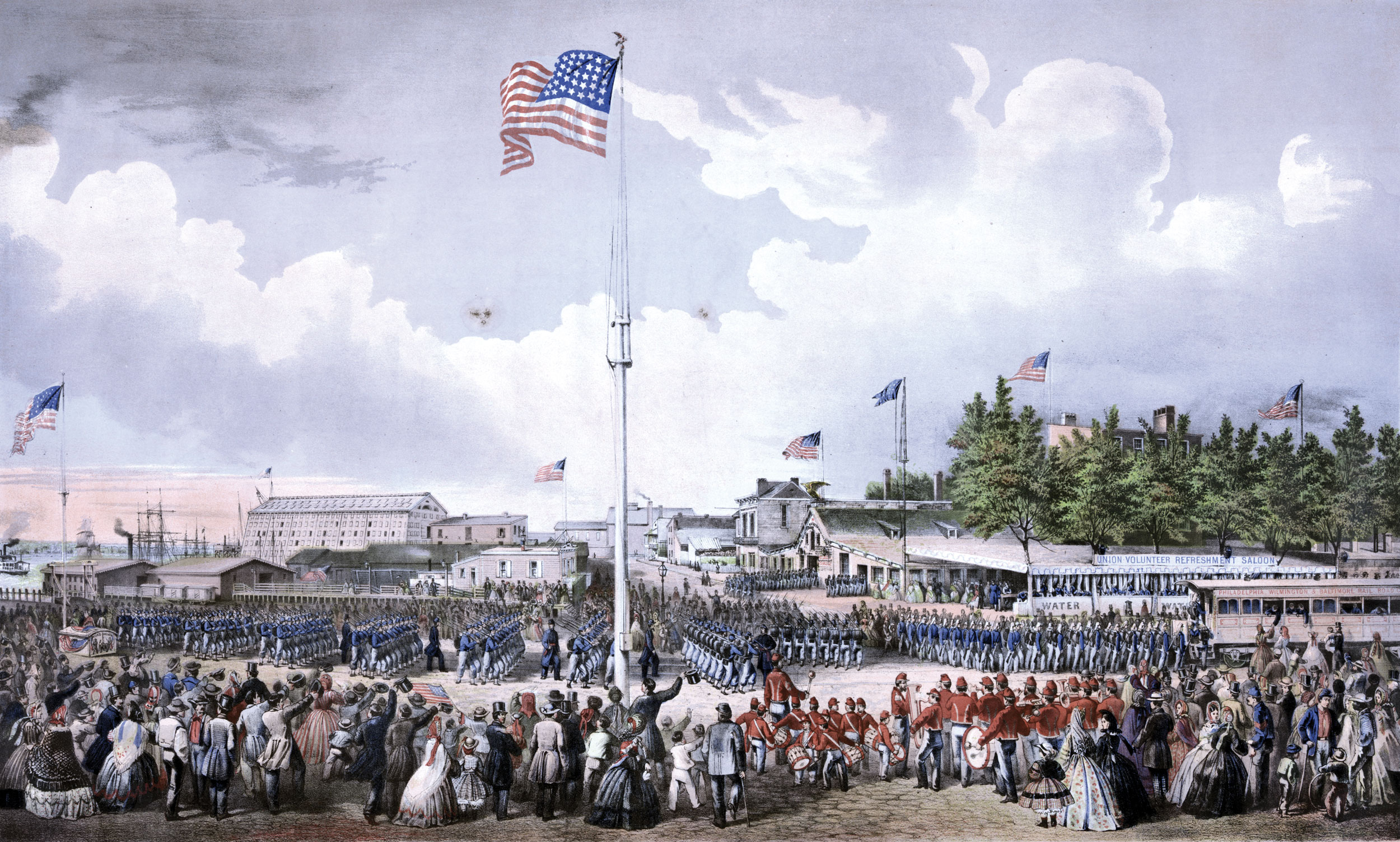 Library of Congress
The Dartmouth Cavalry departed for the front in late June to great fanfare; in Philadelphia, its members dined at the Union Volunteer Refreshment Saloon (depicted above in a wartime lithograph) before continuing on to Washington.
Henry Alvord, who had been installed as first sergeant of his company, challenged that judgment. “I suspect there is but little patriotism in the movement,” he conceded in a letter home. “Most go for novelty, for the sake of going.” Again he admitted to his family that they anticipated “no active service in the field,” and did not expect to ever be under fire. He urged his family not to think of him as having gone to war, “but as on a pleasant journey on horseback, a vacation of three months spent at Washington,” and each man in the squadron pocketed Rhode Island’s $15 bounty for spending money.12
Under the supervision of one of Governor Sprague’s staff, the squadron boarded the passenger steamer Plymouth Rock late on the night of June 28, arriving in New York at daylight. Their horses were waiting there, and a transport shuttled man and beast over to Perth Amboy, New Jersey, where they transferred to railroad cars.13
Philadelphia’s Union Volunteer Refreshment Saloon provided the squadron with a sumptuous dinner. It was noon on June 30 when they arrived at the depot at Washington, after a fitful night attempting to sleep at the Baltimore rail yard. Sprague’s staff officer led them a mile and a half north of Capitol Hill to a campground in an oak grove known as Gates’ Woods, where he turned them over to Major Augustus W. Corliss, a young man as innocent of soldiering as his officers. In all of Company B, just one private and the saddler had ever served in uniform before, and only as 90-day soldiers the year before. The Dartmouth Cavalry, as the college troop was already being called, was probably the greenest company to arrive in Washington that summer. Charles Tillinghast, a Norwich cadet one month past his 17th birthday, assumed the role of adjutant for the squadron with the rank of second lieutenant.14
A Regular Army officer mustered the men in retroactively from June 24, and each one took responsibility for a horse. The recruits had left Providence armed with sabers and breech-loading Burnside carbines, but the carbines were replaced with Colt revolvers, to disencumber the men for equestrian instruction. Most of the students and village-raised tradesmen had never mounted a horse, so they spent the next fortnight learning how to stay in the saddle, taking jaunts into the countryside long enough to make them saddle-sore.15
The “vacation” Sergeant Alvord had apprehended in Washington came to an end on July 19. Pulling down their tents before dawn and packing up their knapsacks for shipment back to Providence, the troopers fell in at the sound of “Boots and Saddles” just after sunrise. A few shy of its original complement of 184 men, the squadron marched over the Long Bridge into Virginia, organizing a new camp near Alexandria. The countryside there had been desolated by a year of occupation, but it was within the secure perimeter of the capital, with no sizable body of Confederates for 80 miles.16
Four recruits from Union College, in Schenectady, New York, joined the company at Alexandria. Rigorous training continued, and one of the Norwich boys assured newspaper readers at home that the cadets were learning a great deal about cavalry tactics. He saw their summer excursion as a chance to round out their military training, and supposed that after they completed their course of study they would return to the army for more serious service. Then came a call for mounted troops at the outpost of Winchester, and bureaucrats who saw no difference between one body of cavalry and another added a more arduous practicum to the curriculum than the students had counted on. After little more than a week near Alexandria, the squadron had to pull up stakes again.17
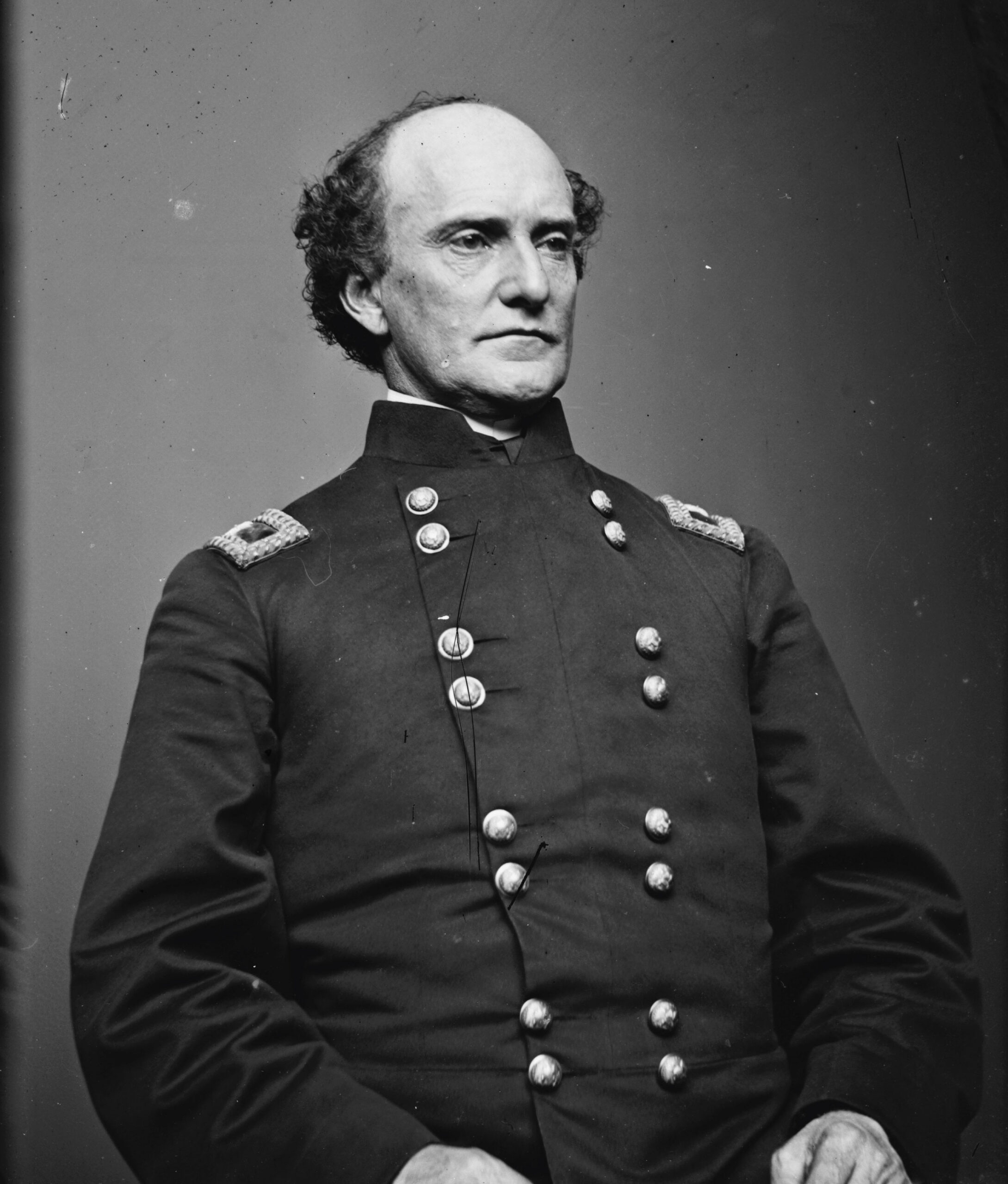 Library of Congress
Brigadier General Julius White
Leaving behind their tents, baggage wagons, and some sick men, the troopers rode back into Washington on July 27. That afternoon they and their horses boarded freight cars for an arduous, roundabout journey up into Maryland and westward, crossing the Potomac at Harpers Ferry after a long delay across the river at Sandy Hook. On July 29 they arrived at Camp Sigel, overlooking Winchester from a hilltop farm belonging to James M. Mason—a former U.S. senator then serving as the Confederacy’s commissioner to Great Britain and France. Major Corliss reported their arrival to Julius White, a brand-new brigadier general who had just assumed command of the post, with its four regiments of infantry and a light battery.18
During their two days in the freight cars, the squadron horses had had little food and less water, and were suffering when they arrived in camp—where no one had ordered forage or grain for them. The only feed available over the next few days was corn. Run-down as they were, the healthiest of those mounts were nonetheless saddled and put into service.19
The better part of both companies embarked on a reconnaissance on July 30 to Front Royal, 20 miles away. Near that town they encountered a detachment of the 12th Illinois Cavalry, from John Pope’s Army of Virginia, with renowned Rebel mail-runner Belle Boyd in tow, freshly captured. (Corliss took her for delivery to General White.) Before dawn the next morning, part of the squadron saddled up again to investigate picket firing, staying out a good part of the day, and late that night the call to saddle sounded once more and kept everyone up all night. Routine picket duty around Camp Sigel required Corliss to detail 58 men each day, and the horses grew so feeble that he found it difficult to mount the whole detail.20
In the first half of August the squadron undertook at least a half-dozen scouting expeditions in addition to daily picket duty. The scouting also involved surveillance of the civilian population, including the searching of private homes, probably on information supplied by Unionist neighbors of southern sympathizers. Corliss and the off-duty portion of the squadron brought in some horses and a herd of cattle on August 6, along with two prisoners who were probably civilian suspects.21
Small bodies of Confederate cavalry roamed the periphery of Winchester, harassing pickets and slashing at communications, but they appeared infrequently enough that the inexperienced cavaliers grew careless. Inspired by Pope’s reckless announcement that his army would subsist on the countryside, two of the Dartmouth boys rode out beyond the pickets one morning on what their comrades called “a private foraging mission.” A squad of Rebel horsemen caught them at it, and escorted them up the Strasburg Pike on the first leg of their journey to Richmond. Belated pursuit by a few dozen of their comrades ended when the trail led to the vicinity of Newtown, where enemy cavalry was reportedly lurking in strength. “We fear they will not be on hand to resume their studies with the rest of their class,” lamented the Norwich University newspaper correspondent.22
The Rebel raiders were growing bolder, and on August 23 they stopped the daily train from Harpers Ferry eight miles from Winchester. Forcing the passengers out, they seized the mail and carried off the express agent and some soldiers as prisoners. They had already cut the telegraph wire, so three hours elapsed before two men who escaped from the train brought the news to Winchester. Major Corliss again took after the raiders, but they, too, had disappeared toward Newtown.23
Matters soon began to look ominous. General White kept the squadron out for two successive nights, scouting roads to the south from which he evidently expected an attack. In the afternoon of August 24 the dull thunder of distant artillery echoed for hours, seemingly from the direction of Warrenton, where Pope was sparring with Robert E. Lee’s army on the upper Rappahannock. Pope warned White that part of Lee’s army might be headed toward Front Royal, and loyal citizens told White that secessionist neighbors predicted the Rebels would come down the valley on their way into Maryland. On August 26 the sound of more gunfire reached Winchester as James Longstreet’s corps covered Jackson’s flank march around Pope’s army.24
Over the next week, the two wings of Lee’s army hopelessly confused Pope, drawing him into a trap that Pope helped to seal by refusing to credit his own intelligence. Circling behind Pope and destroying his supply depot at Manassas Junction, Jackson distracted him for nearly two full days until Longstreet landed a devastating blow that Pope’s subordinates had tried in vain to warn him about. Another of Jackson’s flank marches threatened to cut Pope’s army off from Washington, and by the night of September 1 a battered and hungry Army of Virginia was reeling toward the safety of the capital.
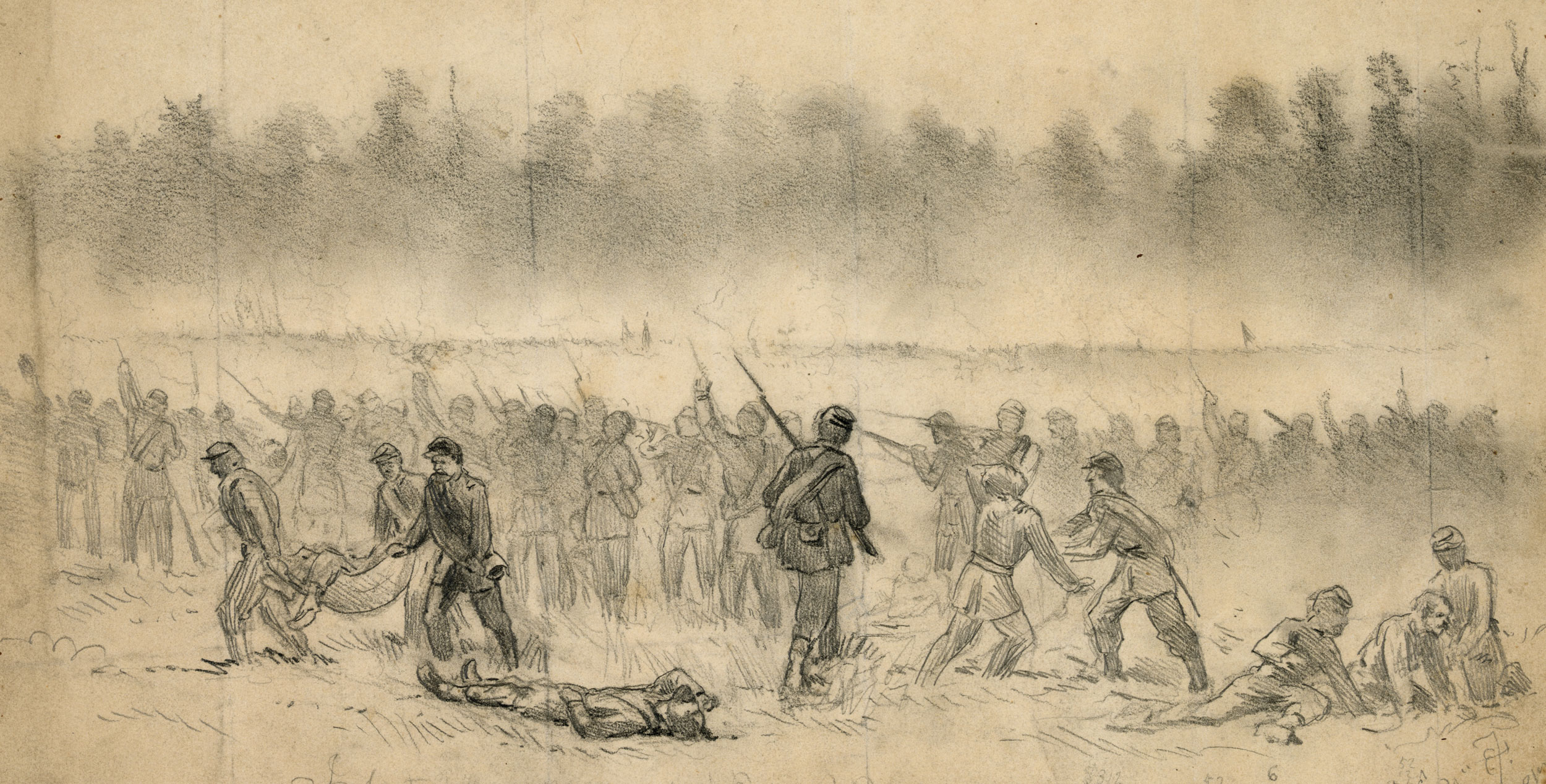 Library of Congress
In the wake of the decisive defeat of Union forces at the Battle of Second Bull Run (depicted above in a sketch by Edwin Forbes), the members of the Dartmouth Cavalry were among those ordered to retreat to the Union stronghold at Harpers Ferry.
Two companies of the 1st Maryland Cavalry had been sent to Winchester to aid White with reconnaissance, but their horses were nearly as broken down as the Rhode Island squadron’s. White nevertheless kept them all out, continually monitoring the roads to the south and the gaps in the Blue Ridge. He sent Major Corliss and all the men who could be mounted down to Newtown and Middletown on September 2, to determine the truth of a rumor that 20,000 Confederates were headed down the Shenandoah Valley. After the squadron left, orders came from army headquarters in Washington to abandon Winchester and retreat to Harpers Ferry, 30 miles away, where Colonel Dixon Miles commanded the equivalent of two brigades.25
The weary troopers filed back into Winchester at 11 p.m., escorting four Rebel stragglers they had picked up during the day. Bonfires illuminated all the camps, including theirs, and all their personal belongings had been destroyed. The infantry was marching down the hill from Camp Sigel, where work details had been building a fort for several weeks, and the college boys learned that the town was being evacuated. A train pulled out at midnight with White, his staff, and all the ammunition and commissary stores it could carry. Thirty-five tons of forage and 60,000 rations went up in flames in the government warehouses, and then the railroad depot was put to the torch. With no time to rest, Corliss and the college boys fell in as rear guard of the brigade. They were just passing the fort when the magazine exploded—shaking the ground beneath them, lighting up the night sky, and tumbling some of them out of the saddle when their horses shied at the roar.26
After spending the afternoon and evening on horseback, they rode all night and into the next day. Not until 9 p.m. on September 3 did they dismount on Bolivar Heights, outside Harpers Ferry. Presumably after unsaddling and feeding their horses, they wrapped themselves in their overcoats and fell asleep on the ground.27
Harpers Ferry sat in a bowl, on the point of land formed by the confluence of the Potomac and Shenandoah rivers. North of the Potomac and a little east, the southern tip of South Mountain looked down on the town from Maryland Heights, at an elevation of 1,500 feet. South of the Potomac and east of the Shenandoah, the same ridge continued as Loudoun Heights at about 1,200 feet. Beyond town to the west stood Bolivar Heights, a ridge just over 600 feet high. With control of all three of those ridges a garrison could hold out against far more powerful forces for as long as food and ammunition remained. The loss of any one of those positions would compromise the defensive potential, and particularly Maryland Heights, which commanded everything. Miles had troops, heavy artillery, and a fort there, and he distributed most of his infantry and light artillery near Bolivar Heights. He ignored Loudoun Heights, which seemed inaccessible.
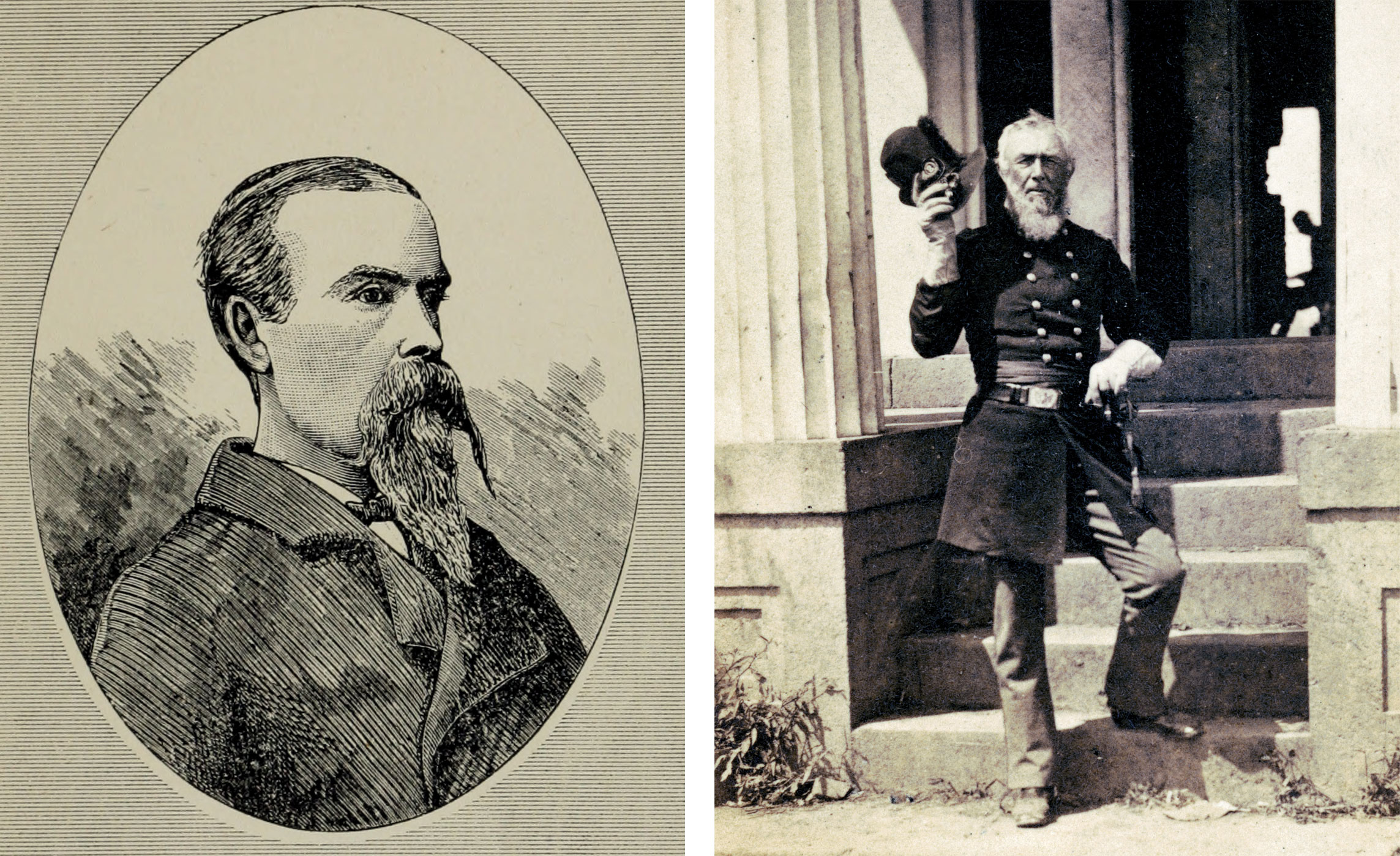 History of the Seventh Squadron, Rhode Island Cavalry (Corliss); Library of Congress
Major Augustus W. Corliss (left) and Colonel Dixon Miles (right). Miles commanded Union forces at Harpers Ferry at the time of the Dartmouth Cavalry’s arrival there.
Two days after reaching Harpers Ferry, General White left his infantry and departed for Martinsburg, to take command of the garrison there. Major Corliss led his squadron over the pontoon bridge across the Potomac, climbing a steep, circuitous route to the crest of Maryland Heights. The Maryland cavalry joined him, and together they picketed the different avenues of approach for Colonel Thomas Ford, who held the works at the top with his own 32nd Ohio Infantry, a few companies of Maryland troops, and a battery.28
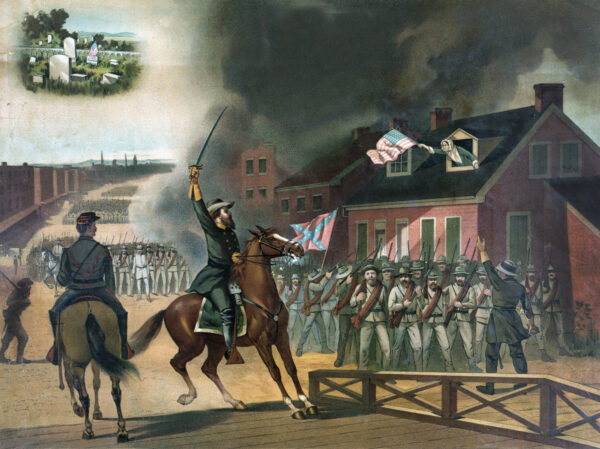
By then the Rebel army had crossed into Maryland. During a stop at Frederick, Lee planned a bold stroke to capture Harpers Ferry. With George B. McClellan following him at the head of a much larger army, Lee detached three divisions from Longstreet’s corps, sending two toward Maryland Heights and another back across the Potomac to plant artillery on Loudoun Heights. A third column, consisting of Jackson’s entire corps, marched upriver and crossed above Harpers Ferry, sweeping back beyond Martinsburg to attack Bolivar Heights from the west. When White deduced Jackson’s intentions, he started his men back on the road to Harpers Ferry. They arrived on the afternoon of September 12.29
White, who had been in the army barely a year, waived his rank and left the command to Miles, a career officer who knew the terrain and most of the command, and had arranged all the gun emplacements. Jackson had followed close behind the Martinsburg refugees, and he deployed his divisions before Bolivar Heights, closing off escape to the west.30
The Rhode Island squadron was absent when White’s reinforcements reached Harpers Ferry. Corliss had led his men on a reconnaissance toward Sharpsburg that morning, over Elk Mountain, but on the way back they spotted Confederates at the crest of the mountain, making their way south to flank Colonel Ford’s position. Turning down the western side of the ridge to the Chesapeake and Ohio Canal, Corliss followed the canal towpath back to the road up Maryland Heights, where his men resumed their post. The Rebels they had seen, commanded by Lafayette McLaws, were already in front of Ford’s picket line, and McLaws opened his attack early on the morning of September 13.31
Ford no longer needed his cavalry for picket duty once the attack had begun, so he sent it all back across the river to Bolivar Heights. He asked for reinforcements, and Miles sent him the 39th and 126th New York—the latter comprising more than a thousand men, but they had been in service only three weeks. With those extra rifles Ford held his ground most of the morning, but toward noon panic struck the 126th New York, which started spilling down the side of the mountain. So dense was the flood of blue uniforms that it was visible from the Bolivar line, and Miles rushed up to stop it. Ford said his troops would not fight, but Miles insisted he had enough men to stand firm and insisted he do so. Ford, relying on contingency instructions he said Miles gave him, abandoned the heights that afternoon.32
Confederate possession of Maryland Heights would obviously leave Harpers Ferry untenable. Ford had spiked the big guns he left behind, and without them the Yankees stood little chance of suppressing enemy fire from Loudoun Heights. On the morning of September 14 Confederates started planting batteries there, and McLaws managed to wrestle a couple of fieldpieces through the woods to Maryland Heights. That afternoon they all opened fire, and Miles replied with his one battery of long-range guns, but before the day ended his ammunition for those guns was running low. Shells began exploding within range of the college students, some of whom must have reflected that they were due to go home in about a week.33
Colonel Benjamin F. Davis, West Point Class of 1854 and a southerner born and bred, commanded the 8th New York Cavalry. He approached Colonel Miles and pointed out that the cavalry would be of no use in such close quarters. With his regiment, much of the 12th Illinois, several Maryland companies, and the Seventh Rhode Island Squadron, there were at least 1,500 mounted troops in the garrison, and Davis asked if he might not try to find a way out for them. Miles, who was already considering surrender, told him to go ahead, but to avoid alerting the infantry, lest he cause a stampede.34
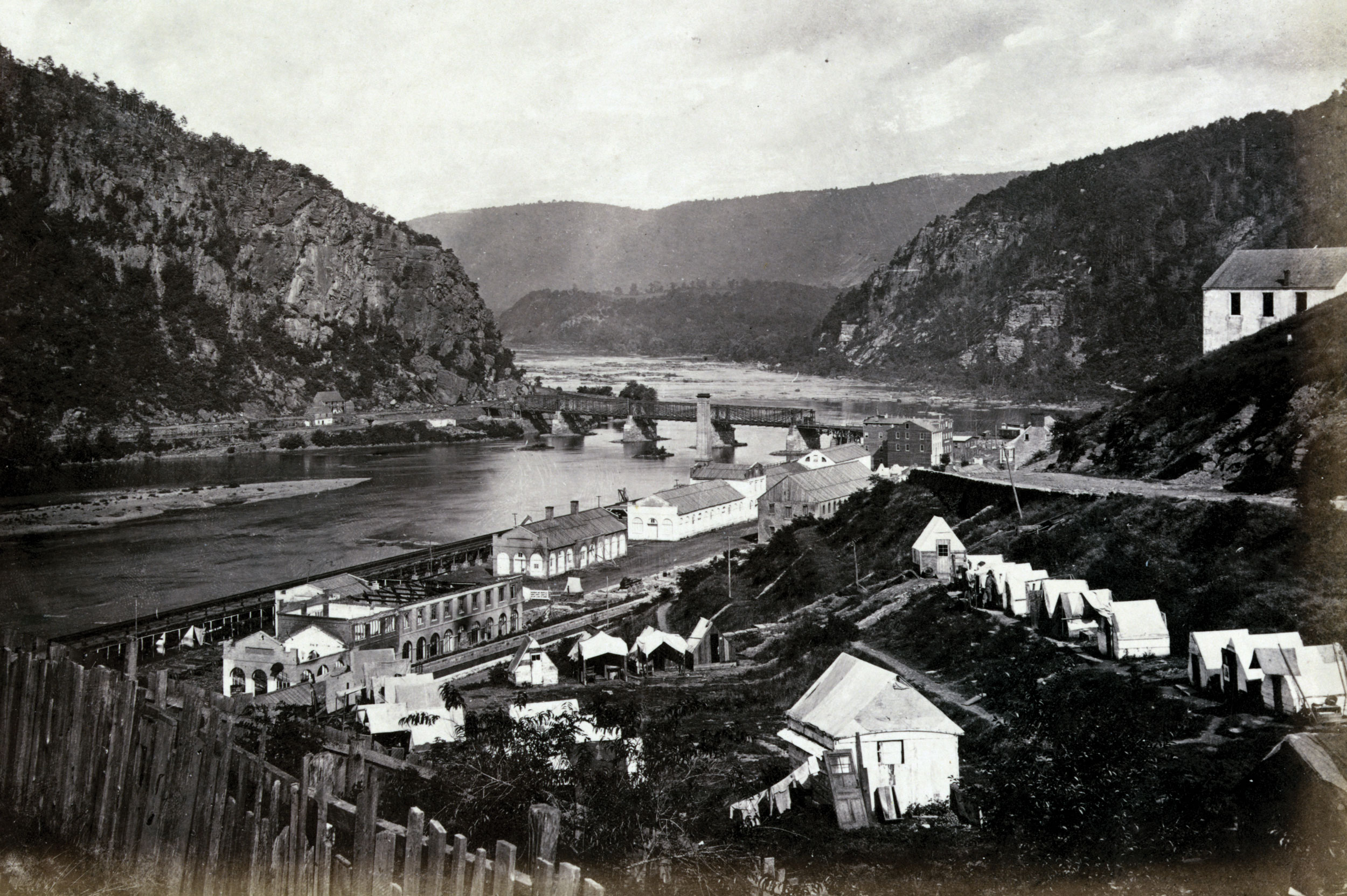 Library of Congress
 Harpers Ferry, at the confluence of the Potomac and Shenandoah rivers, as it appeared in July 1865
The senior officer with the cavalry was Colonel Arno Voss of the 12th Illinois, but the escape was Davis’ idea. Voss commanded, but Davis was widely regarded as the leader of the expedition. Thomas Noakes, a Martinsburg carpenter who had been scouting for White, guided them from the start, aided by Lieutenant Hanson Green of the 1st Potomac Home Brigade Cavalry, who hailed from Frederick.35
Stripped of all inessential belongings, the Rhode Island squadron thudded across the pontoon bridge once more and started up the road to Sharpsburg at the rear of the column. As they had at Winchester, the collegians left several sick men behind in the hospital, but with visions of home so near, every man who could mount a horse joined the exodus.36
Davis’ eventual regimental historian, who rode far to the rear that night, remembered the advance rushing Rebel pickets to clear the Sharpsburg road, but an Illinois sergeant with the leading regiment saw nothing like that. Nor did Voss report any encounter with pickets, and J.E.B. Stuart complained that the Yankee cavalry escaped precisely because McLaws failed to picket the road. The fugitives evidently did encounter a Confederate patrol near Sharpsburg, after which they started up the Hagerstown Pike until a loyal citizen warned them they were headed into territory occupied by Longstreet’s command.37
To avoid that confrontation, the cavalry veered closer to the river, following Noakes over narrow byroads. They had been riding six or seven hours through a pitch-dark night when, a mile or two from Williamsport, they encountered a wagon train laden primarily with ammunition for Longstreet’s corps. As many as a hundred wagons rolled along in the direction of Sharpsburg, but in the grey predawn light the teamsters and their guards apparently mistook the horsemen for an addition to their escort. Before any of the Confederates could resist, Yankee revolvers covered them. Some drivers ran away, or cut their teams loose, and those wagons were burned, along with much of the ammunition. The rest of the train turned north on the turnpike to Hagerstown.38
The column crossed the Pennsylvania line and entered Greencastle by 9 a.m. The telegrapher there announced that Colonel Davis brought in about 40 wagons and as many prisoners, but Colonel Voss wired Baltimore that they had 60 wagons and 675 prisoners.39
The cavalrymen remained in Greencastle the next two days, resting their mounts and catching up on their feed, while the two armies grappled with great slaughter on the very ground they had covered during their retreat. The Dartmouth Cavalry saddled up for the last time on September 23, riding the dozen miles to Chambersburg, where a quartermaster collected the horses and equipment. Boarding cars there, the dismounted cavaliers reached Providence on September 26, already noting that they were two days past their time commitment. Five more days passed before they were paid off and mustered out, and the students fretted the whole time because the academic term had begun. Not until October 1 could they go home.40
Two of them never did go home. Arthur Coombs, a Norwich cadet, had died August 15 of typhoid fever at the brigade hospital in Winchester. Henry Randolph, one of the Union College recruits, had been left behind sick in Harpers Ferry, but did not come back with the other students paroled from the hospitals there and in Winchester. No one ever heard from him again.41
In reporting the discharge of the student squadron, a Vermont newspaper predicted that “some of the students will again take the field for the fall and winter campaign.” Seven did enlist before the end of the year, one of whom joined another short-term regiment that never left its training camp.42
Of the other 76 members of the Dartmouth Cavalry who survived the summer of 1862, 16 volunteered for further military service of some kind during the war, and one was drafted. These included five Dartmouth students who entered the army or navy as surgeons and hospital stewards, or as a medical cadet; another signed articles with the navy, but never reported for duty. One of the Norwich cadets accepted a commission in a special company raised specifically as President Lincoln’s bodyguard. One each from Dartmouth and Williams waited until the final weeks of the conflict to reenlist, although neither returned to college.
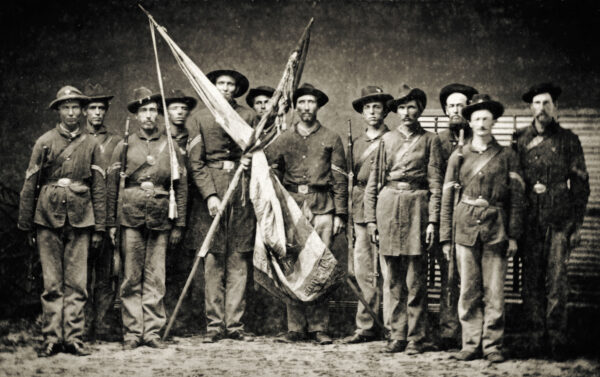
The veterans of the Dartmouth Cavalry came home in better health than the general population, and the oldest of them was only 28 in 1862. None of them had fired a weapon at an enemy, or suffered the slightest wound. Still, more than 70 percent of them never sought further participation in a war they all evidently supported. They had signed on for a lark, and the rigors they encountered in a few weeks of actual field service may have discouraged them from seeking more. They reflected the more prosperous class that could afford the alternatives to conscription, if it came to that, and they seemed immune to the stigma of staying home. “The military is not the highest grade of public service,” concluded the company’s representative from Amherst College, Samuel B. Pettengill, who believed his comrades had “performed yet greater things unarmed.”43
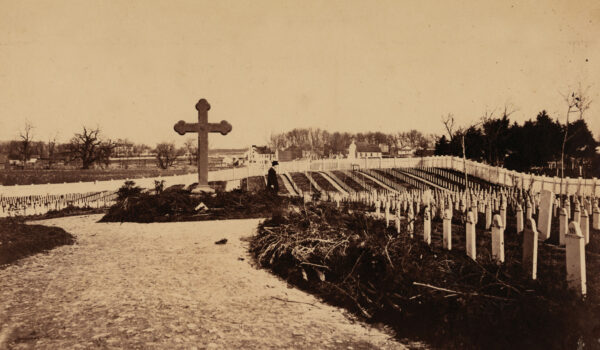
Despite such disdain for military service, and their relative prosperity, most of the student troopers took pensions for their three months of soldiering—including Pettengill. Dartmouth’s Isaac Walker headed a prestigious private academy from his graduation in 1863 until near the end of his life, but in his prime he secured a pension for an injury he blamed on his summer’s service. His classmate, Dr. Zeeb Gilman, fared well enough to buy a private crypt in the Great Mausoleum at Forest Lawn, near the graves of Jean Harlow and Carole Lombard, but he collected a pension until his death on June 5, 1946, at the age of 105.
By the turn of the century, the reverence accorded to Civil War veterans led some of the most professionally successful survivors of the Dartmouth Cavalry to reevaluate their achievements. In youth they may have shared the subtle condescension toward soldiering that Pettengill betrayed, but as they grew old they focused on the memory of their own brief, expensive, and painfully inconspicuous service. Despite their accomplishments in medicine, education, or the law, the only experience many of them chose to commemorate on their tombstones was the 15 weeks they spent in the saddle.
William Marvel is the author of 19 books in the field of Civil War history. Lincoln’s Mercenaries: Economic Motivation Among Union Soldiers During the Civil War appeared in 2018, and Radical Sacrifice: The Rise and Ruin of Fitz John Porter, is scheduled for release by UNC Press in the spring of 2021.
Notes
1. United States War Department, The War of the Rebellion: A Compilation of the Official Records 129 vols. (Washington, 1880–1901), Series 3, 2:2–3, 44–47, 61–65 (hereafter cited as OR).
2. Ibid., 72, 76, 78, and Series 2, 12(3):241, 308–313,
3. Virginia Jean Laas, Wartime Washington: The Civil War Letters of Elizabeth Blair Lee (Urbana, IL, 1991), 152; Henry L. Dawes to Ella Dawes, May 29, 1862, Dawes Papers, Library of Congress.
4. OR, Series 3, 2:84–85, 87, 90, 95, 98–99; John Niven, ed., The Salmon P. Chase Papers 5 vols. (Kent, OH, 1993–1998), 3:205–206; Stanton to Horace Binney, June 2, 1862, Stanton Papers, Library of Congress. Rhode Island raised two regiments under the call, New York 10, Ohio four, and Illinois five. Some of them were not fully organized until July.
5. OR, Series 3, 2:95; Caroline B. Sherman, “A New England Boy in the Civil War,” The New England Quarterly, Vol. 5, no. 2 (April 1932): 313.
6. Samuel B. Pettengill, The College Cavaliers: A Sketch of the Service of a Company of College Students in the Union Army in 1862 (Chicago, 1883), 8; Sherman, “A New England Boy,” 313; The Caledonian (St. Johnsbury, VT), June 20, 1862.
7. Pettengill, The College Cavaliers, 8; The Bellows Falls (VT) Times, September 21, 1861; Augustus D. Ayling, Revised Register of the Soldiers and Sailors of New Hampshire in the War of the Rebellion (Concord, NH, 1895), 1093–1095; Sherman, “A New England Boy,” 313.
8. Ayling, Revised Register, 1093–1095.
9. Pettengill, The College Cavaliers, 11, 13; Sherman, “A New England Boy,” 314.
10. Pettengill, The College Cavaliers, 13–14; [Augustus W. Corliss], History of the Seventh Squadron Rhode Island Cavalry (Yarmouth, ME, 1879), 4–6; The Vermont Phoenix (Brattleboro), July 3, 1862.
11. Pettengill, The College Cavaliers, 13–15, 17–22.
12. Sherman, “A New England Boy,” 314–315; Providence (RI) Journal, July 10, 1862.
13. Providence Journal, July 10, 1862.
14. Ibid.; Corliss, History of the Seventh Squadron, 8–9.
15. Corliss, History of the Seventh Squadron, 9; Providence Journal, July 10 and 29, 1862.
16. Corliss, History of the Seventh Squadron, 9; Providence Journal, July 29, 1862.
17. Providence Journal, July 10, 29, 1862; OR, Series 1, 12(3):469.
18. Sherman, “A New England Boy,” 315–316; Corliss, History of the Seventh Squadron, 9.
19. OR, Series 1, 12(2):792.
20. OR, Series 1, 12(2):792–793, and Series 2, 4:309; Sherman, “A New England Boy,” 316; Corliss, History of the Seventh Squadron, 9.
21. Sherman, “A New England Boy,” 316; Corliss, History of the Seventh Squadron, 9.
22. OR, Series 1, 51(1):772–773; Corliss, History of the Seventh Squadron, 9–10; Providence Journal, September 1, 1862.
23. Providence Journal, September 1, 1862; OR, Series 1, 12(3):650, 652.
24. OR, Series 1, 12(3):652, 665–666.
25. Ibid., 683, 738, 769, 800, 801; Corliss, History of the Seventh Squadron, 10.
26. Providence Journal, September 22, 1862; OR, Series 1, 12(2):765–766, 792–794, and 12(3):801.
27. Providence Journal, September 22, 1862; Corliss, History of the Seventh Squadron, 10.
28. Corliss, History of the Seventh Squadron, 10; Providence Journal, September 22, 1862; OR, Series 1, 19(1):541–542.
29. OR, Series 1, 19(1):524–525, 19(2):249, and 51(1):819–820.
30. OR, Series 1,19(1):525–526.
31. Corliss, History of the Seventh Squadron, 10; OR, Series 1, 19(1):536, 853.
32. Corliss, History of the Seventh Squadron, 10; OR, Series 1, 19(1):526, 536–537, 543–544.
33. Henry E. Pratt, ed., “Civil War Letters of Winthrop G. Allen,” Journal of the Illinois State Historical Society, Vol. 24, no. 3 (October 1931): 563-64; OR, Series 1, 19(1):527, 538; Corliss, History of the Seventh Squadron, 10; Pettengill, The College Cavaliers, 73.
34. OR, Series 1, 19(1):583.
35. Ibid., 538; William M. Luff, “March of the Cavalry from Harper’s Ferry, September 14, 1862,” Military Essays and Recollections (Chicago, 1894), 2:40–241; Pratt, “Civil War Letters,” 564; Henry Norton, Deeds of Daring, or History of the Eighth N.Y. Volunteer Cavalry (Norwich, NY), 1889, 27–28.
36. Providence Journal, September 22 and 27, 1862; Norton, Deeds of Daring, 30.
37. Norton, Deeds of Daring, 29–30; Pratt, “Civil War Letters,” 564–565; OR, Series 1, 19(1):758–759, 818; Luff, “March of the Cavalry from Harper’s Ferry,” 41–42.
38. Luff, “March of the Cavalry from Harper’s Ferry,” 42–45; Pratt, “Civil War Letters,” 564–565; Corliss, History of the Seventh Squadron, 10. Contemporary accounts differ widely on the number of wagons and Confederates captured, while recollections offer contradictory versions of how the capture was made. Pettengill, The College Cavaliers, 84–85, used a postwar account from Colonel Voss, who seemed prone to exaggeration.
39. OR, Series 1, 19(1):758–759, 19(2):305; Pratt, “Civil War Letters,” 565.
40. Corliss, History of the Seventh Squadron, 11; Pettengill, The College Cavaliers, 90–92.
41. Ayling, Revised Register, 1093, 1094.
42. Rutland (VT) Weekly Herald, October 2, 1862; Ayling, Revised Register, 1093–1095.
43. Pettengill, The College Cavaliers, 92–93.