 Library of Congress
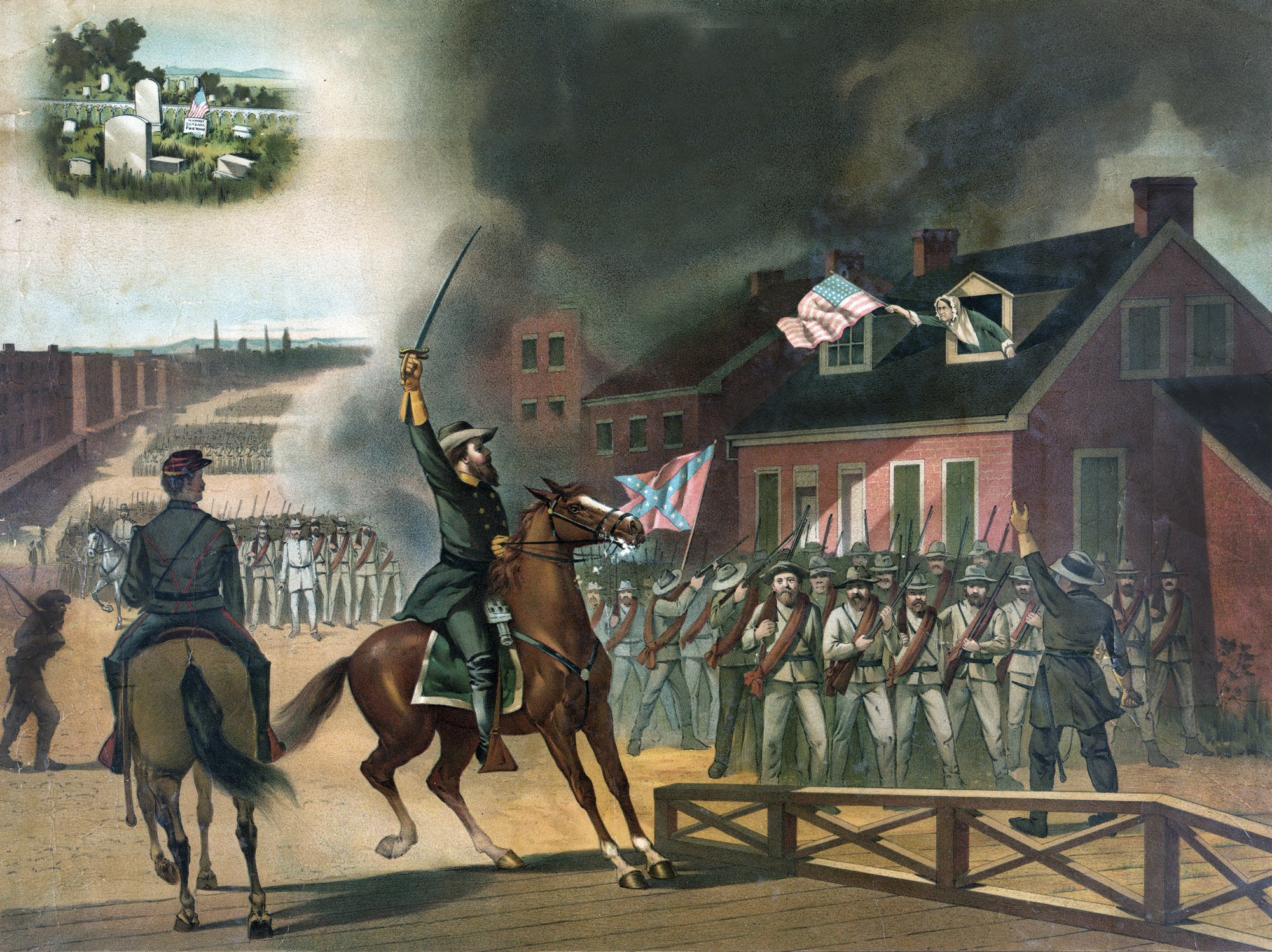
In this postwar depiction by W.W. Welch, a defiant Barbara Frietchie waves a U.S. flag from an upper-story window of her house in Frederick, Maryland, as Confederate troops march past during the Maryland Campaign of 1862.
On July 21, 1863, the popular and prolific novelist Emma Dorothy Eliza Nevitte Southworth (she signed her given name Emma D.E.N. or the acronym Eden), writing from Georgetown outside Washington, sent a note to the New England poet John Greenleaf Whittier. She asked Whittier to confirm his address, “as I have a message to deliver you.”
Eden Southworth was well known to Whittier. In 1849 the abolitionist paper National Era, where Whittier was corresponding editor, had published in serial form her first novel, Retribution; or The Vale of Shadows: A Tale of Passion, and abolishing slavery would become their shared interest. Southworth’s own story was a rags-to-riches one. Abandoned by a ne’er-do-well husband—“a widow by fate but not by fact, with my two babes,” as she put it—she turned her hand to romantic fiction and became a bestselling author overnight. Her novels, a critic observed, “fashioned no psychological mazes for her readers to wander through. No hereditary influences had to be explained. The heroine was a real heroine, the hero a real hero. The villain was always thwarted before he had accomplished his hellish purposes, and when the right triumphed it triumphed for keeps…. Mrs. Southworth took no liberties with the confidence of her readers.” Her biggest seller was The Hidden Hand (1859), a title that nicely describes her proposed transaction with Whittier.1
The poet confirmed his address, and in August 1863 Southworth sent him what amounted to a four-page plot outline. She prefaced it with a teaser paragraph: “When Lee’s army occupied Frederick, the only Union flag displayed in the city was held from an attic window by Mrs. Barbara Frietchie, a widow lady, aged ninety seven years.” That paragraph, she explained, “went the round of the Washington papers” back in September 1862.
Southworth continued: “Some time afterwards, from friends who were in Frederick at the time, I heard the whole story. It was the story of a woman’s heroism, which when heard seemed as much to belong to you, as a book picked up with your autograph on the fly leaf. So here it is—”
In Southworth’s telling, Barbara Frietchie, born in 1766, had witnessed the American Revolution and the War of 1812, and now in this third war was steeped in ardent spirits of patriotism. General Lee’s invading army crossed the Potomac into Maryland, and on September 6, 1862, “led by the formidable Rebel General ‘Stonewall’ Jackson,” entered Frederick: “every Union flag was lowered and the halliards cut; every store and every dwelling house was closed; the inhabitants had retreated in doors; the streets were deserted…. But Mrs. Barbara Frietchie, taking one of the Union flags, went up to the top of her house, opened a garret window and held it forth.”
Novelist Southworth was on a roll now: “The Rebel Army marched up the street, saw the flag; the order was given—‘Halt! Fire!’ and a volley was discharged at the window from which it was displayed. The flag staff was partly broken so that the flag drooped; the old lady drew it in; broke off the fragment, and taking the stump with the flag still attached to it in her hand, stretched herself as far out the window as she could, held the stars and stripes at arm’s length, waving over the Rebels and cried out in a voice of indignation and sorrow—‘Fire at this old head then boys; it is not more venerable than your flag.’ They fired no more; they passed in silence and with down cast looks; and she secured the flag in its place, where it waved unmolested, during the whole of the Rebel occupation of the city. ‘Stonewall’ would not permit her to be troubled.”
Southworth closed her narrative with the Rebels evacuating Frederick and the Federals marching in, and in celebration “Flags of all sizes and from every conceivable place were displayed. But as for the heroic old lady, she died a few days after; some thought she died of joy at the presence of the Union Army—and some that she died of excitement and fatigue from the ‘lionization’ that she received; for those who could not emulate the old lady’s courage, did honor to her act.”2
 Library of Congress
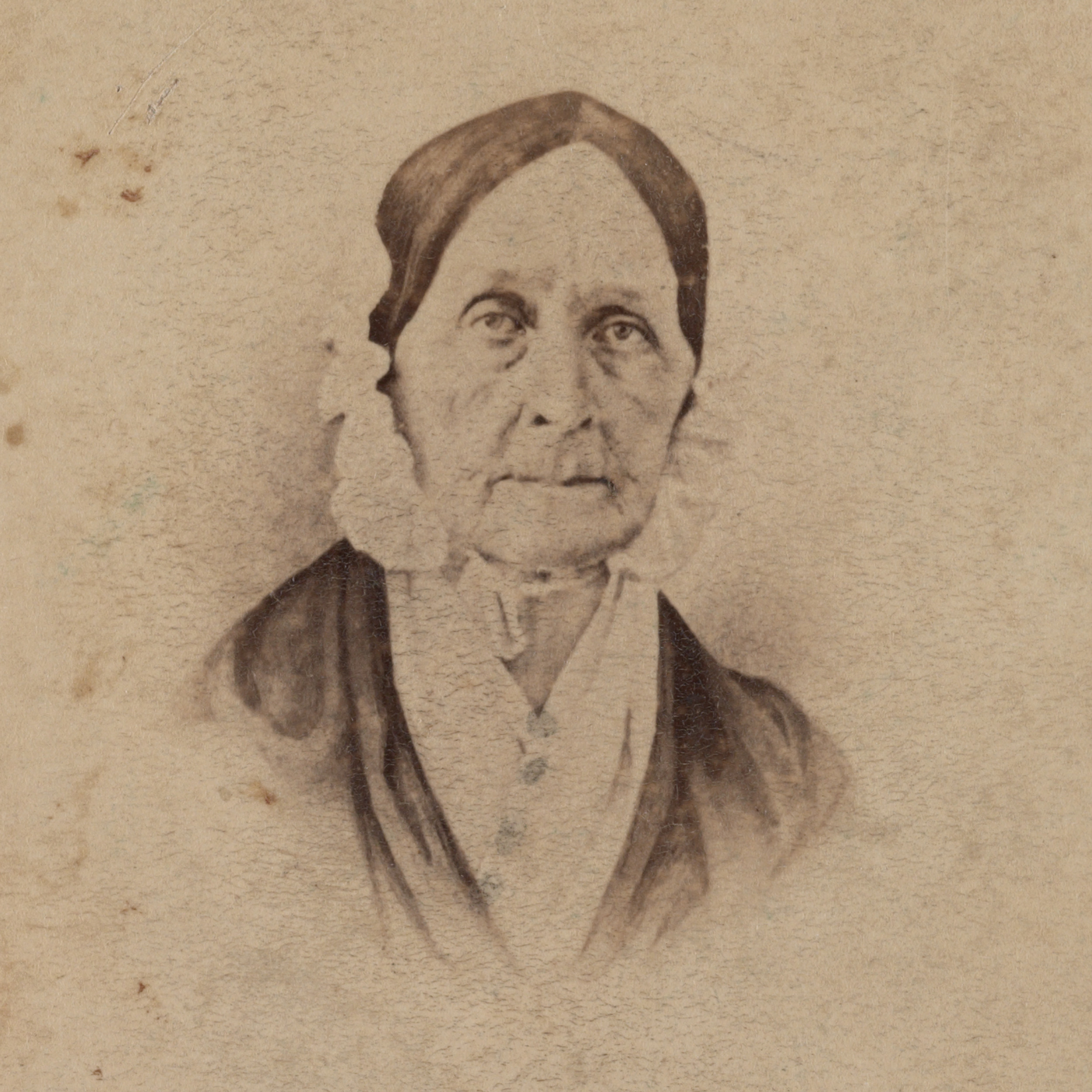
In 1863, novelist Eden Southworth enticed John Greenleaf Whittier to write a poem about an incident involving elderly Frederick resident Barbara Frietchie that had allegedly occurred during Robert E. Lee’s incursion into Maryland the previous year. Above: Frietchie as she appeared in 1862.
Whittier was captivated by Southworth’s account. He was a Quaker, and the war challenged his pacifist beliefs, even as he recognized the fighting as the means to deliver one of his passions, the abolition of slavery. This tale of Barbara Frietchie was a kind of Quaker’s delight—a simple tale of right over might, of patriotism and love of country triumphant. He took up his pen, and within a month, on September 8, 1863, he could write Southworth, “I heartily thank thee for thy kind letter and its enclosed message. It ought to have fallen into better hands, but I have just written a little ballad of ‘Barbara Frietchie,’ which will appear in the next ‘Atlantic.’ If it is good for anything thee deserve all the credit for it.”
“Barbara,” the Atlantic’s editor, James T. Field, had written Whittier, “is most welcome, and I will find room for it in the October number…. Enclosed is a check for fifty dollars, but Barbara’s weight should be in gold.”3
In addition to the Atlantic, Whittier sent “Barbara Frietchie” to the National Anti-Slavery Standard, which ran it in its October 3 issue. He also included it in his new collection then going to press, In War Time and Other Poems. The poem seemed to strike a national chord at a pivotal moment in the war, and newspapers all across the North copied it—including the Frederick Weekly Examiner, on October 21.
October 1863 found northerners more hopeful about their cause after the Union victories at Gettysburg and Vicksburg that summer. Dame Barbara’s Frederick adventure had been more than a year earlier, immediately before the bloody conflicts at South Mountain and Antietam. Then followed a run of Union defeats and checks at Fredericksburg and Stones River and Chancellorsville. So it came to be that a patriotic elderly lady boldly facing down Stonewall Jackson in those otherwise dark times seemed worthy of wide celebration, especially when the respected John Greenleaf Whittier was the celebrator.
Whittier had chosen a very simple poetic format, rhyming couplets, for his “little ballad.” He delivered a prologue, a climax, and a denouement. There was a martial beat to the work that invited reciting out loud; the couplets marched forward confidently. Whittier had never been to Frederick, so for its “clustered spires” (in the second couplet) he borrowed from his friend Oliver Wendell Holmes, who had been there and mentioned them in an earlier Atlantic piece. Everything else featured in the poem came to Whittier courtesy of Eden Southworth. The poet needed only to put it to rhyme—and to give embattled Dame Barbara a much, much better line to deliver.4
 Boston Public Library (Whittier); Woman’s Record (1855)
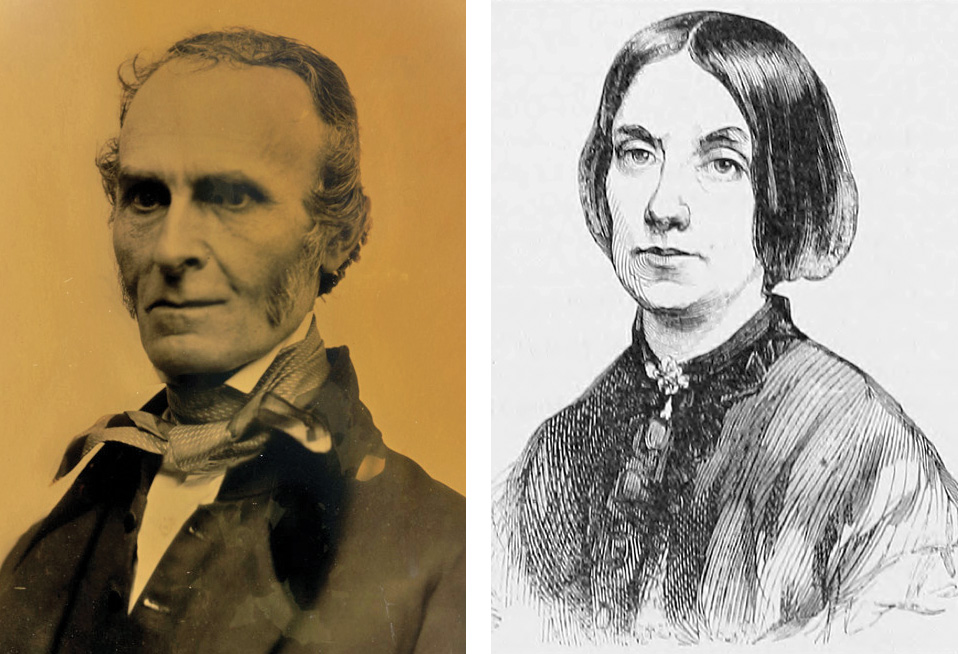
Unbeknownst to John Greenleaf Whittier (left), the story about Barbara Frietchie told to him by Eden Southworth (right) had been a fraud.
The story of Barbara Frietchie deserves to be headlined a caper because in fact the entire affair was a con, wool pulled over poor Whittier’s eyes by novelist Southworth. Whittier would go to his grave trying to fend off critics of his poem, never realizing he had been duped from the start. Eden Southworth, for her part, seems to have intended no harm—her intent being merely to brace up a very thin tale she had heard about a little old lady into an inspiriting feel-good tale, just as she did in the feel-good fiction she cranked out with such regularity. Then the poem’s wide popularity sent matters spinning out of control. She went to her grave silent about her role in the Barbara Frietchie caper, apparently believing that to confess would only make her friend Whittier appear gullible.
Southworth had set the hook in the opening of her letter to Whittier by telling him the old-lady-in-the-garret episode “went the round of the Washington papers” back in 1862. She offered him no clippings, for there were none; the Washington papers had carried no such coverage. Whittier was thus led to believe that the story, or at least the basic elements of it, was on the record, in the public domain, before he ever heard of it. In truth, the only thing Southworth did not invent was the existence of an elderly Barbara Frietchie of Frederick, Maryland.
Southworth’s primary informant for her tale was Cornelius S. Bramsburg, a Georgetown neighbor of hers with a Frietchie family connection, who had visited Frederick during or at some point after the 1862 Confederate occupation. No reporting of Bramsburg’s is known, but at least two incidents of the time would surely have caught his eye—and inspired Southworth’s imagination. One was recorded by Dr. Lewis H. Steiner, an inspector for the U.S. Sanitary Commission, a soldiers’ relief organization, who was in Frederick when the Rebels came. Steiner kept a detailed diary of his experience that was published as a pamphlet late in 1862. In his September 9 entry he wrote, “A clergyman tells me that he saw an aged crone come out of her house as certain rebels passed by trailing the American flag in the dust. She shook her long, skinny hands at the traitors and screamed at the top of her voice, ‘My curses be upon you and your officers for degrading your country’s flag.’” Thus: an aged Frederick woman, venting outrage at Rebels mistreating the Stars and Stripes, with her story in print in 1862.5
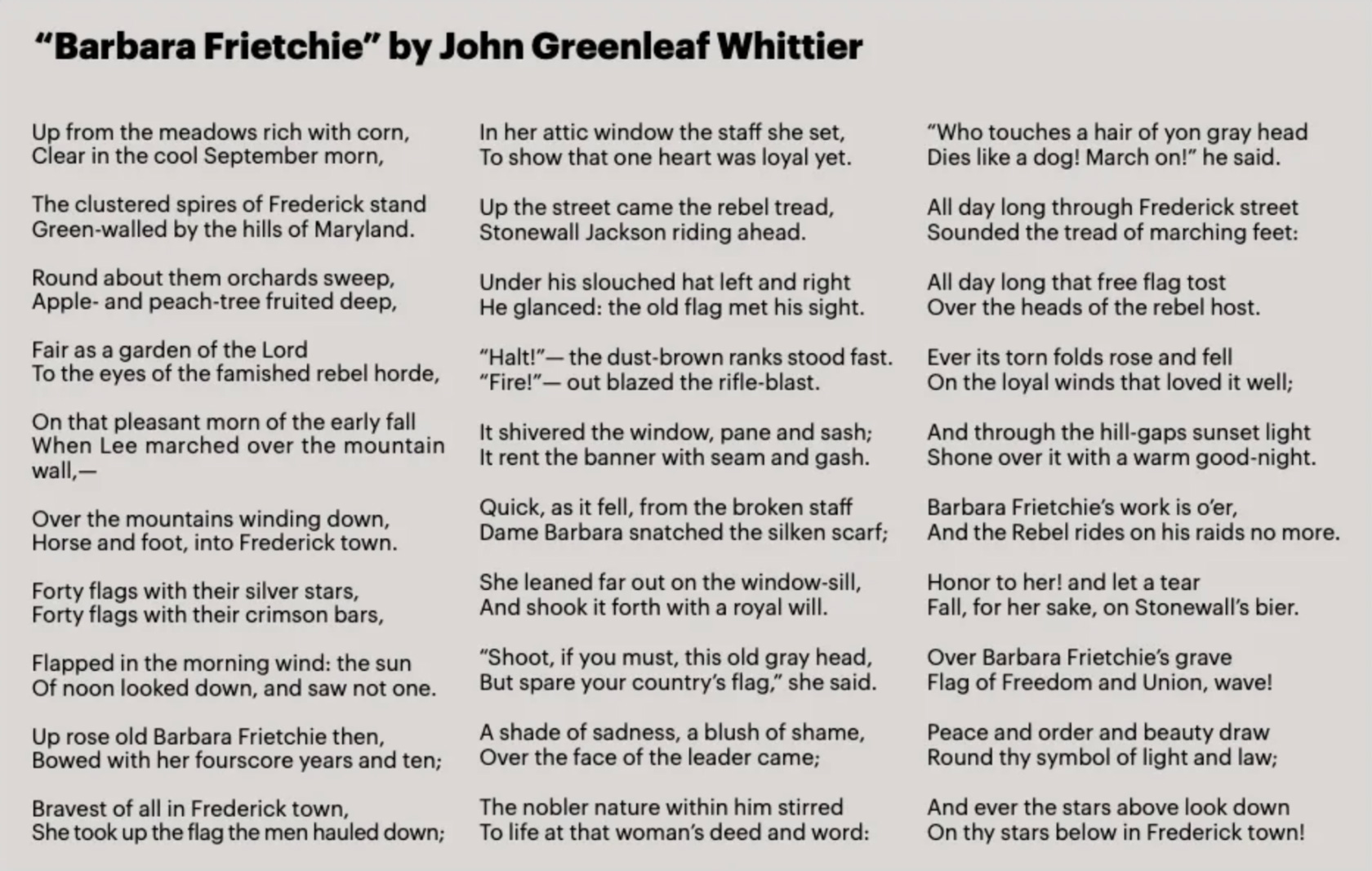
Whittier’s 1863 poem “Barbara Frietchie.”
The second incident introduced Barbara Frietchie into the mix. After the Rebels evacuated Frederick on September 12, the Yankees marched in and were warmly greeted. General Jesse Reno was leading his troops down West Patrick Street when he spotted among the cheering spectators an elderly lady leaning on a cane in her doorway, enthusiastically waving a small American flag at the passing column. “The spirit of ’76!” Reno exclaimed. He dismounted and introduced himself to Mrs. Frietchie (as she proved to be). She welcomed him with a glass of her homemade currant wine. He offered to buy the flag she was waving, but she wanted to keep that and instead gave him a larger, homemade flag. He rode off to the cheers of Dame Barbara’s admiring neighbors, a scenario recorded by the general’s younger brother, a member of his staff. Some 36 hours later Jesse Reno was dead, killed in the fight at Fox’s Gap on South Mountain. The Frietchie flag decorated his coffin on his final journey, and was preserved by his widow.
Cornelius Bramsburg must have witnessed or heard about this flag-waving Frietchie incident (it was mentioned in Barbara’s newspaper obituary in December 1862) and brought it to Eden Southworth, for he is the only credible channel for her learning of Barbara’s existence and something of her life to pass on to Whittier—even if those details were not all accurate. Barbara was 95, not 97 as Southworth had her (Whittier, to capture a rhyme, made her “fourscore years and ten”), and she did not die as a consequence of any bold encounter with Stonewall Jackson but some three months later, on December 18.6
Confusion and debate would thrive throughout the Barbara Frietchie affair because by the time Whittier published his little ballad in October 1863, the actors in the drama were dead: Jesse Reno, a matter of hours after playing his role; Dame Barbara, three months afterward; and Stonewall Jackson, mortally wounded at Chancellorsville the following spring. When questions were asked, there was no one knowledgeable to explain, to confirm—or to deny.
Whittier portrayed Stonewall Jackson as something of an ogre, opening fire on that old gray head, and it was no surprise that the first return fire came from the South—the Richmond Examiner—a month after the poem’s printing: “Late Yankee papers bring us a ballad fresh from the mint, which is so remarkable in itself, and destined to play such havoc with Southern histories of the war, that we cannot refrain from inserting it entire.” A “nimble old harridan” was conjured waving her flag, “careless of the danger of losing her center of gravity and pitching headlong into the street.” The Examiner sarcastically predicted that the “uncultivated may pronounce the poem so much unadulterated and self-evident nonsense, but the wise, the gifted, the good, know that it will outlive and disprove all histories, however well authenticated.”7
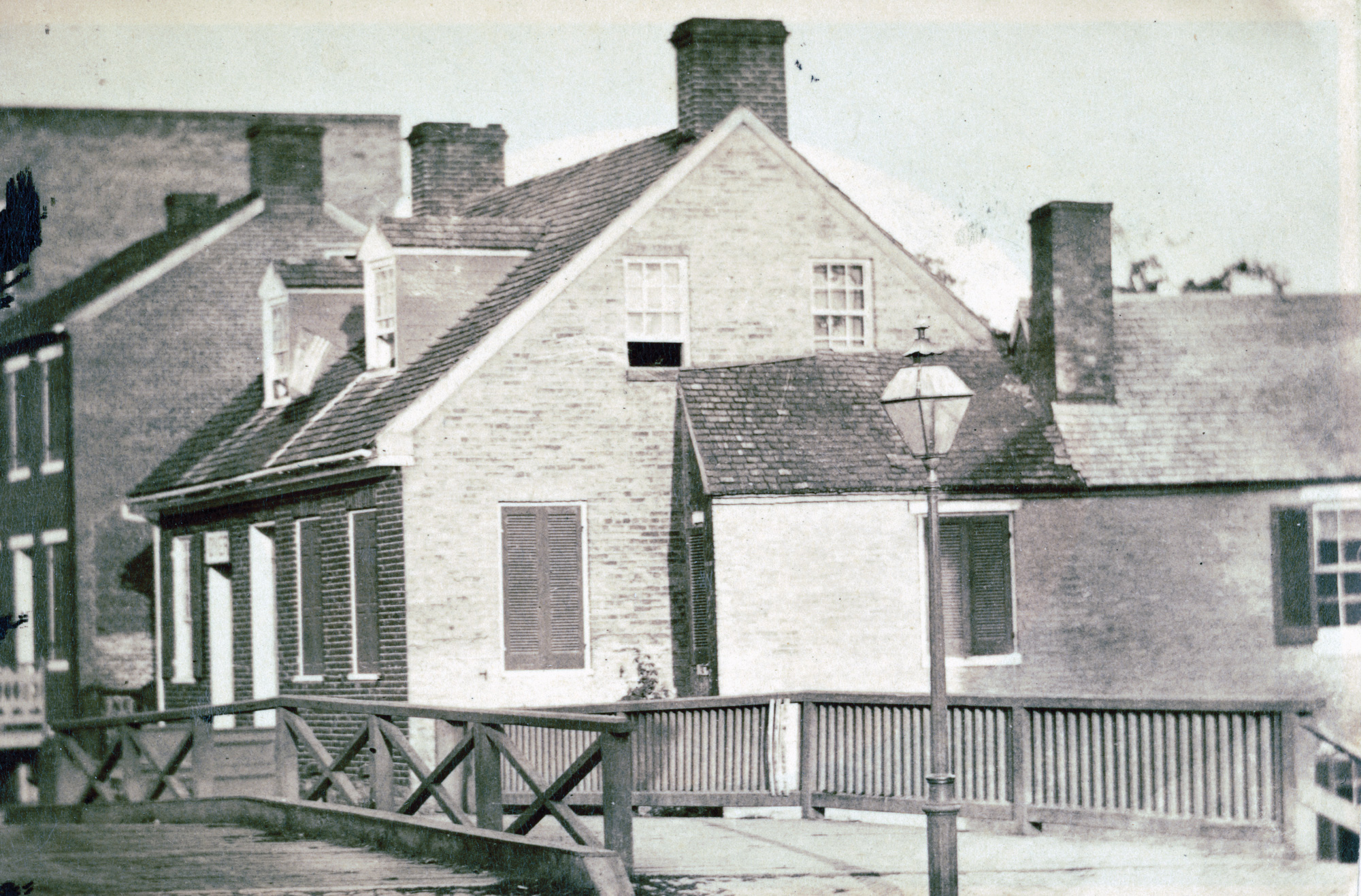
During the remaining war years, Frederick’s residents seemed content to bask in the reflected patriotic spirit Whittier had cast upon them. Even if they did not themselves remember any Rebel volley fired at the late Dame Barbara’s flag, someone must have heard it; best let sleeping dogmas lie. When the war ended, Whittier-smitten visitors made pilgrimages to Frederick to see the Frietchie house and pester the locals about the late heroine. Historian Benson J. Lossing visited in 1866 and included pictures of Barbara and her house in his American Historical Record. A contributor to the Army and Navy Journal hunted up family members to interview. He found Barbara’s nephew “polite upon the subject, but he was very dubious.”
 Library of Congress
While many admirers of Whittier’s “Barbara Frietchie” made the trek to Frederick in the postwar years, others—including residents of the town were dubious of the tale. Above: the Frietchie house as it appeared shortly after the war.
Jacob Engelbrecht, who lived across the road from Frietchie’s house and had been her friend, was himself very dubious. In 1868, when second thoughts were being tossed about, he entered in his diary, “The ‘Barbara Frichty’ exploit as put in poetry by John G. Whittier of Vermont in regard to the displaying of the Union flag in the face of the Rebel Army … is not true. I do not believe one word of it.” He was continually on watch during the Confederate occupation, he wrote, “and should anything like that have occurred I am certain some one in our family would have noticed it.”
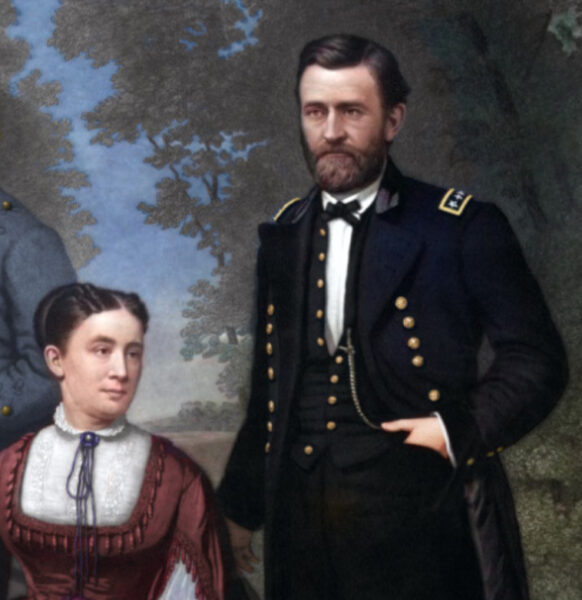
Frederick’s Carroll Creek flooded in 1868, so damaging the Frietchie house that it was taken down. The next year, General Jacob Cox, who had led one of the first Yankee columns to enter Frederick in 1862 (he did not recall seeing Dame Barbara that day), visited the site with General Ulysses S. Grant. They found an entrepreneur there shaping walking sticks from the timbers of the old house. They each got a stick—proof of the legend, Grant dryly remarked—and another found its way to Whittier.8
Whittier initially took a firm stance against the questioners. “Barbara Frietchie is real,” he wrote in 1873. “I have her photograph taken after she was 90 years old; a scrap of her silk dress, and a walking stick from the oaken frame of her house. I had the facts from Mrs. E.D.N. Southworth of Washington in the first place, & they have been confirmed by ample evidence since.”
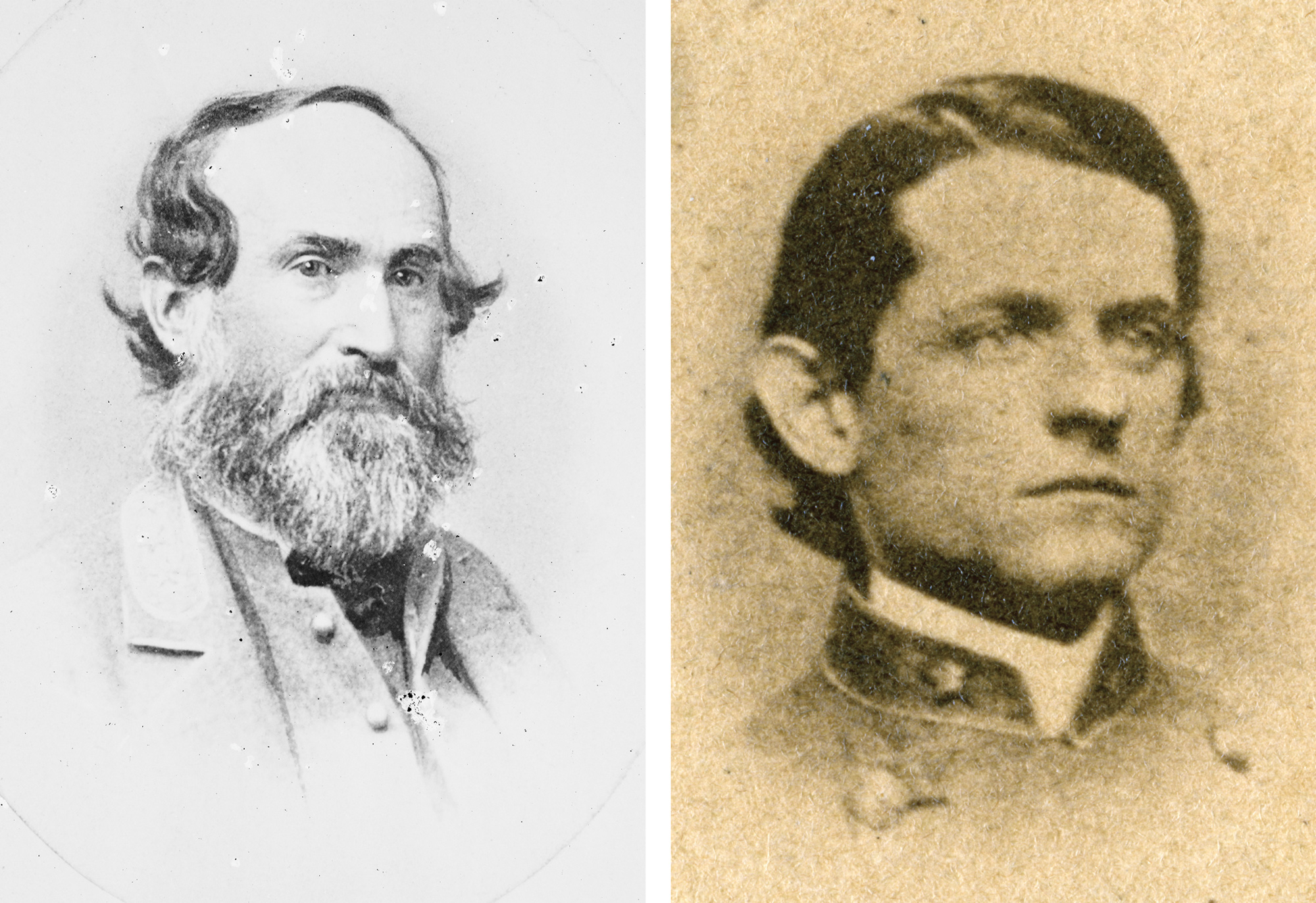
After the war, Whittier’s handiwork was increasingly attacked by ex-Confederates intent on rescuing the reputation of the martyred Stonewall. They found a platform in the pages of the Southern Historical Society Papers. It reprinted an 1875 article by former general Jubal Early, outraged that “Barbara Frietchie” was appearing in school texts. He picked at the poem couplet by couplet, demonstrating its many factual errors. Jackson was nowhere near the Frietchie house that day, he said, and even if he had been, “Neither General Jackson nor any officer in our army was capable of giving such a command.” Early supposed it useless “to quarrel with the license which a poet takes with his subject, but I presume it is allowable to say that our poet in this case has taken an equal license with all the other facts of the case.” He was seconded by former Jackson aide Henry Kyd Douglas, who insisted he was with the general every minute he was in Frederick: “She never saw Stonewall Jackson and he never saw her.” (Eden Southworth had made Jackson her villain presumably because he was the Rebel general best known to her from the northern press.)9
The matter took a sharp turn in 1874 when Valerius Ebert, a nephew of Barbara’s, wrote in the Baltimore Sun that Stonewall Jackson did not pass the Frietchie house that September day, but even if he had, Dame Barbara was in no shape to climb up to her garret and wave a flag. She was, Ebert wrote, “bedridden and helpless, and had lost the power of locomotion. She could at this period only move, as she was moved, by the help of her attendants.” (His letter was reprinted approvingly in the Southern Historical Society Papers.) Ebert’s diagnosis brought a rush of denials from relatives and friends of Barbara’s, including diarist Engelbrecht, who affirmed that at the time she was in good health, “very active for her age.” Valerius Ebert was dismissed as a Confederate sympathizer and a family black sheep.10
The Century Magazine’s “Battles and Leaders” article series, which ran in the 1880s and was collected in the four-volume Battles and Leaders of the Civil War, generated a new flurry of commentary on Dame Barbara. In 1886 historian George O. Seilheimer pulled together for The Century what he said were the facts of the case. “That Barbara Frietchie lived is not denied,” he began. But neither the Sanitary Commission’s Dr. Steiner nor Oliver Wendell Holmes, who were both in Frederick during or soon after the Rebel occupation, had reported any volleys loosed at any Union flag. Ex-Rebels reconfirmed that Jackson was elsewhere in Frederick that day. Seilheimer did introduce “Mrs. E.D.E.N Southworth, the novelist,” whose connection to Whittier he revealed—but only to the extent of her sending the poet “a newspaper slip reciting the circumstances of Barbara Frietchie’s action when Lee entered Frederick.” Southworth’s phantom news clips that had duped Whittier still served their purpose two decades later.
Seilheimer also introduced a second Frederick flag-waver on that day, Mary S. Quantrill, who “was not fortunate enough to find a poet to celebrate her deed.” Indeed, if Mrs. Quantrill’s own account can be believed, she would certainly have caught Whittier’s attention. She had not caught Eden Southworth’s attention, however, and was thereby destined to be only a footnote to the Barbara Frietchie caper.11
In 1876 Mary Quantrill had written to Whittier, seeking recognition for what she termed “the happiest Episode of the war.” She did not believe the glowing tributes to his poem would be lessened “because of a misunderstanding as to the person who enacted it.” She reprised for him that September day in 1862 “when the boasted Army of the South” had stormed into Frederick: “Down to the dust with the Old Flag and its advocates! shouted a hireling. Stepping out as far as the railing of the porch would admit, I threw my Banner upon the same breeze on which floated the Stars & Bars, the Palmetto and the Rattlesnake, indicating by the act there is one true and dauntless too; for I expected to die then and there. A murmur of surprise was heard in the Rebel Ranks. One soldier said I had more patriotism and courage than any man in the Federal Army.”12
There is no known reply by Whittier to Quan-trill’s letter, but he took seriously her flag-waving claim. He told Francis F. Brown, editor of the poetry anthology Bugle-Echoes, that he had based his Frietchie poem on a communication of Southworth’s, but that Quantrill “was a claimant for the honors.” In 1886, in response to Seilheimer’s Century piece, he wrote the magazine in his own defense: “The poem of ‘Barbara Frietchie’ was written in good faith. The story was no invention of mine. It came to me from sources which I regarded as entirely reliable; it had been published in newspapers, and had gained public credence in Washington and Maryland before my poem was written … and I am still constrained to believe that it had foundation in fact. If I thought otherwise I should not hesitate to express it. I have no pride of authorship to interfere with my allegiance to truth.”13
During these postwar years, various Frietchie relations and friends—and additional flag-wavers—had their say in often addled recollections of that time in Frederick, adding to the general confusion. Whittier sought to assure Barbara’s family: “There has been a good deal of dispute about my little poem; but if there was any mistake in details, there was none in my estimate of her noble character and her loyalty and patriotism.” He followed the same theme in an 1890 letter: “I had a portrait of the good lady Barbara … and a cane from Barbara’s cottage…. Whether she did all my poem ascribed to her or not, she was a brave and true woman. I followed the account given me in a private letter and in the papers of the time.”
 Virginia Military Institute (Douglas); Library of Congress
After war’s end, a number of former Confederates—including Jubal Early (left) and Henry Kyd Douglas (right)—attacked the veracity of Whittier’s poem in an attempt to rescue the reputation of Stonewall Jackson. Frietchie “never saw Stonewall Jackson and he never saw her,” wrote Douglas of that day in Frederick.
Shortly before his death, for an introduction to his Complete Poetical Works, Whittier offered a final comment on the Barbara Frietchie saga. Although he shifted his stance, he remained unaware that Eden Southworth had led him down a garden path. The poem, he claimed, “was written in strict conformity to the account of the incident as I had it from respectable and trustworthy sources. It has since been the subject of a good deal of conflicting testimony, and the story was probably incorrect in some of the details.” Yet Barbara herself “was no myth, but … intensely loyal and a hater of the Slavery Rebellion, holding her Union flag sacred,” and when Federal troops “followed close upon Jackson’s she waved her flag and cheered them. It is stated that Mary Quantrill, a brave and loyal lady in another part of the city, did wave her flag in sight of the Confederates. It is possible that there has been a blending of the two incidents.”14
Whittier died in 1892, and Eden Southworth died in 1899. (Mary Quan-trill had died in 1879, three years after writing Whittier to stake her claim. Her obituary in the Frederick Daily News was headed, “Death of the Genuine ‘Barbara Fritchie.’”) By the turn of the century, however, Barbara was firmly established as a figure of legend, widely cherished, especially in Frederick. She was even celebrated in the entertainment world—if only for her name recognition. A play by Clyde Fitch, Barbara Frietchie, the Frederick Girl, ran on Broadway for 83 performances in 1899 and 1900. Her name also titled four silent movie melodramas of the 1910s and 1920s. The plots on both stage and screen bore not the faintest resemblance to any facts, or even fictions, credited to Dame Barbara.
In 1927 a Frederick booster group, the Barbara Frietchie Home Association, directed the construction of a replica of Dame Barbara’s house on its old West Patrick Street site (it formally opened on Flag Day), where a docent in period costume would welcome visitors with a tour and lecture. In 1937 Henry Ford honored Barbara’s memory with a replica of that replica Frederick house as one of his Colonial Village “heritage homes” in Dearborn, Michigan. The Frederick house still stands, restored and re-purposed as a bed-and-breakfast.15
Other reminders of Barbara’s revered place in Frederick’s history are the Barbara Frietchie Handicap for thoroughbreds, run annually at Maryland’s Laurel Park Racecourse, and the nearly century-old Barbara Frietchie Classic, a motorcycle race every July 4 at the Frederick County Fairgrounds. Barbara has even a place in the annals of the Supreme Court. In 1989 Chief Justice William Rehnquist quoted Whittier’s entire poem in his dissent in a flag-burning case.16
In its day, “Barbara Frietchie” was probably Whittier’s best-known poem, and despite its shaky provenance it did little harm to his reputation as one of the 19th century’s better-loved American poets. In contrast, novelist Eden Southworth’s fame was fleeting, and today she is little known outside of the occasional women’s studies inquiry in the academy.
Still, Southworth’s hidden hand lurked behind a memorable scene during a later war. In May 1943, in the midst of World War II, British Prime Minister Winston Churchill visited President Franklin Roosevelt in Washington to firm up the Allied alliance. For a weekend break, President and Mrs. Roosevelt, Churchill, and presidential aide Harry Hopkins journeyed to Shangri-La, the presidential retreat now called Camp David in the Catoctins in Maryland. As they drove through Frederick, Churchill, a close student of American history, inquired after the house of Barbara Frietchie. That moved Harry Hopkins to quote the famous line, “Shoot if you must, this old gray head….”
“When it was clear that no one else in the car could add to this quotation,” Churchill recalled, “I started out.” He proceeded to recite, from memory, in those resonant Churchillian tones, the 30 couplets of Whittier’s “little ballad,” to the astonishment and delight of his audience. All pitched in when he got to “Shoot, if you must….” John Greenleaf Whittier would have felt rehabilitated.
Stephen Sears’ 13th Civil War title is Lincoln’s Lieutenants: the High Command of the Army of the Potomac.
Notes
1. Southworth to Whittier, July 21, 1863, Whittier Manuscript Collection, Friends Historical Library, Swarthmore College; Southworth in Mary Forrest, Women of the South Distinguished in Literature (1861); Southworth obituary, Literary Digest, July 22, 1899.
2. Southworth to Whittier, August 1863, Whittier Manuscript Collection, Swarthmore.
3. Carol Iannone, “John Greenleaf Whittier’s Civil War,” The Modern Age, 47:2 (Spring 2005); Whittier to Southworth, September 8, 1863, Samuel T. Pickard, Life and Letters of John Greenleaf Whittier (Boston, 1894), 2:456–457; Field to Whittier, August 24, 1863, Pickard, 2:458. Barbara’s surname is spelled variously; I have followed Whittier’s spelling as the most commonly used.
4. Whittier, In War Time and Other Poems (Boston, 1864); Holmes, “My Hunt After the Captain,” Atlantic (December 1862).
5. Report of Lewis H. Steiner, M.D. (U.S. Sanitary Commission, 1862), 18.
6. Conrad Reno, “General Jesse Lee Reno at Frederick: Barbara Fritchie and Her Flag,” Massachusetts mollus, Civil War Papers (Boston, 1900), 2:553, 567–569; Frederick Weekly Examiner,
December 24, 1862.
7. Richmond Examiner, November 26, 1863.
8. Lossing, American Historical Record (1872–1874), 2:131, 497; U.S. Army and Navy Journal, 4 (1867): 759; Engelbrecht in Dorothy Mackay Quynn and William Rogers Quynn, “Barbara Frietchie,” Maryland Historical Magazine, 37:3 (September 1942): 244; Cox, Military Reminiscences of the Civil War (New York, 1900), 1:273–274.
9. Whittier to unknown, February 15, 1873, Whittier Manuscript Collection, Swarthmore; Early, Boston Daily Advertiser, May 8, 1875, in Southern Historical Society Papers, 7 (September 1879); Douglas, The Century, June 1886.
10. Ebert, Baltimore Sun, August 27, 1874, in Southern Historical Society Papers, 7 (September 1879); Engelbrecht in Quynn and Quynn, “Barbara Frietchie,” 234.
11. Seilheimer, “The Historical Basis of Whittier’s ‘Barbara Frietchie,’” Battles and Leaders of the Civil War, 2:618–619. Mary Quantrill was cousin by marriage of Rebel guerrilla William Clark Quantrill.
12. Quantrill to Whittier, July 15, 1876, Whittier Manuscript Collection, Swarthmore. For Mary Quantrill, see Chris Haugh in Journal of the Historical Society of Frederick, Maryland (Fall 2008).
13. Whittier to Brown, 1885, Whittier Manuscript Collection, Swarthmore; Whittier to Century editor, June 10, 1886, Battles and Leaders, 2:619.
14. Whittier to unknown, 1888, in Conrad Reno, “General Jesse Lee Reno at Frederick: Barbara Frietchie and her Flag,” 2:558; Whittier to unknown, October 19, 1890, Pickard, Life and Letters of Whittier, 2:458; The Complete Poetical Works of John Greenleaf Whittier (Boston, 1894), 342.
15. Frederick Daily News, August 7, 1879; Frederick News Post, January 12, 2018.
16. Texas v. Johnson, 1989.
17. Winston Churchill, The Second World War, 4: The Hinge of Fate (New York, 1950), 795–796.