 Library of Congress (2)
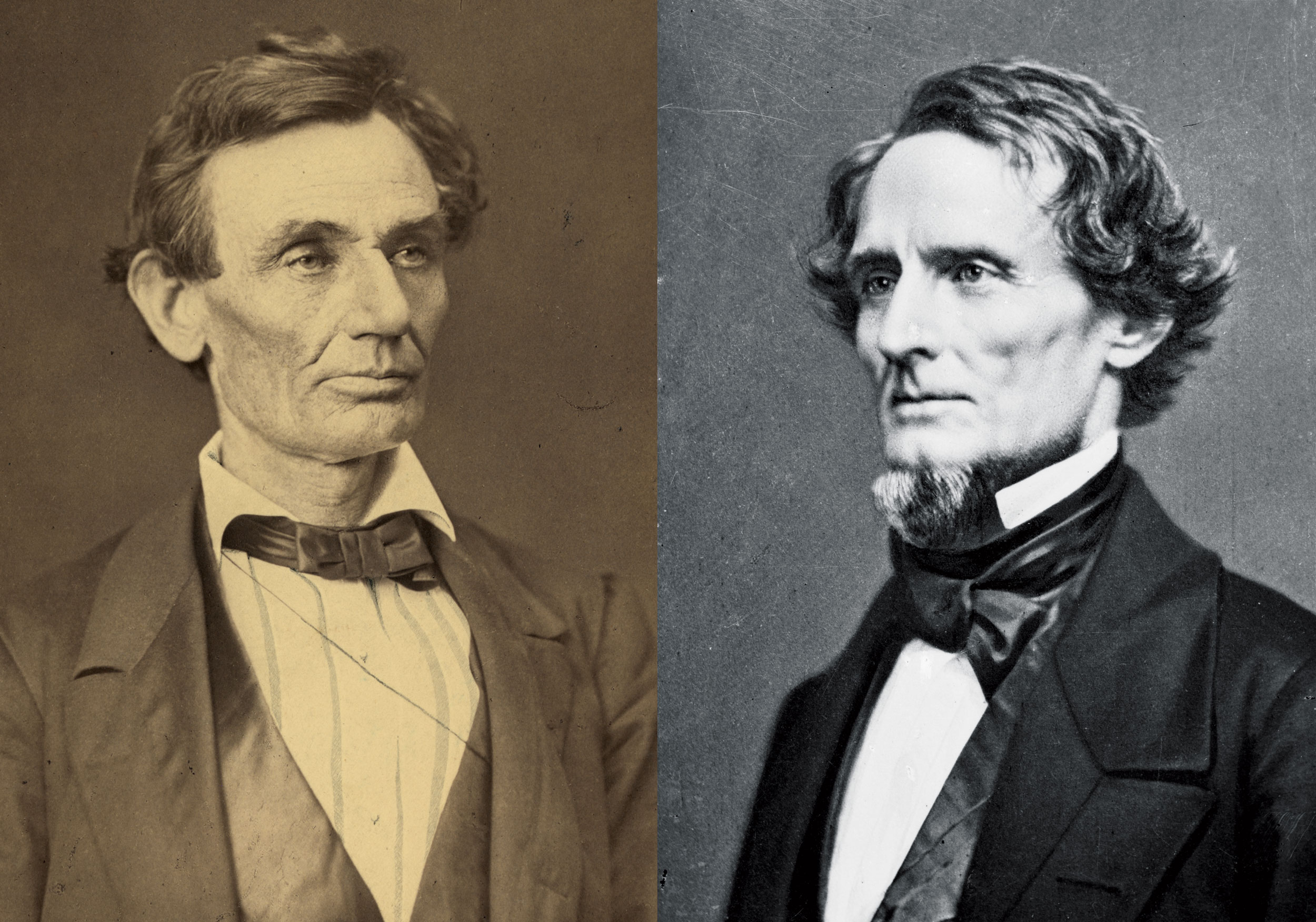
Abraham Lincoln (left) and Jefferson Davis
Jefferson Davis spent the winter of 1860-1861 fighting to protect his beloved society from destruction at the hands of a hostile, irrational, and ruthless opponent. Abraham Lincoln spent his winter doing precisely the same thing. For inspiration and guidance in his fight, Davis turned to America’s Founding Fathers, justifying his actions with the idealism of their principles and supporting his arguments with the wisdom and justice of their Constitution. So did Lincoln. Even as he fought, Davis struggled mightily to maintain the moral high ground: searching for an acceptable middle course, keeping an open mind to reasonable terms of adjustment, reaching out to potential allies among those who had not yet chosen sides, and above all seeking any honorable means of preventing a potentially devastating war among those who had always looked upon each other as brethren and friends. So, too, Abraham Lincoln.
The failure to achieve a peaceful resolution in the winter of America’s discontent lay not in any conscious refusal to compromise—the majority of those in both North and South were relative moderates who saw themselves as bending over backward to be reasonable. Failure lay rather in the vast distance that separated each side’s minimum terms. After decades of bitter accusations and growing defensiveness, the slavery-spawned conflicts that divided North and South defied compromise—and the failure of compromise raised the specter of secession, which was even less negotiable. By 1860, the immense gulf between the sections blurred distinctions among opponents and made efforts of those on the other side to reach across seem puny and insincere.
Both Davis and Lincoln were chosen largely for their moderate views. But moderation is nothing if not relative, and one section’s moderate was the other’s radical. To the southerners who looked to Davis for more prudent, levelheaded leadership than that of militant secessionists—“fire-eaters”—like lawyer and planter William Lowndes Yancey of Alabama or editor Barnwell Rhett of South Carolina, Lincoln’s blunt condemnation of slavery was an open threat. To the northern Republicans who embraced Lincoln’s views on slavery as a sensible alternative to the zealous agitation of radicals like Massachusetts senator Charles Sumner and Ohio governor Salmon Chase, Davis’ insistence on federal protection for slavery in the western territories marked him as a southern extremist, and his support for both the right and the justice of secession made him downright dangerous. In this volatile context, what to one side seemed an acceptable compromise to the other looked selfish and narrow minded. And despite what each side deemed its own best effort at peace, the war came.
In the deep south of the 1850s, no one found political success without being both an outspoken defender of slavery and a staunch advocate of a state’s constitutional right to secede from the American Union. So when the North’s antislavery Republican Party capped an explosive half-decade’s growth by capturing the White House in November 1860, Senator Jefferson Davis of Mississippi joined other Deep South leaders in viewing Abraham Lincoln’s victory as “a transfer of the government into the hands of the abolitionists,” an ominous development that almost certainly compelled southern secession.
Unlike the fire-eaters, though, Davis came to this conclusion with great reluctance. He knew a great many northerners—even counted some of them good friends—and he did not share the belief of most of his Deep South colleagues that the North would not fight to prevent secession. What was more, he knew firsthand the horrors that war entailed—still carried those horrors with him, in fact, in a recurring infection from a foot wound incurred at the Battle of Buena Vista 13 years earlier. So while Davis vigorously upheld a state’s right to secede, he also urged his fellow southerners to proceed slowly. Precipitous action, he argued, would alienate the more conservative upper tier of slave states that ran from North Carolina, Kentucky, and Arkansas north, and dramatically increase the odds of a conflict. “If the border slave holding states unite with us there will probably be peaceful separation,” he reasoned, for the federal government would hesitate to use force against nearly half the Union—“but if the cotton states are to maintain their position alone, war is probable.”1
So when Congress convened in early December, the senator was determined to encourage sectional compromise and see how Republicans responded. Yet Davis’ notion of compromise, like that of a good many other congressional delegates in 1860-1861, acknowledged neither the need for nor even the desirability of both sides to make sacrifices. “Upon you of the majority section it depends to restore peace and perpetuate the Union of equal States,” he informed Republicans, for he believed that their antislavery fanaticism had caused the problem. If they wanted to save the Union, he asserted, they must renounce their hateful attacks upon the South’s slave-based society and instead prove “the purpose of your constituents to fulfill in the spirit of justice and fraternity all their constitutional obligations.”2
It quickly became clear that Republicans were not willing to concede the justice of slavery, confirming Davis’ belief of their ill intentions toward the South. Their stubborn refusal to compromise proved to him the need for secession, and he immediately set about demonstrating that for those misguided southerners who still clung to the illusion that their society would be secure in a Northern-dominated Union. His strategy was simple: contrast the Deep South’s willingness to make concessions with the Republicans’ intransigence. On the Senate’s Committee of Thirteen, created in mid-December to broker a sectional resolution, Davis voted in favor of the popular compromise plan of Kentucky senator John J. Crittenden, which had captured the hopes and imaginations of unionists North and South, despite knowing that its proposition for banning slavery in the northern U.S. territories was anathema in the cotton states and stood no chance of halting secession there. Sure enough, Republican opposition defeated Crittenden’s plan, accelerating the Deep South’s secession. To Davis, this course was not deceitful: he was merely showcasing the northern hostility that he believed had forced the South into disunion.3
 Library of Congress
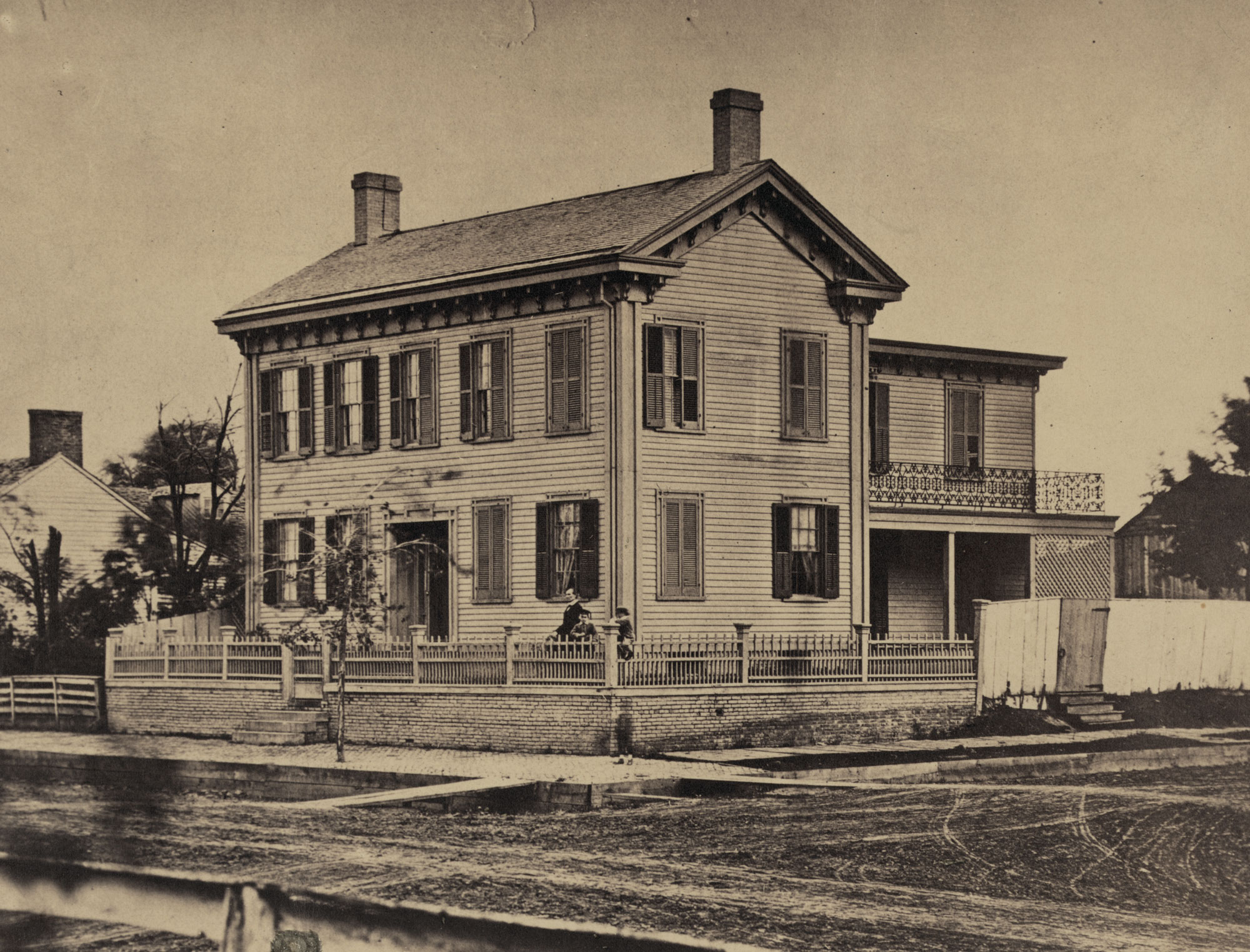
Abraham Lincoln and his sons posed for this photograph outside their Springfield, Illinois, home shortly before the president-elect departed for Washington, D.C.
The president-elect, who spent most of the secession winter observing events from his home in Springfield, Illinois, was blind to the distinction between enthusiastic secessionists like Yancey and reluctant secessionists like Davis, but from his perspective that difference was meaningless anyway. Lincoln had long since recognized that Deep South leaders of any stripe would accept nothing less than northerners’ smiling embrace of the essential goodness of slavery. “What will satisfy them?” Lincoln had demanded several months before the November election. “This, and this only: cease to call slavery wrong, and join them in calling it right. And this must be done thoroughly—done in acts as well as in words. Silence will not be tolerated—we must place ourselves avowedly with them.” He was right; that was essentially what Davis required for a successful compromise.4
Yet in other ways Lincoln was profoundly ignorant of what was happening in the South. Like most Republicans, he was convinced that disunion was a baseless threat, a “shallow pretext” for “extorting a compromise” from anxious northerners.5 Merely the ploy of a small but powerful group of elite agitators, secession had no popular support; unless northerners did something to provoke southerners, Lincoln predicted, they would come to their senses and loyalty to the Union would prevail. After a brief storm, then, the question of secession would at long last be dead. “The tug has to come,” he wrote, “and better now, than any time hereafter.”6
With that in mind, Lincoln acted behind the scenes to squash a procompromise movement gathering steam among Republicans in Congress. In mid-December, he wrote several letters urging his party to hold fast. Those letters enabled the hardliners in his party to gain the upper hand in the struggle over concessions, and the movement failed.7
Yet Lincoln saw himself as undermining a war-averting compromise no more than Davis did. For years, Republicans believed, southerners had used the threat of disunion to bluff northerners into proslavery concessions, thereby expanding slavery and bolstering the power of southern planter-aristocrats. Combatting this Slave Power was precisely why outraged northerners had formed the Republican Party to begin with. So like Davis, who generously gave northerners one last chance to prove their goodwill, Lincoln saw his outlook as more than reasonable. While he stood “inflexible” on slavery’s extension, he urged his party to concede “whatever springs of necessity from the fact that the institution is amongst us”—to enforce the fugitive slave law, for example.8
But disunion was neither a bluff nor a political coup staged by a handful of radicals, and the southern unionism Lincoln was counting on was highly conditional: As Jefferson Davis had astutely recognized, the other slave states would go, too, if secessionist predictions proved true and Republicans showed any intention to act against the peculiar institution, or if the federal government tried to coerce the seceding states of the Deep South into staying. In that sense Lincoln’s entire policy rested on a fundamental misreading of southern politics.9
Yet Lincoln would not have changed his course even if he had read the South more accurately. We have already seen that he recognized that the Deep South would not agree to any terms that the Republicans might realistically offer. Procompromise northerners like New York senator William H. Seward might focus on keeping the border slave states from seceding, but they could only hope vaguely that the Deep South would be unable or unwilling to go it alone and would eventually return to the Union. For Lincoln, who was not willing to take that chance, no congressional compromise could have resolved the crisis.
In addition, while Lincoln may not have grasped the true nature of southern unionism, he did recognize that unionists demanded nothing less than the surrender of Republicans’ most deeply held principle: free soil in the western territories. That concession would crush the party. And like most Republicans in 1860, Lincoln believed that if his party were to crumble under the threat of secession, the American republic itself would collapse. “Any concession in the face of menace,” he said, would establish a fatal precedent for a minority’s trumping the will of the majority and thus mean “the destruction of the government itself.” Moreover, the Republican Party was the only means of restricting the spread of slavery and returning the United States to the antislavery course upon which Republicans believed its Founders had placed it.10
 Library of Congress
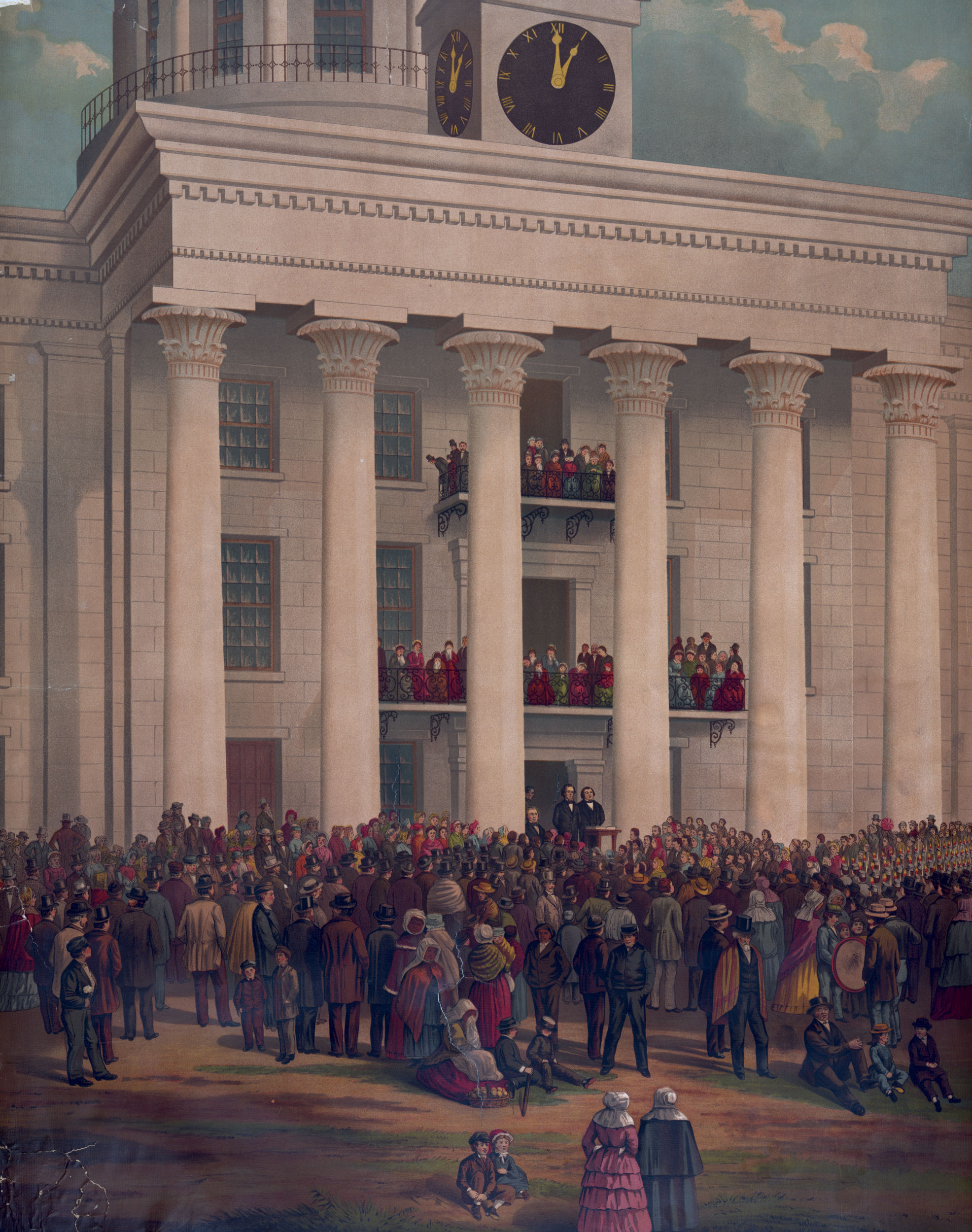
“[M]ake all who oppose us smell Southern powder and feel Southern steel.” Jefferson Davis, in a speech delivered a few days before his inauguration as president of the Confederate States of America on February 18, 1861. Above: An artist’s rendition of the inauguration based on a photograph taken of the event.
Between December 20 and February 4, the seven states of the Deep South formally seceded from the United States. Their senators and representatives gradually withdrew from Congress, and on February 4 delegates from those states met in Montgomery, Alabama, to work out the details of a new slave-state confederacy. Although he had begun working for secession back in December, Davis nevertheless found his front-row view of the Union’s collapse wrenching. Upon learning of Mississippi’s secession in early January, he had pleaded with Republicans to let the departing states go peacefully. Three days later, he had collapsed under the strain; for over a week he lay in a darkened room with an excruciating attack of facial neuralgia.
Nevertheless, on January 21, having received an appointment to serve as commanding general of Mississippi’s armed forces, Davis had shuffled painfully to the Senate chamber to bid a tearful goodbye to his colleagues. Even at that tender moment, he felt compelled to point out the dangerous radicalism of northerners’ applying the Declaration of Independence’s promise of equality to blacks; the blamelessness of southerners, who were merely doing what their Revolutionary forebears had done when the British had similarly threatened their rights; and the risk of trying to coerce the seceded states, who wanted peace but would fight if necessary. The next day he left Washington for the last time.11
Back home in Mississippi, his pain finally receded, Davis prepared for the war he feared was coming. Despite his desire for peace, the former soldier and secretary of war felt he could do the most good as a military leader. He continued to believe that if the federal government faced a sufficiently armed and united South, it would back down. He was dismayed, therefore, when a telegraph informed him that the Montgomery delegates had appointed him provisional president of the Confederate States. Watching as he read, his wife was shocked at his expression. “He looked so grieved that I feared some evil had befallen our family,” she recalled later. When he told her the contents of the telegram, it was “as a man might speak of a sentence of death.”12
But the call of duty was not to be ignored. Davis left for Montgomery the next day, February 11, on a six-day journey marked by cheering crowds and over two dozen speeches. Displaying his typical moderation, he insisted that the “only hope” for the South lay “in a determined maintenance of our position, and to make all who oppose us smell Southern powder and feel Southern steel,” even as he stressed that fighting would occur only “if coercion should be persisted in.” If war came, he declared in his February 18 inaugural address, the Confederacy would be “doubly justified by the absence of wrong on our part, and by wanton aggression on the part of others.”13
Meanwhile, some 500 miles north, Abraham Lincoln was similarly striving to avoid an appearance of belligerence while still projecting firmness of purpose.14 On February 1, he sent New York senator William Seward, the leading pro-compromise Republican and Lincoln’s secretary of state-designate, a token to assuage his Upper South friends: a letter from the president-elect supporting (acquiescing in, really) any reasonable agreement that did not allow slavery into the federal territories. At the same time, Lincoln was drafting an inaugural address that emphasized his oft-repeated pledge to uphold the constitutional rights of the slave states.
Yet in that same speech Lincoln explicitly rejected congressional compromise, pledged to uphold the Republican platform, condemned secession as “the essence of anarchy,” and vowed not only to hold onto the few remaining federal possessions in the South—including military installations—but to recapture those that had already been seized. His stern resolve was plainly visible in his closing lines—words that could as easily have been penned by Jefferson Davis: “In your hands, my fellow countrymen, and not in mine, is the momentous issue of civil war… . With you, and not with me, is the solemn question of ‘Shall it be peace, or a sword?’”15
Despite his stern words, Lincoln, like Davis, was acutely aware of the importance of maintaining friendly relations with the eight slave states that had not seceded—the more so once his February 23 arrival in Washington brought him into direct contact with their representatives. Though all eight Upper South states had rejected secession during that fateful February, Lincoln quickly realized that the unyielding resolve he had stuck to all winter in Springfield was not the best policy. He privately offered to pull the federal garrison out of Charleston Harbor if the Virginia secession convention—dominated by unionists yet still in session in Richmond—would adjourn.16
He also significantly revised his inaugural address. The speech Lincoln delivered on the afternoon of Monday, March 4, still condemned secession as the essence of anarchy and still vowed to enforce the Constitution and protect federal property. But it neither stressed the new president’s obligation to party principles nor pledged to recapture federal property seized by secessionists. And no longer did the speech end abruptly with the implied threat, “With you, and not with me, is the solemn question of ‘Shall it be peace, or a sword?’”—Lincoln had deleted that line entirely and now closed with an eloquent plea for forbearance and peace, rooted in a heartfelt appeal to Americans’ shared history and mutual devotion to the Union:
We are not enemies, but friends. We must not be enemies. Though passion may have strained, it must not break our bonds of affection. The mystic chords of memory, stretching from every battle-field, and patriot grave, to every living heart and hearthstone, all over this broad land, will yet swell the chorus of the Union, when again touched, as surely they will be, by the better angels of our nature.
Yet despite this significant softening of tone, Lincoln retained, in what was now the penultimate paragraph, his insistence that should war occur, it would not be his fault. “In your hands, my dissatisfied fellow-countrymen,” he continued to assert, “and not in mine, is the momentous issue of civil war.”17
 Library of Congress
“We are not enemies, but friends. We must not be enemies.” Abraham Lincoln, addressing southern secessionists in his inaugural address, March 4, 1861. Above: A crowd gathers outside the U.S. Capitol to observe Lincoln’s inauguration as America’s sixteenth president.
President Davis spent his first several weeks in office preparing the new government for the war that both leaders hoped desperately to avoid. He quickly earned notoriety for being both an indefatigable worker and a hopeless micromanager. Secretary of War Leroy Pope Walker, more than any other cabinet officer, found himself at the beck and call of the new president—Davis actually kept a little bell on his desk for summoning his war secretary. A great many of those meetings revolved around Fort Sumter, in Charleston Harbor, and Fort Pickens, just outside Pensacola Harbor. These held the only significant garrisons of U.S. soldiers left in the seceded states.18
Davis viewed the presence of foreign troops at the two sites as equally important, but public attention South and North focused on Charleston. There, in late December, Major Robert Anderson had unexpectedly transferred his federal garrison from a vulnerable coastal fort to the more easily defended island stronghold of Fort Sumter, thereby kicking off a chain of events that had nearly exploded into war when South Carolina artillery had fired upon a U.S. ship bringing Anderson supplies and reinforcements. Since then, Sumter had become the primary symbol of federal authority in the seceded states, hence the most likely flashpoint for conflict. Even while still in the U.S. Senate, Davis had been in close touch with Governor Francis W. Pickens, urging the hotheaded South Carolinian to have patience. “We have much of preparation to make, both in military and civil organization,” he wrote, “and the time which serves for our preparation, by its moral effect tends also towards a peaceful solution.”19
Davis was convinced that the best way to avoid war was to show the federals a strong face. That meant filling out and stabilizing the new government, building and organizing an army and a navy, and engaging in diplomacy with foreign nations, most importantly the United States. On March 3 General P.G.T. Beauregard arrived in Charleston, commissioned with readying Confederate forces there both to prevent reinforcements from reaching Sumter and to capture the fort if necessary. On the same day, Martin Crawford of Georgia arrived in Washington, one of three commissioners appointed by Davis to, he hoped, negotiate a peaceful separation from the U.S.
When Lincoln took office on March 4, his faith in southern unionism led him to believe that he could wait out the secession movement, maintaining a hands-off policy toward the seceded states while keeping a symbolic federal presence at Forts Sumter and Pickens. The very next morning, his plans suffered a monstrous blow when he received word that Sumter’s garrison was running low on food. Worse, Major Anderson estimated that it would take at least 20,000 men to break through the Charleston defenses and relieve the fort.20
General-in-Chief Winfield Scott, aged hero of the Mexican War, counseled that since the entire U.S. Army presently consisted of just 16,000 soldiers, most of them spread across the West fighting Indians, it would take six to eight months to raise and train the necessary forces for a rescue mission. As Anderson had only six weeks’ worth of supplies, General Scott recommended the fort’s immediate evacuation. He drew up the orders for Anderson’s withdrawal.21
To Lincoln, there seemed little choice. After learning of the situation at a cabinet meeting on Saturday, the 9th, Attorney General Edward Bates wrote that he was “astonished to be informed that Fort Sumter must be evacuated.”22 By Monday, newspapers across the country were reporting the fort’s imminent evacuation. Those stories were premature, but on Friday, March 15, the cabinet voted overwhelmingly to follow Anderson’s and Scott’s recommendations, a vote that most of the secretaries believed was decisive. For all Lincoln’s resolve to maintain possession of the southern forts, it appeared that his first major act as president would be to abandon the most prominent of them.23
 Frank Leslie’s The Soldier in Our Civil War
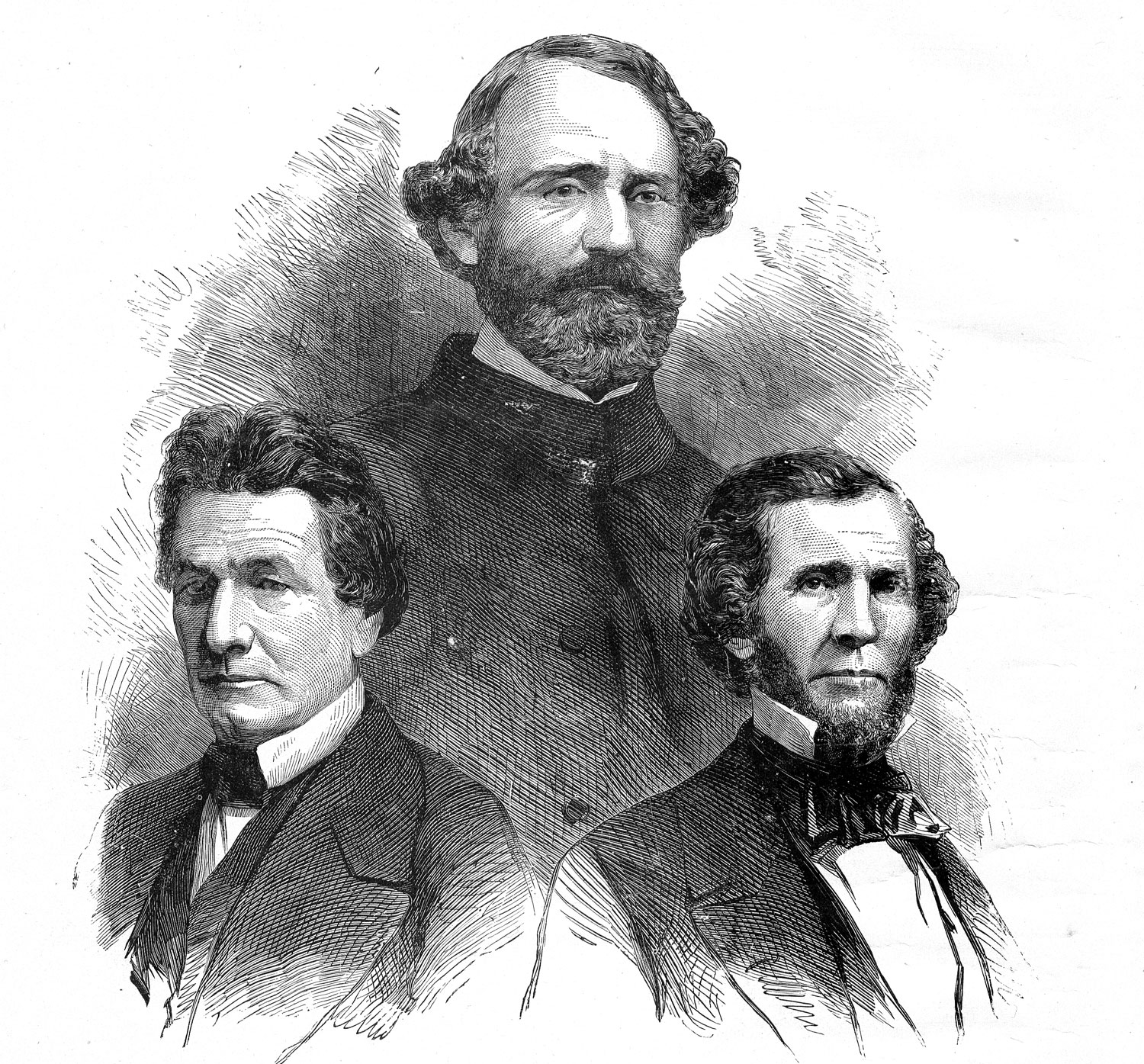
“The President has not the courage to execute the order agreed upon in Cabinet for the evacuation of the fort.” Confederate commissioner martin j. crawford to General P.G.T. Beauregard, April 1, 1861. Above: Jefferson Davis’ commissioners to Washington (left to right)—A.B. Roman of Louisiana, John Forsyth of Alabama, and Martin J. Crawford of Georgia.
As Lincoln struggled to digest the news about Sumter, Davis’ commissioners kept him apprised of their efforts to pressure Seward into recognizing their diplomatic mission as legitimate—which would imply a federal recognition of the Confederacy as an independent nation. Crawford and John Forsyth of Alabama, who arrived on March 5 (the third commissioner, A. B. Roman of Louisiana, would arrive on the 11th), reported that the new secretary of state did not know how to handle their warnings that a refusal to recognize them would result in war. Seward appeared to be giving in.24
The tone of their reports shifted suddenly on Saturday, March 9, with a brief telegram: “The impression prevails in Administration circles that Fort Sumter will be evacuated within ten days.” Davis was optimistic at this news, but through his own secretary of state, Robert Toombs, he warned the commissioners to be wary: “Can’t bind our hands a day without evacuation of Sumter and Pickens,” the telegraph flashed back. A longer letter elaborated: “The evacuation by the United States of Fort Sumter, you are to insist on as a sine qua non. While the United States maintain a force at this fort…it is utterly idle to talk of peace negotiations.”25
The commissioners agreed that “a refusal to treat with us…in the absence of the evacuation of the Charleston and Pensacola forts is, from our point of view, certain war,” but they wrote hopefully that “the Administration still talks of peace,” and even added that “the opinion gains ground here” that Fort Pickens, too, would be evacuated. Then, beginning on the 15th, the reports became more certain and more specific: “We are sure that within five days Sumter will be evacuated.” The reason, it turned out, was a new, high-level contact in the negotiations—Supreme Court Justice John A. Campbell of Alabama, who was now relaying them assurances from Seward himself. The arrangement served everyone’s agenda, allowing Seward to keep the lines of communication open without officially recognizing the Confederate emissaries, Campbell to help broker a potential peace, and the commissioners to keep Seward talking while Davis readied his government and prepared his defenses. That Campbell’s first message was an assurance of Sumter’s imminent evacuation was an auspicious sign for these would-be peacemakers.26
Lincoln could not help but know of the commissioners’ presence—if nothing else, it was all over the newspapers—but what he understood of Seward’s actual dealings with them is uncertain. Seward acted from the shadows throughout those weeks, not trusting Lincoln or anyone else in the administration to follow the path most likely to avoid war. What we do know is that for months, the chief concern Seward had been hearing from his allies in the Upper South was that a collision must be avoided or all was lost. In his view, withdrawing Sumter’s garrison would ease tensions and buy critical time with Crawford and the other commissioners, and he was relieved that Major Anderson’s ultimatum would force Lincoln to make that decision.
On March 15, Justices Campbell and Samuel Nelson arrived at the state department to urge the secretary to make peace with the commissioners. By coincidence, the cabinet had just voted to evacuate Fort Sumter, and Seward took advantage of this unexpected opportunity to inform the justices of that decision. In fact, he told them theatrically, if Campbell were to write Jefferson Davis with the news, the garrison would be removed before his letter could even reach Montgomery. Campbell eagerly relayed that message to Crawford with his own assurance that the information could be trusted. Crawford, as we have seen, passed it on to Davis.27 And everyone waited for Major Anderson to begin his move.
Campbell had informed the commissioners that the garrison would be withdrawn within five days. That deadline came on Wednesday, March 20, with no movement at Sumter. The commissioners remained confident, and urged Davis to be patient. “If there is faith in man, you may rely on the assurances we have as to the status,” they wired. “Time is essential to a peaceful issue of this mission. In the present posture of affairs precipitation is war.” But they also sent Justice Campbell back to Seward to find out what was happening. Seward calmly assured Campbell that nothing had changed—the new president was merely a bit scattered, preoccupied with distributing jobs to an endless horde of office-seekers.28
Seward did consider Lincoln to be disorganized and overly concerned with patronage, but in truth he had no idea why the order to Anderson had not yet been issued. No one did, other than Lincoln, who shared his thoughts with no one. Days passed, then weeks, and the president gave no indication of his plans. Seward was not alone in beginning to think that he had none.
Lincoln understood that evacuating Sumter would eliminate the most dangerous threat of war, but he feared that removing this important symbol of federal authority would constitute a legitimization of secession and a de facto recognition of the Confederacy. While he struggled to make up his mind, he ordered the reinforcement of Fort Pickens at Pensacola—his insurance policy in case he had to abandon Sumter. He also cast desperately about for all possible information. Even as Seward offered his guarantees to Campbell on March 21, Gustavus V. Fox, a former naval officer who had proposed a plan for getting reinforcements past the Confederate artillery at Charleston Harbor, arrived in the city to study the situation at Fort Sumter. On that same day two more emissaries departed for South Carolina to investigate the political climate.
These missions yielded nothing positive. Fox returned optimistic about his plan’s chance of success, but a telegram from Anderson insisted that it would never work. The other two scouts, transplanted South Carolinians Stephen Hurlbut and Ward Hill Lamon, reported that their native state showed none of the latent unionism on which Lincoln was relying; secessionism was widespread and deeply rooted. They also reported that Confederate forces would fire upon any U.S. ship attempting to enter the harbor. A peaceful delivery of supplies, it appeared, was impossible.29
By the time Hurlbut and Lamon reported on March 27, Lincoln knew time was short. The pressure on the president was crushing. “Our poor President…came here tall, strong, and vigorous, but has worked himself almost to death,” one senator wrote home. Lincoln himself confessed to feeling “in the dumps.” And no wonder—with every passing day Anderson’s food diminished, Charleston’s defenses strengthened, criticism from impatient Republicans grew, unionists in Virginia’s secession convention had more trouble holding off disunionists (Seward had told them, too, of the cabinet’s decision to evacuate Sumter), and odds that the authorities in Montgomery would demand action increased. Behind all loomed the overwhelming question of peace or war.
Reports of Sumter’s evacuation were gratifying to Davis, but he was too experienced a statesman to assume their truth—especially when his commissioners interspersed their reports with speculations that Lincoln might still be influenced by Republican hardliners. “Give but little credit to the rumors of an amicable adjustment,” he warned Beauregard. To Governor Pickens he noted, “I have not been of those who felt sanguine hope that the enemy would retire peaceably from your harbor.”30
So even as he encouraged his Washington commissioners, Davis monitored the progress of Beauregard’s defenses. The Charleston commander had used his time well, not only improving on South Carolina’s earlier measures for a potential assault on Fort Sumter but also sealing off the harbor from any reinforcements by sea. On April 4, he reported his preparations “all complete.”31
Davis was also under tremendous pressure, but unlike Lincoln he was spared the burden of choosing between war and peace; as he had been saying for weeks, the Confederacy sought only to be left alone, but would defend itself if necessary. As far as he was concerned, whether secession would mean war was entirely Lincoln’s decision.
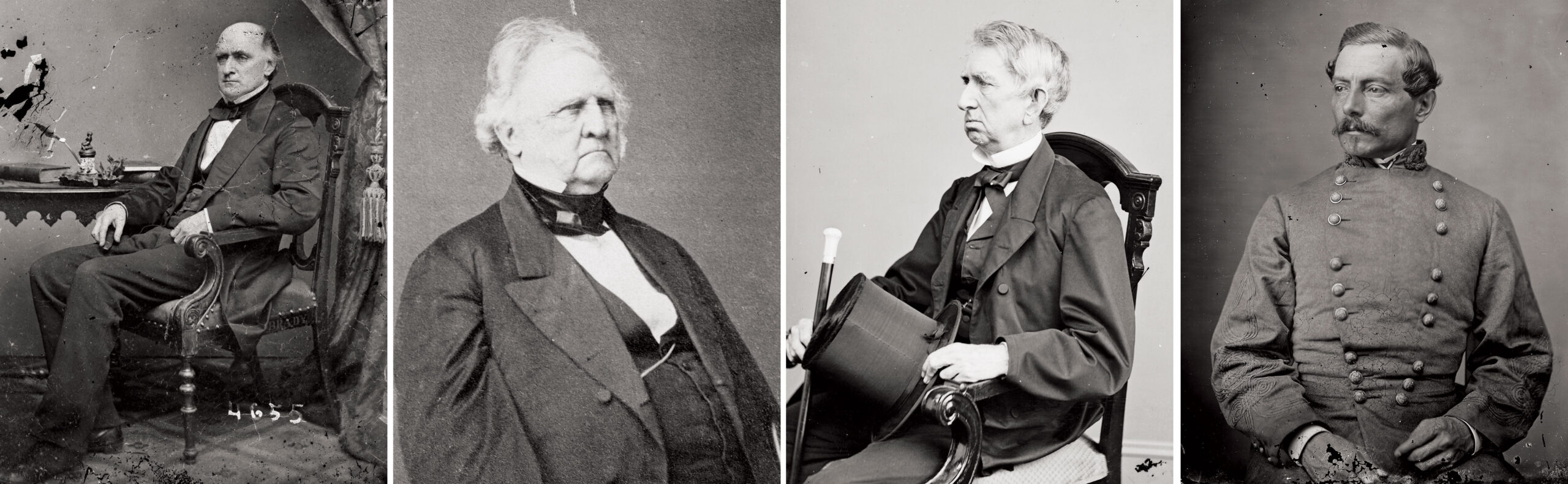 Library of Congress (Scott, Campbell, Seward); National Archives (Beauregard)
Four major players in the secession crisis (left to right): Supreme Court Justice John A. Campbell, General-in-Chief Winfield Scott, Secretary of State William H. Seward, and General P.G.T. Beauregard.
Lincoln, for his part, did not want it. For him the crisis came to a head on the evening of March 28, when General Scott caught him completely by surprise—a “cold shock” was how the president would describe it a few days later—by recommending that the government evacuate both Sumter and Pickens. None of his advisers had ever mentioned abandoning Fort Pickens—on the contrary, all assumed that federal authority in the South required that Sumter’s evacuation be coupled with Pickens’ reinforcement. More distressing still was Scott’s reasoning: The continued presence of U.S. troops in the seceded states, he said, was an irritant to southern unionists and was undercutting their ability to resist secession. This was not military but political advice. Since the administration’s reluctance to reinforce Sumter rested chiefly on Scott’s assessment, the general’s foray into politics instantly cast into doubt its entire Sumter policy. With the strain of the previous weeks bearing down upon him, Lincoln gave the startled Scott an uncharacteristic tongue-lashing. After consulting briefly with his stunned cabinet, he spent a long, sleepless night brooding on his dilemma.32
The next day—Friday, March 29—the same cabinet advisors who two weeks earlier had overwhelmingly favored evacuation now voted for reinforcement. Lincoln ordered an expedition prepared for Sumter’s relief, and one for Pickens as well, as there had been no confirmation yet that the additional troops he had ordered to Pensacola weeks earlier had ever arrived.
But still he hesitated, reluctant to give the final order that would send the ships to Charleston and war. The strain of those days was staggering. On Saturday the brittle, embattled president again lost his temper, snapping heatedly at a California politician before snatching the man’s papers from of his hands and throwing them into the fireplace. Later that day, he collapsed with what his wife called a “sick-headache,” his first in years.33
It did not take long for Davis to learn that his commissioners’ continued assurances of Sumter’s abandonment might not be accurate. When their emissary, Justice Campbell, went back to Seward again on Saturday, March 30, Seward promised to consult Lincoln and asked the justice to return on Monday. Whether the beleaguered secretary of state actually spoke to Lincoln is unknown, but on April 1, he handed Campbell a cryptic note. “The President may desire to supply Fort Sumter,” he had written carefully, “but will not undertake to do so without first giving notice to Governor Pickens.” Seward tried to soften this astonishing statement by adding verbally that Lincoln found evacuating the fort “irksome” and so allowed himself to be swayed by schemes to supply it. But not to worry—“I do not think that he will adopt any of them.” In any event, he said, there was no actual plan for reinforcement. Seward also informed the oddly credulous justice that “the President may desire to supply Pickens, but will not do so.” Desperate to believe war could yet be avoided, Campbell allowed himself to be convinced. Not only did he assure Crawford and the other commissioners that all was still well, but two days later he wrote President Davis to the same effect.34
The commissioners were not so trusting. Crawford opined to Beauregard that “the President has not the courage to execute the order agreed upon in Cabinet for the evacuation of the fort.” Regarding Seward’s new pledge, they cautioned their government that Lincoln’s “form of notice to us may be that of the coward, who gives it when he strikes.” Over the next several days, the commissioners’ reports were filled with talk of naval expeditions being prepared. These were said to be intended for the Caribbean, but that “may be a mere ruse,” they reported. “The rumor that they are destined against Pickens and perhaps Sumter is getting every day stronger.”35
Davis reiterated that the commissioners were to make no commitments without an agreement that both Sumter and Pickens be evacuated. In the meantime, as he had done since assuming office, he continued laboring “to make all the necessary arrangement for the public defence, and the Solidifying of their Government.”36
On Monday, April 8, just five weeks after Lincoln’s inauguration, the crisis broke. Four weeks earlier the commissioners had sent the State Department a formal letter requesting recognition as accredited representatives of an independent nation. Assurances of Sumter’s evacuation had led them to back away from this ultimatum, but now war preparations were so plainly evident and Seward’s responses so pitiful that they decided to demand a response. “If Seward’s reply is not satisfactory,” they informed their government, “we shall consider the gauntlet of war thrown down.”37
Seward’s reply was not the least bit satisfactory: He refused to meet with the three gentlemen, he wrote, on the grounds that the administration recognized neither the Deep South states’ secession nor, therefore, the Confederacy’s existence. The commissioners drafted an indignant response and prepared to leave Washington. But it no longer mattered. That evening they received a telegram from General Beauregard: “Special messenger from Lincoln…informs us Sumter to be provisioned peaceably; otherwise forcibly.” In Charleston Harbor, the endgame had begun, and in a totally unexpected way.38
Four days earlier, on April 4, Lincoln had finally ordered the Fort Sumter relief expedition to proceed. There was still no word from Pensacola regarding the landing of reinforcements there, and to abandon Sumter without being certain Pickens was secure would represent a recognition of secession and, he believed, the effective end of the American republic. Lincoln had finally given up his ideal of maintaining both peace and the Union—as he saw it, the time had come when he must choose one or the other.
Technically, Lincoln could cancel the Sumter mission right up to the time it actually departed, which turned out to be the morning of April 10. But circumstances took that option from his hands some three-and-a-half days early. On the afternoon of Saturday, the 6th, the administration finally heard from Fort Pickens, and the news was bad: The reinforcements ordered back in early March had never been landed. The fort’s new relief fleet, the one Lincoln had ordered on the 29th, was just then steaming out of New York Harbor, but with no guarantee that it would reach Pickens before Sumter’s supplies ran out, Lincoln saw no choice but to take his final, irrevocable step. He dispatched a State Department clerk to Charleston to notify Governor Pickens that Fort Sumter was to be relieved with provisions only, but that, if the Confederates refused permission, force would be used to throw in reinforcements as well. With that move he threw the contest back into Davis’ hands.
The clerk, one Robert Chew, arrived in Charleston on the evening of April 8 and was admitted to Governor Pickens immediately. Upon receiving Chew’s message, Pickens summoned General Beauregard and read him the note. Beauregard in turn wired Secretary of War Walker, who consulted with Davis. The president’s first instinct was resistance. “Under no circumstances,” Davis responded, “are you to allow provisions to be sent to Fort Sumter.”39
Since assuming command in early March, Beauregard had been preparing Charleston’s defenses for two possible scenarios: to prevent a hostile fleet from entering the harbor, and to take Fort Sumter by force should diplomacy fail. They would be needed now for both. It seemed clear, Davis explained later, that “the design of the United States was to place the besieging force at Charleston between the simultaneous fire of the fleet and the fort.” To avoid this disadvantage, there seemed “no alternative but to direct that the fort should at once be reduced.” On Wednesday, April 10, after two days of intense cabinet discussions, the administration ordered Beauregard to demand the fort’s immediate evacuation—“and if this is refused…reduce it.”40
Beauregard put off the demand until the following afternoon; he was short of gunpowder but expected a new shipment. In Montgomery, Davis and Walker waited impatiently, irritated at the delay. On Thursday evening word finally came—and with it an unanticipated hope of peaceful deliverance. As expected, Major Anderson had refused to comply with the ultimatum, but in refusing, Beauregard wrote, “he adds verbally: ‘I will await the first shot, and if you do not batter us to pieces, we will be starved out in a few days.’ Answer.”41
Anderson’s voluntary evacuation promised the ideal resolution: Fort Sumter would be removed from the equation without hostilities. But if the U.S. relief fleet, which was likely to show up at any time, arrived before Anderson’s food ran out, Beauregard would be left fighting both the ships and the fort—the very situation Davis was trying to avoid. Four hours of intense debate later, at shortly past 9 p.m., the president replied. “We do not desire needlessly to bombard Fort Sumter,” he began carefully. As long as Anderson gave a specific time at which he would evacuate, and in the meantime pledged his honor not to “use his guns against us, unless ours should be employed against Fort Sumter,” Beauregard should arrange a truce. If the major refused, however, Beauregard’s orders were clear: he should “reduce the Fort.”42
Again they waited. By the next morning—Friday, April 12—the suspense was too much. “What was Anderson’s reply?” the administration wired anxiously. Beauregard’s terse response crushed the last hope of peace: “He would not consent.” Anderson, also aware that the relief fleet was on its way, would not agree to stand by while Confederate batteries fired upon U.S. ships. At 4:30 that morning the attack had commenced.43
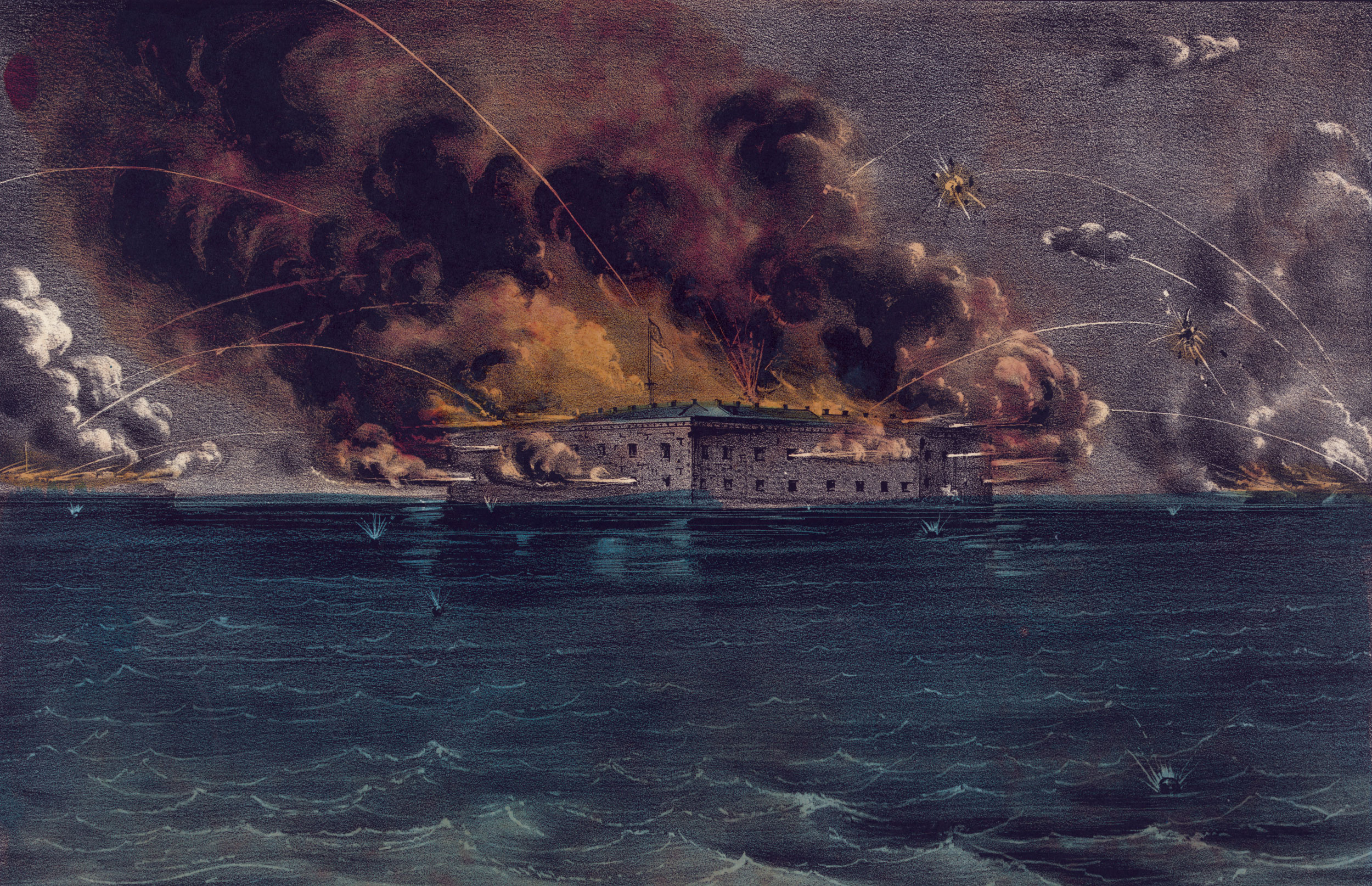 Library of Congress
“We do not desire needlessly to bombard Fort Sumter.” Jefferson Davis, April 11, 1861. The following morning, all hope for a peaceful resolution to the Sumter stalemate was lost when Confederate forces opened fire on the beleaguered fort (above), sparking civil war.
Thus it was that two moderates, both anxious for peace, together began a war. Given the paradox, a closer look at each president’s final decision is in order.
Seward’s April 1 note pledging not to resupply Fort Sumter without giving prior notice was the earliest indication that the administration was rethinking the only relief plan it had discussed up to that point: Gustavus Fox’s scheme to arrive unannounced, drive off any enemy ships by force, and run in troops and supplies at night on small, fast tugboats. Whether Lincoln had yet abandoned Fox’s plan when Seward gave his assurances to Justice Campbell is not clear, but it is certain that by April 6, when he alerted Governor Pickens that the ships were coming, the president had deliberately discarded a relief plan that had some small chance of success for one that was destined to fail. Neither he nor anyone else in the administration had any illusion that Charleston authorities might allow the relief ships into the harbor.
From the start, Lincoln’s advisors had warned that if war could not be avoided, the Confederates must be the aggressors—they had to fire the first shot. The concern was that any appearance of federal belligerence would alienate both the eight still-loyal slave states and a large segment of northerners. Typical was Illinois Republican O.H. Browning, a trusted friend of Lincoln’s, who had urged back in February that “in any conflict which may ensue…it is very important that the traitors shall be the aggressors, and that they be kept constantly and palpably in the wrong.” Several of Lincoln’s advisers had said much the same at the March 15 cabinet meeting, and others had added their voices two weeks later.44
So Lincoln’s new Sumter plan enabled him to tell the American public that the Charleston defenders “knew—they were expressly notified—that the giving of bread to the few brave and hungry men of the garrison, was all which would on that occasion be attempted, unless themselves, by resisting so much, should provoke more.” It was perfectly clear, in other words, that “by the affair at Fort Sumter…the assailants of the Government, began the conflict of arms.”45
Much of this was political posturing, of course—obviously Lincoln recognized that his relief mission involved more than “the giving of bread to [a] few brave and hungry men.” Yet he fully believed that in the larger view his administration had done all it could to avoid a conflict—short of surrendering the government. In his eyes it had been the secessionists who had created this crisis, who had pushed and prodded and backed him into this corner; it had been they who had labored “to drive out the visible authority of the Federal Union, and thus force it to immediate dissolution.” Why should the government now appear the aggressor? “The Executive,” Lincoln declared, “well understood” their goal of destroying the Union, “and having said to them in the inaugural address, ‘You can have no conflict without being yourselves the aggressors,’ he took pains, not only to keep this declaration good, but also to keep the case so free from the power of ingenious sophistry, as that the world should not be able to misunderstand it.”
Jefferson Davis, needless to say, saw the situation a bit differently. To him it was not a question of radical southerners bent on destroying the Union but of states freely exercising their sovereignty, protecting themselves from “the wrongs which they had suffered and the evils with which they were menaced” by hostile antislavery fanatics in the North. Davis insisted that he had acted “with the firm resolve to avoid war if possible”—not until “every effort compatible with self-respect and the dignity of the Confederacy was exhausted” did he “yield to the conviction that the Government of the United States was determined to attempt the conquest of this people.”
But with regard to the final act in Charleston Harbor, Davis did, of course, have an alternative: the status quo. The Confederates could have allowed the supplies to land peacefully, eluding the onus of drawing first blood that Lincoln was trying to place upon them. Davis was keenly aware of the importance of avoiding an appearance of aggression—just a week earlier, he had predicted to General Braxton Bragg, his commander at Pensacola, that “for political reasons” Lincoln would hesitate to attack the Confederates “so long as the hope of retaining the border states remains.” Carrying the notion a step further, he had mused that “there would be to us an advantage in so placing them that an attack by them would be a necessity.” Plainly Davis recognized the neat little box into which Lincoln had put him; he had pondered doing the same to Lincoln.46
Nevertheless, only one voice in Davis’ cabinet protested the proposal to strike first. Secretary of State Robert Toombs is said to have declared that firing upon Fort Sumter “is suicide, murder, and will lose us every friend at the North… . It is unnecessary; it puts us in the wrong; it is fatal.” To Davis and the others, however, losing northern sympathizers—even risking the loss of the Upper South—was less dangerous then passively allowing Anderson and his men to stay indefinitely. For Confederates, “the spectacle of a fortress held within their principal harbor” was “a standing menace against their peace and independence,” and their president knew that they would not stand for its indefinite continuation.47
In the end, Davis simply did not see that his options included permitting the supplies to land—and for precisely the same reason that Lincoln had decided that he could not evacuate the fort without attempting to supply it. Fort Sumter was the concrete symbol of federal authority in the South. Davis knew that as long as U.S. troops remained there, the Confederate states would not be independent. Lincoln knew that to abandon the fort without a fight “would be our national destruction consummated.”48
And so it was that by 1860, what had begun years earlier as the charges and countercharges of proslavery and antislavery extremists had reached the point where even moderates on each side took proslavery or antislavery as a given, a starting point rather than a radical conclusion. And by early April 1861, what had begun months earlier as the threats and counterthreats of secessionist and antisecessionist extremists had reached the point where even moderates on each side took the right or the treason of secession as a given, and were willing to go to war for it.
Russell McClintock teaches history at St. John’s High School in Shrewsbury, Massachusetts, and is the author of Lincoln and the Decision for War: The Northern Response to Secession (UNC Press, 2008).
Notes
1. Jefferson Davis to George W. Jones, January 20, 1861, in William Cooper, ed., The Essential Writings of Jefferson Davis (New York, 2003), 188; Jefferson Davis, Speech in Corinth, Mississippi, September 21, 1860, in ibid., 182.
2. Congressional Globe, 36th Congress, 2nd Session, December 10, 1860, 20-21.
3. Journal of the Proceedings of the Special Committee under the Resolution of the Senate of the 18th of December, 1860. Thirty-sixth Congress, Second Session. Rep. Com. No. 288 (1861), December 22, 1860, 2-8.
4. Abraham Lincoln, Address at Cooper Institute, New York City, February 27, 1860, in Roy P. Basler, et al, eds., The Collected Works of Abraham Lincoln, 8 vols. (New Brunswick, NJ, 1955), 3:547-548.
5. Abraham Lincoln to James T. Hale, January 11, 1861, in ibid., 4:172.
6. Abraham Lincoln to Lyman Trumbull, December 10, 1860, in ibid., 4:150.
7. Abraham Lincoln to Lyman Trumbull, December 10 and 17, to Elihu Washburne, December 13, to William Kellogg, December 11, to Thurlow Weed, December 17, and to John D. Defrees, December 18, all in Basler, ed., Collected Works, 4:149-155. See also Charles Francis Adams diary, December 22, Adams Family Papers, Massachusetts Historical Society; John M. McClernand to Charles H. Lanphier, December 25, Charles H. Lanphier Papers, Abraham Lincoln Presidential Library; Samuel R. Curtis Journal, December 28, Abraham Lincoln Presidential Library; Henry Adams to Charles Francis Adams, Jr., December 22, in Worthington Chauncey Ford, ed., A Cycle of Adams Letters, 1861-1865, 2 vols. (Boston, 1920), 1:70; Russell McClintock, Lincoln and the Decision for War: The Northern Response to Secession (Chapel Hill, 2008), 79-82.
8. Quotations from Abraham Lincoln to William Seward, February 1, and to Elihu Washburne, December 13, in Basler, Collected Works, 4:183, 151. See also Abraham Lincoln to William Kellogg, December 11, to Lyman Trumbull, December 17, and to Thurlow Weed, December 17, all in ibid., 4:150, 153, 154, and Lincoln, Resolutions Drawn up for Republican Members of Senate Committee of Thirteen, and, Inaugural Address, Final Draft, in ibid., 4:156-157, 262-264.
9. Daniel W. Crofts, Reluctant Confederates: Upper South Unionists in the Secession Crisis (Chapel Hill, 1989).
10. Abraham Lincoln, “Remarks concerning Concessions to Secession,” c. January 19-21, 1861, in Basler, ed., Collected Works, 4:176; Lincoln to Trumbull, December 10 and 17, to Elihu Washburne, December 13, to William Kellogg, December 11, to Thurlow Weed, December 17, to John D. Defrees, December 18, and to James T. Hale, January 11, 1861, all in ibid., 149-155, 172.
11. Jefferson Davis, Speech in U.S. Senate (Farewell Address), January 21, 1861, in Cooper, ed., Essential Writings, 190-194.
12. Jefferson Davis to Alexander M. Clayton, January 30, 1861, in Cooper, ed., Essential Writings, 195; Varina Howell Davis, Jefferson Davis, Ex-President of the Confederacy: A Memoir, 2 vols. (New York, 1890), 2:8, 18-19.
13. Jefferson Davis, Speech at Montgomery, February 16, 1861, and Inaugural Address, February 18, 1861, in Cooper, ed., Essential Writings, 196, 198-200.
14. See McClintock, Lincoln and the Decision for War, esp. chapters 7-9.
15. Abraham Lincoln to William H. Seward, February 1, 1861, in Basler, ed., Collected Works, 4:183; Abraham Lincoln, Inaugural Address, First Draft, in ibid., 250-261 (quotations on 256 and 261).
16. Charles S. Morehead, Speech to the Southern Club of Liverpool, October 9, 1862, printed in “Important Statement by the Ex-Governor of Kentucky,” ed. David Rankin Barbee and Milledge L. Bonham, Jr. Mississippi Valley Historical Review 28:1 (June 1941): 65-73; C.S. Morehead to John J. Crittenden, February 23, 1862, printed in Mrs. Chapman Coleman, The Life of John J. Crittenden, 2 vols. (Philadelphia, 1871), 2: 337-338; New York World, n.d., copied in Richmond Enquirer, March 16, 1861, quoted in Michael Burlingame, Abraham Lincoln: A Life, 2 vols. (Baltimore, 2008) (unabridged online version at the Knox College website, chapter 20, p. 2177 (accessed May 23, 2011).
17. Abraham Lincoln, Inaugural Address, Final Draft, in Basler, ed., Collected Works, 4:262-271 (quotation from 271); McClintock, Lincoln and the Decision for War, 196-197, 319n.19.
18. William C. Davis, “A Government of Our Own”: The Making of the Confederacy (Baton Rouge, 1994), 196-223.
19. Jefferson Davis to Francis W. Pickens, January 20, 1861, in Samuel W. Crawford, The Genesis of the Civil War: The Story of Sumter, 1860-61 (New York, 1887), 265.
20. Robert Anderson to Samuel Cooper, February 28 and March 2, 1861, (the latter enclosing a Norman J. Hall memorandum, March 1, 1861), Abraham Lincoln Papers, Library of Congress (hereafter ALP); Joseph Holt and Winfield Scott to Abraham Lincoln, March 5, 1861, ibid.
21. Abraham Lincoln to Winfield Scott, March 9, 1861, in Basler, ed., Collected Works, 4:279; Winfield Scott to Abraham Lincoln, March 11 and March 12, 1861, and to Robert Anderson, March 11, 1861, ALP.
22. Howard K. Beale, ed., The Diary of Edward Bates, 1859-1866 (Washington, D.C., 1933), March 6 and 9 entries, 177.
23. Martin J. Crawford to Robert Toombs, March 6, 1861; John Forsyth and Martin J. Crawford to Robert Toombs, March 8, 1861; and Martin J. Crawford and John Forsyth to Robert Toombs, March 9, 1861, in Commissioners of the Confederate States of America to the Government of the United States, letter book, Washington, D.C., Feb 27-April 11, 1861 (hereafter Commissioners’ Letterbook).
24. Martin J. Crawford to Robert Toombs, March 6, 1861, and John Forsyth and Martin J. Crawford to Toombs, March 8, 1861, in ibid.
25. Robert Toombs to Martin J. Crawford and John Forsyth, March 11, 1861, and William M. Browne to Martin J. Crawford and John Forsyth, March 14, 1861, in ibid.26 Martin J. Crawford and John Forsyth to Robert Toombs, March 12, 1861, in ibid.
27. John A. Campbell, “Papers of John A. Campbell, 1861-1865,” Southern Historical Society Papers 4 (1917): 32-33.
28. A. B. Roman, Martin J. Crawford, and John Forsyth to Robert Toombs, March 20 and 22, 1861, in Commissioners’ Letterbook; Campbell, “Papers,” 33-34.
29. On Fox, see G.V. Fox, “Official Report,” February 24, 1865, in Chicago Tribune, September 14, 1865, reprinted in John G. Nicolay and John Hay, Abraham Lincoln: A History, 10 vols. (New York, 1890), 3:389; Simon Cameron to Robert Anderson, April 4, 1861, and Robert Anderson to Lorenzo Thomas, March 22, 1861, in U.S. War Department, The War of the Rebellion: A Compilation of the Official Records of the Union and Confederate Armies 128 vols. (1880-1901), Series I, Volume 1: 235, 211 (hereafter cited as OR; unless otherwise indicated, all references are to this volume); Crawford, Genesis, 369-372. On Stephen Hurlbut and Ward Hill Lamon, Lincoln’s other two emissaries, see Stephen A. Hurlbut to Lincoln, March 27, Abraham Lincoln Papers, Library of Congress (hereafter ALP); and John G. Nicolay interview with Stephen A. Hurlbut, May 4, 1876, in Michael Burlingame, ed., An Oral History of Abraham Lincoln: John G. Nicolay’s Interviews and Essays (Carbondale, 1996), 62-64. Ward Hill Lamon’s Recollections of Abraham Lincoln, 1847-1865 (Chicago, 1911), 74-79, is an unreliable source on this and most other episodes.
30. Martin J. Crawford, John Forsyth, and A. B. Roman to Robert Toombs, March 26, 1861, in Commissioners’ Letterbook; L. P. Walker to P. G. T. Beauregard, March 15, 1861, in OR, 276; Jefferson Davis to Francis W. Pickens, March 18, 1861, in Dunbar Rowland, ed., Jefferson Davis, Constitutionalist: His Letters, Papers, and Speeches, 10 vols. (Jackson, MS, 1923), 5:61.
31. P. G. T. Beauregard to L. P. Walker, April 4, 1861, in OR, 286.
32. March 28, 1861 [misdated March 15], Winfield Scott memorandum, in OR, 200-201; Montgomery Meigs, March 30, 1861, diary entry in “General M.C. Meigs on the Conduct of the Civil War,” American Historical Review 26:2 (1920-1921): 300; E. D. Keyes, March 29, 1861, diary entry in Erasmus Keyes, Fifty Years’ Observation of Men and Events (New York, 1884), 377-378.
33. New York Herald, March 31, 1861; Samuel Ward to S. L. M. Barlow, March 31, 1861, S. L. M. Barlow Papers, Huntington Library.
34. John A. Campbell to William Seward, April 13, 1861, ALP; Campbell, “Papers,” 34-35; John A. Campbell to Jefferson Davis, April 3, 1861, in Nicolay and Hay, Lincoln, 3:411-412; Martin J. Crawford and A. B. Roman to Robert Toombs, March 30, 1861, in Commissioners’ Letterbook.
35. Martin J. Crawford to P. G. T. Beauregard, April 1, 1861, in OR, 283-284; Martin J. Crawford and A. B. Roman to Robert Toombs, April 2, 1861, and Martin J. Crawford, John Forsyth, and A. B. Roman to Robert Toombs, April 3, 4, 5, and 6, 1861, in Commissioners’ Letterbook; William Howard Russell, My Diary North and South (London, 1863), April 5, 1861, entry, 38-39.
36. Robert Toombs to Martin J. Crawford, John Forsyth, and A. B. Roman, April 2, 1861, Commissioners’ Letterbook.
37. Martin J. Crawford, A. B. Roman, and John Forsyth to Robert Toombs, April 7, 1861, and John Forsyth, A. B. Roman, and Martin J. Crawford to Robert Toombs, April 8, 1861, Commissioners’ Letterbook.
38. William Seward memorandum, March 15, 1861, and John Forsyth, Martin J. Crawford, and A. B. Roman to William Seward, April 9, 1861 in Edward McPherson, The Political History of the United States, during the Great Rebellion, 2nd ed. (Washington, D.C., 1865), 108-110; P. G. T. Beauregard to Crawford, April 8, 1861, Commissioners’ Letterbook.
39. Theodore Talbot to Simon Cameron, April 12, 1861, in OR, 251-252; P. G. T. Beauregard to L. P. Walker, April 8, 1861, and L. P. Walker to P. G. T. Beauregard, April 8, 1861, in ibid., 289.
40. P. G. T. Beauregard to L. P. Walker, April 4, 1861, in OR, 286; Jefferson Davis, Message of Jefferson Davis, April 29, 1861, in Frank Moore, ed., The Rebellion Record: A Diary of American Events, 11 vols. (New York, 1861-1868), 1:171; L. P. Walker to P. G. T. Beauregard, April 10, 1861, in OR, 297.
41. P. G. T. Beauregard to L. P. Walker, April 11, 1861, in OR, 301.
42. L. P. Walker to P. G. T. Beauregard, April 11, 1861, in ibid.
43. L. P. Walker to P. G. T. Beauregard, April 12, 1861, and P. G. T. Beauregard to L. P. Walker, April 12, 1861, in ibid., 305.
44. Orville H. Browning to Abraham Lincoln, February 17, 1861, ALP. See the cabinet opinions in ibid., filed under March 15 and March 29, 1861.
45. This and the following paragraph are drawn from Abraham Lincoln, Message to Congress in Special Session, July 4, 1861, in Basler, Collected Works, 4: 421-426.
46. Jefferson Davis to Braxton Bragg, April 3, 1861, in Cooper, ed., Essential Writings, 206.
47. Jefferson Davis, Message of April 29, 1861, in Moore, ed., Rebellion Record, 1:171.
48. Pleasant A. Stovall, Robert Toombs: Statesman, Speaker, Soldier, Sage (New York, 1892), 226; Jefferson Davis, Message of April 29, in Moore, ed., Rebellion Record, 1:171; Abraham Lincoln, Message to Congress, July 4, in Basler, Collected Works, 4:424.
Related topics: Abraham Lincoln, Jefferson Davis