 Library of Congress
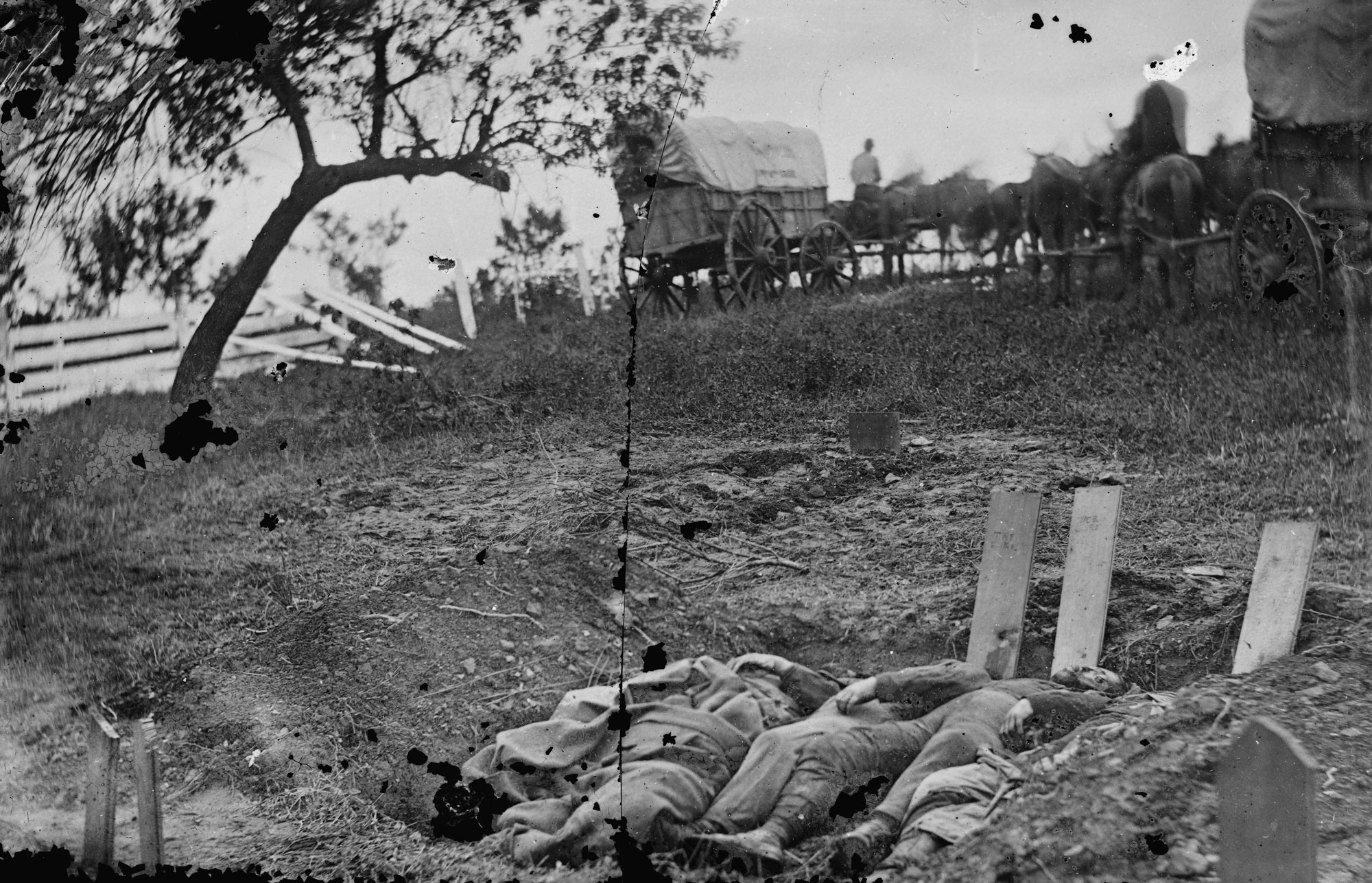
Rebel dead lie in an unfinished grave on the Gettysburg battlefield. Nearly 8,000 Union and Confederate soldiers were killed during the three-day struggle.
In August 1865, New York author John Townsend Trowbridge was seized by a sudden desire to travel the country and tour “the most noted battle-fields of the war.” He wanted, he said, to “follow in the track of the destroying armies” and “interview officers and soldiers of both sides.” Then he intended to make “a record of actual observations and conversations, free from fictitious coloring, [having] endeavor[ed], at all times and in all places, to receive correct impressions of the country, of its inhabitants, [and] of the great contest of arms just closed.” He was, in a sense, the war’s first tourist, and its first historian. And his first stop, as it continues to be for many Americans seeking a first taste of the war, was Gettysburg.1
“Gettysburg is … pleasantly situated on the swells of a fine undulating country,” Trowbridge noted upon his arrival, but the village seemed to owe its existence “to the mere fact that several important roads found it convenient to meet at this point, to which accident also is due its historical renown: The circumstance which made it a burg made it likewise a battle-field.”2
After touring that battlefield, Trowbridge took a stroll through the new soldiers’ cemetery, which was becoming quite lovely. Two years before a visitor would have seen “festering corpses at every step; some still unburied; some [so] hastily and rudely buried [that] the appearance presented was almost as repulsive as where no attempt at burial had been made.” But by August 1865 the shallow trenches and wooden marker-boards had been replaced by ordered graves and gravestones. The gate and gatehouse were complete, iron fences and low stone walls marked the cemetery boundaries, and a macadamized road lolled through the main avenue. There were as yet, however, no headstones for the “unknowns.” “Their resting-places were indicated by a forest of stakes,” Trowbridge noted. And “I have seen few sadder sights…. Each man had his history; each soldier resting here had his interests, his loves, his darling hopes, the same as you or I. All were laid down with his life. It was no trifle to him, it was as great a thing to him as it would be to you, thus to be cut off from all things dear in this world, and to drop at once into a vague eternity. Grown accustomed to the waste of life through years of war, we learn to think too lightly of such sacrifices. ‘So many killed,’—with that brief sentence we glide over … unimaginably fearful fact[s] and pass on to other details. We indulge in pious commonplaces.”3
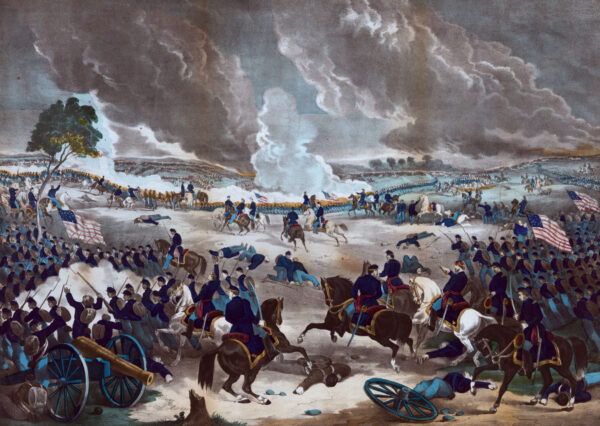
Trowbridge was right. Gettysburg had been the scene of “unimaginably fearful facts.” But even as he wrote, those facts were being churned under by the “swells of a fine undulating country” and the Battle of Gettysburg was cohering as a narrative more ordered than its cemetery. In his Gettysburg address orator Edward Everett had woven all the key ingredients together: the tactical retreat through the village; the arrangement of the Federals’ “fish-hook-shaped” defensive line; the fight for Little Round Top; the surge that broke at the Angle, saving Washington and the war.
But that was Gettysburg as told. As experienced, Gettysburg was a hyper-real, hyper-local anarchy of gore. To the regimental surgeon of the 108th New York Infantry, Gettysburg would always be the whoosh of the shell passing so close that the fuse singed his whiskers. Turning to track its path, the surgeon saw a whole battery of unluckier men he cared about now “rolling on the ground in agony” and “uttering unearthly screams.” For him, the grand narrative of Gettysburg could never quite subsume this one terrifying tableau.4
And Trowbridge was right: Something important gets lost when we “glide over … fearful fact[s] and pass on to other details.” When Abraham Lincoln invoked “these honored dead” at Gettysburg, he was talking, in part, about Isaac Taylor, who had been “hit in the top of the head by shell fragments which took off the back of his head and traveled down his body nearly cutting him in half.” His brother Patrick cried as he buried him: “Well, Isaac, all I can give you is a soldier’s grave.” Alfred Sofield was bisected the other way; a shell “exploded under [his] prostrate form … and literally cut him in two, leaving his heels in contact with his head.” Jefferson Copeland only heard a “stunning explosion” that left his entire shirtfront soaked in crimson. Sure he was dead, he gradually realized that it was the man beside him, Travis Maxey, who had supplied the blood: “[T]he shell must have exploded inside of his body, as his neck, head, and the upper part of his chest were all gone, and he could be recognized only by his clothes.”5
At Gettysburg, men were shot through everything they had: nose, ear, throat, temple. Samuel Zook was so shredded by a shell that it “expos[ed] his heartbeats to observation.” James McCleary was “so badly blown to pieces that … his ribs [were] broken open [and] you could see right into him.” John Cranston was “shot in the gluteus,” and, in deference to his pain and ebbing life, his comrades pretended not to notice the foul stench emerging from the wound. And of course, at Gettysburg, as in Iraq and Afghanistan, men were hit “in the region of the loins”—the kind of obfuscating language preferred in after-action reports. Robert Crawford was officially described as having received a mortal bowel wound passing through both hips. But as the bullet went through him, Crawford took a mental inventory of his trousers and told his friends the truth: “Boys, I am ruined.”6
All of these men died at Gettysburg, and their ends were not pretty. Only generals get last words like “Strike the tent,” or “Let us cross over the river and rest under the shade of the trees.” Lieutenant colonels get last words like “Are you sure that is the order? Well, it is murder, but it’s the order.” And privates get last words like “Oh God! I am shot,” or “I am killed,” or the more plaintive “Who shall care for Mother now?”7
Other last words at Gettysburg were sadder still. At Plum Run Valley, just west of Little Round Top, a shell took off the arm of Samuel Spear, a private in the 42nd Pennsylvania Infantry. Like a squirrel half run over in a road, Spear sprang up and ran around in circles as blood spurted from his stump. “I won’t die, I won’t die,” he cried before keeling over and dying. The last words of Jonathan Leavitt were more typical. His feet and ankles crushed by a cannon ball, Leavitt lay on the field unattended for 40 hours, watching as his extremities turned into a black “mass of corruption.” When he was finally carried to the amputation table, a doctor “passed his knife through the mass of flesh and bones and left his feet and ankles on the stretcher.” Leavitt was “evidently aware of his critical condition, but anxious to live.” His last words were simply: “Shall I pull through, Doctor?”8
Then there were the men who tried to form last words but found, with mounting panic and confusion, that they could make only unintelligible noises. Shot through the heart, Charles Frederick Taylor had enough life and air left to raspingly ask for water. A comrade obliged but noted that with the first swallow “blood began to come from his mouth & he seemed to want to say something. All I could understand was ‘Mum’ ‘mum.’” “Nobody knows how dear Fred was to me,” Bayard Taylor wrote of his “Mum-mumming” brother. “Through him I knew what a brother’s love meant. I had brighter hopes for him than myself: he was better and nobler than I.”9
Gettysburg was a tragicomic slaughterhouse, a heart-rending Grand Guignol that wasn’t supposed to happen in America. Gettysburg was not fought by professional armies but by armies of professionals. Gettysburg is a boatman shot through the liver, a schoolteacher shot in the head, a locksmith whose brains are suddenly coating the regimental adjutant. Gettysburg is an armless man, left out to die and clinging to a branch by his stumps as a creek swells to wash him away. Gettysburg is a spinning shell fragment, driving a man’s cartridge box deep into his body and detonating it. Gettysburg is a limbless torso, lying on a rubber mat, shaking his head to wipe the tears from his face as fellow soldiers open and read him his final letter from home. Gettysburg is a wife, now a widow, crumpling her hand around her husband’s last words: “I dream of holding you again in my arms…. I pray for your good health and safety more than mine…. If I should die remember not the pain of our parting, but of the many joys of our union; remember not the hatred and mistrust that kills, but the love and trust that transcends and sustains. I shall write again tomorrow.”10
The Cost of Gettysburg
Army of The Potomac
23,055 casualties
- 3,155 killed
- 14,531 wounded
- 5,369 captured/missing
Army of Northern Virginia
23,231 casualties
- 4,708 killed
- 12,693 wounded
- 5,830 captured/missing
Quotable
“After the fight is over, then one realizes what has been going on. Then [one] sees the wounded, hears the groans, see[s] perhaps his own dearest friend who he was talking to only a moment before, lie before him a mangled mass of blood and flesh, scarcely recognizable. To view death and destruction in every shape brings one back to his senses again.”
—Lieutenant Colonel Francis E. Pierce, 108th New York Infantry, reflecting on the fighting of July 3, 1863
Stephen Berry is Amanda and Greg Gregory Professor of the Civil War Era at the University of Georgia. He is the author or editor of four books on America in the Civil War era, including House of Abraham: Lincoln and the Todds, A Family Divided by War (Houghton Mifflin Harcourt, 2007).
Notes
1. J.T. Trowbridge, The South: A Tour of Its Battle-Fields and Ruined Cities (Hartford, 1866), iii.
2. Ibid., 17.
3. Ibid., 19-20.
4. For the account of the regimental surgeon of the 108th New York, see Gregory A. Coco, Killed in Action: Eyewitness Accounts of the Last Moments of 100 Union Soldiers Who Died at Gettysburg (Gettysburg, 1992) [hereafter KIAU], 59.
5. On the death of Isaac Taylor, see Travis W. Busey and John W. Busey, Union Casualties at Gettysburg: A Comprehensive Record (Jefferson, NC, 2011), 316. On the death of Alfred Sofield, see Jeffrey J. and Loree L. Kowalis, Died at Gettysburg (Highstown, NJ, 1998), 220. On the death of Travis Maxey, see Warren Wilkinson and Steven E. Woodworth, Scythe of Fire: Through the Civil War with One of Lee’s Most Legendary Regiments (New York, 2002), 237.
6. On the death of Samuel Zook, see Kowalis, Died at Gettysburg, 15-21. On the death of James McCleary, see KIAU, 55. On the death of John Cranston, see Busey, Union Casualties at Gettysburg, 519. On the death of Robert Crawford, see Gregory A. Coco, Confederates Killed in Action at Gettysburg (Gettysburg, 2001) [hereafter KIAC], 90.
7. The lieutenant who questioned his superior—“Well, it is murder, but it is the order”—was Charles R. Mudge of the 2nd Massachusetts. See Kowalis, Died at Gettysburg, 35. “Oh God! I am shot” were the final words of Second Lieutenant Silas A. Miller, Co. A, 12th United States Infantry. See KIAU, 73. “I am killed” were the last words of Private James Johnston, Co. K, 4th Michigan. See KIAU, 44. “Who shall care for Mother now?” were the final words of Private William Purbeck, 5th Massachusetts Light Artillery. See KIAU, 50.
8. On the death of Samuel Spear, see KIAU, 69. On the death of Jonathan Leavitt, see KIAU, 79-80.
9. On the death of Charles Taylor, see KIAU, 58-59.
10. The boatman shot in the liver was John Tracy, born in Ireland and died of his wounds on July 5, 1863. See Busey, Union Casualties at Gettysburg, 513. The schoolteacher shot in the forehead was Joseph S. Corbin. See Busey, Union Casualties at Gettysburg, 511. The locksmith who lost his head was Douglas Fowler, killed instantly while deploying his regiment on July 1. See Busey, Union Casualties at Gettysburg, 31. The limbless torso was an unknown Georgia infantry captain. See Coco, KIAC, 23-24. The soldier who erroneously told his wife that he would “write again tomorrow” was Thomas O. Barri, a captain in the 11th U.S. Infantry. Barri was wounded early on July 2; he was being helped from the field when he was shot again. He died shortly after getting back to Union lines. See Kowalis, Died at Gettysburg, 247-249.