KUDOS
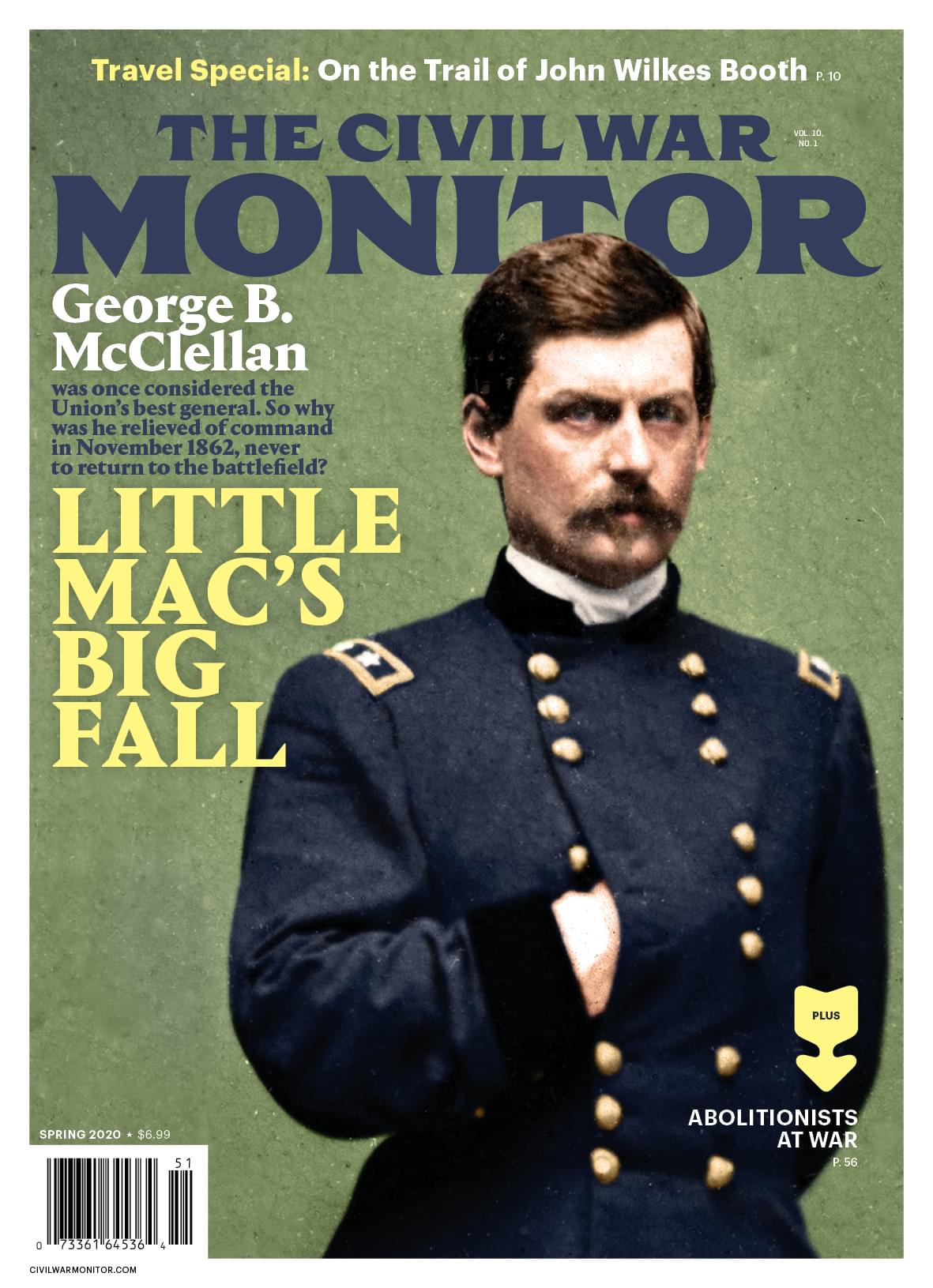
I’m writing to tell you how much I enjoyed your spring issue, especially the article by George Rable about George McClellan’s final weeks in command of the Army of the Potomac [“Little Mac’s Big Fall,” Vol. 10, No. 1]. I already knew that McClellan and Abraham Lincoln didn’t exactly get along, and that the president’s decision to remove McClellan from command after Antietam shouldn’t come as a huge surprise. But what I didn’t know—and what Rable did such a good job explaining—was how much Lincoln agonized over making the final call, as well as how the pro- and anti-McClellan factions in Washington and in the army tried to influence the president’s decision. Just a great article all around!
I also really liked the information on how much Civil War armies discarded on the march [“Figures: Lightening Their Load,” Vol. 10, No. 1]. The amount of personal and military items the troops threw away is simply staggering. Please continue to include such numbers-based features in future issues of the Monitor. They’re always enjoyable.
Richard Gove
Via email
VALLANDIGHAM’S DEMISE
I’m writing in regards to Fergus Bordewich’s article on Clement Vallandigham [“The Great Dissenter,” Vol. 10, No. 1], in which the author outlined how Vallandigham died from an accidental, self-inflicted gunshot wound while defending a man on trial for murder. I am in a position to know “the rest of the story” about the circumstances surrounding his death.
Vallandigham’s client, Tom McGehan, was accused of shooting Tom Myers by firing his pistol from inside the pocket of his distinctive astrakhan overcoat. Apparently, being a tough paid very well in those days.
At the trial, Vallandigham (who would suffer his mortal wound while attempting to show how Myers might have shot himself) had the coat introduced into evidence, and the prosecution had to admit there was no bullet hole or sign of damage to the pocket.
McGehan’s younger sister, Jessie, married my father’s uncle. (Family lore has it that she was named Jessie because her father so admired Jesse James.) For many years, the couple ran a dry-cleaning store in Miamisburg, Ohio, and Jessie did the mending and the alterations for the business.
My parents visited them often, and my mother once admired Jessie’s needlework.
“My mother taught me, but she was much better,” Jessie replied. “My brother once shot a man with a pistol he held in the pocket of his astrakhan overcoat. My mother mended it so well that at the trial they couldn’t find any sign of damage to the pocket.”
K.M. Dawson
Englewood, Ohio
ABOLITIONISTS AT WAR
The article by Frank Cirillo in your spring issue [“Abolitionists at War,” Vol. 10, No. 1] falls into serious error in stating that 11 southern states seceded in November 1860. Secession actually did not begin until December 1860, with South Carolina leading the way in the Deep South, while the Upper South did not secede until after President Abraham Lincoln’s call to arms following the attack on Fort Sumter.
Thomas E. Moseley
Newark, New Jersey
Ed. Thanks for the note, Thomas. While the sentence in question notes that “in the wake of Lincoln’s victory in the presidential election, 11 southern states would secede to form the Confederate States of America,” it does not clearly point out that the process played out over the course of several months. We could have been clearer.
GRANT VS LEE
In the section of your latest special issue, Grant vs Lee, in which you published the opinions of a panel of historians about the generals, I was stunned by the headline “Was Lee a traitor?” It seemed that after all the studious considering of the generals’ personalities and careers this was an unnecessary slur against the South’s “great gentleman.” But then I rolled the thought around in my head. I had to admit that the comment that Lee had worn the U.S. uniform, served under arms, and sworn an oath to defend the very country against which he had taken arms had merit. But just for the moment let us forget that for almost every single person on either side of the conflict, the burning issue was to determine whether the U.S. was a confederation of sovereign entities or a unified, insoluble whole. Forget also that the issue was decided not by reasoned argument and debate, but rather by force majeure—by which army could kill the most men. Instead let me pose a counter question. If the issue in deciding Lee’s status as a traitor is indeed that he swore the oath, wore the uniform, and served under arms, then is Benedict Arnold to be praised for forsaking the Revolutionary Army and returning to his native country (England) where he had lived, taken the oath, served under arms, and worn the uniform? Or even better what is your assessment of George Washington? Should he be despised for taking up arms against his native land (a British colony), a land to which he had sworn an oath and worn the uniform?
Joseph McKeown
Via email