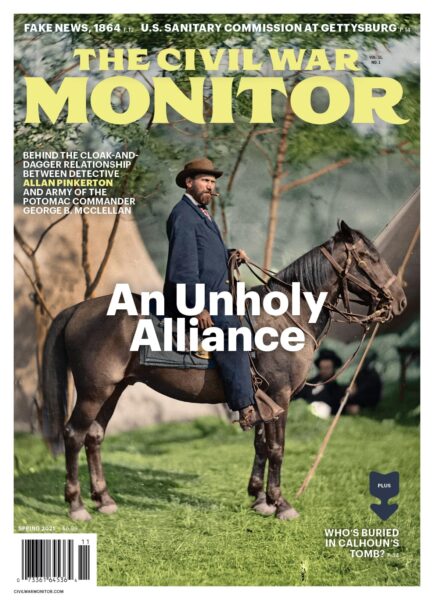
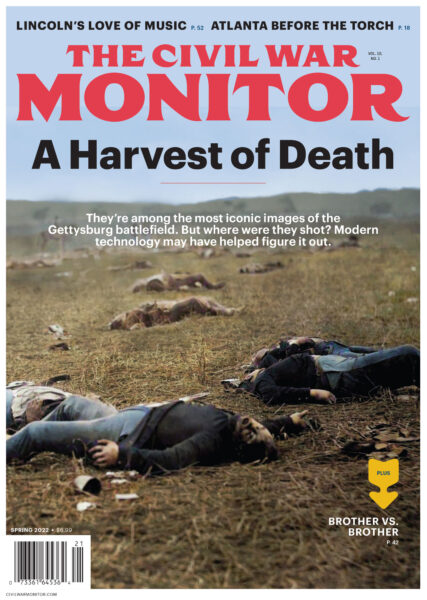
MULE SHOE MELEE
Thanks a million for Jeffry Wert’s terrific article on the fight for the Mule Shoe salient at Spotsylvania [“Mayhem at the Mule Shoe,” Vol. 12, No. 4]. I spent an hour sitting at the apex of the Bloody Angle on a trip several years ago. Then I walked down to the point at which Emory Upton’s breakthrough occurred the previous day. I sat there in reverence too. The scene and terrain instructed me. I got a greater understanding of the horror of that day. Who can say if attacking or defending was the more ghastly ordeal?
Wert is an inspired author. Thank you for this terrific presentation.
Walker Johnson
Via email
GETTYSBURG, READDRESSED
Regarding Cecily Zander’s article in the winter issue [“Gettysburg, Readdressed,” Vol. 12, No. 4], there were actually hundreds upon hundreds of “Gettysburg addresses” delivered over the years, if we consider the speeches made at the dedications of the monuments that cover the battlefield. Here is what Confederate veteran Leigh Robinson had to say at the dedication of the Virginia Monument on June 8, 1917: “Southern slavery will hold up the noblest melioration of an inferior race, of which history can take note—the government of a race incapable of self-government, for a greater benefit to the governed than to the governors. Southern master gave to Southern slave more than slave gave to master; and the slave realized it.” Such speeches should make us reflect on whether there is a place for Confederate monuments anywhere, but especially on U.S. government property.
John A. Braden
Fremont, Michigan
LIKING THE NEW LOOK
The latest issue is superb—everything about it is well done. I especially enjoyed the new layout, which gives the magazine a brighter and less cluttered feel, as well as the vivid cover and the use of large images as illustrations. Historical photos are so often shown smaller in books and on the internet, obscuring their details. Looking at the large ones in the Monitor makes me feel like I was there, almost like a participant in the events.
Alan F. Sewell
Via email
AN UNHAPPY READER
I must concur with other readers who are unhappy with the slant that the Monitor is taking in its telling of the Civil War. The increasing emphasis on race, racism, and the exploits of blacks in the Civil War is at best misleading and perhaps just plain false. To claim that race was behind every move of the Civil War is not true. To claim that the war was only about race/slavery is also not true. To demean every act of kindness and fraternal help among Union and Confederate soldiers by saying they were not true or could never make up for slavery is unkind and probably false. To subtly try to retell the many small stories of the war to make it appear that the black soldiers in fact won the Civil War singlehandedly is not true. A look at the casualty lists will correct this error easily. Perhaps the Monitor is trying to up its readership and go diverse but I can predict that you will lose the readership that is interested in the truth and the history. All the history. If you continue to exaggerate, limit, and slant the types of stories chosen and the emphasis on race, I can guarantee that I will cancel my subscription.
Annette Castellan
Via email
Ed. Thanks for your feedback, Annette, which is a lot to absorb. While I won’t address all of your claims, with which I disagree, let me focus on one: that the Monitor has displayed an “increasing emphasis on race, racism, and the exploits of blacks in the Civil War.” I don’t think our coverage of these or related topics is more or less than it’s ever been. But each is of importance to understanding, as you might say, “all the history” of the conflict, and as such, we’ll continue to run articles that shed light on them.
ABOUT THAT AD
I was intrigued by the advertisement appearing on page 71 of The Civil War Monitor’s Winter 2022 issue propagating the debunked neo-Confederate claim of thousands of blacks serving in the Confederate armies. Of course, blacks were barred from serving as enlisted soldiers in the southern armies until the very end of the war, when a small unit was organized in Richmond, too late to see any action. The renowned southern historian Bell Irvin Wiley noted this in his masterful book, The Life of Johnny Reb. While many blacks, mostly slaves, accompanied the Confederate armies as cooks, teamsters, musicians, laborers, and body servants to their masters, they were certainly not combatants. The notion that the armies of the South, a society based on a white supremacist slave system, were racially integrated, is beyond ludicrous. Perhaps the parties behind this advertisement should pay for another one claiming that Confederate general Patrick Cleburne was never nearly cashiered for simply advocating the use of black soldiers late in the war, given their claim of thousands of blacks already serving in the Confederate ranks!
Dennis Middlebrooks
Brooklyn, New York
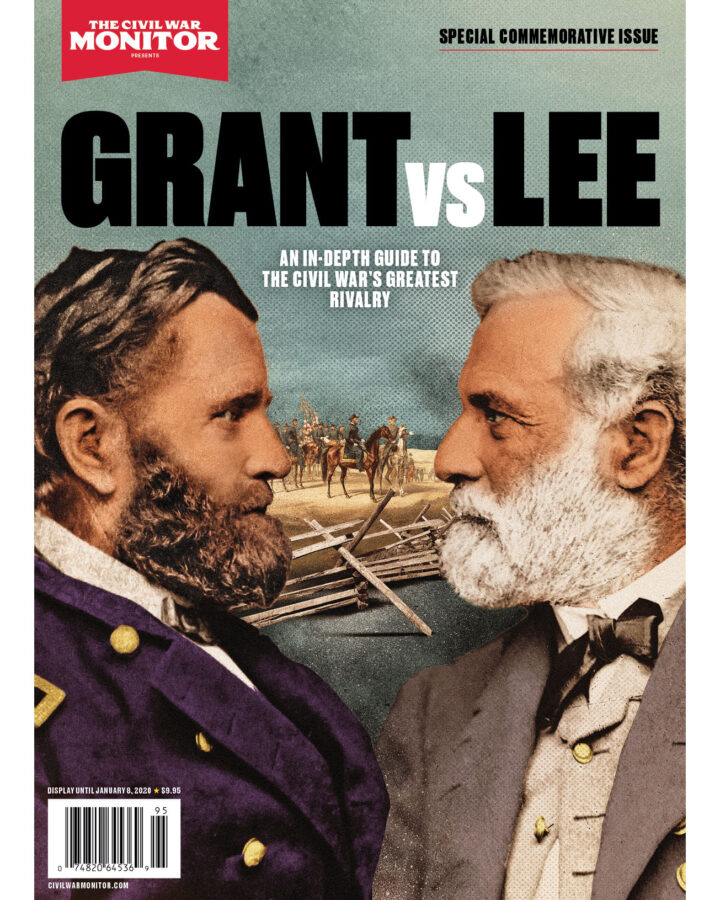
WHERE’D THE SPECIALS GO?
Why hasn’t the Monitor put out a special issue in several years?
Name Withheld
Via email
Ed: Thanks for your question. You’re right to note that we haven’t put out a special, newsstand-only issue for a few years. (Above is the cover of our most recent special issue, from 2019.) The onset of the COVID pandemic disrupted our plans to release our latest one, which had been scheduled for fall 2020. It’s still in our plans, though as of now we have no firm publication date. We’ll definitely keep you posted. In the meantime, readers unfamiliar with our specials can learn more about them—and purchase those that look to be of interest—at our website: civilwarmonitor.com/issue-library/special.
Email us at [email protected] or write to The Civil War Monitor, P.O. Box 3041, Margate, NJ 08402