ANDERSONVILLE
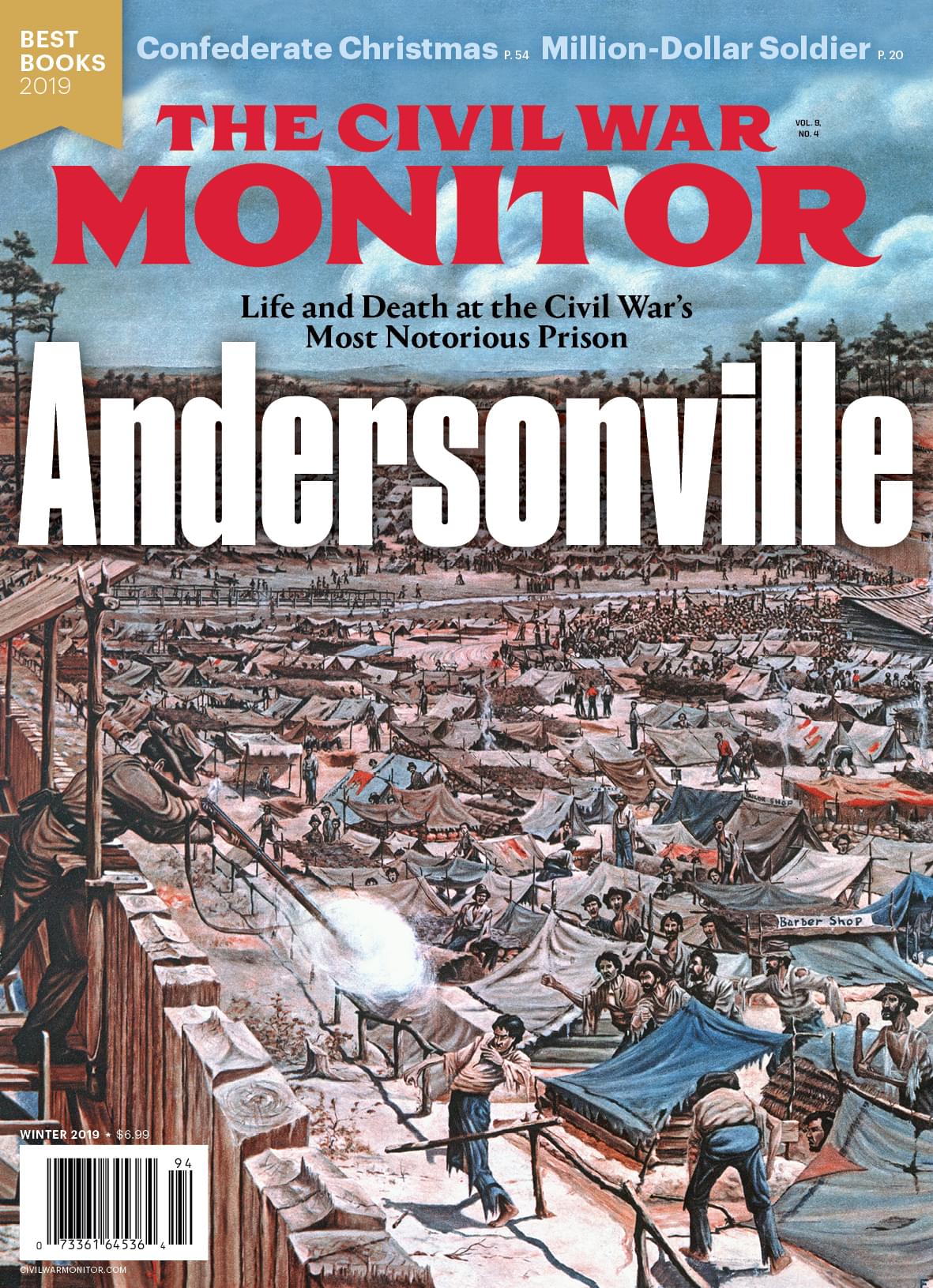
First, let me say that The Civil War Monitor is excellent—its clear, concise, and detailed articles are a pleasure to read. I took particular interest in the article on Andersonville in the Winter 2019 issue [“Andersonville,” Vol. 9, No. 4]. I recently found out that I had a great-great-great uncle who died there in captivity on October 13, 1864. My wife and I visited the prison recently and found his grave marker. It was very moving to say the least.
Ed Bittman
Dade City, Florida
* * *
While I loved the recent article about Andersonville Prison, the part that dealt with the trial of the prison’s commandant, Captain Henry Wirz, needs some clarification.
The article mentions that 158 individuals testified against Wirz. Of that number, however, only 15 testified that they had seen Wirz commit any act of violence. With a prison population of over 32,000 it would not be hard to find 15 men who hated Wirz and were willing to fabricate stories about him. In fact, it was eventually revealed that some of those 15 were frauds and liars. In addition, the 11 acts for which Wirz was convicted were not for “personal cruelty” as the article states, but for murder of nameless men (nobody could testify to their identities). Lastly, Wirz was convicted of conspiracy. But nobody else was convicted. As far as I know, you can’t conspire alone.
I am a northern guy whose Civil War ancestor, Corporal George Garman of the 36th Pennsylvania Infantry, was an Andersonville prisoner. Still, I believe this trial was a sham and could never happen today. Henry Wirz was surely a scapegoat.
Joseph F. Wilson
Magnolia, New Jersey
* * *
I’m writing to offer some thoughts on the Andersonville article that appeared in the Winter 2019 edition of the The Civil War Monitor. Overall, it provides the reader who has not visited the site a concise, general overview of the prison grounds, prisoner numbers and statistics, the prison commandant, and the postwar efforts to preserve the grounds as a National Park.
The result is eye-opening (especially regarding the atrocities that took place at the prison) but not overwhelming, offering just enough information to inspire the reader to seek out more detailed accounts of the prison itself and prison life.
One suggestion for future articles such as this is to include recommended books for further reading on the subject(s) covered.
Joe Coppersmith
Via email
ROCK OF CHICKAMAUGA
I was delighted to see the Monitor recognize Union general George Thomas [“American Iliad: Rock of Chickamauga,” Vol. 9, No. 3], a legitimate war hero—arguably in the top tier of Union commanders—yet still relatively under-appreciated. For remaining loyal to the Union he was outcast by his family in Virginia and universally hated throughout the South, yet he continued to be scrutinized in the North for his southern roots. Though in the Regular Army at the start of the war, he remained on the sidelines as others who reentered service from civilian life and/or were junior in rank were promoted ahead of him, despite his accomplishments. Unlike Ulysses S. Grant, William T. Sherman, and others, he had no home-state political champion in Washington to promote or defend him. Yet he never allowed these issues or vanity to interfere with military matters at hand. After the war, he remained in relative obscurity in various military posts while Grant, Sherman, Philip Sheridan, and others moved on to ever greater military and political fortune. True to his principles, he refused a promotion to lieutenant general by Andrew Johnson because he considered the offer as political in nature. And disgusted by the many skewed and false narratives of the conflict published in newspapers, memoirs, etc., after the war, he arranged for his personal papers to be burned upon his death, predicting to a friend that history would set things right by him. He likely would not have predicted how long it would take. Thank you for casting some much deserved light his way.
Kurt Jagielski
Via email
CONFEDERATE CHRISTMAS
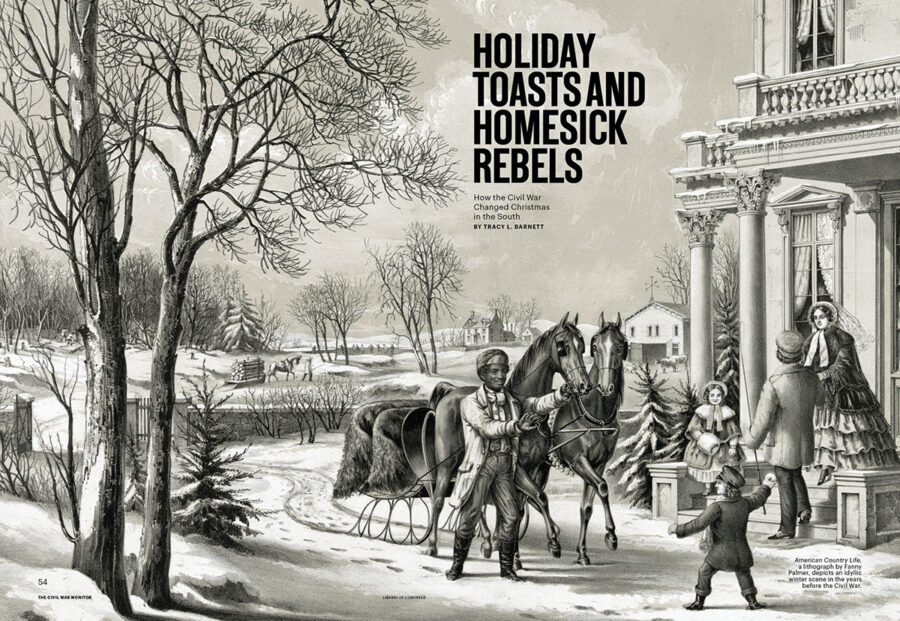
Whether or not snow was present, the southern Christmases described in Tracy Barnett’s article [“Holiday Toasts and Homesick Rebels,” Vol. 9, No. 4] are indeed white Christmases, with the millions of enslaved blacks getting no mention beyond graphics showing them chopping wood or holding horses. What was Christmas like for them?
John Braden
Via email
Ed. That’s a good question, John, but one that fell outside the scope of this particular article, which focused specifically on Christmas celebrations among elite white southerners and Confederate soldiers. To learn about how enslaved African Americans experienced Christmas in the South, you might consult Robert E. May’s Yuletide in Dixie: Slavery, Christmas, and Southern Memory (University Press of Virginia, 2019).
* * *
The 70-year-old Confederate veteran mentioned on page 56 in the Christmas in the South article who was reminiscing about his wartime experiences in 1925 would have been 10 years old when the conflict ended. I know the South was scraping the bottom of the barrel for recruits toward the end of the war, but still.
Dennis Middlebrooks
Brooklyn, New York
Ed. Thanks for the note, Dennis. Actually, the article notes that this particular Confederate veteran was reminiscing on Christmas Day 1935, not 1925—and that he was 92 at the time, not 70 (he does note that “70 long years have rolled away since that mighty struggle ended”). So, at war’s end he would have been in his early twenties. Young, but not that young!
CORRECTION
Ed. An error found its way into one of Brian Matthew Jordan’s selections in our recent roundup of “The Best Civil War Books of 2019” (Vol. 9, No. 4). In his discussion of Thomas R. Flagel’s War, Memory, and the 1913 Gettysburg Reunion (Kent State University Press), his reference to the 1913 “peace jubilee” reunion at Gettysburg somehow became a reference to the 1869 National Peace Jubilee in Boston. Our apologies.