CIVIL WAR CELEBS
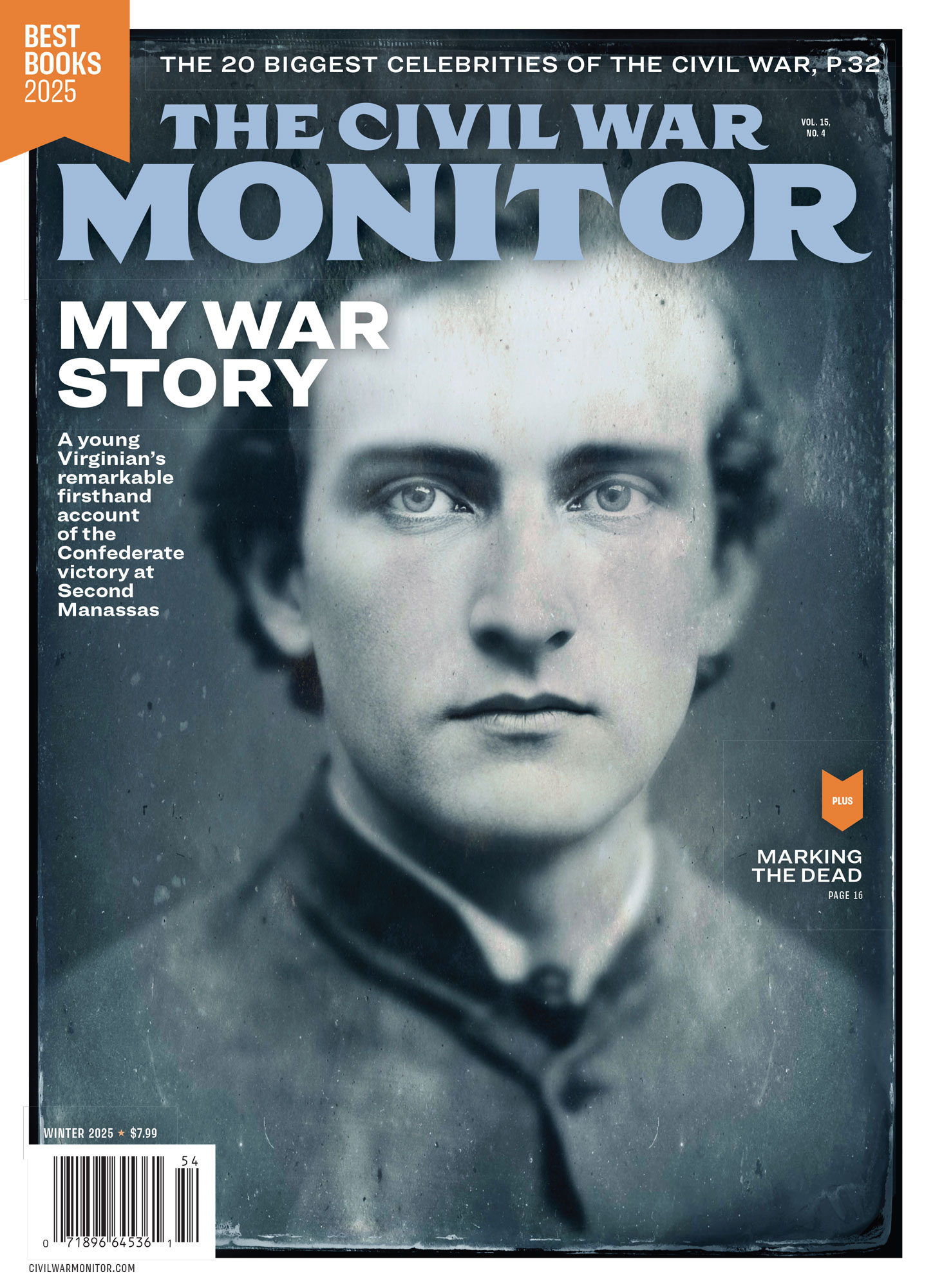
Thank you for the terrific roundup of the Civil War’s biggest celebrities in your Winter 2025 issue [“The Headliners,” Vol. 15, No. 4]. It’s hard to argue with any of the names your panel of historians included on their list, though I was mildly surprised not to see Laura Keene among them. The British-born actress made a big name for herself as a performer in America in the 1850s and even opened her own theater in New York City a few years before the Civil War. However, Keene’s likely best known to Monitor readers as the lead actress in the performance of Our American Cousin held at Ford’s Theater on April 14, 1865, which Abraham Lincoln was seeing when he was assassinated. After John Wilkes Booth fled the theater, Keene made her way to the presidential booth and cradled the dying president’s head in her lap. She continued acting after the war and died of tuberculosis at 47 in 1873.
E.M. Mayer
Via email
* * *
There is a more objective way to determine the biggest celebrities of the Civil War besides asking a panel of historians for their thoughts: Identify those people whose images appeared in mass-produced cartes de visite during the war. As it happens, comic singer Tony Pastor compiled a list of over 30 such celebrities for his song (published in May 1864) titled “The Carte-de-Visite Album.” Some of the names he mentions—Harriet Beecher Stowe, Horace Greeley, Elmer Ellsworth—made your list, while many others—including abolitionist Wendell Phillips, actress and painter Adah Menken, and prizefighter John Heenan—did not. A celebrity that both the Monitor and Pastor omitted but who deserves mention is humorist Charles Farrar Browne, better known as Artemus Ward, whose columns were often found on page one of period newspapers (a rare honor for a humorist).
John Braden
Fremont, Michigan
DRESSER QUESTION
Something seems off in Ronald Coddington’s profile of Union officer George Warren Dresser [“Faces of War: Wartime Zelig,” Vol. 15, No. 4]. Dresser was a West Pointer and served from 1861 to at least August 1864. He was brevetted to captain in that time. How is it that a West Pointer remained a lieutenant for at least three years? Did he get on the wrong side of too many commanding officers or was he just a screwup? In a war where commanding officers were sometimes in their twenties, it is hard to comprehend that Dresser’s only real promotion was from second to first lieutenant.
I always look forward to the arrival of the Monitor.
Henry Schwarzberg
Via email
Ed. Thanks for your comment, Henry, which we forwarded to Ron Coddington. He responds: “I can appreciate your surprise. The comparatively small size of the Regular Army to the Union volunteer forces resulted in fewer promotions for Dresser and other capable soldiers who remained in the Regulars during the conflict. A look at Dresser’s West Point Class reveals that roughly half ranked as captain and the other half as first lieutenant at the war’s end. His classmates who joined the volunteer army achieved higher rank. In Dresser’s case, I found no evidence of professional wrongdoing or ineptitude.”
MY WAR STORY
My thanks to Robert Lee Hodge for his presentation of Alexander Hunter’s detailed description of his experiences at Second Bull Run [“My War Story,” Vol. 15, No. 4]. I’ve read countless firsthand accounts of Civil War combat, and Hunter’s catapults toward the top of the list when it comes to capturing the fear, confusion, and adrenaline experienced by Billy Yank and Johnny Reb in battle. Please consider publishing similarly curated eyewitness descriptions of the conflict in future issues.
Kevin Manning
Via email
* * *
I love The Civil War Monitor. I’m a Virginian and a recovering Lost Causer. I grew up a mile from Brandy Station, on the ground of J.E.B. Stuart’s cavalry review before the battle there.
Your editorial in the Winter 2025 issue [“The Face of Battle,” Vol. 15, No. 4] spoke of the technological enhancement you had performed on the only known wartime photo of Confederate soldier Alexander Hunter. “We hope you agree that the results are powerful,” you wrote. Powerful, yes. However, I believe that it is wrong to manipulate the historical record in this way. Why not use the original wartime photo? I believe we are able to appreciate as much original information as possible in your journal.
Suzanne Crockett
Spring Hill, Florida
* * *
I enjoyed the people-centric perspective of your Winter 2025 issue, as it brings us right into their stories as participants instead of just reading accounts of battles we’ve already read about. I was struck by the lifelike picture of Private Alexander Hunter on the issue’s cover. It shows a real person with a look of intensity in fighting for his cause, a character that the slow-motion photography of 1860–1865 could not capture. To me, the most interesting aspect of Hunter’s wartime story was how he was captured three times and spent so much time in northern POW camps. That must have become a routine experience for him by the third time, but he kept returning to duty and fought to the end. (I can imagine the Yankees saying, “You must like it up here, since you keep coming back.”)
Alan F. Sewell
Via email
BEST SHERMAN BOOKS
I eagerly devoured four of the five books recommended by Bennett Parten in your Spring 2025 issue [“The Five Best Books on William T. Sherman,” Vol. 15, No. 1] and was richly rewarded for having done so. (I skipped Sherman’s memoirs.) As these books make clear, Sherman was much more than Ulysses S. Grant’s trustworthy subordinate; his pre- and postwar life was similarly fascinating, eventful, and significant in developing him into the person he was. Thank you, Mr. Parten!
Larry Sykora
Seaside, Oregon
THE ENEMY WITHIN
Ben Roy’s article in your Fall 2025 issue on soldiers’ use, or lack thereof, of latrines [“The Enemy Within,” Vol. 15, No. 3] is one of the most interesting works to appear in the Monitor since its inception. Too often, studies of the war focus on the proliferation of disease in the army as a result of the association between soldiers from cities and those from rural areas, the latter of whom may have not obtained immunity due to lack of exposure to such illnesses. In Roy’s piece, we learn that in addition to Victorian (and indeed modern) sensibilities about privacy for the most intimate bodily functions, discipline was a key factor in preventing the proper positioning and employment of the “sinks.”
Historian George Washington Adams, in his work Doctors in Blue, is in agreement with Roy. Adams notes that some officers, especially those from the Regular Army, took such sanitation seriously and rigorously enforced hygiene as incidents of illness increased. Adams points out that William T. Sherman not only chose the location of the latrines but ensured that his men knew how to construct them. This likely helped not only with the cleanliness of water sources but encouraged the troops to dig sinks that were more than just holes in the ground. Indeed, the Army of the Cumberland, as Adams observes, constructed sinks “covered with tight, board platforms” that were topped with cracker boxes to serve as makeshift seats. Rather than simple pits with dirty edges—which, as Adams observes, “repelled [their] users, and would be condemned today”—the officers in that army made their best effort at providing some degree of comfort and cleanliness for the men. Adams notes that, by 1864, sanitary regulations were sufficiently instituted, especially within veteran units in which the officers finally comprehended the importance of cleanliness in reducing disease.
Bryan Meyer
Pittsburgh, Pennsylvania
* * *
Re: Ben Roy’s article “The Enemy Within”: What a crappy subject to include in your otherwise fine magazine!
Michael Grimes
Via email
* * *
I just wanted to say how much I enjoyed the Fall 2025 issue. One of my favorite articles was Ben Roy’s “The Enemy Within.” The indelicacy of the subject of latrines should not keep one from realizing just how much damage was done by the armies’ neglect of simple waste management. Most Civil War buffs know that deaths by illness far outnumbered those caused by battle action; however, it’s a staggering fact that so many soldier deaths could have been avoided simply by improved camp hygiene.
James N. Kocur
Linden, New Jersey
* * *
I learned a great deal from Ben Roy’s article “The Enemy Within” on the deadly consequences of the distant siting of latrines in army camps and the resulting overall poor adherence to latrine discipline on soldiers’ health. This was no doubt a major factor in deaths from disease accounting for about two-thirds of all Civil War fatalities. I would like to have seen some commentary on what impact these unsanitary army camps had on the health of the nearby civilian population. Indeed, any army just passing through a populated area would have posed a health risk to civilians, as thousands of men would have stopped to answer the call of nature on roads, fields, and even in people’s front yards. This is a subject that has been neglected by historians for far too long.
Dennis Middlebrooks
Brooklyn, New York
WHO ARE THOSE GUYS?
I’m a new subscriber to your magazine; I think your work is outstanding and look forward to years of enjoyment. I received the Fall 2025 issue and hoped to find in “Dispatches” some information regarding the two soldiers on the front cover of the Summer 2025 edition. Would you have, and are you allowed to give out, information (names, home towns, units, etc.) on them? My own great-grandfather served in the 12th Michigan Infantry.
Thanks again for a great publication!
Alden Marvin
Via email
Ed. Thanks for your letter, Alden. The image on the cover of our Summer 2025 issue is a famous photo (titled “All Enmity Forgotten”) of two aged veterans—one Union, one Confederate—shaking hands at the 50th reunion of the Battle of Gettysburg held in 1913. The Library of Congress’ description of the image unfortunately does not include the men’s names or former units—though it does indicate that the Confederate veteran was wearing a uniform “with Maryland state buttons.” If any of our readers have more information on either of these men, and would be kind enough to share it with us, we would gladly pass it along.
KUDOS
Many magazine readers lament the passing of the Golden Age of magazines when publications like Life, National Geographic, and Ladies Home Journal were in their prime. But with its scholarly but crisply written articles, complementary and often unexpected photographs, and fascinating feedback from its readers, The Civil War Monitor testifies that the Golden Age lives on. And now I wonder what treasures abound as I eagerly sit down to read the new issue. To those of you who toil so creatively to make the Monitor the wonderful publication it is, I say God bless.
Roger Kolb
Somerville, Massachusetts
LINCOLN’S LEARNING
I enjoyed your Fall 2025 issue’s article on Lincoln [“The Military Education of Abraham Lincoln,” Vol. 15, No. 3], and noticed the author Kenneth Noe’s comments on how Lincoln’s reading habits were not as widespread as we always assumed.
I have something to contribute on that subject. Back in the 1990s I went to an antiques fair in Tupelo, Mississippi, and browsed a number of 19th-century books one seller had on his table. I picked up a small 1832 volume titled Select Speeches of John Sergeant; a signature on the bottom third of the title page, in clear, bold handwriting, read “A. Lincoln.” The book was priced at $15, which made no sense if the signature was legit, so I asked the seller, who said he had seen the signature yet hadn’t had time to have it authenticated. I wouldn’t have blamed him if he held the book back, but he let me have it, which makes me think he thought it was a fake.
I never had the funds to have an authentication done myself, but I enjoyed having the book for the next 20 years. After I turned 60, it occurred to me that it could be lost if I kept it too long and died, so I contacted a friend who owned an antiques showroom and auction house, told my story, and sold it to him for a small profit. I saw him again about a year later and asked about the book. He had sent it to be authenticated, and it was a genuine Lincoln signature. I feel blessed to have had a tiny piece of Lincoln’s life for so long.
Who was John Sergeant, and why was he presumably of importance to Lincoln? Sergeant, who died in 1852, was a popular speaker, a brilliant lawyer (he argued several cases before the U.S. Supreme Court), and a congressman from Pennsylvania. Friends persuaded him to let them publish some of his speeches, resulting in the book, a copy of which found its way into Lincoln’s possession. There were no notes in the margins, no underlined passages, just his bold signature on the title page, and the book itself was well preserved. I like to imagine Lincoln, in his circuit riding days, resting with lawyer friends in front of a fire at some inn, maybe reading passages from Sergeant’s speeches and discussing them together.
I have never seen Sergeant’s name mentioned in any books about Lincoln, so I wonder if the man had any influence on Lincoln’s ideas. Lincoln certainly thought enough of the book to keep it and put his name in it. Maybe this is some lost nugget of his background that Lincoln scholars might want to know about. Please bring this note to their attention if you think it could be useful.
Thank you for your time and for your fine magazine.
Richard Wilkinson
Amory, Mississippi
* * *
Let me add my voice to the others (I’m sure there are others) who seek to correct one word in Kenneth W. Noe’s excellent article, “The Military Education of Abraham Lincoln.” Robert Anderson was a major, not a colonel, when he defended Fort Sumter at the outset of Lincoln’s presidency.
Candice Shy Hooper
Via email
Ed. Believe it or not, Candice, yours is the only letter we’ve received about this. Thanks much for the correction!
CIVIL WAR CURIOUS
I’ve been listening to your Civil War Curious podcast and I absolutely love it. I appreciate how each episode addresses the backstory and/or little-known facts on an interesting topic. Whoever is choosing your subjects is doing a superb job, as are the various historian-guests. Also, the short episode length is appreciated; we don’t always have as much time as we’d like to devote to listening.
Please continue this series!
Wayne Cukras
Via email
Ed. Thanks for the kind words, Wayne. I’m happy to report that the second season of Civil War Curious will be launching soon. As previously, you can listen to episodes wherever you get your podcasts. Those unfamiliar can learn more about this or our other podcast series at our website: civilwarmonitor.com.
Letters to the Editor
Email us at [email protected] or write to The Civil War Monitor, P.O. Box 3041, Margate, NJ 08402