Invalid Corps Civil War recruitment poster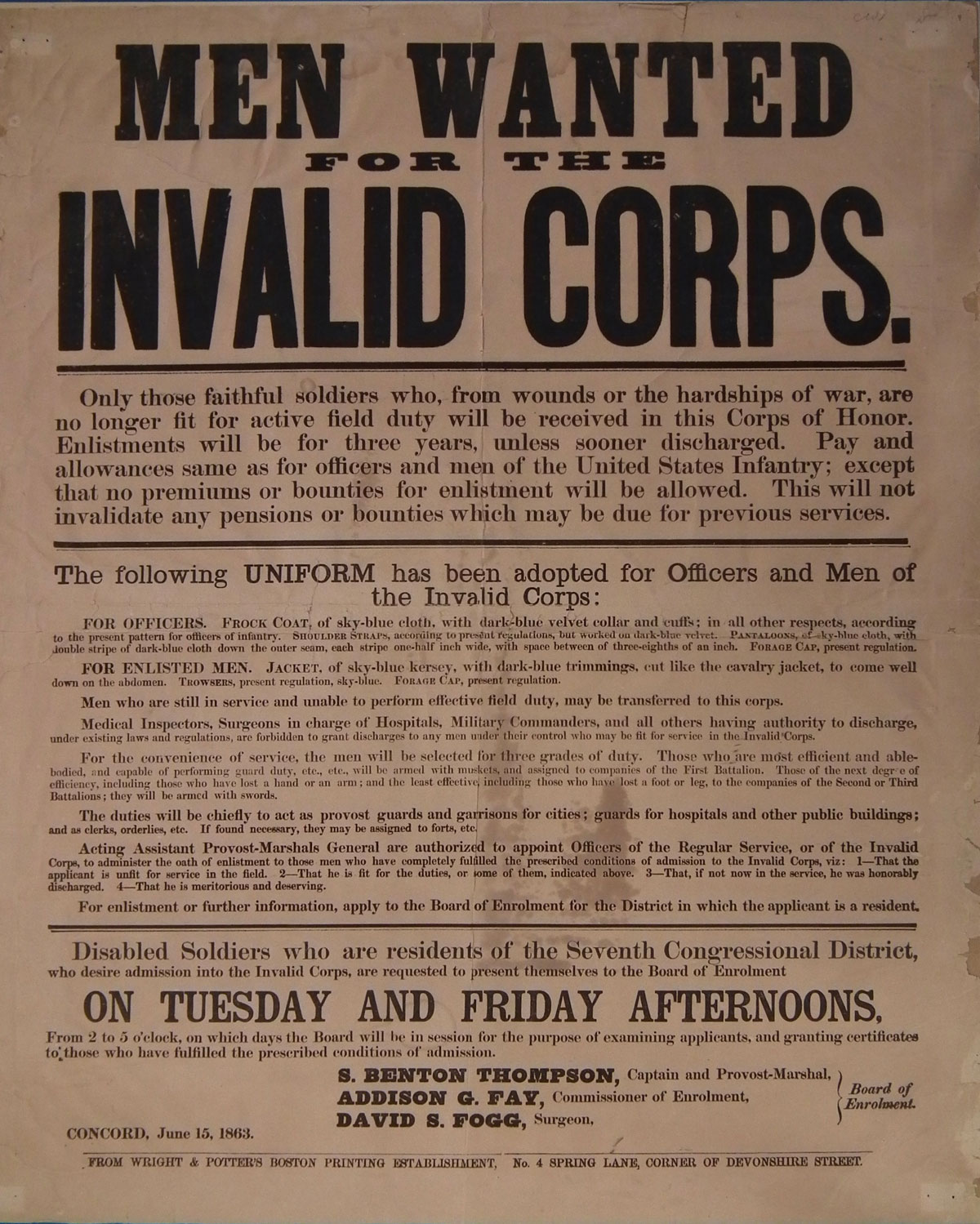 U.S. National Library of Medicine
During the battle of Chancellorsville in May 1863, Private Alfred Bellard of the 5th New Jersey Infantry was wounded in the leg. He managed to get himself to the corps field hospital, where, he later noted in his memoir of the war, “the doctors were busy in probing for balls, binding up wounds, and in cutting off arms and legs, a pile of which lay under the table.” Two weeks later, the army’s medical director visited the hospital.
On coming to Bellard, the officer inspected his injury and said, “Young man, you have had a very narrow escape, as a quarter of an inch further to the right, you would have bled to death, and a quarter of an inch to the left, your leg would have had to come off.” Bellard’s response: “I considered myself a lucky dog.”
Later that year, after he was declared fit for light duty, Bellard was assigned to the Invalid Corps, a unit created in the Union army in April 1863 to extend the military service of partially disabled or infirm soldiers. Members of the Invalid Corps mostly performed non-combatant roles—from guarding prisoners to serving as cooks to assisting in hospitals—thereby freeing their able-bodied comrades to serve on the front lines. By war’s end, some 60,000 soldiers had served in the Invalid Corps, renamed the Veteran Reserve Corps in 1864.
Yet not all of the corps’ soldiers were thankful for the opportunity to continue their service. Some yearned to be sent home; others wanted to continue to fight with their original regiments, alongside the men with whom they had enlisted. Most chafed at being referred to as “invalids.” As Sarah Handley-Cousins outlines in this issue’s cover story, “Wounded Warriors” (page 24), the Invalid Corps, while created with noble intent, proved in many ways to be a source of frustration for the men who served in it.
Want to share your thoughts about this or other articles in this issue? Send your emails to [email protected].