MONUMENTAL DECISIONS
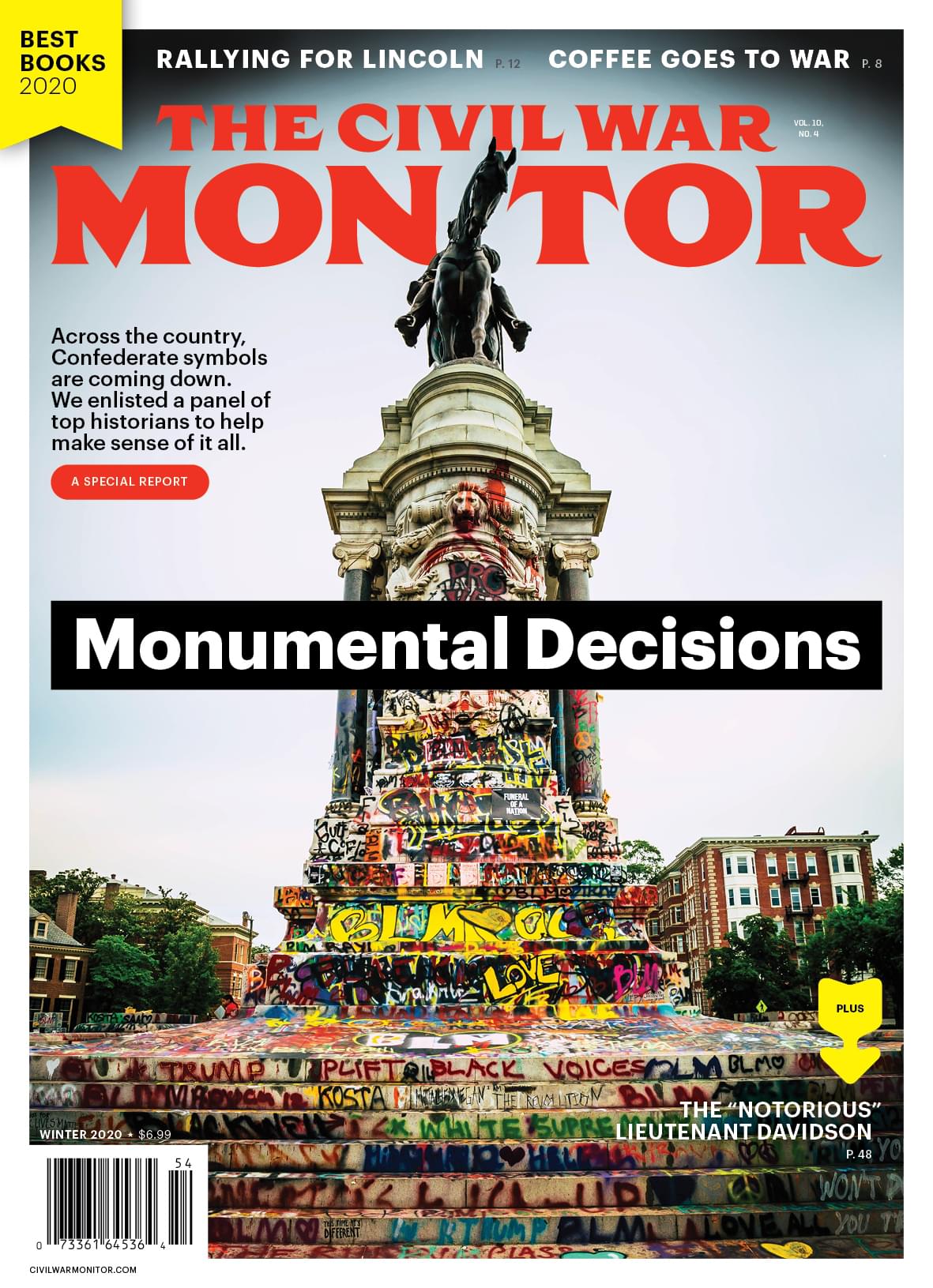
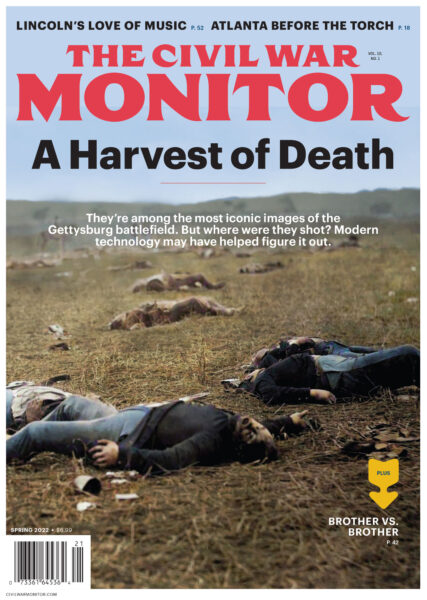
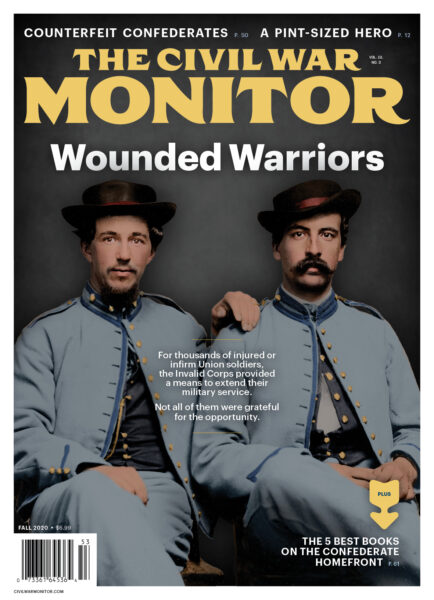
The latest issue of The Civil War Monitor was outstanding. I read it cover to cover. The essays on monuments in public spaces [“Monumental Decisions,” Vol. 10, No. 4] were thoughtful and filled with great suggestions on moving forward. I also found the final installment of Mark Grimsley’s “American Iliad” column a deeply personal reassessment of the two sides in the war. After reading Adam Domby’s article in your Fall 2020 issue [“Counterfeit Confederates,” Vol. 10, No. 3] and book The False Cause, I have reassessed my previous stand on monuments in public spaces. For North Carolina at least, Grimsley makes a strong case that Confederate monuments erected from the 1890s to 1920s were less about recognizing military valor and more about reinforcing white supremacy to justify disenfranchising black men and establishing Jim Crow policies.
Drew Klein
St. Louis, Missouri
* * *
I have been Civil War reenacting for close to 34 years. I represent the 19th Georgia Infantry, Company A. This unit was with the Army of Northern Virginia and was with Joseph E. Johnston when he surrendered to William T. Sherman. I have read memoirs of Robert E. Lee and A.P. Hill. I also have read numerous memoirs of regular soldiers and they were not fighting to maintain slavery. Lee never owned slaves but inherited them from his wife’s family. Hill detested slavery and, like Lee, fought to protect his family and home. The North also had slaves, including Ulysses S. Grant’s father-in-law. I will finish by saying all of mankind have made mistakes. To remove monuments and plaques that honor individual units and men from that time will be a mistake. To bow to political correctness is a big mistake and will affect generations to come!
Tim Trout
Via email
* * *
1) Nauseating, abominable, a disgrace; 2) shameful, monstrous, and unprecedented scandal and mockery; 3) an outrage; 4) a sacrilege. These are labels Union veterans attached respectively to 1) the Henry Wirz monument at Andersonville (1909); 2) the Robert E. Lee statue in the U.S. Capitol (1909); 3) the monument to Confederate prisoners at Chicago (1895); and 4) the Confederate Maryland monument at Gettysburg (1886).
You can’t support Confederate monuments without insulting the loyal United States soldiers the Confederates tried (successfully in many cases) to kill.
John Braden
Fremont, Michigan
* * *
The vandals responsible for the destruction and removal of Confederate statues and monuments did not act out of any sense of moral outrage against slavery. Rather, they are motivated by a hatred of all things American. Monuments to Christopher Columbus, George Washington, Thomas Jefferson, and Teddy Roosevelt have been the targets of their rage. These radical Leftists would no doubt wish to erect monuments to Stalin, Mao, Castro and other Marxists in their stead.
Paul Hoylen
Deming, New Mexico
* * *
While I concur with Megan Kate Nelson’s assessment that Santa Fe’s monument to the Federal dead obscures the complexity of the 1861–1867 conflict in the American Southwest [“The Union Soldiers’ Monument, Santa Fe”, Vol. 10, No. 4], I question her implication that the monument’s champions only intended to memorialize the Euro-Americans among the Union dead.
John P. Slough, the Union commander at the Battle of Glorieta Pass and later chief justice of the New Mexico territorial supreme court, originally lobbied the New Mexico territorial legislature to erect a monument on the Glorieta battlefield. The legislature, composed of both Euro-American and Nuevomexicano members, appropriated $1,500 for the erection of the monument in Santa Fe’s plaza. It appointed Chief Justice Slough and Territorial Treasurer Felipe Delgado to oversee the appropriation’s expenditure. The original appropriation was inadequate to complete the monument. Slough, Delgado, and Territorial Secretary Herman Heath attempted to cover the shortfall through private donations, but their efforts failed. Eventually, the territorial legislature appropriated additional funds to enable the erection of the monument in June 1868.
The significant number of Nuevomexicano legislators voting for a monument plus Treasurer Delgado’s active involvement in its erection suggest that they intended to remember both Hispano and Euro-American dead among the Federal fallen at Valverde, Apache Canyon, Pigeon’s Ranch, and Peralta. That the monument honored both Euro-American and Hispano soldiers underscores the complex nature of memory as we examine the role of Civil War memorials in our nation’s history.
Richard L. Miller
Via email
Ed. Thank you for your letter, Richard. We asked Megan Kate Nelson if she would like to respond. She writes: “Mr. Miller and I do not disagree that the participation of Hispano soldiers in Union army campaigns, and the territorial legislature’s support of the Santa Fe monument to these efforts, complicate the monument’s meaning. We do disagree, however, that Hispano participation means that these military and political actions in New Mexico were not white supremacist. As many scholars of race in America have proven, white supremacy is a political project; a person can support that project even if she/he is not white. This was most certainly the case in 1860s New Mexico, where much of the Hispano population supported the Union army’s campaigns against Native peoples—and lauded them afterward—because they benefited from them. As I note in the piece, this is why officials in Santa Fe should remove this monument, and replace it with an artwork that more fully reckons with the long, complicated, and often dark histories of Indigenous, Hispano, and Anglo communities in New Mexico.”
* * *
I thoroughly enjoyed the article “Monumental Decisions.” It provided not only context to the monuments, but some interesting proposals to add and enhance interpretation to them.
One error in the article though came from Peter Carmichael’s contribution concerning the Virginia Monument at Gettysburg National Military Park [“Let Them Stand But Not Alone,” Vol. 10, No. 4]. While he is quite correct in most of his assessment, he states, “Below him [Robert E. Lee] are six bronze soldiers from the three branches of service—infantry, cavalry, and artillery—assuming military poses around a central equestrian figure waving the Confederate flag.” The monument does not exhibit the Confederate flag, but rather the flag of the Commonwealth of Virginia. This is clearly evident in the photo of the monument you ran parallel to the
contribution.
Carmichael would have been better served to document and interpret the actual history of the monument, including the fact that it had originally been intended to showcase the Confederate flag, a plan that met stiff resistance from Union veterans and other northerners. Park ranger Chris Gwinn has done a fantastic job describing the compromise reached to exclude the Confederate flag from the monument, and to put in its place the flag of Virginia, as well as the Lost Cause narratives utilized at the dedication.
Christopher Roosen
York, Pennsylvania
* * *
I found the article on Confederate monuments very thought provoking. But I feel Peter Carmichael has missed some of the significance of the Virginia Monument at Gettysburg.
On two separate visits to the battlefield I was told this statue stands near where Robert E. Lee watched Pickett’s Charge, and the corresponding state statue of General George G. Meade stands near his headquarters. In short, the two generals face each other as they did on July 3, 1863. Meade’s statue is only “small and insignificant” when seen from Seminary Ridge. It isn’t apparent just how far apart the two ridges are until you get off the park’s roads.
I’ve taken horseback rides from the Union and Confederate sides of the battlefield to the Trostle House. The size of the field the Confederates crossed on that afternoon is not fully apparent from either ridge, but sitting in the middle of it on horseback, not much higher than the soldiers who fought on foot, the distance and undulations of the terrain are indeed sobering.
K.M. Dawson
Englewood, Ohio
WHO IS THAT GUY?
I’m sure you will be inundated by readers who notice an erroneous identification of a soldier as a member of a North Carolina regiment in the photo on page 19 of the Winter 2020 issue. First, the soldier’s belt buckle says U.S. in reverse. Second, Confederate officers did not wear shoulder bars; their rank was displayed by galons on the sleeves and rank devices on a stiff collar that also depicted the branch of service. I am baffled that this slipped by an astute editor.
Fred H. Stout
Pacific, Missouri
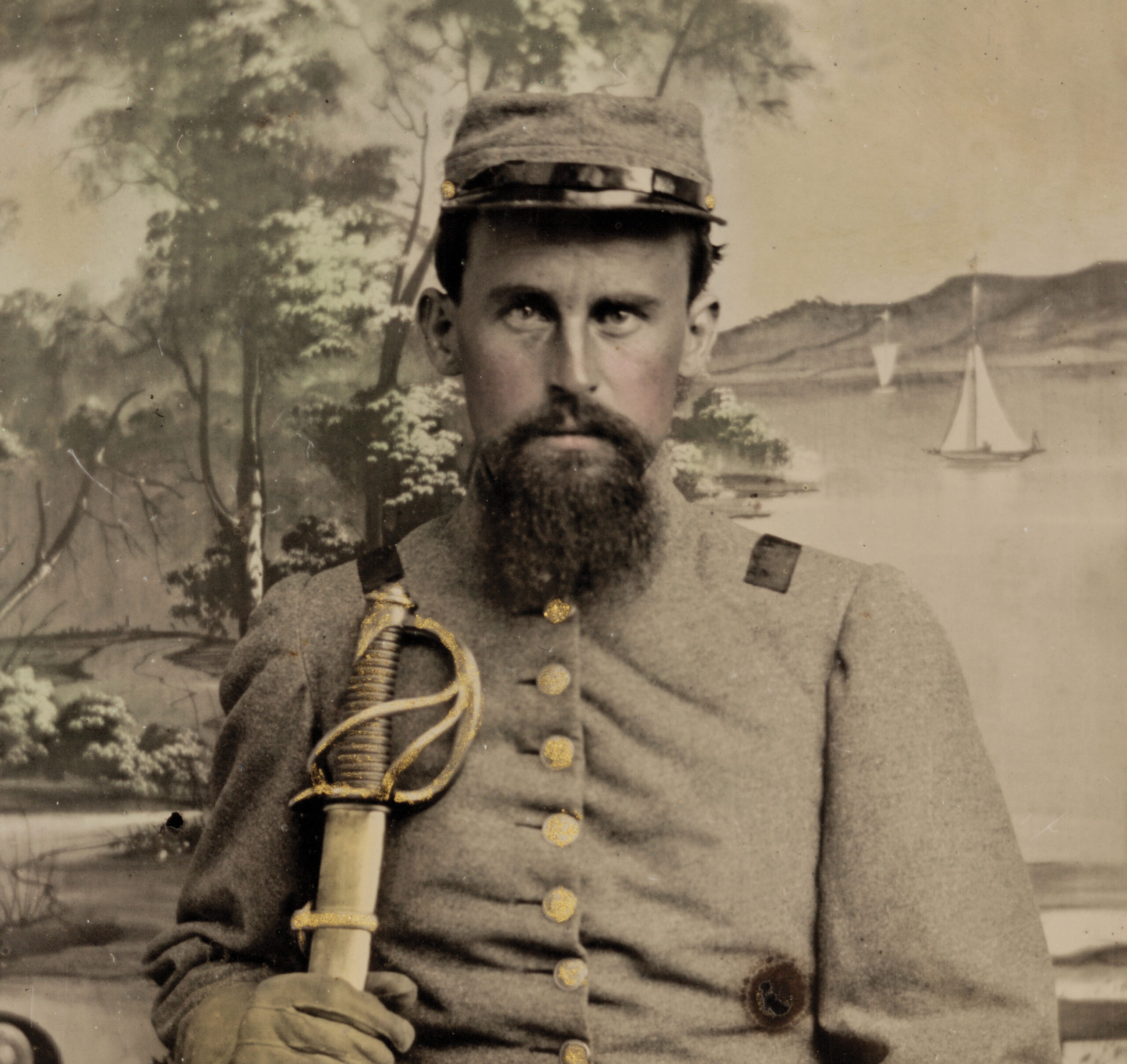
Ed. Thanks for your note, Fred. We obtained a copy of the image from the Library of Congress’ online photo database, which identifies the soldier as Lieutenant Robert Pryor James of Co. E, 20th North Carolina Infantry. In light of your claims, we reached out to Military Images magazine publisher Ron Coddington, who consulted a few of his fellow Civil War photo experts for more information. He reported back with the following: that this soldier was photographed in front of a well-known backdrop associated with images made early in the war in the Wilmington-Smithville area of North Carolina; and that his uniform is Confederate (it was not uncommon for Rebels to wear the U.S. buckle, especially early in the war, and the shoulder straps are of a style that can be seen on a variety of militia uniforms, North and South). Ron concludes, “I am confident that there is a high likelihood that he served with the 20th North Carolina.” We stick by our ID.