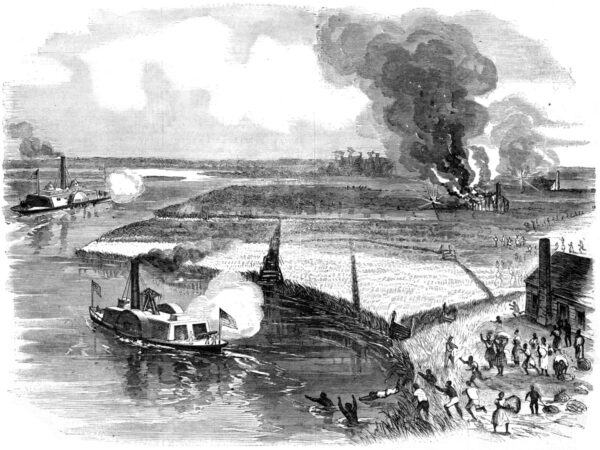
Civil War-era currency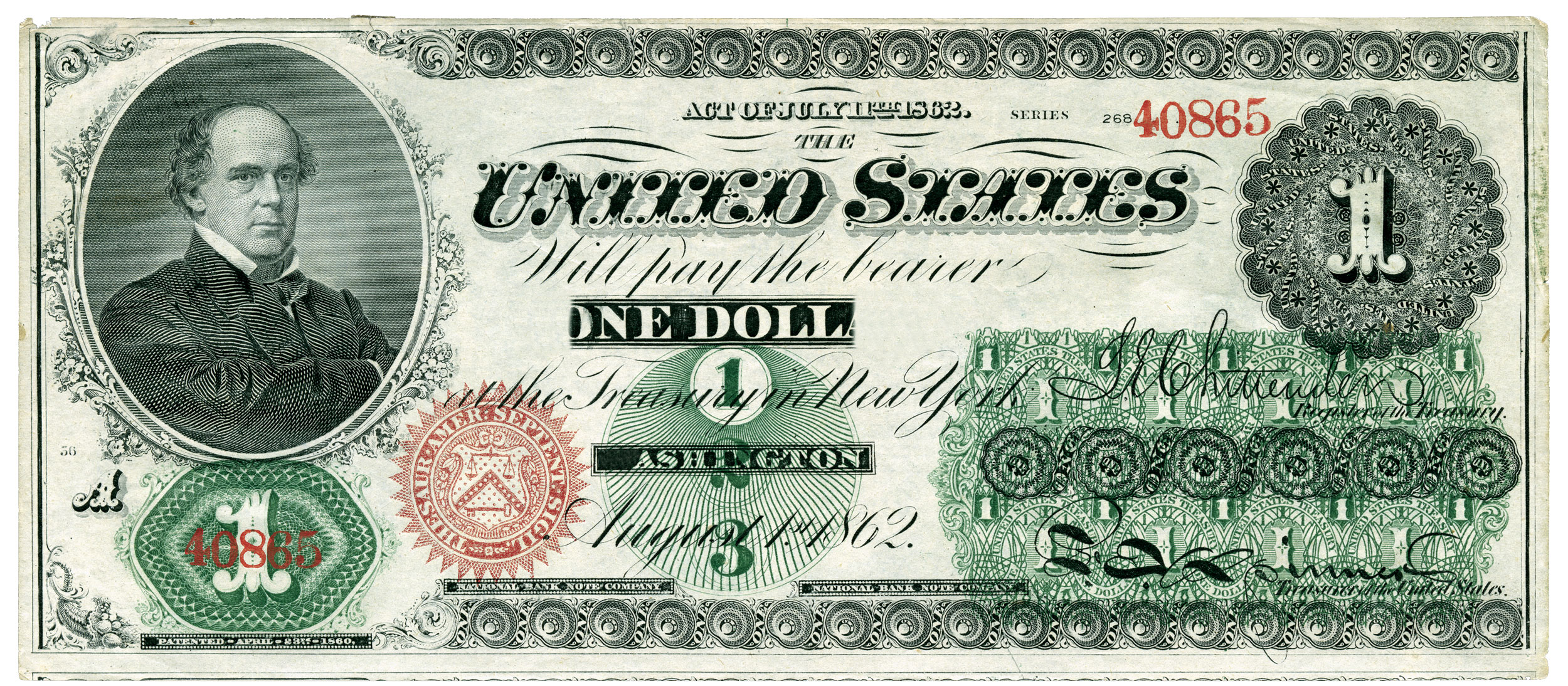 National Numismatic Collection, National Museum of American History
The men who flocked to Union training camps after the attack on Fort Sumter have always been regarded as the most selflessly patriotic of all those who served in Mr. Lincoln’s armies. Contemporary newspaper accounts, regimental histories, and the veterans’ own memoirs often depict them as tossing down their tools and marching instantly to their country’s defense. For over a century, secondary histories of the war reflected that image, but a closer look at the economic conditions of 1861 reveals that vast legions of those early recruits were desperate for any kind of remunerative employment. They and large proportions of those who followed them into uniform in 1862, well before the advent of lavish bounties, were lured as much by money as by patriotic sentiment.
The question of whether the Civil War was a “poor man’s fight” has been long debated but never satisfactorily resolved. Statistical studies have compared the wealth of soldiers from single communities with that of their fellow citizens, but the conclusions have been broadly contradictory. Most of those studies also had to rely on average wealth, which is easily skewed by a few extremely rich families. Quantitative analysis of soldiers’ writings, meanwhile, depends on the candor of the soldier, the interpretation of the analyst, the breadth of material examined, and the degree to which that material represents the overall population of Civil War Soldiers.
 New York Public Library
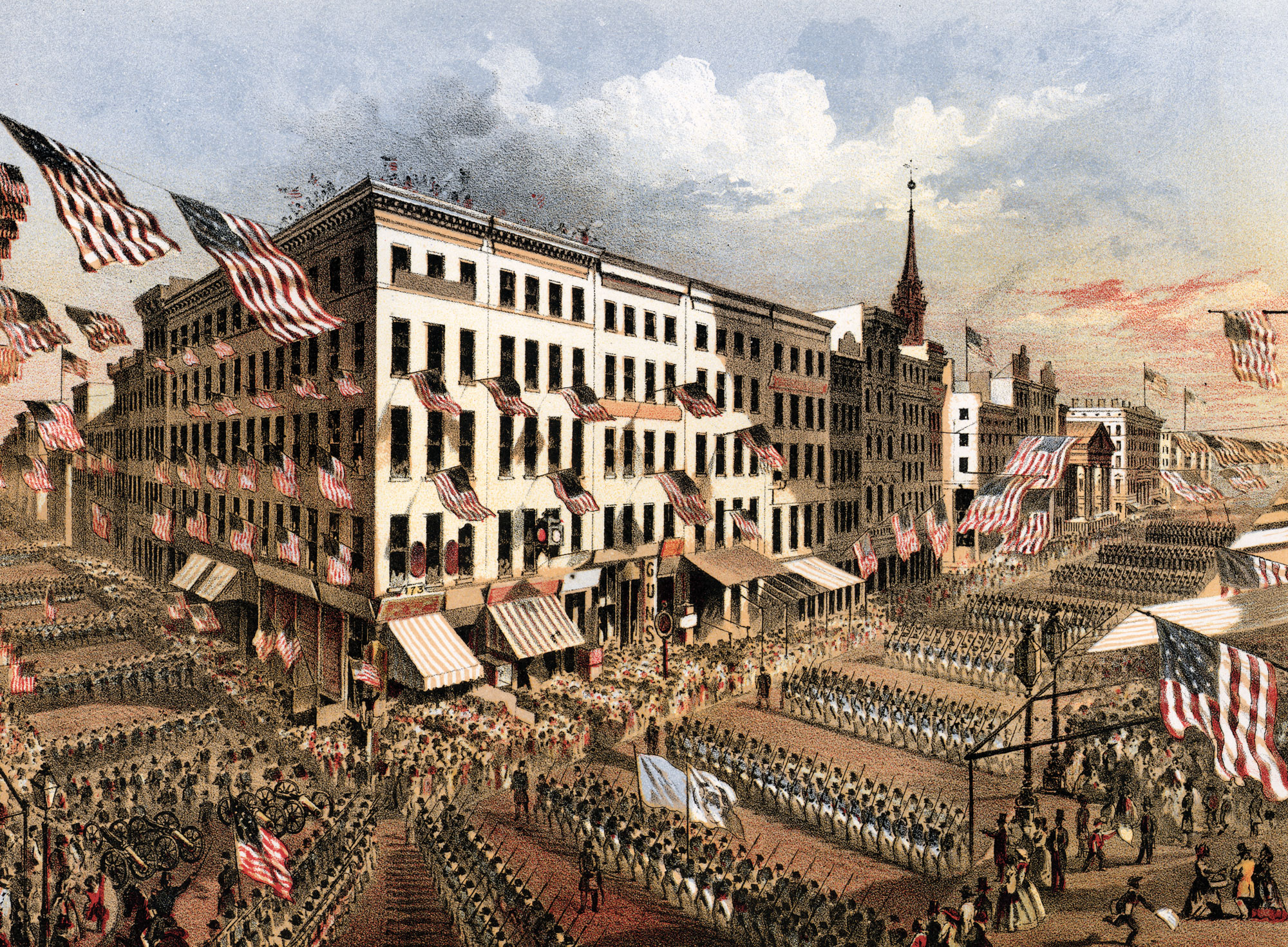
The men of the 7th New York State Militia march through the streets of Manhattan to great fanfare on their way to war in April 1861. While it has been long thought that such early war volunteers were motivated largely by patriotism, financial incentives played a significant factor in volunteerism, even during the war’s first months
A relatively new survey of the 1860 census from the University of Minnesota finally allows a determination of each state’s median wealth for that year.1 Median wealth neatly divides any cohort in two, with half below the median and half above it. Using that measure, I conducted my own examination of the economic status of thousands of Union soldiers in the various northern states at each recruiting period, and found that a substantial majority of them came from the poorer half of society. Units that were raised for short enlistments with some expectation of easier or safer duty frequently attracted solid majorities of recruits from the wealthier strata, but by a margin of more than two to one, the men who did most of the fighting were from the poorer classes. The 90-day troops raised under Lincoln’s first call on April 15, 1861, were the poorest of them all.
Virtually forgotten now, amid all the memorable political and military distractions from late 1860 and early 1861, is the severe economic downturn of that winter. Serious discussion of secession began immediately after the election of Abraham Lincoln, with South Carolina’s formal declaration coming at the outset of winter and the entire southern tier of states pulling out of the Union over the next six weeks. That division precipitated a decline in trade between the sections, with some southern boycotting of northern goods and southern repudiation of sometimes-longstanding debts to northern creditors. State and railroad securities dropped in value anywhere from 20 to 40 percent within a fortnight of the election, at the first hint of secession.
 Library of Congress
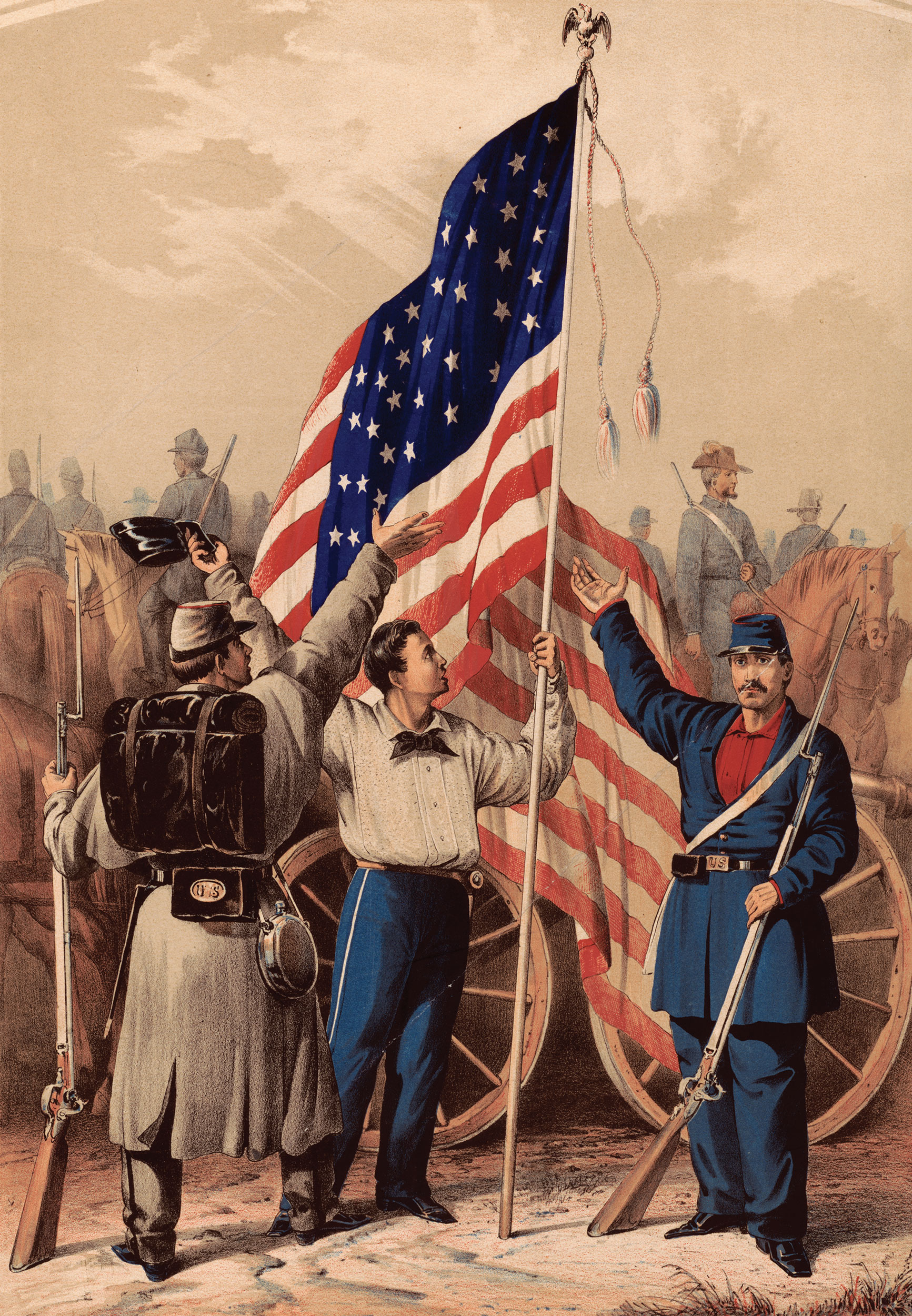
A substantial majority of Union recruits during the Civil War came from the poorer half of society, and the 90-day volunteers raised under Abraham Lincoln’s first call for troops on April 15, 1861, were the poorest of them all. Above: James Fuller Queen’s patriotic 1861 lithograph of early war recruits titled “The Volunteers in Defence of the Government Against Usurpation.”
Those reactions, along with a cotton embargo, hit the industrialized states of the Northeast especially hard. Reduced demand subjected New England’s perennially impecunious shoemakers and textile workers to production slowdowns by Christmas, and their situations only worsened in the spring and summer. One New York City newspaper estimated that 25,000 New York factory workers had lost their jobs before November ended, and by early January, New Hampshire editors were describing a stagnant business climate. By the third week of February the Philadelphia Inquirer calculated that 40 percent of that city’s industrial workers had either been laid off or had their workweeks cut so short that they could not support themselves. A Rhode Island paper supposed that three-quarters of that heavily industrialized state’s labor force lacked steady work before the local economy began to recover. Democratic sheets tended to emphasize such malaise while their Republican competitors leaned toward exaggerated optimism, but abundant contemporary testimony corroborates the reports of “hard times.”2
The more agrarian economy of the states in the West might have afforded them some insulation from that recession in manufacturing had it not been for the impact of secession on southern bonds and river traffic. Individual banks were the source of most currency at that time, and the farther west one went, the more common were banks that secured generous proportions of the notes they issued on southern bonds. With most of the southern states considering themselves out of the Union, including Louisiana and the trade center of New Orleans, confidence in those bonds promptly plummeted. Money from banks heavily invested in them was quickly discounted in the marketplace, and those discounts spread through the Ohio Valley and the watershed of the upper Mississippi. Illinois and Wisconsin bank notes were among the most deeply depreciated, and by the time the guns opened on Fort Sumter it was difficult to pass Wisconsin money anywhere.
Farmers in that region had enjoyed successive years of bumper yields in crops and livestock, but such abundance depressed prices generally. With a soft market and currency scarce, it was a lucky man who could sell his crop or herd at all, let alone for cash, the face value of which might evaporate before he could find a bank to accept the deposit. Great Lakes lumber producers faced similarly low demand.
Banks that managed to survive the currency contraction refrained from lending, which brought an abrupt halt to construction and contributed further to the decline in commerce. Riverboats began tying up for lack of freight or passenger traffic, although no blockade actually closed the Mississippi until a few weeks after hostilities opened. St. Louis, Quincy, Alton, Hannibal, and well-known towns farther upstream lay eerily quiet; those who did travel the river described those places as “grave-yards,” “deserted,” “prostrated,” and “grown over with grass.” Journalists as far west as Kansas acknowledged that “thousands engaged in trade and commercial pursuits, are thrown out of employment by the general derangement of business.”3
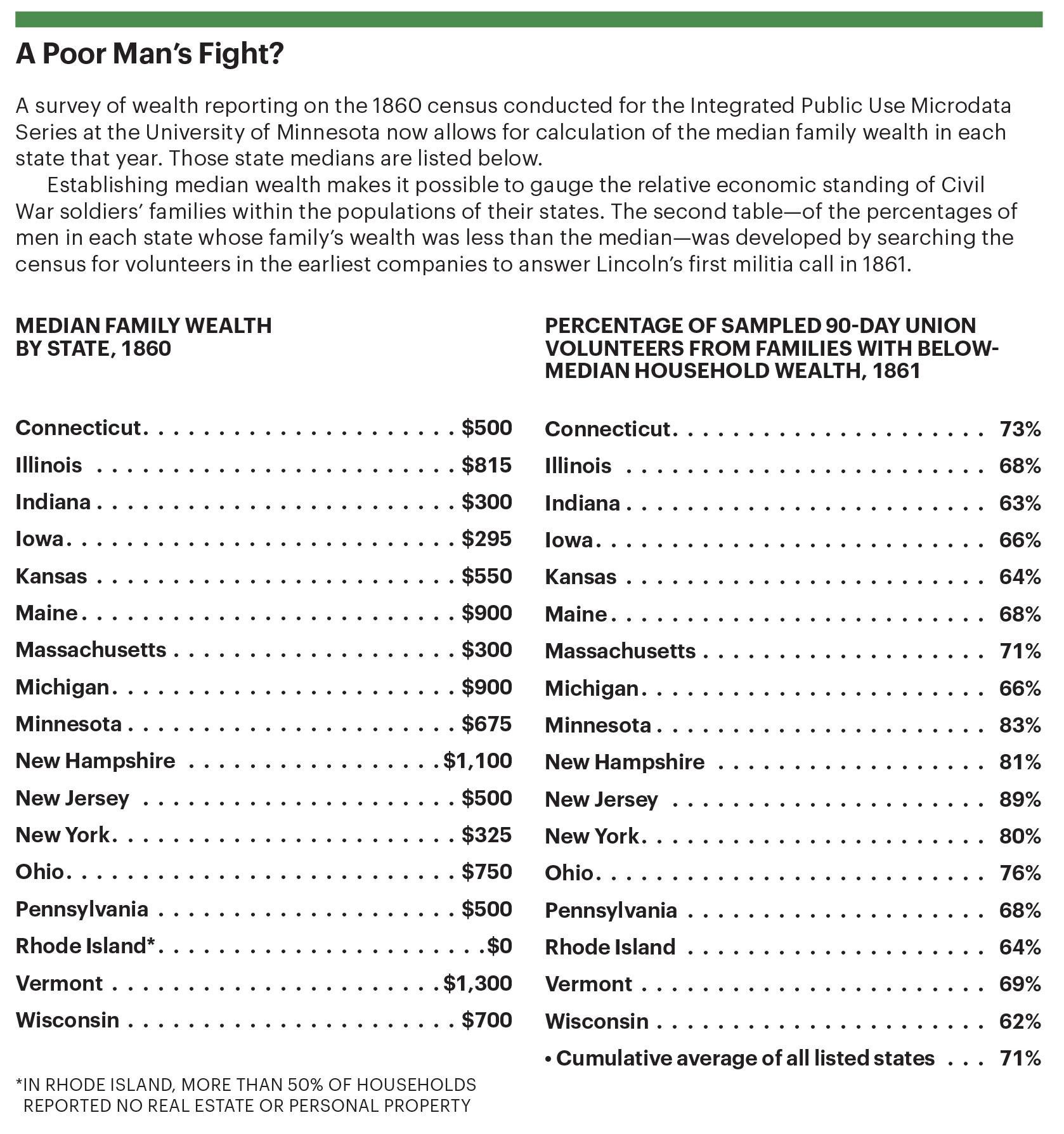
Amid such economic disarray, it should be no surprise that when President Lincoln demanded 75,000 three-month militia after the attack on Fort Sumter, the poorest segment of society produced the lion’s share of the volunteers. In most states, at least two-thirds of the men in the first companies to enroll came from the poorer half of their state’s population. In New Jersey, 89 percent of the first organized company hailed from families with less than the median wealth; in Minnesota the figure was 83 percent; in New Hampshire, 81 percent; and in New York, 80 percent. In the first regiment recruited in Kansas (which happened to be a three-year regiment), the poorer half of that state supplied 87 percent of the surveyed company.
The cumulative average of poorer men in that first call came to 71 percent—nearly two and a half times the proportion of volunteers from the upper economic strata. That percentage is the result of conservative calculation, and many of those enumerated above the median lay barely above it. Additionally, significant numbers of men who had claimed median wealth during the summer census of 1860 had endured serious economic setbacks in the subsequent recession. The truly rich man, or his son, was a relatively rare character in the Union army anytime during the war, but especially among those who enlisted at the outset.
As a reporter for the Dubuque Herald, Franc Wilkie accompanied the 1st Iowa Infantry on its campaign into Missouri. In a memoir of the experience written over a quarter of a century later, he portrayed that regiment not as a phalanx of determined patriots but as a diverse collection of adventurers, dreamers, and idlers, most of whom were financially embarrassed.
“I knew the young men who responded to the call,” Wilkie wrote, “—knew them by hundreds. They were clerks on small salaries; they were lawyers with insufficient business; they were young men with no occupation and anxious for employment.” He saw toilworn farm lads in search of excitement, husbands in flight from shrewish wives, and opportunists hoping to enhance their station with military rank or the political advantage it might bring, but most of them mainly needed money. They included “physicians with limited practice” as well as “clergymen with unappreciative parishes, small incomes, and unsympathetic social environments,” and none of them expected the Rebels to put up a fight. “It was a picnic, … with all the pleasure of a free excursion, new faces and places, and pay, food, and clothing during their absence.”4 Wilkie’s portrait of the 1st Iowa comported with the financial standing found in that regiment’s Company A, two-thirds of which was composed of men from families that did not even own the Iowa median of $295 in real and personal property.
 Cowan’s Auctions Inc. (cowanauctions.com)
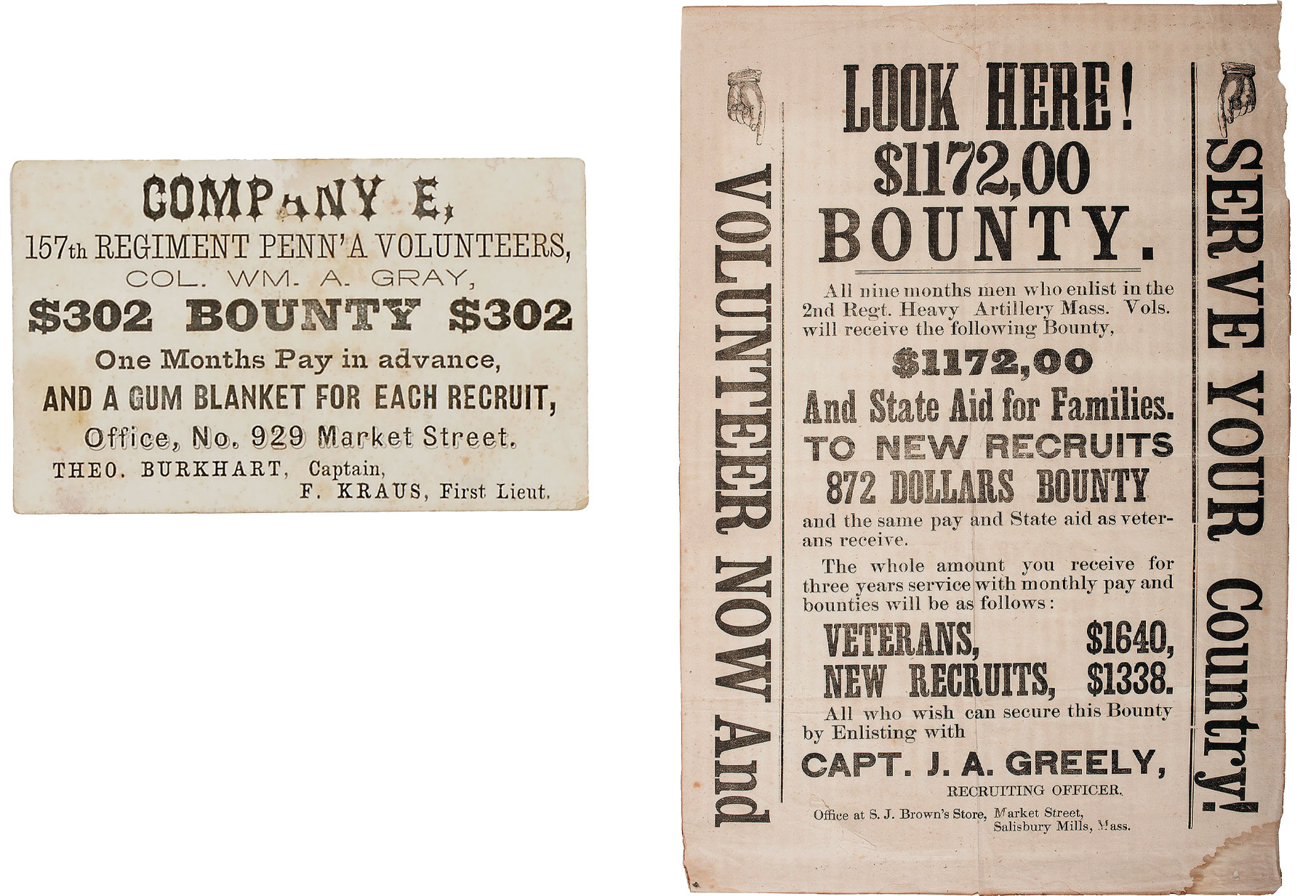
As the pool of the North’s poorest men became depleted, financial inducements for enlistment grew larger—and more prominent on recruiting materials, as evidenced by these wartime broadsides.
The men who volunteered in the ranks that spring earned $11 a month, plus keep. That was a few dollars less than the average farmhand was paid at the time, but most of the public appeals for volunteers were accompanied by fundraising drives for the support of soldiers’ families. April had not ended when the Vermont legislature passed a bill authorizing a $7 monthly supplement to the pay of every volunteer who went into federal service from that state. Rhode Island initially paid its troops an additional $12 a month. Maine offered a one-time bounty of $22 for the three-month militia call. Towns and cities from Maine to the Missouri River formed their own committees to collect donations for distribution to the wives, children, or parents of men who marched away. That level of compensation appealed even to many men with steady employment; it exerted a particular attraction on those who had been without work—or without enough work—for weeks or months. The desperate, the unemployed, and the underemployed therefore poured into the army in disproportionate numbers.
With its limited scope, the militia call came nowhere near exhausting the mass of idle workmen, failing businessmen, and cash-strapped farmers. On May 3 Lincoln made his first appeal for three-year volunteers and expanded the Regular Army, adding the promise of a $100 bounty to be paid at discharge, and three months later Congress raised the monthly pay of private soldiers to $13. In their letters home, recruits often revealed the importance of the money they would earn, including some who cast their enlistments in the most extravagant patriotic metaphor. Some wrote covetously of the discharge bounty as though it were already in their pockets, especially when they anticipated the war ending within months.
The effectiveness of pecuniary inducements was evident in the size of the type they were accorded on recruiting posters. As the pool of poorest men was depleted, those inducements grew larger, as did their font. In regions particularly hard hit economically, the only visible recruiting effort might consist of the list of pay and allowances for all ranks in the army, repeatedly published in local newspapers. Innumerable editors also made the unauthorized promise of 160 acres in bounty land to all volunteers, even if the war ended that summer. A young New Yorker who had failed to prosper in Iowa took their bait, enlisting finally because “everything was dull and promised to remain so untill [sic] after the war.”5
 Library of Congress
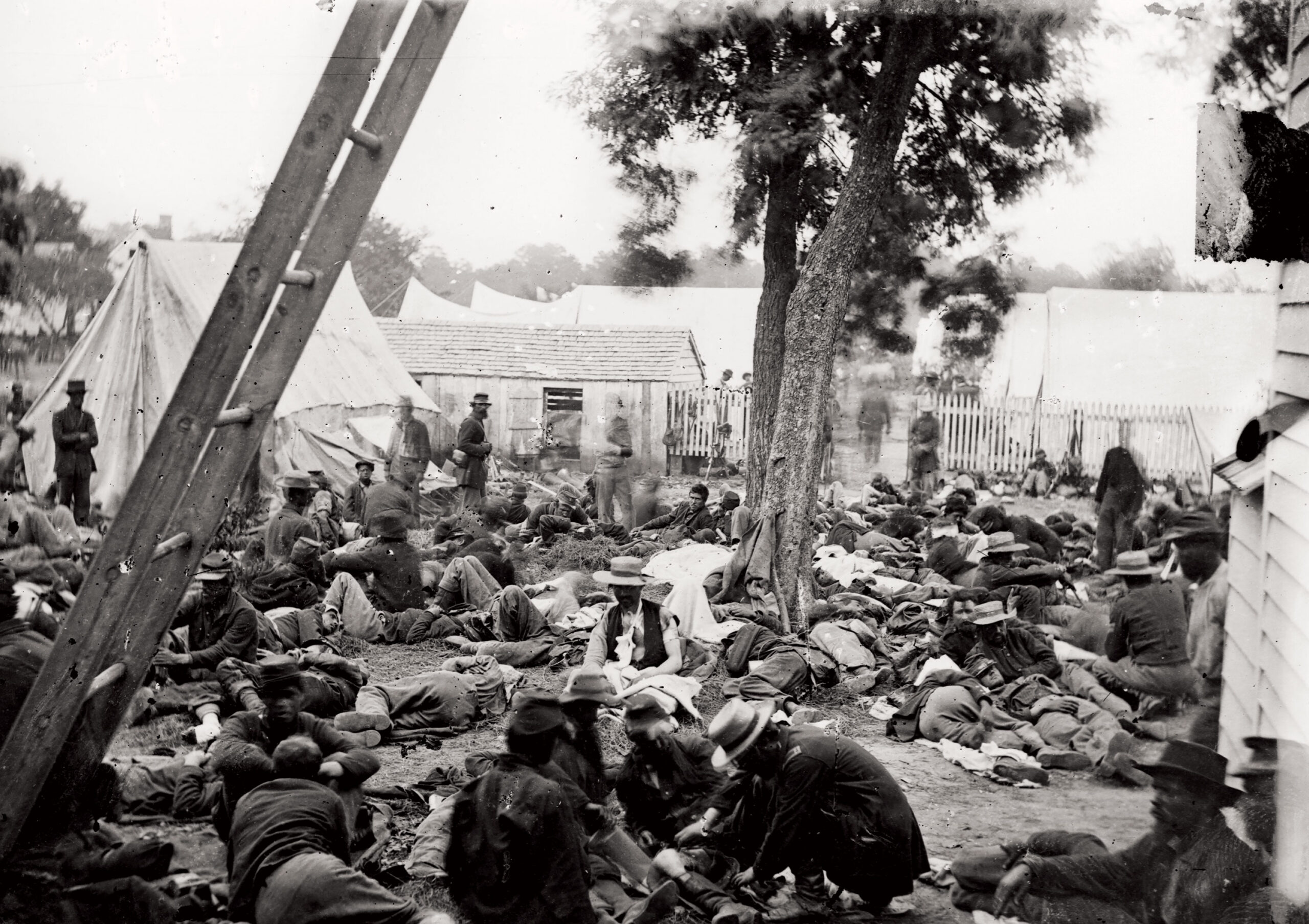
An improving wartime economy, along with Secretary of War Edwin Stanton’s decision to halt recruiting in April 1862, played a large part in cutting off reinforcements to the Union army. Stanton reversed course in May, but heavy casualties incurred during the Seven Days Battles, which ended July 1, contributed to the continued lethargy in Union army recruiting. Above: Doctors treat Union soldiers wounded at Savage’s Station, one of the Seven Days Battles.
Often, those who were begging men to enlist abandoned patriotic pretense and openly argued that in such a crippled economy the army was the best possible solution for a man who had nothing else to do. In Beardstown, Illinois, commerce on the Illinois River had ground to a halt, and the local editor candidly addressed the men lounging about the wharf. “There is a great many men out of employment who might as well take a little trip as not,” he reminded prospective recruits for the army, adding “there is now more clear money in that business than any other that we know of.”6
The editor of the Rutland Herald made an equally honest pitch to farmers in the hardscrabble farm country of central Vermont, conceding that “no business pays so well as soldiering now days [sic]. Twenty dollars per month from the date of enlistment, and all expenses paid, is not to be despised in these hard times.” Vermont’s $7 monthly pay supplement helped that state meet its apportioned quotas of volunteers with a surplus exceeded only by Rhode Island, which offered still more generous state bounties and local support.7
From the spring of 1861 through the succeeding winter many a young man, as well as some who were not so young, wandered up and down the East Coast or followed the river corridors in search of steady work. They recounted their travels and their disappointments in letters to their loved ones, often concluding their correspondence with the announcement that they could find no means of supporting themselves except by enlisting. A survey of the three-year volunteers from the conflict’s first summer confirms that such tales were common, yielding an average of 70 percent who fell below median wealth.8
 Library of Congress
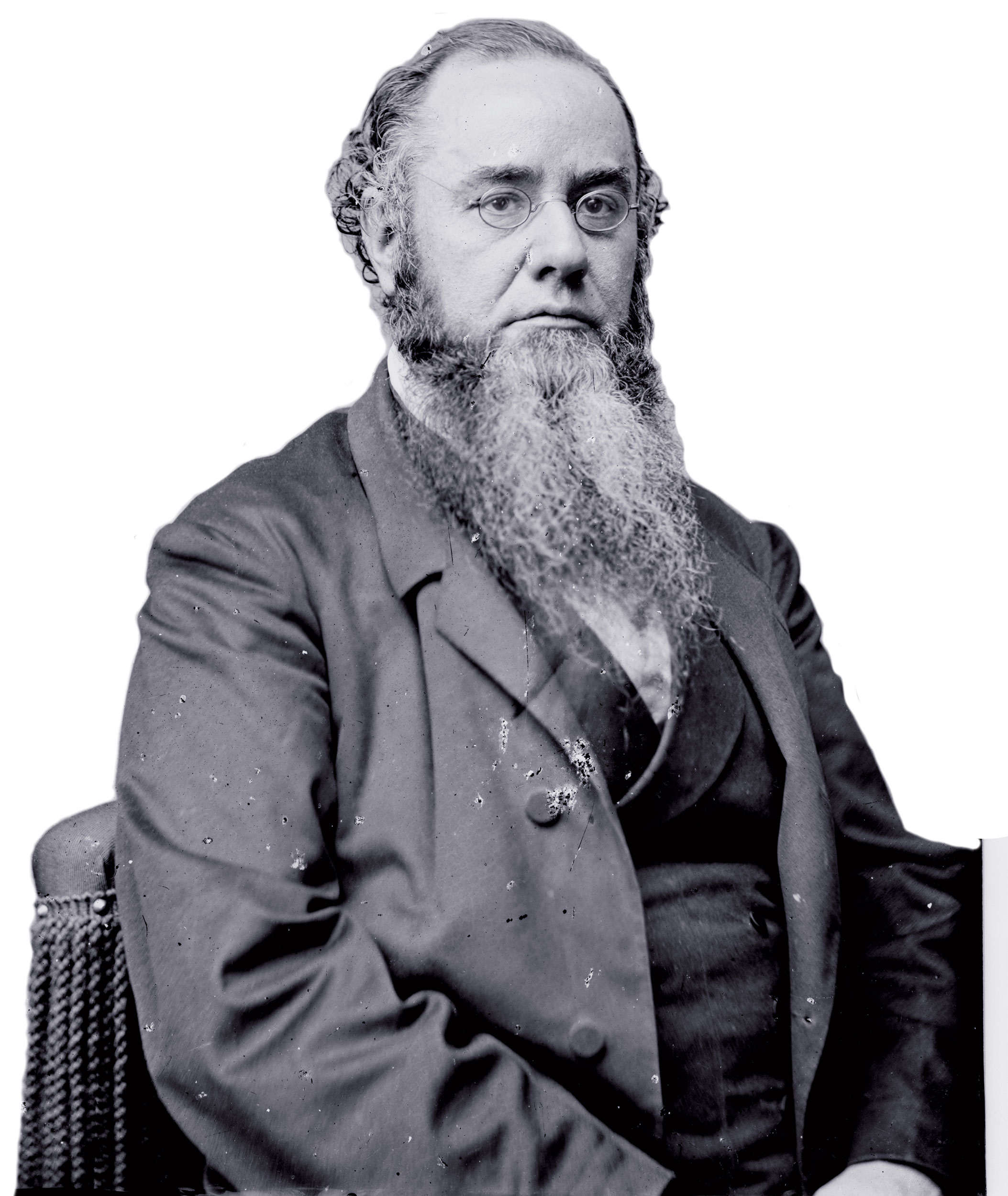
Edwin Stanton
One year into the war, the demand for military supplies had reinvigorated both the industrial and agricultural sectors of the national economy, sharply reducing the number of men who might enlist from financial need. That factor played a prominent role in cutting off reinforcements to the army—as did Secretary of War Edwin Stanton’s incomprehensible halt to recruiting on April 3, 1862. The deadly fighting of that spring and early summer further dampened martial enthusiasm. If the nation’s forces were to be replenished, the ante was going to have to be increased.
In May, Stanton sheepishly reversed his recruiting decree, asking state governors for a few dozen new regiments. He added a frantic addendum to that appeal a couple of weeks later, when Stonewall Jackson led a small Confederate army on a rampage in the Shenandoah Valley, but the enlistment frenzy of 1861 was not repeated. “The war fever has pretty generally subsided,” wrote a young man attending college in Iowa, adding that he knew no one who was enlisting or even talking about it.9 The governors had authorized the formation of new regiments as requested, but most of those organizations still languished incomplete in camp in mid-July, usually with only a fraction of their regulation enrollment.
Between the spring of 1861 and that of 1862 gainful civilian employment had become much more readily available, while the euphoric holiday atmosphere of the war had been replaced by fierce brutality. Those combined factors explained most of the lethargy in recruiting. Far fewer potential soldiers viewed military service as their only hope for basic subsistence, while most of those who might have gone to war for other reasons found the danger too daunting to assume with so little compensation.
That slow response, combined with the tactical reverses and extensive casualties of the Seven Days Battles, which ended on July 1, 1862, led President Lincoln to issue a proclamation for 300,000 new three-year troops. Although it was carefully disguised as an unsolicited offer of troops from the governors, it carried the mandatory quotas of an executive demand. How that demand would be enforced no one really knew, but rumors of impending conscription had begun circulating in conjunction with congressional debate over amendments to the Militia Act. On July 17 those amendments took effect, allowing the president to call up state militia for as much as nine months of service to the general government, and giving him the authority to require a draft for any deficiencies.
Recognizing the importance of money in attracting men, Stanton acceded to gubernatorial suggestions of offering a month’s advance pay of $13 and a quarter of the $100 discharge bounty. The army had long paid a premium of $2 to anyone who recruited a soldier, and Stanton also agreed to assign that to the volunteer himself, which would give each man a total of $40 cash in hand as soon as he mustered in.
Where the aftershocks of recession still reverberated, $40 in greenbacks had some persuasive effect, but confusion over federal conscription may have indirectly played a greater role by encouraging relatively generous local bounties. Coming so soon after the president’s July 2 call for 300,000 three-year men, passage of the militia draft created widespread misunderstanding that shortfalls in the three-year quotas might also be supplied by conscription. Newspaper accounts documented that confusion, and sometimes seemed to deliberately cultivate it, to further spur recruiting efforts. The confusion only worsened when the War Department also demanded 300,000 nine-month militia on August 4, threatening to impose a draft by the impossible deadline of August 15.
The troop quotas were assigned by state on the basis of the 1860 census, and the states further apportioned them to their counties, cities, or towns. If a community failed to provide as many soldiers as required, the balance would be drafted directly from that town. With that first direct risk that citizens might be forced into uniform, the relatively rare phenomenon of town bounties to volunteers suddenly became very popular. In the East most of the bounties were authorized by officially posted public meetings and funded by taxes, but privately raised subscriptions proved popular west of the Alleghenies, where balking county commissioners often held sway. Communities that were effectively competing for each others’ able-bodied men started bidding against each other in a way that demonstrated how relatively few citizens wished to serve. From paltry provincial offers of $10 the bounties quickly rose to $50 and $75, and before the end of July they reached $100 in the larger towns and cities in the East, on top of the federal money.
The approach of the August 15 draft deadline for the militia call prompted further escalation in local bounties. In mid-August the city of Hartford, Connecticut, advertised a bounty of $175, while the state paid $50 in advance and $30 more after each year of a three-year enlistment. State supplements of up to $16 per month had meanwhile been appropriated for soldiers’ families. A supportive editor hastened to calculate that, with such offers in addition to his regular pay and clothing allowance of $3.50 a month, a Hartford recruit could earn up to $495 a year for a three-year commitment. That seemed a small fortune in an age when day laborers might earn $300 in a year, and towns that were more affluent or more desperate began offering $300, $400, and even $500 bounties for each recruit. The bounties rose so quickly that some who might once have been tempted to enlist for less hung back, waiting for them to go higher still.10
That magnitude of municipal largesse attracted an entirely new type of volunteer. The man down on his luck could still be found, or the teenaged boy from an indigent family, but the sudden surge in bounties presented a great many young and middle-aged men with visions of a lifetime stake. Most who entertained that notion were employed, and some already owned farms, albeit often with heavy mortgages. Many were married and had families. Vast numbers of bachelors used their enlistment windfalls to get married, which sometimes earned them additional bounties and usually made their brides eligible for a few more dollars of regular community support. In the fall of 1862 a Massachusetts fisherman observed that “everybody is geting [sic] married and going to the war,” and when the bounties rose high enough that fisherman would follow them.11 Still, fully two-thirds of the surveyed three-year volunteers from the summer of 1862 represented the poorer half of their respective states’ populations.
The nine-month militia, the preponderance of which was recruited after the three-year organizations had been completed, attracted volunteers from noticeably more comfortable backgrounds. In most cases the bounties for nine-month men fell below those offered for three-year enlistments, but in proportion to the length of service, they were frequently even more generous. The shorter term naturally seemed more desirable to men reluctant to neglect their affairs, particularly after newspapers across the country published an unfounded rumor that the militia would remain in camp near home, as a reserve. The timing of the militia recruiting implied that the earlier regiments’ terms would roughly match the academic year, so some regiments boasted disproportionate numbers of college students and professors. The 44th Massachusetts Volunteer Militia teemed with men of Harvard affiliation, and Governor John Andrew directly lobbied Edwin Stanton to have his elite militiamen assigned to the safe and salubrious coast of North Carolina.12
The nine-month levy was nevertheless filled by a solid majority of men from the bottom half of the economic spectrum, amounting to 57 percent of the surveyed samples. That fell 10 percent below the results for the three-year men who had just preceded them, but poor men were still providing the lion’s share of the soldiers.
President Lincoln recognized that economic incentives contributed significantly to filling his armies, although he seemed to play down that less-admirable motivation even as he admitted it. He named patriotism as the first of seven reasons a man might enlist, and he included “ambition” and a “love of adventure” in the list, but he ended it with a “want of employment, and convenience.” A lack of employment specifically indicated economic need, and “convenience” strongly suggested it, since military service could hardly have been considered convenient for anyone who had a better means of supporting himself.
In a manuscript that he evidently intended as part of a speech, but never used, the president concluded sometime in 1863 that all of those personal stimuli had ceased to have any effect. “We already have,” he contended, “… substantially all that can be obtained upon this voluntary weighing of motives.”13 He appeared to be correct in assessing the declining influence of patriotism, ambition, or the desire to test one’s courage in perilous undertakings, but he was clearly mistaken if he thought money had lost its allure.
Lincoln’s meditation on why men enlisted was obviously composed as a brief in defense of more efficient conscription at the federal level, bypassing the states and the militia they raised. Congress provided the authority for a nationwide draft in March 1863 with the Enrollment Act, and the Union army would realize no significant reinforcements until that law was implemented the following July. The most prominent reactions to that first draft call demonstrated that Lincoln had accurately judged the decline in patriotism and most other personal motivations, but that men would still enlist if they were paid enough money.
Riots shook New York and Boston as the first draft lotteries began, but when the violence subsided the most common response to conscription was avoidance. Any drafted man could pay a $300 commutation fee for a one-time deferment, or obtain a permanent exemption by hiring another man to serve as his substitute. Most conscripts escaped through one of those two means.
 Harper's Weekly
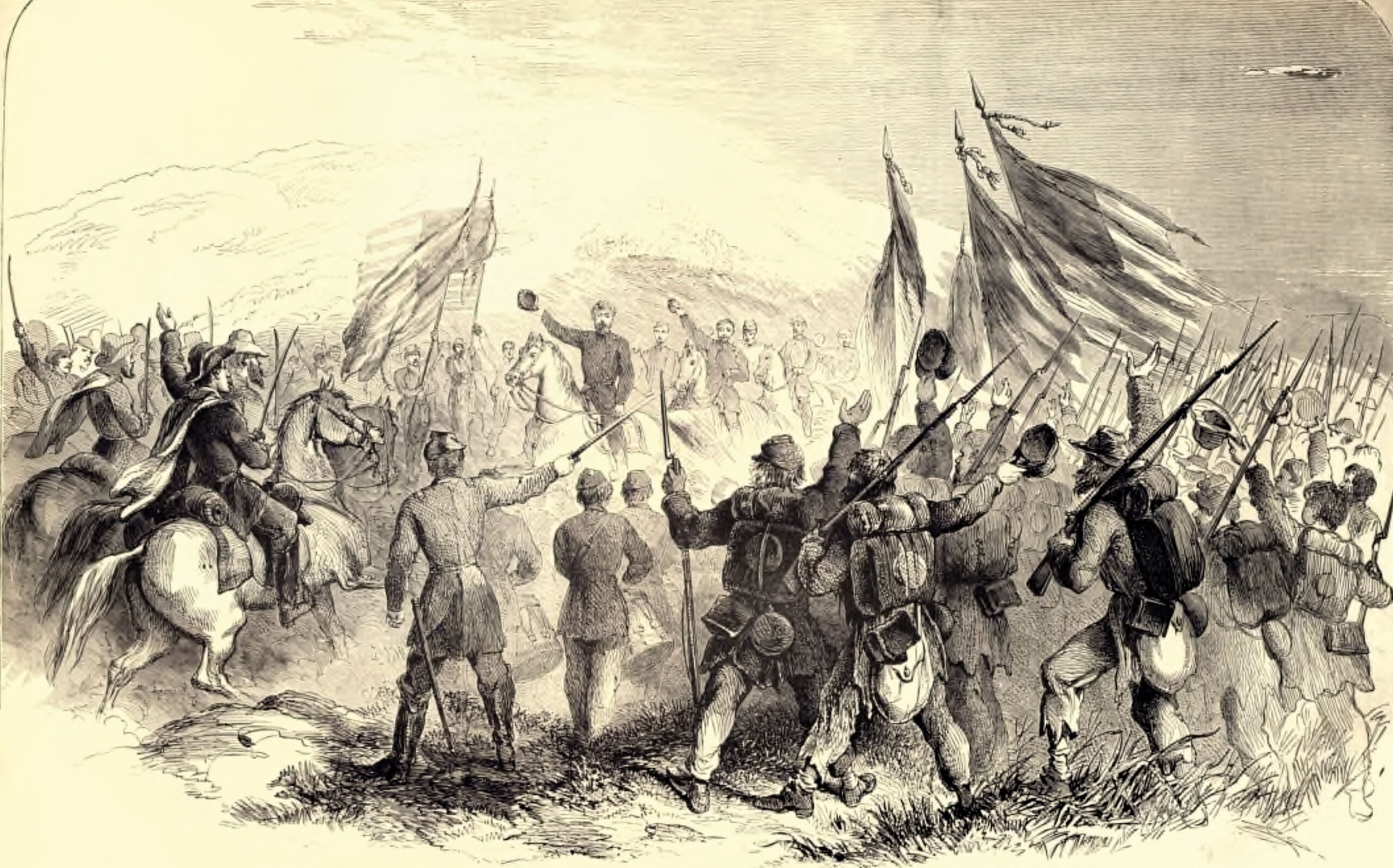
For decades, historians have pointed to the success of the reenlistment program aimed at Union veterans as evidence of their patriotism and determination to see the war through. In truth, financial incentives factored prominently in their decisions. Above: A Harper’s Weekly sketch that captures the “enthusiasm” of reenlisting veterans from the Army of the Potomac’s XVII Corps.
Of nearly 300,000 men whose names were chosen at random nationally in that first levy, barely one in 30 was required to enter the army himself. In Massachusetts only one conscript in 40 went into uniform, and in New Hampshire one in 44.14 If more altruistic motives had ever eclipsed mercenary incentives in Union recruiting, such overwhelming draft avoidance suggested that the appeal of cash had vastly overshadowed those motives by the third year of the war. The fees demanded by most substitutes started in the range of the more extravagant bounties of 1862, and soon surpassed them.
Section 4 of the Enrollment Act implied that anyone “now in the military service” would not be included in either of the two categories of draft eligibility. Whether that was intended as an exemption or not, thousands of former soldiers who had still been in the army on March 3, 1863, were later excused on those grounds when they were drafted. The War Department instead prevailed on those old soldiers to reenlist, beginning in June 1863 with an offer of a $402 federal bounty (including the $2 “premium”) to the two-year and nine-month veterans who were discharged that spring, summer, and fall. This was followed later that year by a similar offer to the three-year volunteers still on duty: after completing all but one year of their enlistments they could reenlist for three more years from that date for the same $402 bounty, plus their original $100 discharge bounty, besides enjoying a 30-day furlough. Local bounties usually augmented that federal payoff.15
For six decades the success of this reenlistment program has been cited as evidence of the unparalleled patriotism of the early Union volunteers. By misinterpreting how many veterans could take advantage of the offer, Bruce Catton calculated that the 136,000 who did reenlist represented more than half of those eligible, and subsequent historians have followed his lead. Catton also asserted that money was the least motivating factor in those reenlistments, relying on a single regimental history and ignoring his only other source on that point—the contradictory wartime letters of a Union soldier. Seemingly on faith alone, Catton opined that most of the veterans reenlisted mainly from “a simple desire to see the job through.”16
The reenlistment program ran from June 1863 until the end of the war, embracing tens of thousands who had completed only nine months of service and hundreds of thousands who had finished two years. Most able-bodied soldiers or veterans who had enlisted from May 1861 until April 1863 could have taken advantage of it, including the two-year and nine-month men. The provost marshal general estimated 1,360,000 enlistments through that period, but by the time the reenlistment program started, a large percentage of those men had died, deserted, gone home permanently disabled, or been discharged before serving nine months. The rest, many of whom had recovered from disabilities for which they had been discharged, became eligible for reenlistment at one time or another. Even if only half of the original soldiers met the requirements, they amounted to 680,000 men, and 136,000 reenlistments reflected only one fifth of them, rather than one half.
Furthermore, notwithstanding the self-serving reflections in memoirs and regimental histories, money seems to have been the primary element in most men’s decisions to reenlist. Through outright admission or indirect inference, contemporary correspondence provides abundant evidence of how irresistible veterans found the bounty offer. The most telling indication that the reenlistments were economically driven came in the spring of 1864, when the War Department eliminated the special veteran bounty. With that, reenlistments all but stopped.17
In the summer of 1864, after Congress abolished the alternative of commutation, substitute prices in the East abruptly soared to $1,000, and occasionally much higher. Local bounties for volunteers rose commensurately as communities strove to fill their quotas before the draft deadline. By September of that year, even one-year volunteers in small communities often realized $1,000 in federal, state, county, and town bounties.
Such munificence predictably drew some men from a little higher up the economic ladder. Of the surveyed three-year recruits from late 1863 and early 1864, 70 percent came from households below median wealth. Only 62 percent of the one-year volunteers from late 1864 fell into that category, partly because the economically vulnerable classes had already been picked over and partly because bigger bounties interested a broader market. In many regions so many enrolled men had already been recruited or exempted that the remainder faced greater likelihood of being drafted. That moved some potential conscripts of slightly better resources to accept the war’s largest bounties rather than go into debt for substitutes, which may explain the slightly smaller majorities of poor among the war’s last volunteers.
Scholars in recent years have closely scrutinized the motivation of Civil War soldiers on both sides. Patriotism has been minutely examined, as has the impulse to defend the homeland, wanderlust, the thirst for adventure, and the individual’s desire to prove his courage and manhood to himself and others. Meanwhile, economic incentives have received little attention outside the context of the exorbitant bounties in the last 20 months of the conflict. The concept of mercenary motivation in the Union army is generally ignored except in regard to the bounty jumpers who flourished after the summer of 1863.
Bounties never rose high enough to seduce the more prosperous, but they appealed tremendously to the lower classes, and from their beginning in 1862 they may have compounded the tendency for poorer men to opt for military service. Yet money played a significant role in Union recruiting long before bounties became the principal alternative to the imposition of compulsory service. From the first beat of the drum Lincoln’s armies were flooded with the chronically and acutely indigent in proportions that patriotism could not account for—unless patriotism is presumed to decline in direct proportion to wealth. That most Union soldiers sprang from such humble circumstances demonstrates that theirs was a poor man’s fight. Their great need for the money they earned shows, in turn, that in large measure it was also a mercenary’s war.
William Marvel is an independent scholar from northern New Hampshire who focuses on mid-19th-century American history. His most recent books include Lincoln’s Autocrat: The Life of Edwin Stanton (2015) and Lincoln’s Mercenaries: Economic Motivation among Union Soldiers during the Civil War, due for release this fall from LSU Press.
Notes
1. Steven Ruggles, Katie Genadek, Ronald Goeken, Josiah Grover, and Matthew Sobek, Integrated Public Use Microdata Series: Version 6.0 (University of Minnesota, 2015).
2. Hartford [CT] Weekly Times, November 24, 1860; Journal of Commerce, quoted in William K. Scarborough, The Diary of Edmund Ruffin (Baton Rouge, 1972), 1:504; Daily Morning Chronicle (Portsmouth, NH), December 22, 1860; Cheshire Republican (Keene, NH), January 2, 1862; Dover [NH] Sentinel, January 4, 1861; Philadelphia Inquirer, February 22, 1861; Providence Post, August 3, 1861.
3. Fort Dodge [Iowa] Republican, February 28, 1861; Weekly Racine [WI] Advocate, February 27, March 6, 1861; Bureau County [IL] Republican, February 28, 1861; Red Wing [MN] Sentinel, December 19, 1860; Mankato [MN] Semi-Weekly Record, February 8, 1861; Alice Cayton to “My Dear Brother,” May 12, 1861, Badger Collection, Missouri Historical Society; Daily Gate City (Keokuk, Iowa), June 1, 1861; Lawrence [KS] Republican, June 6, 1861.
4. Franc B. Wilkie, Pen and Powder (Boston, 1888), 14-15.
5. Ottumwa Courier, May 1, 1861; Waterloo Courier, May 7, 1861; Daily Gate City (Keokuk), May 21, June 1, August 16, 1861; Schuyler Coe to “Dear Mother,” September 18, 1861, Army Heritage and Education Center, Carlisle, PA.
6. Beardstown Democrat, August 22, 1861.
7. Rutland Herald, September 26, 1861; United States War Department, The War of the Rebellion: A Compilation of the Official Records 129 vols. (Washington, 1880-1901), Series 3, 1:383-384 (hereafter cited as OR).
8. See, for example, Thomas McDermott to “Dear Mother and Brothers,” December 10, 1861, Balch Memorial Library, Leesburg, VA; Alfred Wheeler to Alonzo Wheeler, April 4, “1860” [1861], and to “Dear Mother,” August, 1861, Army Heritage and Education Center, Carlisle, PA; John C. Ellis to “Dear Sister,” May 23, 1862, and to “Dear Nephew,” undated, Army Heritage and Education Center, Carlisle, PA.
9. Thomas Blanchard to Sarah Walker, June 15, 1862, Notre Dame University.
10. Hartford Courant, August 22, 1862; Daily Morning Chronicle (Portsmouth, NH), August 14, 15, 1862; Sarah Fales to Edmund Fales, August 6, 13, 1862, Rhode Island Historical Society.
11. Lewis Caswell to “Dear Brother,” October 14, 1862, Peabody Essex Museum, Salem, MA.
12. OR, Series 3, 2:595.
13. Roy P. Basler, ed. The Collected Works of Abraham Lincoln, 9 vols. (New Brunswick, NJ, 1953), 6:445.
14. OR, Series 3, 5:730.
15. OR, Series 3, 3:89, 414-416, 785.
16. Catton, A Stillness at Appomattox (Garden City, NY, 1956), 35, 394-395, n.26.
17. OR, Series 3, 4:190.