On December 1, 2012, just before 8 a.m., Larry Korczyk of Gettysburg, Pennsylvania, drove the short distance from his home on Hanover Street to Harrisburg Area Community College, which sits on the edge of Gettysburg National Military Park. The sky was overcast, and a low fog hovered over the battlefield, obscuring the inscriptions on its some 1,300 monuments—most of which Korczyk had studied in detail over the last few years. His eyes were on the road, but his mind churned with Gettysburg battle facts: the names and ranks of Union and Confederate officers, the number of cannon fired each day, the blow-by-blow actions of every regiment that participated in the most storied battle of the Civil War.
In the parking lot, Korczyk’s car took its place among dozens of others. Many still had people inside them, studying battlefield maps or open books—mostly classics like Edwin B. Coddington’s The Gettysburg Campaign or Harry W. Pfanz’s Gettysburg: The Second Day—braced against steering wheels. Like Korczyk, they were there to take Gettysburg’s licensed battlefield guide written exam—the first phase of a notoriously tough two-part test that many have called the most nerve-wracking and arduous of their lives.
Gettysburg has long stood apart among Civil War battles. It was the conflict’s bloodiest engagement, with 51,000 casualties. It inspired Abraham Lincoln’s most famous speech. Many still consider it the turning point of the war. In modern times, the battlefield stands apart for another, lesser-known reason: its guide force. Since 1915, first the War Department and then the National Park Service has overseen a fleet of independent contractors—currently 155 men and women strong—who together take roughly 230,000 visitors on about 24,000 tours across the battlefield each year. They are an exclusive bunch, the only individuals in the world with the legal right to conduct tours for hire within the military park without a permit. But joining their ranks is anything but easy.
 Tom Wolff
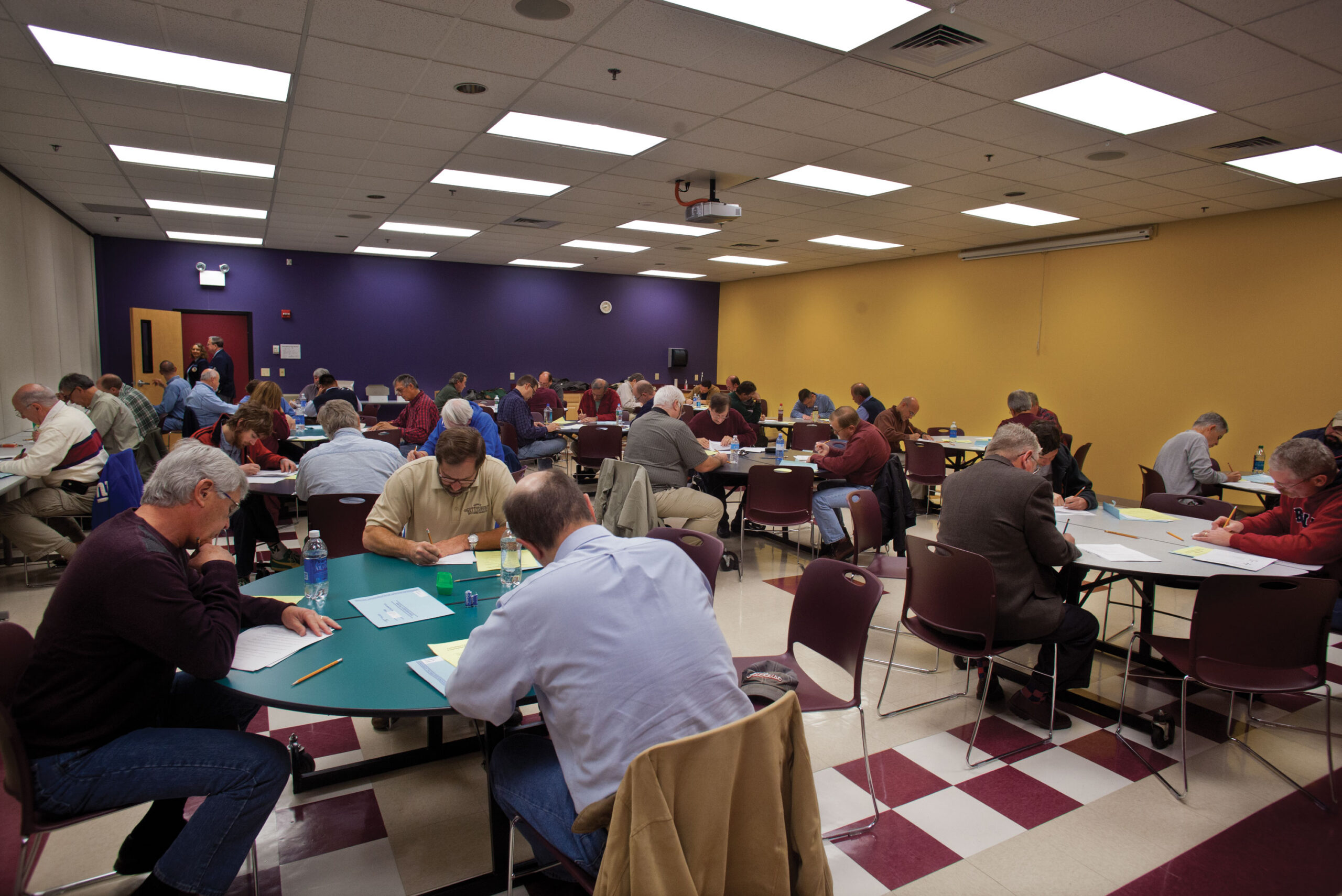
Test-takers huddle over their papers during the 2012 written exam.
One hundred fifty-one people—mostly men—converged on the community college that morning to take the written exam. There were a lot of beards, a lot of gray hair, and quite a few Gettysburg T-shirts. Larry Korczyk wore a bright blue fleece featuring a tiny image of a 19th-century tripod camera and the words “History in Focus” on the front. On a lark, he’d also worn one shoe apiece from his two favorite pairs—one brown, one black—for good luck.
Toward the back of the line stood Chris Bagley, a first-time test-taker and traveling nurse who spent every non-work weekend in Gettysburg. He’d been studying two hours a night since July. Farther up was Kevin Curley, an attorney from Chester County, Pennsylvania. This was his third attempt. First in line was Steve Dunn, an Air Force master sergeant on the verge of retirement who hoped to make guiding his new career. Dunn looked toward the registration table, where a few dozen battlefield guides were now gathering. “All these guys are rock stars,” he said, sweeping a hand in front of him. “I’ve seen their tours on YouTube.”
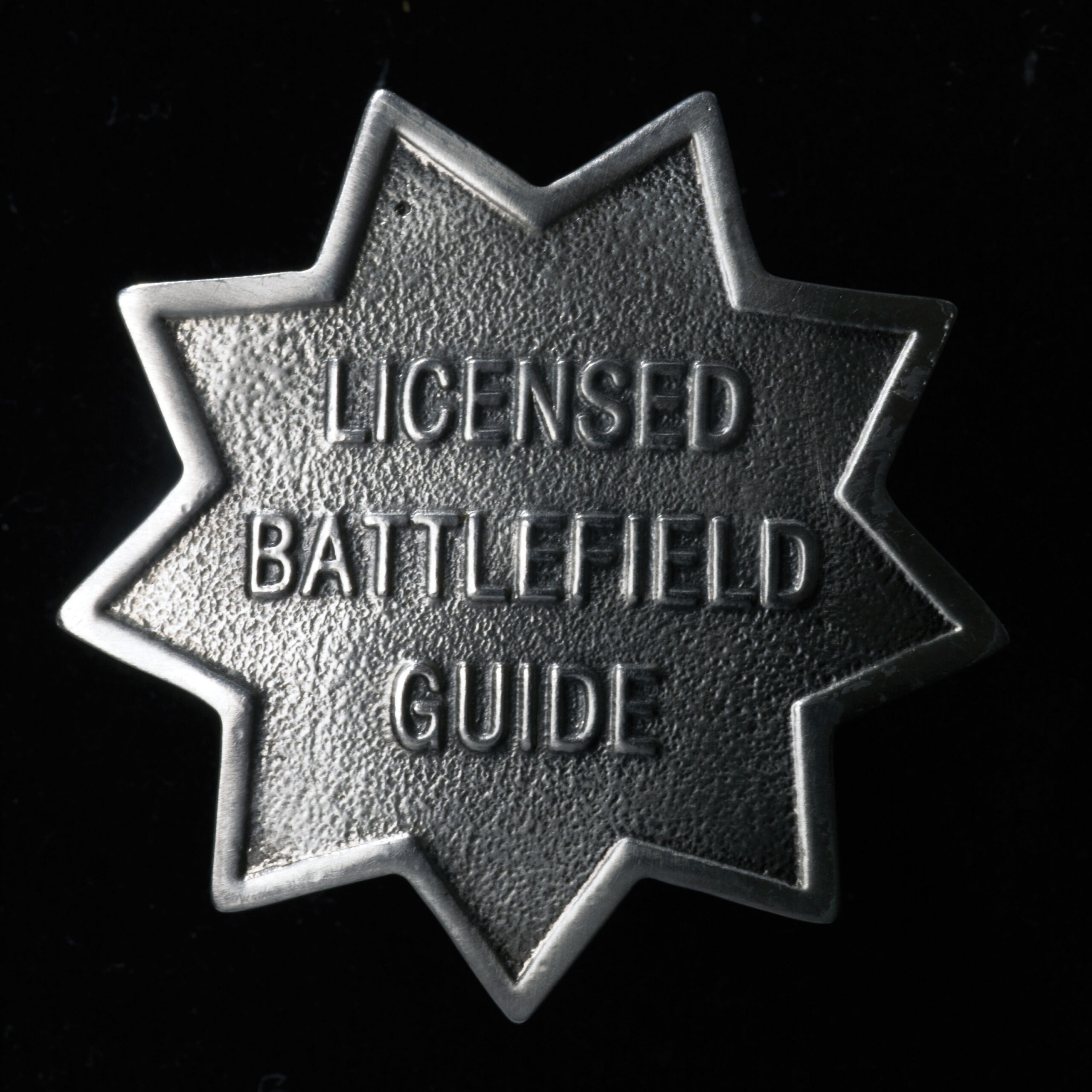
The guides he gestured toward were dressed in full uniform: blue blazers, gray pants with a nine-point star badge attached at the belt, and light blue shirts with a distinctive round patch on the left shoulder, embroidered with the words LICENSED BATTLEFIELD GUIDE. I asked Dunn how many times he’d taken the test. A pained look crossed his face. “This is my fifth try.”
Welcome to the hardest test in history.
Becoming a Gettysburg Licensed Battlefield Guide
In the 150 years since the Battle of Gettysburg, fascination with the events that unfolded over those three brutal July days has only intensified. Each year, new books get published and fresh interpretations surface. The Internet teems with Gettysburg chat groups and message boards, where enthusiasts engage in lengthy debates over how much water the 72,000 horses at Gettysburg required or Robert E. Lee’s mindset just before Pickett’s Charge. Meanwhile, Gettysburg National Military Park continues to draw a million and a half visitors each year, a good many of whom claim to experience something almost mystical when they step onto the field.
 Claudio Vazquez
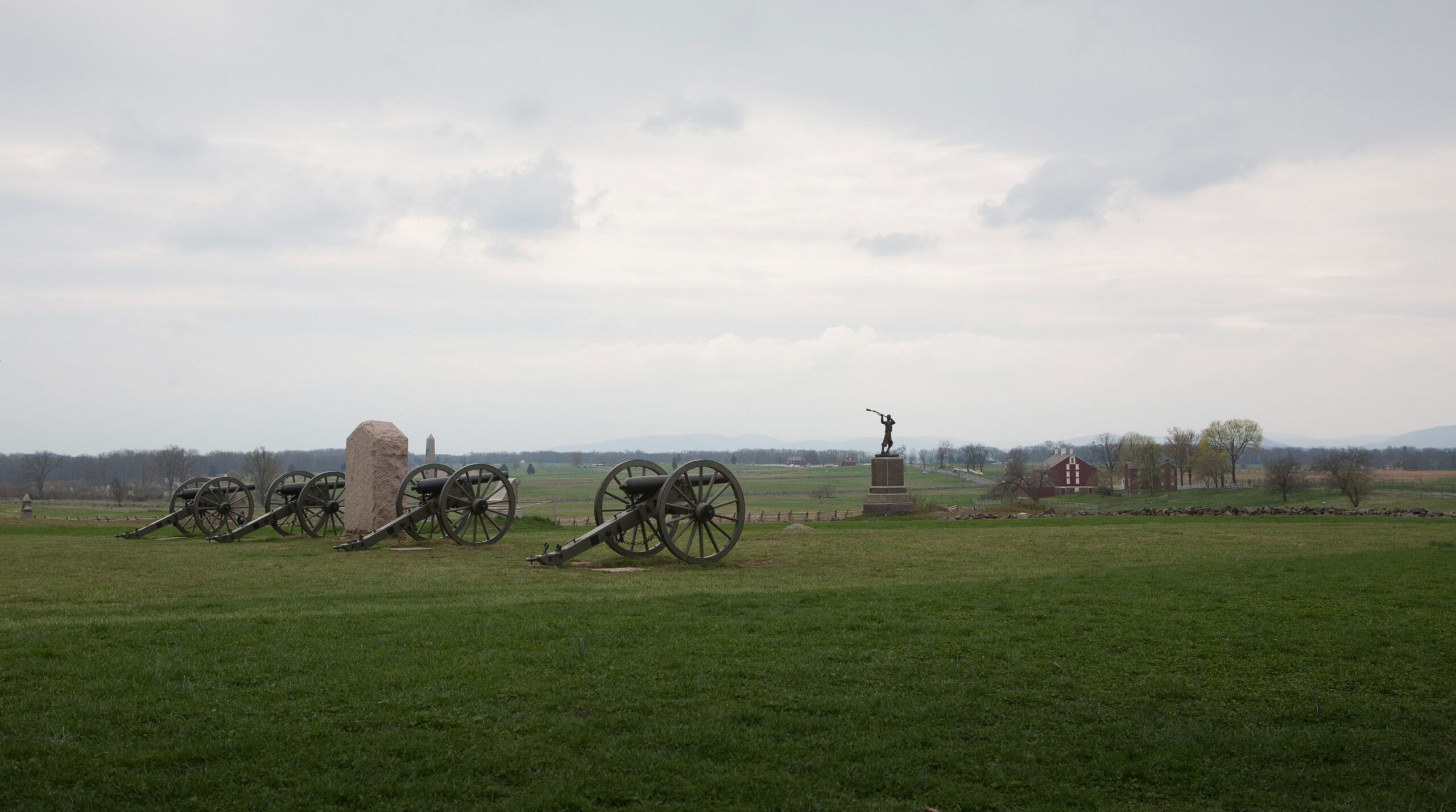
 Battlefield at Gettysburg
Luckily, Civil War buffs—and the sizable subset who hold Gettysburg as their mecca—have any number of outlets for their passion. They can join a roundtable, read a thousand books, research their Civil War ancestors, even take up reenacting—all of which have low barriers to entry. Becoming a Gettysburg licensed battlefield guide is a different story. Passing the test requires a singular vision and typically years of studying.
Two things make phase one of the process—the written exam—so hard. While a few of its roughly 250 questions cover battle basics that even casual buffs might know, most home in on excruciatingly specific details—like which brigade commander wore a black bandana during the fighting (Colonel Edward Cross), the highest recorded temperature on the battle’s third day (87 degrees), or the length of General Lee’s ambulance wagon train back to Virginia (roughly 17 miles). Those with only a surface knowledge of Gettysburg tend to leave the exam early—and stunned. “It’s always the same reaction: ‘Wow, I just got whacked,’” one guide told me.
While amateurs get eaten alive by the questions, Gettysburg “diehards” don’t. Many have studied so hard and for so long that their knowledge of the battle is beyond encyclopedic; they would blurt out “87 degrees” before you even finished asking the weather question, and throw in 12 related facts just because they can’t stop themselves. These diehards do well on the test, even extremely well. The problem for them—problem No. 2—is the competition. In any given test year, only the top 19 or 20 scorers advance to the next phase of testing—or “make the cut,” in guide parlance—and you need a near perfect score to be among them. In 2010, the last year the test was given, the Park Service took the top 19 scorers. No. 1 got 97.96 percent of the 245 questions correct (five wrong) and No. 19 got 96.73 percent (eight wrong)—with 17 scorers squeezed in between. It’s the kind of tight, hundredths-of-a-percentage results clustering typically associated with Olympic sporting events—not a test you take to become a tour guide. By this standard, “passing” the written test is always a long shot, even if you know more about the battle than George Meade.
And that’s just the first part. During the second phase—the oral examination—candidates get two chances to create and deliver a two-hour battlefield tour geared toward the average visitor. For diehards who revel in battlefield minutiae, this task can prove immensely difficult. In recent years, half of those making it to the oral exam have “flamed out,” failing both attempts. If they still want to be guides, they have to wait at least two years until the next written test comes around, and start all over again.
There is no limit to how many times you can take Gettysburg’s battlefield guide test. But with the exams spaced years apart, taking it five times, like Steve Dunn, means 10 years of toil for the right to wear the badge. Trying to pass the test can even become an obsession. “The people competing to take this exam all want it so badly. We’re all working so hard,” one repeat test-taker told me. “If you’re really serious about it, you either make that commitment to do everything possible, or there’s no sense it doing it at all. There is no halfway.”
 Claudio Vazquez
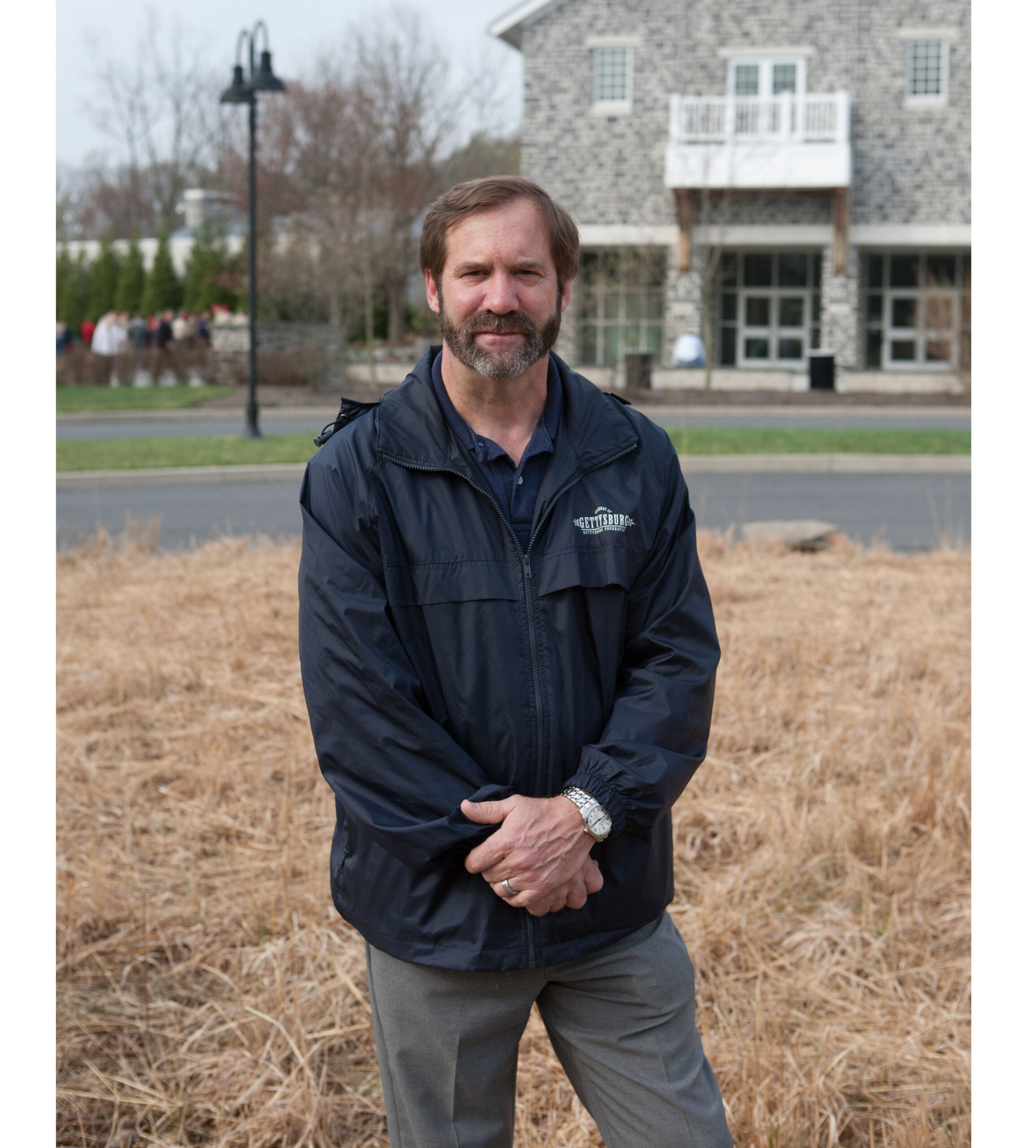
Gettysburg resident Larry Korczyk, one of the 151 individuals who took the 2012 licensed battlefield guide exam.
There is no halfway for Larry Korczyk. Fifty-four years old, with warm brown eyes and a beard that’s graying at the chin, Korczyk is affable and easygoing, the kind of guy you’d seek out at a dinner party because he’s so approachable. While he’s always been drawn to history, it wasn’t until the summer after college graduation, when he cracked open a book by Bruce Catton, that his obsession with the Civil War blossomed. From there, he joined a local Civil War roundtable and started visiting every Civil War site he could find, including far-flung battlefields like Wilson’s Creek, Missouri, and Pea Ridge, Arkansas. But nothing gripped him like Gettysburg. “I hate to be cliché about it, but the first time I came here I had my hair standing on end,” he said. “It felt like hallowed ground. I fell in love with it right away.”
He also started reenacting, portraying a second sergeant with the New Jersey-based 2nd Rhode Island, Company D. While the big battles were “awe-inspiring,” what he really liked was the living history aspect: setting up camp, giving demonstrations, and talking to the public. “It’s one thing to read all this Civil War history. But I love to share it, I really do.” Becoming a battlefield guide—at Gettysburg, no less—seemed like a pursuit tailor-made for him. He started studying.
Korczyk was living in New Jersey, working as an operations and logistics manager for Williams-Sonoma, when he took the battlefield guide test for the first time in 2010. He got a 93.5 percent and ranked in the 30s. Still, he felt encouraged. The written tests are never made public, so first-timers have only a vague idea what they’re in for. Korczyk believed he’d made a strong showing. And just by taking the test, he felt like a man inching toward a more exciting future.
That inching soon turned to leaps. In 2011, Korczyk married his second wife, Lori, a fellow 2nd Rhode Islander, in a ceremony held on the Gettysburg battlefield. In May 2012, determined to pass the next guide test, he quit his job and the couple moved to Gettysburg—the equivalent of an Elvis fanatic moving next door to Graceland. “I can see Culp’s Hill from my bedroom window, I’m that close,” Korczyk said, referring to one of the field’s fabled battle sites. He started attending Gettysburg seminars and events nearly every week, and got to know some guides. He also took on part-time painting and maintenance work—not enough to topple his study schedule—and drove home every day across the battlefield. “Often I’ll just sit on the field and go over in my head, what happened here, what happened there,” he said. “I’m living and breathing all of this history every day now. It’s almost like home field advantage.” He paused. “Or at least I hope so.”
Korczyk put his logistics background to work in formulating his study schedule. In the weeks leading up to the test, his routine had all the intensity of a Tour de France training program: two to three hours of studying in the morning, another three and a half in the afternoon, and a final two after dinner. He converted his dining room into a war room, its table piled high with books, articles, maps, and notepads. “Sometimes I feel like my head’s going to explode,” he told me. “Every study technique I can think of, I’m pulling out.”
Well, every technique but one. Some prospective guides prepare for the test together, forming study groups that become almost like extended families. But Korczyk carved a path on his own. “We all know each other and there’s a camaraderie there,” he said of the other test-takers he’s met over the years. “But in the same respect, deep down, we know it’s competition. It’s me or him, you know?”
Chuck Burkell was firmly in the study group camp. Sixty-one, with thick salt-and-pepper hair and a self-conscious smile, Burkell was a career firefighter in Ohio before joining the U.S. Fire Administration National Fire Academy, located just a few miles south of Gettysburg, where he runs a professional development program for senior fire officers from around the country. As part of that job, he takes them on staff rides across the battlefield, sharing leadership lessons gleaned from the fighting. But he has to request a permit from the Park Service every time. If he had a badge, he wouldn’t have to.
A few days before the exam, Burkell drove me around the battlefield to a few of his favorite spots. His fervor for facts revealed itself almost immediately, when I happened to ask if there are bodies still buried on the field. The last body was found in 1996, he said, near what’s known as the railroad cut. In the 1870s, the Daughters of the Confederacy had 3,320 Confederate bodies exhumed for reburial down south. Also, there were 979 unknown Union soldiers buried in Gettysburg National Cemetery, and 1,664 buried there whose states were known but not their identities. These were just a few of the thousands of details constantly frontloaded in Burkell’s brain.
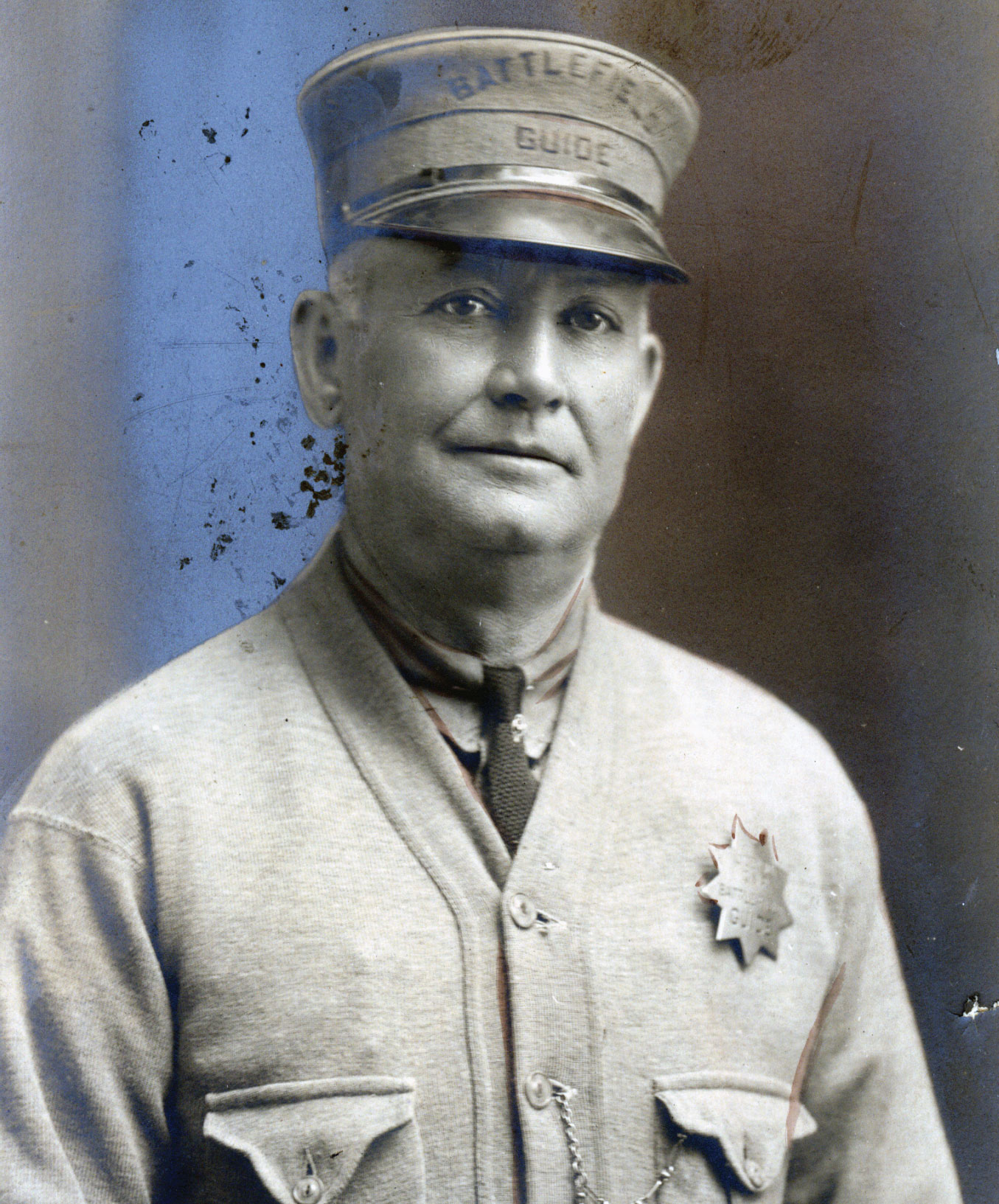 Adams County Historical Society, Gettysburg, PA
An early licensed battlefield guide in full uniform.
Despite the demands of his job, Burkell still squeezed in 15 to 20 hours of study time each week. He read reference books constantly, listened to battle-related CDs and podcasts to and from work, and attended Civil War classes and programs around town. He also had “two or three sets” of homespun flash cards, a trove of methodically captured notes, and a series of battlefield maps he’d laminated so that they wouldn’t wear out from overuse. “After doing this awhile, you accumulate a lot of stuff,” Burkell explained. “There’s just so much information.”
But Burkell’s biggest tool was his study group. Its five members had met in 2008 while attending a series of battlefield guide test preparation classes at the local community college. The 2008 test was Burkell’s first, and it hadn’t gone well. The other four men he’d bonded with during class—a CPA, a veterinary oncologist, a lawyer, and an anesthesiologist—didn’t make the cut either, so they decided to study together for the 2010 exam. On that test, Burkell got a 96 percent and ranked No. 22—just three spots away from the top 19. Another in his group was No. 21, and still another was No. 20. All five committed to taking it again. For four years now, they’ve gathered every six or seven weeks for an all-day Gettysburg overload: a morning cramming at one of their homes and an afternoon on the field with a licensed battlefield guide, hired to walk them through a particular segment of the battle—say, the second-day afternoon, or the fighting on Cemetery Hill. They’ve also taken road trips to Chancellorsville, Spotsylvania Courthouse, Antietam, and the Wilderness.
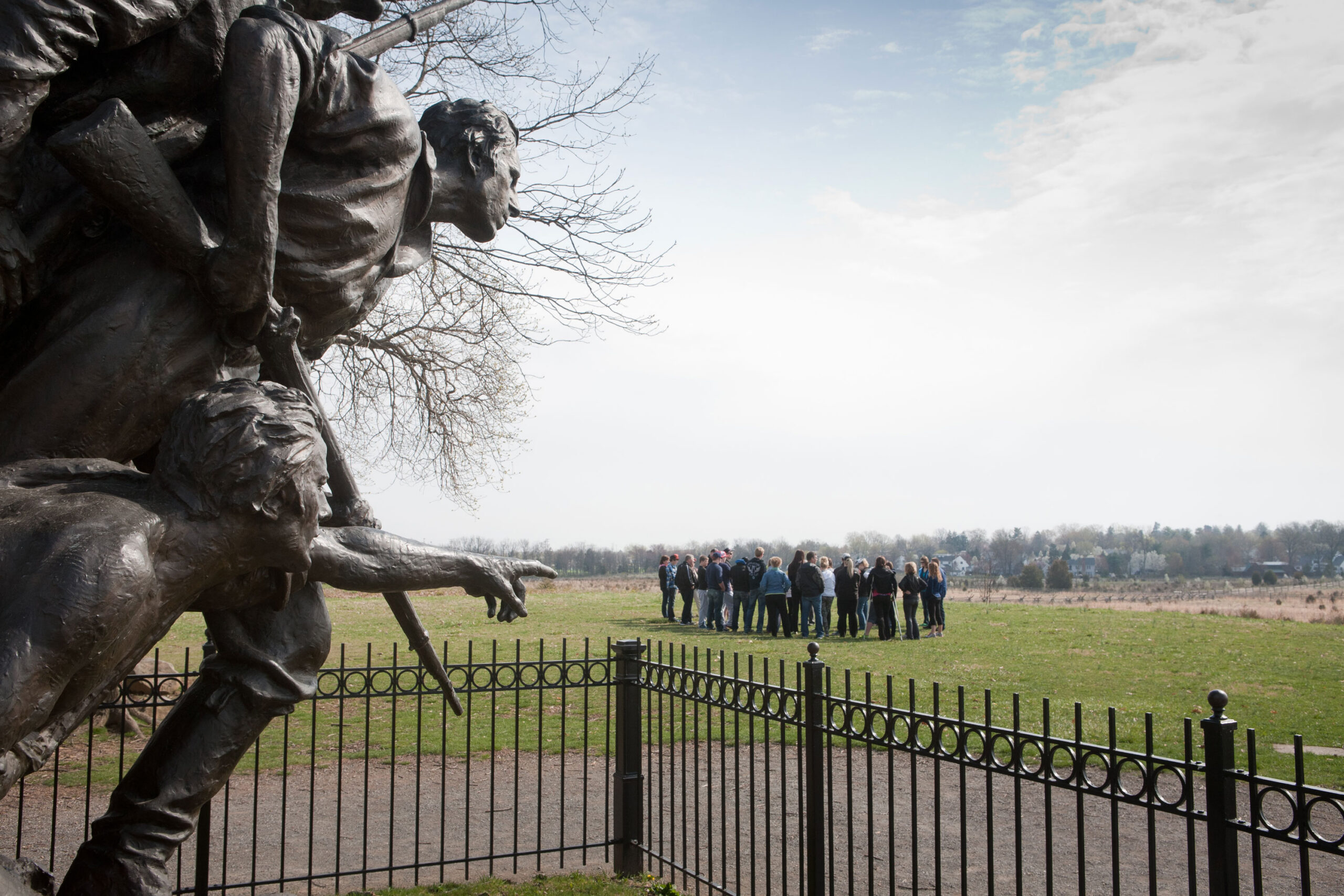
Burkell pulled over when we reached the North Carolina Monument. Strolling toward the sculpture—a giant bronze of five clustered Confederates gripped in battle—he let loose another series of facts. The monument was dedicated in 1929 and sculpted by Gutzon Borglum, the artist behind Mount Rushmore. In fact, Borglum was working on Mount Rushmore when he was approached by Civil War veterans from North Carolina. After quoting the sitting governor of North Carolina’s speech at the dedication ceremony, Burkell mentioned that North Carolina had more casualties at Gettysburg than any other Confederate state.
“How many?” I asked.
Burkell paused, unsure.
Back at the car, he grabbed a book called Gettysburg by the Numbers from his backseat and flipped through its pages until he found what he wanted. North Carolina’s total strength at Gettysburg had been 13,980 men; 6,127, or 44 percent, were counted killed, wounded, captured, or missing. “That’s a possible test question right there,” Burkell said, tapping a finger on the page. “‘Of the Confederate states, which had the highest casualties?’ By percentage it’s Florida. But numerically, it was North Carolina.” He flashed a sheepish smile. “That doesn’t hurt to know. That could come up.”
There was always more to learn, more to memorize. But Burkell didn’t think he could have done anything more to prepare. “It gets to the point where you have to take breaks or it just becomes dysfunctional.” How many days had he taken off from studying in recent months? “None.”
Gettysburg Guiding Through the Years
The nine-point star badge and embroidered arm patch of the licensed battlefield guide haven’t always drawn such reverence or such wanting. Guiding in Gettysburg has a long and strange history. It began almost before Lee’s ambulance wagon train started creaking southward, with local townspeople escorting loved ones over the field. By the early 1890s, Gettysburg was attracting 150,000 visitors a year, and “perhaps as many as fifty individuals were engaged in the more-or-less permanent occupation of ‘Battlefield Guide,’” writes guide Fred Hawthorne in A Peculiar Institution: A History of the Gettysburg Licensed Battlefield Guides, a surprisingly gripping 11-part series published on the Association of Licensed Battlefield Guides website.
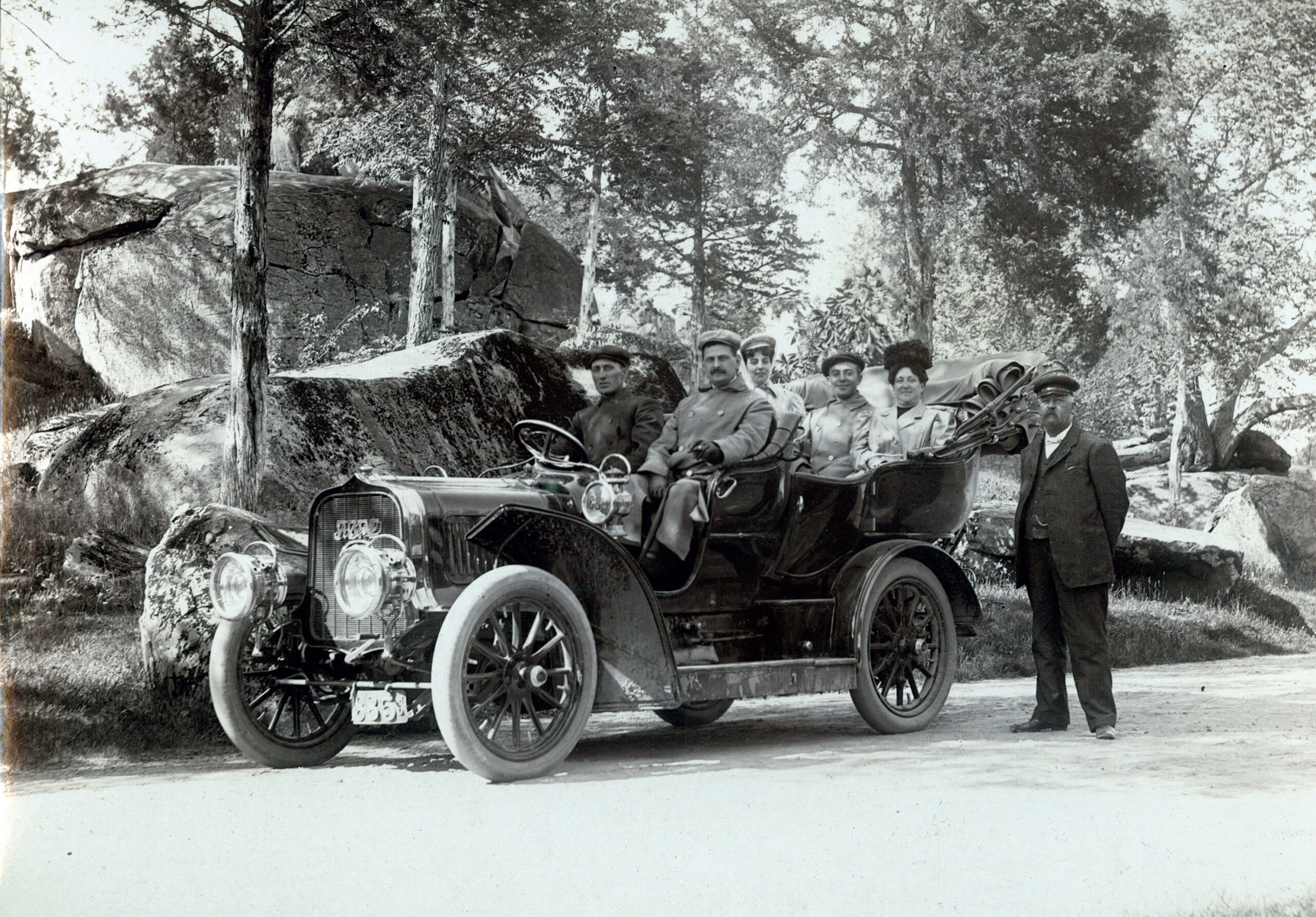 Adams County Historical Society, Gettysburg, PA
Guiding at Gettysburg began soon after the battle ended and became a licensed profession in 1915. Above: Guide Charles Sheads stands alongside a car of tourists on the Gettysburg battlefield in the early 1900s.
But as visitation increased, opportunists swooped in, many of whom cared far less about Pickett than about filling their pockets. These rogue guides swarmed travelers as they disembarked trains. The practice of leaping in front of out-of-state cars to beseech drivers to stop for a tour became so common that the town passed an ordinance banning any guide from stepping more than two feet into the street. Unfortunately, the tours they peddled were often even more alarming than their solicitation strategies. Tourists were regularly appalled at their theatrical and fantastical inaccuracy. “The visitor arrives and is immediately surrounded by guides soliciting patronage,” wrote a man from Pittsburgh, in one of many firsthand accounts turned up by Hawthorne. “Some of these are good, but most of them are poor and illiterate…. On my last visit with some friends the guide took us to the angle first instead of last, and mixed everything else up until, instead of leaving well pleased and impressed, you leave with no clear comprehension of the event except that there was a lot of men killed.”
Inundated with complaints and fed up with the Wild West atmosphere, the War Department eventually proposed a bill to regulate Gettysburg guiding. Beginning in 1915, anyone who wanted to lead tours for hire would need to pass both a written and an oral test to obtain a license. Those caught giving a paid tour without one could be kicked off the field or even arrested. The guide test—and guide force’s monopoly on for-fee tours—had begun.
Unfortunately, regulating the guides didn’t immediately stop their practice of ambushing motorists. (The new uniforms and badges caused many unsuspecting visitors to mistake them for cops and dutifully pull over.) As the National Park Service, which inherited the park and its guides in 1933, soon discovered, licensed guides were also remarkably adept at protecting their turf; they managed to squash most of the Park Service’s attempts to alter their “peculiar” system or infringe on their exclusive rights in any way, often taking their complaints straight to Congress. But over time, things shifted. The guide force professionalized. A system to randomly assign guides to tours replaced the practice of soliciting visitors street-side, and events like the battle’s 1963 centennial celebrations drew a more serious set to the force. Rogue guides were replaced by diehards. Today, there isn’t a person on the force who isn’t an all-out Gettysburg expert. Not a single guide who ever tires of talking about cannon, regiments, or the death of General John Reynolds, or who doesn’t feel a rush of pride every time they pull on the uniform. As guide Wayne Motts put it to me: “It’s one of the greatest achievements and honors of my life, to be the keeper of the memory of the people who died here.”
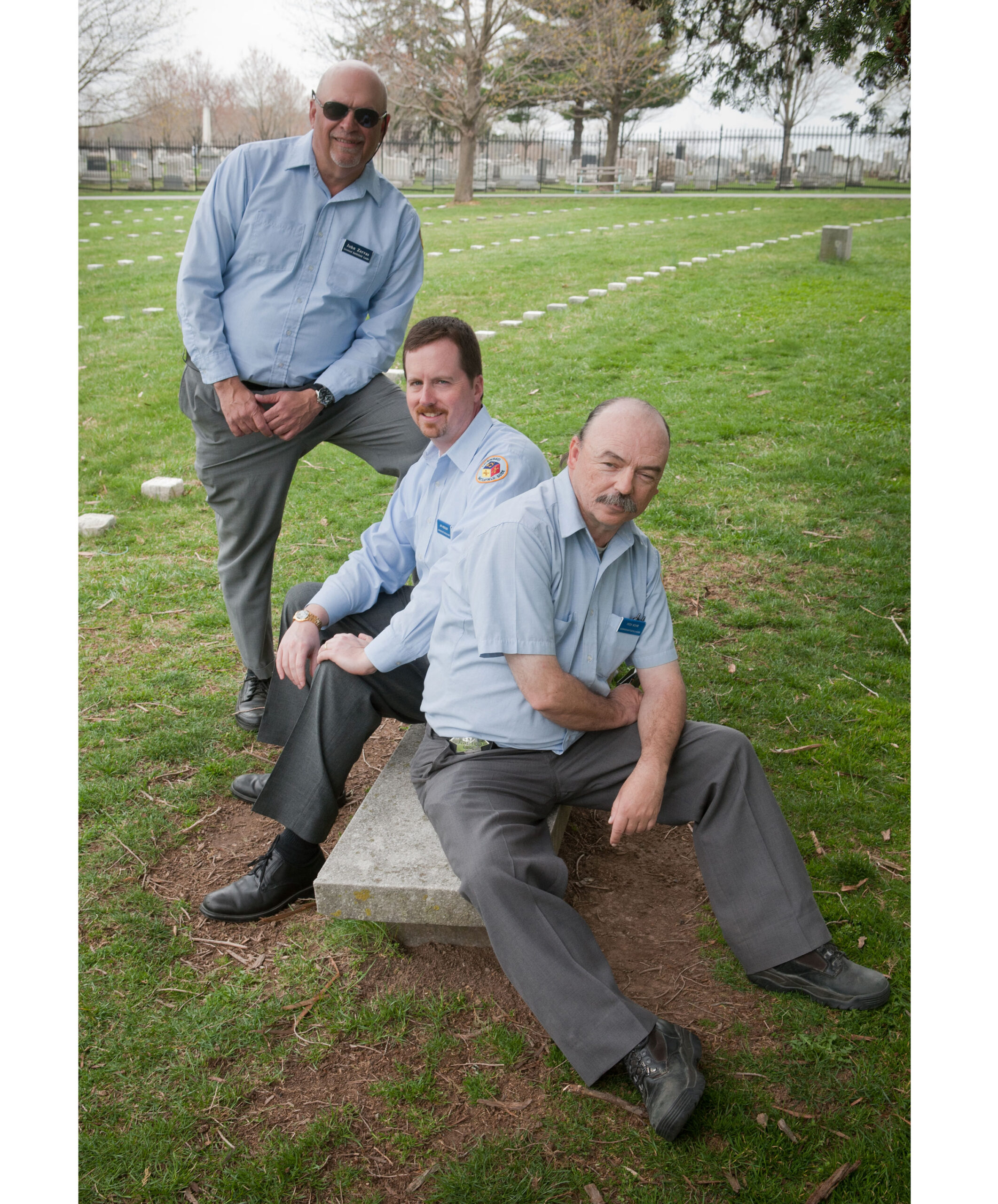 Claudio Vazquez
Licensed battlefield guides, who number 155 and rarely leave the force, are a tight-knit group, often spending their off hours together discussing the finer points of the battle. Pictured here on the Gettysburg battlefield are, from left, guides John Zervas, Jim Hessler, and Rich Kohr.
Today’s guides take field trips together. They chat about the Wheatfield like other people talk about the weather. They take turns giving formal talks to one another with titles like “For the Last Time on Earth: The Life and Death of 1st Sgt. Aaron T. McNaghten, Co. D, 62nd OVI,” and write detailed articles on everything from “Getting to Know the XI Corps: 75th Ohio Infantry (Part 1)” to “Calculating a Conundrum: Pettigrew’s Division on July 3rd: One Line or Two?” Knowledge of Gettysburg is their currency, and they revel in growing and exchanging it.
None of them does it for the money. Full-time guides are required to lead a minimum of 175 tours per year, part-timers no less than 90. (The force’s 50 emeritus guides—those who have served for 25 years or are over 68 and have guided for at least seven—have no requirements). But at just $55 per car tour and $125 per bus tour, that hardly adds up to a lucrative living, and the force is heavy with retirees and emeritus guides for this reason. Most younger guides either do it part-time while holding down other careers or, if full-time, pick up extra jobs in the off-season to supplement their tour earnings. “Everyone here could make a whole lot more money doing almost anything else if they wanted to,” said guide John Zervas. But they don’t want to—and that was the point. Sue Boardman ditched a 23-year career as an emergency room nurse to become a battlefield guide. Fred Hawthorne was an Air Force intelligence analyst, then a high school history teacher, before finding his way to guiding. Zervas spent 25 years in marketing on Wall Street before chucking it all for his badge. Their former colleagues didn’t care that they knew all the names of General Dan Sickles’ staff members. Their new ones do. Now, that knowledge earns them respect. It’s part of why almost no one ever leaves the force—and why the Park Service rarely needs new guides. As one insider put it: “About the only way a guide gives up their license is through death.”
Jim Tate was testament to that. At age 94, he was the oldest member of the force and had been guiding since 1951. I took a tour with Tate, a World War II veteran, a few days before the guide test. He grew up in Gettysburg, he told me, and could remember when some of the town’s picket fences were still scarred by bullet holes. He also remembered the chaos of Gettysburg Square during the Depression era, with men standing on street corners yelling, “Battlefield guide!” at passing cars. “I didn’t realize that years later I would be doing the same thing,” said Tate, who struck me as sharper than most 70-year-olds. When Tate started out, guides still wore olive drab uniforms, with a black tie and a garrison hat. A tour cost $3 or $4.
In July 1938—the Battle of Gettysburg’s 75th anniversary—nearly a quarter of a million people gathered at Oak Hill to hear President Franklin Delano Roosevelt dedicate the Eternal Peace Light Memorial. Tate was there. So were about 1,800 Civil War veterans. “They were wearing uniforms, some in gray, some in blue. Long beards, sideburns, medals,” Tate recalled. “You’re just thinking, these fellas fought in the Civil War. They saved our country.” After the ceremony, Tate followed the veterans to the railroad station—the same station where Lincoln had disembarked on the eve of the Gettysburg Address. At the back of the last train car stood a Confederate veteran and a Union veteran, waving to the crowd. “I thought, look at that, just fading into history,” Tate told me. “People think the Civil War was so long ago, but I can tell you it wasn’t.”
Tate had shaken hands with Battle of Gettysburg survivors, and his fellow guides revered him for that. He inspired them in another way as well. “Till I’m as old as Jim Tate, if I live that long,” Fred Hawthorne said, when I asked him how long he would guide. I heard the same thing from seven or eight others. If Tate was their connection to the past, he also represented the future they wanted for themselves: in their 90s, still sharp, and still guiding.
About six weeks after we spoke, Tate died suddenly. He had been a fixture at Gettysburg National Military Park for more than 60 years, as dependable a presence as Little Round Top. His passing signaled the end of an era. On a blustery winter morning, Tate was buried in Evergreen Cemetery, Gettysburg’s civilian burial ground since 1854. Lining both sides of the path from hearse to grave were about 80 licensed battlefield guides, in full uniform, there to honor a veteran—of war, of guiding, of life—for his legacy of service. “It was a good tribute,” Fred Hawthorne said. Tate would have been delighted.
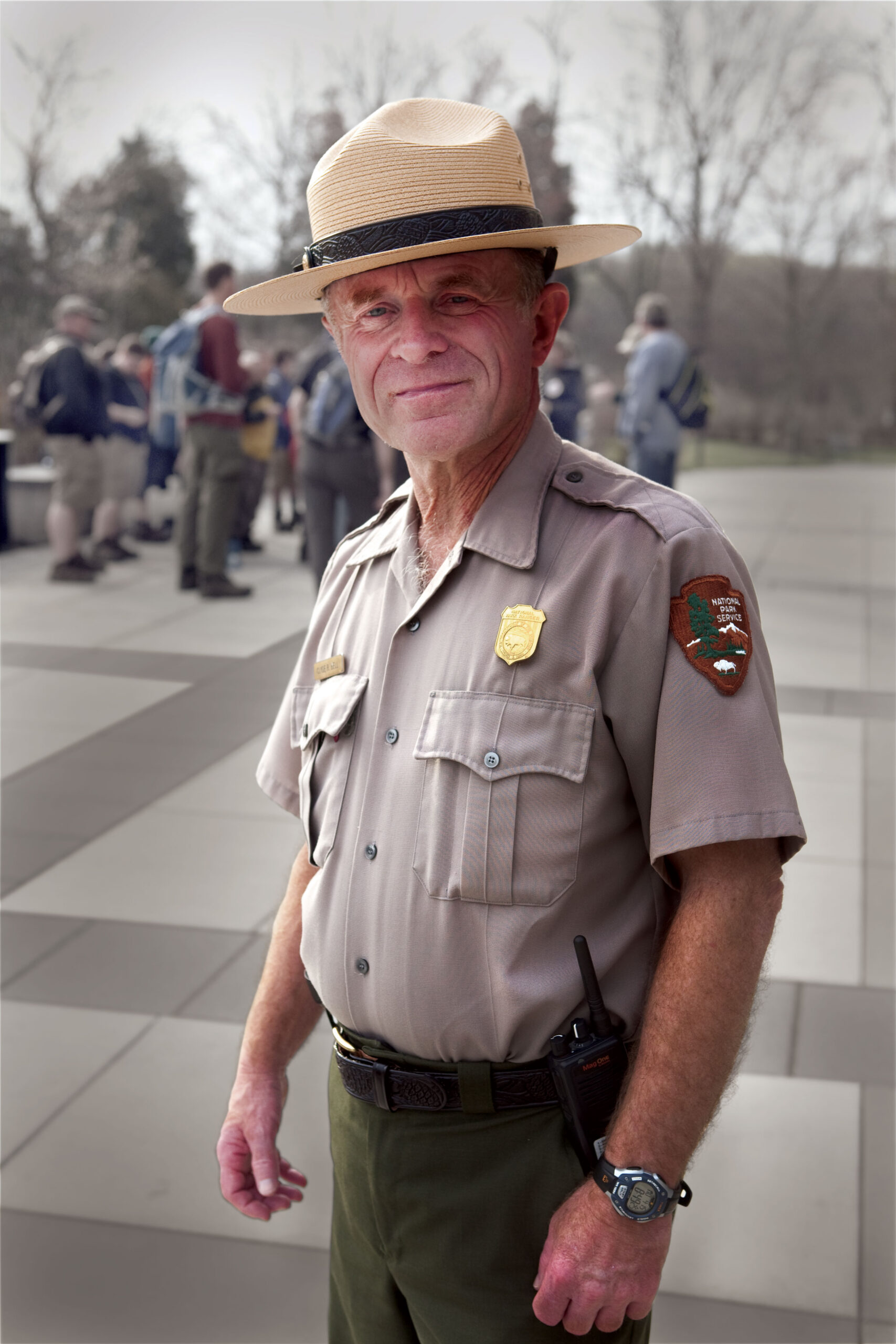 Claudio Vazquez
Clyde Bell, a 30-year employee of the National Park Service, has supervised Gettysburg’s licensed battlefield guide force for nearly two decades.
Taking the Licensed Battlefield Guide Exam
Nobody knows more about what it takes to become a licensed battlefield guide than Clyde Bell. A compact man with graying reddish hair, a square jaw, and intense blue eyes, Bell has worked for the National Park Service for 30 years. For the last 17, he has served as Gettysburg’s guide supervisor, overseeing all aspects of guide testing and licensing. A few days before the test, I popped into his office. Paintings of Gettysburg battle scenes crowded its walls, and Bell’s desk overflowed with paperwork. Sifting through it, he found the stapled stack he was looking for and held it up. “This is it—this is the test,” said Bell. I said I was surprised it wasn’t in a vault somewhere. He laughed. “Maybe it should be.”
Over the last two years, about 250 people had contacted Bell about taking the 2012 exam. He’d sent each a letter designed to deter all but the diehards. (“You should be aware that becoming an LBG is not an easy undertaking, nor is it quickly accomplished…. Please give this serious thought when pursuing your desire to become a Licensed Battlefield Guide.”) The letter turned away about 100 people. Still, the test always draws its share of buffs who don’t heed the warning. “They’ve read The Killer Angels several times and seen the movie Gettysburg, and think they can pass it,” Bell said, shaking his head.
As overseer of all things guide-test-related, Bell was personally responsible for assembling the written exam. The questions—chosen from a vast database of possibilities—change each time but are always a mix of fill-in-the-blank, multiple choice, matching, and true/false. Test-takers also need to identify about a dozen battlefield monuments (with inscriptions blurred), put names to the photos of Civil War-era personalities, and identify natural and man-made features on a battlefield map. In recent years, Bell has broadened the test to include questions about prewar and postwar politics, the experiences of women and African Americans during the conflict, and other Civil War battles. “Guides have to be prepared for visitors’ questions about all aspects of the war—not just what happened at Gettysburg,” he remarked. So, then, do test-takers.
Diehards like Korczyk and Burkell don’t worry much about the map, the monuments, or the photo identifications. But they do fear Bell’s questions about the wider war—especially other Civil War battles—and the multi-part fill-in-the-blank questions he seems to favor. (Doubly worrisome are multi-part fill-in-the-blank questions about other Civil War battles.) And they always look out for trick questions, especially in the true/false section. In the six tests that Bell had administered—the upcoming test would be his seventh—nobody had ever achieved a perfect score.
Now, test-takers had a few new things to worry about. Bell had made it known that he planned to retire soon. Whether his replacement will offer the test again in two years, nobody knows. More alarming was the rampant rumor that the 2012 test would be the hardest anyone had ever seen. Bell and some of the guides were concerned that repeat test-takers were getting too comfortable with the predictable format, the rumor went, and that the top scores were too crammed together. A few months before the test, Bell had asked the guides to come up with some new questions—something he’s never done before. They’d handed him 68 pages’ worth.
Bell pointed to the exam—30-odd pages that the diehards now amassing in Gettysburg would kill to even glance at. “It’s going to be a tough test,” he said. “And it’s meant to be a tough test. They know that going into it.”
 Eric Kulin
A group of visitors gathers to listen to their licensed battlefield guide on a tour of the Gettysburg battlefield.
Not every would-be guide has the advantage of living locally. Three days before the test, Mike Rupert drove the 185 miles from his home in Pittsburgh, Pennsylvania, eager to squeeze in a few study days on the battlefield. With him, he’d hauled two suitcases of books, a duffel filled with printouts and papers, a laptop, and two large framed posters showing the “order of battle”—essentially, a detailed family-tree-like representation of the command structure and units of the opposing armies. Having all these resources at hand would help with a problem he’d dubbed “regimental drift”—when reading about a particular detail of the battle leads you to wonder about another detail that you then must compulsively look up. It was rare that Rupert read anything without catching the “drift.”
Forty-seven years old and a mechanic by trade, Rupert is wiry and soft-spoken, with center-parted sandy-blond hair and a clipped mustache that dips down at the corners, a style I’ve seen before in Civil War soldier daguerreotypes. On my first morning in Gettysburg, I chatted with him over eggs and orange juice at the Doubleday Inn, the charming B&B, located on the battlefield itself, where we were both staying. Rupert’s first visit to Gettysburg came in 2001, during a family trip. At the time, he knew “absolutely zero” about Gettysburg and wasn’t even a Civil War buff. But when the family stopped at the Pennsylvania State Memorial, a giant monument listing the names of all soldiers from Pennsylvania regiments who fought in the battle, Rupert just stood there, awestruck. “My wife said, ‘What’s the matter with you?’” Rupert recalled. “It was those 34,000 names, all from my state. That’s when I realized there was something else here. The field just grabbed me.”
Rupert’s Civil War library, which didn’t exist in 2001, now occupies three walls in his house. He also spends nearly all his vacation time in Gettysburg, studying the field and daydreaming about earning his badge. “Being able to tell people the story here and show them the field would be an honor,” he said. “It would mean more than fixing your brakes.” Rupert took the test for the first time in 2008 and scored an 84 percent. In 2010, he got a 94.69 percent and tied for No. 28—several spots ahead of Larry Korczyk.
As Rupert and I finished breakfast, another Doubleday-dwelling test-taker—Dave Clark, a tall, thin tax attorney from California—ambled in and sat down. I asked him how many times he’s taken the exam. “It feels like 14,” he said, digging into his eggs. Actually, this would be his fourth try. Last time he was tied with Rupert at No. 28. Over the years, Clark has gone to epic lengths to erase some of the disadvantage of living so far from Gettysburg. In order to attend the same test-prep classes that Burkell and his group had a few years earlier, he’d taken red-eyes back and forth from California—two round-trips per week—through most of the summer.
The two men talked about their study plans while Clark finished breakfast. Eventually, Clark put on his jacket and pulled a colorful striped beanie onto his head. Over the next few days, I would spot that beanie at least a half dozen times around the battlefield, as Clark climbed through woods or stood in the middle of a meadow, scrutinizing a heavily highlighted book or just reveling in being on the field that he reads so much about from afar. I asked him if he felt ready. He shrugged. “I think of it this way,” Clark said, zipping his jacket. “There are about 10,000 questions they could ask. I just have to figure out which 250 it’s going to be.”
That a test-taker’s fate can come down to whether they know, say, how much it cost to exhume and rebury a Union soldier’s body in 1863 ($1.59) has an absurdity to it that is not lost on Scott Hartwig, the lead historian at Gettysburg National Military Park and the brain behind its many ranger-led interpretative programs, a free complement to the fee-based tours led by battlefield guides. Hartwig thinks hard test questions are fine, but within limits. “These guys need to know their stuff about the battle and the history of the park,” he said. “But now it’s become, do you happen to know how many cannonballs are on top of the 5th Maine Monument”—which doesn’t strike Hartwig as crucial battlefield knowledge.
Allen Guelzo, professor of history and director of the Civil War Era Studies Program at Gettysburg College, also puzzles over the written test’s focus on extreme detail, likening it to a gigantic game of Trivial Pursuit. “The exam targets very finicky stuff, most of which would never get meaningfully deployed on a tour.” Plus, he added, many of the test’s “facts” aren’t hard data at all. “The exam assumes that there is one authentic narrative of the battle, one authentic sequence of timing, one authentic placement of units—and there isn’t,” Guelzo said. “I can give you five completely conflicting scenarios of how an event unfolded during the battle, and each could be perfectly valid. But that doesn’t work out well on an exam. You can’t turn that into a multiple choice question.”
Guide supervisor Clyde Bell often ponders a different dilemma. In the 1990s, the guide test was offered every three or four years, and anyone scoring above 85 percent would automatically advance to the oral exam. But with the release of the movie Gettysburg (1993) and the swarm of events surrounding the battle’s 135th anniversary, the test’s popularity spiked. In 1987, 50 people took it. In 1994, it was 200—a whopping 85 of whom qualified for the oral exam, creating a multi-year backlog for scheduling and conducting oral exams. So in 2002, Bell started offering the test more frequently—every two years—and capped the number of people making the cut at 19 or 20. That’s when the competition kicked into high gear.
But back in the days of 85 percent, Bell had noticed something. Those who scored lower on the test—closer to 85 than to 100—were often more effective guides. “They just had the personality and could talk to the level of visitor who comes here,” he explained. They also passed their oral exams at a higher rate. Now, that entire subset of exceptional future guides is locked out of the system, unable to advance unless they happen to memorize the number of 5th Maine Monument cannonballs. If the test acts as an exclusionary device, then it could be excluding some of the very people who would be best at the job.
Still, despite these shortcomings, nobody has come up with a better alternative. And there is no arguing that the process continues to yield outstanding guides. “As the testing and the competition became keener and keener, I think the level of who we were getting as licensed guides got higher and higher,” Hartwig said. “When I think of the licensed guides today versus when I first came to Gettysburg, there’s no comparison. We may like to reminisce about the good old days, but the good old days are right now.”
“IDs out, and no cellphones!” bellowed one of the guides manning the registration desk on test day. “H through Z on the right, A through H on the left!” It was 8:30 a.m., 30 minutes before the start of the written exam. The line moved quickly, and test-takers sorted themselves into a dozen or so garishly painted, windowless classrooms. Earlier, some had visited the monument to the 140th New York Infantry’s Colonel Patrick “Paddy” O’Rourke on Little Round Top, rubbing his nose for good luck like others might kiss the Blarney Stone. The Doubleday innkeepers had handed Clark and Rupert dog biscuits to lay at the feet of the 11th Pennsylvania Infantry’s lucky canine mascot, Sallie, depicted on its monument. Larry Korczyk, of course, had pulled on his mismatched shoes. Now, he fiddled nervously with his No. 2 pencils, and waited.
What none of them knew, in those quiet minutes leading up to start time, was that the rumors were true. This test was substantially different, and orders of magnitude harder, than any offered before. Test-takers were about to face a bevy of questions about Civil War battles in the Western theater, far from those best known to Gettysburg experts; a new 12-point section on artillery that would wallop nearly everyone; a host of highly specific questions about the battlefield in more modern times, like the month and year John F. Kennedy had visited; and a few questions that seemed sort of random, like a “band of brothers” quote that had to be matched to its source, which turned out to be Shakespeare’s Henry V. Meanwhile, test questions about the “family tree” of the armies’ command structure ventured out onto smaller, more obscure branches.
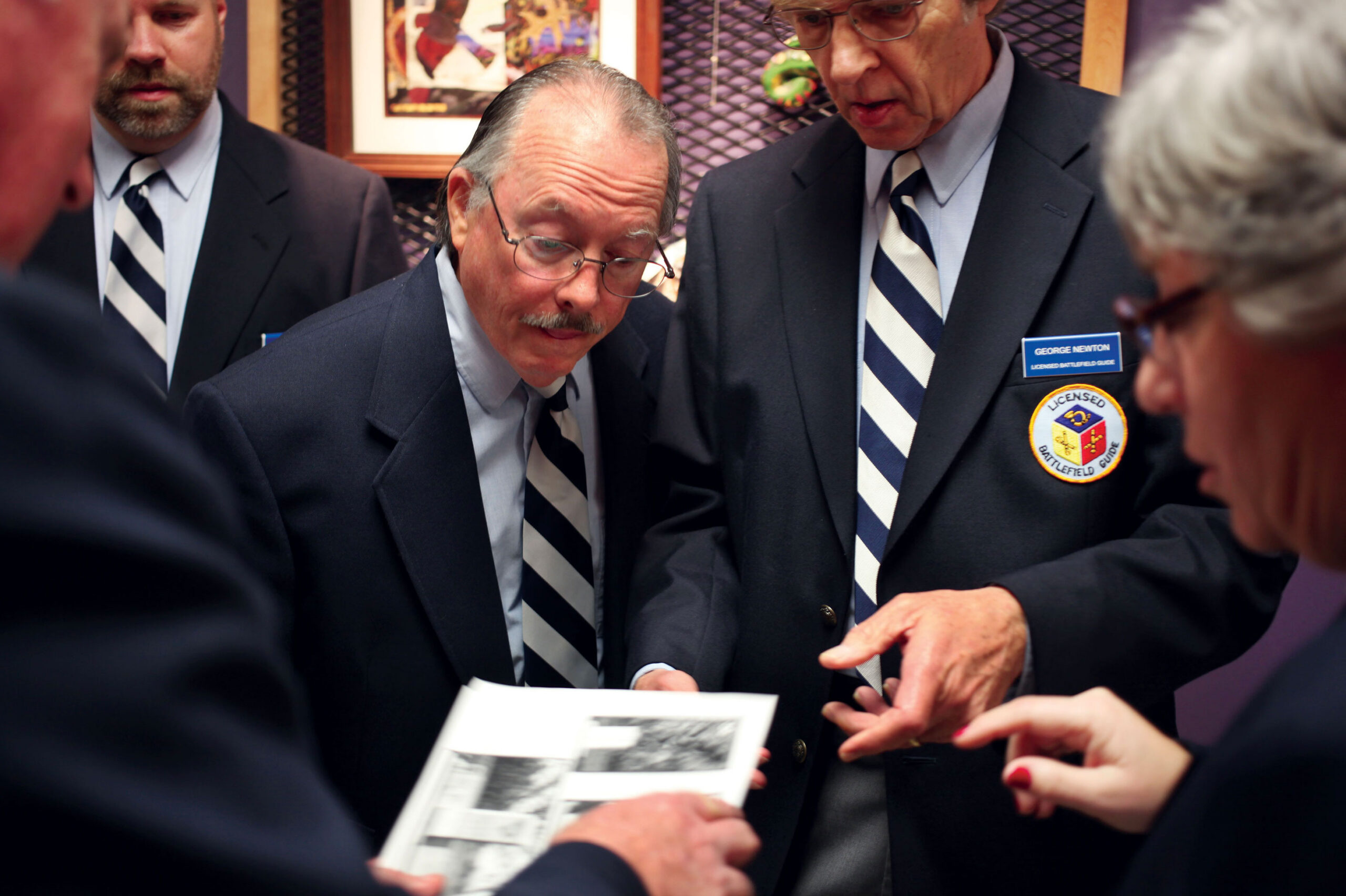
During the test, I was standing in the hallway when a cluster of guides, huddled around a copy of the exam, came across one of those questions: “This brigade, composed of 10th GA, 50th GA, 51st GA, 53rd GA is commanded by ______.”
“Geez,” said guide Joe Mieczkowski, who placed No. 1 on the 2006 written exam. “Who is it?”
The other guides in the huddle weren’t sure.
“Not Doles, not Anderson, not Benning,” Mieczkowski whispered to himself. He pulled a pen and an old receipt from his shirt pocket and scribbled it down to look up later. (The answer was Brigadier General Paul Jones Semmes.) A number of guides would later tell Bell that if they’d taken this test, they doubt they would have made the cut.
 Tom Wolff
A group of licensed battlefield guides gathers around a copy of the exam while the test is in progress.
The first person to leave was a burly, unemployed truck driver who preferred not to give his name. It was just 10:40 a.m. “It was hard,” he said, raking a hand through his beard. “I’m a buff, but all those details….” Someone had told him he’d need at least 92 percent right to even be in contention. “I didn’t even answer 92 percent of the questions,” he muttered. Most test-takers took the full three hours, stumbling out at noon, exhausted. “I wasn’t in tears and I didn’t embarrass myself,” said Chris Bagley, the traveling nurse, sounding as though he’d worried both could happen. “I left myself in the room,” offered a wiped-out Chuck Burkell.
The minute that Larry Korczyk got home, he looked up the answers to every question he could remember, tallied the ones he missed, and started praying that the total was low enough to qualify him for the cut. “I think a lot of questions were designed to put some distance between candidates,” he said. “But with 151 people taking the test, they can afford to be that specific.” Back at the Doubleday Inn, Dave Clark and Mike Rupert sat by the fireplace, books and papers spread around them. “Who fired from the left during Pickett’s Charge? Wait, was it the left or the right?” asked Clark, flipping through his growing set of notes.
“It was the left. That was the 8th Ohio,” Rupert replied.
“Dammit! That’s a gimme,” Clark said. “Everyone else will get that right.”
The president who pardoned General Lee? Clark put Grant. Rupert guessed Nixon. It was Ford. And they’d both blown the Semmes question. Rupert’s shoulders slumped. “I don’t feel good, but who knows,” he said.
“The good news is that I learn something new each time I take the exam,” Clark told me later. “The bad news is there’s no way to prepare if the questions can be about anything.” He and Rupert were both convinced they’d done worse this time. But they figured everyone else had as well. When I left them, they’d started passing study tips back and forth. Each hoped there wouldn’t be another written exam in their future. Yet they were quietly preparing for next time.
the results letters arrived a few days before Christmas. Twenty people had made the cut. While there were still three ties within the top 20, scores were not as tightly clustered: No. 1 got 96.1 percent of the 230 questions right (nine wrong), while No. 20 got 90 percent (23 wrong). About 10 people answered fewer than 100 questions correctly. The lowest score was a catastrophic 11.
It was not good news for Mike Rupert: He had tied for No. 31. The new artillery section accounted for 10 of his 34 missed questions. (Only about a dozen people got 12 of 12 points on that section, and “lots of people just blew it completely,” Bell reported.) Dave Clark, who had been so close in 2010, had tumbled down the rankings to No. 60. Chuck Burkell hadn’t been sure if he’d take the test a fourth time. By placing No. 7, he wouldn’t have to find out. Three other members of his study group had made it, too—one of them in the precarious No. 20 spot. But leaving their fifth man behind dampened their celebration. Steve Dunn, the Air Force master sergeant who stood first in line on test day? On his fifth try, he’d finally made the cut, too. He was No. 18.
The day the results arrived, Larry Korczyk was painting an old Victorian in downtown Gettysburg. His wife spotted the letter in the mailbox and drove it over to him, and everyone in the building gathered around. The top scorer, the one who’d missed only nine questions—it was Korczyk. He was No. 1. “My first reaction was pure shock, then an incredible sense of relief that I had even made the cut,” he said. His second reaction was more sobering. “My very next thought was, Oh my God. Now I’ve got to prepare for the oral.”
“You’re the elite of the elite right now,” Clyde Bell told the two women and 18 men seated around a U-shaped table in the Visitor Center’s education room. Bob Kirby, superintendent of Gettysburg National Military Park, upped it a notch. “You’ve gone through the gauntlet,” he told them. “The Navy SEALs have nothing on you.” I felt as if I’d stumbled onto the set of Top Gun. I hadn’t. It was a frigid Saturday in early February, two months after the written test, and this was “Charm School”—an intensive, two-day boot camp for the top 20 guide candidates, designed to help them survive the dreaded oral exam.
There were familiar faces at the table, like Korczyk, Burkell, and Keith Toney, who’d guided for 10 years before moving to Kentucky to work for a hand-blended pipe tobacco company. His license had lapsed, so he’d tested again and tied for No. 13. There was also Steve Mock, an audiologist obsessed with the battle since 1961, when he wandered the field for three days as a 13-year-old after his dad dropped him off on the way to a bowling tournament. There was Doug Douds, a young Marine lieutenant colonel and fighter pilot who works at the Pentagon, and Rogers Fred III, a veterinary oncologist and member of Chuck Burkell’s study group whose great-great-uncle had fought at Gettysburg with the 63rd Pennsylvania Infantry. Fred remarked that it was easier to pass his medical boards than gain entry into this room. Also among the chosen were an orthopedic surgeon, a retired insurance underwriter, and a ponytailed chef named Gary.
Making it to Charm School was a momentous accomplishment, but in many ways it was easier than what lay ahead. The oral exam sounded simple. One by one, in the order in which they’d placed on the test, candidates would have two chances to deliver a two-hour battlefield tour to Bell and whatever licensed guide served as his co-examiner. But memorizing a zillion facts and bringing the battle to life for tourists who may never have heard of Lee or Meade are vastly different skill sets. Indeed, this is the great irony of the testing process: Achieving a stellar score on the written test in no way determines whether a family of four from Duluth will like having you in their car for two hours, or if you’ll be able to engage and excite them about what they’re seeing. “These are some of the smartest people in the world on the Battle of Gettysburg,” said John Zervas, one of a dozen guides serving as Charm School instructors. “But to pass the oral, they need to take all that knowledge and throw it away.” If historical statistics held, half of them wouldn’t be able to.
Most Gettysburg visitors know almost nothing about the Civil War—and Bell and the guides had two days to get that message through to the 20 minutiae-mongers fanned out in front of them. Guide George Newton put it this way: “You are not going to be talking to Civil War buffs.” He held up a two-inch-thick book of detailed battlefield maps in one hand, and a standard Gettysburg brochure, which folded out to a simple map of the field, in the other. “Your job is not to impart everything you know about the battle,” he said, dropping the thick book and raising aloft the flimsy brochure. “You have to take everything you know and move it down to this level. You can’t dive into the retreat of Humphrey’s division with a group tour. You can’t say the word ‘flank’ and not explain it.” Added Bell: “Not everyone cares how many buttons General Lee was wearing on July 2.”
While guides are required to cover all the basics of the battle during their tours, they get to choose everything from the route they drive to which stories they tell. But that freedom often spells trouble for nascent guides. “There are so many ways to get twisted around out there,” explained Zervas. To help candidates with this problem, Bell had asked them to bring an outline of their oral exam tour to Charm School for instructors to review. Many of those outlines were choked with detail. “You’re going to be pressed for time more than you realize,” guide Jim Hessler told a 30-year-old IT specialist from York, Pennsylvania, crossing out whole sections of his 31-page, single-spaced outline. “When it comes to Lee, it’s 56, from Virginia, in the army 20 years when the war broke out. Boom, you’re done.”
Even harder to impart were the softer skills of guiding—things like approachability, building rapport with tourists, and the art of good storytelling. Even a candidate’s appearance and overall driving ability would be graded during the oral exam—and Bell has flunked people on these criteria alone. Once a candidate passes the oral exam, their very next tour is with paying visitors—so there is no on-the-job training. Moreover, their skills are never reevaluated, which is why they have to be good right out of the gate. “You either have the interpersonal skills or you don’t,” Bell said. Those who didn’t would not make it past him.
Bell also uses the oral exam to test candidates’ ability to handle the stresses of a real tour. Can they flow with visitors’ questions and interests, or are they too rigid? To that end, Bell and his co-examiner would show up at each exam pretending to be tourists from two different states that had regiments at the battle. Candidates would need to personalize their tours accordingly, making sure to cover the experiences of those states’ soldiers at Gettysburg. This forces candidates to adjust their tour—even their whole route—in that moment, and think on their feet. But that isn’t the only curveball. “I’ll often ask questions that may have no direct relation to the battle—or, for lack of a better word, ‘dumbass’ questions, which people do ask,” Bell said. “I’m looking for how they react. They need to be prepared for anything.”
The guides at Charm School could attest to that. Some visitors challenge everything they say, or are too distracted by squirming children to even take in their stories. Others ask odd questions, like what was growing in Gettysburg’s fields in the 1860s (mainly soybeans) or the species of a particular tree. “You want to talk about Heath coming over the hill, but they want to know what bird that is,” said guide Dennis Conroy. Andy Donahue—one of about 15 women on the force and its top cavalry expert—seemed a magnet for unusual tours. Once, a visitor insisted that Donahue give a tour to her dog, Millie. (“I pulled out every Gettysburg dog story I knew.”) Another time, Donahue climbed into a van to give a tour only to learn that all its passengers were blind. They asked her to help them see the battlefield through her eyes. She had them out of the vehicle a lot, feeling cannons and touching the rocks of Devil’s Den. They loved it. Sometimes, a guide will hop into the car of a fellow diehard—and these are the moments they live for. “If they point to a statue and say, ‘That’s General Rhodes,’ you can open it up full throttle,” said guide Rich Kohr.
Throughout Charm School, Larry Korczyk had pen and paper out, taking neat and careful notes at every turn. He had spent countless hours on the battlefield. Yet until a few weeks earlier, he’d never taken a general two-hour tour—the very kind he hoped to soon be delivering. So he’d gone out with Hessler, quickly learning just how much detail he would need to drop from his spiel. “Jim never mentioned more than 10 or 15 generals by name, and none below division level,” Korczyk said, with a tinge of awe in his voice. During one of Charm School’s final exercises, Hessler drove Korczyk and one other candidate out to the battlefield for a similar tour. Hessler was the last guide to pass his oral exam on the very first try—11 years ago. He is also the guide force’s unrivaled expert on General Dan Sickles, even penning a 490-page biography of him. Yet during the tour, he managed to cover Sickles’ controversial refusal to occupy Little Round Top, General Meade’s reaction to that decision, and the flow of fighting that followed in one minute, 58 seconds. Boom, you’re done.
Some candidates would wait months—even as long as two years—before facing their oral exam, depending on the force’s need for new guides. But Korczyk had only four weeks. Knowing this, Hessler loaded his tour with practical tips, like what Korczyk could talk about if he got stuck at one of Gettysburg’s notoriously long red lights during his exam. He also drove out to Culp’s Hill—a wooded, difficult-to-interpret area of the battlefield that was another prime spot for oral exam screw-ups. The drive itself—down a lonely stretch of residential road with not a monument or marker in sight—was part of the problem. “This is an awfully long road,” said Korczyk, setting down his notebook. Getting caught out here with nothing to say and nothing to point toward could spell disaster.
Hessler had suggestions. The road had been a hotbed of activity during the battle, the same road the Union army had used to move men from its right flank to its left. “Or maybe mention how it used to be heavily wooded back here, and then talk about how the park is clearing non-historical tree growth,” Hessler offered.
“That’s great,” Korczyk replied, and wrote it all down.
On a sunday morning in early March, Korczyk took his oral exam. He drove his route beforehand, making sure the roads were open and clouds didn’t obscure the landmarks he planned to point out. He wore a new pair of pants—gray, like the guides wear—and “typical black guide shoes,” also recently purchased.
Clyde Bell and battlefield guide Bobby Housh met Korczyk at the Visitor Center, casting themselves as tourists from the outset. Throughout, Bell intentionally acted spacey and distracted, testing Korczyk’s ability to stay on course despite his antics. “A couple of times he just wandered away while I was talking,” recalled Korczyk. “He’d start touching the cannons, saying, ‘Is this a cannon? What kind of cannon is this?’ The whole time we were in the car, he was purposely not paying attention to me, just no eye contact at all.” Meanwhile, Housh was hitting him with serious questions, engaging him on every detail. “If I talked about a brigade, he would ask, ‘How many men were in that brigade?’” said Korczyk. “It was almost like good cop, bad cop.”
Korczyk had convinced himself that at least one of his “tourists” would be from Alabama. Instead, it was Indiana and Mississippi. “There were only two regiments from Indiana at Gettysburg—the 19th and the 27th—so I covered them well,” he said. But he missed one location for General William Barksdale’s Mississippi Brigade—along Cemetery Ridge, near the Pennsylvania State Memorial. “Barksdale’s brigade had moved northeast toward where the memorial now stands, at which time they ran into a brigade of New Yorkers that stymied their attack. I should have brought that into the storyline.”
Korczyk didn’t pass. But he did as well as anybody does on their first try. He completed his tour in two hours and 20 minutes—just five minutes over the limit. The examiners liked his narrative transitions, and his four out-of-the-car stops—at Oak Hill, the Mississippi State Memorial, Little Round Top, and the Angle—were well handled. He’d also incorporated Culp’s Hill into the tour without getting sidelined—a huge pitfall averted. Afterward, Bell and Housh spent an hour with Korczyk dissecting the tour and making recommendations. “Believe me, I’ll take all the lessons learned and come back and do better,” Korczyk promised. “I’ll be prepared.”
They gave him three weeks. He used them to study the Mississippi Brigade’s regimental strengths and losses and all but memorize Barksdale’s biography. “I canvassed every site where Mississippians ever laid a foot,” he said. He spent hours giving practice tours to guides and fellow candidates, trying to add new content without blowing past his time limit.
For Korczyk’s second oral, Bell and Housh played the same roles. Korczyk wore the same gray pants. This time, he passed. It was his final hurdle. A few weeks later he was back on the battlefield, a distinctive patch on his left shoulder and a nine-point star shining on his belt. “It’s like a badge of honor, as far as I’m concerned,” he said. “It’s a badge of honor.”
The candidate that followed Korczyk “flamed out,” failing both attempts. The next four have taken their first oral. None passed it. Chuck Burkell remains on deck, waiting for his first chance, which will likely come this fall. In Pittsburgh, Mike Rupert is already studying for a test that he can only hope will be offered again in two years.
One night, back when we were both staying at the Doubleday, Rupert approached me toting an earmarked copy of Maine at Gettysburg, a thick book of speeches dedicating the state’s many battlefield monuments, in his hand. He wanted to share part of a speech by Joshua Lawrence Chamberlain, commander of the 20th Maine Infantry at Gettysburg, that helped explain what had happened to him that day at the Pennsylvania State Memorial, the day he fell in love with Gettysburg.
“This is the end of Chamberlain speaking,” he said, clearing his throat. “‘In great deeds, something abides. On great fields, something stays. Forms change and pass; bodies disappear; but spirits linger…. And reverent men and women from afar, and generations that know us not and that we know not of, heart-drawn to see where and by whom great things were suffered and done for them, shall come to this deathless field, to ponder and dream; and lo! the shadow of a mighty presence shall wrap them in its bosom, and the power of the vision pass into their souls.’”
This was why Rupert would never give up. His perseverance was not about passing a test. It was about honoring the vision that had passed into his soul. It was for the privilege of shepherding the heart-drawn across the field. “And so the epic quest shall continue,” he told me. “I’ll keep taking the test forever, if that’s how long it takes.”
LBG 101: How it Works
There are many ways to experience the Gettysburg battlefield. You can take an audio tour, download a growing number of podcasts and battlefield apps, or sign up for one of the National Park Service’s free ranger-led interpretive programs, which focus on specific aspects of the battle. But one of the best ways to grasp the overall story of what happened there on July 1-3, 1863, is to hire a licensed battlefield guide.
WHAT THEY DO
Guides conduct visitors around the Civil War’s most visited and well-marked battlefield, often by bus and occasionally by horse or Segway. However, the vast majority of tours are conducted by car—your car. Your guide will meet you inside the Visitor Center, politely ask for your keys, then drive you around the field. Using the battlefield as a living map, they’ll describe key moments of the battle and share real-life stories of heroism and tragedy. Even Gettysburg “diehards” will learn something. Most tours last two hours.
WHO THEY ARE
Since 1915, there have been fewer than 570 licensed battlefield guides. Today’s force numbers 155, about 15 of whom are women. Guides range in age from late 20s to late 80s, but the majority are in their 50s and 60s. Most guides have specialties and can be hired for customized tours (some guides would be happy to spend a whole day on, say, Little Round Top, or Union artillery units). The force’s most prolific guide is John Fuss, now in his 80s, who averages more than 700 tours a year. The next closest guide, who is much younger, does about 530 tours annually.
THREE WAYS TO HIRE THEM
1. To reserve a guide at least three days in advance, contact the park’s reservation system (877-874-2478; [email protected]). Guides can also be reserved by name or by specialty (Peach Orchard, infantry, etc.).
2. You can also call the Association of Licensed Battlefield Guides to book an upcoming tour (717-337-1709).
3. Otherwise, guides are available on a first-come, first-serve basis at the Visitor Center reservation desk.
Note: It is easier to book a guide in the morning, so show up early. Car tours cost $65 (of which $55 goes to the guide; tips welcome). Van tours cost $90, and bus tours for 16+ people cost $135. In summertime, commercial bus tours with a licensed guide aboard leave regularly from the Visitor Center ($30 for adults, $18 for children 6-12, free for kids 5 and under).
Jenny Johnston is a freelance writer and editor based in San Francisco.
More Gettysburg Featured Content
Reunion at Gettysburg: Fifty years after the epic battle, thousands of veterans gathered to reminisce, reconcile—and be celebrated by a reunified nation.
Three Days in Gettysburg: Planning a trip? Check out our guide.
Surviving Pickett’s Charge: Remembering the spiritual consequences of military decisions.