 Frank Leslie’s Illustrated Newspaper
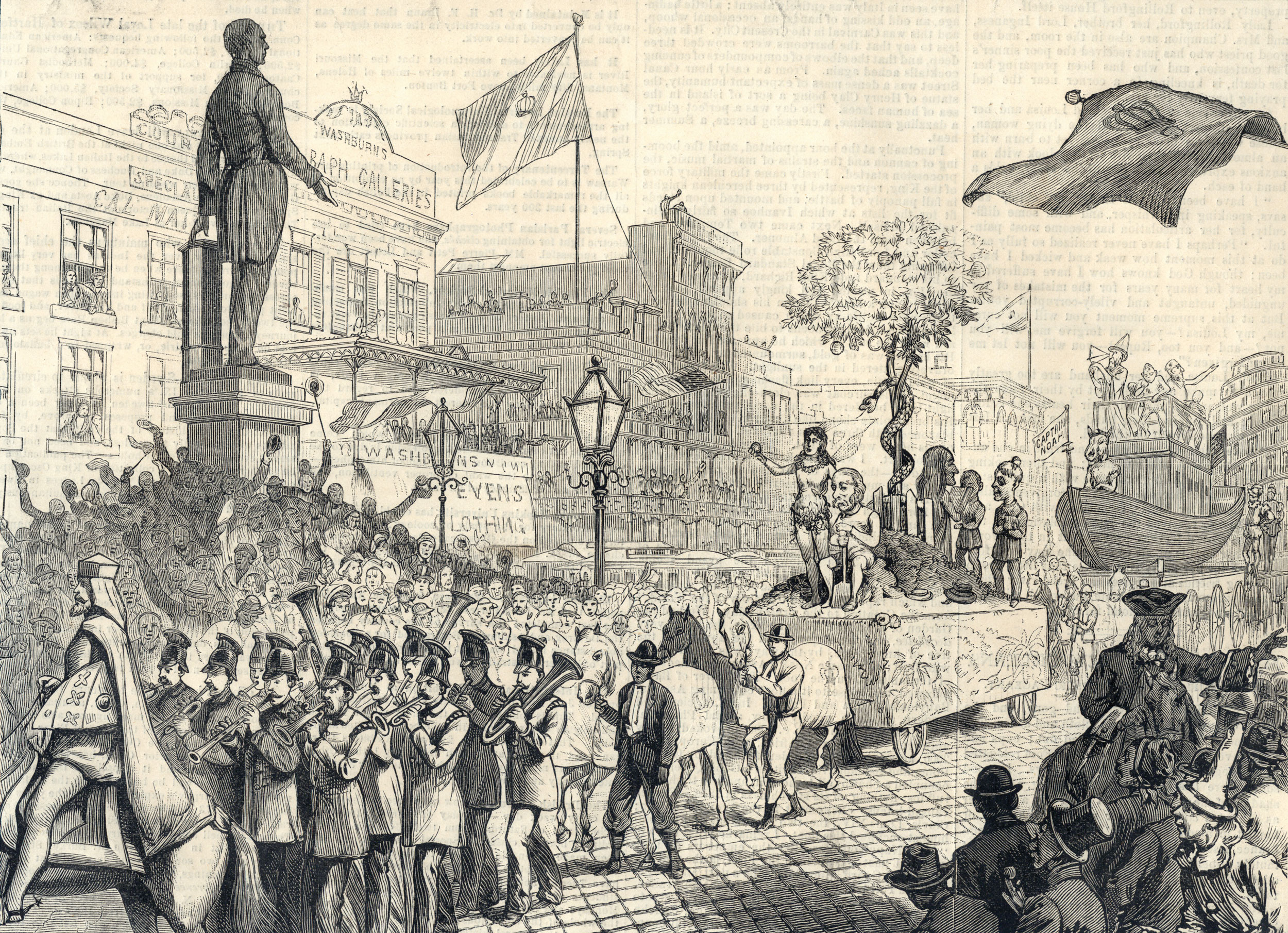
A scene from Canal Street in New Orleans during the 1879 Mardi Gras festivities.
The famed Civil War general arrived in New Orleans during Mardi Gras on February 24, 1879, as a part of a wide-ranging tour across the South. Soon thereafter he received an official summons from “Rex,” the masked king of the festivities (in actuality, James I. Day, a local insurance executive). Before a large, appreciative crowd, Day thanked the general “for dignifying the occasion with his presence.” At a banquet that night he further honored the general by making him a “Duke of Louisiana” and “praising his part in the late war.” A favorite adopted son of New Orleans, the former Confederate John Bell Hood, shared a theater box with his fellow general and gave a speech that praised him in glowing terms. The next day the feted general again appeared with Day, and the men drank champagne to each other’s health before 10,000 cheering southerners. At the grand ball that night the Mardi Gras king once more summoned the general to thank him for coming to New Orleans. Throughout his visit to Mardi Gras, William Tecumseh Sherman was “saluted with unbounded enthusiasm at the South’s greatest popular event.”1
It might surprise many people today that Sherman was New Orleans’ honored guest after the Civil War. After all, haven’t white southerners always hated Sherman for his marches across Georgia and the Carolinas, when his swarming army, so the story goes, inflicted terror and atrocities on defenseless civilians? Historian and Sherman biographer John Marszalek offers a vivid summary of this mindset: “Of all the supposed evil Yankees, William T. Sherman is clearly considered the damnedest…. Is there any Confederate supporter who does not have a Sherman story to relate: about alleged rapine, pillage, arson, or some other kind of destruction and violence?”2
That may be how Sherman is remembered, particularly in the South, but his celebrated presence at Mardi Gras wouldn’t have startled many in 1879. Long after the war Sherman was actually very much a persona grata throughout what had been the Confederacy. He was warmly received on several trips across the South and was on good terms with many ex-Confederates who had opposed him on the battlefield. In fact, for the first decade and a half after the Civil War, his most severe criticisms came from fellow unionists motivated by personal animus and professional jealousy.3 While southerners might have strongly disagreed with Sherman over the justifiability of secession or whether Robert E. Lee was a greater general than Ulysses S. Grant, virtually none of them publicly accused Sherman at that time of the crimes now associated with his campaigns.4
 National Archives
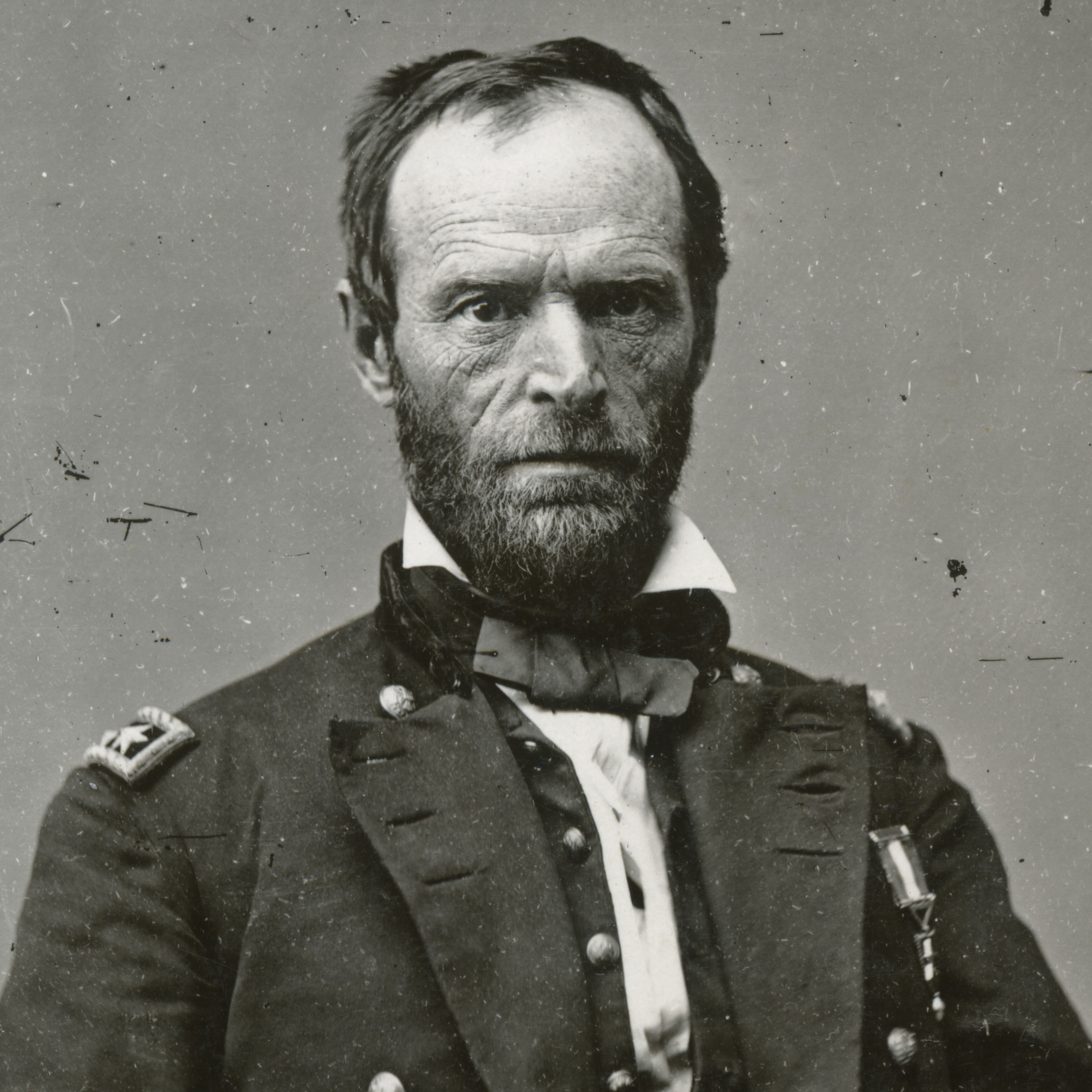
William Tecumseh Sherman
It wasn’t until the 1881 publication of Jefferson Davis’ memoirs—and the bitter, vitriolic debate between Sherman and Davis that followed—that southerners began to turn against him. By this time, many southerners had elevated Davis to a living symbol of their lost nation, and Sherman’s acerbic attacks on Davis and repeated defenses of the Union cause eventually led postwar southerners to reinterpret Sherman’s wartime actions. That is, Sherman’s position in southern memory as a rapacious monster is rooted more in what happened after the war than during it.
The fight between Sherman and Davis in the 1880s did not just obscure the origins of Sherman’s infamous reputation. It has also led many to overlook that Sherman embraced much of the way of life celebrated in Lost Cause mythology. While Sherman was a northerner by birth, his associations, beliefs, and values made him deeply sympathetic to the antebellum white southern way of life.5 It’s a paradox of the Civil War that Sherman, the Confederacy’s bitter, avenging enemy, was also in many respects a thoroughgoing southerner.
Sherman was born in Lancaster, Ohio, on February 8, 1820. His father died suddenly when William was nine, leaving his mother impoverished and unable to care for her 10 children. Sherman was sent to the home of a family friend, U.S. Senator Thomas Ewing Sr., who raised him to age 16, then secured him an appointment to West Point. Sherman excelled at this institution steeped in southern attitudes and values, graduating sixth in the class of 1840.6 He spent the next several years at army posts in Florida, Alabama, South Carolina, Georgia, Missouri, and Louisiana, where he came to know life as lived by aristocratic white southerners. While he didn’t have a uniformly positive view of southern elites—once calling the young men he socialized with in Charleston the “worthless sons of broken down, proud Carolina families … all trash”—Sherman nonetheless enjoyed life among them.7
Sherman resigned his commission in 1853 and embarked on a series of spectacularly unsuccessful business ventures. Old army friends helped him secure the position of superintendent of the nascent Louisiana Military Academy (forerunner of today’s Louisiana State University) in 1859. Before beginning his duties late that year Sherman was confident that his “opinions on slavery are good enough for this country,” and it didn’t take him long to prove to the leading citizens of Louisiana that he shared their beliefs and values.8 At a Baton Rouge dinner party hosted in early 1860 by Governor Thomas O. Moore, Sherman was politely invited to explain his views on slavery. While those who knew Sherman personally held him in high regard, others were concerned that the state’s only college was run by a northerner whose congressman brother was seen across the South as an abolitionist.
After reassuring everyone that his brother had no intention of ending slavery, Sherman declared that the people of Louisiana “were hardly responsible for slavery, as they had inherited it.” Further, while the well-being of field slaves might depend on “the temper and dispositions of their masters and overseers,” Sherman thought slaves who worked in family homes were “probably better treated than any slaves on earth.”9 When he went on to say that he favored keeping slave families intact and allowing slaves to read and write, in order to increase their value as property, a fellow guest pounded the table in excited support. Sherman was “glad to be thus relieved, because at the time all men in Louisiana were dreadfully excited on questions affecting their slaves.”10
 Library of Congress
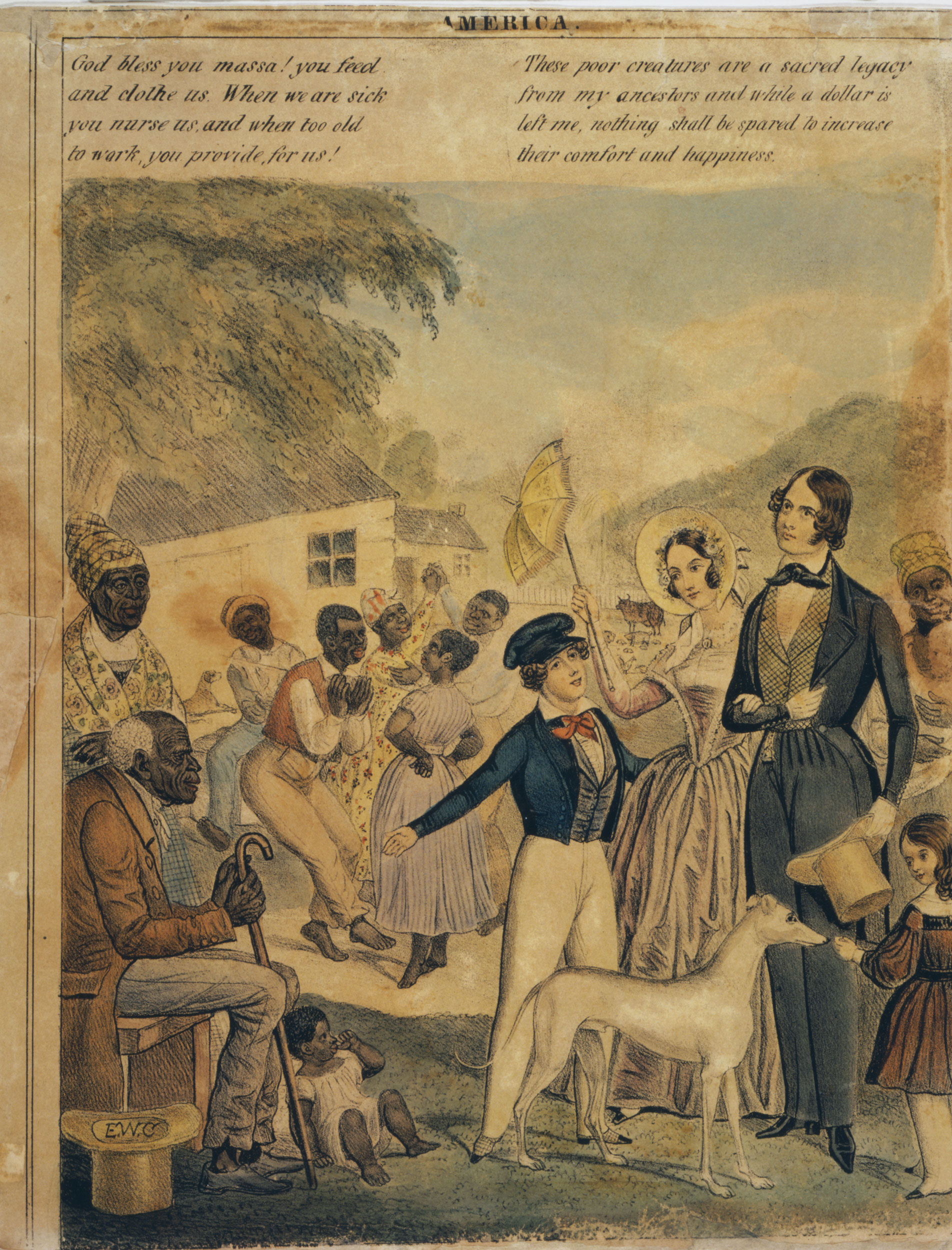
A romanticized portrait of slavery in America, created circa 1841. While Sherman didn’t idealize the institution, his views on slavery were much closer in tune with southern masters than northern abolitionists.
But Sherman had, if anything, understated his views on race and slavery. For one thing, Sherman was nothing less than a white supremacist. “All the congresses on earth can’t make the negro anything else than what he is; he must be subject to the white man,” Sherman wrote his wife in July 1860. “Two such races cannot live in harmony save as master and slave.”11 Otherwise, “[w]hen negroes are liberated either they or their masters must perish.”12 In another 1860 letter, this time to his antislavery brother-in-law regarding Sherman’s plans to bring his family to Louisiana, he crassly joked about becoming a slave master himself. Making light of the problems he anticipated in keeping white servants, he wrote that his wife, Ellen, “will have to wait on herself or buy a nigger. What will you think of that—our buying niggers?”13 Blinded by his implacable racism, Sherman could see no worthwhile moral or political debate to be had over slavery. Even if slavery was disappearing in much of the world, he reasoned, history had forced this institution on the South, and its continued prosperity depended on embracing it. “Theoretical notions of humanity and religion,” he flatly declared, “cannot shake the commercial fact that their labor is of great value and cannot be dispensed with.”14
Still, slavery did trouble Sherman in one way: He grew increasingly worried in the 1850s that political fights over it would threaten the Union’s stability. His response was to wish, however unrealistically, that both sides would calm down and accept slavery as it existed. “You can readily understand that I am sick of this war of prejudice,” Sherman wrote to a Louisiana friend during a trip back to Ohio in September 1860. “Here the prejudice is that planters have nothing else to do but hang abolitionists and hold lynch courts. There, that all the people of Ohio are engaging in stealing and running off negroes. The truth is that they both do injustice to the other.”15
Further, Sherman argued, southern and northern extremists alike failed to see the virtues of the status quo: “[I]f all would forget and mind their respective interests, it would be found that slave and all other property are now at a most prosperous standard.”16 Sherman was apparently blind to the brutal nature of slavery, but he didn’t idealize the institution. In fact, he once confessed a wish that it had never existed because of the social and political “mischief” it caused.17 But slavery did exist, and Sherman held that slavery as practiced in the antebellum South worked to everyone’s benefit (or at least to the benefit of those who counted in Sherman’s racist calculus). Just days before the Civil War began, he would write to a friend in Louisiana that he considered “the practice of slavery in the South … the mildest and best regulated system of slavery in the world, now or heretofore.”18
Sherman was occasionally as angry at southern hotheads as he was at abolitionists, but he nonetheless displayed a clear sympathy for the southern side in the growing schism. He thought that northerners’ protests against slavery were hypocritical, asserting that as a rule “northern men don’t care any more about the rights and humanities of the negroes than the southerners.”19 In addition, attempts to limit slavery in the territories would cause only needless resentment in the South. The disputed areas weren’t conducive to building an economy based on slave labor, so “[n]o sensible man with liberty of choice would think of taking his slaves there. Consequently all this clamor about rights in territories is a theoretical one.”20 All in all, Sherman, as he expressed in an 1859 letter to his brother-in-law, was emphatic that the South should be allowed to make its own decisions regarding slavery and then “receive its reward or doom.”21 Sherman thus anticipated by two years Jefferson Davis’ famous plea that the South simply be left alone. To that end, Sherman made clear more than once that he would defend the slaveholding states against their enemies—meaning slaves and their abolitionist allies—so long as they remained within the federal union.22
Thus, in January 1861, when it was clear Louisiana would follow the cotton states out of the Union, Sherman had no choice but to leave the state—and his position at the military academy. He could not accept disunion under any circumstances. But his departure showed how close he had become to the southerners around him. “You cannot regret more than I do the necessity which deprives us of your services,” Governor Moore wrote Sherman.23 For his part, at a final academy ceremony, Sherman bid farewell to each of his cadets individually, then turned to the assembled faculty but was unable to speak. After a moment, Sherman placed a hand over his heart and choked out, “You are all here.”24
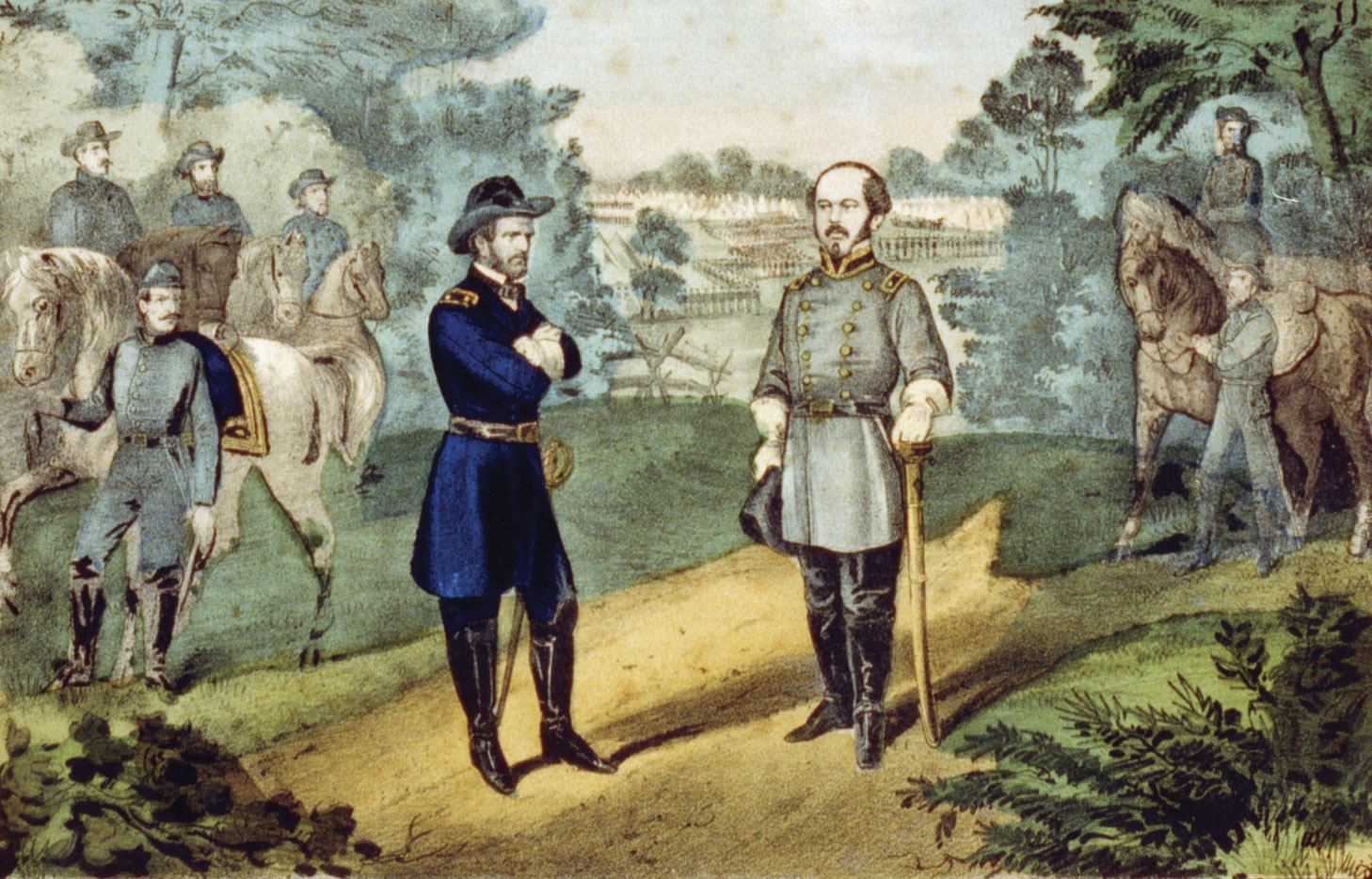
Sherman’s affinities for the South notwithstanding, he passionately believed the Confederacy must be destroyed and did his best to strip away its will and capacity to fight. His view of the Union cause is succinctly expressed in a September 1864 communiqué to the mayor of Atlanta: “We don’t want your negroes, or your horses, or your houses, or your lands, or any thing you have, but we do want and will have a just obedience to the laws of the United States.”25 Once the war ended, Sherman immediately worked toward a reconciliatory peace. On April 29, 1865, he wrote to John Rawlins, Grant’s chief of staff, that “[t]he South is broken and ruined, and appeals to our pity. To ride the people down with persecutions and military exactions would be like slashing away at the crew of a sinking ship.”26 Even before writing this letter, he’d already proved his commitment to a soft peace, by offering such favorable surrender terms to Confederate general Joseph E. Johnston that he was publicly suspected in the North of being a traitor.27
 Library of Congress
Confederate general Joseph E. Johnston surrenders his army to Sherman on April 26, 1865. Sherman’s terms drew cries of protest in the North, where they were deemed too generous.
During Reconstruction, Sherman’s political conservatism and unchanged racism led him to closely align with the white southerners he’d spent four years fighting. He believed the nation should return to a kind of pre-Civil War state of affairs—without, of course, contention over slavery.28 To that end, political power must be reserved for those who could responsibly exercise it, and for Sherman this meant a whites-only franchise: “The white men of this country will control it, and the negro, in mass, will occupy a subordinate position as a race.” While it was important to “secure them the liberty now gained,” social and political equality between the races was not possible “in our day, even if at all.”29
Sherman thought this arrangement would benefit the nation as a whole and newly freed blacks in particular. “We should aim for the sake of the future,” Sherman wrote a friend in July 1865, “to keep power and influence in the hands of the most energetic and stable race, white.”30 After all, voting requires “an understanding almost equivalent to the ability to make laws,” a capacity Sherman could not conceive of blacks possessing.31 Further, he was convinced that blacks intuitively understood their limitations even if their Radical Republican allies did not: “The Negroes don’t want to vote. They want to work and enjoy property, and they are no friends of the Negro who seek to complicate him with new prejudices.”32
While he eventually came to distance himself from President Andrew Johnson’s political methods, Sherman remained a strong supporter of Johnson’s staunchly pro-southerner approach to Reconstruction. When Johnson ordered the return of South Carolina land Sherman had confiscated from whites in January 1865, Sherman approved, claiming it had all been the doing of Radical Republican Edward Stanton, then President Lincoln’s secretary of state.33 Johnson’s rejection of the Freedmen’s Bureau Act, which allowed the federal imprisonment of whites who discriminated against blacks, caused Sherman to declare, “[A]s I am a man of peace, I go for Johnson and the Veto.”34 Such legislation constituted “an attempt to place the negro on a par with the whites” and could only “produce new convulsions” in a nation that, Sherman felt, needed social and political stability above all else. Finally, Sherman was concerned about worsening violence against southern blacks only to the extent that it weakened Johnson’s ability to thwart his congressional foes. He hoped that white southerners would “at least make it seem mean and contemptible to shoot a negro because he is black. Unless that is done and done soon, it is idle … to attempt an apology or excuse to ward off the measures of the extreme Radicals.”35
Sherman’s political bonds with ex-Confederates were not the only way he re-established ties with the South after the war. In December 1866 he returned from a diplomatic mission to Mexico by traveling through Louisiana and Mississippi on his way home to St. Louis. In a letter to his brother, Sherman recalled thinking he might “hear some things that would not be pleasant”; instead, “many people met me all along the road in the most friendly spirit.”36 In Jackson, surrounded by the desolate chimney stacks and destroyed railroads that were reminders of his last visit, Sherman found himself greeted by Mississippians who “evinced their natural curiosity” about the Union hero, “nothing more.”37 This visit through the South strengthened Sherman’s conviction that the government should adopt a patient, conciliatory policy toward the defeated Confederates.
Sherman returned to Louisiana in 1869, this time to Alexandria to visit the military academy he’d helped establish 10 years earlier. Although he had been warned that people in the area might have strong anti-Union feelings, Sherman said that “not a word or look reached me but what was most respectful and gratifying.”38 In fact, his old friends “did all they could to make us welcome,” including covering Sherman’s steamboat fares and hotel bills.39 Sherman was pleased to see the many books and maps he’d donated to the college library, as well as a portrait of him in full military regalia hanging in the school’s main hall.40
The trip that took Sherman to Mardi Gras in 1879 was part of a larger fact-finding tour across the South in his capacity as head of the U.S. Army. Despite his earlier travels, Sherman was curious to see what the rest of the South’s “attitudes and prospects were some fourteen years after the war’s end.”41 This trip included a visit to Atlanta, something Sherman had been reluctant to undertake only a few years earlier.
He would have no reason to be concerned about his reception there. Newspapers reported that “[a] sort of light, good humor pervaded the crowd” waiting for Sherman’s train; as it pulled into view someone yelled out “Ring the fire-bells! The town will be gone in 40 minutes!”42 When Sherman walked to his nearby hotel he was accompanied by Atlantans who, while “spiced up with curiosity to see the man” who had burned their city, seemed entirely respectful.43 During his three days there Sherman toured much of Atlanta and the surrounding area. He so liked what he saw that he was happy to comply with a request to publicize his praise for the region. In a letter reprinted in newspapers across the country, he recounted receiving “everywhere nothing but kind and courteous treatment from the highest to the lowest.”44 Even E. Merton Coulter, as much a Lost Cause historian as any of the 20th century, had to acknowledge in 1931 that for years after the Civil War, Sherman “had a friendly regard for the South, the region he had so thoroughly devastated in war, and the South was not without a certain friendly feeling toward Sherman.”45
Still, there were limits to Sherman’s southern travels. In September 1879 he refused an invitation to a soldiers’ reunion in North Carolina. As he explained in another letter reprinted in many newspapers, he could not accept “the proposition that Confederate and Union men were alike worthy of celebration for the terrible history of 1861 and 1865.”46 Sherman declared that he would be honored to attend any event that cultivated “feelings of friendship and respect [among] fellow citizens of the United States,” but he could not in good conscience be present anywhere the Confederate cause would be praised as glorious and sacred.47
Notwithstanding his closeness to southern whites regarding a host of racial and political matters, Sherman’s refusal to attend the North Carolina reunion shows that, in many ways, the Civil War never ended for him. He devoted much of his postwar life to ensuring an accurate remembrance of the conflict in public memory.48 He was motivated partly out of a deep concern for his own legacy; after all, if the Confederate view of the war prevailed, Sherman would be denied what he considered his rightful place in history. But he was equally concerned that “the great Unionist achievement in preserving the nation” be properly acknowledged.49 The North’s victory, Sherman would say and write many times, had preserved America’s core principles and values. In 1887 he went even further, asserting that “[t]hey may call it otherwise, but it was a holy war, a war in the interests not only of America, but of the whole human race.”50 As such, Sherman held, “[w]e the victors must stamp on all history that we were right and they wrong—that we beat them in Battle as well as argument, and that we must give direction to future events.”51
Sherman dedicated tremendous energy to giving that direction. In his 1875 memoirs (and a slightly revised 1886 edition) and in thousands of interviews and speeches, he relentlessly promulgated his view of the Civil War. In the 1870s and ’80s Sherman fought as aggressively against those with differing war views as he did against Confederates in the 1860s.
With the significant exception of Jefferson Davis, though, Sherman didn’t have to wage a war of words against southern memoirists. While many discussed Sherman’s campaigns at length, they were notable for their relative restraint in criticizing his hard war tactics.52 These memoirs simply don’t portray Sherman as a bloodthirsty merchant of terror and death. A prime example is John Bell Hood’s Advance and Retreat, posthumously published in 1880. A brief examination of how Hood portrays Sherman makes clear how unusually malignant Davis’ view of Sherman was.
To be sure, Hood—who had opposed Sherman in the fight for Atlanta—disapproved of Sherman’s campaign against the vital southern city. Sherman violated “the laws which should govern nations in time of war” in shelling Atlanta, evacuating the remnant of its civilian population, and subsequently burning much of it, Hood writes, and he offers many pages of densely cited legal authority in support.53 This legalistic approach is matched by a measured, even analytical, tone, as this passage shows: “And whereas I marched out at night, allowing [Sherman] the following day to enter the city, unopposed, as he himself acknowledges, and whereas no provocation was given by the authorities, civil or military, he can in no manner claim that extreme war measures were a necessity.”54 Hood’s account of Sherman’s Atlanta campaign, therefore, is much closer to a legal brief that alleges wrongdoing than an outraged condemnation of atrocities.55 While he writes that Sherman violated the laws of war and caused unwarranted suffering, Hood doesn’t argue that Sherman is guilty of wanton cruelty or barbarism.
Memoirs like Hood’s played an important role in shaping public opinion in the South. Even if these books criticized Sherman, often severely, “because the Southern generals who faced Sherman portrayed [him] as a professional, the people of the South mostly accepted Sherman as their former generals had.”56 G. Mason Graham, one of the Louisiana Military Academy’s administrators when Sherman was superintendent, spoke for many southerners in an 1875 letter published by the New Orleans Picayune: “Whatever repugnant acts the necessities of war may have enforced on him, I … am satisfied that his sympathies are with the South in its struggles for peace, quiet, restoration, and self-government.”57
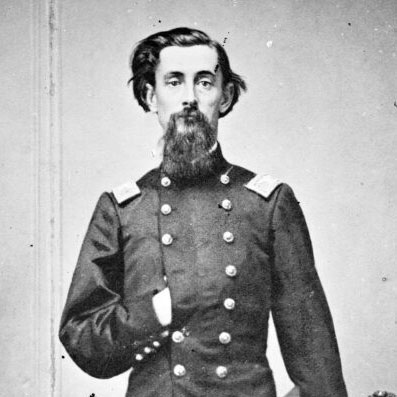
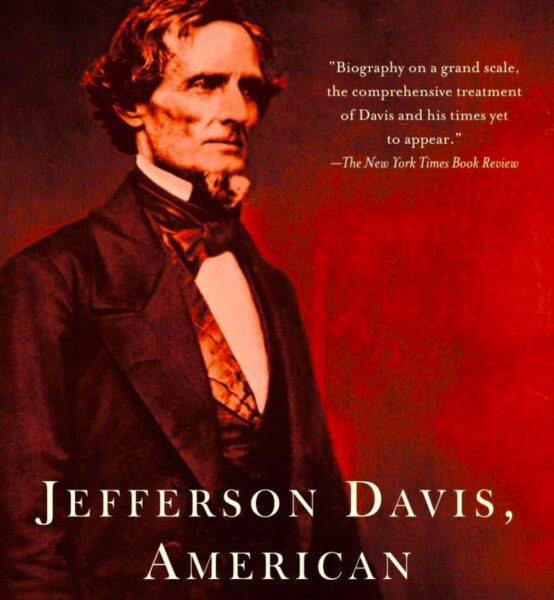
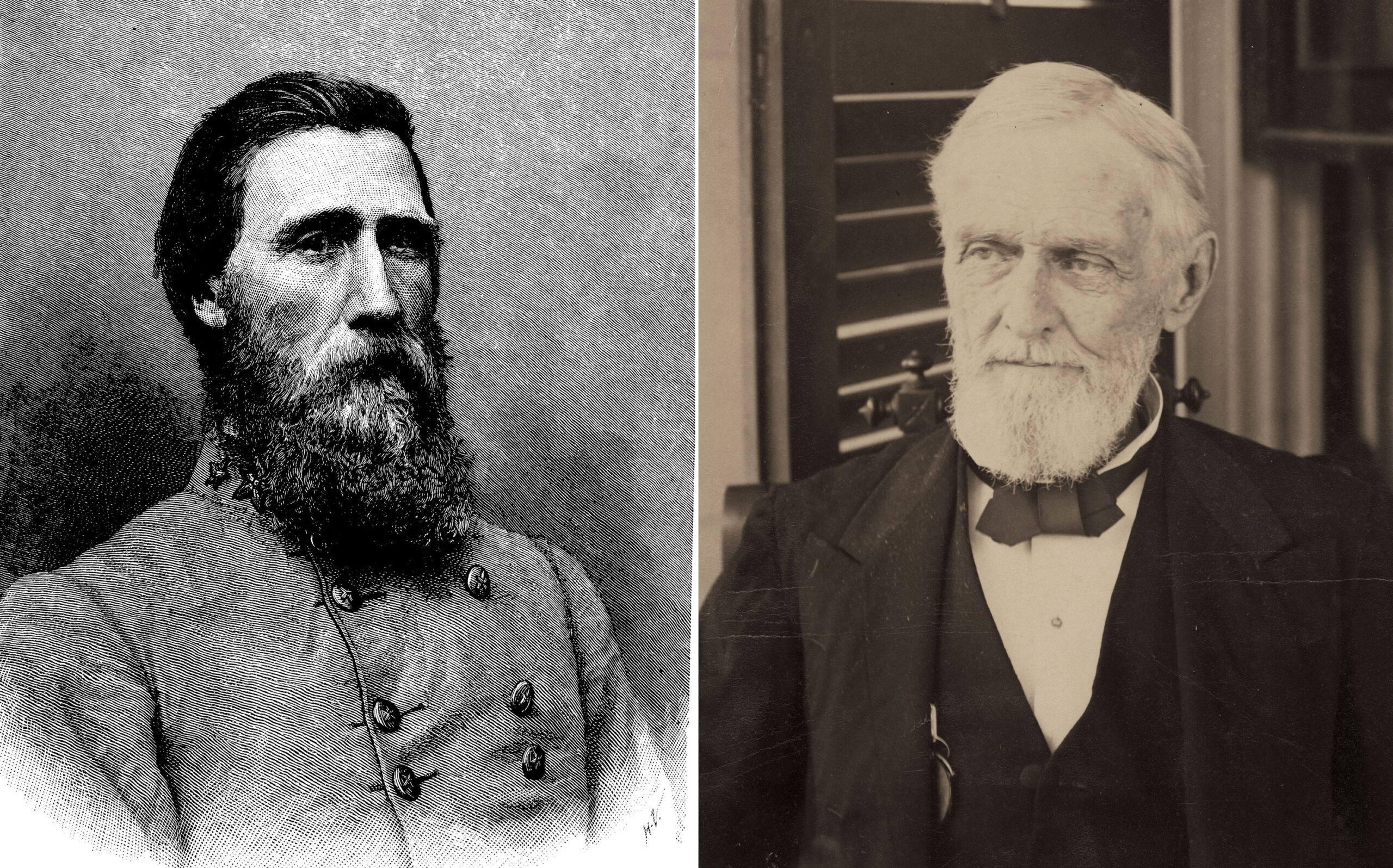 Battles and Leaders of the Civil War (Hood); Library of Congress (Davis)
Unlike his fellow former Confederate John Bell Hood (left, as he appeared during the war), Jefferson Davis (right, c. 1885) used his memoirs to excoriate Sherman’s Civil War record.
But Sherman’s relationship with the South would begin to change dramatically following the 1881 publication of Jefferson Davis’ mammoth defense of the secessionist cause, The Rise and Fall of the Confederate Government. Davis’ attempts at character assassination, and Sherman’s equally harsh rebuttals, constituted the most protracted and bitter of Sherman’s public disagreements with ex-Confederates.58 Even toward the end of Sherman’s life, when he sought to reconcile with as many old enemies as possible, Union and Confederate, he continued feuding with Davis.59 This was indeed an “irrepressible conflict”: Both men were easily angered and provoked, unshakably convinced they were right, and committed to advocating endlessly for their radically incompatible views of the history and meaning of the Civil War.
Sherman’s memoirs appeared before Davis’ account and say relatively little about the Confederate president, which might itself have been a kind of insult. The only direct attack came when he mocked Davis (in language that is restrained compared to what Sherman would eventually use) over Davis’ repeated public discussion in September 1864 of Hood’s plans to move his army north into Tennessee after the fall of Atlanta, effectively leaving Georgia to Sherman. Davis “made no concealment of these vainglorious boasts,” Sherman wrote, “and thus gave us the full key to his future designs.” Indirectly referring to his devastating March to the Sea, Sherman smugly concluded that “I think we took full advantage of the occasion.”60
Davis had worse, much worse, to say about Sherman when his turn came. He called Sherman’s decision to remove Atlanta’s civilian population after the city’s surrender unparalleled in modern warfare. “Since Alva’s atrocious cruelties to the noncombatant populations of the Low Countries in the sixteenth century, the history of war records no instance of such a barbarous cruelty as that which this order designed to perpetrate.”61 The brutality worsened once defenseless women and children were outside the city, when they were stripped of their few remaining possessions by Union soldiers.62 Davis made perfectly clear whom he considered responsible for these depredations, thundering that Sherman had issued an “inhuman order” and that the “cowardly dishonesty of its executioners was in perfect harmony with the temper and spirit of the order.”63
Davis next turned his attention to the burning of Atlanta and Sherman’s subsequent march to Savannah. He claimed Sherman deliberately and “utterly destroyed the city by a fire” in which “[n]ot a single house was spared, not even a church.” The line of Sherman’s march was marked by “[s]imilar acts of vandalism” in every town or village the army encountered. In Davis’ account, the March to the Sea proved that Sherman was something less than fully human: “The arson of the dwelling houses of noncombatants and the robbery of their property … made the devastation as relentless as savage instincts could suggest.”64
Davis’ outrage only grew when he discussed Sherman’s February 1865 occupation of Columbia, South Carolina. The former president luridly described the march north from Savannah as identifiable by “the burning dwelling houses and by the wail of women and children pitilessly left to die from starvation and exposure in the depth of winter.” After Columbia’s surrender, Sherman and his troops turned it into a place of hellish suffering, in which “the defenseless city is burned to the ground” and its helpless citizens—a call for readers to picture virtuous Confederate women—“subjected to outrage and insult of a character too base to be described.”65 In sum, Sherman was a monster guilty of “an act of cruelty which finds a parallel only in the barbarous excesses of Wallenstein’s army in the Thirty Years’ War.”66
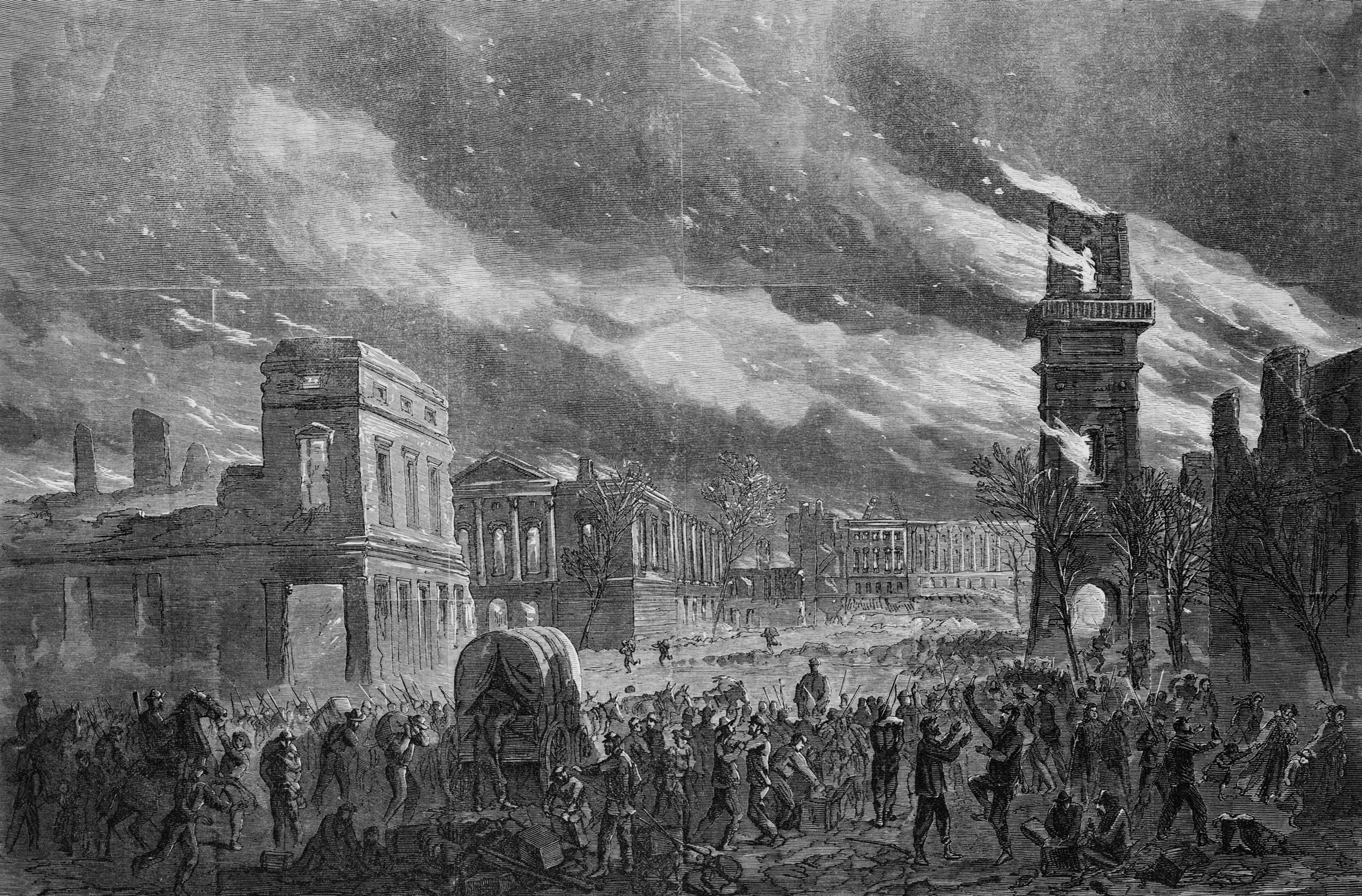 Library of Congress
Responsibility for the burning of Columbia, South Carolina (depicted above), became a major point of contention during the postwar feud between Sherman and Davis.
Sherman might not have been describing Davis when he wrote it, but a letter to a friend after the war nonetheless captures his attitude toward the unrepentant secessionist. Sherman had no patience, he said, for southerners who condemned the so-called “vandalism of the Yankees.” After all, southerners started the war; they also “dared and defied us to come south, threatening to kill and mutilate us.” So Sherman felt only “contempt” for anyone who subsequently “whined and complained of the inevitable consequences of their own acts.”67 It’s not surprising, then, that Sherman didn’t wait long before striking back against Davis.
The opportunity arose at a reunion of the Army of the Potomac in Hartford, Connecticut, in June 1881. Other speakers included Mark Twain and Secretary of War Robert Lincoln, but Sherman delivered the keynote speech at a “grand banquet” on the evening of June 8.68 He began by confessing that he hadn’t read Davis’ book, which had appeared that spring, but only seen “copious extracts” and thus wasn’t sure whether it deserved to be taken seriously. He then launched into a point-by-point response that betrayed his deadly intent.
Sherman accused Davis of being too late with his rhetoric of condemnation for the Atlanta campaign. Comparing the Union seizure of the city to “Alva’s atrocious cruelties in the Netherlands” might have been fine in 1864, Sherman allowed, because then “extraordinary language was needed to arouse the sinking energies of his people.” But to use it now, years after the war, “is simply absurd.” Judging by what Sherman said next, Davis’ criticisms of the civilian evacuation particularly incensed him. He emphatically declared that “[n]ot a man, woman, or child was harmed in that removal” and “not a single piece of property broken or molested.” As proof Sherman read at length from the official report of a Confederate officer assigned by John Bell Hood to help oversee the evacuation and who also, according to Sherman, “bore public testimony to the kindness of the [Union] escorts.”
Moreover, Sherman could not let Davis’ accusations of inhumanity go unaddressed. He said it was not only “eminently humane to remove a noncombatant population from the theatre of war,” but that such actions also hastened the end of the conflict, “which Mr. Davis, according to his own accounts, would never have terminated as long as he could have saved his own life.” This was a charge Sherman felt compelled to repeat later in his speech. In contrast to his own attempts to save civilian and combatant lives by bringing the war to the quickest possible conclusion, Davis wanted in April 1865 to turn the war from something fought by “grand organized armies into one of partisan guerrillas.” Such a long and pointlessly bloody conflict, Sherman declared, would have been “an unpardonable crime against humanity.”
Further, and no doubt to the delight of his audience, Sherman claimed Davis was openly dishonest in his portrayal of what happened in Columbia. He relied heavily on the findings of the 1872 international commission that determined which American and British citizens could pursue claims for loss of property during the war. After hearing testimony from both Union and Confederate witnesses, the commission decided that the blame for fires that destroyed a large section of Columbia could not be assigned to either side. Therefore, Sherman said, it was “simply infamous” for Davis to blame Sherman for the fire and to assign him guilt for supposed atrocities in South Carolina. Sherman concluded that Davis’ comparison of him with Alva and Wallenstein was nothing but “the fruit of his pompous vanity, for the likeness is about as wide of probability as his own resemblance to Julius Caesar.”
Sherman and Davis would exchange similarly vicious ad hominem charges for the next several years. At various times Sherman called Davis “a simple monomaniac,” the “impersonation of all that was wicked” in the Civil War, and “the impersonation of treason and hate.” He even wrote that Davis was “the type of a class that must be wiped off the face of the earth,” a form of eliminationist rhetoric Sherman often resorted to when feeling supremely indignant.69 For his part, Davis characterized Sherman as nothing but a “vain man” suffering from the “hallucination that he is a great general” and the leader of “an organized gang of plunderers.”70 When Sherman alleged in 1884 that Davis had plotted against the federal government while still a U.S. Senator, Davis demanded that he produce proof of the charge or “wear the brand of a base slanderer.” After Sherman claimed the evidence, which he said was a letter written by Davis himself, had been destroyed in the 1871 Chicago fire, Davis said that Sherman was “remarkable” because “he is not only willing to lie, but does not feel degraded by the detection.”71
Sherman’s war of words with Davis had an immediate effect on how southerners viewed him. In November 1881, shortly after he publicly savaged Davis in his Connecticut speech, Sherman attended the Atlanta International Cotton Exposition. His reception this time was markedly cooler than during his 1879 visit. South Carolinians came down by the trainload to protest Sherman’s presence, and threats were made to burn the general in effigy.72 While Sherman praised the region as thoroughly as he had two years earlier, the Atlanta Constitution published excerpts of Davis’ book, including the damning comparison with Alva.73 The most the paper would allow regarding the protests against Sherman was that none “need … fear that Atlantans will do anything to disgrace the name of the state, lower its dignity, or sacrifice the least particle of respect due its history or traditions.”74
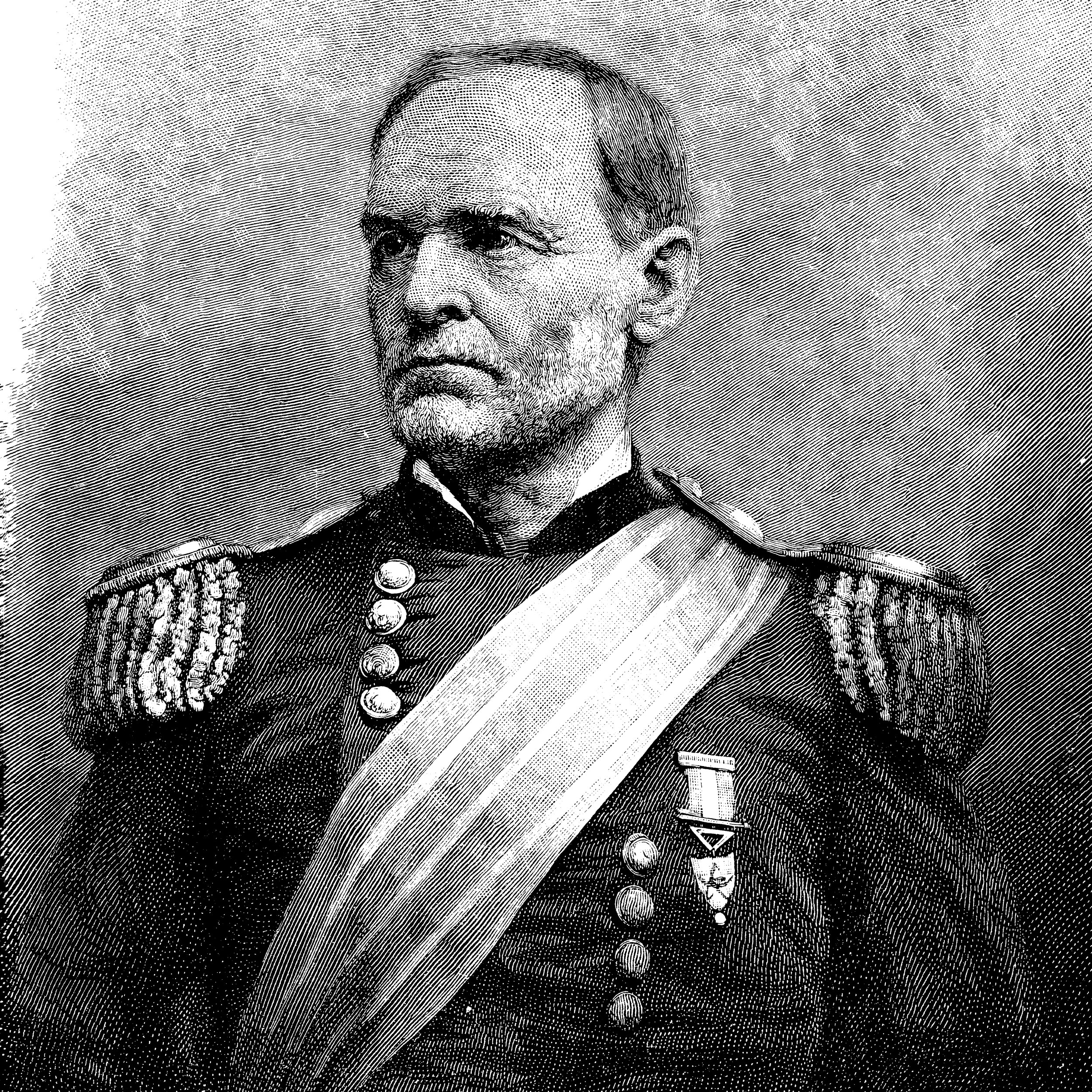 Battles and Leaders of the Civil War
William Tecumseh Sherman, as he appeared in the 1880s.
Over time the divide widened between Sherman’s immediate postwar standing in the South and his long-term reputation. Southerners came to remember Sherman only as the general who said his “aim … was to whip the rebels, to humble their pride, to follow them to their inmost recesses, and make them fear and dread us.”75 It became inconceivable that an ex-Confederate could write to Sherman, as Marcus Wright did in 1883, that “I, in common with the Army commanders of the Confederate armies, … always had the highest appreciation of you as a General during the war, but we learned after the war to admire and respect you [even more] for your earnest dispositions to make real peace.”76
A stark example of the change in how southerners had come to view Sherman appeared in the September 1910 issue of Confederate Veteran (then the most popular magazine in the South). It included a lengthy tribute to Sherman by David F. Boyd, who taught at the Louisiana Military Academy under Sherman and during the war served as an officer with Stonewall Jackson. On the basis of their long friendship, Boyd endeavored to show that Sherman “loved the South when the war came…. Nor did he ever lose his love for the South.”77
Following Boyd’s essay the editors explained why they published an encomium to the South’s now most hated enemy: “the purpose is to show his inconsistency with whatever … kindness at heart Boyd may attribute.” In other words, Confederate Veteran treated an essay in praise of Sherman as a golden opportunity to remind its readers of why he deserved only condemnation by true southerners. “[A]s to General Sherman, his association with representative men of the South makes his villainous deeds all the more reprehensible…. He was not only bitter during the war, but … seemed unrelenting against the prostrate people whom he had professed to esteem.78
Sentiments like these show that Davis’ rhetorical salvoes had struck home. Sherman’s reputation lay in ruins across a South that had been devastated in war and was now increasingly dependent on Lost Cause mythology. The Union general who was respected and even admired by his foes in the field, and who so strenuously advocated for a soft peace after withdrawing the hard hand of war, would be forgotten by generations of white southerners. A demonic Sherman took his place and would live on in southern memory, conjured by Davis’ bitter incantations from the ashes of war fires long grown cold.
Thom Bassett is writing a novel about William Tecumseh Sherman and the destruction of Columbia, South Carolina, in February 1865. He teaches at Bryant University in Smithfield, Rhode Island.
Notes
1. John F. Marszalek, “Celebrity in Dixie: Sherman Tours the South, 1879,” The Georgia Historical Quarterly 44 (Fall 1982): 378, 380.
2. John F. Marszalek, “Was Sherman Really a Brute?” Blue and Gray Magazine 7 (December 1989): 46.
3. Wesley Moody, Demon of the Lost Cause: Sherman and Civil War History (Columbia, 2011), 35-60.
4. There were exceptions, of course. South Carolina man of letters William Gilmore Simms published a series of newspaper articles just weeks after the destruction of Columbia in February 1865 that accused Sherman and his men of intentionally burning down the city and inflicting widespread terror. A City Laid Waste: The Capture, Sack, and Destruction of the City of Columbia, ed. David Aiken (Columbia, 2005).
5. Robert K. Murray, “General Sherman, the Negro, and Slavery: The Story of an Unrecognized Rebel,” The Negro History Bulletin 22 (March 1959): 125.
6. Lloyd Lewis, Sherman: Fighting Prophet (New York, 1932), 54-55.
7. Quoted in Michael Fellman, Citizen Sherman: A Life of William Tecumseh Sherman (New York, 1995), 19.
8. General W.T. Sherman as College President, ed. Walter L. Fleming (Cleveland, 1912), 77.
9. Ibid.
10. Memoirs, 140-41.
11. College President, 241.
12. Home Letters of General Sherman, ed. M.A. DeWolfe Howe (New York, 1909), 229.
13. Ibid., 124.
14. College President, 88.
15. Ibid., 291.
16. Ibid.
17. Citizen Sherman, 74.
18. College President, 376.
19. Ibid., 241-42.
20. Ibid., 290.
21. Ibid., 89.
22. Ibid., 44.
23. Memoirs, 149.
24. David F. Boyd, “Gen. W.T. Sherman: His Early Life in the South and His Relations with Southern Men,” Confederate Veteran 18 (September 1910): 413.
25. Sherman, Memoirs, 495.
26. Sherman’s Civil War: Selected Correspondence of William T. Sherman, 1860-1865, ed. Brooks D. Simpson and Jean V. Berlin (Chapel Hill, 1999), 884.
27. Memoirs, 677-732; Fellman, Citizen Sherman, 238-56.
28. John Marszalek, Sherman: A Soldier’s Passion for Order (New York, 1993), 364.
29. The Sherman Letters, ed. Rachel Sherman Thorndike (New York, 1894), 263.
30. Quoted in Marszalek, Sherman, 366.
31. Sherman Letters, 261.
32. Home Letters, 353.
33. Marszalek, Sherman, 368.
34. Quoted in Lewis, Fighting Prophet, 587.
35. Quoted in Marszalek, Sherman, 372.
36. Sherman Letters, 287.
37. Ibid.
38. Ibid., 328.
39. Ibid., 327.
40. Sherman would visit the college again in 1871 and 1879, as well as help it secure a number of buildings and grounds when it relocated to Baton Rouge in 1886. Boyd, “Sherman,” 414.
41. Marszalek, “Dixie,” 369.
42. Atlanta Constitution, January 30, 1879.
43. Ibid.
44. St. Louis Globe-Democrat, February 11, 1879.
45. E. Merton Coulter, “Sherman and the South,” North Carolina Historical Review 8 (January 1931): 53.
46. St. Louis Globe-Democrat, September 16, 1879.
47. Ibid.
48. Marszalek, Sherman, 460.
49. Ibid., 461.
50. Ibid., 470.
51. Ibid., 461.
52. Moody, Demon, 62.
53. John Bell Hood, Advance and Retreat (New Orleans, 1880; reprint, Secaucus, NJ, 1985), 236, 229-42.
54. Ibid., 237.
55. It isn’t that Hood was incapable of such impassioned rhetoric. In September 1864 he protested Sherman’s plans to evacuate Atlanta civilians in order to make the city a military depot. Hood wrote to Sherman that the proposed evacuation “transcends, in studied and ingenious cruelty, all acts ever before brought to my attention in the dark history of war” (Ibid., 230). It’s possible that the discrepancy between this letter and his memoirs is partly explained by the postwar help Sherman gave Hood during a period of serious financial need, but, it’s unlikely that’s the whole story. The description of Sherman’s campaign set out in his memoirs reflects probably Hood’s more considered view of the matter. It’s implausible that if Hood really considered Sherman to have been the guilty of atrocities he would have asked for Sherman’s help after the war, much less publicly praised Sherman during the 1879 Mardi Gras. Instead, it appears that Hood after the war held Sherman in some professional and possibly even personal esteem, which wouldn’t have been possible if he considered Sherman guilty of unparalleled wartime evil.
56. Moody, Demon, 65.
57. Quoted in Marszalek, “Brute,” 48.
58. Fellman, Citizen Sherman, 304.
59. Ibid., 402.
60. Sherman, Memoirs, 508.
61. Jefferson Davis, The Rise and Fall of the Confederate Government 2 vols. (New York, 1881; reprint, Da Capo Press, 1990), 476.
62. Ibid., 476, 478.
63. Ibid., 478.
64. Ibid., 483.
65. Ibid., 531-32.
66. Ibid., 533.
67. Marszalek, “Brute,” 48.
68. “A Rebel Rebuked,” Daily Inter Ocean, June 9, 1881. All quotations in the following three paragraphs are from this article.
69. Quoted in Marszalek, Sherman, 472-73, 475.
70. Quoted in Moody, Demon, 90-91.
71. Quoted in William J. Cooper Jr., Jefferson Davis, American (New York, 2000), 672.
72. Moody, Demon, 91.
73. Marszalek, “Dixie,” 382.
74. Quoted in ibid.
75. Sherman, Memoirs, 608-09.
76. Quoted in Marszalek, “Brute,” 48.
77. Boyd, “Sherman,” 409.
78. Ibid., 414.