Henry B. Carrington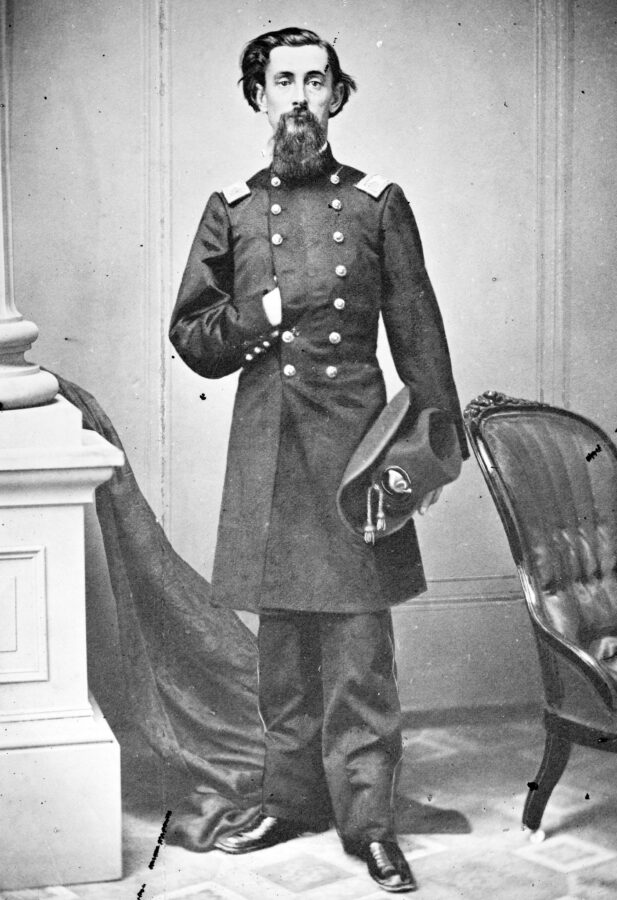 Library of Congress
Henry Carrıngton’s military talents and his heroic struggle against a conspiracy to overthrow the government are the stuff of legend. That legend is based almost entirely on Carrington’s own account, which bristles with exaggeration and misrepresentation.
Intentional distortion emerges in the earliest memory he ever recorded, which he cast in a tone of tragedy in order to smother the scent of scandal. In a brief autobiography written for his son, Carrington mentioned how little he remembered of his own father, “who I lost when I was very young.” That loss was not occasioned by death, as he implied, but by abandonment. In 1830, when Henry was six, his father lived with him and his mother in Wallingford, Connecticut—but by 1834, with or without benefit of divorce, his 40-year-old father had taken a teenaged bride and begun a new family in Mississippi.1
A visit to West Point the summer he was 16 purportedly infected Carrington with a burning desire for a military career, but he insisted that the dream was “checked by incipient lung trouble.”2 During nine years in the U.S. Army, Carrington reported the onset of ominous respiratory symptoms whenever he was ordered away from his desk to more perilous assignments, but for all his claimed fragility, he was to outlive his generation’s average life span by a quarter century.
He never sought an appointment to the U.S. Military Academy, going instead to nearby Yale University, graduating in 1845 and entering Yale Law School in 1847. The next year, at 24, he moved to Columbus, Ohio, to work in a law firm where his cousin was a partner. His legal career involved no prominent cases, but he achieved considerable status by marrying into a well-established Columbus family, which may have led to his partnership with William Dennison.
 National Portrait Gallery
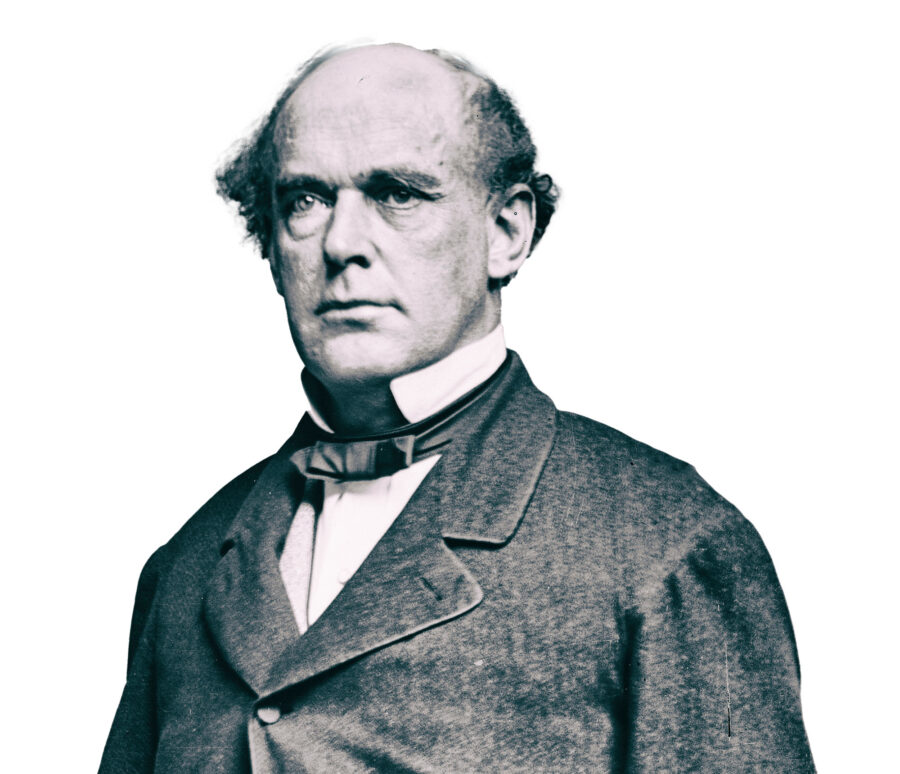
Salmon P. Chase
Dennison enjoyed a close political relationship with U.S. Senator Salmon P. Chase, who would give Carrington his first chance to wear a uniform. By 1857, Chase had become governor, and he appointed Carrington judge advocate general of Ohio’s militia, promoting him to adjutant general soon afterward. When Dennison followed Chase as governor, he continued Carrington in that position. It was primarily a ceremonial sinecure—the militia survived mostly on paper—but Carrington cherished the title and the attire. In three years as adjutant general, he communicated with U.S. Army headquarters only once, to ask how much ornamental frippery the regulations allowed him to attach to his hat.3
In 1861, Chase returned to the Senate, but soon resigned to accept President Abraham Lincoln’s appointment as head of the Treasury Department. Carrington asked Chase to keep him in mind for federal office. Chase inquired among other cabinet members on his behalf, but Carrington relished a diplomatic mission in some warm and pleasant clime, and Chase forewarned him that the choice posts would all be spoken for. When the Fort Sumter crisis blossomed into war, Chase offered a commission as army paymaster, with the rank of major. Carrington found that unappealing, but in May, with several new infantry regiments authorized for the Regular Army, Chase suggested the inviting possibility of a permanent commission at higher rank. Carrington immediately raised the issue of health. In veiled allusion to the dangers of soldiering, he expressed a concern that he might be ordered somewhere so unhealthy that he would be forced to resign. Chase discounted that concern, and when he secured for Carrington the highest position available, as a full colonel, “with a good chance to be General,” Carrington could not resist.4
Thus did Carrington assume command of a regiment of Regulars without ever having performed a day of active military duty. Expecting that his correspondence with Chase would never see the light of day, he pretended that the position came to him as a surprise, entirely unsolicited, in recognition of his service and demonstrated capacity as adjutant general.5
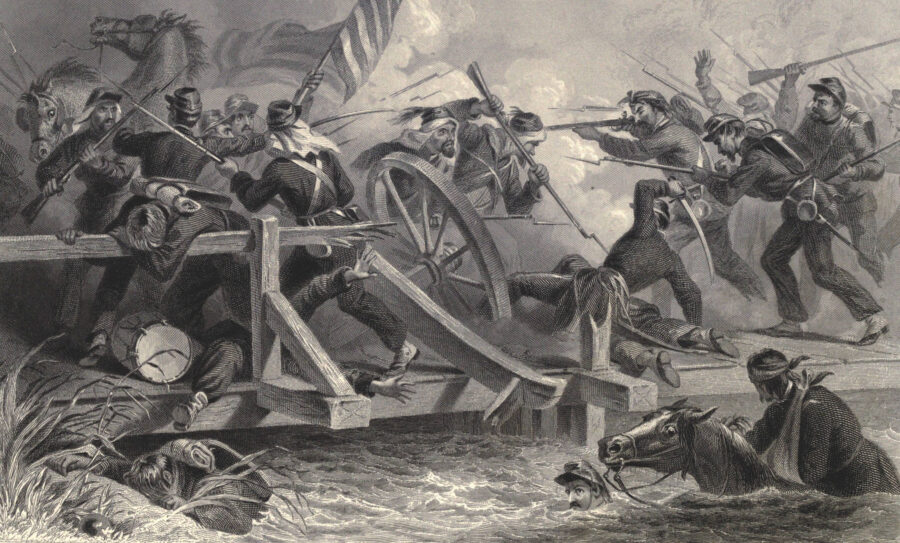 The War With the South (1862)
When his ally Treasury Secretary Salmon Chase secured an army colonelcy for him at the outset of the war, Henry Carrington could not resist. After the Battle of Bull Run (depicted above in an illustration by F.O.C. Darley), Carrington’s zeal for recruiting a regiment waned noticeably.
Carrington’s assigned regiment, the 18th U.S. Infantry, did not yet exist, and was to be recruited in Ohio under his supervision. He established regimental headquarters near his home in Columbus, with a camp of instruction outside of town. When he accepted the commission, in June, the rebellion remained a war in name only, nearly bloodless after 10 weeks, with no encounters more serious than what would soon be called a skirmish. Then, on July 21, came the battle at Bull Run, with hundreds killed and thousands wounded.
Before Bull Run, Carrington’s correspondence with army headquarters focused on his plans for enhanced speed and efficiency in recruiting, so he could lead a complete regiment into the field as soon as possible, but that changed abruptly after the battle. In his first letter to Washington in the wake of that defeat, on July 30, he reported having volunteered to yield some of his most productive recruiting districts for the benefit of a different regiment of Regulars. He defended the decision as a way to avoid the expense and inefficiency of army officers competing with each other for enlistments from the same population, but he admitted that it would significantly slow his own recruiting.6
 National Portrait Gallery
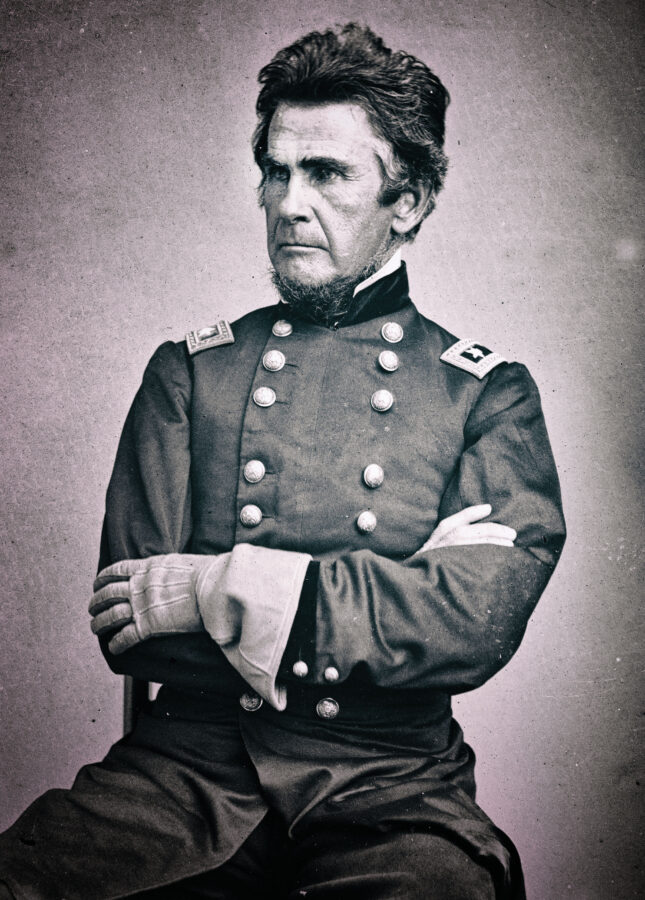
After Brigadier General Ormsby Mitchel (pictured here), placed in charge of the Department of the Ohio in September 1861, called on Carrington for a status report about his command, and then for him to report with his troops for duty, the reluctant colonel pleaded with officials in Washington for more time.
In September, Kentucky came into play militarily. Brigadier General Ormsby Mitchel took command of the Department of the Ohio, with orders to drive through Kentucky and into east Tennessee, and he called Carrington to Cincinnati to report on the status of his command. Deducing that Mitchel wanted him to bring down the troops he already had, and lead them against the enemy, Carrington appealed to Washington for more time to continue drilling and organizing his men in Columbus. If he were allowed to do so, he predicted, he might be able to field two full battalions at least by Christmas. A month later, Mitchel did order Carrington to come down at once, and to bring the organized portion of his regiment. Carrington promptly beseeched the adjutant general for delay, pleading that he had no funds, and could not close up his financial accounts.7
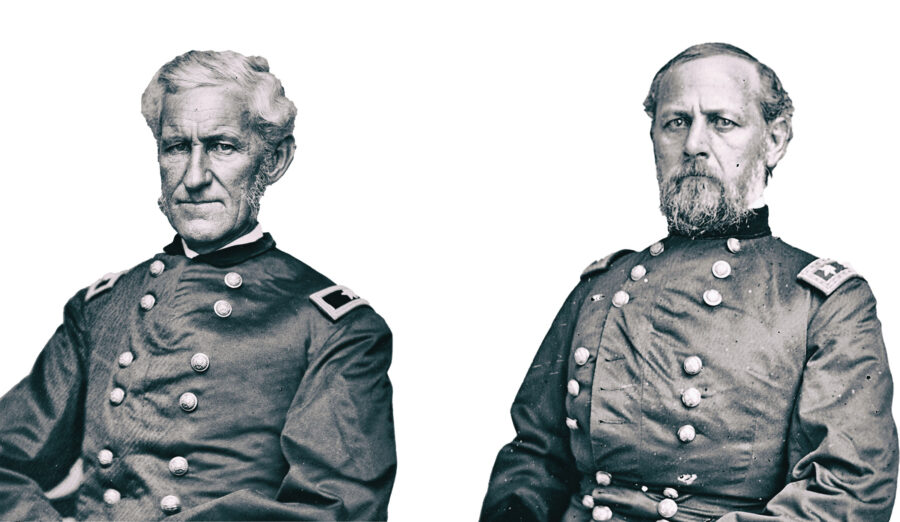
Adjutant General Lorenzo Thomas and the secretary of war stopped in Cincinnati just then, on their way back from an inspection tour in Missouri. Carrington wired them at their hotel, asking them to stop in Columbus, but their itinerary did not allow it. Obviously hoping to convince them to overrule Mitchel’s order, he attempted to intercept their train, but could not catch up with them. Apparently growing desperate, he complained to headquarters that his regiment’s arms had not all been received. He offered his full confidence that he could fill the first two battalions within four weeks, and complete the third by Christmas, if only he could remain in Columbus to oversee the work.8
 Library of Congress (Thomas); National Archives
Lorenzo Thomas (left) and Don Carlos Buell
This time, an administrative technicality saved Carrington. While Thomas was absent from Washington, an assistant adjutant general forwarded an opinion that Mitchel had no authority over Carrington’s Regulars, who were not specifically assigned to him. In November, Major General Don Carlos Buell replaced Mitchel, and his orders for troops foretold the same ominous expectations that Carrington would lead his regiment into the field. Carrington again telegraphed Washington, asking if he was correct in understanding that he was to remain in Columbus until he had completed his regiment. When Buell ordered Carrington to bring all his organized companies down to Kentucky, Carrington wired army headquarters twice in rapid succession, asking outright whether Buell had the authority over him that Mitchel had not had. In the second telegram, he complained additionally that neither Sibley tents nor overcoats had been received, and that he had wanted to start issuing pay. He implored the department for a postponement, declaring that it would be “extremely prejudicial” to move the regiment just then.9
When informed that his orders stood, Carrington had the temerity to counter with a compromise. With headquarters approval, he proposed forwarding the completed portion of the regiment to Buell under Lieutenant Colonel Oliver Shepherd—a West Point graduate, Mexican War veteran, and career soldier. Carrington himself would remain behind in Columbus to organize the incomplete battalions, if that were satisfactory.10
That was not satisfactory, and early in December Carrington led a dozen companies of his regiment to Lebanon, Kentucky. On December 6, his name appeared on the roster of a field army for the first and only time during the war, but his sojourn on the hostile side of the Ohio River did not last long. How he managed it remains a mystery, but he may have pitched the substitution of Colonel Shepherd to the commander of his division, Brigadier General George H. Thomas, who had graduated from West Point in the same class with Shepherd. By December 11, Carrington was back at his desk in Columbus and Shepherd commanded the portion of the regiment assigned to Thomas, who marched it into southern Kentucky, to win the first significant Union victory of the war.11
The projected Christmas deadline passed with Carrington’s regiment still only half full, and with him looking for reasons to reject perfectly healthy recruits. Under his own interpretation of the pertinent law, Carrington required members of volunteer regiments who had enlisted in the 18th Infantry to return to their former commands. Periodically he offered encouraging new estimates of how quickly his roster would be filled, with each new estimate bearing a later date than the last one, yet he kept taking actions likely to reduce the pace of enlistments. Three weeks into 1862, he asked Adjutant General Thomas to assure the general-in-chief, George McClellan, that “the time will not be long” before the second half of the 18th Infantry would head into the field. Then, on February 7, he explained that because of a need for subalterns with the companies in the field, he had ordered the recruiting officers from several major cities to rejoin the regiment, and had closed those stations.12
By late April 1862, the second battalion of Carrington’s regiment was fully organized and the third battalion was filling up. On April 22 he apprised army headquarters that he expected the last battalion to have 700 of its anticipated 800-man complement “in sixty days, at the latest.” As those last companies neared completion, he came closer to having to redeem his pledge to take the field, and he chose that juncture to ask permission for a visit to Washington, to discuss the recruiting service at the War Department. He had been working without respite for months, Carrington wrote, and could use the rest. That request went unanswered, but he asked again early in June. Complaining that he had “struggled against” a severe bout of pneumonia, and had been working all day, every day, he begged authority to come to the capital for the benefit of his health, adding that he would make the visit “beneficial to the service.”13
Permission was finally granted. In an unpublished late-life memoir, Carrington asserted that he was “called to Washington” that summer, casting himself improbably in the midst of such momentous White House scenes as the debate over replacing McClellan as commander of the Army of the Potomac and the arrivals of both John Pope and Henry Halleck.14 His nominal business of recruiting would, instead, have confined him to the War Department, where he would instinctively have accentuated his own abilities and experience as an organizer, in the hope of winning a permanent administrative assignment.
 National Portrait Gallery
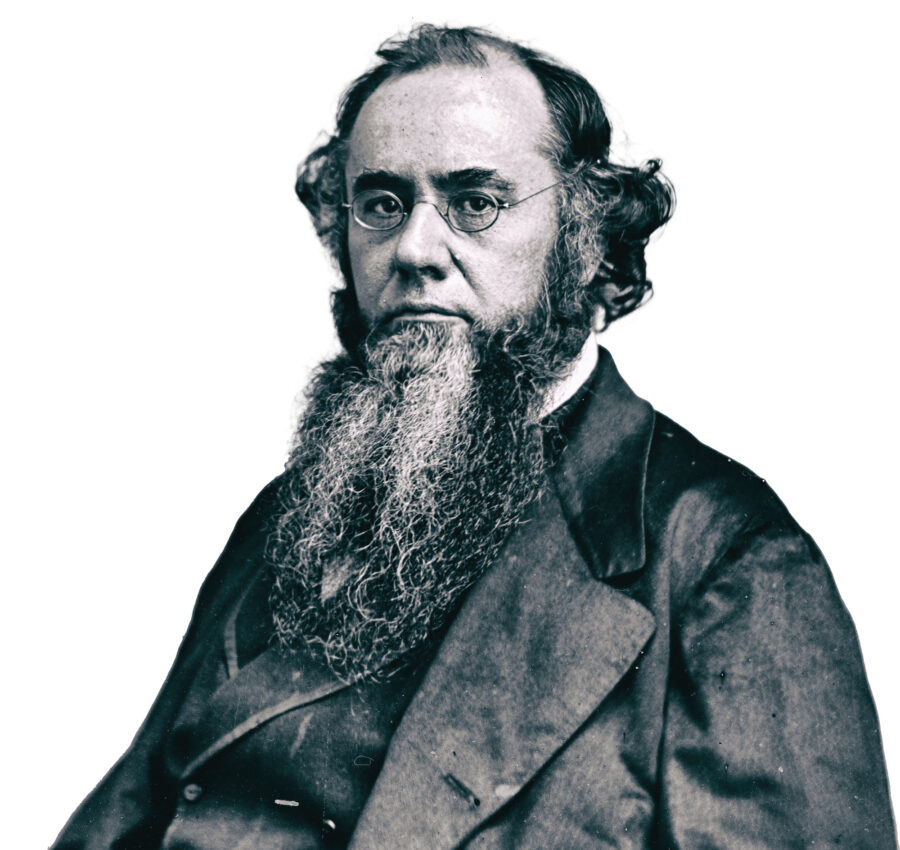
Edwin Stanton
That effort bore timely fruit. The president had called for 300,000 more three-year volunteers in July, and Secretary of War Edwin Stanton invoked a new draft law early in August, levying the same number of nine-month militia. Carrington pulled the newspaper advertising for recruits in his own 18th Infantry, further slowing progress on his last battalion, but completion of the regiment could not be forestalled forever. Not a moment too soon, on August 16, orders came to Carrington from the War Department, instructing him to report to Indianapolis. Governor Oliver P. Morton had complained about the U.S. Army mustering officer in that city, where Indiana volunteers were pouring in, and that complaint must have reached someone who recalled Carrington’s recent visit to Washington.15
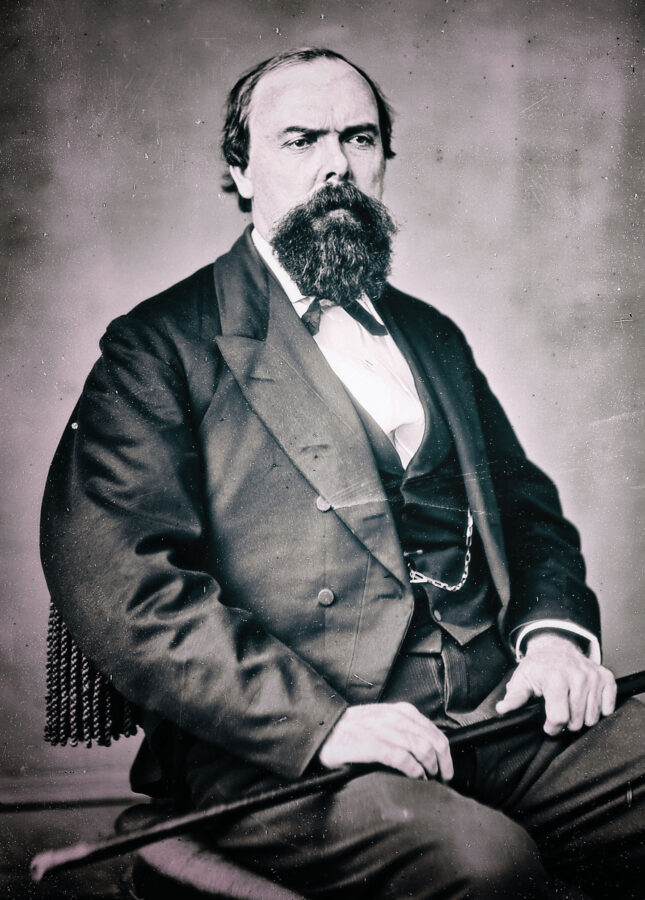
The Indianapolis post provided only temporary relief for Carrington, for his duties as mustering officer would theoretically end when the last of the new troops left for the field. He put the opportunity to good use, developing a powerful patron in Morton, whose influence would help keep him at his desk for the rest of the war. Fifty days into his Indianapolis assignment, Carrington discovered the role that would make him seem indispensable north of the Ohio.
The announcement of Lincoln’s Emancipation Proclamation aroused tremendous resentment early in the autumn, coming right on the heels of conscription, because it made involuntary abolitionists of men who had no such inclination. Indignation boiled over as counties that had not met their quotas prepared to draft, and on October 7 instructions reached Carrington from Washington to arrest Harris Reynolds, of Fountain County, for the new crime of disloyal language. At a Democratic rally on October 2, Reynolds had denounced Lincoln’s “abolition war,” and had characterized the draft as a ploy to force Democrats into the army so they could not vote. Carrington dutifully sent off a file of soldiers who brought Reynolds in.16
Reports of similar public criticism of the government sent Carrington looking for troops to arrest other miscreants in southeastern Indiana and along the upper reaches of the Wabash. A more serious protest erupted northeast of Indianapolis, at the Blackford County Courthouse, when a score or so of men rushed the provost marshal and his assistant as they prepared to draw names for the draft. They tore up the enrollment lists, smashed the lottery wheel containing enrolled men’s names, and threatened to kill the marshals if they persisted.17
Such determined dissent suggested a new field of endeavor for Colonel Carrington, and he desperately needed one, because on November 11 he reported that the third battalion of his regiment was finally complete. That same day, he wrote to Secretary Chase, hinting that he was the last of the 1861 crop of Regular colonels who had not been promoted. Complaining of that neglect to other influential correspondents, Carrington began soliciting letters to the president recommending him for appointment as a brigadier, or even as a major general. A promotion to brigadier general of volunteers would temporarily disassociate him from the 18th U.S. Infantry, and he would not have to serve with it. As he pointed out to Chase, a general’s commission would also allow him to assume administrative command of some northern district, if he could be “spared” from his duties in Indianapolis.18
 National Archives
After reporting to Indianapolis to assume the role of mustering officer in the city, Carrington made an ally of the governor, Oliver P. Morton (pictured here), whose influence would help keep Carrington from field command for the rest of the conflict.
What Carrington feared most, of course, is that he could easily be spared from Indianapolis. On December 19, the dreaded order arrived relieving him from duty, so he could lead his last battalion to the front. He objected instantly, as before, that his duties had prevented him from closing out his accounts, and asked for 30 days to do that. Leave was especially important, he said, because “an attack of congestion of the lungs prostrated me very much, and I am still suffering.”19
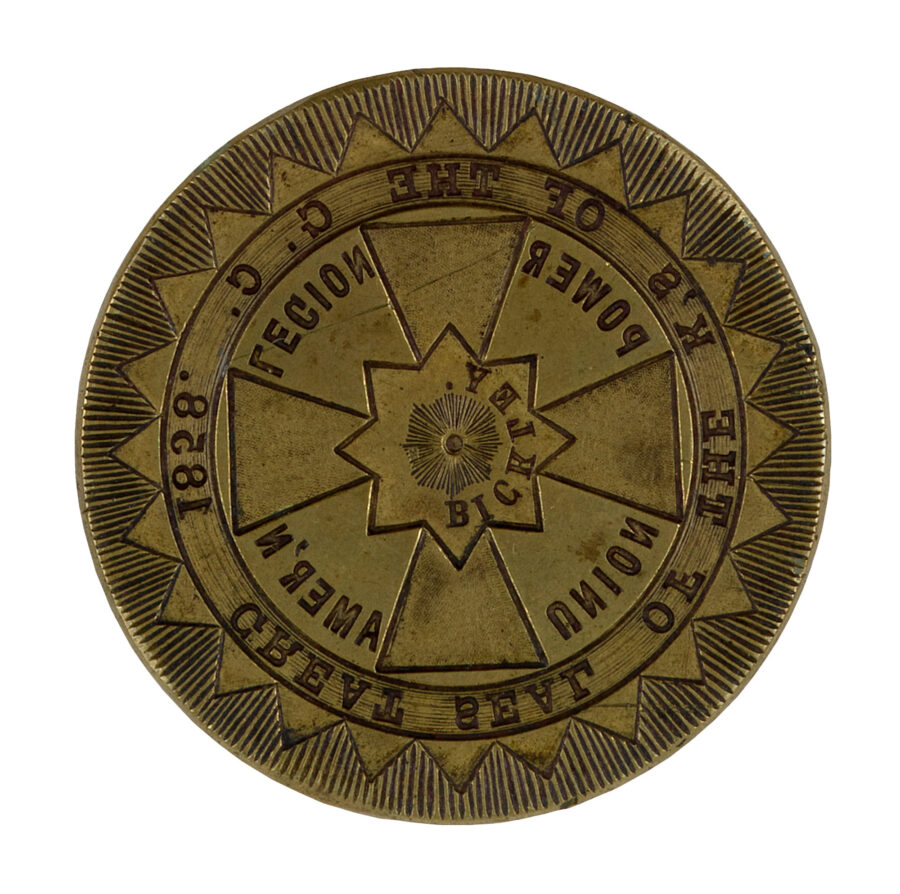
The plea for leave was only a stopgap. Carrington simultaneously pursued a strategy that might lead to the obnoxious order being countermanded altogether. In three days, he composed a report for Secretary Stanton on a subversive secret society in Indiana that was actively inducing soldiers to desert, protecting them from arrest, and discouraging enlistments. It was, he alleged, sometimes called the Holy Brotherhood, or the Knights of the Golden Circle—borrowing the name of an antebellum brotherhood founded by a man deeply interested in the $10 membership fees, who pitched a crackpot scheme for slave-state expansion. Carrington said he was preparing a case for court-martial, and hoped to prosecute the civilians he supposed were behind it. Confederates were actively involved, he added, and the conspiracy was so widespread and dangerous that he thought the president and cabinet should be apprised immediately.20
This was a subject of great interest to Governor Morton, who the previous summer had tried to drum up evidence of a disloyal secret society and precipitate a grand jury proceeding that might make the papers just before the fall elections. After those elections went heavily against Indiana Republicans, the prospect of connecting Democrats to a clandestine cabal grew even more appealing. Morton wrote Stanton right away, asking him to leave Carrington in Indianapolis “for the present,” and calling him “the man for the emergency.” More than a month after Carrington was supposed to have closed up shop, Morton informed him that the order relieving him had been rescinded.21
With that, Carrington transformed himself into a chief of detectives. Adorning fragments of fact with rumors and vague testimony, he eventually depicted a broad network of seditious lodges operating under the aegis of the Knights of the Golden Circle, or KGC. Presenting the alleged plan to abet desertion and curb enlistments as a new enterprise of the KGC, Carrington stigmatized almost any fraternity that seemed unfriendly to Republican policy with the taint of treason.
A contingent of Indiana soldiers who had been captured in Kentucky were camped at Indianapolis, awaiting exchange, and one of them had joined what seemed to be a secret version of the Democratic clubs with which Indiana abounded. With Carrington portraying such associations as treasonous, the young man professed perfectly innocent intentions, offering incriminating testimony about his comrade John O. Brown in what was likely an attempt to save himself. Carrington secured officers for a court-martial who not only convicted Brown of treason, but sentenced him to death. Writing directly to Lincoln, Carrington requested a presidential reprieve for Brown so he could testify against others, and the terrified Brown supplied more suspects.22
The appeal for clemency in Brown’s case cost Carrington the publicity that would accrue to his conspiracy theory in the wake of an execution, and he specifically recommended the death penalty for the next defendant. Robert Gay had belonged to no secret society, but he had signed a loyalty oath to the Confederacy when he was captured. That technically constituted desertion to the enemy, and Gay admitted it, throwing himself on the mercy of the court, but because he had returned home, he was also assumed to be a spy. Carrington’s intercession precluded any mercy, and Carrington himself arranged Gay’s execution by firing squad. The spectacle brought national attention to Carrington and his crusade against the mysterious secret society, or societies.23
While military courts regularly convicted defendants on thin or dubious evidence, civil courts proved more faithful to the rule of law. In his efforts to implicate civilians in the conspiracy, Carrington pursued grand jury proceedings, where the prosecution presented its case without rebuttal from the defense. Grand juries seldom failed to offer indictments, and when the principal aim is to create an impression of wrongdoing, an indictment is more useful if a weak case is never tested in a trial. As part of his campaign to manufacture a perception of widespread disloyalty with partisan implications, Carrington dragged some Democrats before grand juries in February. In a letter to Stanton, he mentioned two Democrats he put on the stand who admitted belonging to an organization for which they claimed a statewide membership totaling 82,000, but he failed to name the organization, allowing Stanton to assume it was the KGC.
Like many of Carrington’s communications with his superiors, his letter about the grand jury testimony combined an opportunity for blatant boasting with an excuse for ill-disguised begging. After an unconvincing expression of regret that his “important duties” kept him from joining his regiment in the field, Carrington concluded the missive with the suggestive hope that his absence from the battlefield would not “defeat my reasonable promotion.”24
 National Archives
In one more quest to avoid joining his regiment in the field, Carrington began investigations into the existence, and activities, of subversive anti-war or pro-Confederate societies such as the Knights of the Golden Circle (KGC). Above: the seal of the president of the KGC.
Neither did he hesitate to jump the chain of command in his zeal to enlist official interest in his cause, and in himself. In a memorandum to the president a month later, Carrington inflated the number of clandestine insurgents in Indiana to 92,000. He assumed they were armed, too, alleging that 30,000 revolvers had recently been brought into the state, for which he claimed to have invoices; he speculated that thousands more had been smuggled in, unseen. He warned Lincoln that it was “certain” this network of lurking traitors only awaited an inviting opportunity to initiate an “armed overthrow of the Administration.”25
The desired promotion to brigadier general came a few days later, backdated to his first lobbying in November. With it came the district command he had coveted, encompassing the entire state of Indiana, and no sooner did Carrington assume those duties than he betrayed a tendency to panic. He credited exaggerated accounts of clashes between soldiers and ostensibly disloyal civilians that he amplified further before relaying those tales to Washington. When a force of Rebel cavalry seemed to threaten Indiana from Kentucky, Carrington advised having a division sent from the Army of the Potomac, prompting his department commander to assure him that he need not be “scared.” Major General Ambrose Burnside assumed command of the Department of the Ohio soon thereafter, and he came with General-in-Chief Henry Halleck’s caution about Carrington’s imprudence. Carrington helped corroborate Halleck’s opinion with a wild report that 100,000 arms had recently been delivered in Ohio and Indiana, presumably for treasonable purposes. When his alarms about secret societies turned almost frantic, Burnside removed him from district command, which he had held for only four weeks.26
Comprehending the likelihood of being ordered to an unhealthy climate, such as embattled Tennessee, Carrington prevailed on his old patron, Secretary Chase. He informed Chase that his doctors said he could not take the field “for a long time,” and if he could not remain at Indianapolis, he preferred something “northward.” He mentioned, too, that Governor Morton was working on his behalf, and that prominent citizens were calling for his reinstatement.27 Chase orchestrated an assignment for him at a recruiting camp in Cleveland, but Morton engineered Carrington’s return to Indianapolis, probably through Stanton. On July 1, 1863, the War Department specifically assigned Carrington to duty with the governor.
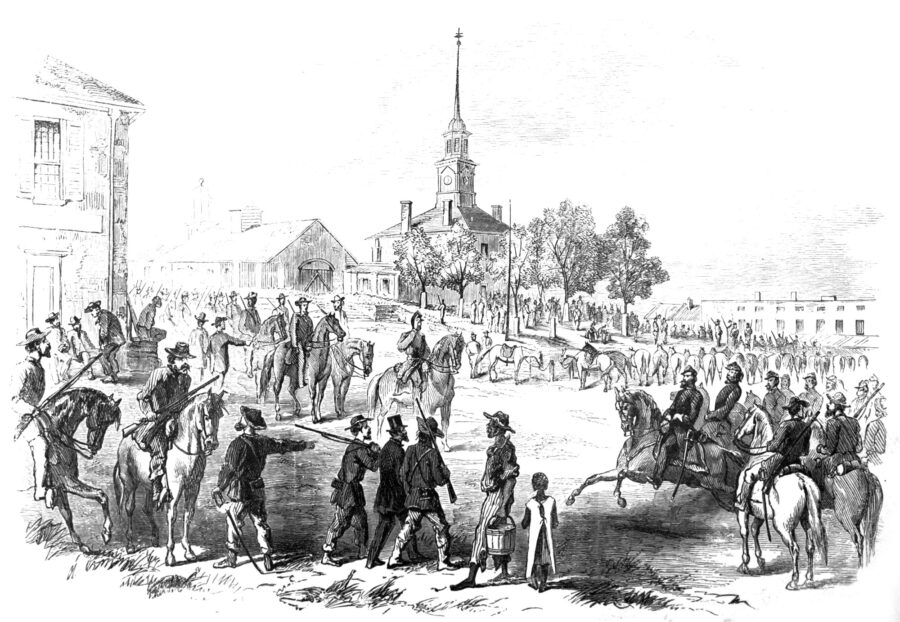
He almost instantly disgraced himself. John Hunt Morgan’s Confederate cavalry crossed into Indiana barely a week later, and Morton assigned Carrington to organize the militia as it came into the capital. Morgan cut across southeastern Indiana toward Ohio, and Brigadier General Orlando B. Willcox—who had replaced Carrington in district command—ordered Carrington to take three regiments of that militia and head Morgan off as he came into Ohio. The three regiments were waiting at the rail depot, and Carrington had only to join them and leave, but near the depot he admitting stopping for some “refreshments,” no doubt to steel his nerves. So tall a task required what Willcox characterized as “a drop too much,” and Carrington’s subsequent stupor caused a delay of several hours. When Willcox learned of it, he replaced Carrington with another general who had just arrived in the city, who hurried the brigade off, but too late to catch Morgan. In his own self-serving memoir of the incident, Carrington admitted surrendering command of the brigade to another officer because he was so “worn out,” insinuating as usual that he was suffering from another bout of “blood-spitting.” Congressman George Julian was at the depot, however, serving as a private with one of the militia regiments, and he unequivocally attributed the delay to the “drunkenness of an officer high in command.” That officer was Carrington.28
 Frank Leslie’s Illustrated Newspaper
Carrington, charged in 1863 with organizing Indiana’s militia in response to a raid by John Hunt Morgan’s Confederate calvary (depicted in this illustration from Frank Leslie’s Illustrated Newspaper), delayed in taking three regiments to try to cut off morgan’s men, having first stopped at a rail depot for some alcoholic “refreshments.”
Even before Morgan’s raid, Willcox had scorned Carrington as much as most professional soldiers did, and would probably not have chosen him to lead the militia had there been another general available at the time. Regarding him as “a convenient military tool” of Governor Morton’s, Willcox had no doubt that Carrington had been exaggerating the size and threat of the KGC “for the purpose of being useful, and to be kept out of the field.”29
After the fiasco at the depot, Carrington assumed a less conspicuous role in Morton’s employ for a few months. He provided the material for a pamphlet on KGC activities that was published in time for the state elections, and he maintained such a close relationship with the governor that when Mrs. Carrington bore another son, in January 1864, they named the child after Morton. As the political season of 1864 opened, Morton initiated efforts to have Carrington returned to his duties as chief political inquisitor. Helping the governor in that endeavor was Indiana’s acting provost marshal general, Conrad Baker, who was himself a Republican candidate for lieutenant governor. In March, Baker recommended Carrington to Provost Marshal General James Fry as “well fitted” to keep an eye on disloyal characters, and Carrington was assigned to that duty by early April. In May, Morton prevailed on Stanton to have Carrington fully reinstated as commander of the District of Indiana, and with Burnside no longer in charge of the Department of the Ohio, it was quickly done.30
The rest of Carrington’s war consisted largely of cultivating the appearance of impending insurrection by an insidious web of conspirators. As the fall elections approached, he grew more direct in associating that nebulous, nefarious underworld with Democratic candidates and principles. On July 30 the Indianapolis Journal ran his lengthy account of sensational subversive plots drawn from the reports of a government detective. In mid-August, Carrington warned of an imminent uprising by the Sons of Liberty—another incarnation of the perennially transmorphic secret order—in conjunction with a revolt by Confederate prisoners in Camp Morton, outside Indianapolis. Nothing ever happened, but the arrest of some Democrats who were purportedly involved provided grist for some very effective election-eve show trials.31
Late in August, Carrington was again relieved from district command, presumably so he could focus more on propaganda during the final furlong before the October state elections and the national election in November. At the behest of Judge Advocate General Joseph Holt, he immediately started writing a “history” of sedition in the West—“for the public,” as he apprised one correspondent. Carrington’s contribution formed the core of a War Department pamphlet that Holt published in profusion four weeks before the presidential election, connecting disloyal activities with the Democratic Party, and specifically with its presidential nominee, McClellan.32
After the last political season of the war, Carrington’s utility in Indianapolis waned. He was relieved on March 27, 1865. Predictably, he responded with urgent complaints of ill health and exhaustion, asking two months’ leave to recover from “hemorrhage of the lungs.” Between his characteristic resort to the putative pulmonary ailment, and the excuse that his aged mother required his presence in Connecticut, he avoided further duty until October. He sought the influence of his former partner, Governor Dennison, who was then serving as postmaster general, and Dennison persuaded Secretary Stanton to give Carrington an assignment in salubrious and placid California. General Ulysses S. Grant refused to approve such a plum for Carrington—who, with the expiration of his volunteer commission as brigadier, finally had to report to his regiment, then in Kentucky. He was one of only seven brigadier generals whom Grant did not recommend for a brevet as major general at war’s end, and he was the only one of the seven who never got one at all.33
Short of resigning his colonel’s commission, Carrington could not escape serving on the frontier. In the summer of 1866, he traveled to present-day Wyoming with the 18th Infantry, with orders to establish Fort Phil Kearny on the Bozeman Trail. Into the autumn, fatigue details went out daily to cut firewood and timber for buildings and a stockade. On December 21, that wood detail and its escort came under attack by Sioux, and Carrington sent Captain William Fetterman and 80 men to their relief. Every man was killed in the fight that followed. It marked the worst military disaster in Plains history, and remained so for a decade—until George Armstrong Custer met his fate at the Little Bighorn.34
Carrington disclaimed any fault for the catastrophe, insisting that he had ordered Fetterman not to cross the ridge that would take him beyond sight of the fort, where the detachment was ambushed. That assertion was reiterated by both of Carrington’s wives: his first wife lived at the fort with him, and after she died, he married the young widow of one of the officers killed with Fetterman. Each of those women wrote a memoir of her experiences at Fort Phil Kearny, and each exonerated Carrington from blame for the disaster.35 They wrote with his encouragement—and probably with his assistance, given that both memoirs employed similar language, imitated his deftly deceptive use of the passive voice, and flattered him ad nauseam.
General William T. Sherman nevertheless hung the blame on Carrington. “I know enough of Carrington to believe that he is better qualified for a safe place than one of danger,” he confessed to a fellow officer; there had simply not been anyone else available. With an investigation pending, Carrington and his regiment were ordered to Fort Laramie, which came a little closer to Sherman’s notion of a “safe place.” Along the way to Laramie, while Carrington rode between two separated segments of the column, he suffered a relatively minor wound in his left leg from his own revolver. There were apparently no witnesses.36
Ultimately, Carrington escaped official censure for the massacre, but for the next three years he pursued a succession of furloughs for “wounds and debility incurred, while in the line of duty, on the Plains.” An examining surgeon noted how small a ball it was that had pierced his leg, and testified that from the appearance of the wound he would have considered Carrington fit for duty, except for Carrington’s own complaint that it hurt so badly. In 1870, Congress revised the Pension Act, giving retired army officers 75% of their base monthly pay for life, but limiting the retired list to 300 officers, and Carrington was among the first to take advantage of the revision. With too little service to his credit, he had to apply on the grounds of disability. His name went on the coveted retirement list December 15, 1870. He had been in the army less than a decade, and on leave of absence one-third of that time.37
With his thirst for military glory sated, Carrington lived out the second half of his life, to age 88, in relative comfort, supplementing his pension with academic pursuits and reminiscing, privately and publicly, about his epic struggle to save the country from pervasive treason. Thanks largely to his own literary efforts, at his death in Boston in 1912 the newspapers that carried his obituary praised him as a “noted warrior” and a “famous Indian fighter.”38 
William Marvel has written more than a score of books, mainly about the Civil War era, including biographies of Ambrose Burnside, Edwin M. Stanton, and Fitz John Porter. This article is adapted from his current book project, The Treason Industry: Selling Sedition in the Civil War.
Notes
1. Carrington to “My dear Son James,” April 28, 1908, Choate Rosemary Hall, Wallingford, CT; Sixth Census of the U.S., Lowndes County, MS (M704), Reel 215, and Eighth Census of the U.S., Mobile County, AL (M653), Reel 586, RG29, National Archives (NA).
2. Carrington to “My dear Son James,” April 28, 1908.
3. Highland Weekly News, Hillsboro, Ohio, May 14, 1857; Carrington to Samuel Cooper, January 15, 1858, Letters Received by the Adjutant General, 1822–1860, (M567), RG94, NA.
4. Chase to Carrington, March 27, April 16, May 5, 24, June 8, 1861, Carrington Family Papers, Yale; Carrington to Chase, April 5, May 7, 1861, Chase Papers, Library of Congress (LC).
5. Whitelaw Reid, Ohio in the War: Her Statesmen, Her Generals, and Soldiers, 2 vols. (Cincinnati, 1868),1:931.
6. Carrington to Lorenzo Thomas, June 27, July 6, 30, 1861, Letters Received by the Adjutant General, 1861–1870 (M619), Reel 12, RG94, NA (hereafter LRAG).
7. War of the Rebellion: A Compilation of the Official Records of the Union and Confederate Armies, 128 vols. (Washington, 1880–1901), 4:300 (hereafter rendered OR, with all citations from Series 1 unless otherwise stated); Carrington to Lorenzo Thomas, September 13, October 14, 1861, LRAG, Reel 13.
8. Carrington to Lorenzo Thomas, October 17, 19, 1861, LRAG, Reel 13.
9. Carrington to Lorenzo Thomas, November 20, 24, 25, 1861, LRAG, Reel 14.
10. Carrington to Lorenzo Thomas, November 26, 1861, LRAG, Reel 14.
11. OR, 7:749; Carrington to Lorenzo Thomas, December 11, 1861, LRAG, Reel 14.
12. Carrington to Lorenzo Thomas, January 21, February 7, 14, 1862, LRAG, Reel 82.
13. Carrington to Lorenzo Thomas, April 22, June 7, 1862, LRAG, Reel 83.
14. Carrington’s ludicrous 1908 recollection of his visit to Washington is in the Carrington Papers, Reel 1, frames 44-46, Indiana State Archives, Indianapolis (henceforth ISA).
15. Morton to Stanton, August 11, 1862, Vol. 15, and Carrington to Morton, August 16, 1862, loose telegram, Governor Morton Telegraph Books and Slips, ISA; Daily Ohio Statesman, Columbus, August 19, 1862; Indianapolis Journal, August 18, 1862.
16. Baker to Carrington, October 7, 1862, and affidavits of Ezra Heslar, Robert C. Wilson, and Samuel Wilson, Case Files of Investigations (M797), Reel 16, Case File 475, RG94, NA; Chicago Tribune, October 9. 1862.
17. Samuel Glassey to Simon Draper, November 5, 1862, and affidavits of James Crosbie, A.B. Jetmore, James S. Williams, John Phipps, Moses Stahl, Peter Kemmer, Robert Ransom, Samuel McCormick, Jacob Hedge, and Smith Casterline, Case Files of Investigations (M797), Reel 16, Case File 475, RG94, NA.
18. Carrington to Lorenzo Thomas, November 11, 1862, LRAG, Reel 14; Carrington to Chase, November 11, 1862, Chase Papers, LC; Carrington to William Cullen Bryant, November 14, 1862, Indiana State Library (ISL); Richard Owen to Lincoln, November 25, 1862, with endorsement of Robert Dale Owen, LRAG, Reel 87.
19. Carrington to Lorenzo Thomas, December 19, 1862, LRAG, Reel 87.
20. OR, Series 2, 5:108; Carrington to Stanton, December 22, 1862, Case File NN3409, Court Martial Case Files, Entry PC-29 15A, RG153, NA.
21. Morton to Edward B. Allen, July 14, 1862, Allen Papers, Indiana Historical Society; OR, 20(2):294, and Series 3, 3:19-20.
22. William Andrus affidavit, Carrington Family Papers, Box 1, Yale; Carrington telegram to Lincoln, March 2, 1863, ALP; Roy P. Basler, ed., The Collected Works of Abraham Lincoln, 9 vols. (New Brunswick, NJ, 1953), 6:158.
23. Carrington to Joseph Holt, March 5, 1863, LRAG, Reel 165; New York Daily Tribune, March 28, 1863; Portland (Maine) Daily Press, March 28, 1863; Chicago Tribune, March 31, 1863.
24. Carrington to Stanton, February 17, 1863, and to Lorenzo Thomas, February 18, 1863, Case File NN3409, Court Martial Case Files, Entry PC-29 15A, RG153, NA.
25. OR, Series 2, 5:363-67.
26. OR, 23(2):168, 170; Halleck to Burnside, March 21, 1863, and Carrington to Burnside, March 26, April 19, 20, 1863, Burnside Papers, Rhode Island Historical Society; Daily Evansville (Indiana) Journal, April 24, 1863.
27. Carrington to Chase, May 26, 1863, Chase Papers, LC.
28. Carrington’s narrative and transcripts of orders, Carrington Papers, ISA, Reel 1:14, 17-18, 36-40, 52, 2:89, 91-92; OR, 52(1):382, and Series 3, 3:410; Robert Garth Scott, Forgotten Valor: The Memoirs, Journals, & Civil War Letters of Orlando B. Willcox (Kent, OH, 1999), 439–440; Julian, Political Recollections, 1840 to 1872 (New York, 1970), 233.
29. Scott, Forgotten Valor, 439–440.
30. OR, Series 3, 4:163; Carrington to Peter Heintzelman, August 18, 1864, and Morton to Stanton, May 23, 1864, Box 6, Papers of Henry B. Carrington, Generals’ Books and Papers, Entry 159A, Subseries B, Record Group 94, NA; Carrington to Lorenzo Thomas, April 7, 1864, LRAG, Reel 245.
31. Indianapolis Journal, July 30, 1864; Carrington to C.H. Potter, August 16, 1864, and to L.H. Lathrop, August 23, 1864, Letters Sent, 1864–1866, 1:82-84, 87, District of Indiana, Entry A1-3 218, RG393, NA; OR, Series 2, 8:6–11, 543–548.
32. Carrington to Richard W. Thompson, Thompson Collection, ISL; OR, Series 3, 7:930–953.
33. Carrington to H.C. Woods, April 3, 1865, with endorsements, and to Lorenzo Thomas, April 1, July 15, August 16, and October 1, 1865, LRAG Reels 341, 343, 344, 345; John Y. Simon, ed., Papers of U.S. Grant (Carbondale, 1967–2009), 15:220.
34. Letter of the Secretary of War in Relation to the Causes and Extent of the Late Massacre of United States Troops by Indians at Fort Phil Kearney, Senate Executive Document No. 15, 39th Cong, 2nd sess.
35. Mary Irvin Carrington, Ab-sa-ra-ka: Home of the Crows (Philadelphia, 1868), 201–202; Frances C. Carrington, My Army Life and the Fort Phil Kearney Massacre (Philadelphia, 1910), 144.
36. Sherman to Christopher C. Augur, February 28, 1867, Augur Papers, Abraham Lincoln Presidential Library; Carrington’s affidavit, undated, Letters Received by the Commission Branch of the Adjutant General’s Office, 1863–1870, (M1064), Reel 396, Frame 173, Record Group 94, NA.
37. Testimony of Surgeon Glover Perin, Letters Received by the Commission Branch of the Adjutant General’s Office, 1863–1870, (M1064), Reel 396, Frame 159, Record Group 94, NA; Carrington to the Adjutant General, U.S. Army, October 25, 1867, and June 1, 1868, with endorsements, LRAG, Reels 545, 616.
38. Barre (VT) Daily Times, October 28, 1912; River Falls (WI) Journal, October 31, 1912; Miller (SD) Press, October 31, 1912; Lincoln County Times (Jerome, ID), October 31, 1912.