 Bob Zeller Collection
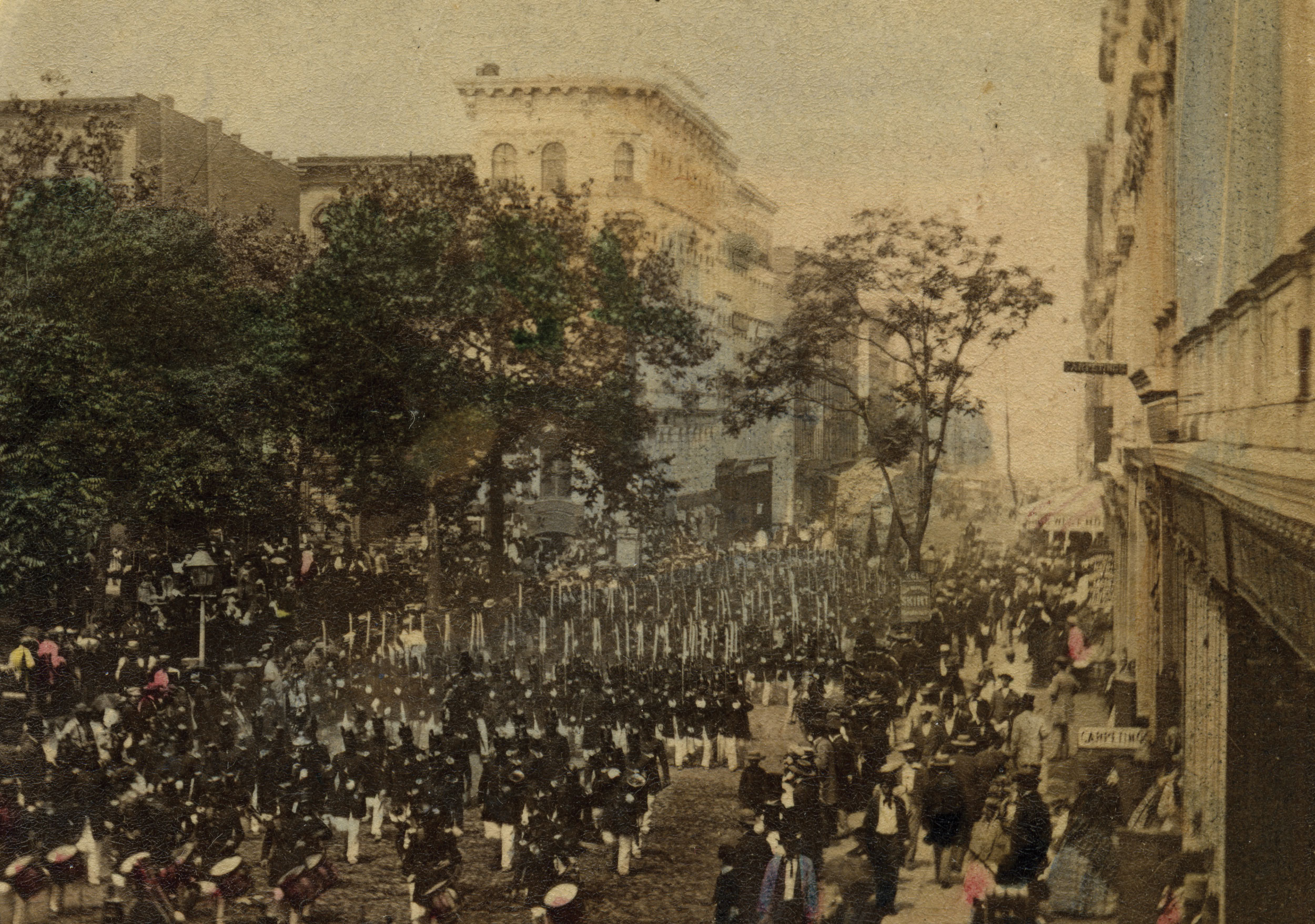
Militiamen march through the streets of New York City on July 4, 1860—the last Fourth of July before the start of the Civil War.
Although the big Confederate surrenders had taken place more than two months before, it surely didn’t feel like the Civil War was over for the soldiers of the 22nd Iowa Infantry.
They were expecting to be mustered out soon, but in early July 1865, they were stuck in sweltering Savannah and would have to spend one more Independence Day away from home. In camp, they celebrated in the same ways Americans had been celebrating the Fourth for decades. Someone read the Declaration of Independence aloud. There was a regimental parade, a short speech, some noisy cheering, the firing of a salute. That evening, the men got to see some fireworks and a grand illumination of the city of Savannah. It wasn’t the same as being home, but at least it was something.
Amid the revelry, one incident cast a dark cloud. As Union soldier Taylor Pierce later reported to his wife back home, a local volunteer fire company was planning to parade its engine around town. That in itself wasn’t unusual; fire companies had long taken part in Independence Day celebrations across the country. But this was a black fire company, and it was 1865 in the South. War’s wounds remained raw. Racial tensions churned. The black firemen were violently assaulted by a group that Pierce described as “low white citizens and boys assisted I am Sorry to say by some drunken soldiers and some others who thinks that a nigger has no rights that a man is bound to respect, but who is found on all occasions when they can get into bed with the dirtiest wenches that this dirty southern confederacy can produce.” The rabble “beat them with brick bats drove them off from their Engine tore up their Cloths and run their engines in to a mud hole.”1
What Pierce witnessed that day epitomizes the sizable stakes of Independence Day celebrations in the Civil War era. Throughout America’s history, it’s been a day to celebrate what unites Americans and what sets them apart from the rest of the world. But it’s also been a day when Americans have argued about what it means to be an American, about who is included and who is excluded. And that’s precisely what was going on in Savannah in 1865. The black fire company, by parading on the Fourth, was staking a claim to equal status as Americans. Their white assailants replied—in the unambiguous language of physical violence—that even after slavery’s end, African Americans were not equal members of the American national community. In this light, the Fourth of July may have been one of the most consequential Civil War battlegrounds of all.2
 Library of Congress
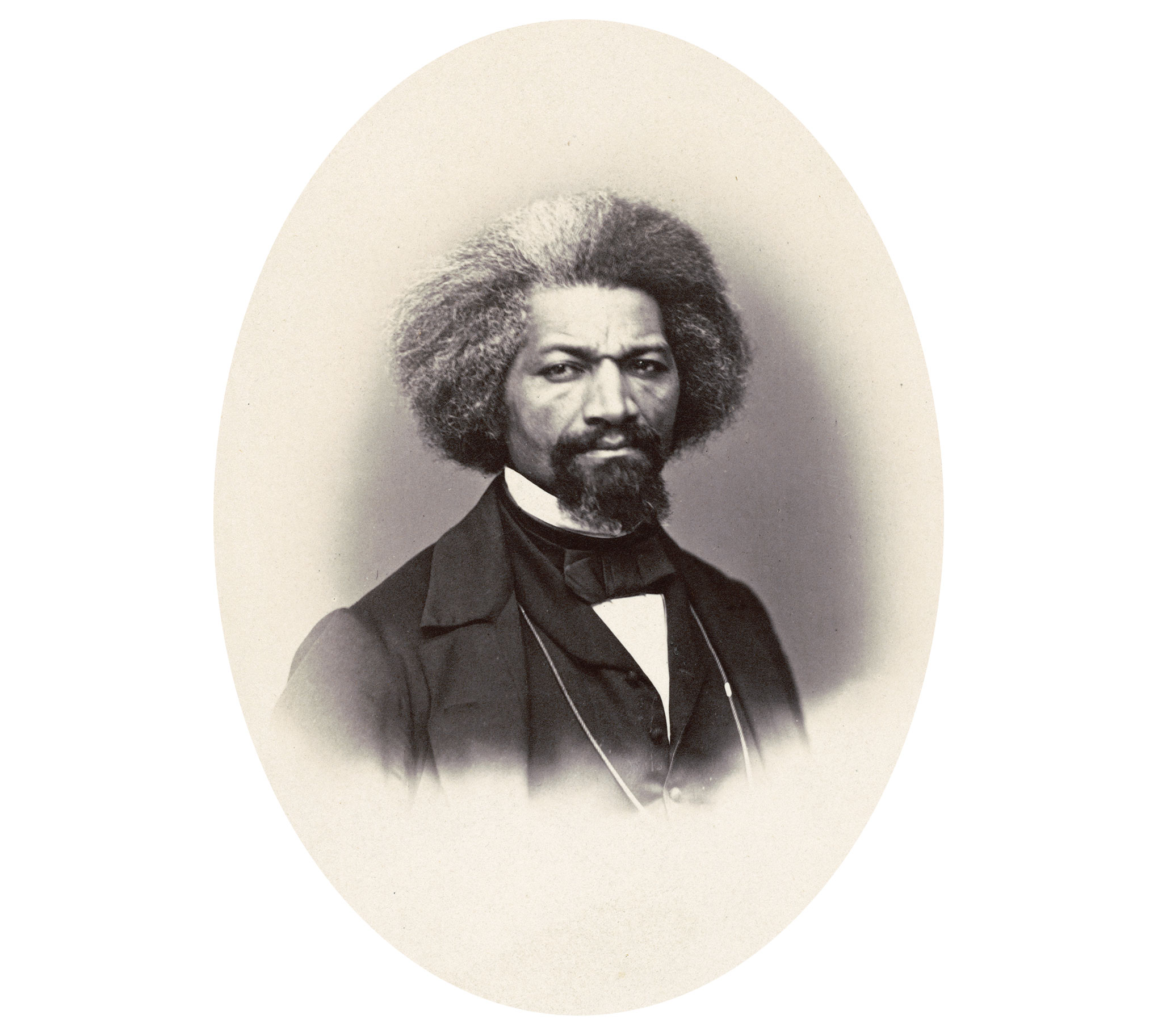
In the decades before the Civil War, celebrations of the Fourth of July generally highlighted the colonies’ separation from the British Empire, not issues of racial equality. Abolitionists like Frederick Douglass (pictured above in 1862), however, used the day to underscore the incongruity between slavery and the anniversary of the Declaration of Independence.
From its beginnings during the American Revolution, the Fourth provided the perfect occasion to debate what America was and what it ought to be. Rival political parties, beginning with the Federalists and the Democratic-Republicans in the 1790s, used the holiday to press their own agenda by aligning themselves with the country’s sacred revolutionary heritage. In the decades leading up to the Civil War, so too did reform movements working for all kinds of goals: temperance, Sabbatarianism, and, of course, abolitionism.
Antebellum Americans’ disputes over slavery went on year round. They ebbed and flowed and circled back around. But each year they acquired special meaning on the Fourth of July. From our modern-day perspective, the nature of the connection is unmistakable. The Fourth commemorates the adoption of the Declaration of Independence, with its profession that “all men are created equal” and with its invocation of unalienable rights. But slavery was based on the assumption that black men (not to mention women) were definitely not equal to white men, that their rights were absolutely alienable, if they existed at all.
The contradiction seems glaring through our eyes, but for most early Americans with white skin it was not. From the colonial period onward, they separated white equality and black slavery into different intellectual compartments. Moreover, in the decades following the Revolution, the Declaration was held up mostly as a simple act of withdrawal from the British Empire, not an idealistic declaration of universal human rights. Before the Civil War, hardly anyone emphasized the phrase “all men are created equal.” Most white Americans gave little thought to the incongruity between slavery and the anniversary of the Declaration.3
 Alamy Stock Photo
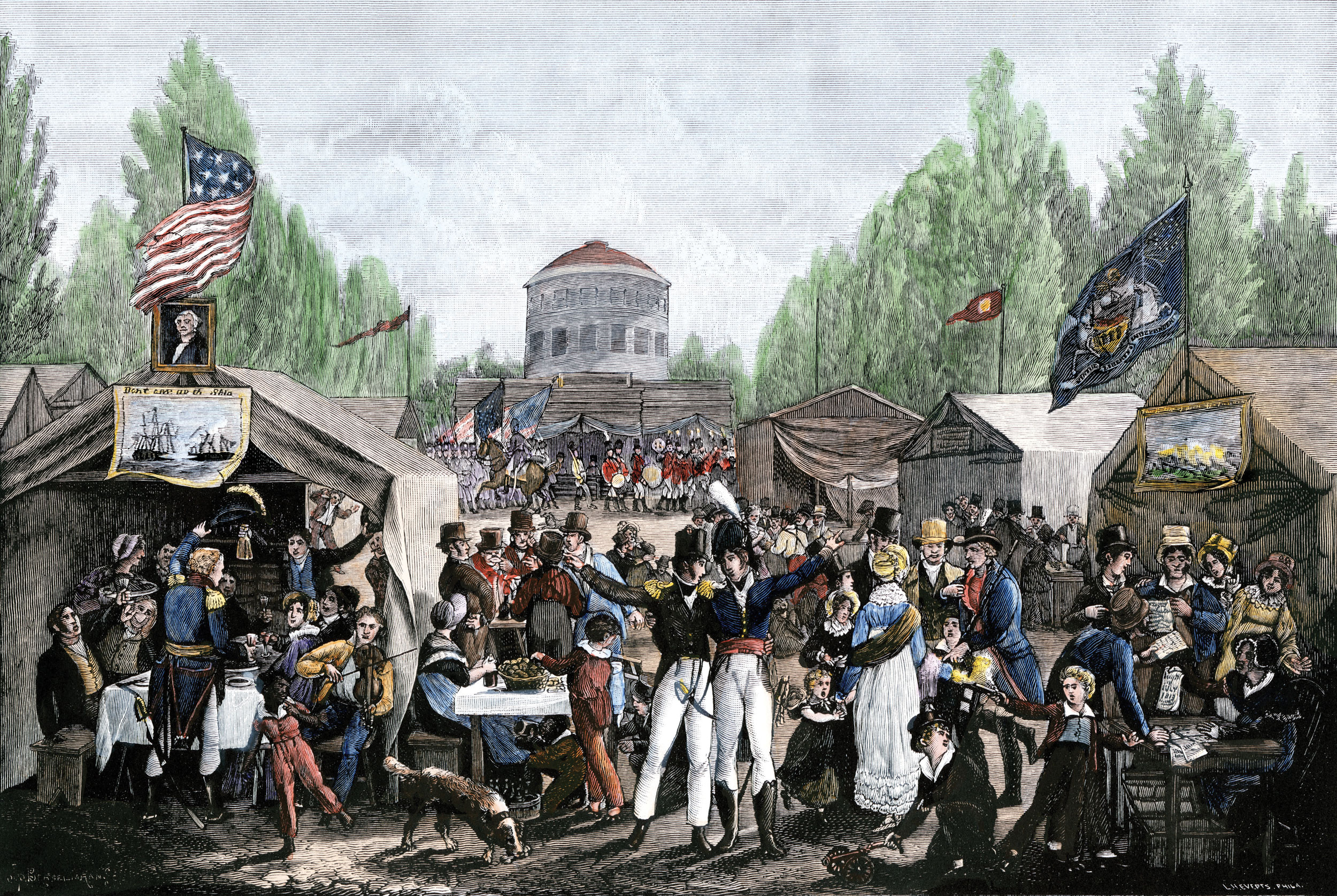
Soldiers and civilians celebrate Independence Day in Philadelphia in 1819.
The exceptions were abolitionists, white and black, who embraced the Fourth as an opportunity to expose the inconsistency between lofty American ideals and the despicable practice of slavery. In 1852 Frederick Douglass delivered what is probably the most powerful Independence Day speech of all time, posing the question, “What, to the American slave, is your 4th of July?” and responding with a searing critique of white American hypocrisy:
I answer: a day that reveals to him, more than all other days in the year, the gross injustice and cruelty to which he is the constant victim. To him, your celebration is a sham; your boasted liberty, an unholy license; your national greatness, swelling vanity; your sounds of rejoicing are empty and heartless; your denunciations of tyrants, brass fronted impudence; your shouts of liberty and equality, hollow mockery; your prayers and hymns, your sermons and thanksgivings, with all your religious parade, and solemnity, are, to him, mere bombast, fraud, deception, impiety, and hypocrisy—a thin veil to cover up crimes which would disgrace a nation of savages. There is not a nation on the earth guilty of practices, more shocking and bloody, than are the people of these United States, at this very hour.
In short, even before war broke out, Independence Day was well established as a holiday of contention—a day to argue over the meaning of the American experiment in the past, present, and future.
 Louisiana State University Libraries Special Collections
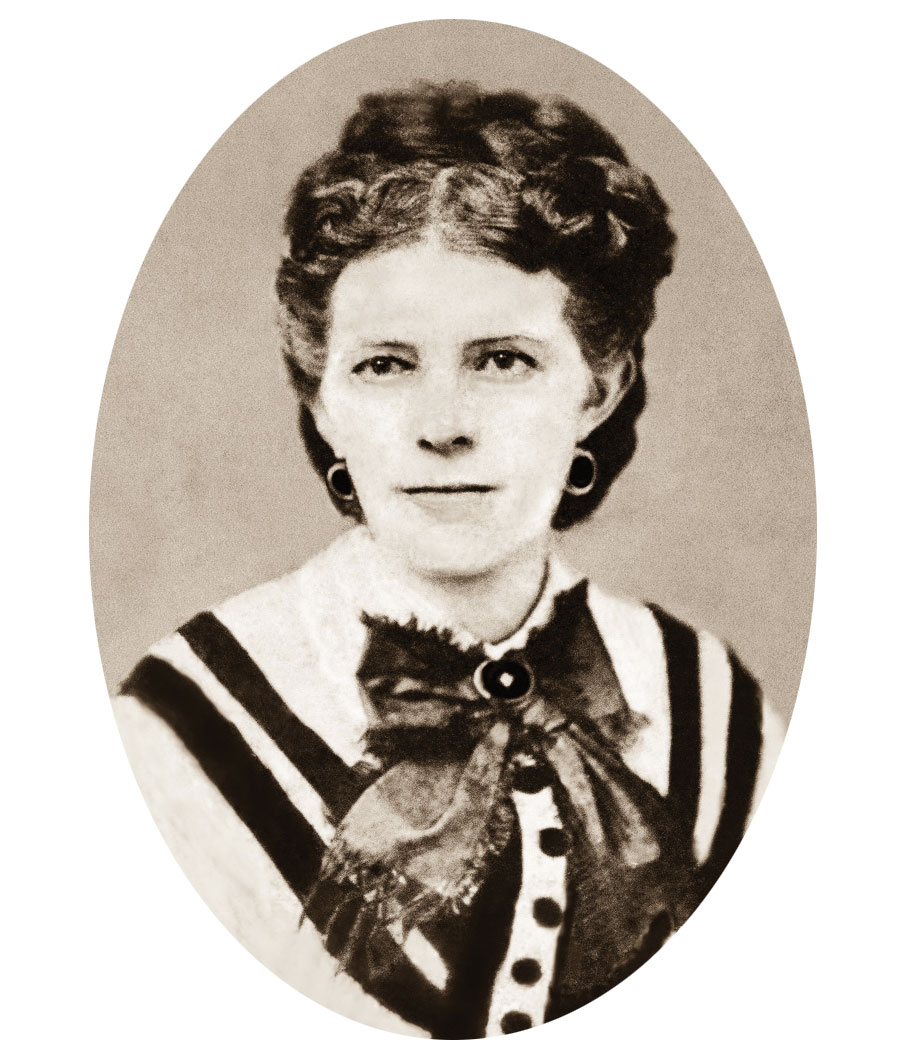
While the questions of how and whether to celebrate Independence Day plagued white southerners (like Kate Stone, pictured above) during the war, most northerners’ attitudes toward the Fourth remained largely the same.
The Civil War transformed the holiday—hardly surprising, given how all-consuming a conflict it became. As July 1861 approached, it was clear to all that the day would be different than usual. But different in what way? In the wake of secession and the creation of the Confederacy, in the wake of the firing on Fort Sumter and President Abraham Lincoln’s call for troops to suppress the rebellion, what would happen to the annual celebration? How would the American people commemorate their national anniversary when the nation was falling apart?
The Fourth presented a particular problem for white residents of the Confederate States. They had left the Union, so how should they celebrate the birthday of a nation they no longer considered themselves citizens of? The question would bedevil white southerners throughout the war. Beginning in 1861 they engaged in a wide-ranging conversation over what to do about the Fourth of July, and revealed a kaleidoscope of attitudes toward the American revolutionary heritage and Confederate identity.
A few wished to abandon the Fourth. Yet many others thought it more important than ever. As one orator in Austin, Texas, explained during a Fourth of July celebration in 1861, “We are to-day engaged in the second war for independence, resisting the demands of centralization fighting battles for self-government, and upholding the cause of constitutional freedom.” The American Revolution was about local self-government, not universal liberty, so the Confederacy would naturally cherish the principles of the Fourth. From Louisiana, a newspaper editor wrote, “The Yankees have robbed us of too much already. We have no idea of giving up the national anniversary—not a bit of it. The Fourth of July is ours.”4
The prevailing outlook, though, was pained uncertainty. In the midst of a revolution that quickly turned their world upside down, white southerners simply did not know what to do. Many, in newspapers and private writings alike, wanted the Fourth to be marked in some way—but not in the same way as before. During the first summer of the war, teenaged Louisianan Sarah Lois Wadley had forgotten about the holiday until she wrote “July 4” in her diary, prompting her to reflect, “I think that the day should have been observed with unusual strictness, but it is natural and right that the feeling should have been more of sober thankfulness and religious prayer than of noisy joy.”5
Of enslaved black southerners’ view of the holiday, we know little. But there are tantalizing hints in the writings of white southerners. In June 1861, Kate Stone confided in her diary, “We live on a mine… [T]he Negroes are suspected of an intention to spring on the fourth next month.” The significance of the date was unmistakable. At least some slaveholders surely recognized that the principles of the Declaration might imply the liberation of slaves. Most, though, would never admit it. On July 4, 1861, Susan Eppes revealed the blinkered perspective that blinded so many southern slaveholders to slaves’ political aspirations: “This day, which was once so filled with merriment and pleasure, is now a thing of the past, where we are concerned. Father and my uncles let the negroes go ahead with the usual Fourth of July barbecue. Father said it would not be right to curtail their pleasures because of our own troubles; so they are having a merry time today.”6
As would become so apparent, whites’ “own troubles” were inextricably bound up with the fate of the slaves themselves. But in 1861, almost everyone involved, North and South, was trying to avoid the Civil War becoming a war explicitly for or against slavery.
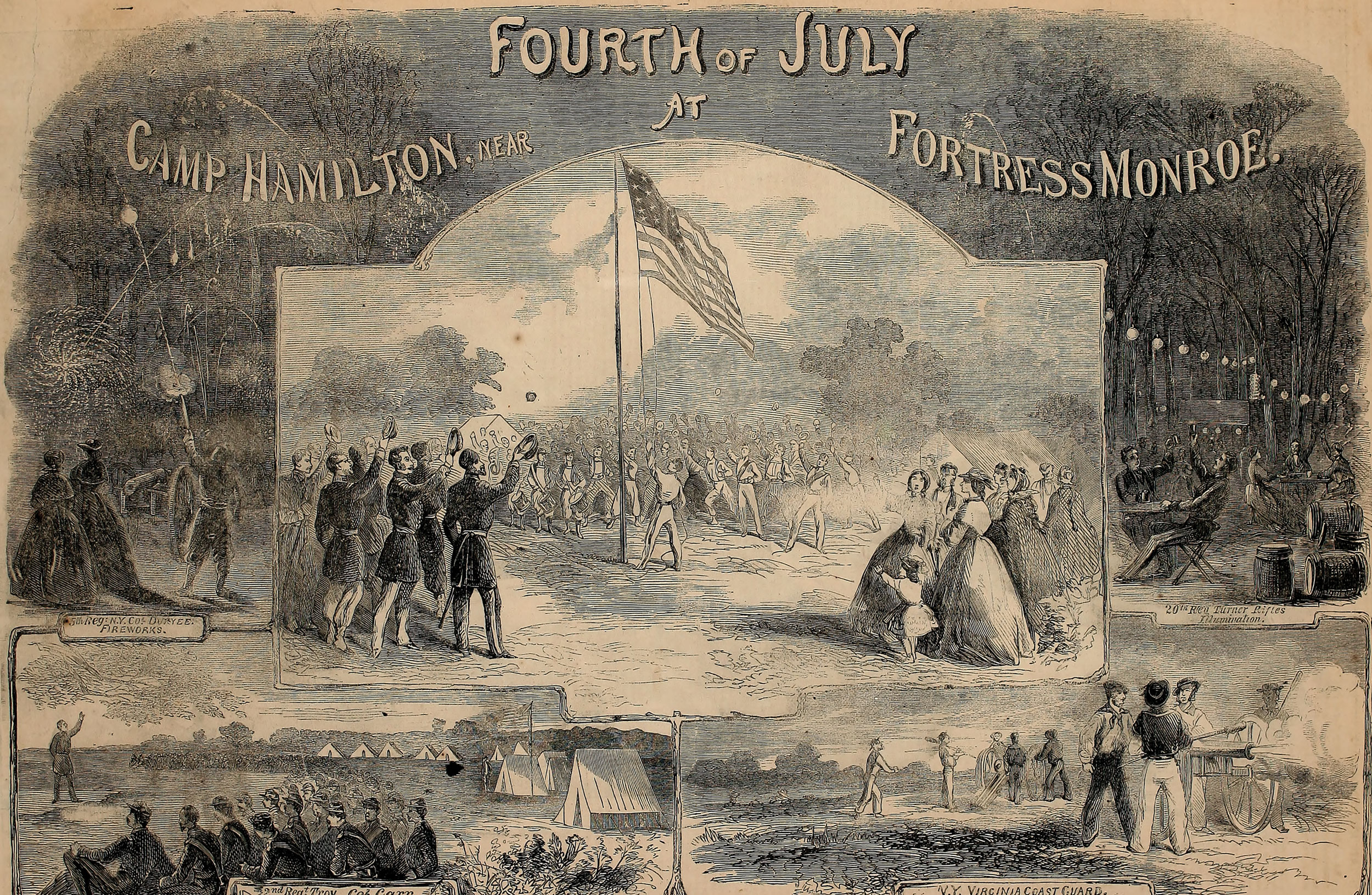 Harper’s Weekly
This group of scenes showing Fourth of July celebrations in Union army camps appeared in Harper’s Weekly in 1861.
In most parts of the North, wartime attitudes toward the Fourth were little changed. There was no question as to whether northerners would celebrate, and so they reveled as they always had, lighting fireworks and illuminations, firing salutes, listening to speeches, raising the Stars and Stripes. As The New York Times wrote, the holiday was marked “with all the outward display, and much more of the inward spirit” than in previous years. Indeed, for the Times, Independence Day was the “last link of the Union that treason has spared,” and therefore an apt date to put an end to the rebellion and bring the southern states back into the Union.7
That turned out to be wishful thinking. But northerners continued to commemorate the Fourth with enthusiasm throughout the war, while their enemies continued to wonder whether they should celebrate at all. For Confederates, the escalating hardships of war provided insufficient time, few resources, and precious little reason to celebrate even if they had a mind to do so.
Two years later, Independence Day took on added significance, in part because of the twin Union victories at Gettysburg and Vicksburg. On July 4, 1863, the same day Robert E. Lee was leading his defeated army from Pennsylvania back toward Virginia, Confederate commander John C. Pemberton was surrendering the city of Vicksburg to Ulysses S. Grant. A native of Philadelphia, Pemberton explained the reason for the symbolic timing to his staff: “I am a northern man. I know my people. I know their peculiar weaknesses and their national vanity; I know we can get better terms from them on the Fourth of July than on any other day of the year.”8
Even without Gettysburg and Vicksburg, July 4, 1863, would have been a turning point in the history of the holiday. The Emancipation Proclamation was in effect, and the Lincoln administration had come to define the ending of slavery as a war goal. Although emancipation policy was framed as a military measure to help the Union defeat the Confederacy, it also heralded a much further-reaching shift. Adopting emancipation as a war goal opened the door to both an abolitionist vision of Independence Day and a more inclusive interpretation of the Declaration of Independence.
That is not to say that all white northerners supported emancipation. In fact, dissenters saw the Fourth of July as an opportunity to make their positions clear. Thomas H. Seymour, former governor of Connecticut, gave an 1863 Independence Day speech blaming the war on abolitionist agitators in the North and complaining about the corrupt and tyrannical Lincoln administration’s centralization of power and lack of respect for states’ rights. Because of all this—what he saw as a betrayal of the principles and spirit of the Revolution—Seymour wondered whether Americans would be celebrating the Fourth for much longer. As he explained, “I do not come before you so much to rejoice or congratulate with you upon this occasion as to lament that the day is no longer what it once was.”9
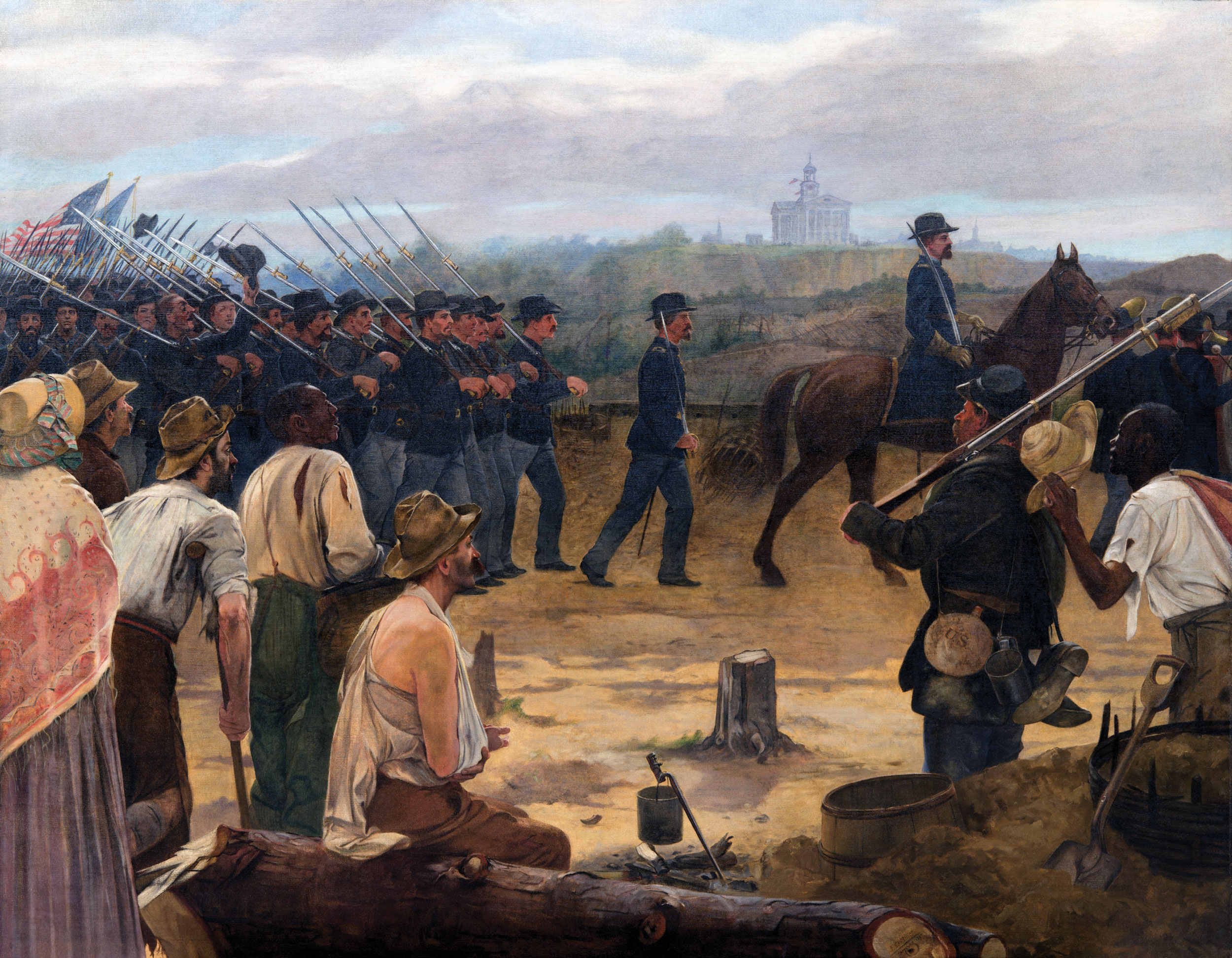 Minnesota Historical Society
Independence Day in 1863 took on added significance, not only due to the twin Union victories at Gettysburg and Vicksburg, but also because of the recent adoption of emancipation as a northern war goal, which opened the door to a more inclusive interpretation of the Declaration of Independence. Above: Victorious Union soldiers march into Vicksburg on July 4, 1863.
By July 1865 much more was certain. The Union was victorious. As Independence Day neared, white northerners saw an opportunity to celebrate final victory and draw a line under the horrific events of the last four years. With the long process of demobilization underway, what better day than July 4 to fete the returning soldiers who had fought to keep the nation together? In June, Pennsylvania governor Andrew Curtin recommended that “in every part of the State, on the approaching anniversary of Independence, special observances be had of welcome to our returned defenders, and of commemoration of the heroic deeds of themselves and their comrades who have fallen.”10 Other northern governors issued similar proclamations. One of the most widely noted celebrations was held at Gettysburg, where a cornerstone was laid for a monument in the new Soldiers’ National Cemetery. The nation’s leading dignitaries and many Union veterans convened there on that symbolic day, returning to the place that was already coming to signify the preservation and rebirth of the United States.
Jamestown, in western New York, offered a more lighthearted take on the day. Following a grand procession and a free dinner for returning soldiers, other activities included “an ascension of the monster Balloon ‘Union’”; an exhibition by the “‘Jamestown Dead Beats’ in fantasticals, on horseback and so forth”; and a reenactment of the “pursuit and capture of Jeff. Davis in hoops.” The day culminated with an elaborate fireworks display, including “BOMBSHELLS” that were “cast from mortars to the height of 1,000 feet,” and a “POLKA DANCE” that was predicted to be “quite incomprehensible to those unacquainted with the secret of its construction.”11 Oh, to have been in western New York that night.
Other northern towns came up with their own quirky ways to mark the Fourth of July. But the old conventions held, too. Northerners paraded and fired salutes. They listened to speeches and to public readings of the Declaration. They picnicked and they went on excursions. They ate and they drank, and then they ate and drank some more.
In the minds of many white northerners, Independence Day 1865 was a day not to crow over victory, but rather to extend the hand of reconciliation to their erstwhile foes. The New York Herald expressed just such a sentiment: “In the South, we hope, the nation’s anniversary may be celebrated in a reunion between Unionists and repenting rebels, which will do much to reclaim the old devotion of the Southern people to ‘the old flag.’ North and South, ‘the glorious Fourth’ of the year of grace and peace 1865 ought to be such a jubilee as the world has never known since the occupation of the promised land by the children of Israel.”12
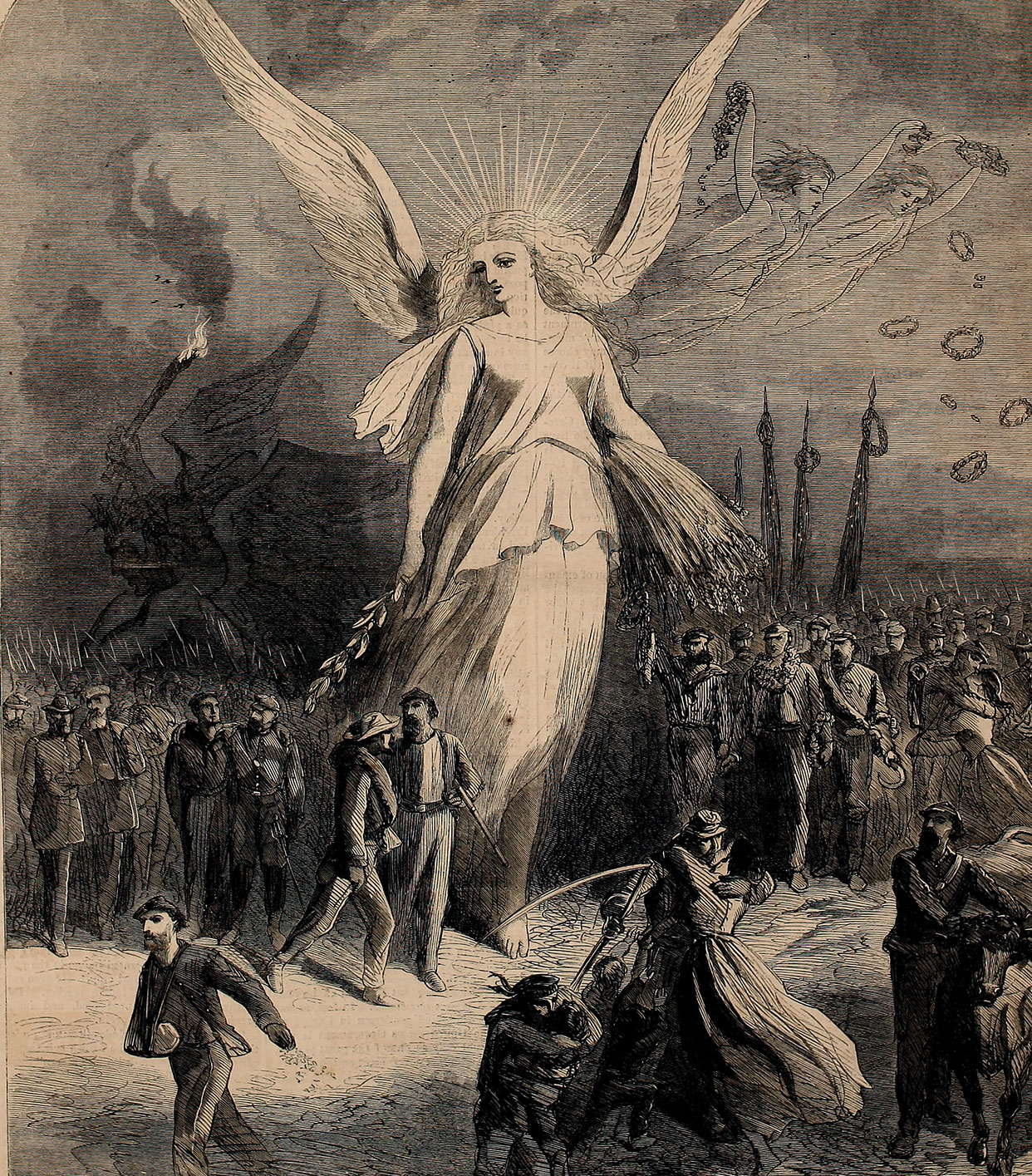 Harper's Weekly
The cover of the July 8, 1865, edition of Harper’s Weekly contained this image, which ran with a simple label: “Peace—Fourth of July, 1865.” While many white northerners viewed the celebrations that year as an opportunity to extend the hand of reconciliation to old foes, others were not interested in forgiving and forgetting so quickly.
Not all northerners wished to forgive and forget so quickly. On the contrary, there is much evidence of lingering bitterness in 1865 and for a long time thereafter toward former Confederates. Perhaps reconciliation should not be so easy, some seemed to feel, not after four years of devastating warfare. One Albany, New York, newspaper reported that the Fourth would be celebrated in South Carolina—but only by order of a U.S. general. There would be salutes, a parade, and readings of the Declaration and the Emancipation Proclamation. The paper’s editor wrote, “Here is a fine chance for the people of that testy little State to redeem themselves. If their professions of loyalty are sincere, let them ‘celebrate.’ Let them proclaim their resurrected love for the old Flag through the expressive medium of torpedoes and firecrackers.” The barbed humor made it perfectly clear that the conflict was not yet settled.13
For their part, African Americans and their allies were glad of Union victory and saw July 4 as a prime opportunity to consolidate its benefits. Perhaps the biggest black celebration of the Fourth of July that year was in Washington, D.C., on the grounds of the White House. As the organizers put it, this was the first time African Americans had “attempted any celebration of a national character”—on Independence Day or any other day of the year. The speakers made the most of the historic occasion. But even as they celebrated the gains they had made, they acknowledged that the battle wasn’t over. At this point, the Thirteenth Amendment had not yet been ratified, and the Fourteenth and Fifteenth amendments had not yet been proposed. There was much left to fight for every day of the year.14
Still, 1865 was another turning point in the meaning of the Fourth of July. The promise of 1776 seemed more real than ever. One African-American newspaper described the Civil War as having completed the unfinished work of the revolutionary generation: “This second birth is as great if not greater, than the first, in the light of Christianity. The glorious work of liberty, which was commenced more than eighty years ago, has just been finished. They left the superstructure unfinished. It was for us to complete it, and make it perfect.”15
In an Independence Day speech in Illinois, a white abolitionist lawyer told his audience that the Fourth had previously been a sad day, one that had exposed what he called “the utter falsity of our national life to the national ideas, embodied in the Declaration of Independence.” But Union victory in the Civil War had ended that hypocrisy. The orator, Edwin Larned, did not see emancipation merely as a side result of the Civil War but as its central significance. And he drew a direct line between the principles of 1776 and the abolition of slavery in the 1860s, referring to the Emancipation Proclamation as “the child of the Declaration of Independence.”16
It would be difficult to overstate the significance of that first Fourth of July after the end of the war. Throughout the slowly reuniting nation, black Americans celebrated Independence Day, some of them for the first time. In Augusta, Georgia, for example, thousands of African Americans, mostly former slaves, paraded beneath three banners: one commemorating the martyred Lincoln, another rejoicing over the death of slavery, and a third celebrating the principles of freedom and equality. Such a spectacle would have been unimaginable just a few years before.17
To white southerners, such celebrations were a betrayal of everything America stood for. Whether or not they had owned slaves, they had lived in a society structured by white supremacy and black enslavement. That world had been overturned. The plantation mistress Mary Chesnut grumpily recorded the day in her diary as “Black 4th of July—1865.” And in Columbia, South Carolina, Emme LeConte wrote, “The white people shut themselves within doors and the darkies had the day to themselves—they and the Yankees. I could have listened to the roar of cannon at our very doors all day and thought it music were we celebrating our independence and—but well, well—what is the use of talking about it.”18
African-American assertiveness on July 4, 1865, sparked new kinds of racial tensions, strains that would shape the long process of Reconstruction. Even in northern cities, whites reacted strongly. When an Independence Day orator in Hudson City, New Jersey, celebrated the end of slavery and all it implied, he was interrupted by hecklers. One former aldermen went so far as to run up to the stage and stop the speech.19
But it was in southern towns and cities that racial conflict boiled over most forcefully. On the same sweltering Fourth of July when Iowa soldier Taylor Pierce saw the assault on the black firemen in Savannah, another Iowa soldier named William Clayton was waiting to be mustered out in Mobile, Alabama. There wasn’t much of a celebration in Clayton’s camp—only a regimental review and a speech from an officer. But in a letter home he reported that several thousand African Americans had gathered in town, along with some black Union troops. As the large celebration wore on, tensions with some of the white troops in town began to mount. As Clayton told it, the African Americans “scratched one or two soldiers with their bayonets, and two or three of the ‘nigs’ were killed and thus ended the celebration.” Once again, the struggle for the Fourth of July had resulted in violence, and this time fatalities ensued.20
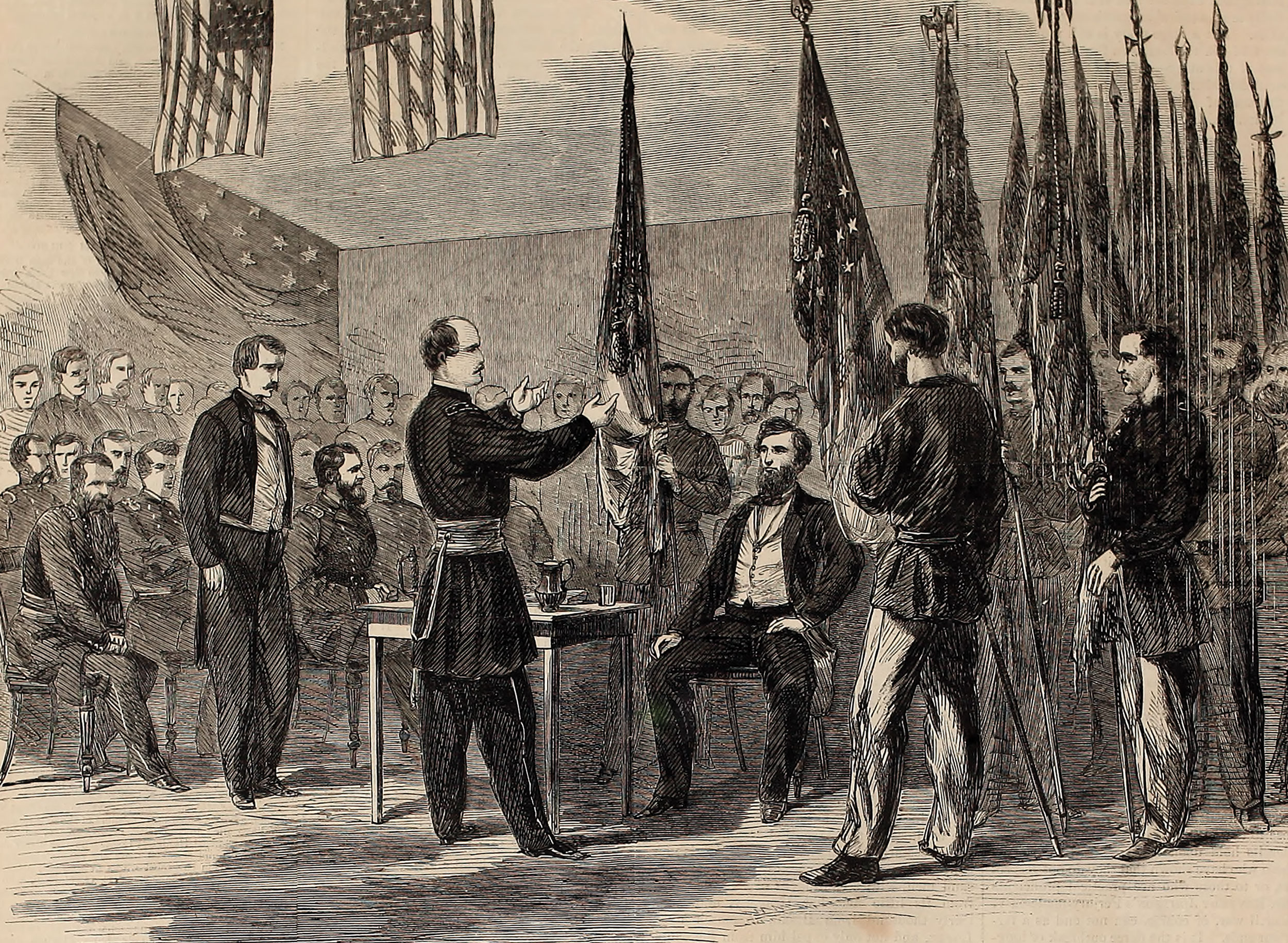 Harper's Weekly
Union veterans present 200 “battle-flags” to the governor of New York on July 4, 1865.
In the years following 1865, the Fourth of July continued to be an ideological battleground—literally and symbolically—to define who belonged in America. Throughout the Civil War era, the holiday focused Americans’ attention on the biggest questions of the time. Was the South part of the United States? Were African Americans really Americans? What did the American Revolution properly mean in the 1860s?
Like every generation of Americans, those who fought the Civil War thought it vital to connect themselves to the memory of the Revolution. The year 1776 has always been the great touchstone of American life. It’s been the subject of conflict and reinterpretation at every stage of American history—but never more so than when Americans did battle against Americans between 1861 and 1865.
Paul Quigley is director of the Virginia Center for Civil War Studies and the James I. Robertson Jr. Associate Professor of Civil War Studies at Virginia Tech. He is the author of Shifting Grounds: Nationalism and the American South, 1848–1865 (2011) and co-creator of the digital archive Mapping the Fourth of July: Exploring Independence Day in the Civil War Era (july4.civilwar.vt.edu).
Notes
1. Dear Catharine, Dear Taylor: The Civil War Letters of a Union Soldier and his Wife, ed. Richard L. Kiper (Lawrence, KS, 2002), 415-417.
2. The history of the Fourth of July can be traced in Diana Karter Appelbaum, The Glorious Fourth: An American Holiday, an American History (New York, 1989); Matthew Dennis, Red, White, and Blue Letter Days: An American Calendar (Ithaca, 2002); Adam Criblez, Parading Patriotism: Independence Day Celebrations in the Urban Midwest, 1826–1876 (DeKalb, 2013); Paul Quigley, “Independence Day Dilemmas in the American South, 1848–1865,” The Journal of Southern History Vol. 75, No. 2 (May 2009): 235-266. The website “Mapping the Fourth of July” (july4.civilwar.vt.edu) allows users to explore the thousands of primary sources for themselves.
3. Pauline Maier, American Scripture: Making the Declaration of Independence (New York, 1997); David Armitage, The Declaration of Independence: A Global History (Cambridge, 2007).
4. Alexander Watkins Terrell, Oration Delivered on the Fourth Day of July, 1861, at the Capitol, Austin, Texas (Austin: Gazette Office, 1861); “The Fourth of July at Shreveport,” excerpt from The Southwestern, in Mobile Advertiser and Register, July 4, 1861.
5. Sarah Lois Wadley Diary, July 7, 1861, Sarah Lois Wadley Papers, Southern Historical Collection, Louis Round Wilson Special Collections Library, University of North Carolina at Chapel Hill.
6. Entry for June 19, 1861, Brokenburn: The Journal of Kate Stone, 1861-1868, ed. John Q. Anderson (Baton Rouge, 1955), 28; entry for July 4, 1861, Susan Eppes, Through Some Eventful Years (Macon, 1926), 155.
7. “Independence Day,” The New York Times, July 4, 1861.
8. S. H. Lockett, “The Defense of Vicksburg,” Battles and Leaders of the Civil War, eds. Robert Underwood Johnson and Clarence Clough Buel, vol. 3 (New York, 1888), 492.
9. “The Day,” New York Herald, July 6, 1863.
10. “Address from Gov. Curtin,” New York Tribune, June 12, 1865.
11. “Celebration of Independence and Welcome to Returned Soldiers,” Jamestown Journal, June 30, 1865.
12. “The Coming Fourth of July—Our Union Soldiers,” New York Herald, June 12, 1865.
13. “The Fourth Of July In South Carolina,” Albany Evening Journal, June 30, 1865.
14. Celebration by the Colored People’s Educational Monument Association in Memory of Abraham Lincoln. On the Fourth of July, 1865, in the Presidential Grounds, Washington, D.C. (Washington, D.C, 1865), 3.
15. “Fourth of July,” Christian Recorder, July 8, 1865.
16. Edwin C. Larned, The Great Conflict: What has been Gained, and what Remains to be Done (Chicago, 1865).
17. James Lynch, The Mission of the United States Republic. An Oration Delivered by Rev. James Lynch, at the Parade Ground, Augusta, Ga., July 4, 1865 (Augusta, 1865).
18. Mary Chesnut’s Civil War, ed. C. Vann Woodward (New Haven, 1981), 832; When the World Ended: The Diary of Emma LeConte, ed. Earl Schenck Miers (New York, 1957), 113-114
19. “Disgraceful Proceedings,” The Liberator, July 14, 1865.
20. William Henry Harrison Clayton, A Damned Iowa Greyhound: The Civil War Letters of William Henry Harrison Clayton, edited by Donald C. Elder III (Iowa City, c1998), 172-174.