On a brisk november morning in 2022, a group of historians (and an anthropologist) gathered in a vacant field on the edge of Cleveland, a small city in southeast Tennessee. Armed with maps, compasses, notes, and a considerable sum of local history knowledge, they wandered among the cracked asphalt and concrete remnants of an old industrial site, wincing occasionally in the biting breeze of late autumn. They suspected that amid the weeds, broken foundations, and old hardwoods, somewhere lay remnants of a long destroyed and nearly forgotten edifice of great significance to the region’s Civil War history: Cleveland’s copper rolling mill. At the request of a local resident deeply interested in city lore, the group scoured the ground, taking photographs and making notes while conversing about the once-great copper industry here, speculating about what had once been. I was one of the historians, and our purpose on that day was twofold: first, to try to fill any gaps among the local man’s facts, and second, to see what if anything could be done to locate—and maybe even preserve—the vanished mill’s location.
 Library of Congress
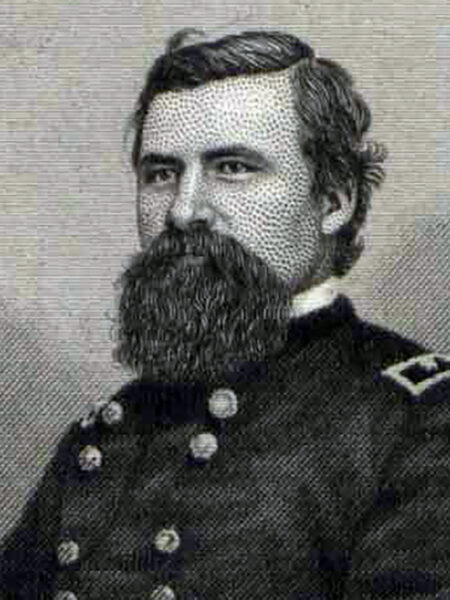
Eli Long
At first glance, Cleveland seems an unlikely place to pique the interest of Civil War enthusiasts. While charming and historic (and home to my own university), Cleveland feels off the beaten path despite its relative proximity to some of the most consequential military actions of the two-year period 1863–1865. But being just 30 miles from Chattanooga, Cleveland was an important railroad depot, and, for military purposes, possessed the only copper rolling mill in the South. Julius E. Raht, a German émigré and mining engineer, helped build his fortune transporting copper from the mines at nearby Ducktown and turning a considerable profit for out-of-state investors North and South. Raht was also a Unionist, and refused to swear fealty to the new Confederate States of America, which led to the seizure of his assets when war broke out. The Confederacy recognized the military importance of such a resource, and quickly turned the mill to producing percussion caps for firearms, telegraph wire, and even mysterious “torpedoes” that may have been early land or sea mines. Raht decided to stay and oversee the mill. Meanwhile, the Confederate government’s only source of the thin copper sheets required for percussion caps was Cleveland.
That is, until November 25, 1863, a day much like the one when our group began its quest. On that day, a Union cavalry brigade rode into the town with orders to cut Confederate railroad lines and damage what military assets they could discover. The brigade commander, Colonel Eli Long, was a bull-necked horse soldier, and his some 1,500 troopers were determined to carry out their mission as efficiently as possible. At the same time, Union troops in Chattanooga were storming the heights of Missionary Ridge and throwing back the Confederate siege laid by General Braxton Bragg’s Army of Tennessee. Long’s goal was to cut the railroad connecting Chattanooga and Knoxville, and thus prevent the troops there under Lieutenant General James Longstreet from bringing support to their comrades in Chattanooga. The Union cavalry succeeded over several days in tearing up track and chopping down telegraph lines, greatly distressing the Confederate sympathizers in the divided town.1
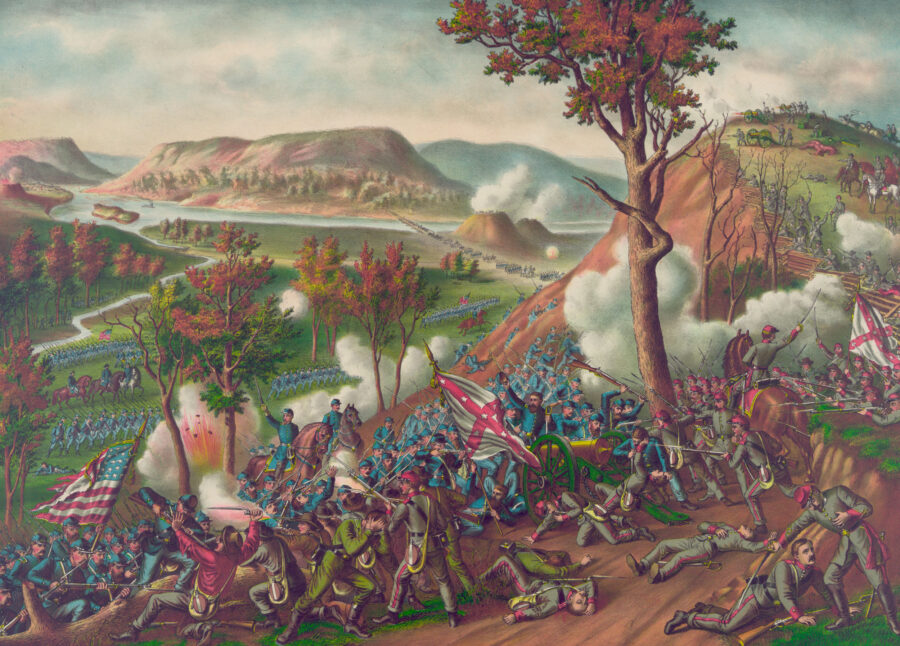 USAHEC
As Union soldiers assaulted entrenched Confederates on Missionary Ridge in November 1863 at Chattanooga (depicted here in a detail from a Kurz & Allison lithograph), Eli Long and some 1,500 Union troops executed a raid against the town of Cleveland, some 30 miles to the east.
Myra Inman, a Cleveland girl who kept a meticulous diary of the events, complained that Long’s troopers came on “a pretty day” and seized their “corn, potatoes, pork, salt, and never pay a cent and besides talk very insulting to us…. They burnt Mr. Raht’s wagon and the railroad and some cars….”2 Confederate cavalry eventually rode to the rescue, but not before Long’s troopers burned the copper mill and made their escape. According to Long, “In Cleveland I found a considerable lot of rockets and shells, large quantities of corn, and several bales of new grain sacks, all belonging to the rebel Government. Destroyed all that was not appropriated to use of my own command. Burned several railroad cars found here; also the large copper rolling mill—the only one of the kind in the Confederacy.”3
Long’s raid, usually relegated to a minor sidenote in the Chattanooga Campaign of 1863, was the product of a chain of important military decisions, and had real consequences. Major General Ulysses S. Grant decided to send Long to Cleveland in support of his effort to salvage the critical transportation hub of Chattanooga and to disrupt Confederate efforts in East Tennessee. In that, Long succeeded admirably. Further, Long interpreted his mandate to disrupt and destroy Confederate assets to include destruction of the copper mill, a hugely important industrial resource for the Confederate military. The raid paved the way for the occupation of Cleveland and its important rail connection to Knoxville and Virginia beyond—and it relieved the beleaguered but sizable Unionist population in Bradley County.
Though Long’s raid will never rival the flashier actions of J.E.B. Stuart in Virginia, Joseph Wheeler in Kentucky and Ohio, or Benjamin Grierson in Mississippi, the series of decisions that filtered down from army to corps, from corps to division, and from division to brigade, changed the face of little Cleveland, and the fortunes of the Confederacy, in important ways in 1863. And while it remains to be seen whether my circle of academics and Civil War aficionados will find much left of the copper mill, it is both humbling and exciting to reflect on how the consequences of those decisions resonate 160 years later.
Andrew S. Bledsoe is associate professor of history at Lee University in Cleveland, Tennessee. He is the author of Citizen-Officers: The Union and Confederate Volunteer Junior Officer Corps in the American Civil War (LSU Press, 2015); the co-editor, with Andrew F. Lang, of Upon the Field of Battle: Essays on the Military History of America’s Civil War (LSU Press, 2019); and author of the forthcoming Decisions at Franklin: The Nineteen Critical Decisions That Defined the Battle (University of Tennessee Press).
Notes
1. David Powell, All Hell Can’t Stop Them: The Battles for Chattanooga—Missionary Ridge and Ringgold, November 24–27, 1863 (El Dorado Hills, CA, 2018), 25–35; Dennis W. Belcher, The Cavalry of the Army of the Cumberland (Jefferson, NC, 2016), 179–181.
2. William Snell, ed., Myra Inman: A Diary of the Civil War in East Tennessee (Macon, GA, 2000), 230.
3. United States War Department, The War of the Rebellion: A Compilation of the Official Records 129 vols. (Washington, 1880–1901), Series I, Vol. 43 (2):561.