 National Archives
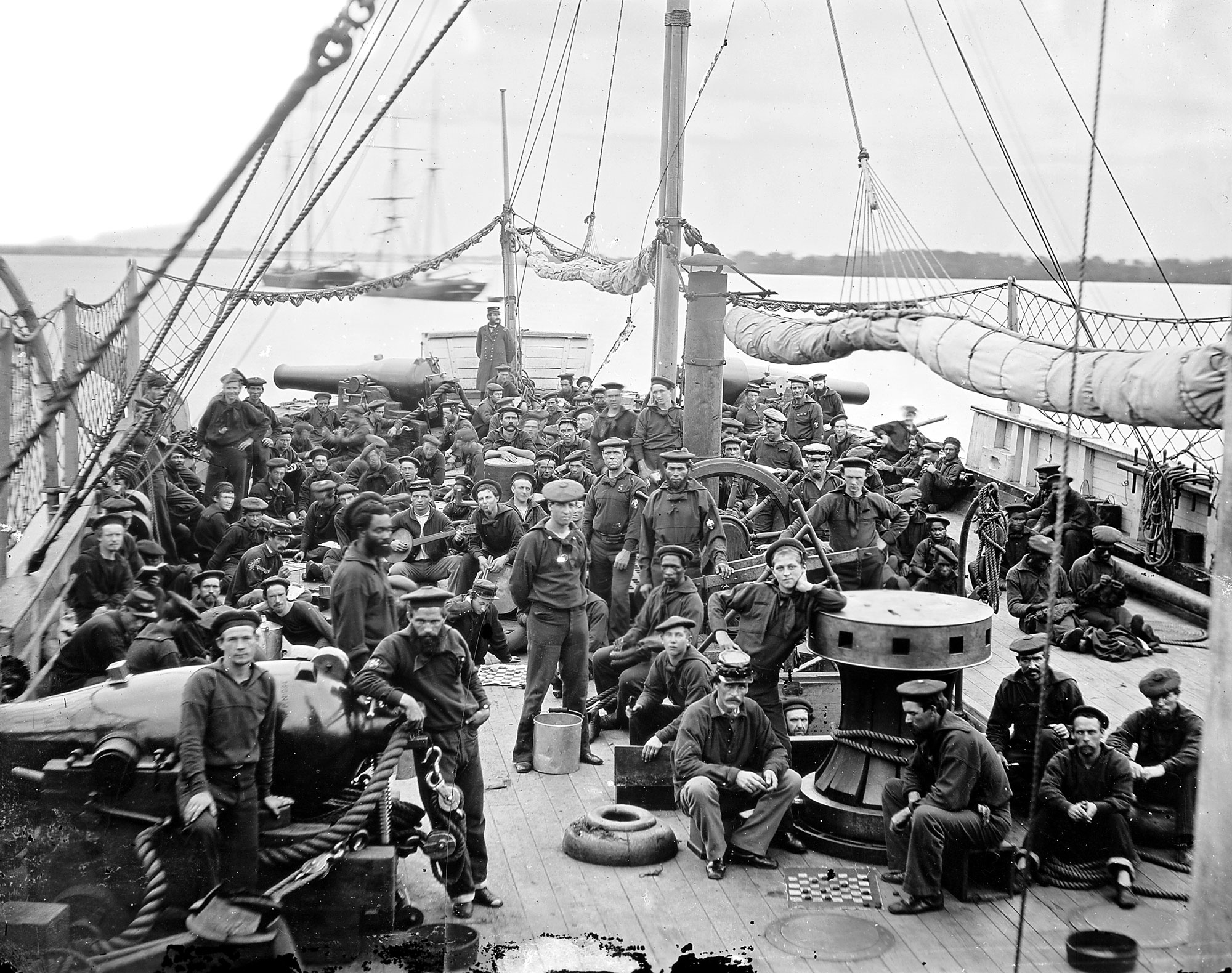
The crew of a Union gunboat crowds the deck. During the Civil War, some naval crews were afforded the opportunity of a “skylark,” a time when sailors could act—or act up—freely without fear of retribution.
sky• lark | subs. | { common } Originally tricks in the rigging of H.M. Navy; hence any rough-and-tumble horseplay. As verb. = to frolic, to play the fool; SKYLARKING = boisterous merriment or fooling; and SKYLARKER = a practical joker.1
All is quiet aboard a blockading Union ship off the southern U.S. coast. These are the “dog-watches,” the long hours between 4 and 8 p.m., when there is little work to do and the crew is allowed to rest. All hands laze about the various decks and stations, smoking, chatting, writing letters, and sewing. The boatswain, the officer in charge of all the activities on deck, walks among the sailors, his silver whistle dangling from his neck. A few sailors eye the old salt as he passes, expecting a call to some onerous work or duty. Standing bowlegged at the top of the steep passageway between the upper and lower decks, from where he can be heard by all the crew, he blows the whistle. But instead of a call to labor or drill, he plays the “call to mischief.”2 The sailors jump up and smiles cross their sunburned faces. One sailor cries out, “D’ye hear there, fore and aft! all hands skylark!”
All over the rigging, sailors playfully dive and leap from place to place, while others swing in long arcs from ropes tied to the masts and yardarms. On deck, an unwitting Marine is seized by a crowd of cheering sailors, who hoist him onto a cannon’s rammer and bounce him, much to the Marine’s discomfort and chagrin. On the gun deck, a fierce game of “Fox and Geese” is being played. A blindfolded “fox” wildly swings a hammer all around him, and whichever unfortunate “goose” the hammer contacts becomes “it,” and after they recover, they don the blindfold, and the game starts again. Illicit stores of liquor are drawn from their hiding places throughout the vessel, and drunkenness becomes general among the crew. The sea shanties normally banished on navy ships resound across the waves, and knots of jubilant sailors dance “hornpipes, fandangoes, Donnybrook-jigs, reels, and quadrilles.” Outside the officers’ cabin, a group of impish sailors puts on an even better show. They loudly parade and salute each other with ludicrous aplomb, mocking the pretentious mannerisms of the gentlemen inside. Behind the closed doors, the captain and his officers indulgently laugh at the jokes at their expense, until the good-natured smiles start to fade when their wives become the butt of the jokes.4 Yet they do not interfere. The crew have absolute possession of the ship during a skylark, and for a few hours, drunken revelry rules over duty, spontaneous fun triumphs over routine, and mockery usurps obedience.
Largely unknown on land, the skylark was a distinctive ritual of seafaring culture during the age of sail, from the mid-16th century to the mid-19th. The term originated in the acrobatic stunts sailors would perform while climbing the rigging of sailing ships. They were named “larks” after the birds with their similar swooping dives, and the first known use of the word in print was in 1771.5 Over time, the skylark evolved from informal horseplay on the rigging into a ritual that encompassed the entire crew and a wide variety of activities. Historian Greg Dening wrote that in the Royal Navy of the 1790s, the skylark “was a quaint and seemingly contradictory order to participate in exuberant play, to transfer the conflicts of messes and watches and the tensions created by the skilled work that stratified them to giddy games.”6 Like many of the American navy’s early practices, skylarking was inherited from the Royal Navy, and by the time the Civil War began, it was an established tradition. Skylarks were more organized on some vessels, with officers superintending athletic competitions among the men. Other crews put on amateur theatrics, showcasing original productions complete with homemade costumes and props. Then, aboard some ships, a skylark was a flat-out riot, spiraling into ferocious brawls, caustic mockery of officers, and drunken revelry.7
 Library of Congress
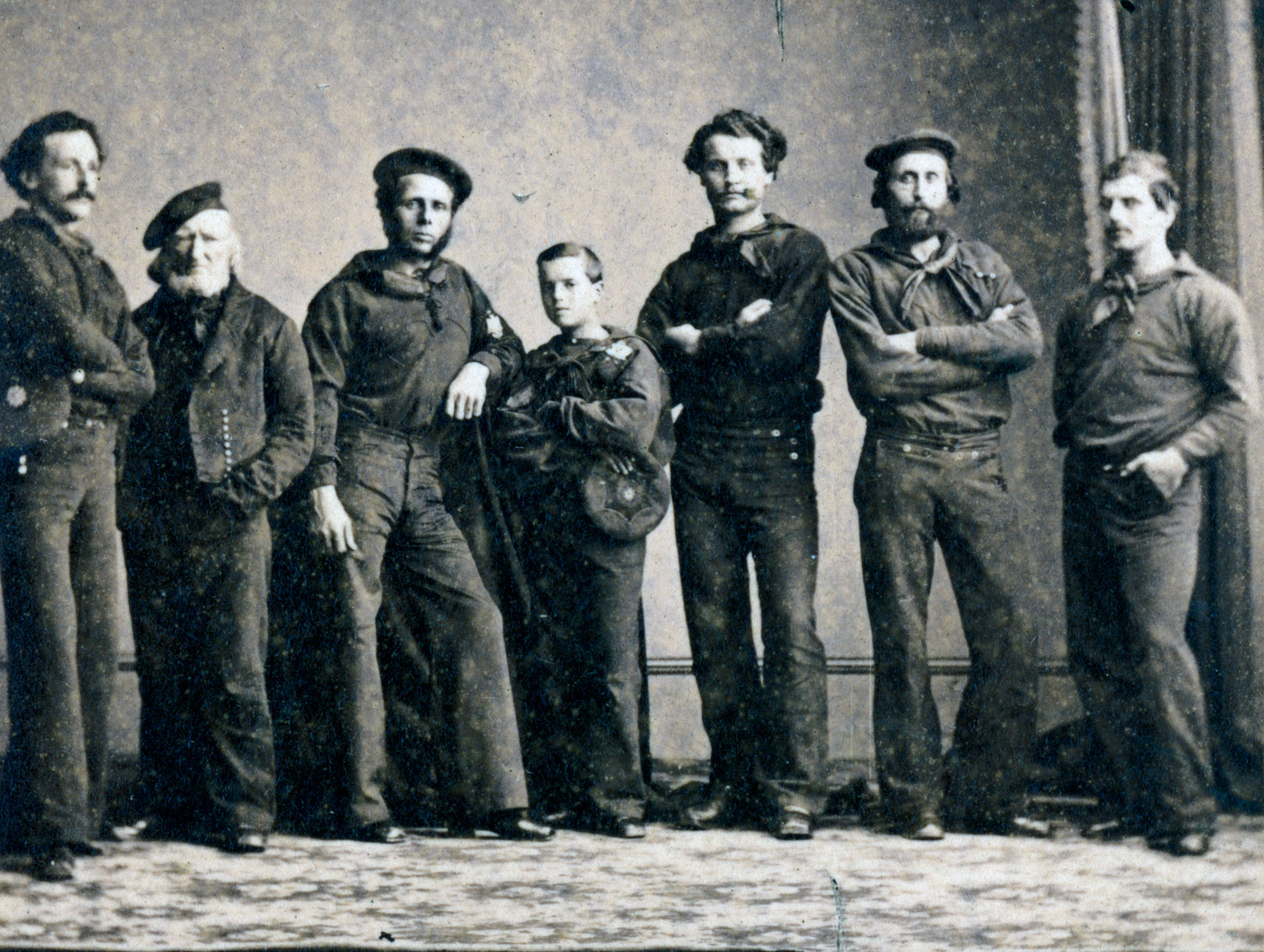
Unidentified union sailors pose for the camera in Mathew Brady’s New York studio sometime during the Civil War.
A trait shared by all skylarks was the spirit of inversion. A temporary radical equality prevailed; whatever was foremost on a man’s mind could be freely spoken, or acted on, without fear of disciplinary retribution. Skylarks were supposed to be fun, but the temporary suspension of discipline gave the crew an opportunity to settle grievances among themselves. If there was an injustice to be rectified or an ego in need of deflation, the skylark was such an opportunity. Officers were more apt to call it anarchy, but except in the most extreme cases of violence, they were forbidden from intervention.8 If they failed to give the crew an outlet for their frustrations, they could face consequences far more serious than a bruised ego.
Skylarks were part of the fragile balance of life at sea during the age of sail. Civil War sailors lived under a disciplinary regime far more encompassing and brutal than what their comrades on land experienced. For minor transgressions like spitting on the deck or swearing, a sailor could be locked in shackles for days, fed only on bread and water.9 Under these suffocating conditions, men endured mind-numbing routines for weeks at a time on blockade duty. They needed an opportunity to vent and disrupt the monotony. Officers ordered skylarks to release pressure and restore discipline. Sailors leaned into them to remind their commanders that their authority was dependent on the consent of the crew. The skylark was therefore an important part of an unwritten social contract between sailors and officers; a few hours of unrestrained and unpunished revelry in exchange for long weeks of productive work and obedience.
We know of a few skylarks that occurred during the Civil War. The crew of USS Kearsarge enjoyed one in April 1862, which relieved the frustration and tedium of hunting Rebel commerce raiders off the Iberian coast.10 USS Lancaster held a skylark on September 15, 1861, and Surgeon Charles Stedman witnessed at least one during his service on the ships Circassian and Huron.11 The frequency of skylarks is difficult to determine because they were rarely recorded in a ship’s log. But based on available evidence, they were held most often on national holidays like Washington’s birthday and the Fourth of July; otherwise they occurred infrequently, with fewer skylarks over the course of the war.
Skylarking was already in decline during the antebellum period. Herman Melville, who served on USS United States in the 1840s, wrote that they never occurred “except upon very rare occasions.”12 The Civil War only accelerated their decline. The vigilance practiced by ships on blockade duty usually preempted such riotous distractions. Steam engines also kept shifts of coal heavers and engineers busy around the clock to feed and maintain the temperamental machines. Finally, cultural attitudes had turned against the skylark, and a new emphasis on “respectability” dampened officers’ tolerance for the rowdy idiosyncrasies of sailors.13
More ominously, the threat of racial violence made a temporary suspension of discipline potentially murderous. Although black sailors had always served in the American navy, the Civil War pushed racial tensions to their breaking point. White working-class seamen felt their economic security and social standing threatened by the influx of more black sailors, and lethal brawls often broke out if officers were not watchful, especially after the Emancipation Proclamation.14
By the end of the 19th century, the skylark was virtually defunct. But its spirit survives today in the colloquial phrase of having, or going for, “a lark.” Though more common in British slang, a lark implies a bit of mischievous and spontaneous fun.15 It is an echo of the carnivalesque attitude of the skylark, though the full scope of the original meaning has shrunk over time. However, some aspects of the ritual have experienced a resurgence in the digital age. In the Civil War-era navy, singing while working was forbidden; sailors could sing only during the dog-watches or during a skylark.16 Music, and sea shanties in particular, were a celebrated aspect of skylarking. In 2021, a TikTok of a Scottish singer’s version of the whaling song “The Wellerman” went viral, and the maritime tradition of shantying experienced an explosion of popularity among young people.17 Over 6,000 singers joined the a cappella folk group The Longest Johns to sing “Leave Her, Johnny” in a video that has over 7.5 million views on YouTube.18 While the full realm of skylarking is not likely to make a comeback, maybe the boatswain’s call for “all hands to mischief” will be heard again someday.
Ben Roy is a PhD student at the University of Georgia, studying the cultural history of tobacco in the 19th century. He is also interested in the American Civil War, and researches the social history of common sailors, soldiers, and their officers.
Notes
1. John Stephen Farmer and William Ernest Henley, Slang and Its Analogues Past and Present Vol. VI (1893), 236.
2. Michael Bennett, Union Jacks: Yankee Sailors in the Civil War (Chapel Hill, 2004), 116.
3. Herman Melville, White Jacket: or, Life Aboard a Man of War (1850), 164.
4. This is a composite description of various skylarks that occurred during the Civil War era. Melville, White Jacket, 152–154, 164–166; William Marvel, The Alabama and the Kearsarge: The Sailor’s Civil War (Chapel Hill, 1993), 44; Bennett, Union Jacks, 116–118.
5. Merriam-Webster.com Dictionary, “skylark” (merriam-webster.com/dictionary/skylark).
6. Greg Dening, Mr. Bligh’s Bad Language: Power, Passion, and Theatre Aboard the Bounty (Cambridge, 1992), 71.
7. Dennis Ringle, Life in Mr. Lincoln’s Navy (Annapolis, 1998), 85–86); Donald Canney, Lincoln’s Navy: The Ships, Men, and Organization, 1861–1865 (Annapolis, 1998), 137; James Valle, Rocks and Shoals: Order and Discipline in the Old Navy, 1800–1861 (Annapolis, 1980), 18.
8. Valle, Rocks and Shoals, 18; Ringle, Life in Mr. Lincoln’s Navy, 80; Bennett, Union Jacks, 116; Marvel, Alabama and Kearsarge, 44.
9. June 6, 1863: “Matthew Thomas (Boy) and Lewis Walker was put on lookout … for … spitting on deck”; July 21, 1863: “Confined Jos. M. Barber O.S. [Ordinary Seaman] in single irons on bread and water for five days for impertinence to Executive Officer and cursing shipmate,” Log of USS Macedoni
10. Marvel, Alabama and Kearsarge, 44, 295.
11. Diary Entry, n.d. [September 15, 1861], John B. Wirts Diary, Special Collections, University Library, University of California at Los Angeles; The Civil War Sketchbook of Charles Ellery Stedman, Surgeon, United States Navy, ed. by Jim Dan Hill (San Rafael, CA, 1976).
12. Melville, White Jacket, 164.
13. Leon Fink, Sweatshops at Sea: Merchant Seamen in the World’s First Globalized Industry, From 1812 to the Present (Chapel Hill, 2011), 46–49.
14. Bennett, Union Jacks, 155–182.
15. “Lark.” Collins English Dictionary.
16. Melville, White Jacket, 94.
17. Palmer Haasch, “Sea Shanties Are Taking Over TikTok…,” Insider, January 24, 2021.
18. “Leave Her Johnny | The Longest Johns | Mass Choir Community Video Project,” The Longest Johns, YouTube, December 30, 2020.
Related topics: naval warfare